




 Request Quote



Vehicle Dismantling Equipment Guide
A dismantling yard does not fail because it owns too few machines. It usually fails because the wrong work is done in the wrong order. Before the car shell reaches the shredder,the factory must make it safe,remove valuable parts,control the liquid,and decide whether it should be sold,packaged,sheared,chopped or separated on site.
Quick Answer: What is vehicle disassembly equipment?
Vehicle disassembly equipment includes tools, workstations and machines to make scraped vehicles safe, remove reusable and valuable parts, prepare the remaining hull, and use them in the downstream recycling process. In a small yard, this may mean lifts, drainage systems, hand tools, battery storage and a hulk baler. In a larger ELV recycling plant, it can extend to shears, car body shredders, hammer crushers, magnetic separation, eddy-current separation, conveyors and central controls.
The key is to separate dismantling from downstream metal recovery. Dismantling removes hazards and value by hand or semi-mechanized work. Downstream processing turns the prepared hulk into saleable metal fractions. YUXI’s waste car recycling line belongs mainly to this downstream stage: it is designed to process scrapped vehicles and waste metal parts, crushing and separating materials such as scrap iron, aluminum and engine casings after suitable preparation.
Start with the ELV Workflow, Not the Machine List
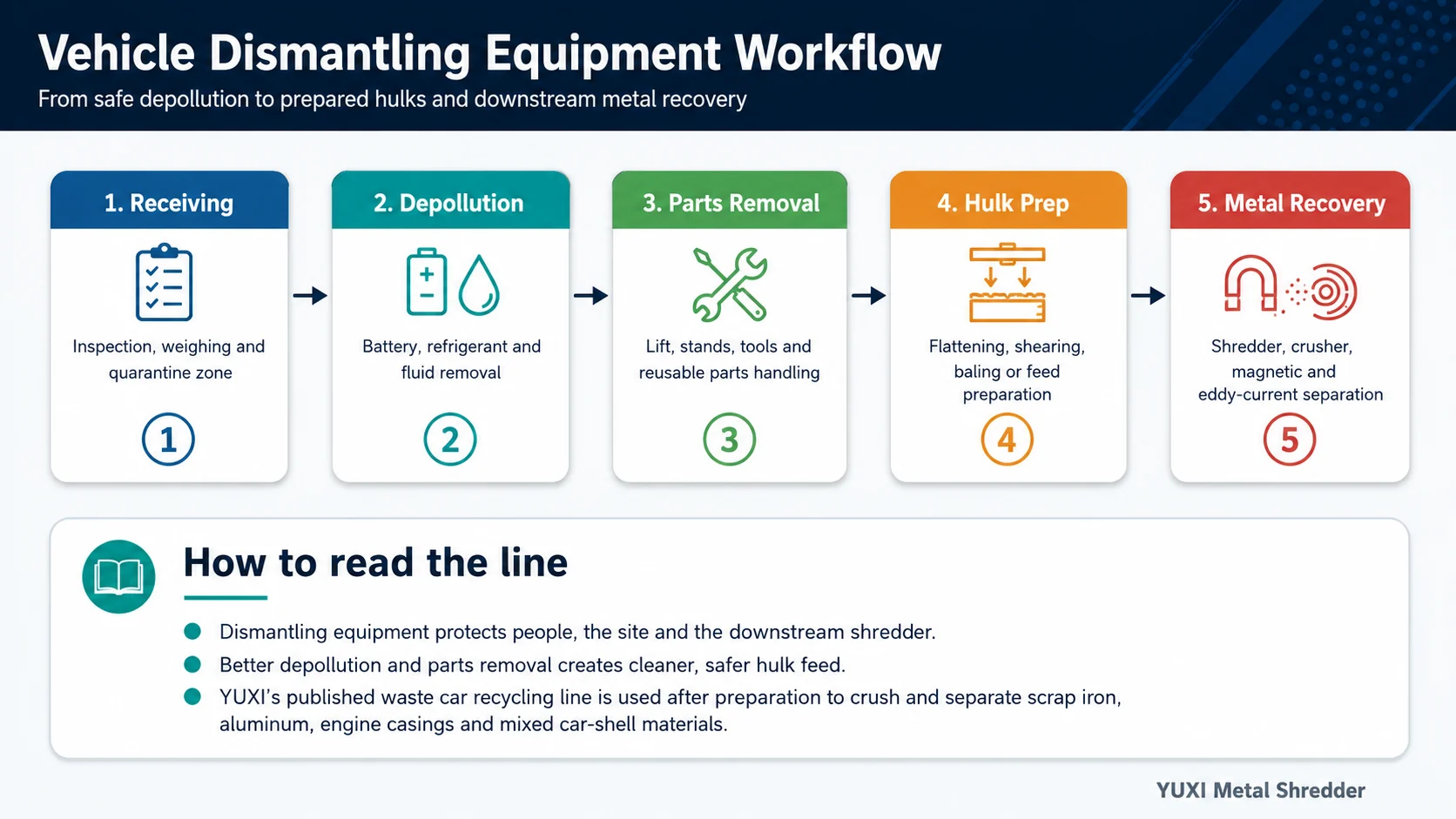
A complete vehicle dismantling operation usually starts with receiving and inspection. The vehicle is identified, weighed, checked for obvious leakage or fire risk, and placed in a controlled storage area. From there, it moves to depollution, where the plant removes energy and hazardous fluids. Only after this stage should the vehicle move into parts removal, hulk preparation or shredding.
This order matters because downstream machines are strong, but they are not magic. Shredders can reduce car shells, but they should not be used as a shortcut for unsafe preparation. Fuel, refrigerants, batteries, airbags, liquids and pebble non-metallic components may cause environmantal,fire,safety and pollution problems.Good equipment selection keeps the danger upstream and allows the main recycling line to do what it does best:shrinking size and metal recycling.
Core Vehicle Dismantling Equipment by Stage
1. Receiving, inspection and storage equipment
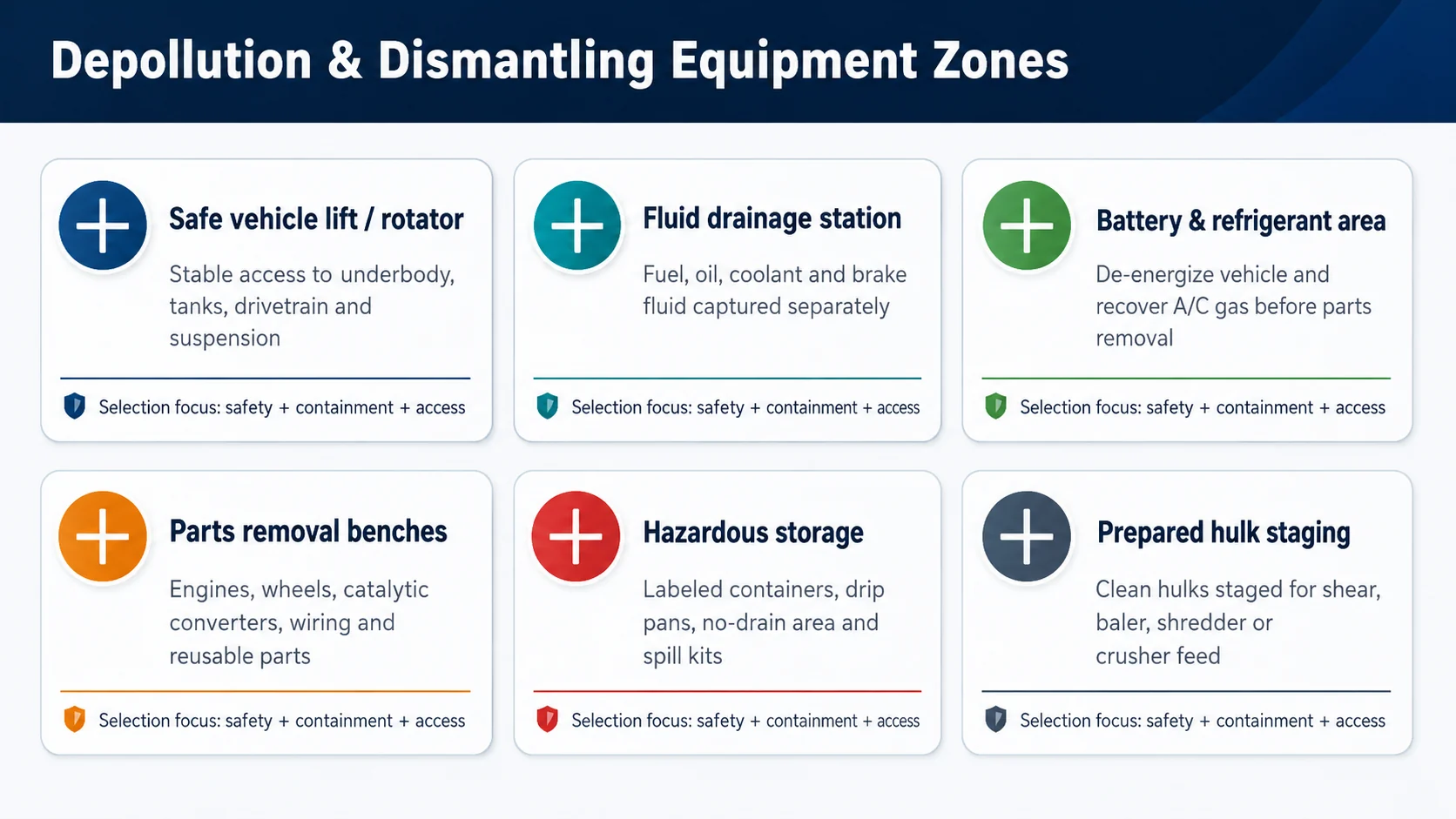
The receiving area may include a weighbridge, inspection tools, cameras, leak-control materials, quarantine space for damaged vehicles, forklifts or loaders, and a traffic route that keeps customers and operators away from machine movement. A simple yard still needs clear zones for incoming vehicles, depollution-ready vehicles, dismantled parts and prepared hulks. Poor storage layout increases handling time and can mix clean material with contaminated material.
2. Battery removal and electrical safety tools
Battery removal is one of the first practical safety tasks. For conventional vehicles, equipment may be basic: insulating tools, lifting aids, acid-resistant PPE, battery trays and covered storage. For hybrid and electric vehicles, the program has become more specialized and must follow local rules, OEM information and well-trained requirements. The purchase point is simple: buy storage and security equipment before expanding the dismantling volume.
3. Fuel, oil, coolant and fluid drainage systems
Fluid drainage equipment may include vehicle lifts or tilt stations, fuel suction equipment, oil drains, piercing tools, pumps, hoses, labeled containers, overflow kits and secondary seals. Separate collection can prevent cross-contamination and make recycled materials easier to dispose of. The low-cost open-floor drainage method may seem cheaper, but it will cause clean-up risks, regulatory risks and poor working conditions.
4. Refrigerant recovery equipment
Air-conditioning refrigerants should be recycled with appropriate equipment and trained operators. This is not only an environmental step; it can also reduce the exposure of workers and avoid accidental release during later cutting, crushing or shredding. A serious ELV facility regards refrigerant recovery as a dedicated workstation rather than a temporary task that can be completedd when time allows.
5. Vehicle lifts, rotators and work platforms
Lifts and rotators make dismantling faster, safer and more repeatable. The operator needs to enter the bottom, engine compartment, transmission system, wheels, fuel tank and wiring without unstable jacks. The right choice depends on the size of the vehicle, the daily amount of work available. A lift that works well for passenger cars may not be suitable for vans, truck cabs or mixed automotive scrap.
6. Hand tools, pneumatic tools and hydraulic cutters
Most vehicle dismantling remains semi-manual because every ELV arrives in different condition. Common tools include sockets, wrenches, impact guns, grinders, wire cutters, cable strippers, hydraulic cutters, catalytic converter cutters, engine removal tools and torque tools. Tool choice should support the parts you actually sell. If the engine, wheels, wiring harness and catalytic converter are your high-value streams, the workstation should be designed around these removals.
7. Parts sorting, storage and resale support
Disassembly of equipment does not stop at removal. Parts require racks, labels, trash cans, cleaning areas, test benches, inventory workflows and safe storage of airbags, batteries, liquids and tires. If the factory sells reusable parts, the area may generate more profit than the hulk itself. If the factory only sells scrap, the parts area can be kept simpler, but dangerous and regulated materials still need to be handled under control.
8. Hulk preparation: shear, baler, flattener or direct feed
After depollution and parts removal, the remaining shell can be prepared for sale or further processing. Some yards flatten or bale hulks to reduce transport cost. Others use shears to size the material before feeding a shredder. A plant that operates a downstream metal shredder needs a feeding plan: loader access, grab reach, hopper height, hulk dimensions and safe operator visibility all affect real throughput.
Where YUXI’s Waste Car Recycling Line Fits
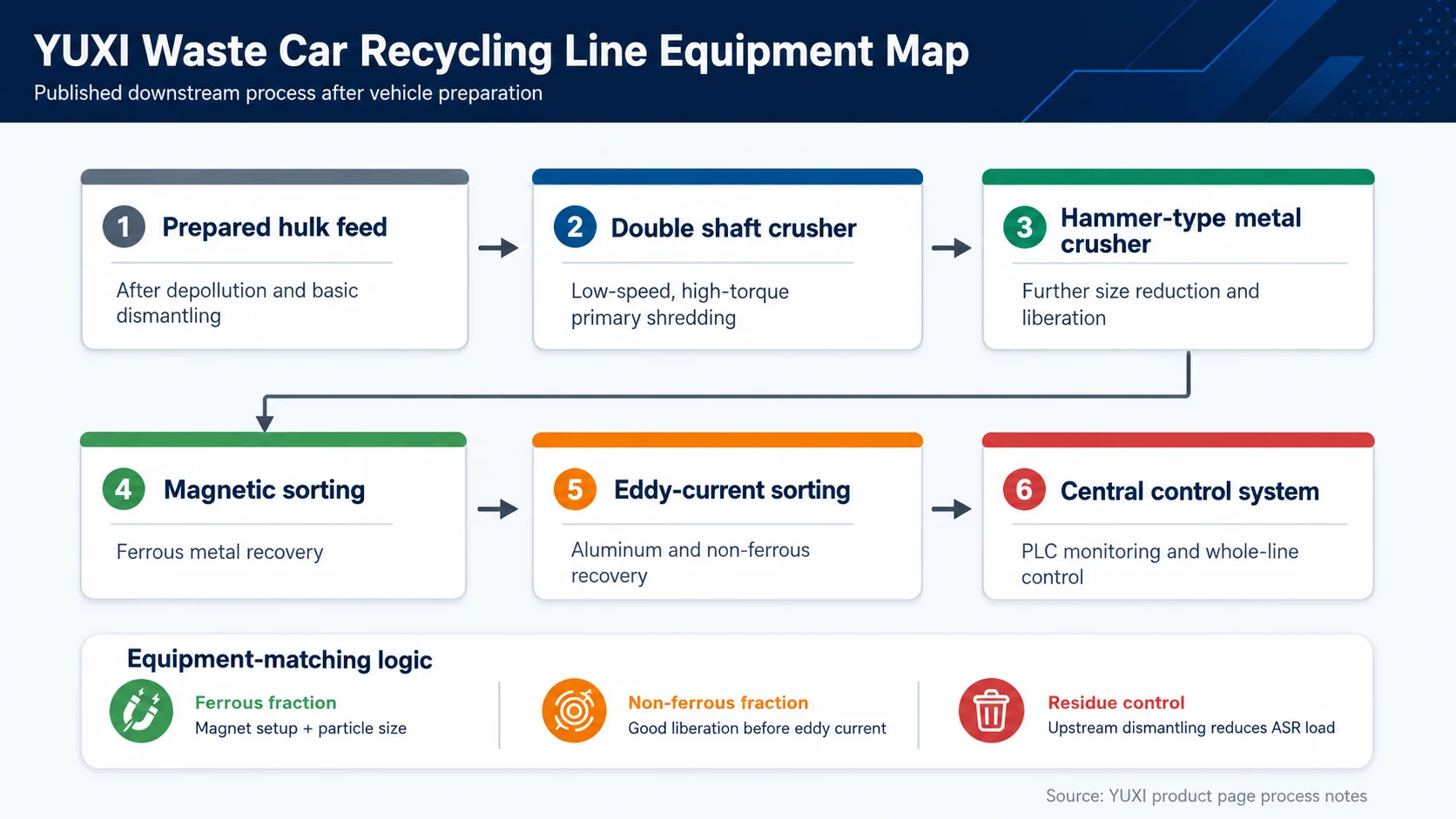
YUXI’s published waste car recycling line is designed for scrapped vehicles and waste metal parts. The product page describes the line as a way to crush and separate scrap iron, aluminum, engine casings and other mixed materials in car casings. Its stated process includes a double shaft crusher, scrap hammer-type metal crusher, magnetic separator, eddy-current separation and central controlling system.
This makes the line especially relevant after the yard has completed necessary depollution and basic dismantling. The double shaft crusher handles primary shredding of the prepared shell. A hammer mill metal crusher can provide deeper crushing when the plant needs smaller, better-liberated material. The magnetic separator recovers iron metal, while the eddy current vortex separator targets aluminum and other non-ferrous metals in the processing flow. The central control system helps to monitor the production line and coordinate operation.
For buyers, the important point is not to treat the YUXI line as a replacement for every upstream dismantling task. It is the main downstream processing section in a broader ELV plant. A good quotation should define what enters the line: complete vehicle, depolluted hulk, car shell, mixed metal parts or engine casings. The cleaner and more consistent the feed, the easier it is to size the shredder, crusher, conveyors and separators correctly.
Manual, Semi-Automatic or Integrated Dismantling?
A manual dismantling yard has lower equipment cost and flexible labor, but output depends heavily on operator skill. It is suitable when vehicle supply is uncertain, reusable parts have high value, or local labor cost is manageable. A semi-automatic system adds lifts, drainage stations, dedicated tools, conveyors and handling aids. It improves safety and speed without forcing every vehicle into a rigid process. An integrated plant connects dismantling bays to shredding, crushing and separation equipment. It has the highest capital cost but can recover more value when feedstock volume is stable.
Security and Compliance Functions to be Included
Vehicle dismantling equipment should choose a safety system from the beginning. Powered machinery needs guarding, emergency stops, maintenance access and locking/marking programs. Cutting and crushing equipment also produces noise, flying chips, sharp edges, pinch points and stored hydraulic energy. OSHA’s machine protection rules cover hazards such as point of operating points, entry bite points, rotating parts,debris and sparks. OSHA’s locking/marking standard apply to service and maintenance that may harm employees by accidental power-up,start-up or release of stored energy.
Environmental controls are just as important. Fluid drainage areas should use an impermeable floor, drip pans, spill kits and labeled containers. Batteries should be protected from short circuits and moisture. Refrigerants should be recovered with proper equipment. Fire risk should be considered in vehicle storage, fuel removal, cutting, battery handling and shredding. These items are not “extras”; they protect the permit, the workforce and the equipment investment.
How to Size Equipment for Real Throughput
Capacity should begin with vehicles per day and tonnes per hour, but it should not stop there. A plant that receives 60 vehicles per day may not dismantle 60 complete vehicles in one shift if each unit needs detailed parts removal. A yard that only depollutes and prepares hulks can move faster, but it will recover less reusable-part value. The right capacity is a balance between labor, equipment, downstream feed, product quality and local scrap prices.
Use a simple bottleneck check before buying equipment:
Then compare that number with the downstream processing line. If the shredder can process more material than the dismantling bays can prepare, the line will wait. If the dismantling bays prepare more hulks than the shredder can accept, the yard will need staging space. Balanced flow is more valuable than a single oversized machine.
Vehicle Dismantling Equipment Selection Checklist
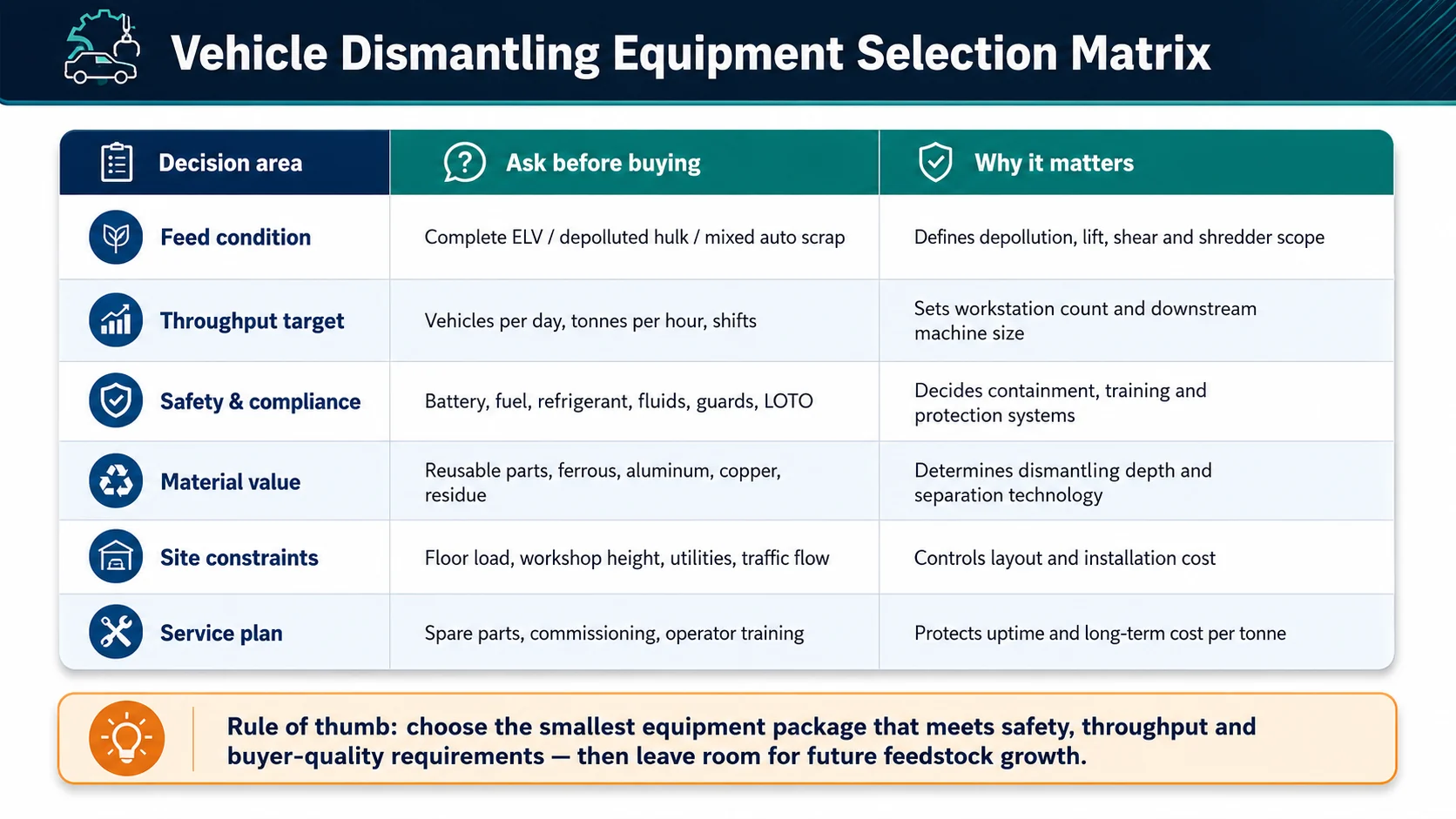
Before requesting a quotation, define the feedstock and output. The supplier needs to know whether the incoming material is a complete ELV, a drained hulk, a compressed shell, a mixed auto scrap load or a stream that contains engines and wheels. Photos and videos are often more useful than a written description. Include maximum dimensions, average weight, contamination level and the parts you intend to remove before shredding.
| Decision point | What to confirm | Equipment impact |
|---|---|---|
| Business model | Parts resale, scrap preparation, full ELV recycling or integrated metal recovery | Determines whether you prioritize dismantling bays, hulk preparation or downstream separation |
| Vehicle condition | Complete car, depolluted hulk, flattened shell, mixed automotive scrap | Changes safety steps, feed method, shredder torque and crusher duty |
| Dismantling depth | Only hazards, high-value parts, drivetrain, wiring, plastics, glass or tires | Sets tools, lift access, labor and storage space |
| Throughput | Vehicles per day, tonnes per hour, shift plan and seasonal peaks | Defines number of workstations, material handling capacity and downstream equipment size |
| Output product | Prepared hulk, baled shell, ferrous scrap, aluminum-rich fraction, residue | Controls whether shearing, shredding, hammer crushing and separation are required |
| Site conditions | Workshop height, floor load, voltage, transformer, drainage, dust and fire controls | Affects installation design and project budget |
| Maintenance plan | Wear parts, cutter access, hydraulic parts, local service and operator training | Determines long-term uptime and cost per tonne |
Quotation Information to Send YUXI
For a serious line quotation, send YUXI a practical feedstock brief rather than a one-line price question. Include photos and videos of the vehicles or scrap, target capacity, work shifts, whether the cars are already depolluted, what parts are removed, desired output size, final product buyers, local voltage, available workshop layout, and whether you need installation, commissioning, training and spare parts support.
- Incoming material: complete ELVs, depolluted hulks, car shells or mixed auto scrap.
- Removed items before feeding: batteries, refrigerants, fuel, fluids, tires, engines, glass, seats and large plastics.
- Required output: coarse hulk pieces, ferrous product, aluminum-rich fraction or further upgraded material.
- Capacity target: vehicles per day, tonnes per hour and number of shifts.
- Site data: voltage, transformer capacity, floor area, workshop height, loader route and drainage.
- Service scope: shipping terms, installation, commissioning, operator training and recommended spare parts.
When the information is clear, YUXI can match the downstream line more accurately. Buyers who are still comparing process routes can also review the ELV recycling process and car body shredder selection logic before finalizing equipment scope.
Common Buying Mistakes
Buying the shredder before defining depollution
A shredder is not a substitute for fluid removal, battery handling and refrigerant recovery. Without upstream control, the plant may face fire risk, contamination and downtime.
Choosing equipment by motor power only
Motor power is only one specification. Feed opening, shaft torque, cutter design, chamber access, overload protection, hydraulics, controls and service access matter just as much.
Ignoring material handling
Loaders, grabs, conveyors and storage buffers determine whether the main line receives stable feed. A strong shredder cannot perform well if the yard cannot feed it safely.
Underestimating residue and non-metal streams
Plastics, rubber, glass, foam, dust and mixed residue still need a plan. Better dismantling can help to reduce residue load and improve metal product quality.
Final Suggestion
Vehicle dismantling equipment should be bought as a system. Start with safe depollution, choose the right level of dismantling, plan how the hulk will be prepared, and only then size the downstream shredding and separation line. For buyers who want onsite metal recovery, YUXI’s waste car recycling line gives a clear downstream path: double shaft crushing, hammer-type metal crushing, magnetic separation, eddy-current separation and central control. Actually, the one with the longest machine list is not the best project; the best is that matches the local vehicle supply, operator workflow, safety requirements and saleable metal targets.
FAQ: Vehicle Dismantling Equipment
What equipment is required for vehicle dismantling?
Practical ELV removal settings usually include receiving and checking tools,vehicle lifts or rotators,battery handling tools,refrigrant recovery equipment,fluid drainage systems,part removal tools,storage containers,spill control,material handling machines,and downstream paper shredding or separation equipment at the business process site.
Does YUXI supply a complete vehicle dismantling line?
YUXI’s published waste car recycling line is a downstream recycling line for scrapped vehicles and waste metal parts. Its process includes a double shaft crusher, hammer-type metal crusher, magnetic separator, eddy-current separation and central control system. Upstream depollution and detailed dismantling equipment should be planned according to local rules and feed condition.
Should a plant dismantle first or shred first?
Depollution and key dismantling should happen before crushing or shredding. Batteries, refrigerants, fuel and other hazardous materials must be removed safely so the hulk can be processed with lower risk and better material recovery.
How do I choose vehicle dismantling equipment capacity?
Start from vehicles per day, average hulk weight, shift plan, dismantling depth, parts value, local labor cost, downstream buyer requirements and available site utilities. Then match the number of workstations and downstream machine capacity to the real feed flow, not only catalog ratings.
Need a configured ELV recycling line?
Send YUXI your vehicle photos, feed condition, capacity target, output requirement and site information. The engineering team can recommend a practical combination of shredding, crushing, separation and control equipment for your waste car recycling project.
References and Source Notes
- U.S. EPA: Processing End-of-Life Vehicles. Used for depollution, hazardous-material handling and safe dismantling sequence.
- OSHA 29 CFR 1910.212: General requirements for all machines. Used for machine guarding and moving-part hazard references.
- OSHA 29 CFR 1910.147: Control of hazardous energy. Used for maintenance and hazardous-energy control references.