




 Request Quote



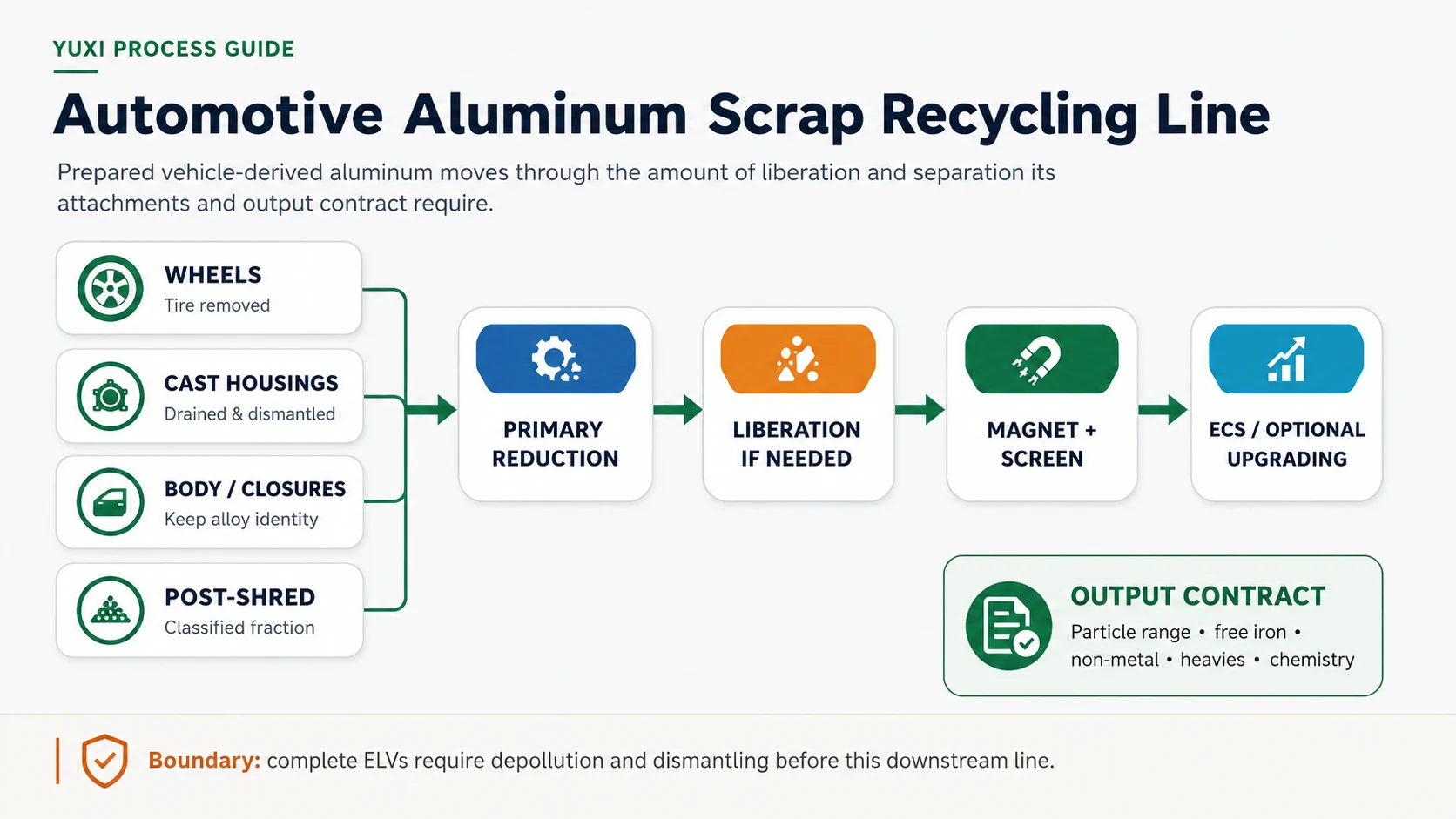
A wheel with the tire removed, a transmission housing with a steel shaft still inside, and a pile of post-shred non-ferrous material may all be described as “automotive aluminum.” That label hides three different jobs. One stream may only need inspection and size control. Another needs iron liberated from cast aluminum. The third may already be a mixed metal fraction that requires classification and additional sorting before it can be sold under a meaningful specification.
This Is Not a Complete-Vehicle Depollution Line
The first boundary is operational and legal, not semantic. The U.S. EPA’s end-of-life vehicle guide describes vehicles as containing fluids and other materials that can harm workers and the environment, and it places safe removal, storage and handling before scrapping and materials recovery.[1] That principle applies here: fuels, oils, coolants, refrigerants, batteries, pyrotechnic devices and other hazardous components are not ordinary shredder feed.
YUXI already has a separate Waste Car Recycling Line for prepared vehicle shells and mixed car-body material.
The distinction also protects material value. Removing a known aluminum closure, wheel, heat exchanger or housing before the hulk is shredded can preserve composition and reduce cross-contamination. European Aluminium argues that dismantling selected components before shredding can keep known alloy families separate and prevent one component from contaminating another recovered fraction.[2]
Which Automotive Aluminum Streams Can Be Processed
Automotive aluminum is not one grade. It appears as castings, wrought sheet, extrusions, heat exchangers, wheels and post-shred mixtures. The incoming form decides whether the line is mainly handling, liberation or sorting.
| Feed stream | Typical condition | Main risk | Likely treatment objective |
|---|---|---|---|
| Aluminum wheels | Known component, usually cast alloy; tire, valve, balance weights or steel inserts may remain | Rubber, lead/zinc/steel attachments and mixed wheel grades | Remove tire and attachments, reduce size only when the buyer or furnace requires it |
| Engine and transmission housings | Heavy cast aluminum with bearings, shafts, bolts, seals and trapped fluids | Dense ferrous cores, oil and unpredictable impact load | Dismantle and drain first, then liberate exposed iron from the aluminum casting |
| Body sheet, closures and structural parts | Wrought sheet, extrusion or plate; may be painted, bonded or riveted | Loss of wrought-alloy value when mixed with high-silicon cast scrap | Preserve source segregation where possible; otherwise reduce and remove attachments |
| Heat exchangers and radiators | Thin aluminum structures, sometimes with copper, steel, plastic and residual fluid | Special alloy mix, fines and non-aluminum attachments | Prefer dedicated preparation and separation rather than mixing with general cast scrap |
| Irony automotive aluminum | Mixed parts with attached bearings, brackets, bolts or steel reinforcement | Iron remains locked in coarse pieces | Shred or crush enough to expose ferrous material, then use magnetic removal |
| Post-shred non-ferrous fraction | Mixed aluminum, copper, brass, zinc, stainless and non-metal residue after car shredding | Particle-size spread, wire, heavies and alloy mixing | Classify and upgrade the stream with staged physical and, where required, sensor sorting |
For wheels, the dedicated aluminum wheel recycling process should remain the detailed reference. For mixed profiles or non-automotive aluminum, the broader scrap aluminum recycling line remains the parent solution.
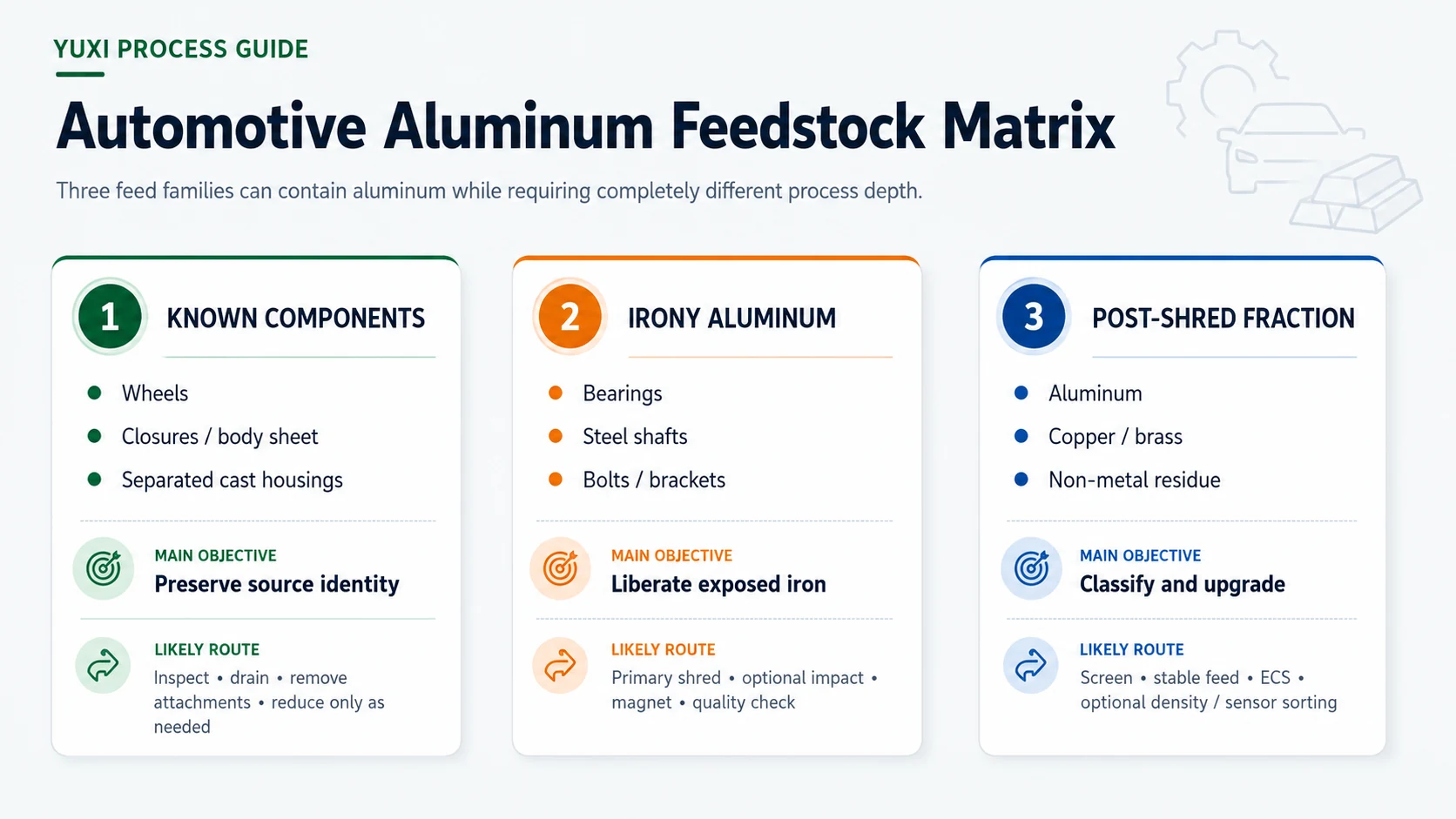
Three Practical Automotive Aluminum Line Routes
For separated wheels, housings, closures or production scrap. Inspection, drainage, attachment removal and controlled size reduction may be enough. The objective is to preserve a known composition, not to force clean material through every separator.
For parts where steel bearings, shafts, bolts or brackets remain attached. The line needs enough shredding or impact liberation to expose iron, followed by magnetic removal and a product inspection loop.
For a classified non-ferrous/non-metal stream from an ELV shredder. Screening, stable feeding, eddy-current separation and optional downstream upgrading are more important than another coarse primary shredder.
One project can include more than one route, but the streams should not be blended simply because all of them contain aluminum. A load of wrought body sheet and a load of cast transmission housings may have similar bulk density after shredding while still carrying very different chemistry. Mechanical equipment can improve physical cleanliness; it cannot restore alloy identity after uncontrolled mixing.
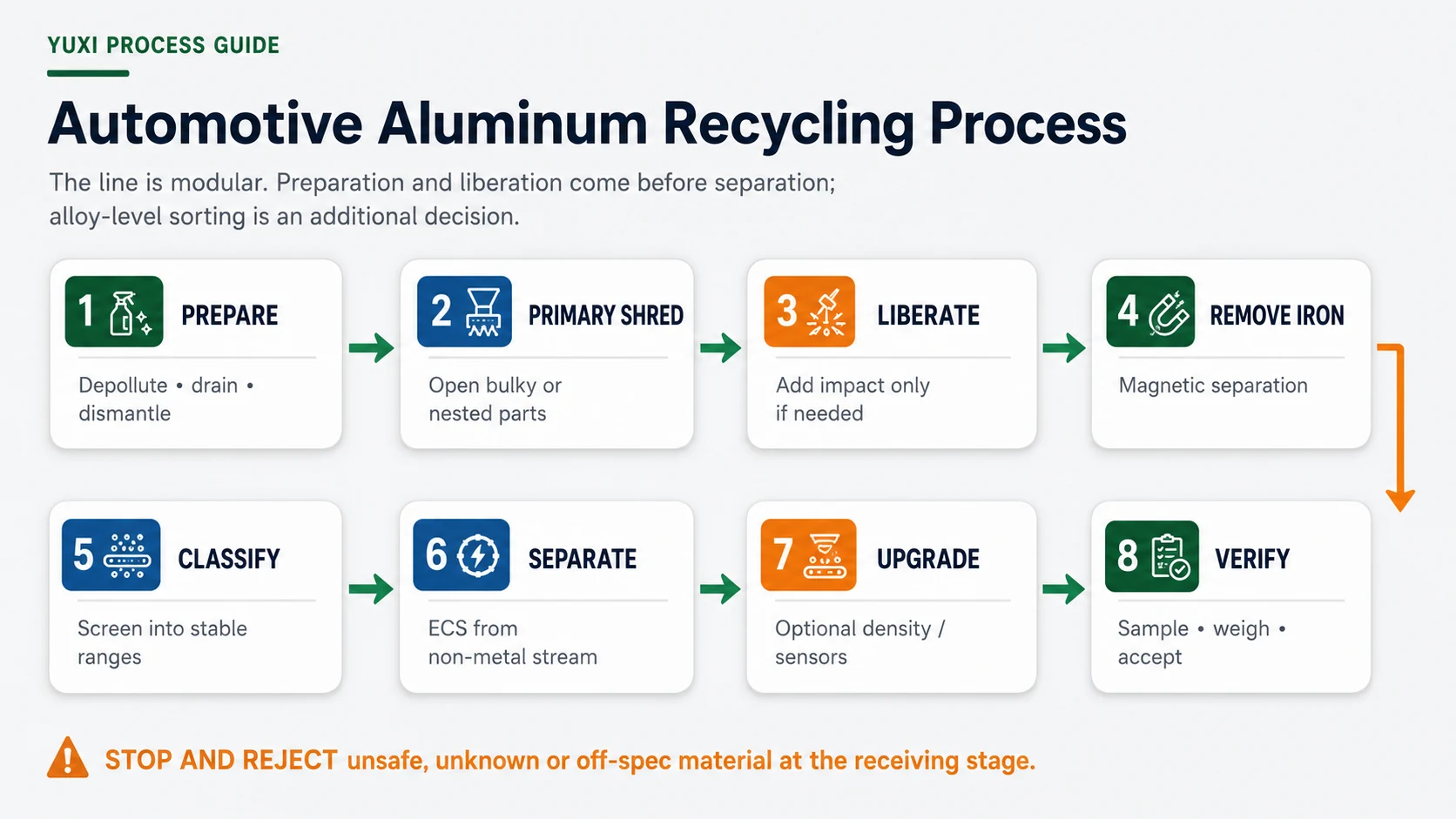
How an Automotive Aluminum Scrap Recycling Line Works
The Aluminum Association’s U.S. grave-to-gate study describes three collection stages for automotive aluminum: dismantling, shredding and downstream separation.[3] A YUXI project begins by deciding which of those stages has already happened and which output the new line must produce.
Define and quarantine the feed
Record each regular component type and its percentage by mass. Check the maximum dimension, unit weight, wall or casting thickness, attached steel, non-metal content, moisture and fluids. Keep unknown, oversize or hazardous items in a separate inspection area. A single dense shaft left in a housing can set the mechanical duty far above the average sample.
Depollute, drain and dismantle upstream
Remove batteries, fuels, oils, coolants, refrigerants, airbags and other pyrotechnic devices through the appropriate vehicle-treatment procedure. Drain housings and remove reusable parts. Tires must be removed from wheels. Where source segregation has value, keep known wrought and cast components in separate containers before they ever reach a shredder.
Control feeding and primary reduction
Bulky, nested or irregular parts may need low-speed primary shredding to make a conveyor-friendly stream. YUXI’s double-shaft metal shredder is a primary reducer: it grips and shears prepared scrap, opening hollow or folded pieces for downstream work. Model choice depends on dimensions, thickness, density, required throughput and the next machine—not on the word “aluminum” alone.
Add secondary liberation only when attachments remain locked
A coarse shred may shorten a housing without releasing a bearing race, seal or steel bracket. A hammer mill metal crusher or another secondary liberation stage adds impact and deformation when the output contract justifies it. However, unnecessary over-crushing can create fines, dust, oxidation surface and a wider particle-size distribution.
Remove exposed ferrous material
Magnetic separation pulls out steel and iron once those items have been physically exposed. It is not an aluminum sorter. The order matters: asking an eddy current separator to solve a steel-bearing problem usually means the feed has not been prepared correctly. The practical distinction is explained further in YUXI’s magnetic separator versus eddy current separator guide.
Screen and stabilize the particle stream
Separators work on particles, not on a nominal material name. Screening can remove fines, split broad size ranges and create a steadier feed layer. Very thin sheet, wire-like pieces, dense cast fragments and fluffy residue behave differently. When they are mixed in one thick belt layer, recovery and product quality become less predictable.
Use eddy current separation for a suitable non-ferrous/non-metal split
An eddy current separator can repel conductive non-ferrous particles from a prepared non-metal stream. It cannot identify the chemical composition of aluminum,nor will it automatically separate aluminum from copper or magnesium in each case.Belt speed,rotor design,particle size and shape,moisture and feed depth will all affect the trajectory.
Upgrade by density or sensor technology when the contract requires it
Post-shred automotive fractions may need further separation of heavy non-ferrous metals, cast and wrought aluminum, or alloy families. That can require density-based equipment, X-ray transmission, laser-induced breakdown spectroscopy or other sensor systems beyond a standard mechanical line. Where alloy-level upgrading is required, YUXI can evaluate these technologies as additional integration stages. A magnet and eddy current separator alone do not create an alloy-specific product.
Sample, weigh and verify every output
Measure the aluminum-rich product, ferrous fraction, heavies, non-metal residue, fines and recirculation stream. Record the sampling method and test duration. Visual cleanliness is useful for troubleshooting, but the commercial acceptance method should reflect what the buyer measures—metallic content, chemistry, free iron, moisture, particle range or a named scrap specification.
What Each Machine Actually Contributes
| Equipment | Main duty | When it earns its place | What it cannot guarantee |
|---|---|---|---|
| Inspection and feeding conveyor | Creates a controlled layer and a place to reject unsafe or off-spec items | Whenever loader or grab feeding would otherwise arrive in large, uneven batches | It does not correct poor upstream depollution or unknown feed composition |
| Double-shaft shredder | Coarse, low-speed size reduction of bulky prepared parts | Parts are too large, hollow, nested or irregular for downstream conveyors and separators | Uniform granules, complete liberation or fixed line capacity |
| Hammer mill / secondary crusher | Impact liberation and further size reduction | Steel and non-metal attachments remain locked after primary shredding | Better economics when the feed is already clean; more impact can also create fines |
| Magnetic separator | Removes exposed ferrous steel and iron | Bolts, bearings, brackets, reinforcement or shredder wear parts are present | Aluminum recovery from non-metal residue or aluminum alloy identification |
| Screen | Controls particle-size ranges and fines | The feed size spread is too wide for stable downstream trajectories | Material identification by chemistry |
| Eddy current separator | Separates suitable conductive non-ferrous particles from non-metal material | A classified stream contains recoverable aluminum and other non-ferrous metals mixed with residue | Cast-versus-wrought or alloy-family sorting by itself |
| Optional sensor/density stage | Upgrades non-ferrous or aluminum products by density or composition | The buyer pays for a tighter heavy-metal, cast/wrought or alloy-family boundary | A valid design without representative tests and a product contract |
YUXI’s public aluminum solution follows this same equipment logic: primary shredding, optional secondary crushing, magnetic removal, screening and optional ECS are selected around the feed and final product. The line is not a fixed catalog chain in which every project automatically buys every machine.
High Recovery Is Not the Same as High-Quality Recycling
This is the point many commercial pages miss. In the Aluminum Association study, the weighted material collection rate after dismantling and downstream separation was reported as 99.7%, while the overall study-specific automotive aluminum recycling rate was 91% after recovery-process losses were included.[3] European Aluminium has separately described European recovery as already around 95% and says the larger opportunity is improving the quality of the recovered aluminum fraction by separating alloy families.[2]
Once wrought body sheet, high-silicon castings, copper-bearing parts and magnesium-rich parts are shredded together, a mechanically clean aluminum fraction can still be chemically unsuitable for a high-value closed-loop destination. That is why source dismantling, alloy-family control and a written output contract matter.
Industry specifications also continue to become more granular. ReMA’s specifications are living commercial guidelines, and recent additions include Vesper for wrought aluminum segregated from Zorba or Twitch and Ginger for mixed shredded cast aluminum mechanically segregated from those streams.[4][5][6] A recycler does not need to promise one of these grades, but the trend is clear: “clean aluminum” is becoming too vague for serious transactions.
| Quality level | What the line may produce | Typical control needed |
|---|---|---|
| Physically cleaner aluminum-rich fraction | Lower visible steel and non-metal content | Liberation, magnet, screening, ECS and routine sampling |
| Heavy non-ferrous controlled fraction | Reduced copper/brass/zinc/stainless carryover | Additional density or sensor sorting and product testing |
| Cast versus wrought split | Separate product families with different remelting destinations | Source segregation and/or suitable sensor technology |
| Alloy-family product | Material suitable for a tighter closed-loop specification | Known-component dismantling, traceability, advanced sensing and chemistry verification |
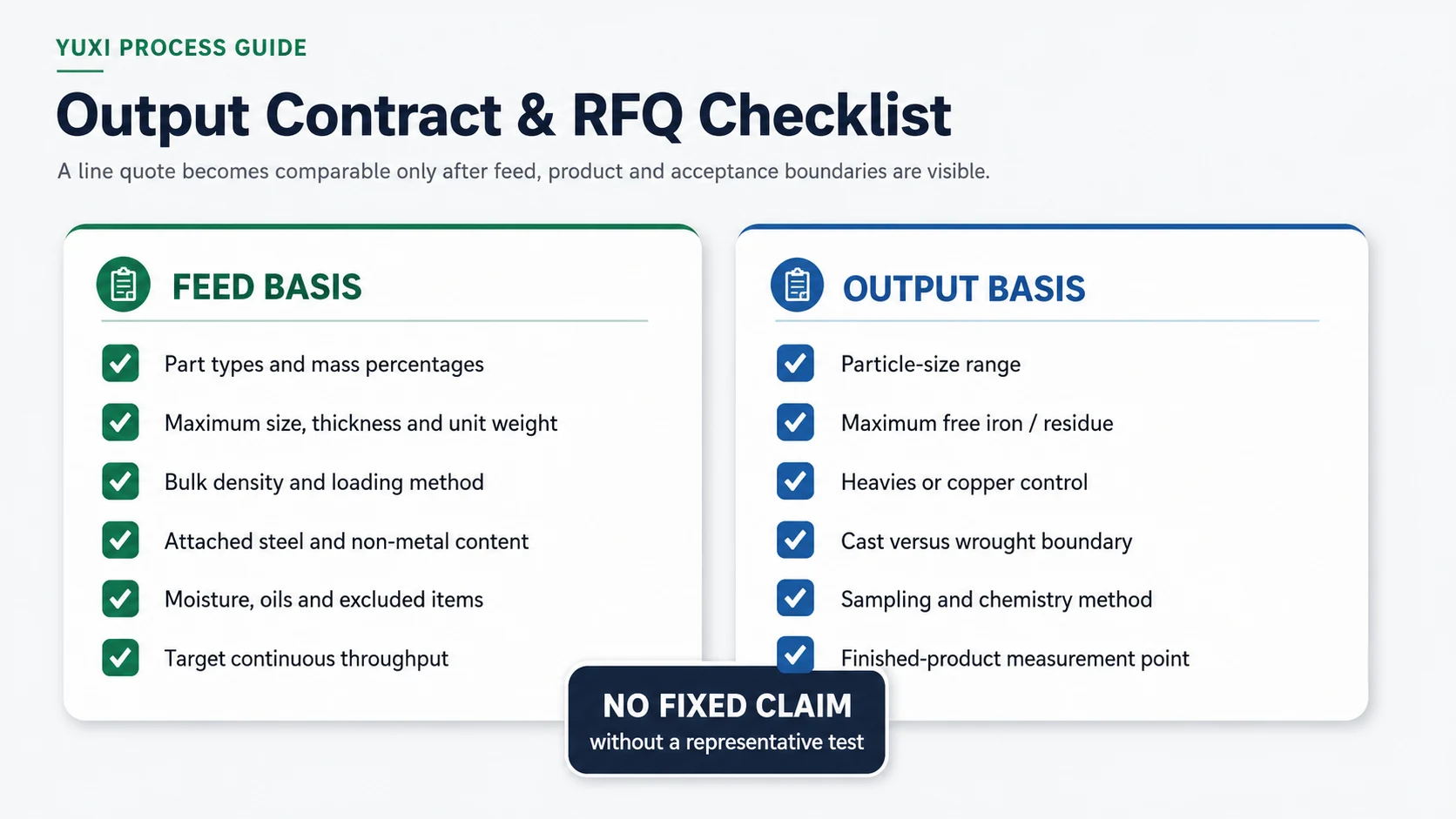
Define Capacity at the Finished-Product Boundary
A supplier can quote the shredder’s peak input, the screen feed, or the saleable aluminum leaving the line. Those numbers are not interchangeable. For automotive scrap, capacity is especially sensitive to the percentage of dense castings, steel shafts, thin sheet, nested structures and recirculation.
Use the method in the aluminum recycling line capacity guide: define the feed, measurement point, net productive time, required output, rejects and recirculation before comparing tons per hour.
Feed basis
- Part categories and mass percentages
- Maximum dimensions, thickness and unit weight
- Loose bulk density and loading method
- Attached ferrous and non-metal content
- Moisture, oils and other residual contamination
Output basis
- Required particle-size range
- Maximum free iron or non-metal content
- Whether copper/brass heavies must be reduced
- Whether cast and wrought must remain separate
- Sampling, chemistry and acceptance procedure
Also state whether the project rate means continuous feed through the full line, finished aluminum product per hour, or scheduled daily input. A wide shredder capacity range can be honest when the feed varies; it becomes misleading only when the reference material and measurement boundary are hidden.
Safety, Dust and Material Exclusions
Automotive scrap can bring sharp edges, stored energy, trapped fluids, heavy moving parts and unknown attachments into one work area. OSHA’s metal scrap recycling guidance highlights machine guarding and lockout/tagout before cleaning or maintenance, including rotary shredders.[7] Site-specific guarding, interlocks, access platforms, lifting methods, fire controls and electrical isolation should be resolved during layout—not after commissioning.
Secondary crushing can generate dust and fines from coatings, rubber, plastics and dirt. The project should define dust capture, housekeeping, hot-particle or spark monitoring where applicable, and a safe method for clearing jams. EPA AP-42 describes secondary aluminum pretreatment as varying with scrap quality and involving sorting, size reduction, screening and magnetic removal before melting; it also makes clear that pretreatment and furnace operations are separate process stages.[8]
What to Send YUXI for an Automotive Aluminum Line Proposal
A useful quotation starts with the material, not with a requested motor size. Send information from several representative loads, including the difficult material that appears regularly.
| Required project data | Why it changes the line |
|---|---|
| Photos and video of each regular feed stream | Shows geometry, nesting, attachments and loading behavior that a material name cannot describe |
| Estimated mass percentage of wheels, castings, sheet, extrusions, irony parts and post-shred material | Determines whether streams should be kept separate and which stage becomes the bottleneck |
| Maximum dimensions, thickness and single-piece weight | Sets hopper, shaft, cutter, drive, crane and foundation requirements |
| Attached steel, copper, rubber, plastic and residual fluid | Defines liberation depth, magnetic duty, exclusions and downstream sorting |
| Target continuous throughput and working hours | Sizes the complete line, not only the primary machine |
| Required finished product and acceptance method | Determines screens, separators, sensors, sampling and recirculation |
| Power supply, workshop dimensions, feeding method and discharge elevations | Controls drives, layout, conveyors, platforms and maintenance access |
Build the Line Around the Aluminum Product You Plan to Sell
Send representative material details, required tons per hour, the buyer’s output specification and the available plant layout. YUXI can then separate the project into component preparation, primary reduction, optional liberation, ferrous removal, screening and non-ferrous upgrading stages—without forcing every automotive aluminum stream through one fixed configuration.
Automotive Aluminum Recycling Line FAQ
What can an automotive aluminum scrap recycling line process
A configured line can process prepared aluminum wheels, cast housings, transmission and engine casings after drainage and dismantling, body sheet or closure scrap, mixed irony aluminum parts, and suitable post-shred non-ferrous fractions. The route changes with attached steel, rubber, plastics, fluids, piece size and the required output.
Can complete end-of-life vehicles enter this line
No. Complete vehicles require legal depollution and dismantling before downstream size reduction. Batteries, fuels, oils, refrigerants, pyrotechnic devices, tires and other hazardous or reusable components must be handled through the appropriate upstream process.
Do all automotive aluminum parts need shredding
No. Clean, size-controlled components may be sold or charged after inspection and attachment removal. Shredding is justified when parts are bulky, nested, too large for the downstream process, or when attached materials need to be liberated.
Does an eddy current separator separate aluminum alloy grades
Not by itself. It separates suitable conductive non-ferrous particles from non-metal material. Cast-versus-wrought or alloy-family separation normally requires source segregation or additional sensor and density technology, supported by a written quality specification.
Why remove iron before the eddy current stage
Steel bolts, bearings, shafts and brackets are a ferrous-contamination problem. Magnetic separation removes that material before the non-ferrous stream is classified and presented to an eddy current separator.
Can aluminum wheels be processed with cast housings
They can be reduced in the same project only when the buyer accepts the resulting alloy and contamination mix. Wheels should have tires removed and their weights, valves and steel inserts reviewed. Separate treatment often preserves more predictable composition.
What determines line capacity
Real capacity depends on bulk density, maximum unit size and thickness, feed consistency, steel attachments, target particle size, recirculation, number of sorting stages, loading method and the agreed output. A catalog shredder rate is not automatically the complete-line rate.
What data should be sent to YUXI
Send representative photos and video, the percentage of each part type, maximum dimensions and unit weight, attached steel and non-metal content, fluids or moisture, desired tons per hour, required product and size range, working hours, power supply, feeding method and workshop dimensions.
Sources and Technical References
- U.S. EPA / SEMARNAT — Processing End-of-Life Vehicles
- European Aluminium — Top Priorities for the Revision of the ELV Directive (2024)
- The Aluminum Association — Automotive Aluminum Recycling at End of Life
- Recycled Materials Association — Specifications Circular
- ReMA — Vesper specification notice
- ReMA — Ginger specification notice
- OSHA — Guidance for Metal Scrap Recycling Hazards
- U.S. EPA AP-42 Chapter 12.8 — Secondary Aluminum Operations