




 Request Quote



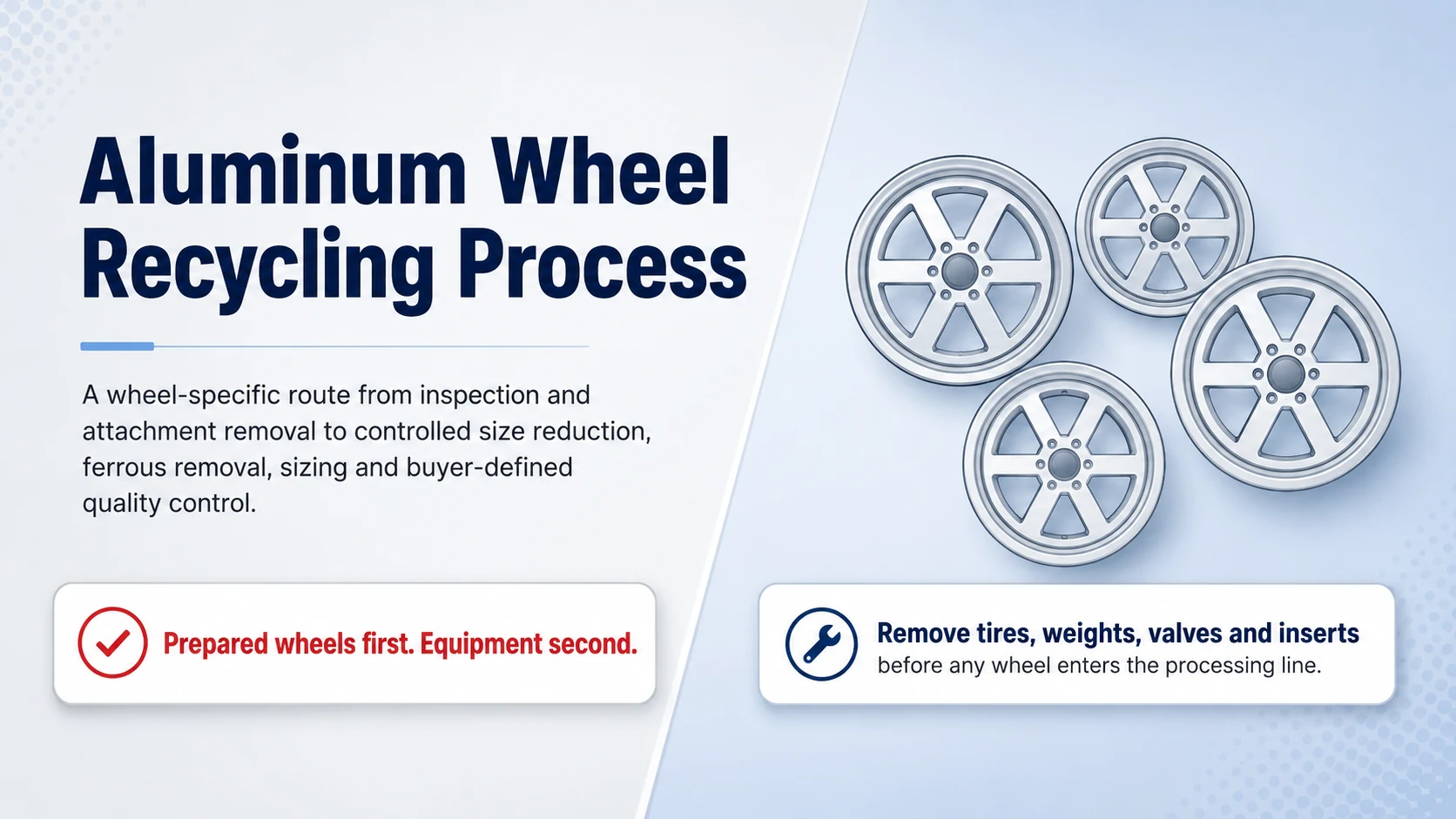
A pile of alloy wheels looks like easy aluminum. Sometimes it is. A clean, tire-free lot can be sold or remelted without being shredded at all. The trouble starts when wheel weights, valve assemblies, inserts, plating, dirt, mixed wheel metals or unknown constructions are treated as someone else’s problem. They become the recycler’s problem instead—usually after the material has entered a machine.
Why Aluminum Wheel Scrap Is Not Just “Mixed Aluminum”
Wheel scrap is physically dense, usually recognizable and often collected as a distinct automotive component. That creates an opportunity: the recycler may be able to preserve a cleaner cast-aluminum stream instead of blending the wheels into general mixed scrap. The Aluminum Association’s automotive end-of-life study treats alloy wheels as heavy-gauge scrap and distinguishes them from smaller shredded automotive fractions. The distinction matters because whole or large wheel pieces have a lower surface-area-to-volume ratio than light shredded material.3
It also creates a trap. “Alloy wheel” is a trade name, not an incoming specification. A receiving pile can contain aluminum wheels, steel wheels, magnesium wheels, plated wheels, multi-piece assemblies, inserts, tire-pressure hardware and weights made from other metals. A magnet is useful, but it cannot identify every non-aluminum item or tell one aluminum alloy from another.
The public YUXI scrap aluminum recycling line page therefore places wheels and automotive castings in a pre-treatment, crushing and separation route rather than treating them like cans, profiles or chips. It specifically asks the buyer to define tires, valves, steel inserts, part thickness and any alloy-sorting requirement. That boundary is sensible. The equipment list should come after those questions, not before them.
The First Decision: Keep the Wheels Whole or Reduce Their Size?
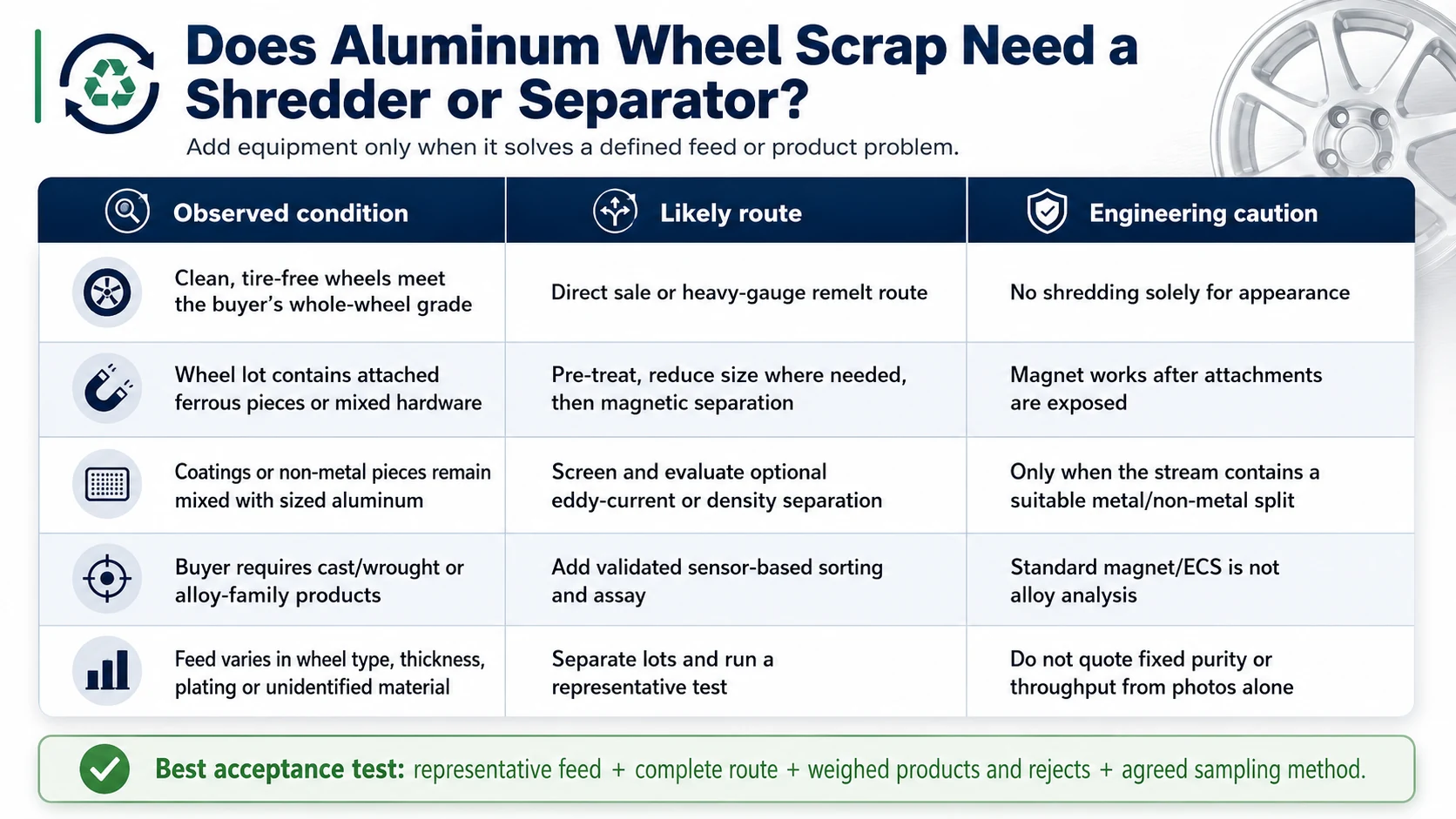
Many online explanations jump from collection straight to shredding. That is not always the best route. The decision depends on the feed condition and the product the buyer will accept.
Route A: Clean whole-wheel or heavy-gauge scrap
Use this route when the wheels are correctly identified, tire-free, clean enough for the agreed grade and accepted by the downstream buyer in whole or large-piece form. The main work is receiving inspection, attachment removal, segregation, storage and documentation.
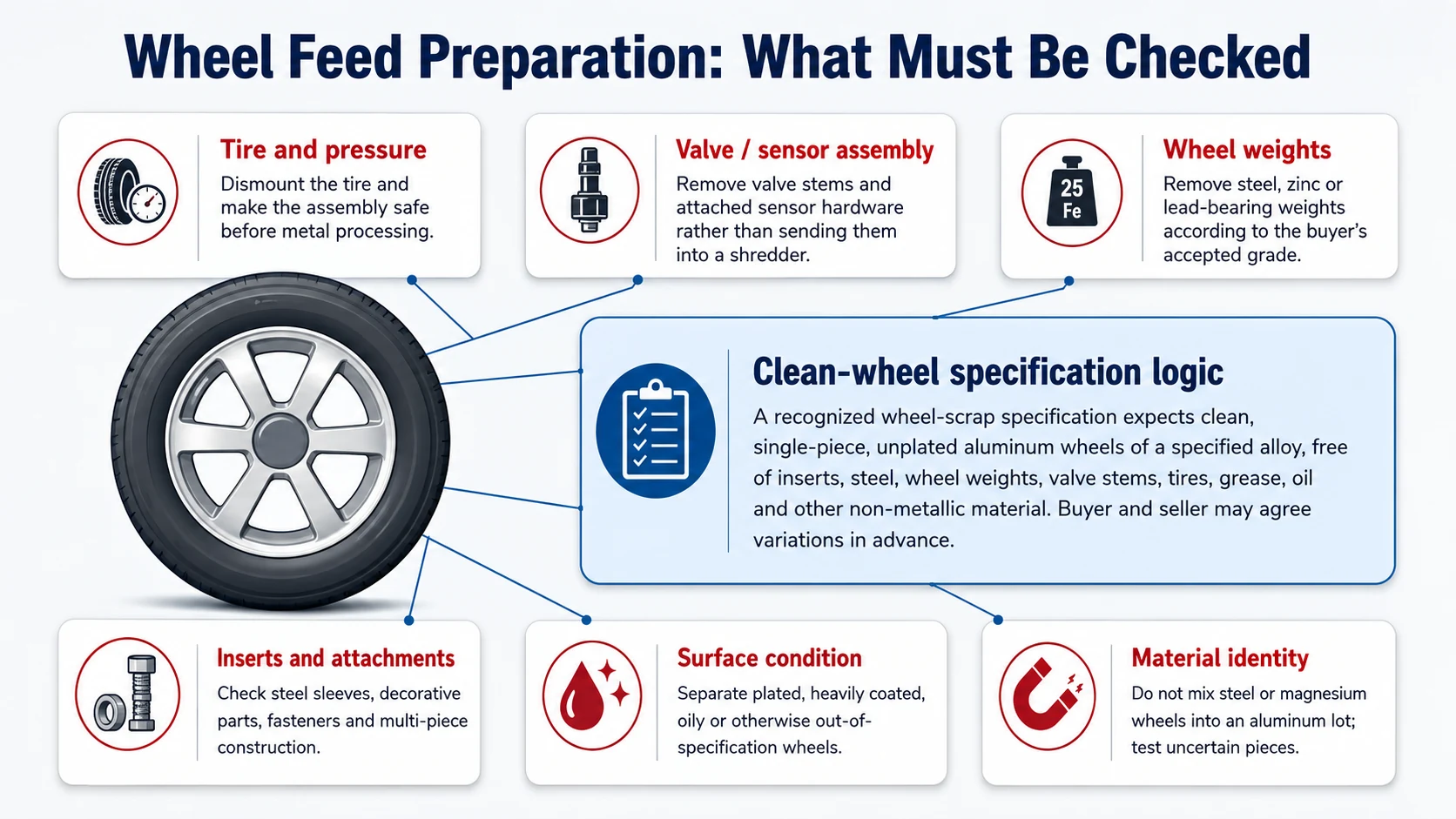
The ISRI Scrap Specifications Circular defines “Troma” aluminum auto or truck wheels as clean, single-piece, unplated wheels of a specified alloy, free of inserts, steel, wheel weights, valve stems, tires, grease, oil and other non-metallic items; variations are subject to buyer-seller agreement.1 That is not the only possible commercial contract, but it shows how demanding “clean wheel scrap” can be.
Route B: Size reduction and physical separation
Use this route when the wheel pieces are too large for the next process, embedded attachments must be liberated, mixed material remains after practical manual preparation, or a sized product is required. The route may use controlled feeding, a shredder or crusher, magnetic separation, screening and additional sorting.
Size reduction should solve a measured problem. Breaking clean wheels into very small pieces merely to make the line look complete can create more fines, wear and exposed surface without improving the sale grade.
We normally settle this question with the downstream buyer before selecting equipment. Ask what dimensions the furnace, charging system or scrap contract accepts. Then inspect a representative wheel lot. A clean whole-wheel route and a dirty mixed-wheel route are not two capacity settings on the same machine; they are different projects.
Aluminum Wheel Recycling Process, Step by Step
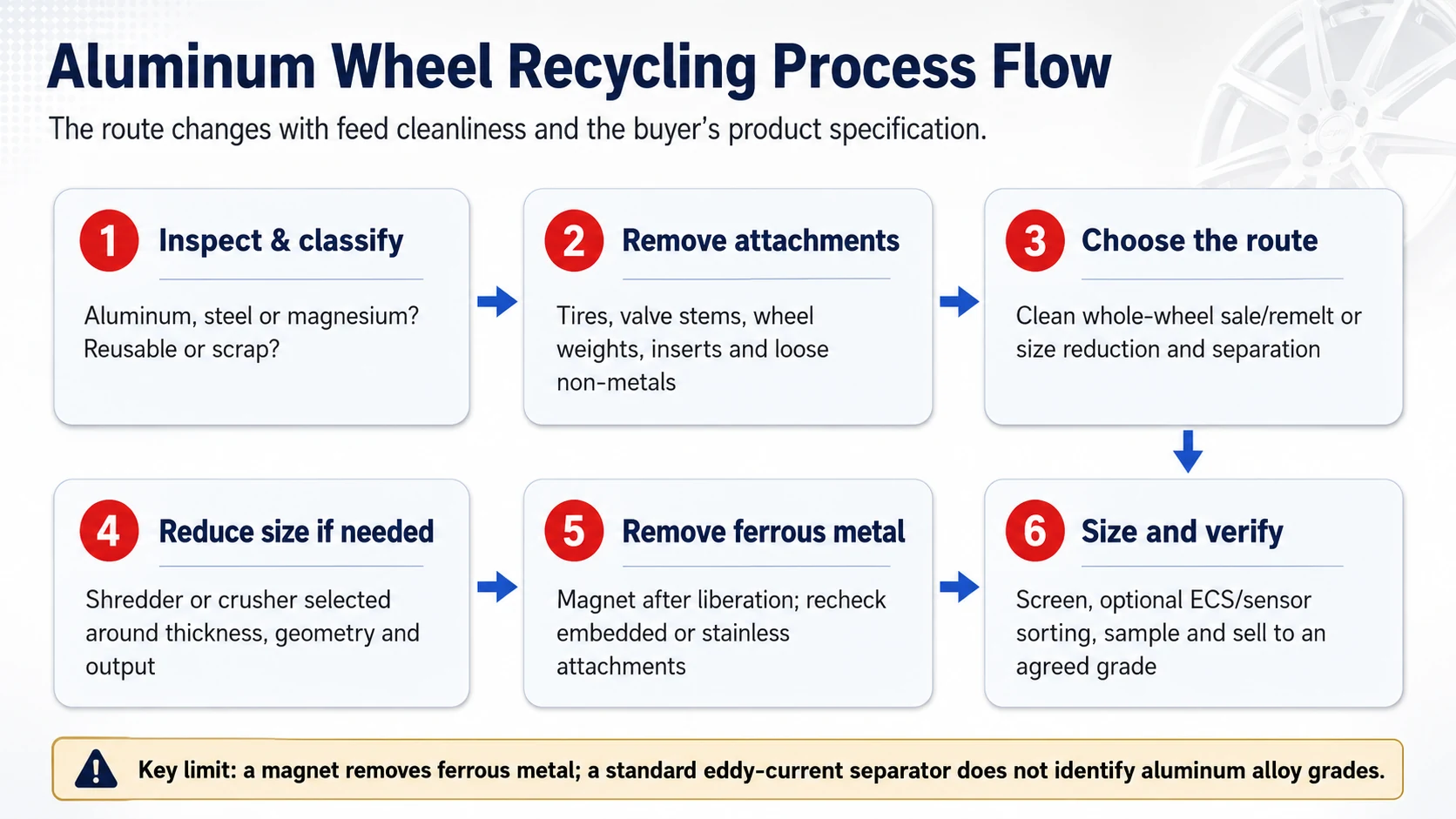
1. Decide whether the wheel should be reused, repaired or scrapped
Metal recovery should begin after the wheel has been removed from service and judged unsuitable for safe reuse. This article does not provide a roadworthiness test. The receiving procedure should prevent potentially reusable inventory, suspect damaged wheels and final scrap from becoming one uncontrolled pile.
2. Identify the wheel material and construction
Separate obvious steel wheels with a magnet, but do not stop there. Uncertain lightweight wheels, multi-piece designs, decorative covers, heavy plating and mixed attachments need a defined inspection method. A handheld alloy analyzer or specialist test may be justified where visual identification is not reliable. Magnesium wheels must not be silently blended into an aluminum lot.
3. Remove the tire, valve assembly, weights and detachable hardware
YUXI’s published wheel guidance requires tire removal and review of valves, weights and steel inserts. The same logic appears in the wheel-scrap specification cited above. Remove these items before the wheel reaches a size-reduction machine. This improves feed consistency and reduces the burden on magnetic and manual recovery later.
During an incoming audit, counting attachments is often more useful than describing the lot as “mostly clean.” For example, record the percentage of wheels still carrying clip-on or adhesive weights, metal valve parts, sensor assemblies, center caps, steel sleeves or loose rubber. That count becomes the basis for labor planning and the expected ferrous/non-metal reject.
4. Segregate the wheel lot where alloy value matters
The Aluminum Association notes that scrap segregated by chemical composition maintains higher value than mixed-alloy material.4 A wheel stream may be cleaner than general auto shred, but “wheel” still does not prove one alloy. Keep known production scrap, single-source OEM lots, aftermarket wheels, plated wheels and unknown mixed wheels separate when the buyer grades them differently.
5. Feed the wheels in a controlled condition
Wheel diameter, width, spoke geometry, single-piece weight and stacking behavior influence feeding. Nested wheels can bridge or enter in batches. A loader that drops several heavy pieces at once may create overloads even when the average tons per hour looks modest. The feed arrangement must match the machine opening and its approved wheel duty.
6. Use primary size reduction only when required
For suitable prepared wheels, a low-speed metal shredder may be used to open and reduce bulky material before downstream sorting. YUXI describes its twin-shaft units as primary machines for light- and medium-gauge scrap, with the exact model and cutter configuration selected from feed dimensions, thickness, bulk density, throughput and the downstream process. Wheels are dense cast parts, so suitability must be confirmed rather than inferred from the word “aluminum.”
Some projects use a crusher or a second reduction stage instead. The correct choice depends on whether the objective is coarse furnace pieces, stronger liberation of inserts, or a sized feed for a separator. A hammer mill metal crusher is a higher-impact secondary tool, not a compulsory first machine for every wheel lot.
7. Remove exposed iron and steel magnetically
EPA AP-42 describes mechanical cleaning of aluminum scrap as physical size reduction followed by recovery steps that can include magnetic iron removal, screens and air classification.2 In a wheel line, the magnet can recover exposed steel weights, sleeves, clips and other ferrous attachments. It cannot pull steel out of an unbroken composite if the steel remains locked inside an aluminum piece.
Magnet placement therefore follows liberation. It also requires verification: stainless parts and non-ferrous weights may remain in the aluminum stream, while small aluminum pieces can be mechanically carried into the ferrous discharge if the burden is too deep or the separator is poorly adjusted.
8. Screen and add downstream sorting only where the split is real
Screening stabilizes particle size and separates fines or oversize recirculation. That control is especially important before trajectory-based sorting. The detailed relationship between particle range, burden depth and separation performance is covered in YUXI’s guide to aluminum particle size for eddy current separation.
An eddy current separator is useful when sized conductive non-ferrous pieces are mixed with a suitable non-metal fraction. It is not automatically useful for an already clean stream of aluminum wheel pieces, and it does not separate aluminum from copper, zinc or magnesium by alloy identity. The operating distinction between magnets and ECS equipment is explained in the magnetic vs eddy current separator comparison.
9. Inspect, sample and sell the product to an agreed specification
The final product may be clean whole wheels, coarse aluminum pieces, a sized aluminum-rich fraction, ferrous attachments and non-metal residue. Do not judge the line from one attractive handful. Weigh each stream, sample it using the agreed method and inspect where aluminum is being lost. Oversize, fines, ferrous discharge and non-metal rejects all deserve attention.
10. Remelt under the downstream facility’s alloy and furnace controls
Scrap preparation ends when the material meets the receiving specification of the secondary smelter or foundry. Melting, fluxing, alloy adjustment, dross management and emissions control belong to the furnace operation and are not presented here as part of a standard YUXI mechanical wheel line. The downstream operator must decide whether whole wheels, coarse pieces or a sensor-sorted fraction best fit the charge recipe.
What Each Machine Actually Does
| Equipment or station | Wheel-line duty | Important limit |
|---|---|---|
| Receiving and preparation station | Identifies the wheel, removes tire and attachments, and separates unacceptable items | Manual preparation cannot be replaced by a downstream separator when complete tires or unknown assemblies remain |
| Controlled feeder or conveyor | Prevents batch loading and presents wheels consistently to the reduction stage | Average loader capacity does not guarantee stable machine feed |
| Twin-shaft shredder | Coarse, low-speed opening and volume reduction for approved wheel feed | Not every dense or thick wheel is standard light-scrap shredder feed; cutter duty must be confirmed |
| Crusher or hammer mill | Further reduction, densification or liberation when the product or separator requires it | Higher impact may increase fines, noise, wear and dust; it should not be added without a reason |
| Magnetic separator | Removes exposed ferrous weights, clips, sleeves and inserts | Does not recover aluminum or identify non-ferrous contaminants |
| Screen | Controls particle ranges, removes fines and defines recirculation | A screen separates by size, not by metal chemistry |
| Eddy current separator | Recovers conductive non-ferrous pieces from a suitable non-metal stream | Does not sort aluminum alloy grades and may add little to already clean wheel metal |
| Sensor sorter | Can support cast/wrought or alloy-family separation when the selected technology is validated | Requires controlled particle presentation, calibration, ejection and product verification |
The YUXI solution page deliberately describes a configured system rather than one fixed “wheel recycling machine.” That is the right position. Wheels that arrive clean may need very little equipment. Wheels mixed with hardware, non-metal and other castings may need several stages. The quotation should explain what each stage removes and what material enters the next machine.
Output Quality: Clean Metal Is a Contract, Not a Visual Impression
A serious wheel project defines quality before the trial. At minimum, agree the accepted wheel types, plating condition, alloy scope, maximum attached ferrous and non-metal material, moisture, size distribution, fines, packaging and sampling method. Where chemistry matters, include the test method and the number of samples.
Standard mechanical equipment can create an aluminum-rich product, but it cannot guarantee a wheel-to-wheel closed loop by itself. A magnet removes ferrous material. An ECS separates a suitable non-ferrous/non-metal stream. Neither confirms the silicon, magnesium, copper or zinc content of every aluminum piece. The Aluminum Association notes that LIBS and color sorting are among the technologies used to improve scrap sorting, but their suitability still depends on the product target and the prepared feed.4
Track the reject streams as carefully as the product
Wheel attachments can create several saleable or disposable fractions: ferrous metal, non-ferrous weights, rubber and plastic, fines and mixed residue. During a trial, weigh them separately. Then hand-sort representative samples to find misplaced aluminum. A clean product with excessive aluminum loss in the reject is not a successful process.
What Changes Real Wheel-Recycling Throughput?
Wheel recycling capacity is not determined by motor power alone. A stable line depends on the slowest connected stage and the condition of the wheel lot.
- Wheel dimensions and unit weight: diameter, width and dense cast sections change the bite and impact load.
- Wheel construction: nested wheels, multi-piece assemblies and steel inserts alter feeding and liberation.
- Preparation labor: tire and attachment removal can be the real bottleneck.
- Required output: coarse pieces normally need fewer stages than a tightly sized, sensor-presented fraction.
- Feed consistency: mixed steel, magnesium, plated and heavily contaminated wheels create stops and extra sorting.
- Recirculation and rejects: oversize return and product re-cleaning reduce net saleable output.
- Maintenance condition: worn cutters, poor clearances, magnet buildup and blocked screens change performance during the shift.
For a meaningful quotation, distinguish three numbers: tons of wheels received, tons entering the primary machine and tons of accepted aluminum product. They are not automatically equal.
Safety and Operating Controls
Prepared wheel scrap is still heavy industrial feed. The site must control vehicle movement, manual handling, lifting, sharp edges, rotating machinery, stored energy, dust and unexpected startup. OSHA’s scrap-metal recycling guidance requires lockout/tagout before cleaning or maintenance and emphasizes guarding to prevent contact with moving parts.5
Do not reach into a hopper, shredder, crusher, screen or conveyor to clear a bridged wheel. Stop the complete affected system, isolate every energy source and verify zero energy under the site procedure. Interlocked gates and emergency stops are supporting controls, not substitutes for isolation.
The incoming-material procedure should also exclude pressurized items, batteries, sealed containers, hazardous residues and unapproved hard steel parts. Remove tires and attached hardware in a dedicated work area. If coatings, rubber, oils or fines can generate dust, smoke or fire risk, the plant designer must evaluate extraction, housekeeping, spark detection and fire protection for the actual feed.
Information Needed to Design and Test a Wheel Line
A useful inquiry contains more than “aluminum wheels, 5 tons per hour.” Send the evidence that changes the process.
Feed data
- Passenger, truck, motorcycle or mixed wheel types
- Diameter, width, unit weight and daily volume
- Aluminum, steel and uncertain-wheel percentages
- Plated, painted, multi-piece and damaged-wheel percentages
- Tire-free condition and attachment counts
- Known alloy/source segregation
Project data
- Required accepted product and buyer specification
- Target tons per hour and operating schedule
- Whole-wheel acceptance or required particle range
- Downstream furnace, smelter or scrap customer
- Available feeding method, power and workshop dimensions
- Dust, fire, environmental and local safety requirements
Representative acceptance test
- Freeze the sample description. Photograph and weigh the wheel lot; record every preparation step.
- Run the complete proposed route. Do not test only the shredder when the commercial product depends on the magnet, screen and sorter.
- Record operating behavior. Feed rate, reverse events, bridging, stops, recirculation, dust and manual intervention all matter.
- Weigh every output. Aluminum product, ferrous fraction, oversize, fines and residue must close the test balance as far as practical.
- Sample under the agreed method. Visual inspection alone is insufficient when the contract includes chemistry or strict contamination limits.
- Check safe access and maintenance. Verify guarding, interlocks, emergency stops, lockout points and access for cutters, screens, magnets and conveyors.
That test gives YUXI and the buyer a defensible basis for the machine route. It also reveals when the correct answer is simpler than expected—perhaps preparation and whole-wheel sale—or more demanding, such as sensor sorting for an alloy-specific product.
Aluminum Wheel Recycling Process FAQ
Do aluminum wheels always need shredding?
No. Clean, tire-free wheels that meet an agreed whole-wheel scrap grade may be sold or remelted as heavy-gauge scrap. Size reduction is justified when the wheels are too bulky for the next stage, attachments must be liberated, the buyer requires a controlled size, or the material will enter a separation line.
Must tires be removed before recycling aluminum wheels?
Yes. YUXI’s public aluminum solution page identifies tire removal as a wheel-feed requirement, and recognized wheel-scrap specifications also exclude tires. Valve stems, wheel weights, inserts, grease, oil and other non-metallic material should be removed or addressed in the purchase specification.
Can a magnetic separator recover aluminum?
No. A magnet removes exposed ferrous items such as steel weights, sleeves or inserts. Aluminum remains in the non-magnetic stream. The magnet should be placed after enough liberation has occurred for the steel to be physically released.
Does an eddy current separator sort aluminum wheel alloys?
No. A standard eddy current separator separates conductive non-ferrous pieces from a suitable non-metal stream. It does not identify alloy chemistry. Alloy-family sorting may require LIBS, XRT or another validated sensor system plus a defined quality-control method.
Can magnesium wheels enter the aluminum wheel recycling line?
Uncertain wheels should be identified and separated before processing. Magnesium is a different metal stream and should not be assumed to be aluminum because it looks similar. The receiving procedure must define how uncertain, multi-piece, plated and mixed-material wheels are handled.
What output should an aluminum wheel recycling line produce?
The output may be clean whole wheels, reduced aluminum pieces, an aluminum-rich fraction, a separated ferrous fraction and controlled residue. The contract should define size, moisture, attached material, alloy scope, sampling method and the acceptable aluminum loss in rejects.
What information does YUXI need for a wheel-recycling proposal?
Provide representative photos and video, wheel types and sizes, tire-free condition, unit weight, plating or coatings, attached steel and non-metal content, required tons per hour, target output, downstream buyer or furnace, power supply and available workshop dimensions.
Define the Wheel Feed Before Requesting the Line
Send representative photos and video, wheel dimensions, tire-free condition, attached-material percentages, required hourly output, the buyer’s product specification and available plant space. YUXI can then separate the project into the correct preparation, size-reduction and sorting stages.
References
- ISRI Scrap Specifications Circular (2022), Troma: Aluminum Auto or Truck Wheels.
- U.S. EPA AP-42 Chapter 12.8: Secondary Aluminum Operations.
- The Aluminum Association: Automotive Aluminum Recycling at End of Life.
- The Aluminum Association: Secondary Production 101.
- OSHA 3348: Guidance for the Identification and Control of Safety and Health Hazards in Metal Scrap Recycling.