




 Request Quote



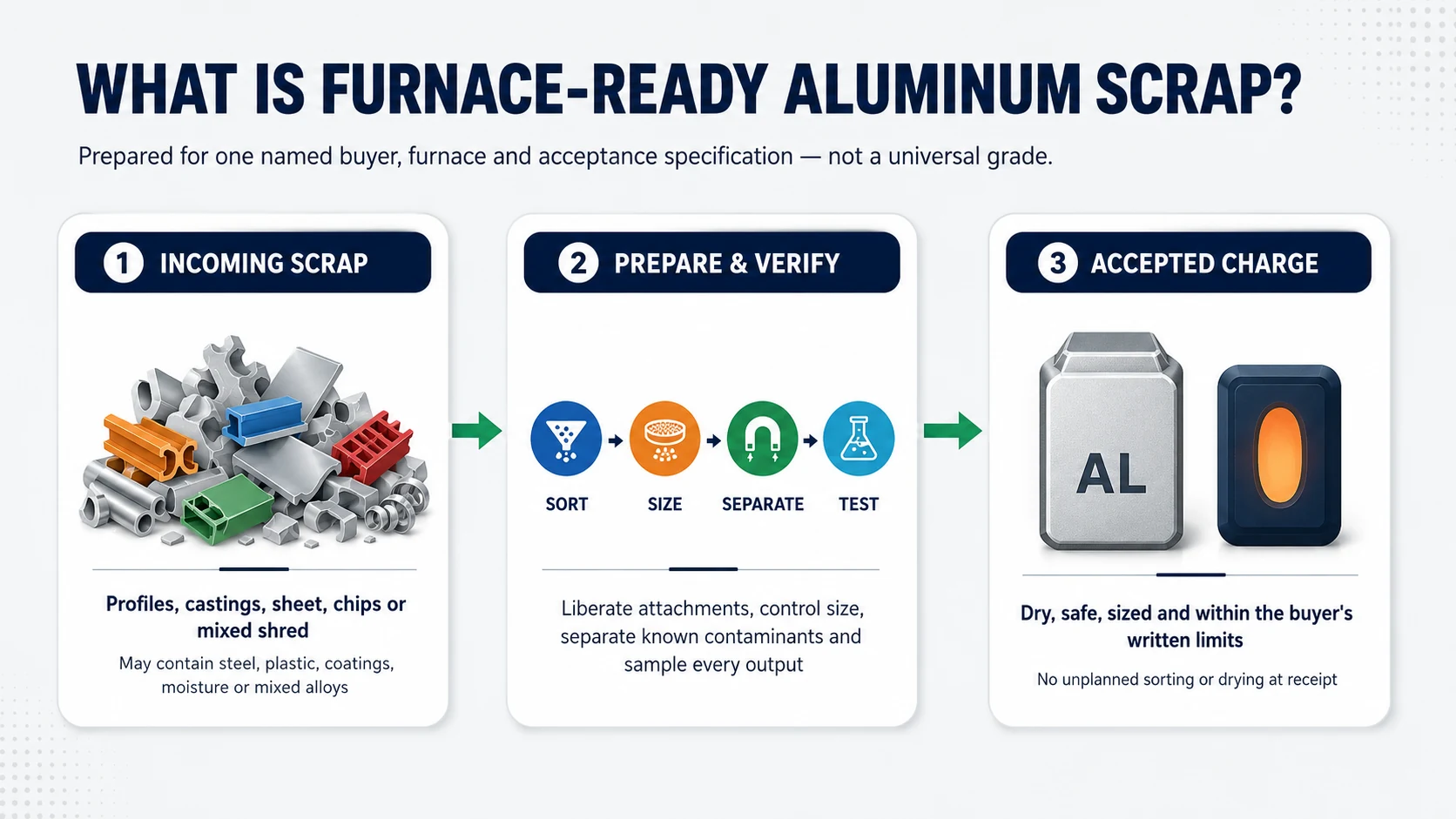
Furnace-ready aluminum scrap is scrap that a named mill, remelter or foundry can receive and charge under an agreed specification without unexpected sorting, dismantling, drying or size reduction at its gate. That does not make it a universal grade. A lot may be ready for a rotary furnace producing casting alloy and still be unacceptable to a rolling-slab remelter that needs tightly controlled wrought scrap.
A Practical Definition: Ready for a Named Receiver
The U.S. EPA describes secondary-aluminum pretreatment as sorting and processing waste to remove other metals, dirt, oil, plastics and paint, so as to prepare materials for smelting.1 This description is intentional.It explains the work,but it does not specify a finished scrap grade.
Commercial specifications do the next part. The Recycled Materials Association’s aluminum grades set different limits for different products. Taint/Tabor sheet scrap, Talcred shredded UBC, Tutu extrusion scrap, Teens segregated turnings and Tense mixed castings are not interchangeable., and many clauses explicitly leave variations to agreement between buyer and seller.2 In other words, “furnace-ready” sits on top of a real grade and contract; it should never replace them.
“No unplanned preparation” is more useful than “direct charge.” Most plants still inspect incoming scrap. Some open bales, blend grades or pass material through a controlled in-house stage. The point is that those actions are part of the planned receiving process, not an emergency response to contamination or the wrong piece size.
The Seven Dimensions Behind a Furnace-Ready Lot
A purchasing team can reduce the argument to seven questions. We have found this format easier to use than a single purity percentage because the biggest rejection risk is not always chemistry.
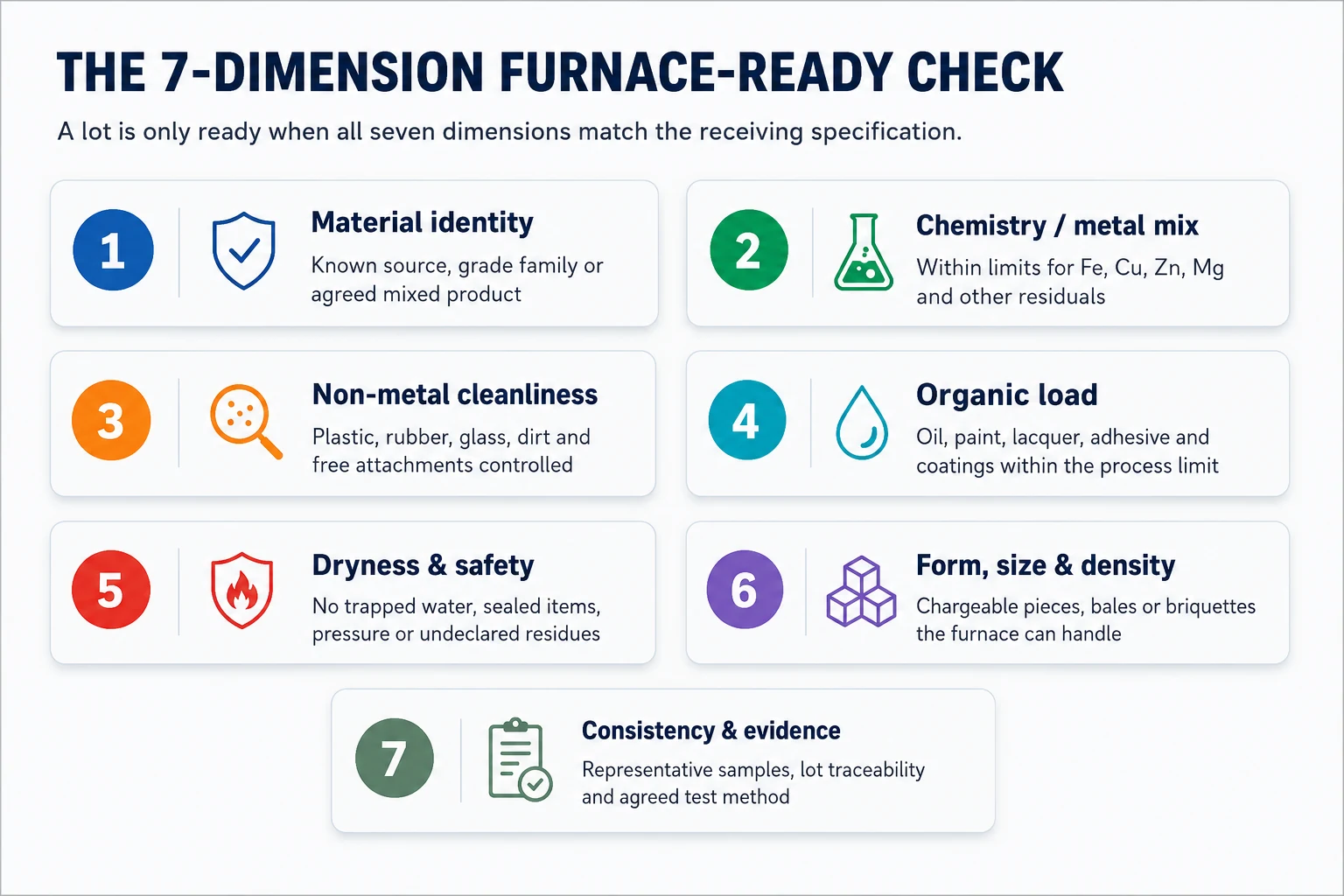
1. Is the material identity known?
Production scrap from one alloy and one process is easier to control than post-consumer material assembled from several metals. A buyer may accept one specified extrusion alloy, a mixed wrought grade, a casting fraction or an agreed non-ferrous concentrate. Those are different products. If the source changes, the chemistry risk changes with it.
2. Does the metal mix fit the intended alloy?
Removing plastic does not solve the problem of unnecessary copper, zinc, magnesium or another aluminum alloy. The newer Vesper specification is a useful example: it combines the properties of forged aluminum with the limitations of free magnesium,free zinc,analytical iron and non-metals.3 The exact restriction is specific to the product,but the lesson is that general metallic chemistry belongs to the preparation inspection.
3. Are the non-metal attachments under control?
Rubber seals, thermal breaks, glass, wood, dirt and loose plastic all reduce the metal content of a shipment. Some are easy to remove before processing. Others must be liberated by cutting or chopping.Some attachments must be liberated by cutting or shredding. However, finer size reduction is not automatically better. It can increase dust and fines, raise aluminum losses into the light reject fraction and make downstream separation less stable.
4. What organic load reaches the furnace?
Paint, lacquer, oil, adhesive and polymer are not one contaminant. Their acceptance depends on the furnace, pre-treatment equipment and environmental controls. The International Aluminium Institute’s 2026 PV circularity report notes that heavy coatings, bonded insulation and difficult attachments increase processing cost and can push recovered aluminum into lower-value applications.5
5. Is the lot dry and safe to receive?
Moisture can sit on a surface, hide inside hollow profiles, remain in chips or collect under compacted material. Closed containers and crimped tubing add another risk. A current U.S. scrap supplier manual lists water, snow, ice, closed containers, crimped tubing, aerosols and volatile substances among its prohibited conditions and explains the steam-explosion risk from trapped water.6 That is one receiver’s rule, not a global standard, but it shows why “dry” must be defined and inspected.
6. Can the furnace handle the physical form?
Large frames, springy sheet, dense cast blocks, loose turnings and a stable bale behave differently at the charge door. Size affects handling, melt exposure, bridging and the way a load is blended. Density matters too, but higher density is not automatically better. A bale that hides water, steel or mixed alloys can be harder to inspect than loose prepared pieces.
7. Can the seller prove consistency?
A sample bag cannot represent a truckload unless the sampling method says how it was taken. Strong contracts define the lot, the inspection point, sample frequency, weighing method, analytical method and response to an off-spec result. The receiving plant may also require grade labels, certificates or source traceability. That evidence is part of the product.
“Clean,” “Mill-Ready” and “Furnace-Ready” Are Not the Same Claim
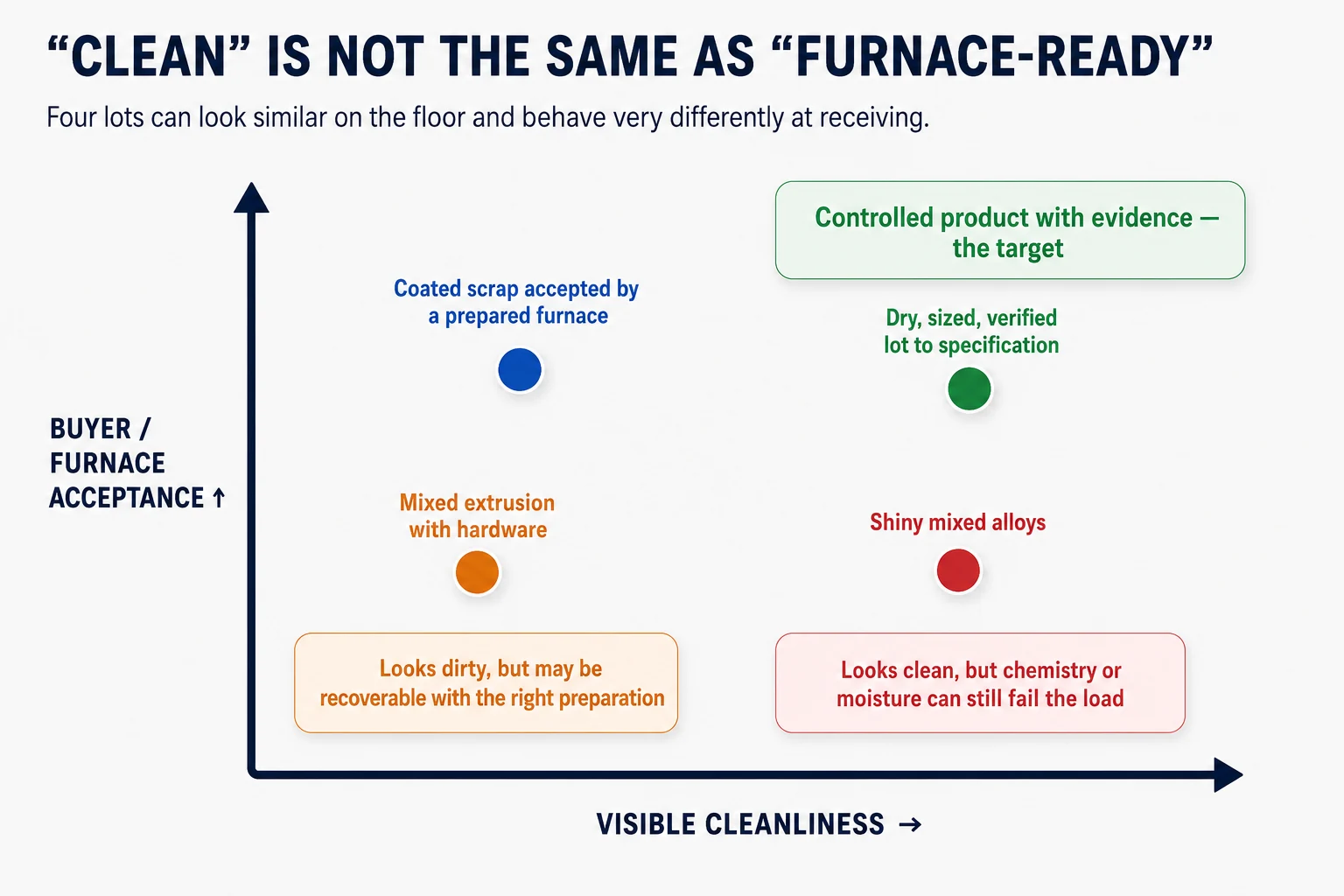
Clean aluminum scrap usually means visible foreign material has been reduced. It says little about alloy chemistry or trapped moisture. Mill-ready is often used for high-quality scrap that fits a particular mill route. Furnace-ready places the emphasis on the receiving melting operation. In everyday trade the phrases can overlap, so the purchase specification must do the real work.
The Aluminum Association’s 2025 supply-chain paper gives a useful negative example. It describes Zorba as a mixed stream containing roughly 70% to 90% aluminum along with copper, stainless steel, brass, nickel, tin, lead, magnesium and other metals, and says it requires further processing before becoming a furnace-ready aluminum product.4 Zorba can be valuable. It is simply not the same thing as a defined aluminum charge.
How Different Aluminum Scrap Becomes Furnace-Ready
The YUXI scrap aluminum recycling line is organized around three broad routes: shredding and physical separation, baling for appropriate light scrap, and liquid control with briquetting for chips. That feed-based structure is important here because furnace readiness is an output condition, not one machine arrangement.
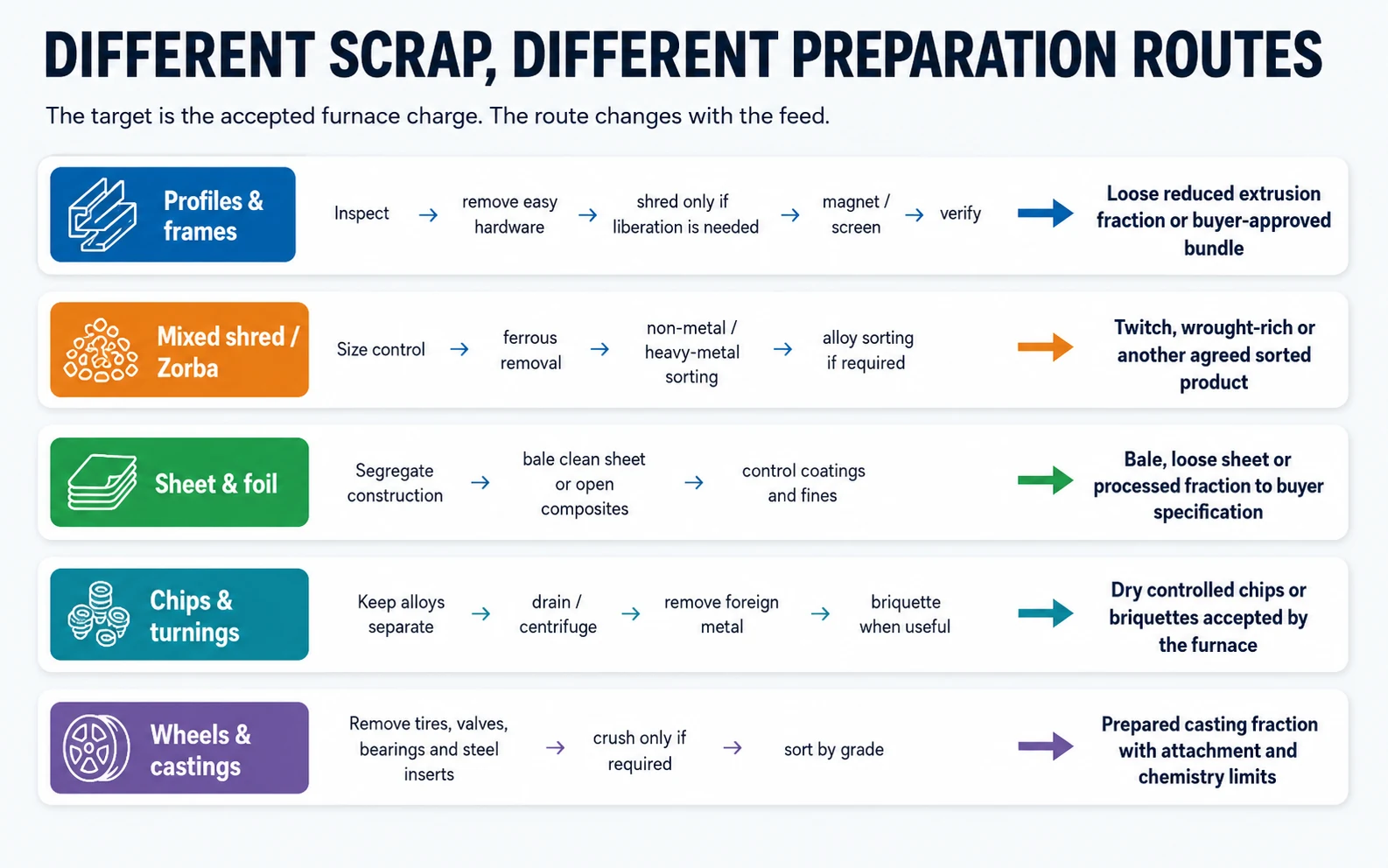
| Feedstock | What normally blocks furnace readiness | Practical preparation logic | Output evidence to request |
|---|---|---|---|
| Profiles and frames | Steel screws, zinc corners, thermal-break polymer, seals, glass, mixed 6xxx or other alloy families | Source segregation and easy dismantling first. Shred only when the line needs shorter pieces or better liberation, then remove exposed ferrous and separate the released non-metal fraction. | Grade/source definition, maximum size, attached-ferrous limit, polymer/nonmetal limit and moisture condition |
| Mixed aluminum or automotive shred | Copper, brass, zinc, stainless, magnesium, plastic, rubber, glass and unresolved alloy mix | Size classification, ferrous removal, controlled non-metal separation and heavy-metal or alloy sorting where the buyer requires it. The separate mixed aluminum scrap sorting line guide covers this route in more depth. | Product and reject mass balance, aluminum content, residual heavy metals, particle range and sampling method |
| Sheet and foil | Paint, paper, plastic laminate, adhesive, oil, mixed series and very low bulk density | Keep clean sheet separate. Bale or shear when the buyer accepts that form. Open or shred composites only when a downstream stage can actually separate the released layers. | Alloy family, coating allowance, organic/non-metal limit, bale dimensions and fines limit |
| Chips and turnings | Cutting fluid, trapped water, steel swarf, fines, oxidation and mixed alloys | Keep chips separate at the machine, drain or centrifuge where needed, check for foreign metal and use controlled feeding. Briquetting can improve handling, but the aluminum chips recycling process still has to prove dryness and alloy control. | Source/alloy, free-fluid and moisture basis, fines, steel content, briquette condition and storage method |
| Wheels and automotive castings | Tires, valves, weights, bearings, steel inserts, residual fluids and mixed casting chemistries | Remove obvious attachments before size reduction. Crush or shred only when inserts remain locked or the furnace needs a smaller charge. Add grade sorting where the buyer separates casting families. | Attachment limits, cast-alloy range, iron and heavy-metal limits, maximum piece size and fluid condition |
| Clean UBC and light packaging | Residual liquid, steel cans, glass, plastic, dirt, wrong aluminum items and hidden bale contamination | Inspect, drain, magnetically remove steel, control foreign material and bale only after the loose stream meets the requirement. A clean can stream may not need shredding. | UBC identity, moisture, steel and non-metal limits, bale density/size and receiver’s opening method |
Where YUXI Equipment Helps—and Where It Does Not
A preparation line closes the gap between the incoming lot and the agreed charge. It does not define the furnace specification. We normally recommend assigning one measurable job to every machine; if a stage cannot be linked to a known contaminant, size problem or handling constraint, it may be unnecessary.
| Stage | Useful job in a furnace-preparation line | Limit to remember |
|---|---|---|
| Inspection and controlled feeding | Reject prohibited items, record feed variation and present a stable layer to the process | Cannot correct an unknown or constantly changing purchase grade |
| Primary metal shredder | Shorten bulky profiles and mixed light scrap; open assemblies so attachments can leave | Does not make the product clean by itself and may create unnecessary fines if used on already suitable scrap |
| Hammer mill or secondary crusher | Increase liberation and create a smaller, denser fraction for selected downstream separation | More impact is not always better; wear, dust, oxidation and aluminum loss must be included in the trial |
| Magnetic separator | Remove accessible iron and ordinary steel after attachments are liberated | Does not remove copper, brass, zinc, plastic, coatings, moisture or wrong aluminum alloys |
| Screen | Create particle ranges that feed separators more consistently and isolate fines or oversize | A screen classifies size, not chemistry |
| Eddy current separator | Recover conductive non-ferrous pieces from a suitable non-metal stream | Does not automatically split aluminum from copper or classify aluminum alloys |
| Air or density separation | Use shape, drag or density differences to remove selected light or heavy fractions | Results change with size, moisture, shape and overlapping densities |
| Baler | Produce a stable transport or charge package from scrap that is already acceptable | Compaction can hide contamination; it does not create quality |
| Chip briquetting press | Improve bulk density and handling, and express some free liquid from suitable chips | Does not prove dryness, alloy identity or absence of foreign metal |
For a broader equipment decision, use the separate guide on how to choose aluminum recycling equipment. This article keeps a narrower boundary: defining and verifying the output that the furnace will actually accept.
Write the Specification Backward from the Charge Door
We have seen many inquiries start with “clean aluminum, 2 tons per hour.” That is not enough for a process guarantee. A useful specification can fit on one page, but it has to answer the questions that change the line.
Material and quality
Name the source or commercial grade, allowed alloy families, residual-element limits, permitted coatings, maximum free ferrous, heavy non-ferrous and non-metal contamination, plus oil and moisture conditions.
Physical product
State loose, baled or briquetted form; maximum and minimum piece size; fines; bulk or bale density; package dimensions; stability; and how the receiver will unload and charge it.
Safety exclusions
List sealed and pressurized items, batteries, airbags, radioactive material, hazardous residues, volatile liquids, trapped-water geometries and any alloy or component excluded by the plant.
Acceptance method
Define lot size, sample method, analytical method, moisture basis, weighing, visual checks, downgrade/rejection rules and who has the final decision when results differ.
Sometimes a buyer can provide a formal supplier manual. Sometimes the recycler has only a recent settlement sheet and a verbal description. In that case, ask the downstream buyer to convert the recurring deductions into measurable limits before finalizing the equipment. It is easier to design a separator around “maximum 0.5% exposed ferrous by this sample method” than around “make it cleaner.”
Prove Furnace Readiness with a Representative Test
A polished sample from the top of a stockpile is not a process test. The trial material should include normal variation: long and short pieces, heavy and light components, the usual attachments, moisture condition and the dirty portion that tends to settle at the bottom.
- Freeze the test basis. Record feed mass, source categories, approximate composition, largest piece, bulk density, moisture condition and prohibited-item inspection.
- Run to stable operation. Include normal recirculation, bin changes, cleaning and operator intervention. A short demonstration can hide bridging and splitter drift.
- Weigh every output. Product purity alone is incomplete. Record aluminum in ferrous, oversize, fines and non-metal rejects.
- Sample the product and rejects. Use the buyer’s method where possible. Chemistry, metal content, moisture and non-metal contamination may need different tests.
- Compare accepted tons per hour. The useful capacity is saleable furnace-ready output, not gross feed through the largest motor.
For example, a line feeding 3 t/h but losing a large aluminum fraction into rejects may deliver less saleable material than a slower, better-controlled route. The same logic applies to over-shredding: a very clean coarse product can coexist with excessive fine-metal loss. Test both sides of the split.
Common Mistakes When Buyers Ask for “Furnace-Ready” Output
Treating the phrase as a universal grade
It is not. Two furnaces can buy the same feedstock under different size, coating, chemistry and packaging rules. Put the receiving specification beside the phrase every time.
Equating visual cleanliness with chemistry
A bright aluminum fraction may still contain incompatible wrought and cast alloys, copper-bearing pieces or free magnesium. Visual QC is useful for attachments and dirt, but it cannot replace the agreed analytical check.
Believing a bale or briquette proves quality
Densification solves logistics and handling. It can also make the center of the package harder to inspect. Quality must be established before compaction and verified with a sampling plan that represents the full lot.
Adding shredding before defining the reason
Sometimes shredding is exactly what releases screws, thermal breaks or steel inserts. However, clean production scrap may already be the correct furnace charge. Unnecessary reduction adds wear, power, dust and fines without increasing value.
Using one “purity” figure for every contaminant
Non-metal percentage, ferrous content, heavy non-ferrous content, alloy chemistry, oil and moisture are different measurements. A single number can hide the reason a buyer rejects the material.
Ignoring the receiver’s permit and process
A furnace with decoating and suitable air controls may accept a controlled coated feed. Another plant may buy only clean charge. That is why an internet definition cannot replace the buyer’s written limits.
What to Send YUXI for a Furnace-Preparation Proposal
The engineering team needs evidence from both ends of the project: what arrives and what the buyer will accept. Send:
- Representative photos and video from several loads or stockpile locations
- Material categories, sources and approximate percentages
- Maximum dimensions, wall thickness, single-piece weight and bulk density
- Attached steel, copper/brass/zinc parts and non-metal components
- Oil, cutting-fluid, coating, adhesive and moisture condition
- Known alloy families and whether alloy-level sorting is required
- Target gross feed and accepted product tons per hour
- Written buyer, mill or furnace acceptance specification
- Required loose, baled or briquetted output form
- Power supply, workshop dimensions, loading method, environmental-control scope and operating hours
YUXI can then separate the project into the appropriate inspection, shredding, optional secondary liberation, magnetic removal, screening, physical separation, baling or briquetting route. No fixed furnace-ready purity, yield or capacity should be promised before the feed, product and test method are agreed.
Define the Furnace Specification Before the Machine List
Send YUXI your representative scrap data and the receiving buyer’s limits. The proposal can then be built around accepted charge material rather than a vague “clean aluminum” target.
Furnace-Ready Aluminum Scrap FAQ
Is furnace-ready aluminum scrap an official universal grade?
No. The phrase describes a commercial and process condition, not one universal chemistry or size standard. The receiving mill, remelter or foundry must define the accepted scrap grade, contaminant limits, physical form, sampling method and any special restrictions.
Does furnace-ready mean the scrap can be charged without any inspection?
No. Receiving inspection still matters. Furnace-ready means the lot is expected to meet the agreed charge specification without unplanned sorting, drying, dismantling or size reduction at the buyer’s site. The receiver may still inspect, sample, weigh, scan and reject nonconforming material.
Can Zorba be called furnace-ready aluminum?
Not automatically. Zorba is a mixed non-ferrous concentrate that can contain aluminum and copper, brass, stainless steel, zinc, magnesium and other metals. It uauslly needs another sorting step to become an aluminum-rich product accepted by a specific furnace.
Must furnace-ready aluminum be unpainted?
That depends on the furnace, environmental permit and purchase specification. Some buyers accept controlled coated scrap because they have suitable pre-treatment or decoating. Others require unpainted or clean-charge material. Coating acceptance must be written into the contract rather than assumed.
Does every furnace-ready aluminum product need shredding?
No. Clean production offcuts, segregated sheet, sorted UBC, prepared castings or alloy-controlled solids may be accepted without shredding. Shredding is justified when it improves handling, releases attachments or creates the size needed by downstream separation and charging.
Are aluminum chip briquettes always furnace-ready?
No. Briquetting improves density and handling, and it can help express free liquid, but it does not prove alloy identity, dryness, absence of steel or compliance with a furnace specification. The chips still need source control, liquid management and buyer acceptance.
What should be included in a furnace-ready scrap specification?
At minimum, name the scrap grade or source, alloy or chemistry limits, permitted and prohibited contaminants, moisture and oil limits, size range, density or packaging requirements, sealed-item exclusions, sampling and weighing method, and the action for off-spec loads.
What information does YUXI need to design a preparation line?
Provide representative photos and video, material categories and percentages, maximum dimensions, bulk density, attached steel and non-metal content, moisture or fluid condition, target product, required tons per hour, buyer or furnace specification, available space and utilities.
References
- U.S. EPA — AP-42 Background Document for Secondary Aluminum — Scrap pretreatment removes contaminants and prepares aluminum for smelting; mechanical cleaning includes size reduction and magnetic removal.
- Recycled Materials Association — Scrap Specifications Circular — Commercial aluminum grades define alloy, cleanliness, oil, moisture, size and buyer–seller agreement conditions.
- Recycled Materials Association — Vesper specification — Example of a current wrought-aluminum specification with limits for free Mg, free Zn, analytical Fe, nonmetallics, dryness and prohibited sealed items.
- The Aluminum Association — Powering Up American Aluminum — Explains why Zorba is not furnace-ready and needs further processing into a more suitable aluminum product.
- International Aluminium Institute — Aluminating the Path — Shows how attachments, sealants, coatings and alloy mixing affect the ability to produce clean furnace-ready aluminum.
- Aluminum Dynamics — Scrap Supplier Manual — Illustrates receiver-specific safety, contaminant, size, packaging, inspection and documentation requirements.