




 Request Quote



Refrigerator recycling plant safety is mostly decided before the first cabinet reaches the cutters. A line can have a strong shredder and still be poorly protected if intact cooling circuits enter the feed, hydrocarbon vapor is not detected, foam dust is carried into an unprotected collector, or an operator has to defeat an interlock to clear a jam.
Why refrigerator recycling safety starts before the shredder
Waste refrigerators are awkward feedstock because a single cabinet combines several things a normal scrap shredder does not have to manage at once: a sealed refrigeration circuit, compressor oil, plastic, sheet steel, copper and aluminum, rigid polyurethane foam and, depending on the appliance, different refrigerants and foam blowing agents. YUXI’s refrigerator recycling process therefore places inspection, refrigerant recovery, compressor removal and oil handling ahead of cabinet shredding. That sequence is not simply for cleaner metal recovery. It is the first safety barrier.
That means the receiving yard needs a decision, not just a pile. Is this cabinet genuinely ready for the mechanical line? If the answer is uncertain, it should not move forward merely because the compressor has already been cut away.
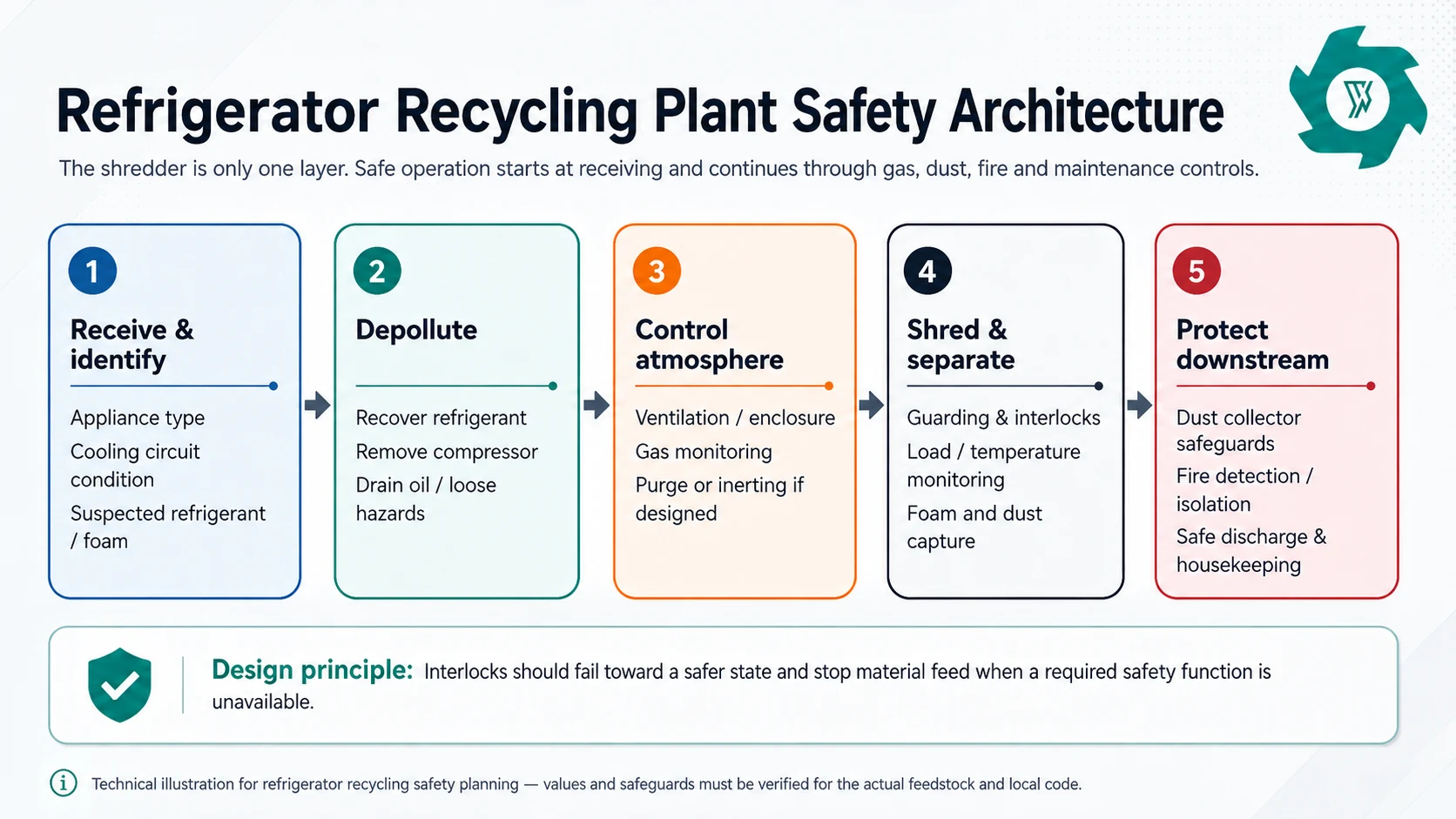
1. Refrigerant control: make depollution a release gate
For U.S. projects, the refrigerant question has both environmental and process-safety consequences. The appliance population is not chemically uniform. Older equipment may contain CFC or HCFC refrigerants, while later units can contain HFCs or hydrocarbon refrigerants. EPA’s current SNAP information lists R-600a (isobutane) as an acceptable household refrigerator/freezer refrigerant with use conditions.[1]
In other words, “recover the refrigerant” should be a controlled workstation with a documented release condition. We would not treat compressor removal, a cut tube, or a painted X on the cabinet as the control itself. Those are observations. The control is the verified recovery process and the record that supports it.
A workable receiving and release sequence
- Inspect the appliance. Record whether the cooling circuit is intact, damaged, already cut or obviously incomplete.
- Check the acceptance documentation. For U.S. disposal facilities relying on prior recovery, align the paperwork with EPA’s safe-disposal requirements and retain records for the required period.
- Quarantine uncertain units. A crushed or partly dismantled refrigerator is not automatically “safe” simply because much of the refrigerant may already have escaped.
- Recover refrigerant where required. Use the appropriate certified recovery equipment and the facility procedure before the unit is released to further dismantling or shredding.
- Remove the compressor and manage oil. Keep the oil-handling station physically and operationally separate from the shredder feed path so leaks do not become normal housekeeping.
EPA’s brochure also tells facilities to check state and local requirements in addition to the federal rule. That is important when a machine supplier is writing a proposal for a U.S. buyer: the equipment list alone cannot define the customer’s whole compliance boundary.[2]
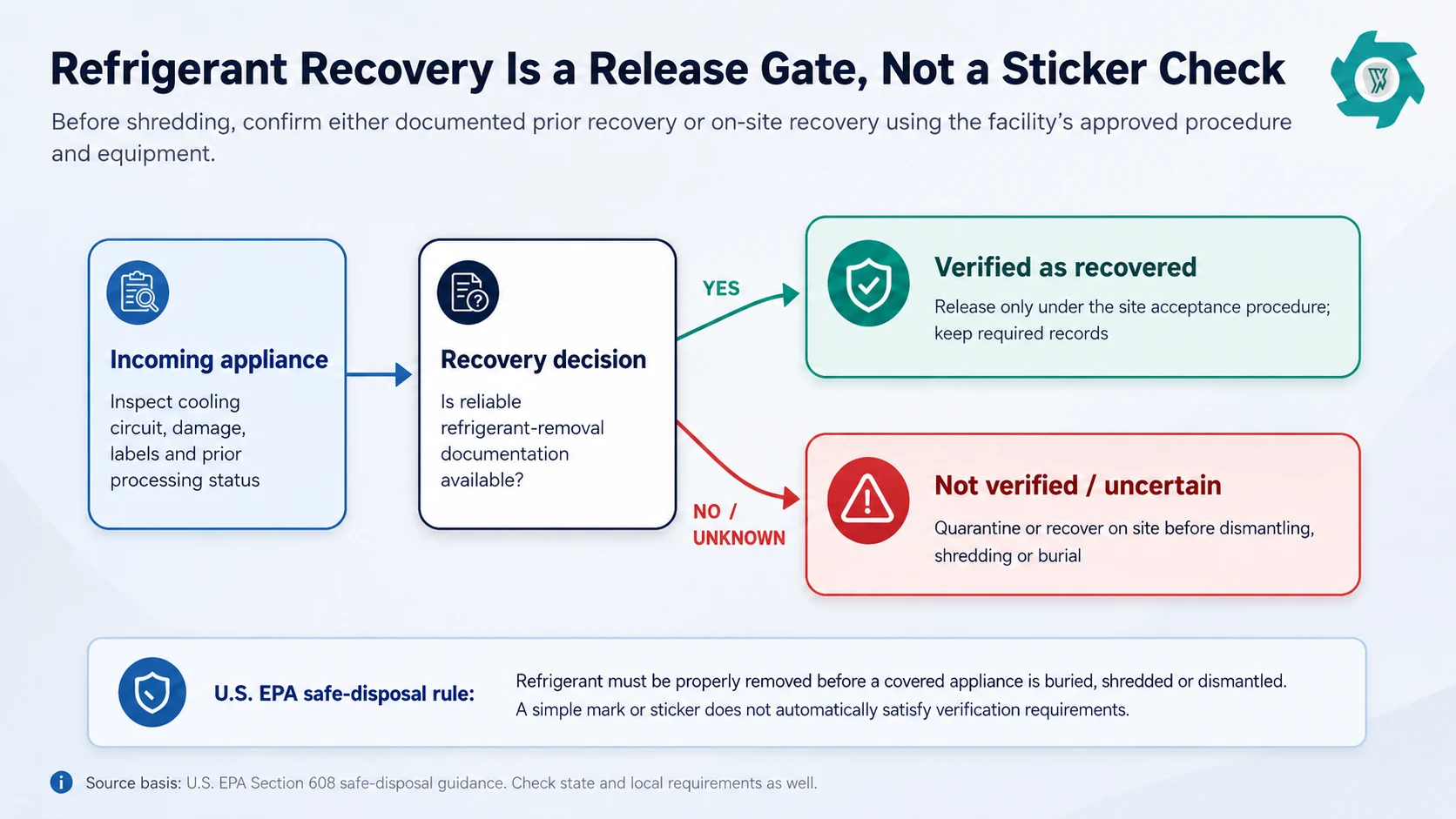
2. Pentane and hydrocarbon control: know which gas can appear after shredding starts
Refrigerant is only one gas issue. The insulation foam can contain a blowing agent that is released when the cabinet is opened and the polyurethane structure is broken down. EPA notes that appliance foam has used a range of blowing agents over time, from CFCs and HCFCs to HFCs and, increasingly, hydrocarbon or other low-GWP alternatives.[3]
This is where “pentane safety” belongs. Pentane or cyclopentane in the foam is not the same thing as the refrigerant in the sealed cooling circuit. A plant can do the refrigerant-recovery step correctly and still release hydrocarbon vapor later when the shredder and secondary crusher expose the foam.
OSHA’s chemical data list an LEL of 1.5% for n-pentane and a very low flash point. That is enough to show why a design should not depend on odor or on an operator noticing “too much gas.”[4]
Three common engineering approaches
Commercial refrigerator recycling systems can use different combinations of enclosure, negative pressure, gas monitoring and inerting. There is no single arrangement that fits every feed mix or plant layout.
For a YUXI project, the correct question is therefore not “Does the line have nitrogen?” It is “What is the approved gas-control philosophy for this feedstock, and what happens automatically when that protection is lost?”
| Hazard variable | What to define in engineering | What should be visible in the controls |
|---|---|---|
| Expected gas | Refrigerant and foam-blowing-agent mix based on incoming appliances | Detector type, range and calibration basis |
| Process enclosure | Which shredder, crusher, foam separator, ducts and collectors share the gas space | Pressure / ventilation status where monitored |
| Ventilation or purge | Required flow, purge time and proof-of-flow method | Permissive before feed starts; fault alarm if flow is lost |
| Gas concentration | Alarm and trip philosophy determined by the hazard assessment | Pre-alarm, high alarm, shutdown state and event logging |
| Electrical area | Hazardous-location classification and equipment suitability where applicable | Documented area classification and approved equipment list |
| Failure response | What stops immediately and what continues to run to make the system safer | Cause-and-effect matrix tested during FAT/SAT |
Do not copy a gas alarm setpoint from a brochure
The chemical LEL is a physical reference, not a ready-made PLC setting. Alarm levels depend on detector technology, sampling location, response time, ventilation rate, process volume, expected gas mixture, local code and the selected protection strategy. If nitrogen inerting is used, oxygen concentration becomes another process variable and introduces its own asphyxiation controls around access and maintenance.
Where a project identifies hazardous electrical areas because flammable vapor, gas or combustible dust may be present, equipment selection should follow the project’s documented area-classification basis. A generic “explosion-proof motor” note on one machine is not the same as an electrical area-classification package for the plant.
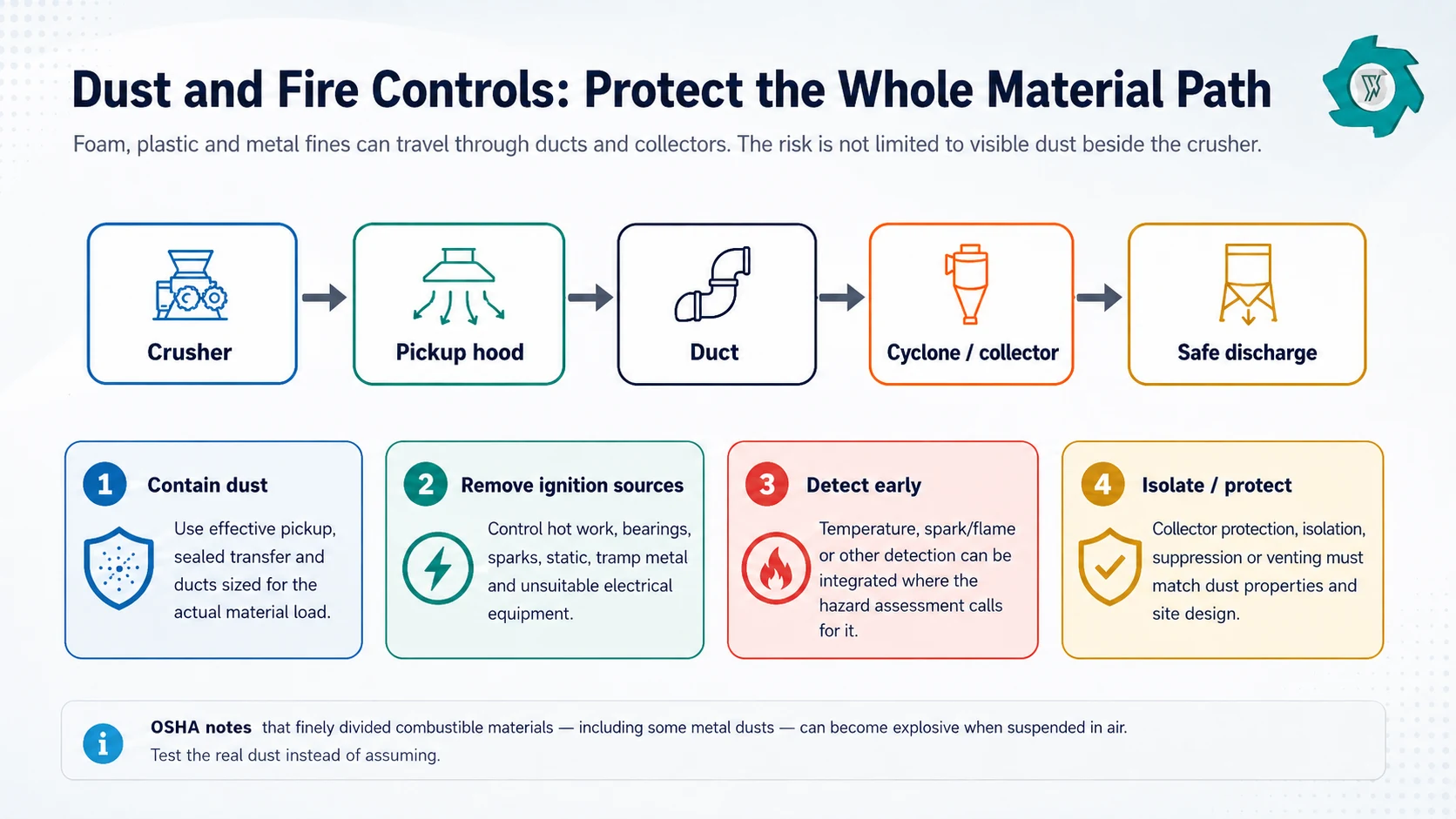
3. Dust control: the collector is part of the process hazard
Refrigerator shredding produces light polyurethane foam, plastic fragments and fines. Secondary crushing and conveying can make the dust load much higher than the floor around the machine suggests because the finest fraction is the material most efficiently pulled into the ventilation system.
OSHA’s combustible-dust guidance explains that combustible material can burn rapidly in finely divided form and that fine dust can create explosion hazards under the right conditions.[5] For a refrigerator plant, that is a reason to test the actual collected material instead of making assumptions from the appearance of larger pieces on the belt.
What a dust-control specification should include
- Pickup points. Define hoods or extraction at the secondary crusher, foam separation, transfer points and any discharge where fines escape.
- Duct transport. Size the system for the real particle mix so material does not settle and create hidden deposits.
- Dust characterization. If the collected fraction may be combustible or explosible, obtain representative test data and use it in the hazard analysis.
- Collector protection. Explosion venting, suppression, isolation or another protection method is not a catalog checkbox; it must match the dust properties, collector location and connected ductwork.
- Housekeeping. Design platforms, ledges and cable routes so they can actually be cleaned. Compressed-air blowdown that disperses dust can make a weak housekeeping program worse.
- Electrical suitability. Dust-related hazardous locations, if identified, need the appropriate equipment and documentation rather than a mix of ordinary and classified components.
OSHA’s prevention bulletin recommends minimizing dust escape, using dust-collection systems, inspecting hidden areas and cleaning residues with methods that do not generate dust clouds when ignition sources are present.[5]
4. Fire control: find the ignition path before specifying suppression
Fire protection becomes much easier to discuss after the gas and dust hazards are mapped. Without that map, “add a water spray” can be either useful, ineffective or harmful depending on what is burning and where the fire can travel.
On a refrigerator recycling line, likely ignition scenarios deserve separate review: tramp metal or hard parts striking in a crusher, overheated bearings, a jammed conveyor, hot work during maintenance, electrical faults, static discharge, a hot particle entering ductwork, or flammable vapor reaching an ignition source. The prevention method is different for each.
A layered fire strategy is stronger than one device
In practice, we prefer to see the fire system divided into four jobs:
- Prevent ignition where possible. Control hot work, keep bearings and drives maintained, remove unsuitable feed, bond and ground where required, and keep electrical equipment appropriate for the area.
- Detect abnormal conditions early. Temperature, spark, flame, smoke or gas detection can be selected according to the hazard and process location.
- Stop propagation. Shut down feed, isolate conveyors or ducts, and prevent a collector event from sending pressure or flame back toward occupied areas where the protection design calls for it.
- Control the event. Fire suppression, water spray, deluge, dry chemical, inerting or other systems should be selected by the project fire-protection engineer and authority having jurisdiction (AHJ), not assumed from one supplier’s standard package.
Fire-control hardware can vary widely with the process design. That is why the fire philosophy should be written into the technical specification before quotations are compared.
Interlocks: decide what the line must refuse to do
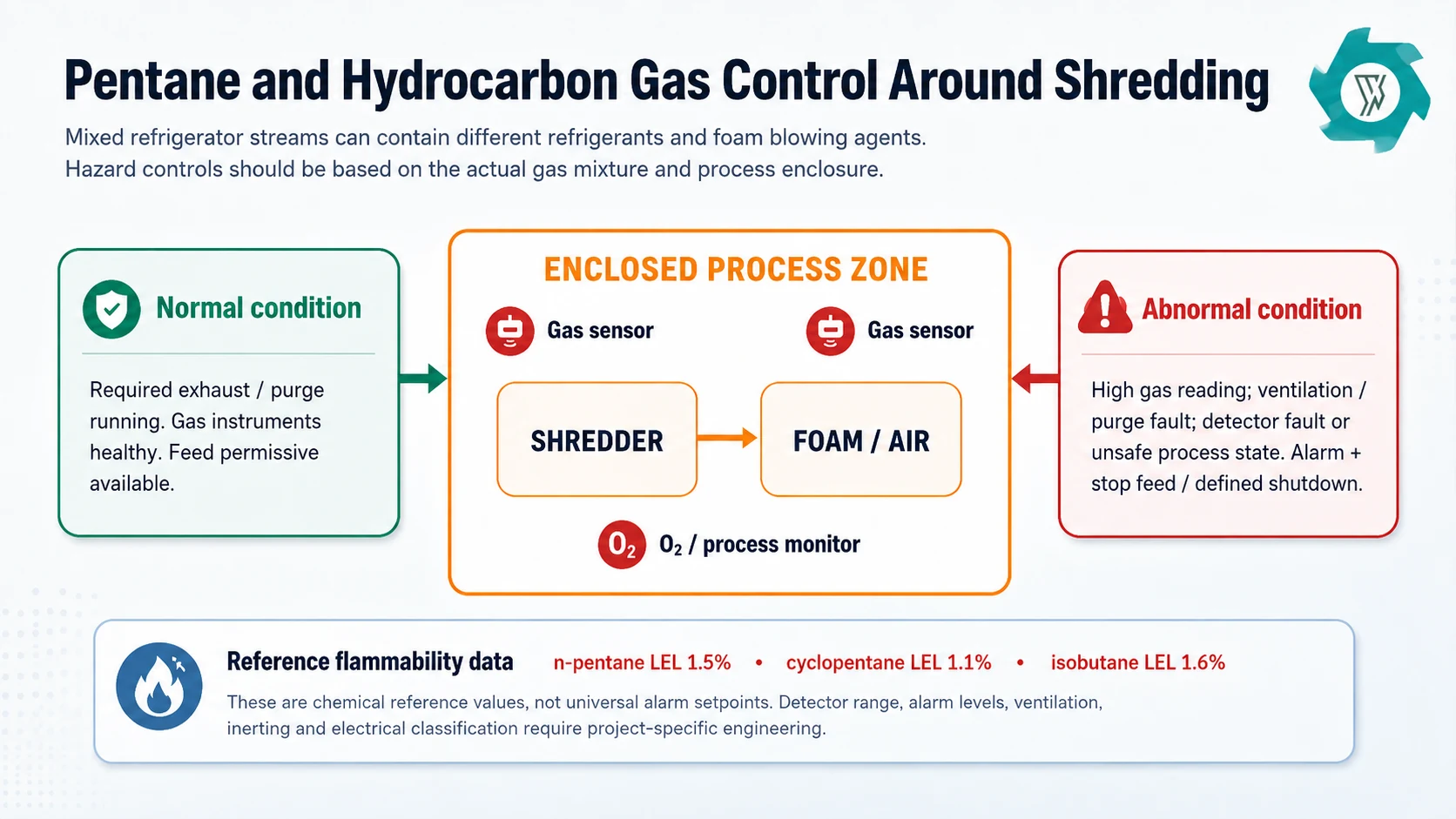
A central PLC does not make a plant safe by itself. The important part is the permissive logic behind the screen. Before startup, define which conditions must be healthy for feed to begin and which failures require a controlled shutdown.
Typical items considered in a refrigerator recycling cause-and-effect matrix include gas detector health, gas concentration, enclosure exhaust or purge status, oxygen level where inerting is used, crusher temperature, bearing temperature, dust collector status, fire-system trip, guard-door status, emergency stops, downstream conveyor availability and critical blockage.
One useful FAT question: If the gas detector loses power while the line is processing foam-bearing refrigerator cabinets, what does the feeder do within the next few seconds? The answer should come from a tested sequence, not from an operator remembering a manual instruction.
The same logic applies to a dust collector fault. If the collector trips and the crusher keeps making fines because “production can continue for a few minutes,” the protection boundary has been defeated. Where a support system is safety-critical, its healthy state should normally be part of the feed permissive.
Guarding and lockout: jams are normal, reaching into them is not
Refrigerator cabinets are thin sheet assemblies with wire, plastic liner, insulation and occasional loose parts. Bridging and awkward jams can happen even in a well-designed feed system. Safety depends on making the clearing method predictable.
Machine guards should prevent access to moving parts and other mechanical hazards during normal operation. For servicing and jam clearing, OSHA 1910.147 addresses unexpected energization, startup and the release of stored energy where employees may be exposed.[6]
For the line designer, that means maintenance access is a safety feature. Provide reachable isolation points, lockable disconnects, safe access platforms, blocked or restrained hydraulic/pneumatic energy where applicable, and enough clearance to remove tangled material without improvising around guards.
Safety items to put in the refrigerator recycling RFQ
Safety gets vague when the buyer asks only for “dust removal and fire protection.” A better RFQ identifies the boundaries that the supplier must price and document. These are the items we would ask a project team to send or confirm:
- Incoming refrigerator/freezer mix and typical production years if known
- Known refrigerants and hydrocarbon refrigerants in the stream
- Known foam blowing agents or uncertainty about appliance foam
- Whether refrigerant and compressor oil are removed before delivery to the line
- Required units/hour and tonnes/hour on the same feed condition
- Maximum cabinet dimensions and unit weight
- Workshop plan, clear height, doors and occupied areas
- Power standard and local hazardous-area electrical basis
- Required gas monitoring and detector philosophy
- Ventilation, negative-pressure, purge or inerting requirements
- Dust test data if already available
- Dust collector location and explosion/fire protection philosophy
- Fire alarm/suppression interface with the building system
- Emergency-stop and shutdown zoning
- LOTO points and maintenance-access expectations
- FAT feed sample and abnormal-condition tests
What to compare between refrigerator recycling plant suppliers
Two proposals may both say “gas detection + dust collector + fire system” and still be very different. Normalize the comparison by asking what is actually included and who owns each interface.
| Compare this | Weak quotation | Stronger technical proposal |
|---|---|---|
| Refrigerant boundary | “Refrigerant removed by customer” | Defines incoming acceptance condition, recovery scope if included, records and cabinet release point |
| Pentane / hydrocarbon control | “Gas detector included” | Defines gases, sensor locations, ventilation or inerting concept, alarms, trips and reset conditions |
| Dust system | Collector airflow only | Defines pickup points, ducting, material properties, collector protection and discharge handling |
| Fire system | “Water spray available” | Defines hazard scenarios, detection, isolation, suppression interface and AHJ responsibility |
| Electrical safety | Selected explosion-proof components | Defines area-classification responsibility and equipment suitability by zone/division if applicable |
| Controls | PLC + emergency stop | Cause-and-effect matrix, safety permissives, alarm priorities, fault handling and restart sequence |
| Maintenance | Manual provided | Lockout points, stored-energy controls, access, jam-clearing method and operator training |
Final takeaway: safe refrigerator recycling is a system design problem
There is no single “safety machine” that turns a refrigerator shredding line into a safe plant. The strongest projects make the hazards visible in the process flow.
First, the cabinet is not released until refrigerant recovery and required depollution are verified. Next, the enclosed mechanical section has a defined strategy for hydrocarbon vapor from the cooling circuit or insulation foam. Dust is captured and assessed as a process hazard, not treated only as a cleanliness issue. Fire detection and protection are then selected around credible ignition and propagation paths. Finally, the PLC is programmed so that a missing protection layer removes the right operating permissive.
Define the Safety Scope Before You Compare Refrigerator Recycling Lines
Send YUXI your appliance mix, depollution condition, target throughput, workshop layout and local safety requirements. We can use that information to define the mechanical line, dust/foam handling, monitoring interfaces and the project boundaries that need to be confirmed in the technical proposal.
FAQ
Can a refrigerator be shredded after the compressor is removed?
Not necessarily. Compressor removal does not by itself prove that refrigerant has been properly recovered, and it does not address blowing agent in the insulation foam. Release the cabinet only after the facility’s depollution and acceptance conditions are met.
Is a dust collector enough to make refrigerator shredding safe?
No. Dust collection is only one layer. The dust properties, ignition sources, collector protection, isolation, electrical classification, housekeeping and fire response all need to be considered as part of the connected system.
What should stop the refrigerator recycling line automatically?
The exact logic is project specific. Common safety-critical trips considered in design include high hydrocarbon gas, loss of required ventilation or purge, gas-detector failure, unsafe temperature, fire-system activation, dust-collector failure, guard opening, emergency stop and critical downstream blockage.
Does every refrigerator recycling plant need nitrogen inerting?
No. Nitrogen is one possible protection method, not a universal requirement for every plant. The selected strategy should be based on the appliance mix, expected hydrocarbon release, enclosure and ventilation design, gas monitoring, process volume and applicable code review.
How should combustible dust risk be checked?
Start with a representative sample from the actual or expected dust stream and have the relevant properties tested when the hazard assessment indicates this is necessary. Do not assume that foam/plastic dust is harmless or that the presence of metal automatically defines the risk.
What should be tested during FAT?
In addition to throughput and separation, test selected interlocks and fault sequences: emergency stops, guard circuits, ventilation or purge loss, detector fault simulation, dust collector trip, alarms, controlled shutdown and restart permissions.
References
- U.S. EPA — substitutes in household refrigerators and freezers.
- U.S. EPA — safe disposal procedures for household appliances that use refrigerants.
- U.S. EPA — substitutes in foam blowing agents.
- OSHA — chemical data for pentane.
- OSHA — combustible dust fire and explosion guidance.
- OSHA 29 CFR 1910.147 — lockout/tagout hazardous-energy control.