




 Request Quote


Two suppliers can quote an “OCC recycling line” and still be proposing different factories. One line ends with loose or baled fiber-rich material. The other ends with pumpable stock that has passed through water-based pulping, screening and cleaning. The machine lists overlap only at the receiving end; the accepted products do not.
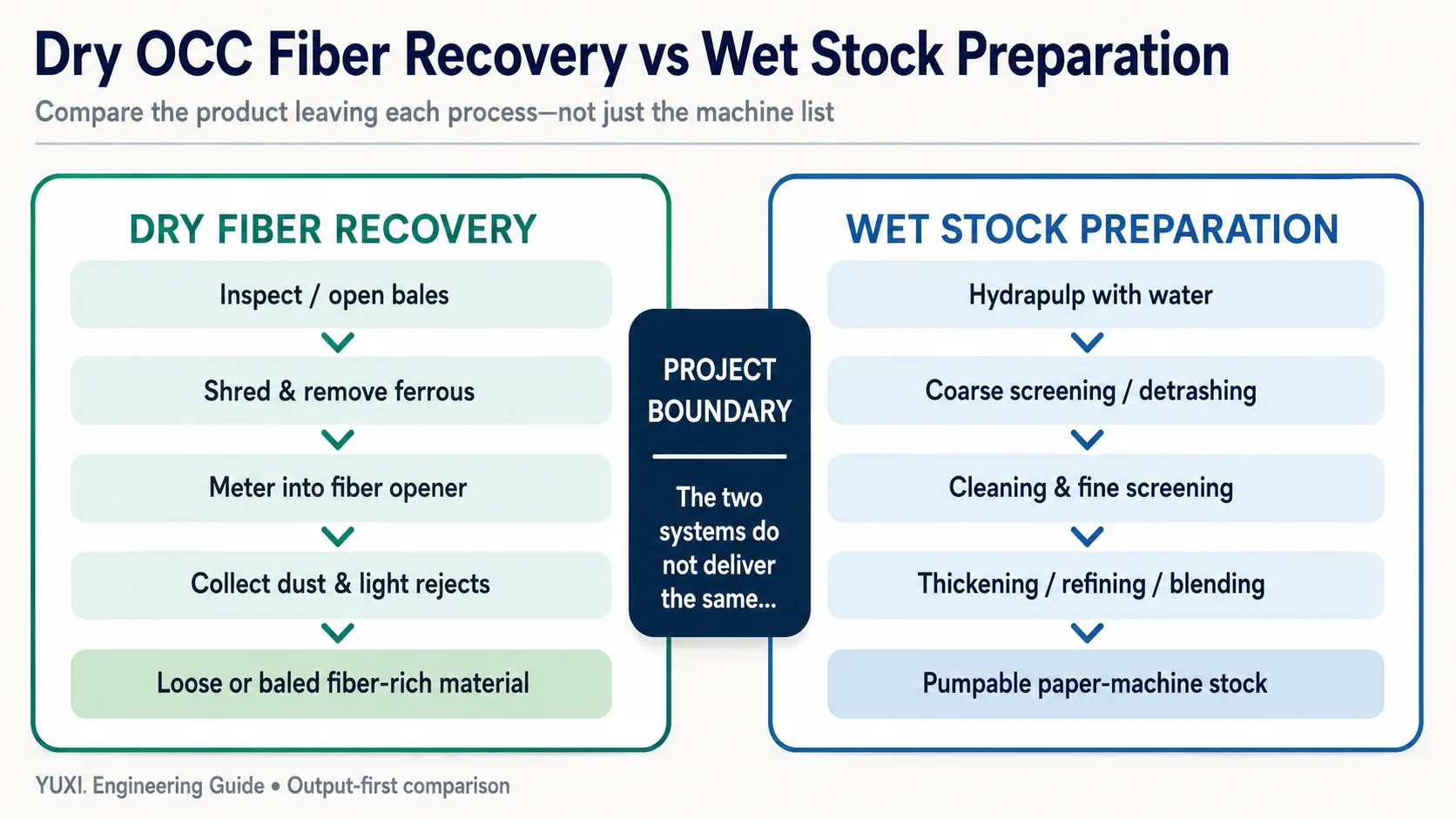
That is the practical meaning of dry OCC fiber recovery vs wet stock preparation. Dry recovery is built around material handling, primary size reduction, mechanical fiber opening, air management and collection. Wet stock preparation is a paper-mill process that turns recovered paper into a controlled fiber suspension. Neither route is automatically better. The right route depends on where the project boundary ends and what the next process is willing to accept.
The Decision Starts With the Product Leaving the Line
A dry fiber-recovery plant receives physical paper waste and produces another dry bulk material. The OCC may be opened from bales, inspected, shredded, magnetically protected, metered into a fiber-opening machine, separated from selected rejects and collected loose or in bales. The material is easier to handle and its paper structure is more open, but it is still a dry recovered-paper feedstock.
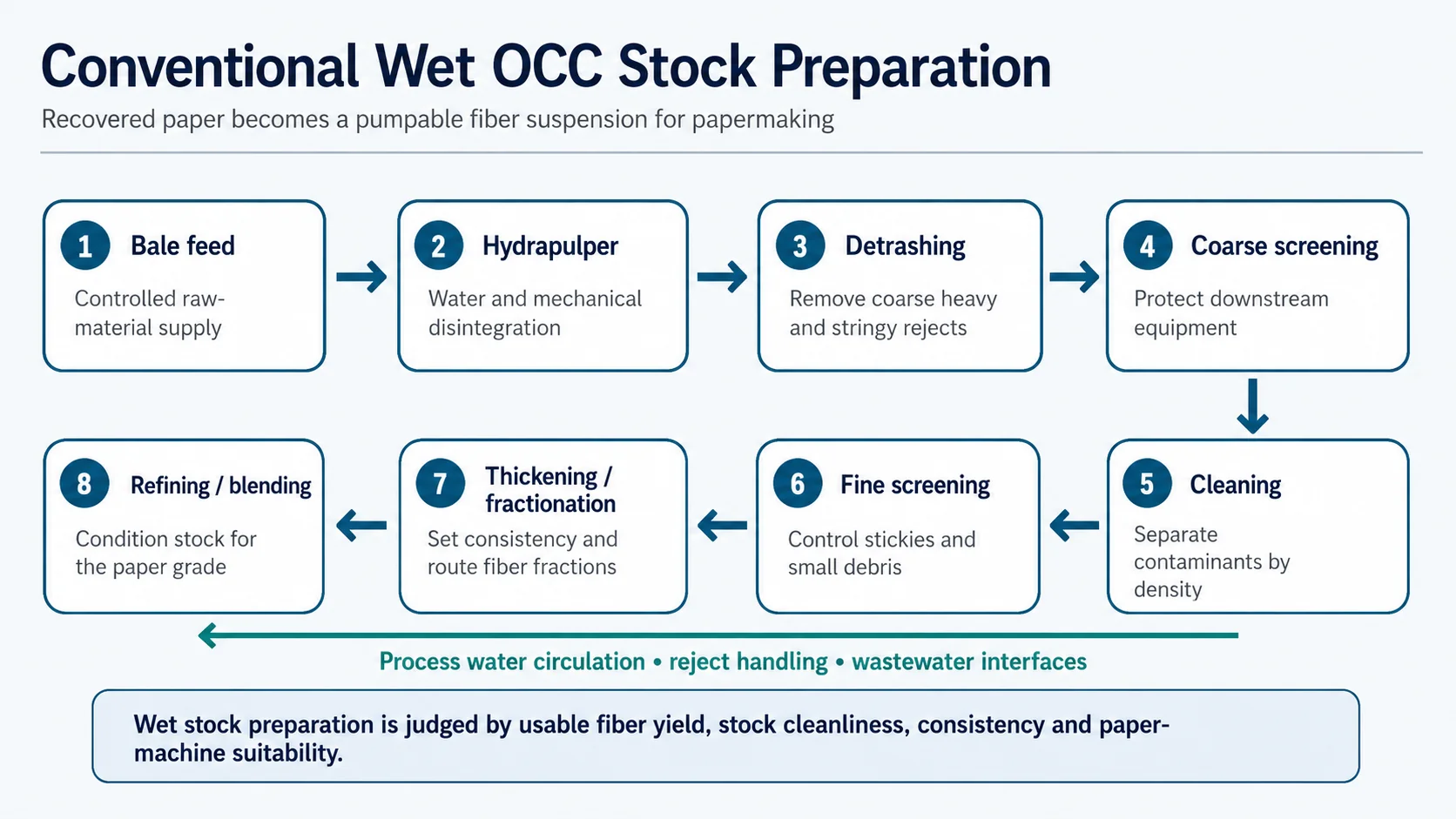
A wet stock-preparation plant receives recovered paper and produces fiber suspension. Paper is mixed with water and mechanically disintegrated. Coarse debris is removed, the slurry is screened and cleaned, and the accepted fibers may be thickened, fractionated, refined or blended before they reach a machine chest. AF&PA describes the mill stage in the same sequence: bales enter a pulper, paper is mixed with water, contaminants are screened out, and the fiber slurry is cleaned before new paper is formed.[1]
The output specification is the dividing line
Ask one question before comparing equipment: Will the customer accept a dry fiber-rich material, or does the project have to deliver pumpable paper-machine stock? The answer determines the process, utilities, laboratory tests, reject handling and contract boundary.
This distinction also prevents a common purchasing error. A dry line should not be credited with the functions of hydrapulping, fine screening, density cleaning and stock conditioning when those systems are not in the quotation. Likewise, a full wet line should not be dismissed as expensive merely because its scope continues much farther downstream.
What Dry OCC Fiber Recovery Actually Changes
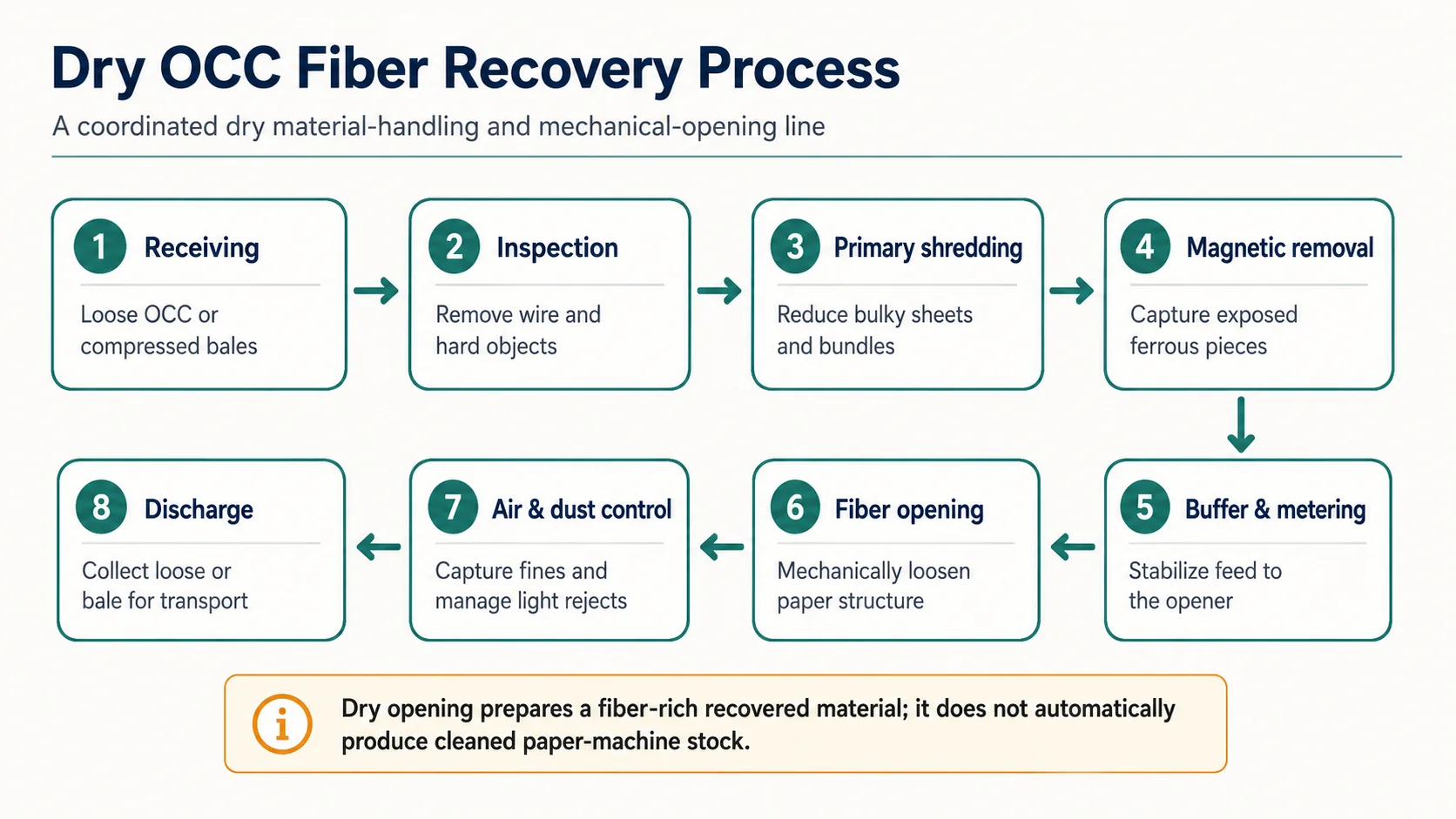
In a dry project, the engineering problem is often physical rather than chemical. Corrugated boxes are bulky, springy and irregular. Dense bales arrive with wire, trapped film and material from several suppliers. Once opened, the OCC has low bulk density and can bridge above a shredder or surge onto the next conveyor. A stable plant therefore depends on the connections between machines as much as on the machines themselves.
Receiving and feed stabilization
Loose warehouse cartons can often be inspected before the feed conveyor. Compressed bales need a defined wire-removal and bale-opening method. The conveyor, hopper and control logic must then meter material into the primary shredder. In practice, this is where many optimistic capacity estimates fail: a shredder may have enough torque, but the plant cannot feed or discharge it steadily.
Primary size reduction and ferrous protection
Shredding reduces large sheets, flattened boxes and compacted bundles to a more manageable geometry. It can expose staples and wire fragments to magnetic separation. It does not, by itself, confirm the paper grade or remove coatings, food residue, wax, adhesives and fine plastic. The role is feed preparation and equipment protection.
Mechanical fiber opening
The fiber-opening stage loosens the shredded paper structure without a conventional hydrapulper loop. Rotor, screen, feed layer and residence time influence the discharge condition. A finer-looking product is not automatically a cleaner product; excessive mechanical action can also create more fines and dust. Define the discharge condition with retained physical samples rather than a phrase such as “high-quality pulp.”
Air handling, dust and final collection
Dry opening creates airborne fines at transfer and discharge points. Pickup hoods, duct velocity, filters, access for cleaning and the final dust-discharge method should be designed with the process.OSHA lists moving parts, unexpected machine startup and combustible materials among paper-recycling hazards. Its combustible-dust guidance also identifies paper and pulp as materials that can become explosible when finely divided and suspended in air.[6][7]
The direct product may be collected loose, pneumatically transferred to a buffer or compacted into bales. That product can be valuable. It is simply not the same product as cleaned wet stock.
What Wet OCC Stock Preparation Actually Changes
Wet stock preparation changes the material phase. Recovered paper becomes a pumpable suspension, which allows screens and cleaners to separate contaminants by size, shape, deformability and density. The process also gives the mill control over consistency, fiber fractions and stock treatment before papermaking.
Pulping and coarse reject removal
A hydrapulper or drum pulper mixes recovered paper with water and releases fibers. Detrashing systems, traps and coarse screens remove large contaminants before they are broken into smaller pieces. Voith emphasizes early removal because OCC commonly carries adhesives, metals, sand and plastics, and because feed fluctuations continue into every downstream stage.[3]
Screening and cleaning
Screening separates material according to geometric behavior at the screen basket. Cleaning uses density and centrifugal effects to remove heavy or light contaminants from the suspension. Valmet describes cleaning as a major OCC unit operation and notes that recovered furnish may include adhesives, dirt, plastics and other foreign material.[4] Fine screening, reverse cleaning and reject-stage design depend on the furnish and the required stock quality.
Thickening, fractionation and refining
After contaminant removal, the mill may thicken the stock, split long and short fiber fractions, disperse troublesome contaminants, refine selected fibers and blend the furnish. These stages are not universal in one fixed order, but they show why “wet line” means more than a pulper. The goal is a controlled stock for a defined paper or board grade.
Water and reject circuits
Water carries the fiber between stages. Pumps, chests, valves, instrumentation and water loops therefore become part of production, not merely utilities. Rejects leave at several points and may carry usable fiber, water and contaminants. The plant must balance cleanliness against fiber loss and reject-treatment cost.
Dry OCC Fiber Recovery vs Wet Stock Preparation
| Decision point | Dry OCC fiber recovery | Wet OCC stock preparation |
|---|---|---|
| Project purpose | Open, reduce, protect, separate selected dry contaminants and prepare a transportable fiber-rich material. | Disintegrate recovered paper, remove contaminants from slurry and condition fiber stock for papermaking. |
| Material phase | Dry bulk solids throughout the core process. | Fiber suspension carried in process water. |
| Typical core equipment | Bale opening, sorting, shredder, magnet, buffer, fiber opener, air handling, collection and optional baler. | Bale handling, pulper, detrashing, screens, cleaners, pumps, chests, thickeners and optional fractionation/refining. |
| Direct output | Loose or baled mechanically opened fiber-rich material. | Pumpable prepared stock matched to a paper or board furnish. |
| Strong contaminant control | Visible non-paper items, bale wire, exposed ferrous pieces, selected coarse or light rejects. | Coarse debris plus additional size- and density-based removal in slurry. |
| Important limitations | Fine stickies, coatings, embedded plastic and furnish quality are not solved by dry opening alone. | Poor feed quality still causes yield loss, reject load, water-system problems and stock-quality variation. |
| Primary quality language | Grade, moisture, non-paper content, metal, particle/fiber-opening condition, dust and buyer acceptance. | Oven-dry accepts, usable fiber yield, consistency, cleanliness, ash, stickies, drainage and paper-machine suitability. |
| Best-fit site | Recycling, logistics or preprocessing site without a full paper-mill water system. | Paper or board mill with process-water, stock handling and effluent infrastructure. |
| Commercial handoff | Recovered-material buyer or downstream processor. | Machine chest or paper-machine stock system. |
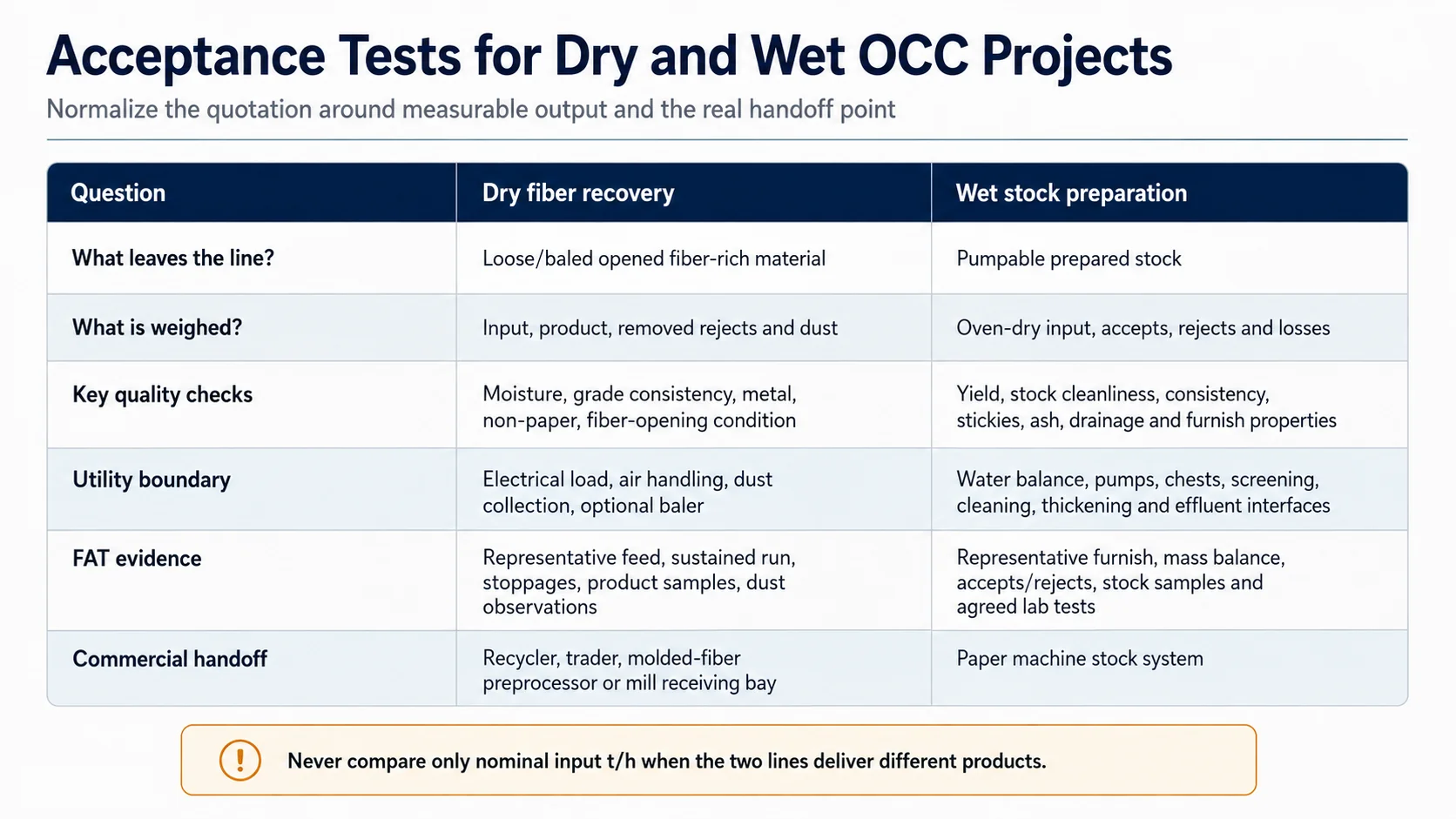
The table should be used to normalize quotations. It is not a claim that every dry or wet line uses the same modules. Feed grade, contamination, required availability and the downstream product determine the final arrangement.
Fiber Recovery and Stock Yield Are Not the Same Measurement
The phrase fiber recovery can hide different calculations. A dry plant may report the mass of saleable product divided by incoming OCC. A wet mill may report oven-dry accepted fiber after repulping and screening. The denominators, moisture basis and excluded streams may all differ. Comparing the two percentages without a common mass balance is meaningless.
Dry-line mass balance
A useful dry trial records incoming material, moisture, removed wire and metal, hand-sorted rejects, dust or fines, accepted dry product and material left in the equipment. Product samples should be retained from several points in the run. The buyer then checks whether the receiving customer accepts the grade, opening condition and non-paper content.
Wet-line fiber yield
Wet yield normally needs an oven-dry basis and a clear definition of accepts, rejects and dissolved or fine losses. A 2026 peer-reviewed study tested a broad group of recovered paper products with laboratory repulping and screening. Its 17 OCC samples averaged 78.9% fiber yield, but the range was wide—63.1% to 98.4%—and the authors explicitly treated the results as directional rather than product certification.[5] That spread is a useful warning: the label “OCC” does not guarantee one yield.
Coatings, fillers, labels, wet-strength treatments, attached plastic and the construction of the box can change the result. The 2025 AF&PA/FBA voluntary standard therefore uses a screening method to evaluate repulpability and recyclability of coated or treated corrugated products and to determine whether fiber yield and fiber quality are acceptable for papermaking.[2]
Do not turn a laboratory value into a YUXI performance promise
The research numbers above describe tested paper products under a specified laboratory method. They do not establish the recovery, purity or operating cost of a commercial dry line or wet mill. A project guarantee needs representative feed, agreed measurement methods and an acceptance protocol.
Contaminant Removal Depends on When the Material Becomes a Slurry
Dry processing has an advantage while contaminants remain large and visible. Bale wire, straps, wood, stones, plastic bundles and hard objects are easier to remove before they reach rotating equipment. Primary shredding can expose hidden ferrous pieces, and a magnet can protect the fiber-opening section. Air classification or screens may help with selected light and coarse rejects.
Wet processing gains additional separation mechanisms after the paper becomes a suspension. Screens can reject material that does not pass the selected openings. Cleaners can separate particles with different density behavior. Multi-stage systems can protect fibers while concentrating contaminants into reject streams.
Neither route makes poor feed harmless. Breaking film and adhesive into smaller pieces can make later removal harder. Wetting a heavily contaminated furnish does not eliminate the contaminants; it transfers the problem into screens, cleaners, water circuits, sludge and rejects. This is why early inspection and supplier control matter in both routes.
Dry controls are strongest for
Bale wire, large visible plastics, wood, hard objects, exposed ferrous items, oversize sheets, feed surges and selected light rejects.
Wet controls are strongest for
Contaminants that can be separated from fiber suspension by screening, cleaning and mill-specific stock-treatment stages.
Water, Energy and Site Scope Must Be Compared on the Same Boundary
A dry plant avoids the conventional hydrapulper, pulp chests and process-water circuit inside its own core boundary. That can simplify installation at a warehouse, recycling yard or fiber-preparation site. It does not mean the overall paper-recycling chain uses no water. If the material later becomes linerboard, medium or molded fiber, the downstream process will still require water-based stock preparation and forming.
Electrical energy also needs a boundary. A dry line uses drives for conveyors, shredding, fiber opening, fans and baling. A wet line uses pulping power plus pumps, screens, cleaners, agitators, thickeners and stock conditioning. A useful comparison includes the complete plant and the same accepted output, not only the largest motor.
Site requirements that are easy to omit
- Receiving space, bale storage and safe wire removal
- Conveyor elevations, access platforms and maintenance clearances
- Dust hoods, duct routes, filter location and housekeeping access
- Fire zoning, ignition-source control and emergency planning
- Water supply, drainage, chests, pumps and wastewater interfaces for wet systems
- Reject storage, dewatering and disposal routes
- Sampling points and laboratory capability
A low equipment-only price can become expensive when these interfaces are added later. The separate industrial cardboard recycling machine guide explains the difference between buying a baler, a shredder and a coordinated OCC line.
A Hybrid Dry and Wet Route Is Often the Most Honest Design
The two routes do not have to compete. A dry preprocessing plant can receive mixed supplier bales, remove wire, open the material, stabilize size, remove ferrous contamination and produce a dense transport bale. A paper mill can then repulp that prepared feed, remove fine contaminants and condition the stock.
This arrangement can make sense when the recycling site and the paper mill are separate, when water infrastructure belongs at the mill, or when the dry site serves several downstream customers. It can also make no sense if the dry stage adds cost without improving logistics, feed stability or reject control. The value has to be demonstrated at the handoff.
Questions that decide whether a dry front end adds value
- Does it reduce transport or storage problems?
- Does it remove contaminants that would otherwise damage the mill system?
- Does it make bale composition more consistent?
- Does the receiving mill pay for the changed material condition?
- Does dry opening create fines or fragments that the mill considers undesirable?
- Can the same result be achieved with better source sorting and conventional baling?
One customer may need the full dry sequence. Another may need only inspection and baling. That is why the project should start from the receiving specification rather than a standard machine list.
Three Project Scenarios
1. Clean packaging waste at a distribution center
The feed is mostly dry corrugated boxes with predictable suppliers and limited contamination. The commercial goal is transport efficiency. A baler may be enough. Adding shredding and dry fiber opening is justified only when oversized material, feeding, storage or buyer requirements create a real need.
2. Multi-supplier OCC preprocessing site
Bales vary in wire, film, moisture and box construction. The site wants to inspect, open, remove ferrous pieces, prepare a consistent dry product and ship it onward. This is the strongest case for a coordinated dry fiber-recovery line, provided the downstream buyer has approved the output condition.
3. Containerboard mill making paper-machine stock
The mill must control usable fiber yield, stickies, ash, stock cleanliness and machine runnability. A dry front end may assist receiving, but it cannot replace hydrapulping, screening, cleaning and stock conditioning. The core project is wet OCC stock preparation.
RFQ and Acceptance-Test Checklist
Feed information
- Paper grade, supplier mix and percentage of non-OCC paper
- Loose material or bale dimensions, density and tying method
- Normal and worst-case moisture
- Film, labels, tape, coatings, wax, wet-strength board, food residue, metal, wood and textiles
- Photos, videos and representative samples—not only a hand-selected clean sample
Required output
- Loose or baled dry material, or pumpable stock
- Target bale, bulk-density or material-handling condition
- Accepted non-paper, metal, moisture, fines and opening-condition limits
- Wet stock consistency, yield, cleanliness and furnish tests where applicable
- Name of the downstream process that will accept the product
Performance test
- Sustained run length and start/stop rules
- Measurement basis: as-received mass or oven-dry mass
- Definition of accepted product, rejects, dust, retained material and losses
- Downtime exclusions and operator interventions
- Sampling points, sample frequency and laboratory method
- Utility consumption and plant boundary
- Procedure if the feed differs from the approved sample
In acceptance tests, disputes often begin with sample traceability rather than machine performance.Every sample should state the time, feed lot, machine setting and process point. A clean product sample taken during a short stable period should not represent an eight-hour run that included bridging, reject surges and stoppages.
Where the YUXI OCC Dry Pulping Line Fits
The current YUXI OCC paper dry pulping and cardboard recycling line is positioned as a dry mechanical recovery system. Its published process combines controlled feeding, primary shredding, ferrous-metal removal, buffer and metering, mechanical dry fiber opening, dust management, collection and optional baling. The direct output is loose or baled fiber-rich material—not finished paper-machine stock.
That boundary is important. The line can be configured for OCC bales, loose cartons, kraft offcuts and selected paperboard waste, but coatings, moisture, adhesive load and mixed-paper content need sample review. When the receiving process needs controlled pulp furnish, additional wet screening, cleaning, refining or other stock-preparation stages remain downstream.
Define the OCC Project Boundary Before Quoting
Send the feed condition, required output, downstream use and site constraints so the line can be configured around a measurable handoff point.
FAQ
Is dry OCC fiber recovery the same as wet pulping?
No. Dry recovery mechanically opens and prepares dry paper waste. Wet pulping turns recovered paper into a water-based fiber suspension and continues through screening, cleaning and stock conditioning.
Can dry-recovered OCC fiber feed a paper machine directly?
Normally not without the mill’s approval and additional stock preparation. Paper-machine stock needs controlled consistency, cleanliness and furnish properties.
Which route removes tape, labels and plastic better?
Dry sorting can remove large visible contaminants before they are fragmented. Wet systems add screening and density-based cleaning in slurry. Performance depends on the contaminant, its size and the process sequence.
Does a dry OCC line eliminate water use?
It can avoid a conventional hydrapulper loop at the dry site. Water is still required if the recovered material later becomes paper-machine stock or a wet-formed product.
How should line capacity be compared?
Use the same mass basis and define sustained input, accepted output, rejects, downtime and plant boundary. Nominal input tons per hour alone is not enough.
When is a hybrid dry and wet route practical?
It is practical when a separate site improves receiving, opening, contaminant removal and logistics before the material is repulped and cleaned at a paper mill.
References and Source Notes
- American Forest & Paper Association, The Paper Recycling Process. Used for the mill pulping, screening and fiber-slurry boundary.
- American Forest & Paper Association and Fibre Box Association, 2025 Voluntary Standard for Repulping and Recycling Coated or Treated Corrugated Fiberboard and OCC Equivalents. Used for repulpability, recyclability and screening-method context.
- Voith, BlueLine OCC Process. Used for multi-stage contaminant removal and feed-consistency context.
- Valmet, Maximizing Operational Performance of the OCC Process With Screening and Cleaning. Used for cleaner and screening functions.
- Brito, A. et al. (2026), Assessing the Paper Recycling Repulping Yield and Fiber Properties of Recovered Paper Products, BioResources 21(3). Used for directional OCC yield variability and measurement cautions.
- U.S. Occupational Safety and Health Administration, Green Job Hazards: Recycling—Paper. Used for machinery, unexpected startup, crushing and combustible-material hazard context.
- U.S. Occupational Safety and Health Administration, Combustible Dust: An Explosion Hazard. Used for paper/cardboard dust hazard evaluation context.