




 Request Quote



A buyer asks for an industrial cardboard recycling machine and receives three very different proposals. One supplier quotes a baler. Another recommends a shredder with conveyors. A third presents a complete OCC line with metal removal, dry fiber opening, dust collection and final baling.
All three proposals may be technically reasonable. The problem is that they solve different jobs.
A baler makes cardboard easier to store and transport. A shredder changes the size and feeding behavior of the material. A complete line changes the condition of the feed by combining several stages. Before comparing motor power, press force or headline price, define what must enter the system and what must leave it.
Which Industrial Cardboard Recycling Machine Do You Need?
Choose a baler when clean, source-separated cardboard already meets the recycler’s material requirements and the main task is volume reduction.
Add a shredder when cartons, sheets, cores or opened bales are too bulky, irregular or difficult to meter into a baler or downstream machine.
Choose a complete line when the project must receive variable OCC, remove damaging contaminants, stabilize the material flow, mechanically open the paper structure, control dust and deliver loose or baled fiber-rich material.
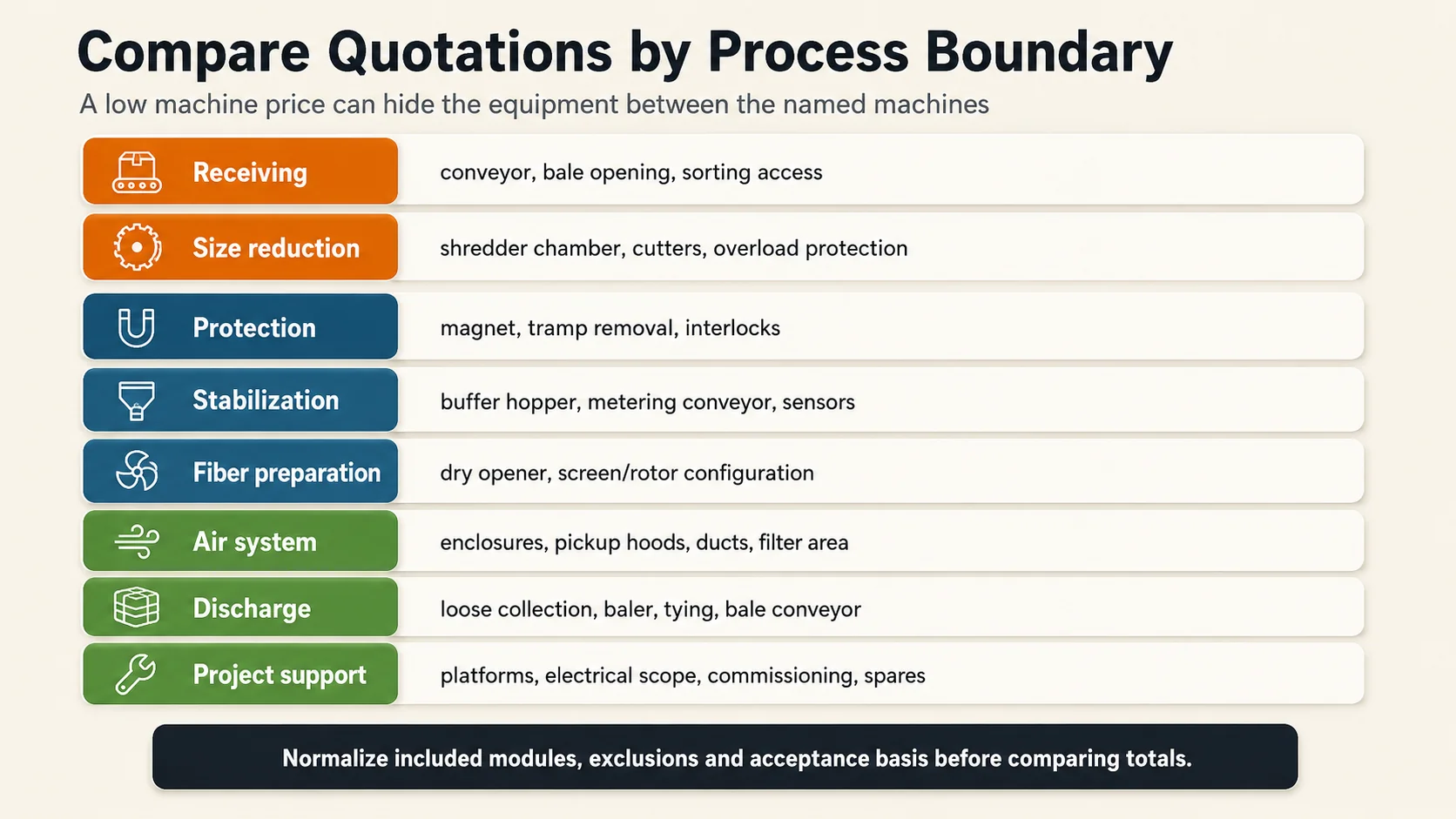
| Selection | Main job | Typical feed | Direct output | What it does not do |
|---|---|---|---|---|
| Baler only | Compress material | Clean loose or flattened boxes | Dense OCC bale | Does not shred, open fiber or remove contamination |
| Shredder + baler | Reduce size, improve feeding, then compress | Bulky cartons, trim, sheets or irregular packaging waste | Shredded cardboard bale | Does not automatically produce cleaned or opened fiber |
| Complete dry OCC line | Prepare a more uniform fiber-rich material | Loose cardboard, opened OCC bales, kraft and suitable paperboard waste | Loose or baled mechanically opened fiber-rich material | Does not replace wet stock preparation or a paper machine |
What a Cardboard Baler Does—and When It Is Enough
A baler uses hydraulic or mechanical force to compact cardboard into a tied bale. This is valuable because loose OCC takes up a great deal of space, is awkward to stack and may need to be collected frequently. A properly specified bale can simplify internal handling, storage and transport.
For a retailer, supermarket, warehouse or distribution center producing clean boxes, the bale may be the only output required. The material is already source-separated. It does not need to be opened into fiber. It only needs to be kept dry, free from unacceptable contaminants and compacted to the specification accepted by the recycler.
Vertical baler or horizontal baler?
A vertical baler is often considered for lower-volume, batch-fed operations where labor can load, cycle and tie each bale. A horizontal baler becomes more relevant when the site needs conveyor feeding, higher sustained throughput or automatic tying. The correct choice depends on daily volume, peak generation rate, bale specification, available floor area, clear height and labor.
Do not select a baler only by press force. Chamber dimensions, feed opening, cycle time, tying method, bale weight, discharge arrangement and the recycler’s acceptance requirements can matter just as much.
What an Industrial Cardboard Shredder Adds
A shredder is not simply a more aggressive baler. It changes the geometry of the cardboard before the material reaches the next stage. That can solve feeding problems caused by oversized cartons, long sheets, folded structures, cores, trim skeletons or irregular factory waste.
In a cardboard application, a low-speed shredder may be used to tear bulky material into rough pieces. This can expose hidden wire or hard objects, reduce bridging and create a more even load for a conveyor or baler. YUXI’s double-shaft shredder is positioned as a primary size-reduction machine; in a paper line, its role is rough opening and feed preparation rather than final pulp production.
When a shredder and baler make sense together
- Large cartons do not fall consistently into the baler feed opening.
- Long sheets bridge on conveyors or form springy layers in the chamber.
- Packaging trim must be reduced before pneumatic or belt conveying.
- The plant wants denser, more consistent feeding into a horizontal baler.
- Rough tearing is needed before magnetic separation or another preparation stage.
What shredding does not guarantee
Shredding does not confirm the paper grade. It does not remove plastic film, wax, wet-strength coating, food contamination or the wrong paper furnish. It does not turn cardboard into finished paper pulp. A rough shred size can also be misleading: the material may look smaller while still carrying the same contaminants and moisture.
Surprisingly, a larger shredder can make line performance worse when the downstream conveyor, baler or fiber opener cannot accept the discharge. The useful question is not “How much can the shredder tear?” It is “What continuous load can the complete system accept?”
What a Complete OCC Recycling Line Adds
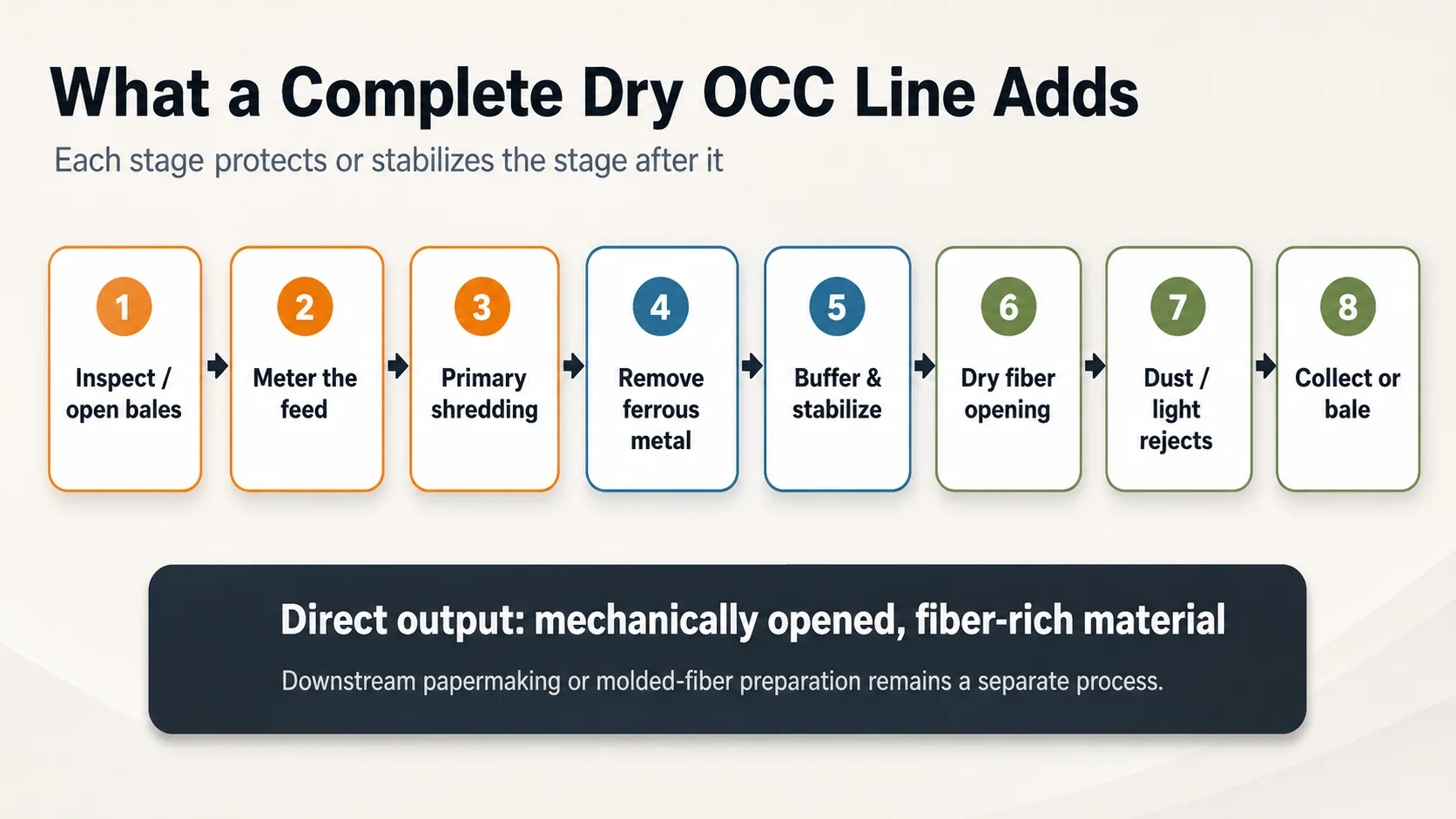
A complete line is selected when the project must do more than reduce volume. The YUXI OCC paper dry pulping and cardboard recycling line is built around controlled feeding, primary shredding, ferrous removal, feed stabilization, mechanical dry fiber opening, dust management, fiber collection and optional baling.
The direct product is a mechanically recovered, fiber-rich material. It may be collected loose or baled for transport. It is not automatically finished paper stock, and it should not be sold as a substitute for a conventional wet OCC stock-preparation system.
1. Receiving, inspection and bale opening
Loose boxes can be inspected before a metering conveyor. Dense OCC bales require a different front end. Wire or straps must be removed, the bale must be opened safely and obvious contaminants need a removal route. Feeding a compressed bale directly toward a shredder can create a surge and hide damaging objects.
2. Controlled feeding and primary shredding
Light cardboard has low bulk density, so volume flow can be large even when the mass flow looks modest. A conveyor, hopper and level-control strategy should meter the material instead of dumping large batches into the shredder.
3. Ferrous-metal removal
Staples, nails and wire fragments should be removed before the dry opening section. A magnetic separator is useful, but it is not a replacement for front-end inspection. Large metal pieces, wire bundles and hard foreign objects should not be treated as normal magnet load.
4. Buffering and metering
This stage is easy to omit from a quotation and difficult to replace after installation. A dry fiber opener normally performs more consistently with a steady material layer. Without a buffer or controlled transfer, the line may alternate between starvation and overload.
5. Mechanical dry fiber opening
The fiber-opening machine mechanically loosens the shredded paper structure. Rotor design, screen arrangement, feed rate and the required fiber condition should be evaluated together. More aggressive opening is not automatically better; it may increase fines, dust and wear without improving downstream acceptance.
6. Dust, light rejects and fiber collection
Shredding and dry opening create fines. Enclosures, pickup hoods, ducts, filters and housekeeping access should be designed as one air system. Light-reject separation may also be added when film, labels or other low-density contaminants are present.
7. Loose discharge or final baling
The material can discharge into storage, a container, a receiving process or a baler. When baling is required, the baler should be sized from the opened material’s bulk behavior and the required bale—not from the incoming box volume.
How the Feedstock Changes the Machine Choice
“Cardboard” is not a precise equipment specification. Clean corrugated box trim from a packaging factory behaves differently from supermarket OCC, imported mixed bales, waxed produce boxes or wet paper-mill residue.
Before selecting equipment, define at least five feed variables: material grade, loose or baled form, piece or bale dimensions, moisture range and non-paper contamination. The guide to OCC cardboard grades and quality provides useful context, but a trade name still does not replace a representative sample.
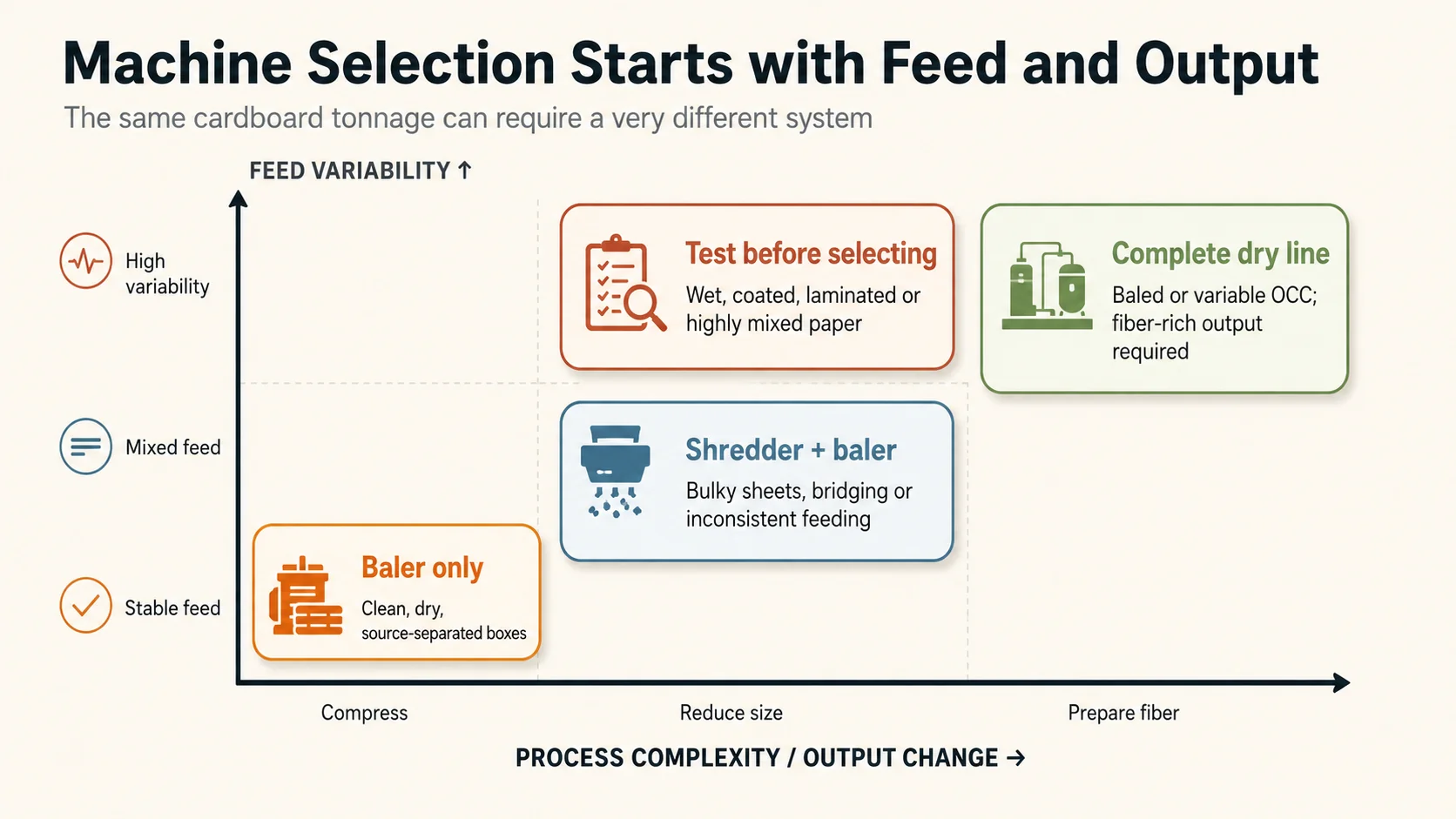
| Feed condition | Likely equipment route | Main checks |
|---|---|---|
| Clean flattened warehouse boxes | Baler only | Moisture, bale size, collection volume, labor and recycler specification |
| Large loose cartons or long converting trim | Shredder + baler | Bridging, feed opening, desired rough size and baler loading |
| Wire-tied OCC bales from variable suppliers | Bale opening + inspection + complete line | Bale density, wire, film, wood, moisture, coated board and reject route |
| Clean packaging-factory kraft offcuts | Metered shredding + dry opening; baling optional | Consistent feed, required fiber condition and downstream use |
| Waxed, wet-strength, laminated or food-soiled board | Test before selecting | Repulpability, coating load, odor, moisture, rejects and buyer acceptance |
| Mixed paper or fiber-rich industrial residue | Sample test + project-specific separation | Composition by percentage, hard contaminants, fines and final product specification |
AF&PA and the Fibre Box Association maintain a voluntary test standard for coated or treated corrugated products in the OCC stream.[4] The practical lesson for machinery selection is simple: a coated board should not be assumed to behave like ordinary corrugated material merely because both are brown and fiber-based.
Start from the Required Output, Then Work Backward
Many machine-selection errors begin with the incoming pile. A stronger method begins with the receiving specification.
Output option 1: a saleable OCC bale
Ask the recycler or paper buyer for the accepted grade, prohibited materials, moisture expectations, bale dimensions, bale density, tying method and minimum shipment volume. When clean boxes already meet those requirements, extra processing may only add cost and fiber loss.
Output option 2: shredded cardboard for handling or baling
Define why the material must be shredded. Is the target a smaller piece for conveyor feeding, higher bale density, confidential destruction, packaging fill or another downstream process? These are not interchangeable goals. A machine that creates rough hand-sized pieces may be suitable before baling but unsuitable when a uniform screen-controlled size is required.
Output option 3: mechanically opened fiber-rich material
Define the degree of opening, acceptable fines, remaining film or metal, loose or baled delivery and the intended receiving process. A paper mill, molded-fiber plant and insulation or composite application may use different acceptance criteria.
The U.S. EPA separates recycling into collection, processing and remanufacturing.[1] That distinction is useful here. A baler or dry preparation line is part of processing. It does not by itself complete remanufacturing into a new paper product.
Capacity Is Controlled by the Slowest Stable Stage
Cardboard projects are especially vulnerable to optimistic capacity estimates because loose material has low bulk density. A conveyor can appear full while carrying little mass. A bale opener can create surges. A shredder can discharge faster than a magnet or transfer conveyor can clear. A fiber opener can be rated under steady laboratory feeding while the actual plant receives inconsistent batches.
We normally recommend defining capacity on two bases:
- Gross input rate: all material fed into the receiving section.
- Accepted output rate: usable material after rejects, downtime and quality losses.
A practical acceptance test should state the representative feed grade, moisture, contamination, run duration, allowed interruptions, staffing, output condition and measurement method. Peak shredder throughput on hand-selected cartons is not the same as sustained line capacity.
For a fuller treatment of this issue, the existing cardboard recycling plant capacity guide should be used alongside the equipment-selection decision.
Dust, Fire and Machinery Safety Are Part of the Line
Paper recycling equipment combines conveyors, rotating cutters, hydraulic presses, stored energy, forklifts, stacked bales and combustible material. OSHA notes that machinery used for transporting, compacting and baling paper can be fatal and identifies moving parts, unexpected startup, crushing hazards and combustible dust among the concerns.[5]
Machine access and unexpected startup
Jams should be treated as maintenance work, not normal hand-feeding. The site needs guarding, emergency stops, safe access, isolation points and a lockout/tagout procedure appropriate to the installed equipment. Interlocks should coordinate staged shutdown so material does not continue accumulating after one machine trips.
Baler loading and discharge
Pits, feed openings, bale doors and discharge paths require specific guarding and work procedures. The risk assessment should include falls into loading areas, crushing during bale ejection, wire handling, unstable bales and forklift interaction.
Paper dust and housekeeping
OSHA lists paper and pulp among materials that can present a combustible-dust hazard when sufficiently fine and dispersed.[6] That does not mean every cardboard line has the same hazard classification. It means the project should evaluate the actual dust, ignition sources, enclosure, extraction, grounding, housekeeping, fire detection and emergency isolation under local requirements.
A dust collector should not be treated as a catalog accessory. Pickup locations, air volume, duct velocity, filter media, discharge, cleaning access and fire-control provisions must be coordinated with the machines and building.
How to Compare Cardboard Recycling Machine Quotations
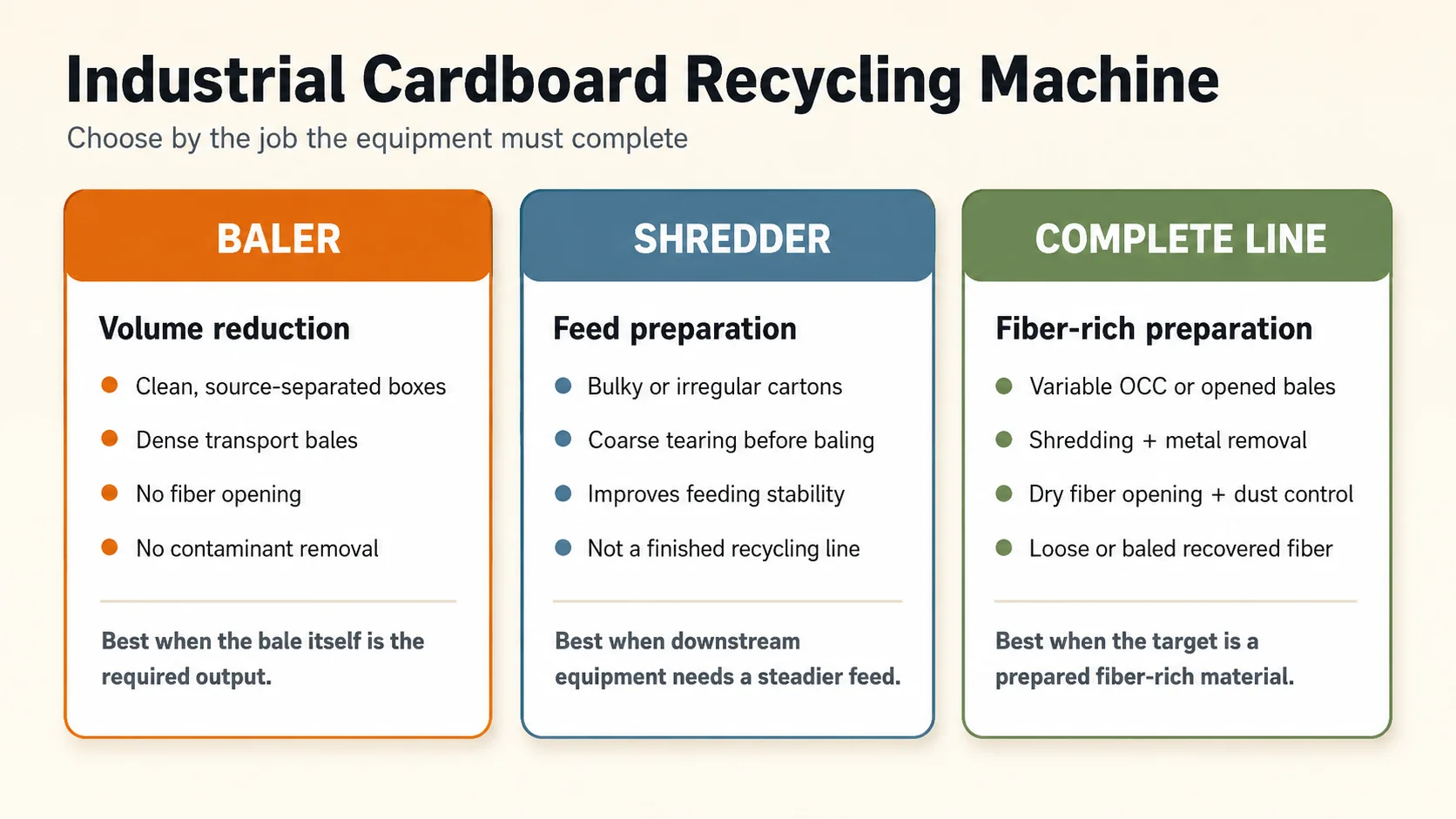
Put every proposal into the same scope matrix. A baler-only quote should not be compared with a complete line total. Likewise, a “complete line” is not complete when it omits the transfer equipment, ducting, platforms or controls required to connect the named machines.
Minimum scope checklist
- Receiving method, hopper, conveyors, bale opening and inspection access
- Shredder chamber, cutter design, drive, overload logic and expected output
- Magnetic separation and hard-contaminant removal route
- Buffer hopper, metering conveyor, level sensors and line-control logic
- Dry fiber opener, rotor/screen basis and required fiber condition
- Dust hoods, ducts, fan, filter area, discharge and fire-related interfaces
- Loose collection or baler type, bale specification and tying system
- Platforms, guards, emergency stops, electrical panels and cable scope
- Foundations, building openings, utilities, installation and commissioning
- Wear parts, initial spares, documentation, training and acceptance test
Price should be reviewed after the boundary is normalized. The separate cardboard recycling machine price guide explains why a low equipment-only number cannot be treated as the installed cost of a complete plant.
Common Buying Mistakes
Buying the machine name instead of the process function
“Cardboard machine,” “OCC machine” and “paper recycling machine” are broad commercial labels. Write the required functions in order: receive, inspect, open, reduce, remove metal, meter, open fiber, collect dust and discharge.
Assuming shredding means recycling is complete
A shredder produces smaller cardboard. It does not guarantee a clean grade, a mill-ready furnish or an accepted product.
Adding a generic baler at the end
Opened fiber behaves differently from whole boxes. Baler feed opening, chamber, cycle, tying and dust containment should match the actual discharge material.
Using only the best material sample
A clean hand-sorted sample hides the film, wet board, wire and hard rejects that determine downtime. Test normal and worst-case feed, not only the easiest batch.
Ignoring the equipment between major machines
Conveyors, buffers, hoppers, sensors, enclosures and access platforms often decide whether the line runs steadily. They are not secondary details.
Specifying finished paper from a dry preparation line
The line can prepare recovered fiber-rich material. The downstream paper or molded-fiber plant must confirm final suitability and add the required wet stock preparation or product-forming stages.
Where YUXI Fits
YUXI configures industrial cardboard recycling systems around the actual feedstock and required discharge rather than one fixed machine list. The possible scope includes receiving conveyors, bale opening, double-shaft shredding, magnetic separation, buffer storage, mechanical dry fiber opening, dust collection, loose fiber collection, automatic baling and PLC coordination.
For an initial engineering review, provide material photos or video, normal and maximum feed size, loose or baled condition, bale dimensions and wire, moisture, contamination, required hourly or daily output, downstream use, available workshop size and local power supply.
Choose the Line from Your Actual Cardboard Waste
Send material photos, bale details, contamination, required output and workshop dimensions. YUXI can assess whether the project requires simple compaction, primary shredding or a complete dry OCC preparation line, then define the equipment boundary around the actual feed and required output.
Industrial Cardboard Recycling Machine FAQ
Is a cardboard baler a recycling machine?
Yes, it is a material-preparation machine used to compact cardboard for storage and transport. However, it does not shred the cardboard, remove contamination or convert the material into finished paper pulp.
Do I need to shred cardboard before baling?
Not always. Clean flattened boxes can often be baled directly.When cartons or sheets are too bulky, bridge in the feed system, require confidential destruction or must be reduced before another process,shredding becomes useful .
What is the difference between a cardboard shredder and a complete recycling line?
A shredder performs size reduction. A complete line coordinates receiving, shredding, contaminant removal, metering, dry fiber opening, dust control, collection and optional baling.
Can a complete dry line make finished paper?
No. It can produce loose or baled mechanically opened fiber-rich material. Finished paper normally requires downstream wet pulping, screening, cleaning, stock preparation and paper-forming equipment.
Can OCC bales go directly into the shredder?
The bale condition must be reviewed first. Wire or straps should be removed, the bale may need controlled opening, and obvious hard or non-paper contaminants should be taken out before continuous feeding.
What cardboard should be tested before equipment selection?
Mixed paper, wet board, waxed or wet-strength packaging, laminated board, heavily coated material and streams from several variable suppliers should be tested against the intended downstream specification.
What determines real line capacity?
Feed bulk density, bale opening, conveyor loading, moisture, contamination, shred size, fiber-opening intensity, air-system balance, baler cycles, reject rate and operating availability all affect sustained output.
What information is needed for a quotation?
Provide feed photos or video, material grade, loose or baled form, bale dimensions and weight, moisture, contamination, required output, working hours, workshop dimensions, loading method, voltage and downstream use.
References and Source Notes
- U.S. Environmental Protection Agency, The U.S. Recycling System. Used to distinguish collection, processing and remanufacturing.
- American Forest & Paper Association, The Paper Recycling Process. Used to describe baling at a MRF and water-based pulping at a paper mill.
- American Forest & Paper Association, Paper & Cardboard Recycling. Reports a 2024 U.S. cardboard recycling rate of 69%–74% and more than 33 million tons recycled.
- American Forest & Paper Association, Voluntary Standard for Coated or Treated Corrugated. Used for the repulpability and recyclability testing boundary.
- Occupational Safety and Health Administration, Green Job Hazards: Recycling—Paper. Used for machinery, crushing, unexpected-startup and paper-handling hazards.
- Occupational Safety and Health Administration, Combustible Dust: An Explosion Hazard. Used to establish that paper and pulp dust may require hazard evaluation.