




 Request Quote



The first quotation says 3 t/h. The second also says 3 t/h, but costs more. A third supplier uses the same headline capacity and then adds a screen, magnetic removal, an eddy-current separator, dust collection, platforms and commissioning. The totals now sit in the same spreadsheet, although the suppliers are not really pricing the same job.
We see this problem most often when “aluminum scrap” is treated as a complete feed description. It is not. Long window profiles behave differently from cast housings. Light sheet does not feed like mixed demolition scrap, and wet machining turnings should not be routed as though they were dry bulky material. The quotation only becomes useful when the feed, product and project boundary are visible behind the price.
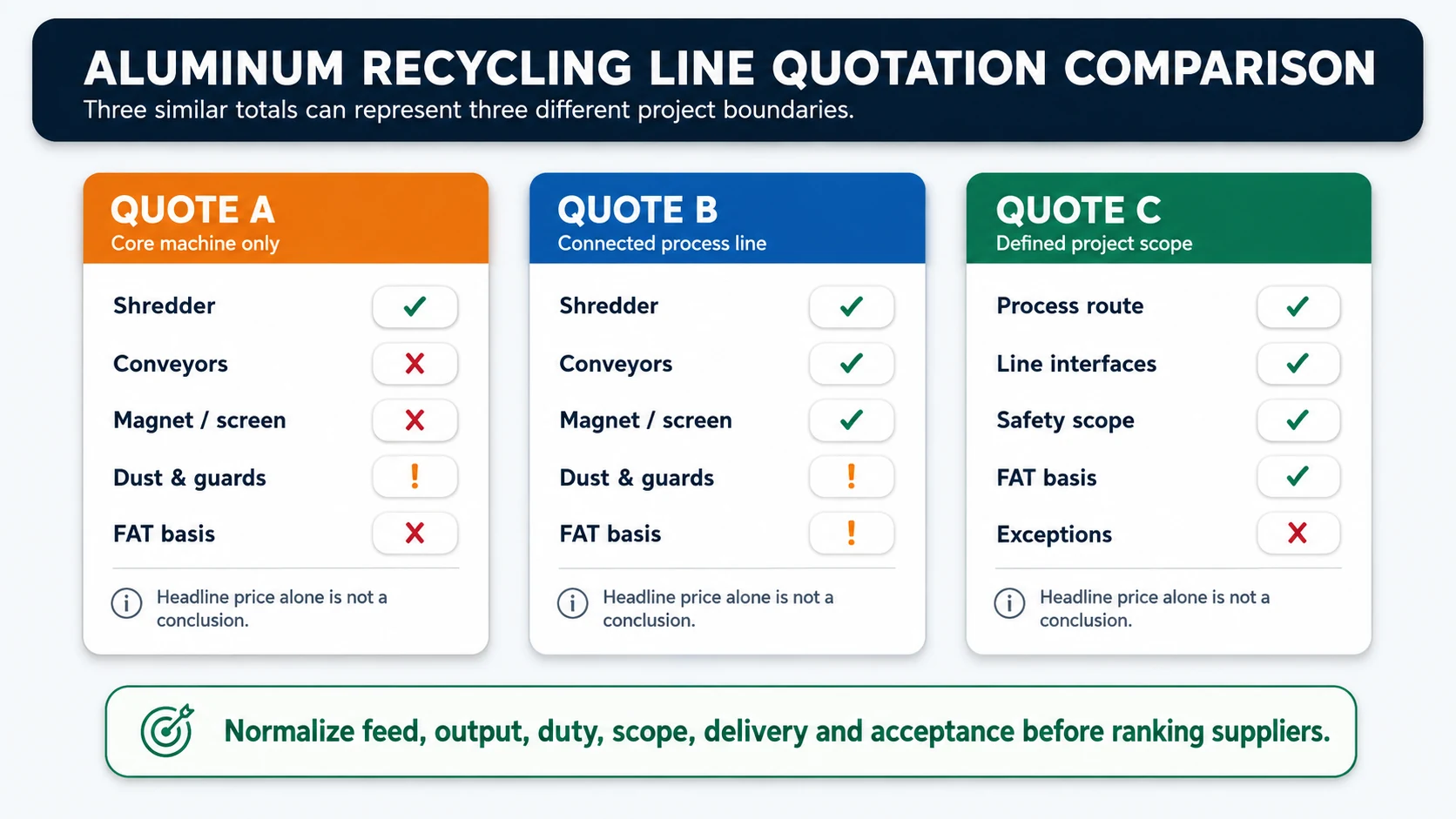
The Price Sheet Is Usually the Last Thing to Compare
The public YUXI scrap aluminum recycling line page separates several broad routes. Suitable profiles or mixed scrap may need shredding and physical sorting. Selected light material may be inspected and baled. Chips and turnings can require liquid control and briquetting. These are not alternative price levels for one standard plant. They solve different handling and product problems. For the equipment-scope view, compare the quotation boundary with YUXI’s scrap aluminum recycling line solution page.
The U.S. EPA describes secondary aluminum pretreatment in much the same way: sorting, processing and cleaning steps vary with scrap quality, source, available equipment and the required product.[1] That matters during procurement. A quotation for primary size reduction cannot be judged against a proposal for liberation, screening and separation simply by dividing both totals by the stated tonnes per hour.
A practical review starts with one question: what must be different about the material when it leaves the line? Sometimes the answer is only “shorter and easier to transport.” In another project, attached steel must be removed and a more uniform aluminum-rich fraction is required. A third buyer may need a product that fits a downstream sensor sorter. Those answers lead to different machines, transfers and tests.
Surprisingly, the longest equipment list is not always the safer quotation. We have also seen the opposite problem in proposal reviews: a short list appears economical because feeding, return material, dust capture or product discharge has been left for the buyer to solve. Before discussing price, make each supplier state the result its route is designed to deliver.
Give Every Supplier One RFQ Basis They Can Actually Use
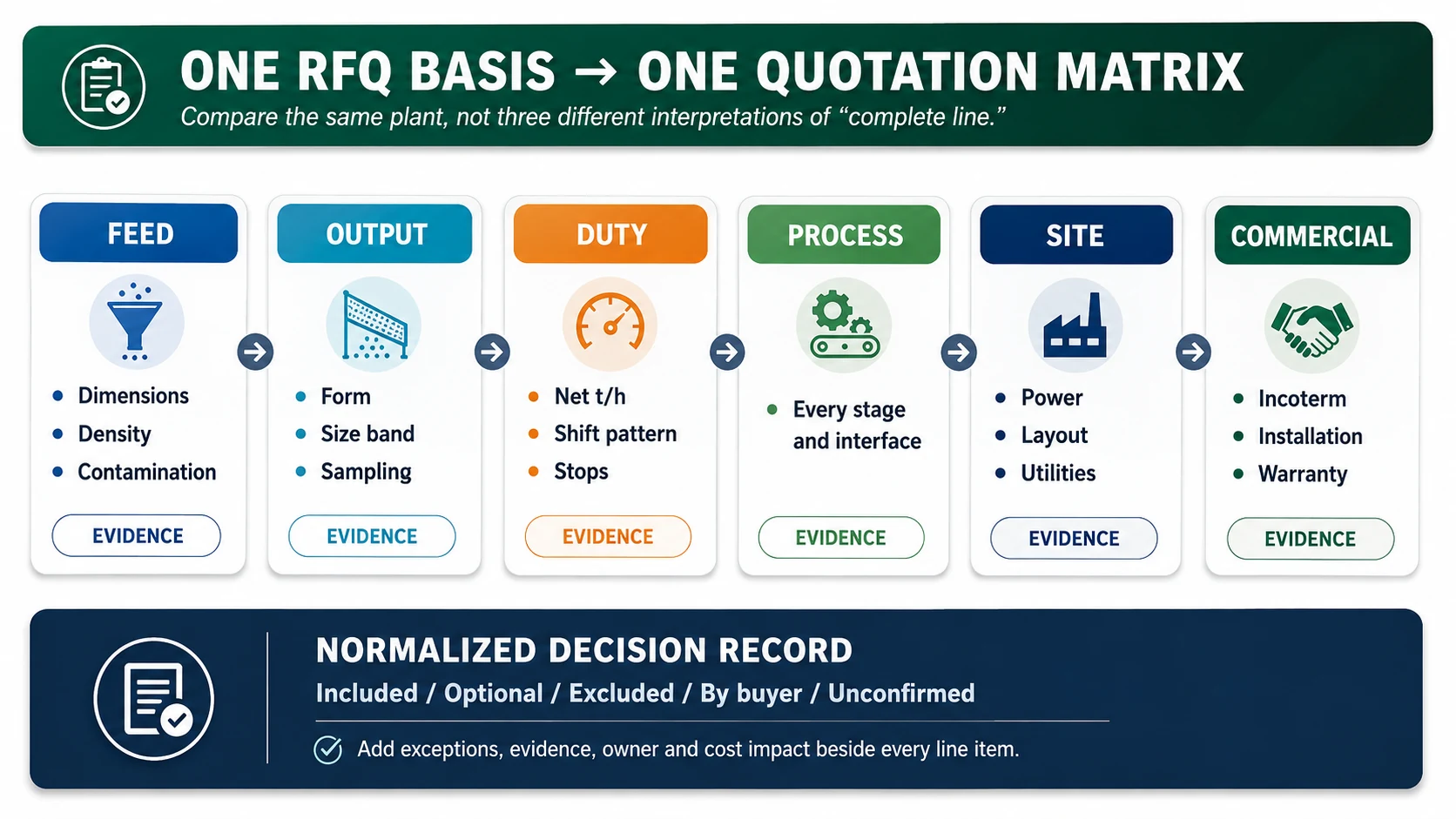
Good comparison work begins before the quotations arrive. Send the same revision-controlled request for quotation to every supplier. When the feed video, building dimensions or output specification changes, issue the same update to all bidders. Otherwise, one proposal may reflect the latest information while another is still based on the first email.
| RFQ section | Information that changes the design | Useful evidence |
|---|---|---|
| Incoming material | Material groups, typical mix, maximum dimensions, thickness, single-piece weight, bulk density, moisture or cutting fluid, attached steel and non-metal contamination | Typical and worst-case photos, loading video, weighed sample and container-density check |
| Required product | Reduced pieces, cleaner aluminum fraction, bale, briquette or prepared sensor-sorter feed; target size and allowed contamination where relevant | Buyer specification, representative product sample, sampling method and reject limits |
| Operating duty | Required net throughput, scheduled hours, shifts, normal feed changes, cleaning allowance and expected seasonal variation | Current supply volumes, shift plan and realistic operating calendar |
| Site and utilities | Voltage, frequency, control preference, floor and headroom, door openings, columns, loader access, lifting method and local requirements | Dimensioned plan, photographs, utility list and site responsibility notes |
| Commercial boundary | Destination, requested Incoterm, packing, delivery, erection, commissioning, training, spares, documents and acceptance | Responsibility matrix and required quotation format |
Do not make the material look easier just to receive a cleaner price. Normal batches may be lighter, wetter or more tangled than the sample photographed on the floor. That difference often shows up later as bridging at the hopper, extra reversals, screen overload or slower manual sorting.
A supplier that asks for another video or a measured bulk-density check may appear slower during the enquiry stage. In practice, those questions are often more valuable than an immediate promise. They show where the design still depends on an assumption.
Read the Process Route from the Feed Backward
The separate aluminum recycling equipment selection guide deals with equipment choice in more detail. During quotation review, the useful exercise is simpler: write one sentence beside every machine explaining why it is there.
Start at receiving. Long profiles and loose light sheet can create a volume problem before they create a motor-load problem. The hopper, loading method and metering arrangement need to control surging and bridging. Then look at reduction. A low-speed metal shredder may be suitable for primary size reduction of bulky light scrap. A hammer mill metal crusher performs a different duty when finer reduction or greater liberation is needed. An eddy current separator belongs where suitably sized conductive non-ferrous pieces need to be recovered from an appropriate non-metal stream. None of these machines is a universal substitute for the others.
A common quotation review looks like this. Supplier A includes a primary shredder, magnet and discharge conveyor. Supplier B adds secondary reduction and screening. At first glance, B appears to be adding equipment to raise the price. The real question is whether steel inserts, plastic strips or compact assemblies remain locked after primary shredding. If they do, B may be solving a product-quality problem. If the feed is already clean sheet and the buyer only wants volume reduction, the deeper route may add wear and power without creating value.
We normally ask suppliers to mark three points directly on the process diagram: where uncontrolled feed becomes metered feed, where attached material is expected to be liberated, and where the product is declared acceptable. Those marks reveal more than a long component schedule because they connect the equipment list to the result.
A Capacity Number Needs a Measuring Point
“5 t/h” can describe a short trial into the first machine, gross feed entering a complete line, accepted material leaving a screen, or saleable aluminum product after rejects and recirculation. Each number can be accurate. They are not interchangeable.
The aluminum recycling line capacity guide explains why bulk density, piece shape, contamination, target size and downstream bottlenecks change practical output. For quotation comparison, ask each supplier to answer the same five questions.
| Question | Answer that is too vague | Evidence that can be compared |
|---|---|---|
| What material was used? | “Aluminum scrap” | Photos, dimensions, bulk density, attachments, contamination and test mass linked to the design feed |
| Where was throughput measured? | “At machine output” | Primary discharge, complete-line discharge or qualified product named clearly |
| How long did the run last? | Peak display or edited video | Total duration, productive runtime, interruptions and manual intervention |
| What counted as acceptable product? | A clean handful | Written size or contamination method, weighed product and identified reject streams |
| What limits the route? | Largest motor rating | Feeder volume, reduction duty, screen load, separator burden, recirculation and discharge reviewed together |
We treat capacity as provisional until the feed, runtime, measuring point and product condition are attached. A larger unsupported number is not a stronger guarantee. It is simply harder to test later.
Rebuild the Offers on One Scope Sheet
Supplier quotation formats rarely line up. A conveyor may be shown on a drawing but absent from the commercial list. “Complete electrical system” may mean the control cabinet only. Platforms may be included around one machine and expected from the buyer around the rest of the line.
Instead of reading each proposal in its own format, rebuild the relevant lines in one worksheet. We usually add an owner, evidence and cost-impact column. “By buyer” is not automatically a weakness. An item with no owner is.
| Scope area | What should be visible | Typical hidden boundary |
|---|---|---|
| Core process | Machine function, drive, feed limits, discharge condition and wear system | A named machine without the duty it is expected to perform |
| Material handling | Hoppers, conveyors, chutes, return paths, reject discharge, bins and transfer elevations | Unpriced interconnecting conveyors or product bins |
| Quality control | Magnet, screen, ECS, sampling points and product inspection method | Separator included without suitable sizing or stable feed presentation |
| Dust, access and guarding | Capture points, duct boundary, platforms, covers, interlocks and maintenance openings | Collector shown while ducting, supports or local hazard review remain open |
| Electrical and controls | Panel, PLC/HMI, field devices, local isolators, software, drawings, cables and trays | “Electrical included” but field wiring and installation excluded |
| Delivery and site work | Packing, freight, unloading, positioning, civil data, erection, commissioning, training and acceptance | Turnkey wording without named battery limits |
Field cables are a good example. On a compact skid, the omission may be minor. On a spread-out recycling line, cable length, trays, terminations and installation labor can become a meaningful site cost. A single phrase in the quotation is not enough; the boundary needs to be marked on the electrical or layout drawing.
The Missing Lines Often Cost More Than the Price Difference
The dedicated aluminum recycling plant cost guide covers the wider project budget. At quotation stage, the immediate task is to move every proposal to the same point: delivered, installed and ready for the agreed acceptance test.
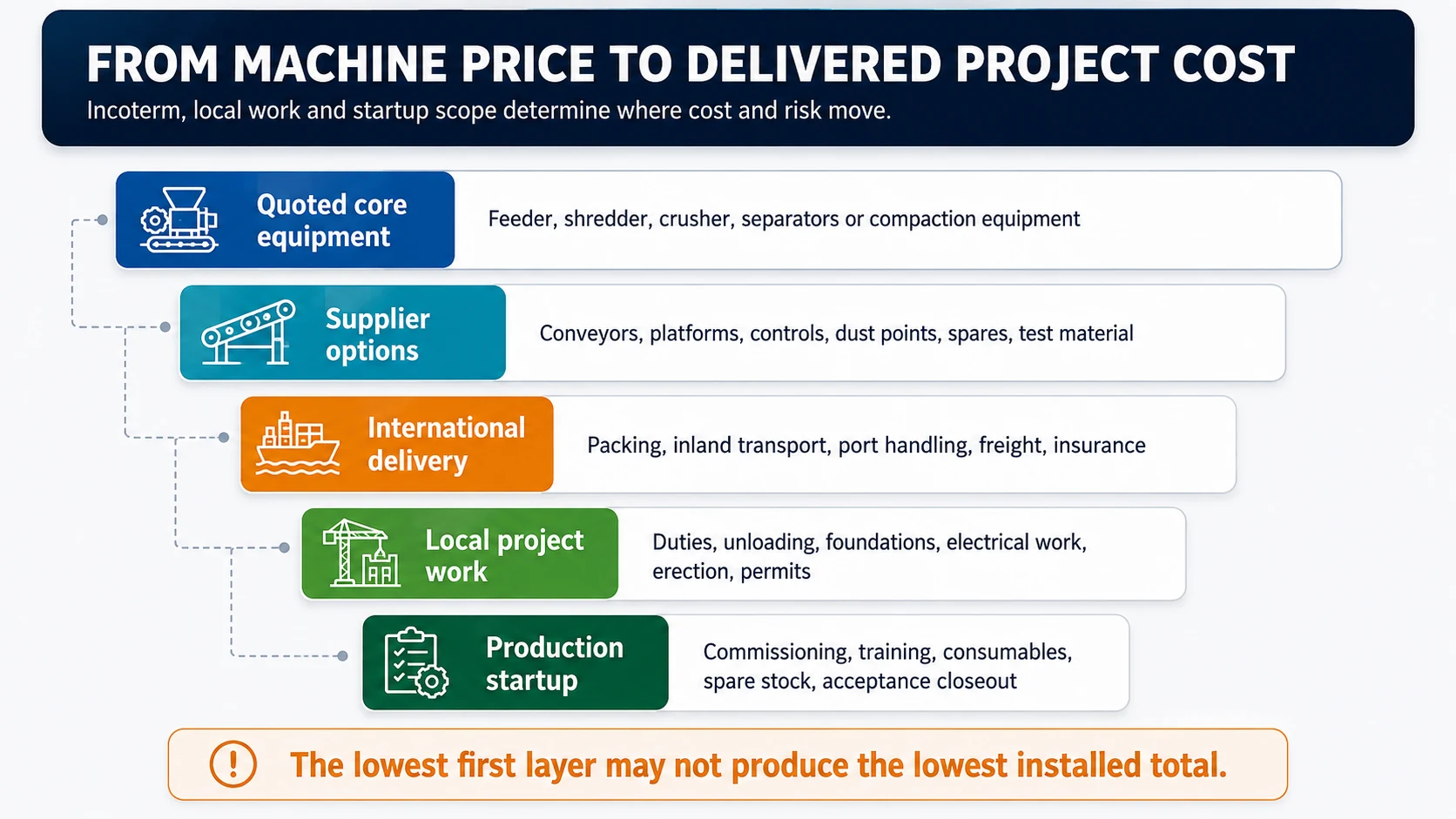
Start with the equipment total, then add required options, freight and handling, local fabrication, foundations, cables, utilities, erection labor, travel, accommodation, commissioning resources, startup material and any buyer-supplied safety or dust work. Record taxes and duties separately because treatment varies by destination and buyer circumstances.
International offers also need the same named place and Incoterms rule. The U.S. International Trade Administration explains that Incoterms allocate transport, insurance, documentation and customs responsibilities between buyer and seller.[2] ICC publishes the Incoterms 2020 rules used to clarify those responsibilities.[3] The rule is useful, but it does not tell you who will unload a container, move a machine inside the workshop or provide the crane for assembly unless those tasks are written.
On one common comparison pattern, the factory-price offer looks clearly cheaper. After ocean freight, port charges, unloading, local platforms, field wiring and commissioning are added, the gap narrows sharply. That does not make the first supplier misleading. It means the buyer compared a factory boundary with a startup boundary.
Look at What Operators Will Notice After Startup
Component brands matter, but the nameplate does not show whether a bearing can be removed, whether a blocked chute can be reached safely or whether an adjacent conveyor must be dismantled before a screen panel is changed. The aluminum recycling line maintenance checklist can be turned into procurement questions before the layout is frozen.
Safety and dust boundaries need to be concrete. For U.S. projects, OSHA’s general machine-guarding rule covers hazards such as points of operation, ingoing nip points, rotating parts, chips and sparks.[4] OSHA’s hazardous-energy standard addresses energy control during servicing and maintenance.[5] OSHA’s scrap-metal guidance discusses shredding, baling, de-energization, dust and engineering controls in recycling operations.[6]
At the quotation stage, ask where guarding starts and ends, which access doors are interlocked, where emergency-stop devices are located, where lockable isolation points are provided, and how jams can be cleared under an approved energy-isolation procedure. For dust, mark the proposed pickup points and the supplier’s duct or collector boundary. The final site still requires local review by the operator, qualified professionals and relevant authorities.
The aluminum recycling plant layout guide explains why loader movement, maintenance pull-out space, bin changes, platforms and utility routes affect whether the line can be operated and serviced as intended.
Warranty language deserves the same treatment. “One year” is incomplete until the start date, long-stop date, excluded wear items, remedy, freight responsibility and claim evidence are written. Documents should also have due dates. A machine may physically arrive before the foundation drawing, final electrical schedule or software backup, but the project cannot usefully proceed in that order.
A Useful FAT Is Less Theatrical Than a Demonstration Video
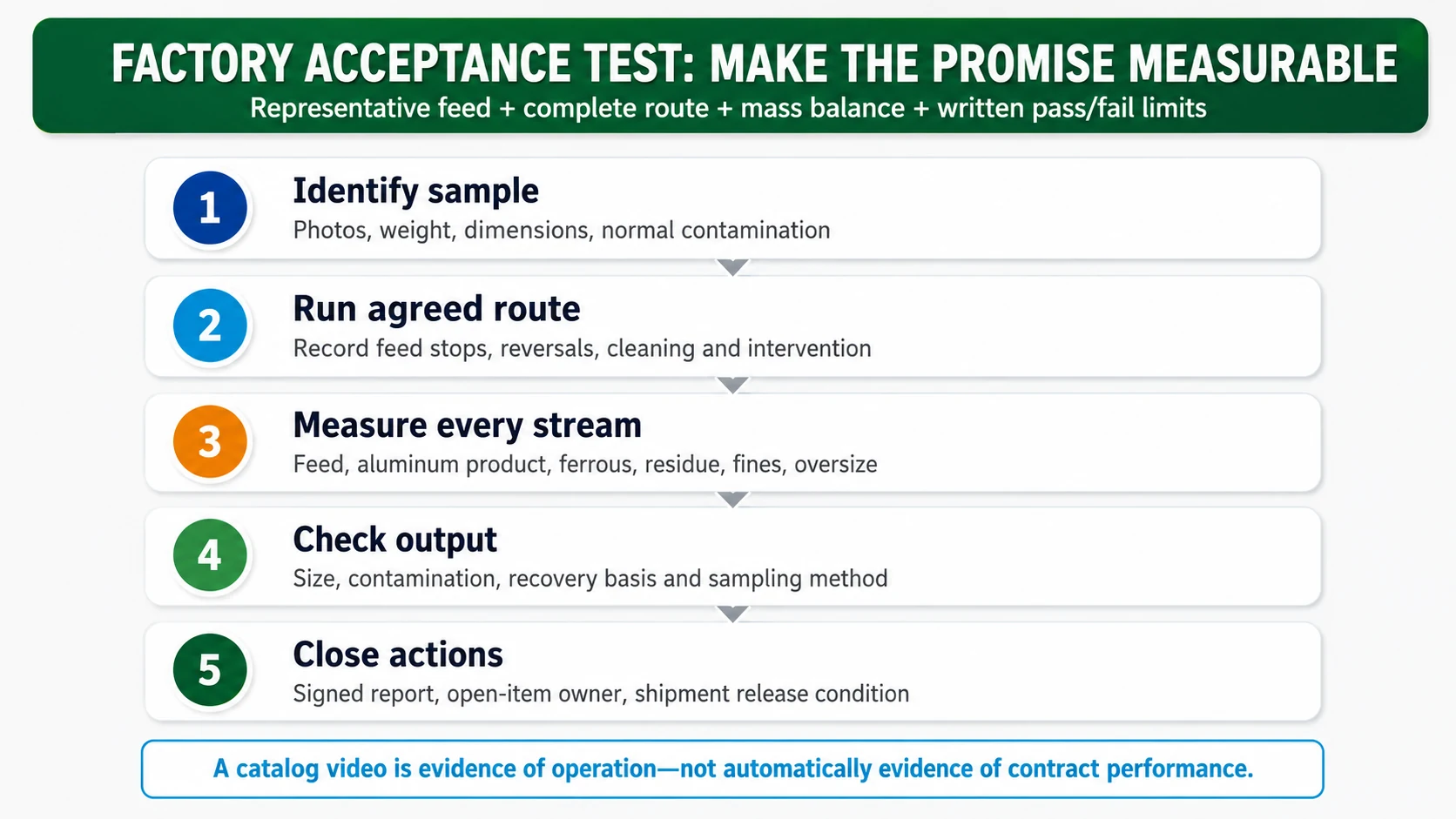
A clean video proves that material moved through the machine. It may not prove complete-line throughput, product quality, mass balance or the amount of operator intervention. The factory acceptance test needs to match the promise used to approve the quotation.
- Identify the test feed. Photograph and weigh it. Record dimensions, bulk density, attached material, moisture and contamination, then compare it with the design basis.
- Run the contracted route. A shredder-only trial does not validate downstream screening or separation when those stages are part of the purchase.
- Record the whole test period. Show productive runtime, no-feed periods, reversals, blockages, cleaning and manual sorting or intervention.
- Weigh important streams. Feed, accepted aluminum product, ferrous material, non-metal residue, fines, oversize and retained material should be traceable.
- Use the agreed product check. Apply the written size, contamination or sampling method rather than selecting a few clean pieces for inspection.
- Close findings in writing. Give each open item an owner, evidence requirement and due date, and state which findings block shipment.
Payment milestones should follow evidence that can be verified: approved design information, manufacturing progress, FAT release, shipping documents, commissioning and final site acceptance. There is no universal percentage schedule. The important part is to avoid treating shipment and proven production as the same event.
Rank Evidence Only After Removing Hard Failures
A weighted scorecard can help a team compare several viable offers. It can also create false comfort. A quotation should not collect enough points for delivery and warranty to compensate for a route that cannot handle the normal feed.
We remove hard failures first. Typical examples include an incompatible process route, capacity with no defined measuring point, an acceptance method that cannot measure the promised result, or major buyer and supplier responsibilities that remain unowned. Only then does a weighted comparison become useful.
Process fit usually carries the most weight. The supplier should explain how the feed is received, reduced, liberated, sized and separated, including where the route may struggle.
Performance evidence comes next. Representative tests, a defined complete-line measuring point and a traceable product check are more useful than confident language.
Scope completeness protects the budget. Conveyors, platforms, field wiring, dust boundaries, local work and acceptance responsibilities should be visible even when they are excluded.
Lifecycle support separates two technically similar offers. Access, spares, drawings, software backups, training, warranty and response arrangements influence the cost of owning the line long after the purchase order.
A drawing, test record or responsibility matrix should score higher than “included as standard.” The aim is not to reward the proposal with the most pages. It is to reward the proposal that leaves the fewest important assumptions hidden.
A Quotation Review That Looks Simple but Is Not
The pattern below is illustrative rather than an actual YUXI customer project. It reflects the kind of mismatch that appears when three offers are summarized too early.
| Review point | Offer A | Offer B | Offer C |
|---|---|---|---|
| Process description | Primary shredder and discharge conveyor | Shredder, secondary crusher, magnet, screen and ECS | Feed-based route with optional second stage and defined product handling |
| Capacity statement | High figure at primary discharge | Same headline figure; complete-line point unclear | Lower provisional figure tied to representative feed and accepted product |
| Site boundary | Factory supply | Freight to port; platforms and ducts open | Named Incoterm, responsibility sheet and drawing interfaces |
| Acceptance | No material test | Supplier-selected demonstration feed | Buyer-approved sample and written pass/fail method |
| What the review reveals | Lowest total, but mainly a size-reduction purchase | Deepest equipment list, though performance basis needs clarification | Most transparent basis; still requires test and normalized cost before ranking |
Offer C is not automatically the winner. It is easier to evaluate because the assumptions are visible. Offer A may be correct for a buyer who only needs volume reduction. Offer B may be the right route when liberation and downstream separation are essential. The decision changes with the required product.
This is why a quotation review should finish with technical exceptions and unpriced owner items, not with a colored ranking alone. A proposal can be commercially attractive and still need one more test. Another can be technically complete but unnecessarily complicated for the feed. The review needs room to say both.
Questions Worth Sending Before the Purchase Order
- Which revision of our feed, output and site information was used for this proposal?
- Which normal feed conditions are outside the quoted duty?
- Where is capacity measured, and what material and runtime support the figure?
- How will particle size, contamination or product acceptance be sampled?
- Where do oversize, fines, ferrous material and non-metal residue leave the process?
- Which conveyors, bins, platforms, guards, dust interfaces, cables and site works are excluded?
- Which Incoterm and named place apply, and who handles unloading and indoor positioning?
- Which drawings are due before civil and electrical work begins?
- What parts, tools and training are included for startup and routine maintenance?
- What starts the warranty clock, and who pays freight and labor for an accepted claim?
- Which FAT findings block shipment, and which may be closed after delivery?
- Who owns commissioning, operator training and final site acceptance?
How YUXI Prepares a Comparable Aluminum Line Proposal
YUXI’s public solution framework starts with the actual material and required product rather than one fixed “aluminum recycling plant.” Depending on the feed, a project may use shredding and physical sorting, inspection and baling, or chip collection with liquid control and briquetting. Inside a shredding route, primary reduction, optional secondary liberation, magnetic removal, screening and eddy-current separation are selected according to the contamination and product target.
For a useful comparison, send YUXI the same evidence supplied to other bidders: representative and worst-case feed photos or video, maximum dimensions, bulk density, attached steel and non-metal content, moisture or fluid condition, required net throughput, operating hours, final product, power supply, workshop dimensions, destination, installation boundary and acceptance expectations.
The proposal can then be reviewed as a process and responsibility document rather than only as a number at the bottom of a price sheet.
Request a Comparable Aluminum Line Proposal
Send your feed evidence, output specification, capacity basis, site data and required delivery boundary. YUXI can separate the core equipment, options, local work, commissioning and acceptance items so the proposal is easier to compare with other quotations.
FAQ
Why can two aluminum line quotations show the same capacity but different prices?
The suppliers may be measuring capacity at different points or pricing different process depth. One offer may cover primary size reduction, while another includes liberation, screening, metal separation, dust work and commissioning. Compare the feed, accepted output, measuring point and project boundary before treating the price gap as meaningful.
Does a turnkey quotation always include installation?
No. Turnkey is only useful when the contract lists the battery limits. Confirm foundations, unloading, positioning, platforms, ducts, utilities, field wiring, erection labor, commissioning, training and acceptance. Some may remain buyer work even when the main line is described as turnkey.
What should be proven during the factory acceptance test?
The FAT should use agreed representative material, run the contracted process, record productive time and interruptions, weigh important product and reject streams, apply the written product-check method and close open items in a signed report. A short machine demonstration is not equivalent to a complete-line acceptance test.
Can a supplier guarantee a fixed aluminum purity?
Only when the feed range, process route, product definition, sampling method and acceptance limit are written. Purity or recovery claims without those boundaries are difficult to verify because the result changes with contamination, alloy mix, liberation and the way samples are collected.
References and Source Notes
- U.S. Environmental Protection Agency, AP-42 Chapter 12.8: Secondary Aluminum Operations. Source
- U.S. International Trade Administration: Know Your Incoterms. Source
- International Chamber of Commerce: Incoterms 2020. Source
- OSHA 29 CFR 1910.212: General Requirements for All Machines. Source
- OSHA 29 CFR 1910.147: The Control of Hazardous Energy. Source
- OSHA 3348: Guidance for the Identification and Control of Safety and Health Hazards in Metal Scrap Recycling. Source