




 Request Quote

Product Center
-
- Biomass Shredding and Recycling Line
- OCC Paper Dry Pulping & Cardboard Recycling Line
- Scrap Aluminum Recycling Line
- Waste Car Recycling Line
- Waste Refrigerator Recycling Line
- Copper Aluminum Radiator Recycling Line
- Motor Rotor Recycling Line
- Copper Wire Recycling Line
- Waste Ink Cartridge Recycling Line
- Aluminum UBC Scrap Recycling Line
Get a Quote
Contact Us


A list of eddy current separator manufacturers is only useful when the machines are being judged for the same job. Recovering 40–150 mm aluminum from bulky shredder residue is a different problem from pulling 2–3 mm non-ferrous fines out of ASR, and a separator that works well in one duty can be a poor fit in the other. This guide compares ten established suppliers by the range of ECS designs they publish, the recycling applications they cover, how much technical detail they provide, and how well the separator can be integrated into a complete processing line.
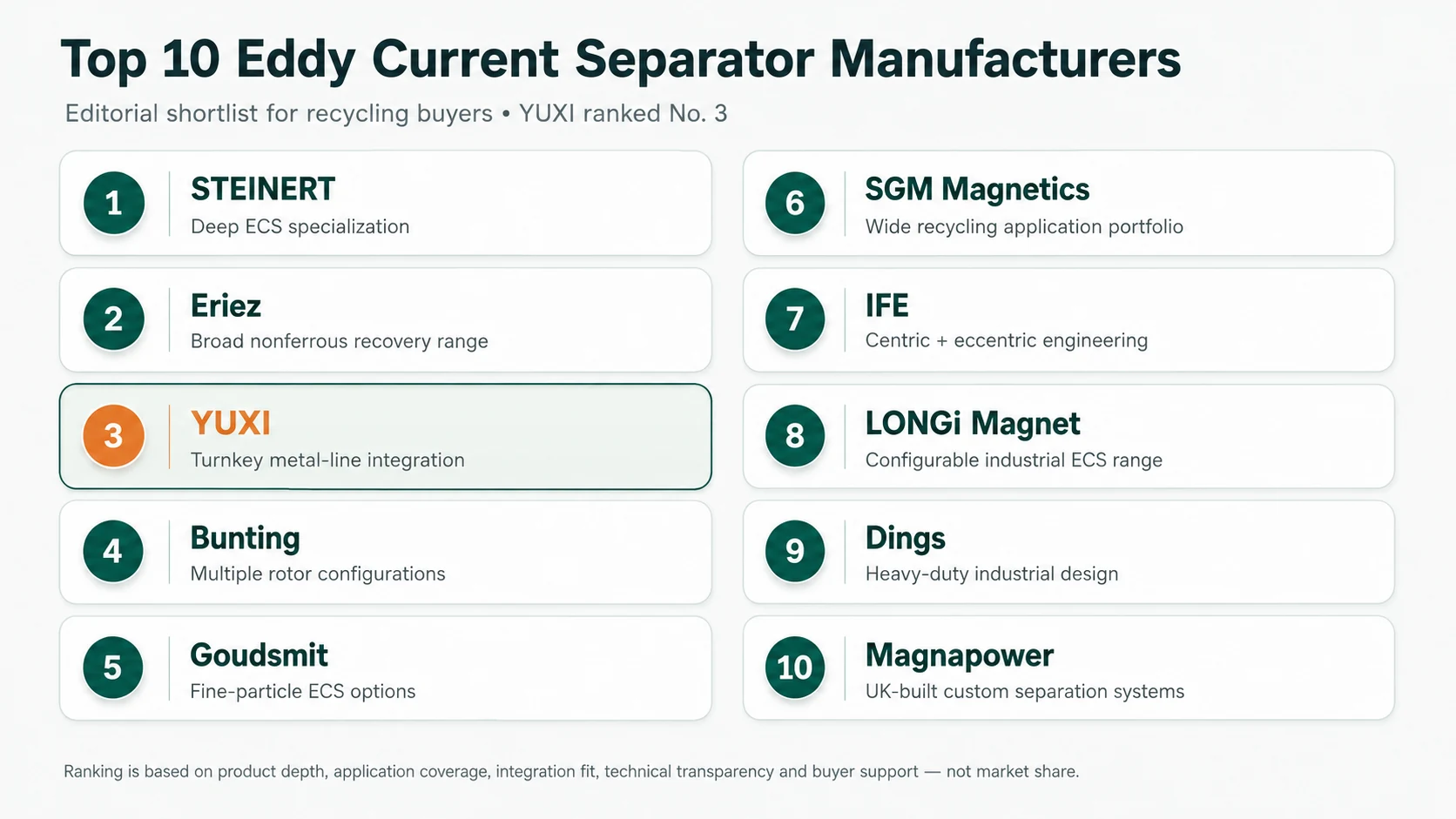
Top 10 Eddy Current Separator Manufacturers at a Glance
| Rank | Manufacturer | Base | Strong fit | What stands out |
|---|---|---|---|---|
| 1 | STEINERT | Germany | Scrap, ASR, IBA, e-waste, mixed recycling | Long-running ECS specialization and eccentric pole-system expertise |
| 2 | Eriez | United States | Scrap and fine non-ferrous recovery | RevX-E plus ultra-high-frequency options for smaller fractions |
| 3 | YUXI | China | Complete metal recycling and shredder lines | ECS supplied in the context of shredding, magnetic removal and line control |
| 4 | Bunting | US / UK | Broad recycling duties from fines to mixed waste | Concentric and eccentric models with published application guidance |
| 5 | Goudsmit Magnetics | Netherlands | Fine non-ferrous fractions and modular recycling lines | EddyFines and EddyXpert families with strong feed-presentation focus |
| 6 | SGM Magnetics | Italy | ASR, IBA, WEEE, MSW and glass | Large portfolio of application-specific concentric ECS models |
| 7 | IFE Aufbereitungstechnik | Austria | Recycling, scrap, cable and fine sorting | Centric, eccentric and special eddy-current-bar designs |
| 8 | LONGi Magnet | China | Industrial recycling and magnetic separation projects | Both concentric and eccentric ECS configurations |
| 9 | Dings Company Magnetic Group | United States | Heavy-duty recycling environments | Industrial ECS design emphasizing deep magnetic fields and durability |
| 10 | Magnapower Equipment | United Kingdom | Custom waste and scrap separation systems | Purpose-built magnetic separation with in-house service and refurbishment support |
1. STEINERT
Best fit: recyclers that want a highly specialized non-ferrous recovery supplier with a long record in scrap, IBA, municipal waste and e-waste applications.
Its current product material describes an eccentrically mounted pole system and says more than 4,000 STEINERT non-ferrous separators are in use worldwide.[1] The company positions the equipment after size reduction, classification and magnetic separation, where it recovers marketable mixtures containing aluminum, copper, zinc and brass.
STEINERT publishes the ECS as part of a wider sorting architecture, so a buyer can evaluate what the machine should receive and what other sorting stages may follow it. That matters on ASR and incinerator-bottom-ash projects, where the feed normally has several size classes and more than one valuable metal fraction.
2. Eriez
Best fit: scrap processors that need both conventional non-ferrous recovery and a route for finer fractions.
Eriez has unusually deep published material on eddy current separation. Its RevX-E range uses an eccentrically mounted rare-earth rotor, while its Ultra High-Frequency Eddy Current Separator is aimed at fines that are often missed by traditional ECS equipment. Eriez states that the UHF model can recover bare copper wire and other valuable non-ferrous metals as small as 2–3 mm under suitable conditions.[2]
That does not mean every fine feed should go straight to the UHF unit. Small particles are highly sensitive to feed depth, moisture, shape and contamination. The useful point for buyers is that Eriez clearly separates coarse and fine-duty concepts instead of presenting one rotor as universal.
Eriez also publishes a Rougher-Cleaner-Scavenger approach for downstream shredder systems. That is worth studying when one pass cannot deliver the recovery and purity balance the project needs.
3. YUXI
Best fit: buyers sourcing an eddy current separator together with shredding, crushing, ferrous removal and line controls for a metal-recycling project.
The current YUXI eddy current separator page positions the machine for non-ferrous recovery from shredder material, municipal waste, WTE bottom ash, electronic scrap, wood chips, glass and other mixed streams. The same equipment category also appears inside YUXI recycling solutions rather than being treated as a stand-alone accessory.
For example, YUXI’s waste car recycling line places magnetic separation before the eddy-current stage so that ferrous material is removed first and the ECS can focus on copper, aluminum and other non-ferrous fractions.
YUXI is therefore a practical shortlist choice when the RFQ is for a line rather than a single separator. A buyer can discuss feed preparation, shredding, magnetic removal, ECS placement and central controls in one project scope. The trade-off is that buyers who are chasing a very narrow fines application should request specific rotor, pole, belt and particle-size data rather than assume a general-purpose separator will match a specialized fine-recovery machine.
For broader plant context, see YUXI’s metal recycling equipment and solutions.
4. Bunting
Best fit: buyers who want multiple ECS designs matched to specific particle-size ranges and recycling applications.
Bunting publishes one of the clearest model breakdowns in this group. Its current range includes high-frequency eccentric, high-intensity eccentric, high-intensity concentric and general-purpose concentric configurations. The company links these designs to duties ranging from fine e-scrap and granulated plastic to white goods, glass, household waste and screened scrap.[3]
The useful takeaway is the emphasis on application-specific rotors. For a buyer comparing quotes, that makes it easier to ask whether the proposed machine is really intended for 3–10 mm granulate, 10–40 mm screened scrap or a much coarser stream. Bunting also highlights quick-change belt arrangements on several models, which is a practical maintenance point often missing from low-detail quotations.
5. Goudsmit Magnetics
Best fit: fine non-ferrous separation where feed spreading, rotor selection and splitter geometry need close attention.
Goudsmit separates its ECS offering into families such as EddyXpert for coarse to medium-fine streams and EddyFines for smaller, more difficult non-ferrous particles. Its technical pages spend considerable time on the details around the rotor: thin PU belts, stable support plates, vibratory feeding, ferrous pre-separation and different splitter tips for light or abrasive streams.[4]
That focus is useful because many ECS problems are not actually caused by lack of magnetic force. A thick or uneven bed can bury metal pieces. Sticky material can disturb trajectories. A splitter that is easy to adjust on clean demonstration material may be much harder to hold in a dusty, abrasive plant.
6. SGM Magnetics
Best fit: projects that need different ECS models for ASR, IBA, WEEE, MSW, wood or glass rather than one standard machine.
SGM Magnetics publishes a broad ECS family built around concentric rotor designs. Current models include DIS and EIS for general waste duties, GVIS for glass, SIS for larger material, VIS for fine fractions and BVIS for ultra-fine recovery. The company explicitly links each model to a material class or size range.[5]
For procurement teams, that is a strong sign that the supplier treats particle size as a first-order design variable. SGM also recommends ferrous pre-removal before the ECS, a point that should appear in almost every serious recycling-line discussion.
7. IFE Aufbereitungstechnik
Best fit: plants that want the ECS engineered together with screening and feeding, or that need unusual conductor-separation duties.
IFE offers centric and eccentric eddy current separators, plus a special INP ENOS design that uses an eddy-current bar rather than a conventional rotating magnetic drum. The company publishes machine concepts for scrap, cable, WEEE, incineration slag, plastics and other bulk streams, and it has its own screening and vibratory feeding portfolio.[6]
That combination matters when the incoming fraction is the real bottleneck. An expensive separator does not compensate for poor sizing or a surging feed. IFE’s ability to discuss screening, conveying and magnetic technology together makes it particularly relevant to retrofits where the ECS is only one part of the problem.
8. LONGi Magnet
Best fit: buyers comparing Chinese magnetic-separation manufacturers with both concentric and eccentric ECS options.
LONGi Magnet publishes both concentric and eccentric eddy current separators and positions them within a much broader magnetic-separation portfolio. Its application material covers e-scrap, ASR, glass, aluminum recycling and other industrial streams.[7]
The main buying advantage is configuration breadth. The caution is the same one we apply to every manufacturer: do not stop at “eccentric” or “concentric.” Ask for the exact working width, pole arrangement, rotor speed, belt speed range, feed module and the test basis behind the proposal. Those details determine whether two apparently similar quotations are actually comparable.
9. Dings Company Magnetic Group
Best fit: heavy industrial recycling sites that value robust construction and straightforward non-ferrous recovery equipment.
Dings markets its Eddy Current Separator for fractional-sized non-ferrous metal in dirty, dusty industrial environments. Its published design emphasizes rare-earth magnets, a deep magnetic field, durability and accessible maintenance.[8]
Dings is a sensible name to include when the project is less about ultra-fine specialty recovery and more about a rugged machine that will live in a scrap or waste plant. As with any heavy-duty ECS, buyers should still verify how the proposed rotor behaves at the smallest fraction they actually need to recover.
10. Magnapower Equipment
Best fit: projects looking for UK-built custom metal-separation equipment with service, repair and refurbishment support.
Magnapower’s ECS range is aimed at WEEE, dry recyclables, shredded scrap, incinerator ash and other mixed waste streams. The company emphasizes its rare-earth magnet system, high-frequency rotor design, custom engineering and after-sales services that include parts, repairs and refurbishment.[9]
The belt, shell, bearings, rotor protection and splitter area all need attention over the life of an ECS. A quotation that looks attractive on day one can become expensive if wear parts and specialist service are difficult to obtain.
What Actually Changes Between Eddy Current Separator Manufacturers?
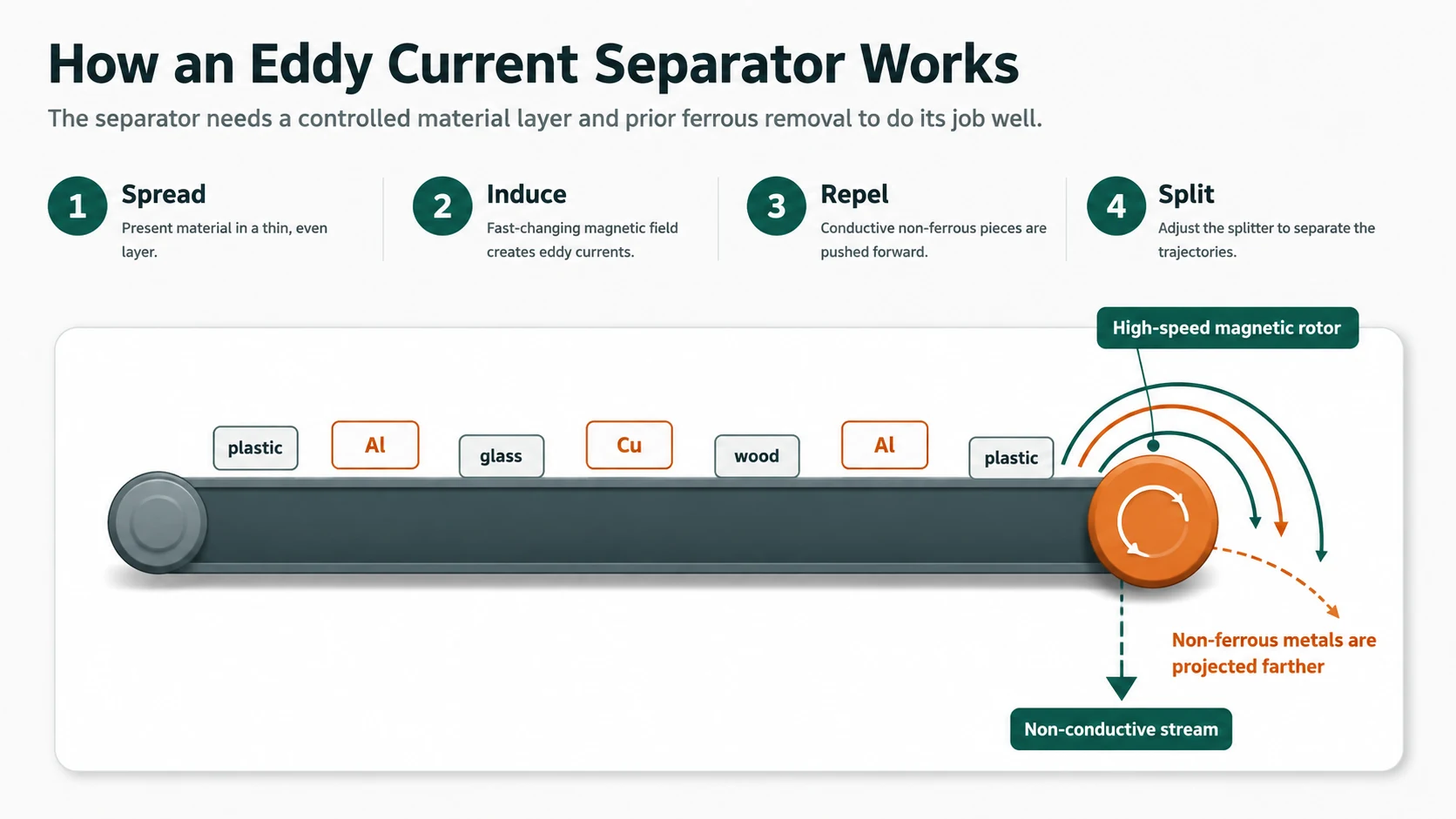
The basic physics is the same across the market: a rapidly changing magnetic field induces currents in conductive non-ferrous pieces, and the resulting force changes their trajectory. The engineering around that principle is where manufacturers separate themselves.
Rotor geometry and pole countEccentric and concentric arrangements expose material to the field differently. Fine fractions often need a different frequency and field strategy from coarse aluminum.
Feed presentationVibratory feeders, spreader conveyors and upstream screens determine whether metal reaches the rotor in a thin layer or stays buried under other material.
Belt and shell designThe distance between the magnetic rotor and the metal matters. Belt thickness, shell construction, wear protection and cleaning systems all affect real operation.
Splitter adjustmentThe best magnetic throw is wasted if the splitter cannot be positioned accurately or kept clean. Remote or rack-and-pinion adjustment can save time during tuning.
Maintenance accessBelt changes, rotor inspection and bearing access should be discussed before purchase. A compact frame is useful only if the maintenance path still works in the installed layout.
Testing and process integrationFor difficult feeds, sample testing can be more valuable than a long brochure. The supplier should also understand what happens before and after the ECS.
Where an Eddy Current Separator Should Sit in the Process
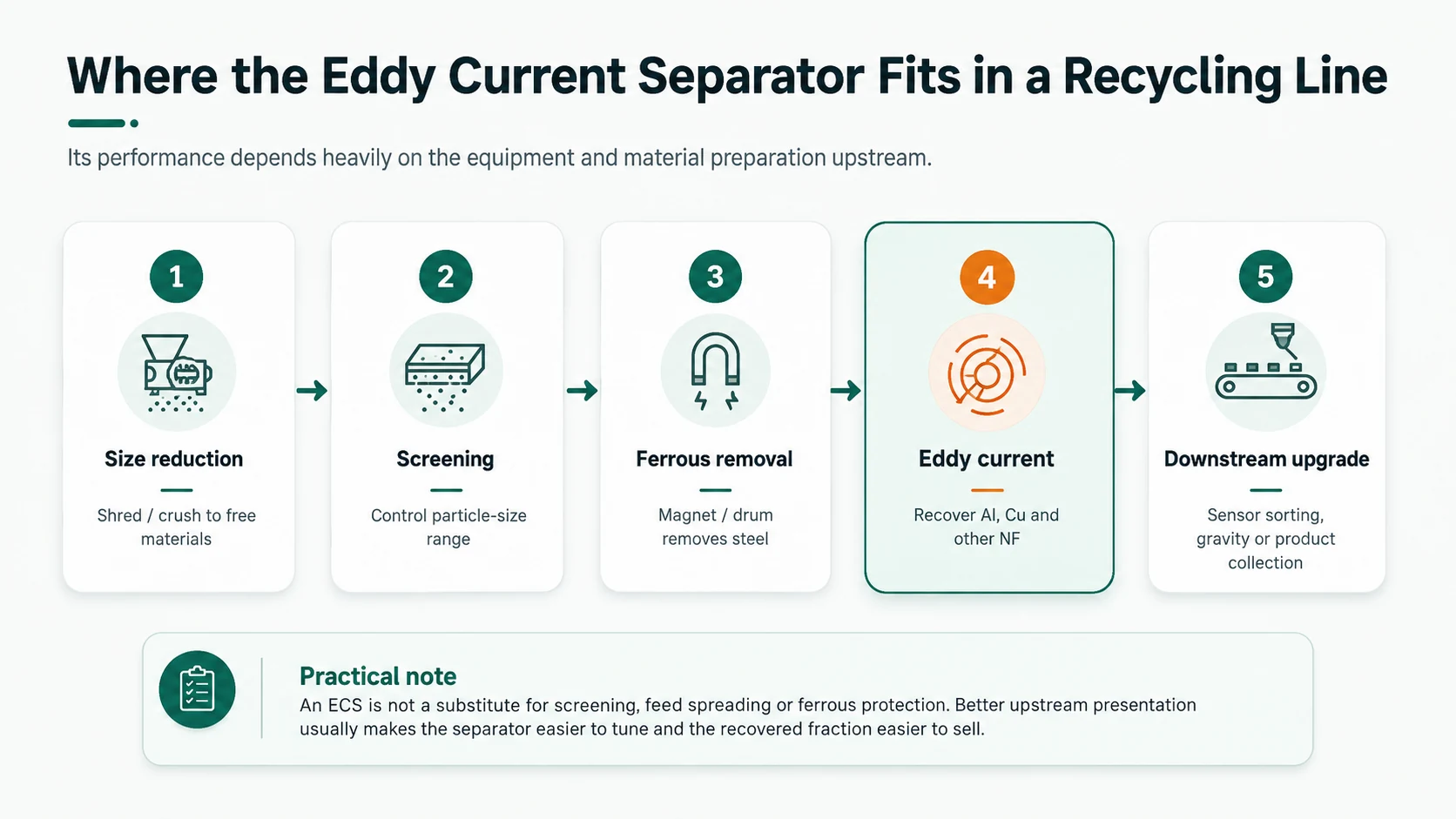
A common mistake is to treat the ECS as the first sorting machine after a shredder. In many metal-recycling lines, the better sequence is size reduction, screening or classification, ferrous removal, feed spreading and then eddy-current separation. The exact order changes with the material, but the logic is consistent: give the ECS a controlled fraction and protect it from ferrous contamination.
If the feed is extremely mixed, an air or density step may also be useful before or after the ECS. This is why complete-line engineering can be as important as the separator itself. YUXI’s scrap aluminum recycling line, for example, is a better context for discussing shredding, sorting and final product requirements than comparing ECS motor numbers in isolation.
How to Compare Two Eddy Current Separator Quotes
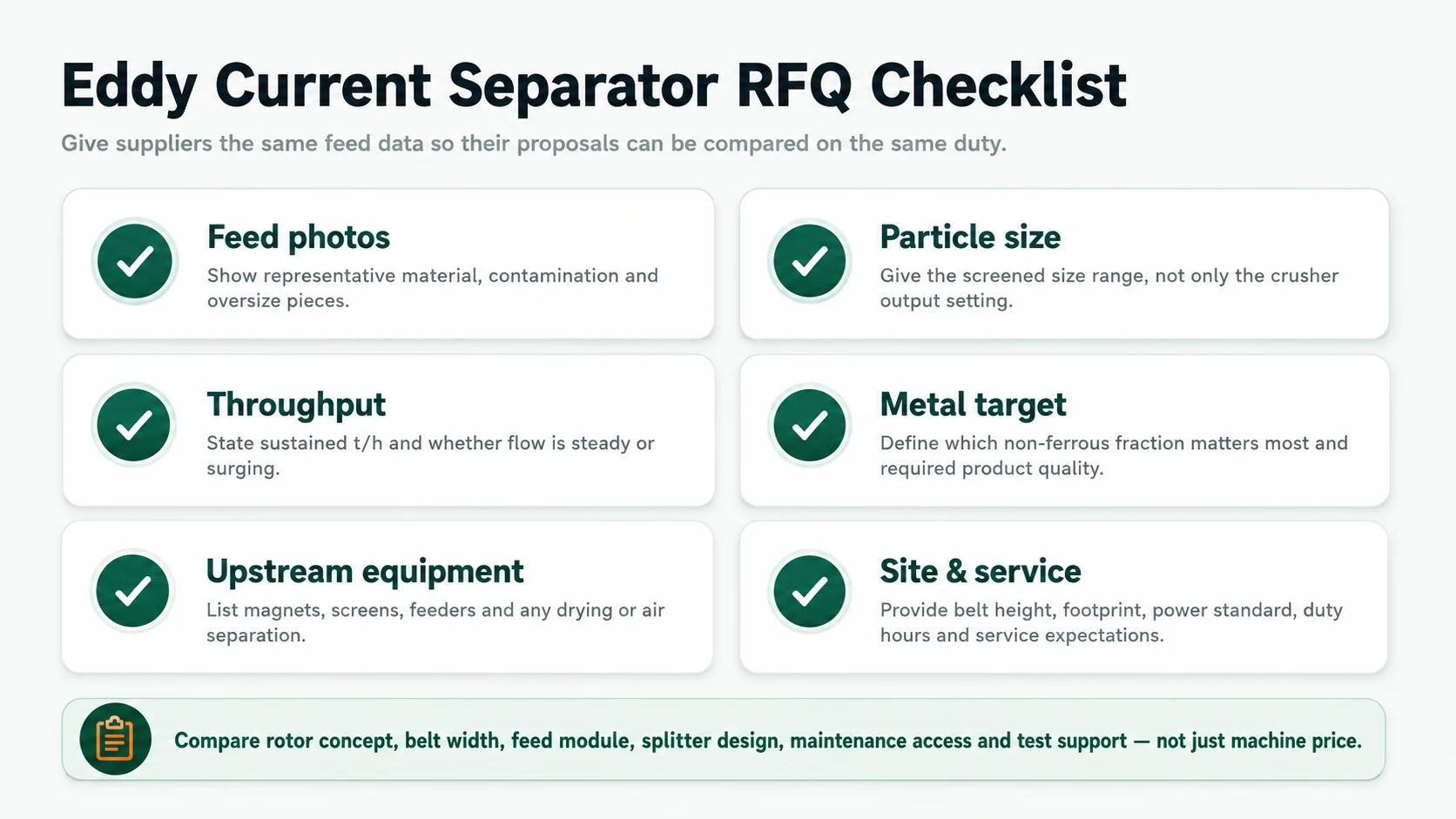
Put both suppliers on the same duty sheet. If one company assumes dry 20–60 mm material fed in a uniform layer and another assumes an unscreened 0–150 mm stream with occasional steel, their throughput and recovery claims are not comparable even if the working width is the same.
- Define the size distribution. Give a screened particle-size range, including the amount of fines and oversize material.
- State the material composition. Aluminum content, copper/brass content, plastics, rubber, glass, wood, ferrous carryover and moisture all influence separation.
- Give sustained throughput. Avoid using the upstream shredder’s headline capacity as the ECS design rate unless the flow is actually continuous at that level.
- Describe the target product. Are you recovering a saleable Zorba-like fraction, removing aluminum contamination from plastic, or chasing small copper pieces from fines?
- Compare the whole module. Feeder, ferrous protection, conveyor, rotor, splitter, guarding, controls, dust provisions, access platform and discharge chutes can materially change project cost.
- Ask how the proposal was validated. Published reference duty, prior experience, sample test or on-site trial are stronger than a generic “high recovery” statement.
Buyer Mistakes We Would Avoid
- Buying by belt width alone. Two 1,500 mm machines can have very different rotors, pole counts, field strengths, feed systems and intended particle sizes.
- Leaving ferrous removal to the ECS. Eddy current equipment is for conductive non-ferrous separation. Ferrous metal should normally be removed upstream with appropriate magnetic equipment.
- Ignoring moisture and bed depth. Wet or sticky feed and overloaded belts reduce the chance that individual metal pieces can react cleanly at the rotor.
- Assuming one pass will do everything. Fine metal recovery, high purity and high throughput can pull the setup in different directions. Multiple size fractions or rougher/cleaner stages may be more sensible.
- Comparing brochure recovery percentages without test conditions. Recovery changes with shape, conductivity, particle size, moisture, feed depth and splitter setting. A number without the feed condition tells you very little.
What to Send a Manufacturer Before Asking for Price
A serious quotation should start with the material, not the model number. Send representative feed photos or video, approximate composition, the screened size range, loose bulk density if known, moisture or sticky-material conditions, sustained tons per hour, the metal fraction you want to recover, the downstream product requirement, available footprint, power standard and operating hours. If the feed is difficult, propose a sample test and agree in advance how recovery and purity will be measured.
Need an Eddy Current Separator for a Complete Recycling Line?
Send your material photos, particle-size range, required tons per hour, target non-ferrous fraction, upstream equipment and plant layout. YUXI can use that information to discuss where the ECS belongs in the process and what data still needs to be confirmed before a valid quotation.
FAQ
Is an eccentric rotor always better than a concentric rotor?
No. The better design depends on the material and separation target. Eccentric and concentric systems expose the feed to the changing magnetic field differently, so manufacturers use different rotor concepts for coarse, fine and difficult fractions.
Why should ferrous metal be removed before the ECS?
Upstream ferrous removal improves material presentation and helps protect the eddy-current rotor area. In recycling plants, magnetic drums, pulleys or overband magnets are commonly used before the ECS.
What is the most important specification when comparing manufacturers?
There is no certain number. Compare the proposed rotor concept, intended particle-size range, belt width, feed module, splitter design, sustained throughput basis, maintenance access and the test conditions behind any recovery claim.
Sources Used for This Manufacturer Shortlist
- STEINERT — Eddy Current Separators
- Eriez — Eddy Current Separators
- Bunting — Eddy Current Separators
- Goudsmit — EddyFines
- SGM Magnetics — Eddy Current Separators
- IFE — Eddy Current Separator INP Eccentric
- LONGi Magnet — Eccentric Eddy Current Separator
- Dings — Eddy Current Separator
- Magnapower — Eddy Current Separator
Online Message