




 Request Quote


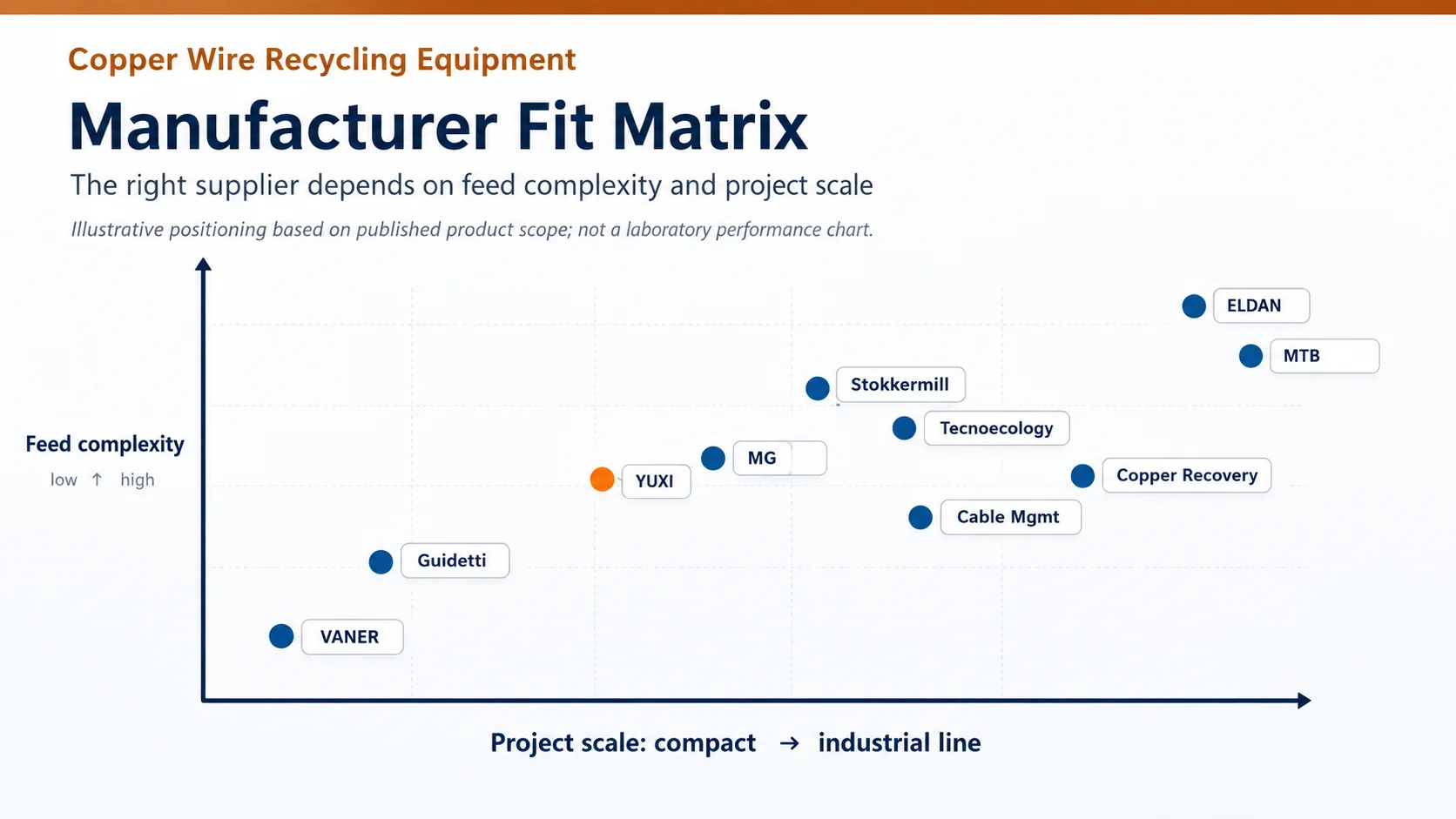
A list of copper wire recycling machine manufacturers only helps when the machines are being compared for the same job. A 65 kg/h compact granulator, a wire-chopping line with a pre-shredder, and a multi-ton industrial cable plant may all produce copper granules, but they solve very different feed and production problems.
How We Ranked Copper Wire Recycling Machine Manufacturers
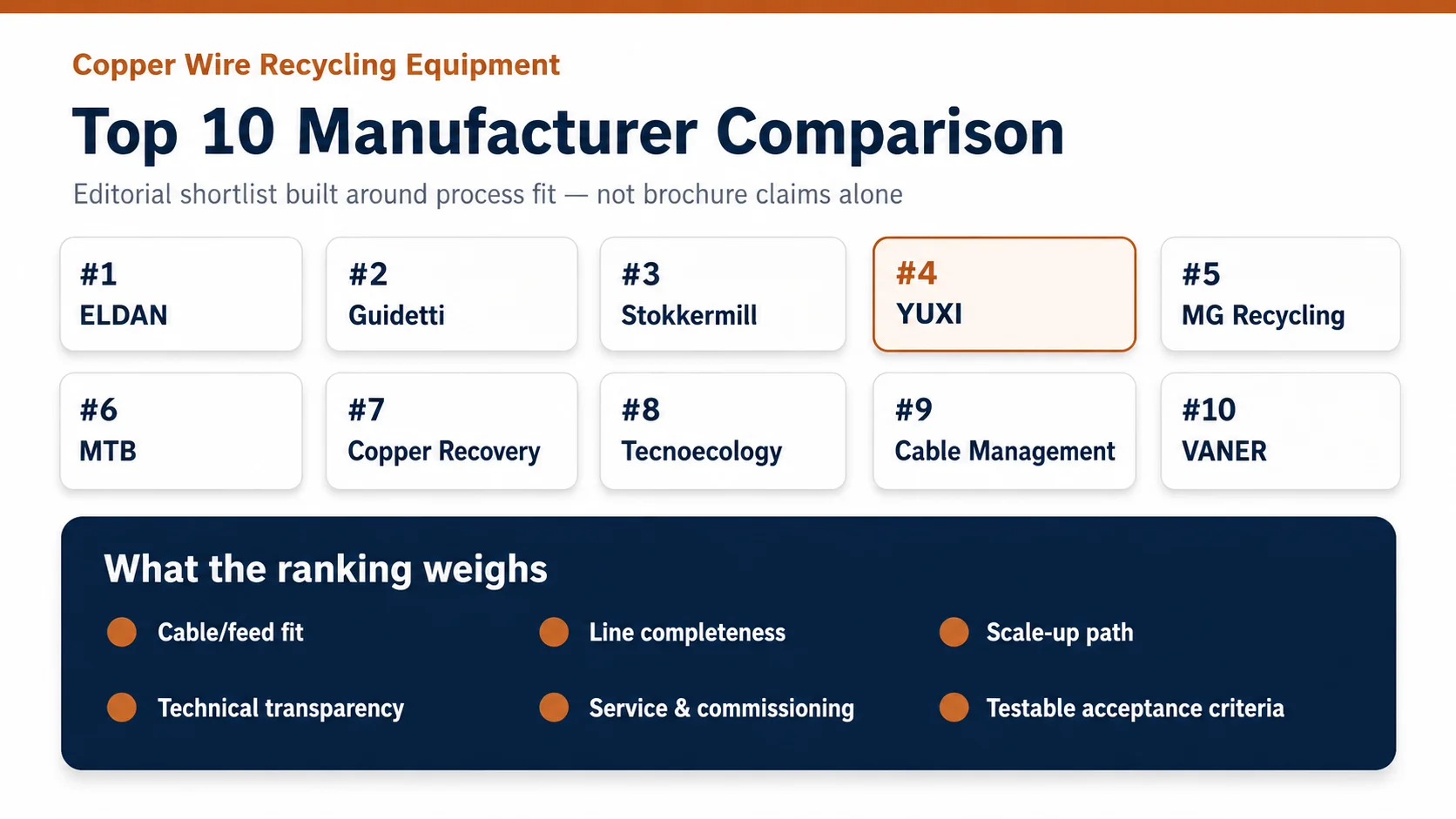
We did not score a company higher simply because it publishes the largest capacity or the highest purity number. Those figures are rarely measured under identical feed conditions. A fairer comparison starts with process fit. The buyer needs to know whether the supplier understands mixed automotive harnesses, thin communication wire, large coils, armored cable, aluminum cable or relatively clean production scrap—and what extra preparation each feed requires.
The second question is line boundary. Some suppliers sell a compact granulator with an air table. Others offer pre-shredding, magnetic removal, granulation, density separation, recirculation, dust filtration and central controls as one project. The third question is whether the supplier gives enough technical detail to make a factory acceptance test meaningful.
Top 10 Manufacturers at a Glance
| Rank | Manufacturer | Strongest fit | Published equipment direction | Buyer note |
|---|---|---|---|---|
| 1 | ELDAN Recycling | Industrial cable recycling plants | Raspers, granulators, separation and specialized cable systems | Best evaluated as a complete process supplier rather than a compact-machine vendor. |
| 2 | Guidetti Recycling Systems | Compact to medium cable granulation | Sincro series plus pre-shredders and modular systems | Clear model range and useful step-up path for growing plants. |
| 3 | Stokkermill Recycling Machinery | Mixed and fine cable processing | K, TURBO/TURBOFLEX and larger cable lines | Broad cable-specific catalog; pay close attention to which turbo/refining stage is included. |
| 4 | YUXI Machinery | Dry mixed-wire recycling line | Crusher, conveying, vibrating separation, dust collection and controls | Strong practical fit when the project needs an integrated dry copper/plastic route. |
| 5 | MG Recycling | Compact to larger modular systems | MG compact systems, VZT configurations and shredding options | Useful range for cable and harness processors that want staged expansion. |
| 6 | MTB Recycling | Industrial and complex cable streams | Shredding, granulation, density sorting and turnkey CableBox systems | Particularly relevant when cable type and project scale exceed a simple granulator. |
| 7 | Copper Recovery | U.S. wire-chopping operations | Phoenix modular and automated lines with pre-shredding options | Good U.S. service/installation angle and a clear modular upgrade story. |
| 8 | Tecnoecology | Italian compact/modular non-ferrous lines | T-series granulation and separation plants plus shredding | Worth comparing when footprint and modular integration matter. |
| 9 | Cable Management | U.S. custom wire-chopping systems | C-series lines, granulation, air tables, turbo and dust systems | Strong integrator/service proposition for North American processors. |
| 10 | VANER | Entry to mid-range granulators | Wide catalog of compact and larger cable granulators | Accessible range; verify model-specific capacity, support and acceptance test in writing. |
1. ELDAN Recycling
ELDAN earns the first position because cable recycling is presented as a complete process rather than just a granulator. Its public cable material covers established granulation technology and specialized routes for difficult cable, including jelly-filled telecommunications cable. That matters for processors whose feed mix changes from ordinary copper cable to steel-bearing, oily or otherwise difficult material.
The practical advantage is system thinking. A buyer can discuss coarse reduction, granulation, separation and upgrading as connected stages. That usually makes more sense for a high-volume operation than selecting each machine independently and hoping the transfer points work later.
2. Guidetti Recycling Systems
Guidetti is one of the easier suppliers to compare because the Sincro Eko range is published as a family rather than a single “one size fits all” machine. The manufacturer lists five compact granulator models for recovering copper and aluminum from electrical cables and radiators, and it publishes a production range that steps from small equipment toward substantially larger compact systems. The same range can be paired with PMG pre-shredders.
That creates a sensible migration path for a recycler who starts with prepared cable but expects feed volume or coil size to grow. It also keeps the buyer focused on where pre-shredding becomes necessary instead of assuming the granulator should accept every incoming shape.
3. Stokkermill Recycling Machinery
Its public catalog covers compact K-series machines, TURBO and TURBOFLEX configurations, and larger industrial cable recycling lines. The manufacturer specifically discusses mixed and extremely thin-diameter cables and uses downstream turbo refining in several configurations to improve liberation of fine wires.
This is useful for buyers whose material is not dominated by thick building cable. Thin data cable, telephone wire and harness material can expose the weakness of a system that looks excellent on larger conductors. Stokkermill gives buyers several process routes rather than forcing all feed through the same arrangement.
4. YUXI Machinery
The public Copper Wire Recycling Line lays out a complete dry route: crusher, fan conveyor, vibrating screen, dust collector and electrical control. After size reduction, copper and plastic move across the screen while airflow suction and linear vibration separate the heavier copper fraction from lighter insulation. YUXI also states that vibration frequency and air volume can be adjusted for different working conditions. For buyers who want a YUXI-specific reference path, review the copper wire recycling line page before sending samples and capacity requirements.
That configuration fits the kind of material many scrap yards struggle to strip manually: automotive circuit lines, appliance wire, communication cable, computer wire and other mixed waste cable. In practice, this is where a dry granulation line earns its place—when labor is being consumed by small, tangled or inconsistent cable rather than clean, long conductors.
Before requesting a configuration, it is useful to read the dry-type copper wire recycling machine guide and decide whether the normal feed is already short enough for direct granulation or needs upstream size reduction.
5. MG Recycling
MG Recycling has a well-developed progression from compact machines to higher-capacity VZT systems. Its public product pages identify electrical, telephone and automotive cable as core feedstocks, and larger combinations can incorporate additional granulation and shredding equipment.
What stands out is the ability to stay within one equipment family as the line grows. For a plant that begins with clean cable and later adds harnesses, radiators or more difficult non-ferrous feed, that continuity can simplify training and spare-parts planning. The tradeoff is that the buyer must be precise about which MG configuration is actually being quoted; the compact-machine name alone does not define the full process boundary.
6. MTB Recycling
MTB is closer to an industrial cable-processing specialist than a compact granulator vendor. The company describes a three-step cable process—shredding, granulation and sorting—and lists copper and aluminum cable, EHV cable, ACSR and automotive harnesses among its feed types. Its CableBox concepts combine multiple process stages, including air filtration and dust recovery, into compact turnkey packages.
That breadth is valuable when the incoming material includes reinforcing steel, large conductors or several metal types. MTB also states that it operates recycling equipment itself, which gives the company an operator/manufacturer perspective. For smaller yards, however, the system depth may be more than the project requires.
7. Copper Recovery
Copper Recovery is particularly relevant to U.S. processors because its Phoenix wire-chopping systems are built around modular expansion and on-site support. The company publishes a base line and automated configurations that add pre-shredding, dosing and additional cutting capacity. It also states that installation assistance, machine-operation training and process training are included with certain Phoenix configurations.
The practical appeal is not only equipment. A recycling plant needs someone to help stabilize feeding, airflow and separation after the crates are opened. Copper Recovery’s service model and the fact that it says it runs its own equipment are useful points for a buyer who values a domestic demonstration and training path.
8. Tecnoecology
Tecnoecology designs granulation and separation plants for copper and aluminum recovery and publishes both compact and modular layouts. Its product scope includes pre-shredders, granulation, dry-table separation, conveying and filtration components. This makes it a useful comparison point for projects that sit between a single compact granulator and a very large industrial cable plant.
The manufacturer’s T-series approach also makes footprint and modularity easier to discuss during layout planning. Buyers should still ask the same questions asked of larger brands: which stage is responsible for fine-wire liberation, how middlings are returned, and how the dust system affects stable airflow at the separation table.
9. Cable Management
Cable Management builds wire-chopping systems for North American recyclers and explains the process in three recognizable stages: optional pre-shredding, granulation and separation. Its public material also highlights turbo mills, air tables, vibratory screens, dust collection, installation, operator training and continuing support.
That makes Cable Management worth including even though its catalog is not as globally broad as some European cable specialists above it. For a U.S. plant, commissioning response time, spare parts and the ability to get someone on site can outweigh a small difference in brochure specifications.
10. VANER
VANER rounds out the list because it publishes a broad range of copper wire granulators, including compact machines and larger systems. The manufacturer lists communication cable, automotive harnesses, industrial cable and household wire among its applications, which gives smaller buyers several entry points without immediately moving to a large turnkey plant.
A wide online catalog makes specification checking more important, not less. Capacity, cable diameter, output purity, local stock and delivery statements are vendor-published and can vary by model or market. Buyers should request a model-specific quotation and a live or recorded test using comparable feed before treating those figures as accepted performance.
Which Manufacturer Fits Your Cable?
The ranking changes quickly when the feed changes. A yard running clean #1 or #2 insulated cable has a different problem from a dismantler handling short automotive harnesses. The first may care about steady metering and output value. The second may need pre-shredding, magnetic removal and much better fine-wire liberation. A processor buying obsolete telecom cable may face steel, jelly or other contaminants that a basic dry table was never designed to handle.
We normally recommend writing down the worst regular feed before asking for a quote. Photograph it. Weigh a representative batch. Record the percentage of plugs, steel, aluminum, fabric, moisture and fines. Then ask every candidate to propose a route for that material—not for the cleanest cable in the warehouse. The copper wire granulator vs stripper comparison is also useful here: thick, clean cable may still be more profitable to strip before lower-grade leftovers are sent to a granulation line.
Do Not Compare Capacity Until the Test Basis Matches
Capacity is the most abused number in cable recycling quotations. One supplier may state input to the granulator. Another may quote an entire line. A third may use clean, pre-cut cable with a favorable copper content. If the buyer’s real feed is tangled harness with connectors, the three figures are not comparable.
A more useful request is: “Process this defined batch for a sustained period and report incoming mass, accepted copper, plastic, middlings, rejects and downtime.” It is also worth recording screen size, recirculation and whether the pre-shredder is included in the measured rate. For cost normalization, the copper wire recycling machine price guide explains why two quotations with the same nominal capacity can have very different equipment boundaries.
Purity Is Only Half of the Separation Question
A bright sample of copper granules can be impressive and still hide a weak mass balance. If the air table is set aggressively, the copper outlet may look exceptionally clean while fine copper is carried into plastic or middlings. That lost metal is usually more important financially than a small difference in the appearance of the saleable copper.
During a factory test, sample every outlet. Ask how purity is calculated and how copper loss is measured. Run more than one feed condition if your operation receives cable from different suppliers. We have found that the difficult batch often reveals more about the machine than a perfectly sorted demonstration load. For a wider selection framework, see the best copper wire recycling machine buyer guide.
RFQ Checklist: Make Ten Manufacturers Quote the Same Job
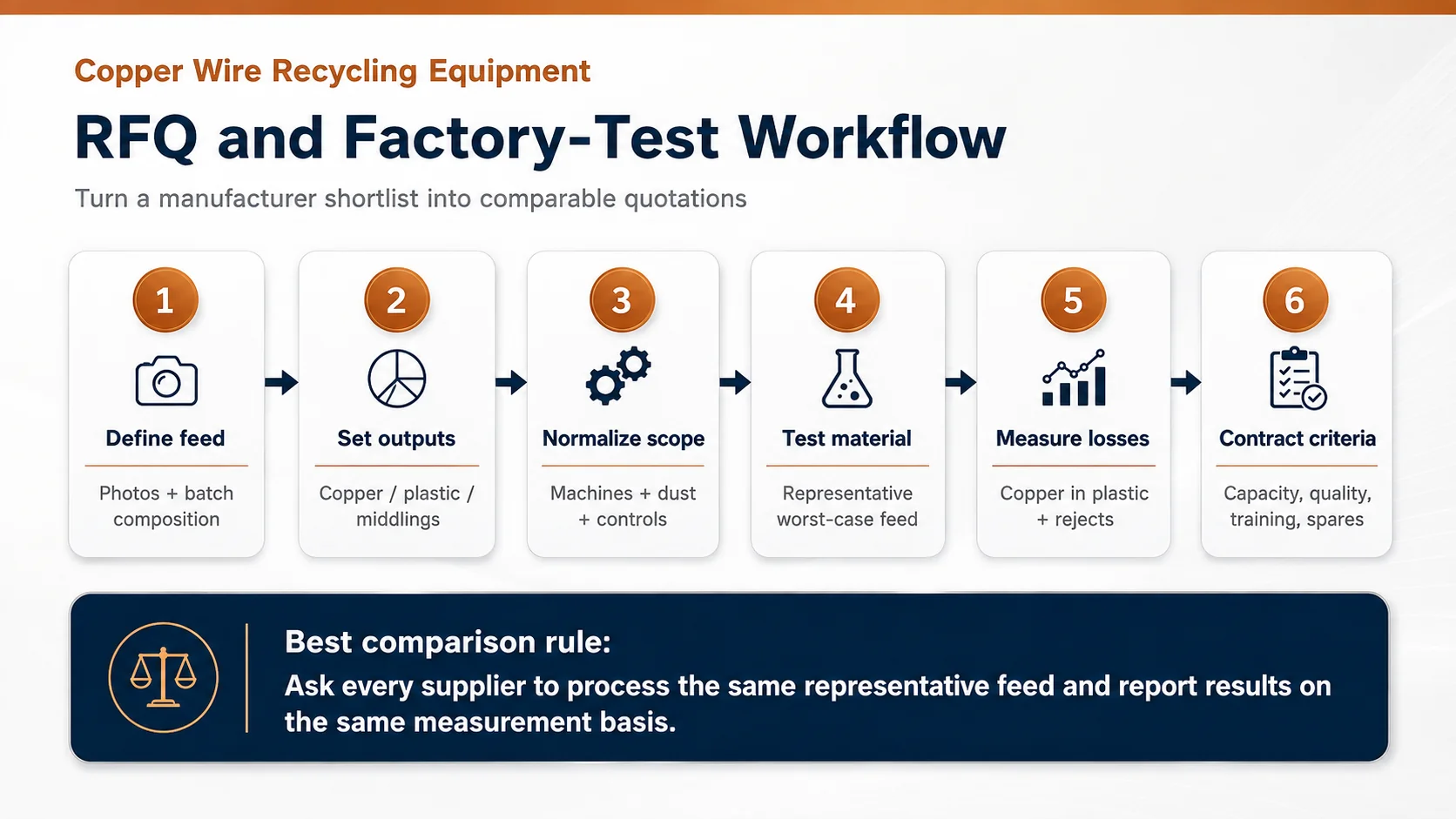
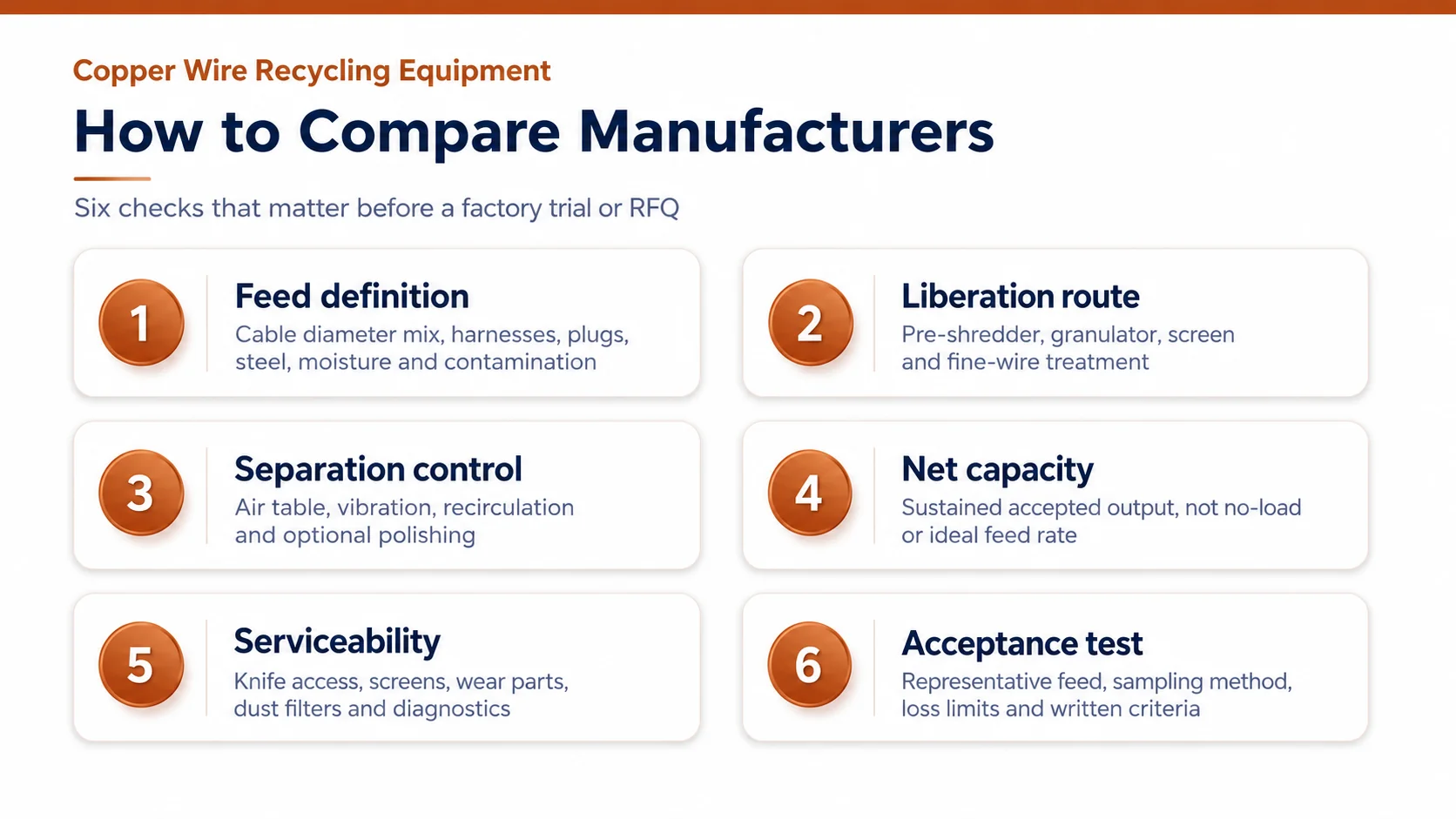
Before asking for price, send the same project sheet to every shortlisted supplier. The document does not need to be complicated, but it should remove ambiguity. Include the normal cable mix, maximum coil or piece size, estimated copper content range, problematic contaminants, target shift hours and the outlet quality your customer will accept.
- Feed: cable types, diameter range, harnesses, plugs, steel, aluminum, moisture, oils and non-cable contamination.
- Throughput: define whether the target is gross input, net input after sorting or accepted product per hour.
- Line scope: pre-shredder, granulator, conveyors, magnets, air/density separation, recirculation, dust collection, controls and platforms.
- Utilities: voltage, frequency, connected load, compressed air, extraction, foundation and available floor/ceiling space.
- Quality: copper purity, copper loss in plastic, middlings allowance, particle range and sampling method.
- Service: installation supervision, commissioning, operator training, remote support, wear parts and critical-spares package.
- FAT: representative feed mass, run duration, sampling points, measurement instruments and pass/fail conditions.
The same principle applies to the business case. A higher-capital line can be the cheaper choice if it cuts sorting labor, handles more of the incoming cable mix and loses less copper. The copper wire recycling business guide is a better place to model those economics than trying to infer payback from a machine price alone.
Compare a Copper Wire Recycling Line for Your Feed
Send YUXI photos or video of your cable mix, expected hourly input, cable size range, contaminants, power supply and target copper/plastic output. A useful proposal should start with the material and process boundary, then define the equipment configuration and test method.
FAQ
Who makes the best copper wire recycling machine?
There is no single best manufacturer for every cable stream. ELDAN and MTB are strong candidates for larger industrial systems, Guidetti and MG have well-developed compact-to-mid-size ranges, Stokkermill offers a broad cable-focused portfolio, and U.S. buyers may value the local service models of Copper Recovery or Cable Management. YUXI is a practical option when a buyer wants a dry crushing, airflow/vibration separation and dust-collection line configured around mixed waste wire. The shortlist should be proven with the buyer’s own feed.
What capacity should I use to compare copper wire recycling machines?
Use sustained net input or accepted output under a defined cable mix, not a headline number by itself. Ask whether the published capacity assumes clean single-type cable, pre-cut material, mixed harnesses, thin data cable or a specific copper content. Also record recirculated middlings, downtime and rejects.
Is a copper wire granulator the same as a complete recycling line?
Not always. A granulator is the liberation machine that cuts cable into particles. A complete line may add pre-shredding, metered feeding, magnetic removal, air or density separation, screens, recirculation, dust collection and controls. Compare system boundaries before comparing prices.
How should copper purity claims be checked?
Treat catalog purity figures as vendor-published results until they are reproduced with representative material. During a test, sample the copper outlet, plastic outlet and middlings separately.
Do I need a pre-shredder before a copper wire granulator?
A pre-shredder is useful when the normal feed includes large coils, bundled or tangled harnesses, heavy cables, spools or inconsistent pieces that cannot be metered safely into the granulator. Clean, short and already-sized wire may not need one.
External References and Manufacturer Sources
- ELDAN Recycling, Cable Recycling Solutions.
- Guidetti Recycling Systems, Sincro Eko Series.
- Stokkermill Recycling Machinery, Copper Recycling Plants and Lines.
- MG Recycling, Electric Cable Recycling Systems.
- MTB Recycling, Cable Recycling Solutions.
- Copper Recovery, Phoenix Cable Recycling Equipment.
- Tecnoecology, Granulation and Separation Plants.
- Cable Management, Wire Choppers & Cable Recycling Systems.
- VANER, Copper Wire Granulator Range.