




 Request Quote



A car radiator is easy to underestimate. From the outside it looks like one thin metal component. Once it reaches a recycling yard, however, it may include an aluminum fin-and-tube core, plastic end tanks, steel clips, rubber hoses, a fan shroud, brackets, transmission-cooler fittings, dirt and residual engine coolant. Older or heavy-duty units may also bring copper/brass construction into the same pile. A useful car radiator recycling machine therefore has to do more than “crush metal.” It has to turn a variable automotive assembly into metal fractions that can actually be sorted and sold.
What a Car Radiator Recycling Machine Actually Does
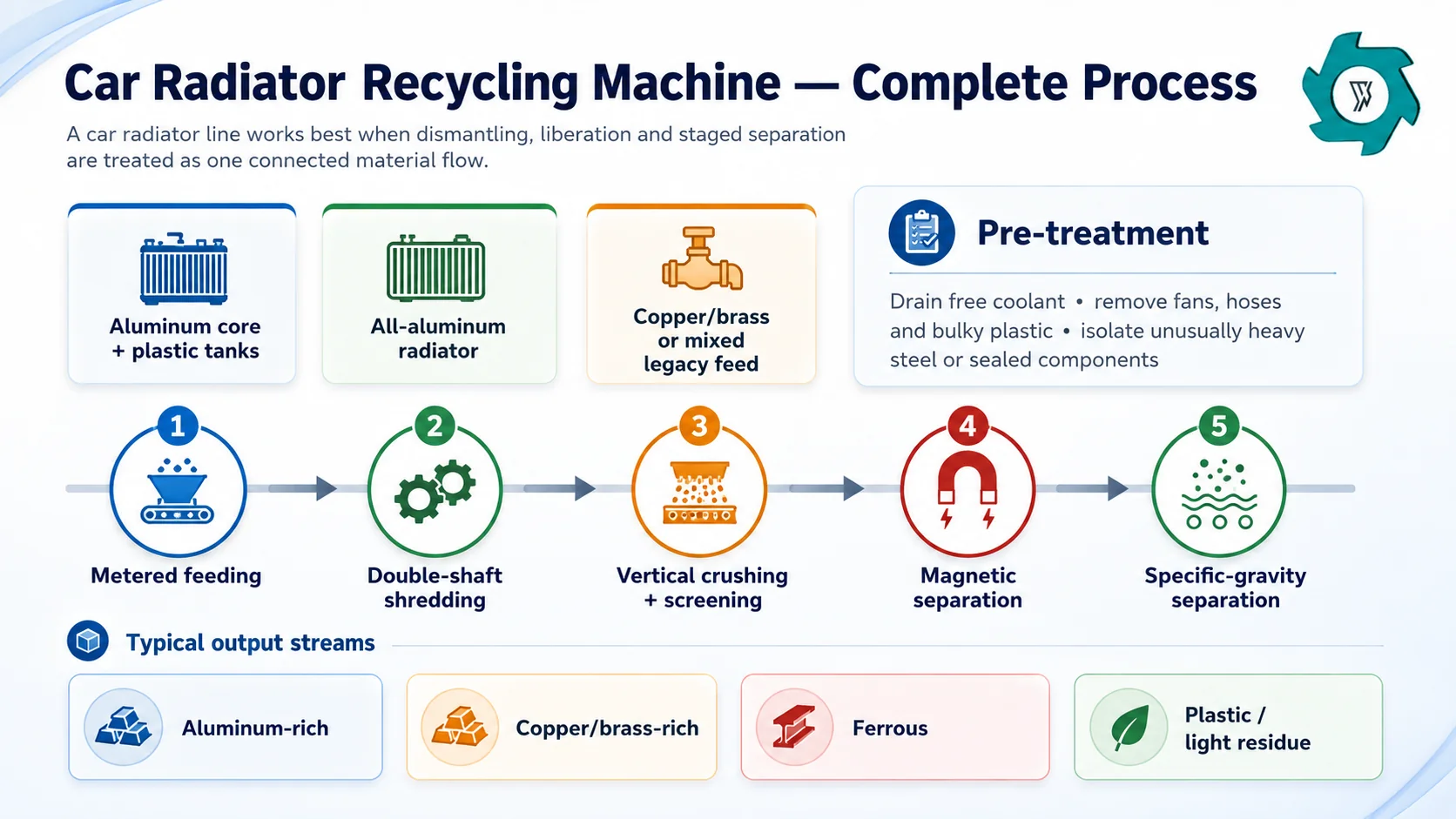
For mixed automotive radiator scrap, the industrial route is a sequence rather than a single machine: controlled feeding, primary shredding, secondary crushing and screening, ferrous removal, density-based separation, dust collection and product discharge. YUXI’s published radiator line follows that same logic with a double-shaft shredder, vertical crusher, magnetic separator and specific-gravity separator coordinated with conveying, PLC control and centralized dust collection.
The point of the line is not to reduce everything to the smallest possible particle. The point is liberation. Plastic tanks must be detached from metal. Steel clips need to become available to the magnet. Aluminum fin material must stop behaving like one locked sheet. If copper or brass is present, it must be sufficiently free from aluminum and light material to respond differently in the final separation stage.
That distinction matters when comparing quotations. A crusher can make a radiator look “processed” while leaving valuable materials locked together. A complete process is judged by what comes out of every discharge point, not by how small the center pile looks.
First, Make Sure the Scrap Really Is an Engine Radiator
One recurring purchasing mistake is to use “car radiator” as a catch-all name for every heat exchanger removed from the front of a vehicle. An engine radiator and an air-conditioning condenser may sit in the same cooling pack, but they do not arrive with the same fluids or always the same construction. An intercooler, heater core and oil cooler add more variations.
At an ELV dismantling site, separating these components before the shredder usually makes the downstream job clearer. The vehicle recycling equipment guide covers the wider depollution and dismantling sequence. For a dedicated radiator line, the more useful question is narrower: what materials are still attached to the radiator when it reaches the feeding conveyor?
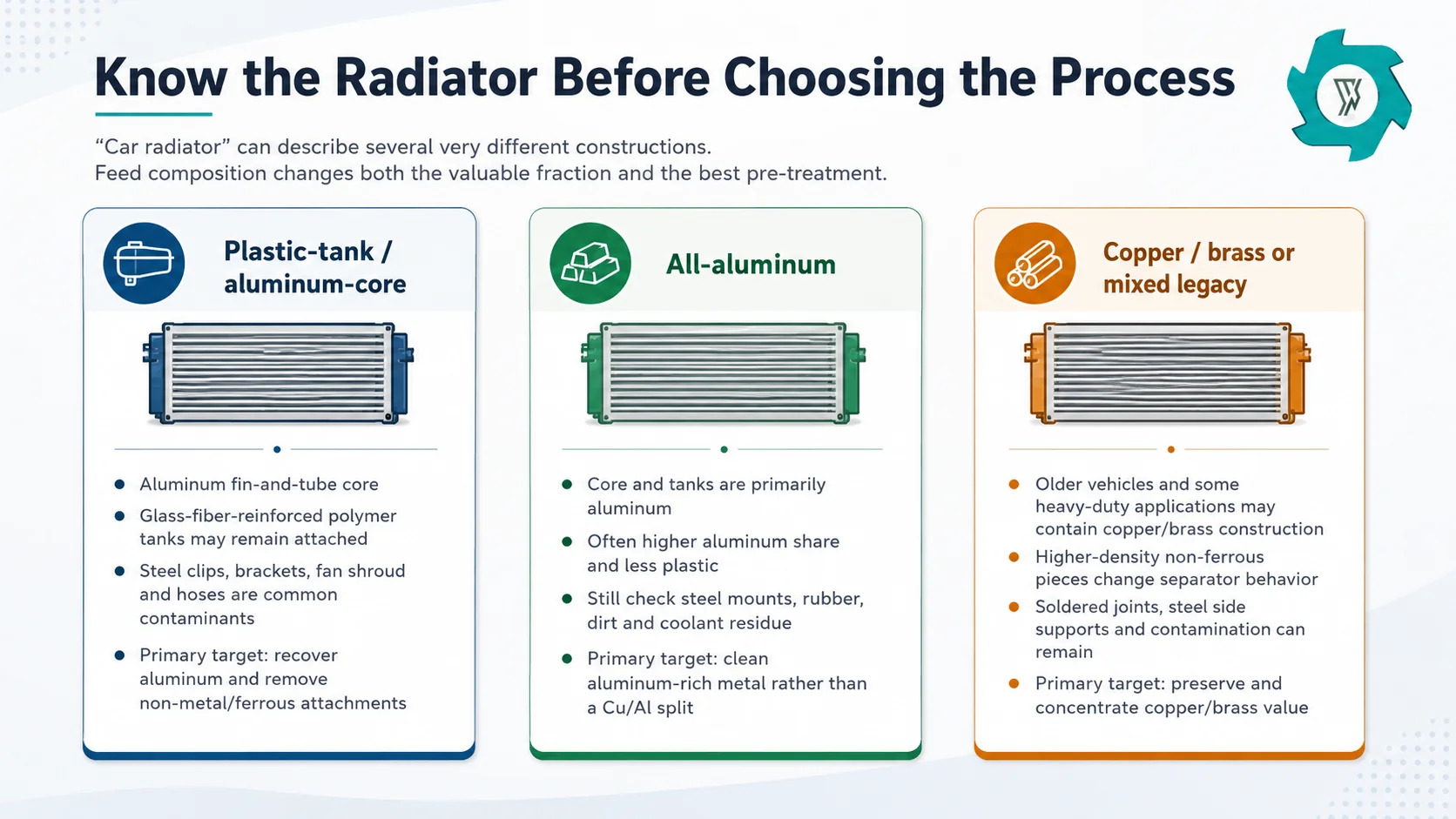
Three Car Radiator Constructions Change the Recycling Route
1. Aluminum core with plastic tanks
This is a common modern construction. The radiator core is mainly aluminum, while molded polymer end tanks are mechanically attached around the header area. Steel clips, brackets and mounting hardware may remain around the perimeter. For a recycler, that means the valuable mass is not simply “mixed copper and aluminum.” Often the primary task is to free aluminum from plastic, steel and rubber, then produce a cleaner aluminum-rich fraction.
This is also why a generic copper-aluminum separator can be the wrong mental model. If the incoming automotive batch contains almost no copper in the radiator core, the process should not be configured around chasing a copper fraction that is not there.
2. All-aluminum radiators
All-aluminum radiators reduce the plastic-tank component, but they still arrive with different mounts, fittings, dirt and possible steel attachments. The economic objective becomes even more straightforward: preserve the aluminum value while removing ferrous and non-metal contamination without creating unnecessary fines.
Sometimes buyers assume that an all-aluminum radiator is automatically the easiest feed. That is not always true. A heavily crushed unit can bridge in a hopper, folded fins can trap dirt, and thick mounting sections can behave very differently from thin fin material inside a high-speed crusher. Geometry still matters.
3. Copper/brass and mixed legacy radiators
Copper/brass radiators remain relevant in older vehicles and parts of the heavy-duty market. Northern Radiator, for example, still describes copper/brass and plastic/aluminum options in heavy-duty truck applications.[1] When these units are mixed with aluminum radiators, the downstream separator is dealing with a wider density range and a higher-value heavy non-ferrous fraction.
For a mixed yard, this can be worth tracking at receiving. If one week’s feed is almost entirely aluminum/plastic and the next includes a significant copper/brass batch, the same separator settings may not produce the same split. Record the mix instead of treating “one ton of radiators” as a standardized raw material.
Pre-Treatment: What Should Be Removed Before Shredding?
A radiator recycling line should receive the prepared scrap, not anything left after the vehicle lifts it from the disassembly rack. The exact pre-treatment level depends on the approved feed specification, but several checks are practical for nearly every project.
Drain free engine coolant. EPA guidance on used antifreeze notes that coolant can be reclaimed or recycled and that waste characterization can depend on contamination and local handling conditions.[2] From a machine standpoint, free liquid also creates a more immediate problem: it spreads across conveyors, mixes with dust and dirt, changes material behavior on screens and makes housekeeping harder. The shredder is not a coolant-treatment system.
Remove bulky fan assemblies and oversized plastic shrouds when they fall outside the accepted feed. Small plastic tank material can be part of the intended separation job. A large fan motor, thick shroud or complete cooling module is a different object. It adds steel, wiring, bearings and large plastic pieces that may dominate the feed opening.
Watch for unusually heavy steel brackets. The magnet can remove exposed ferrous material later, but the primary shredder and secondary crusher still have to survive everything that reaches them. A thick structural bracket is not equivalent to a thin radiator clip.
Keep batteries, sealed pressure vessels and unrelated hazardous items out of the line. ELV depollution happens upstream. OSHA’s scrap-recycling guidance emphasizes that rotary shredders and similar machinery expose workers to severe caught-in, struck-by and unexpected-energy hazards, so feed control and safe clearing procedures belong in the operating plan from the beginning.[3]
When Manual Dismantling Stops Making Sense
A clean and intact radiator is sometimes worth disassembling manually: remove the plastic end tanks, pull the obvious steel, cut the accessories, and sell the clean core. That route uses labor instead of a complete processing line. It can be reasonable when volume is low, material is uniform and the recovered pieces already meet a buyer’s grade.
The calculation changes once radiators are bent, nested, dirty or coming in continuously from vehicle dismantling. Manual work becomes inconsistent, especially when every unit has a different bracket or plastic assembly. A complete line is useful because it converts irregular geometry into a controlled particle stream.
Do not read that as “more machinery is always better.” Over-processing a clean aluminum core can create extra fines and wear. The right route depends on how much preparation labor is available, the variability of the feed, and what the buyer actually pays for in the final product. The types of metal shredders guide is useful here because it explains why low-speed twin-shaft shredders and higher-speed crushers can solve different tasks instead of competing for the same position.
Complete Car Radiator Recycling Process, Step by Step
1. Controlled feeding
Radiators have high volume for their weight and tend to overlap. If the excavator or loader puts a large nest on the conveyor, the average tonnage per hour may still seem acceptable while the shredder repeatedly surges. Feed control matters because each downstream machine inherits the feed pattern created at the front of the production line.
In practice, a stable line sounds almost boring: the conveyor runs, the shredder draws material steadily, the crusher does not alternate between empty and overload, and the separator receives a shallow, repeatable bed. This kind of stability is usually more valuable than a brief peak capacity demonstration.
2. Double-shaft primary shredding
The double-shaft shredder opens whole or deformed radiator assemblies and reduces them to pieces that can be conveyed reliably. Low-speed, high-torque cutting is useful for grabbing bulky thin-walled assemblies without relying on a perfectly oriented feed.
This stage should not be expected to finish the metal separation. It is preparation. Aluminum fin can still be attached to tube or header material, plastic can remain trapped around metal edges, and steel clips may still be locked into a larger piece. The shredder’s job is to make the next liberation stage possible.
3. Vertical crushing and screening
Secondary crushing does the finer work. Repeated impact, shearing and screening break open connections that primary shredding leaves behind. At the same time, the screen helps hold the process inside a more useful particle-size window.
Too coarse, and locked composite pieces pass to the separator. Too fine, and the line creates more dust, more surface area and more difficult-to-handle aluminum foil-like particles. The useful setting is the one that liberates the actual radiator mix without turning good metal into unnecessary fines.
4. Magnetic separation
Once clips, screws and steel brackets have been exposed, magnetic separation removes them before the non-ferrous stage. This is a simple step conceptually, but feed depth matters. A magnet covered by a thick, pulsing bed cannot perform like the same magnet under an even layer.
Removing ferrous material early also protects the logic of the final separator. You want the copper/brass, aluminum and light non-metal fractions to be compared against each other without a changing steel load mixed into the bed.
5. Specific-gravity separation
After size reduction and magnetic removal, the remaining stream contains non-ferrous metal and lighter plastic or other residue. Specific-gravity separation uses controlled airflow, vibration and density-related particle behavior to split these materials.
The key phrase is after sufficient liberation. A separator cannot classify a piece of plastic that is still physically clamped around aluminum as if the two materials were separate. When the heavy outlet carries too much aluminum or the light outlet loses metal, the problem may be upstream rather than in the final machine setting.
6. Dust collection and product discharge
Crushing, screening and transfer points can generate fines. YUXI’s published radiator-line concept includes centralized dust collection, which should be engineered around the real dust produced by the feed and process. Aluminum-bearing fines require particular attention because OSHA notes that even metals that are not readily combustible in larger form can become explosible when finely divided and suspended under the right conditions.[4]
Product discharge also deserves design time. If separated aluminum drops into a bin that is contaminated by loader traffic, or ferrous pieces are allowed to bounce into a neighboring fraction, the machine can be working correctly while the saleable product gets worse after it leaves the separator.
Main Equipment and the Questions a Buyer Should Ask
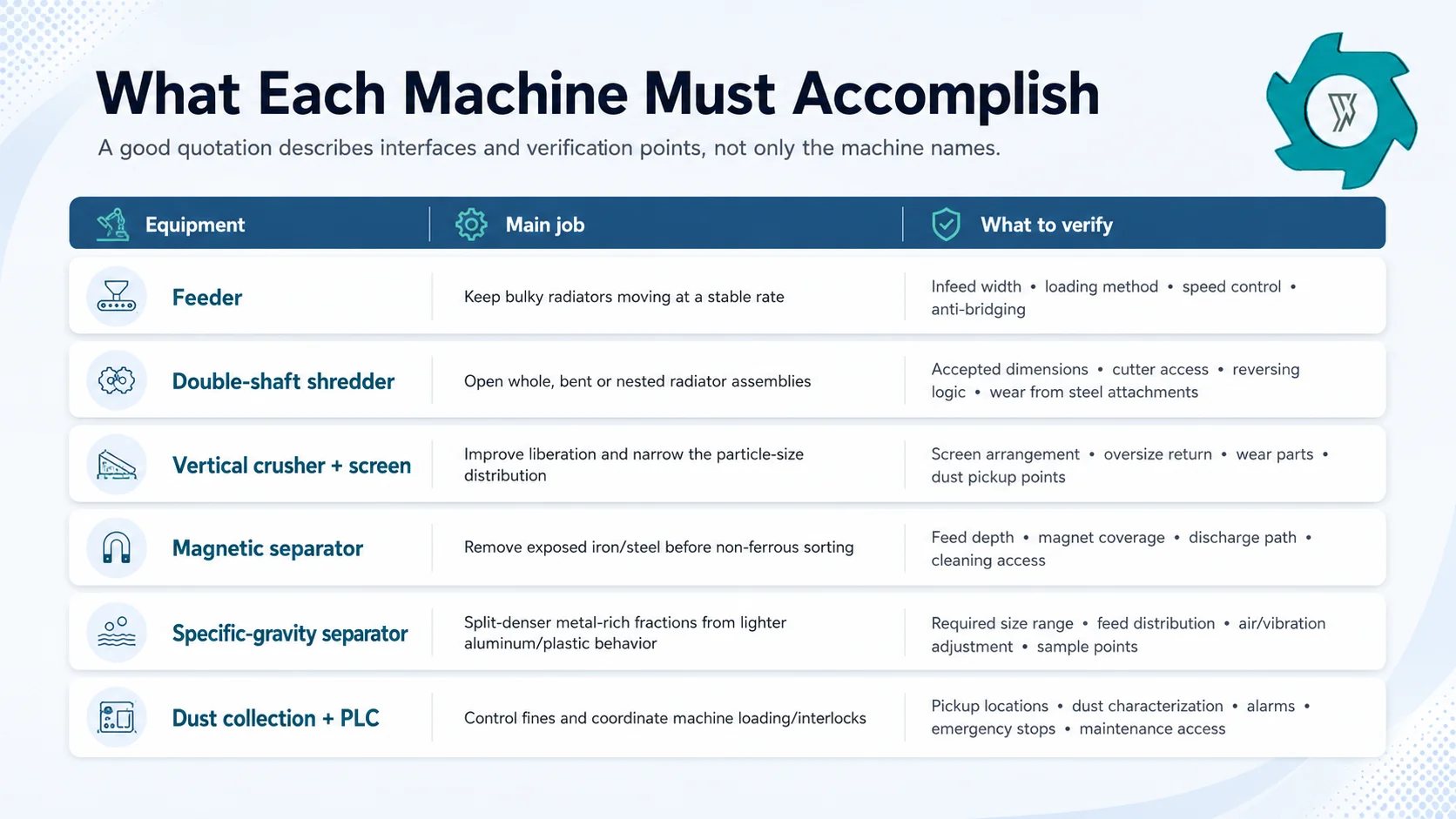
| Equipment | Main job | Car-radiator-specific verification |
|---|---|---|
| Feeding conveyor | Meter bulky units into the line | Can it accept the largest normal radiator without bridging? How is speed tied to downstream load? |
| Double-shaft shredder | Open whole or deformed units | Define maximum dimensions, attached steel limits, reverse logic and access for a folded or jammed radiator. |
| Vertical crusher / secondary crusher | Improve liberation and control size | Review wear parts, screen openings, oversize return and behavior with thin aluminum fin. |
| Magnetic separator | Remove exposed ferrous metal | Check magnet coverage, feed depth and whether steel discharge can cross-contaminate non-ferrous outlets. |
| Specific-gravity separator | Separate heavy and light fractions | Ask for the required particle-size range, feed-bed condition and how copper/brass-rich and aluminum-rich samples are evaluated. |
| Dust collection | Capture fines at generation points | Identify actual pickup points, expected dust, collector location, housekeeping and fire/explosion protection interfaces. |
| PLC/electrical control | Coordinate loads, alarms and stops | Review interlocks, emergency stops, reverse logic, overload response, local power standard and maintenance mode. |
Notice what is missing from that table: a universal motor size, universal tons per hour or universal purity number. Those values are configuration-dependent. A better quotation explains the acceptance basis for your feed instead of borrowing a performance label from a different material.
Why Liberation Matters More Than a “Purity” Headline
Suppose a sample looks like clean aluminum at the outlet, but several grams of copper/brass remain in the aluminum fraction and a measurable amount of aluminum is being lost with plastic. Which number describes performance? The answer depends on the sampling method, mass balance and buyer specification.
For radiator recycling, three process observations are more useful than a visual purity claim:
- Locked pieces: how much metal remains mechanically attached to plastic or to another metal after secondary crushing?
- Particle-size tails: how much oversize needs recirculation, and how much very fine material is being created?
- Cross-contamination by outlet: what valuable metal remains in the light residue, ferrous stream and wrong non-ferrous fraction?
When a factory test is run, weigh the input and the main outputs. Then sample each product. If the numbers do not roughly reconcile, the test has not yet told you enough. A polished outlet photo is useful for marketing; a mass balance is useful for buying equipment.
What Comes Out of the Line?
The exact products depend on the incoming radiator construction. A modern aluminum/plastic batch may produce an aluminum-rich fraction, a ferrous fraction and a plastic/light fraction with little or no meaningful copper output. A mixed legacy batch may add a copper/brass-rich heavy fraction. All-aluminum feed may simplify the non-ferrous target but still require plastic, rubber, dirt and ferrous removal.
Aluminum-rich fraction
Fin, tube, header and tank material from aluminum radiators. Check plastic carryover, steel pieces and heavy non-ferrous contamination.
Copper/brass-rich fraction
Relevant mainly where copper/brass radiators or copper-bearing heat exchangers are included. Measure aluminum carryover rather than assuming the heavy outlet is clean.
Ferrous fraction
Steel clips, brackets, screws and other magnetic pieces. Large steel should be controlled upstream so the magnetic discharge is not overloaded with avoidable structural parts.
Plastic and light residue
End-tank plastic, shroud fragments, rubber, dirt and other light material. This stream is also the best place to look for metal losses.
What Actually Controls Car Radiator Recycling Capacity?
Capacity is often quoted as one hourly number, but a car radiator is bulky and low-density. The number changes with the way the material is loaded, not only with the installed motor power. A pallet of loose flat radiators and a compacted nest of crushed cooling modules can have the same mass and completely different feed behavior.
Useful capacity variables include radiator dimensions, degree of deformation, percentage of attached plastic and steel, construction mix, moisture, target liberation size, screen condition, separator loading and operator interventions. If a quotation states a throughput without describing these conditions, ask for the feed basis.
For wider sizing methodology, the metal shredder capacity guide explains the difference between headline throughput and sustained plant throughput. For a car-radiator project, the same principle applies: test representative material long enough to expose feeding surges, recirculation, screen loading and cleaning time.
Safety, Dust and Maintenance Access Are Part of the Machine
Radiator recycling combines conveyors, rotating cutters, a high-energy crusher, magnets, vibrating/air separation equipment and dust collection. It also creates places where operators may want to reach in and clear a folded radiator or inspect a transfer point. OSHA’s general machine-guarding requirements address hazards such as points of operation, ingoing nip points and rotating parts.[5] Guards and interlocks should be reviewed before the line layout is finalized.
Servicing is a separate issue. OSHA’s lockout/tagout standard requires hazardous energy to be controlled during covered servicing and maintenance activities.[6] The practical design question is whether a technician can isolate the shredder, crusher, conveyors and stored mechanical energy before entering a dangerous area, and whether the isolation points are accessible.
Dust collection needs the same early attention. A radiator core is not “dusty” when it arrives, but secondary crushing can create metal and non-metal fines. OSHA specifically lists aluminum among materials that can present combustible-dust hazards in finely divided form under the right conditions.[4] Collector selection, grounding, isolation, housekeeping and fire protection must be based on the actual dust and local requirements, not on a generic fan-and-baghouse assumption.
The site’s dust control and fire-risk planning guide goes deeper into that interface. Layout also needs room for screen changes, knife inspection, bearing service, magnet cleaning, duct access and safe material sampling; the metal shredder installation guide covers those broader plant interfaces.
RFQ and Factory Test: Send the Supplier the Difficult Material, Not the Best-Looking Sample
A car radiator line can only be configured around the feed information provided. “We have 1 ton of radiators” is not enough. For a serious RFQ, include the percentage split between aluminum/plastic, all-aluminum and copper/brass units; normal and maximum dimensions; attached fans, shrouds and brackets; free-liquid condition; required sustained throughput; target products; operating hours; local voltage; available floor area; and dust-control constraints.
Then make the factory test representative. One clean radiator proves only that one clean radiator can pass through the machine. A better test batch includes the normal variation the plant will receive: bent units, plastic tanks, steel clips, some dirty material and any copper/brass units that will genuinely be mixed into production.
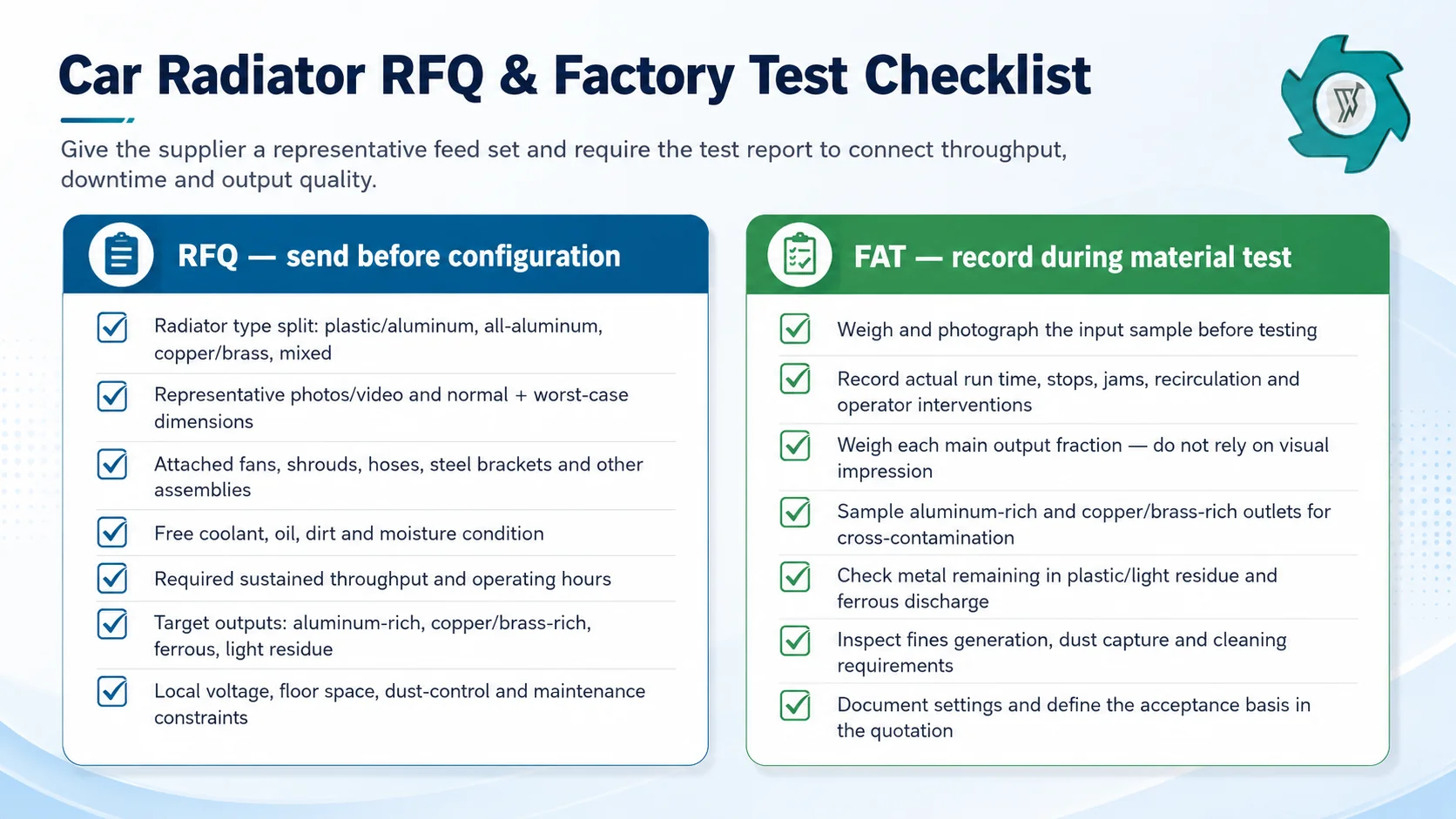
During the test, record input weight, run time, stops, jams, recirculation and operator intervention. Weigh the main output fractions and sample them. If the proposal includes a guaranteed acceptance condition, make sure the contract states the feed basis, sampling method and test duration rather than only a brochure purity phrase.
Six Mistakes That Turn Into Expensive Problems Later
- Treating the A/C condenser and engine radiator as the same feed.
- Assuming every automotive radiator contains recoverable copper.
- Sending whole cooling modules into a line designed for radiator cores.
- Over-crushing because smaller particles look more “finished.”
- Judging a factory test by one product photo.
- Designing the line first and maintenance access later.
Summary: Build the Process Around the Radiator You Actually Buy
A car radiator recycling machine is not one universal separator. Modern aluminum/plastic radiators, all-aluminum units and copper/brass legacy radiators create different product targets. Start by separating the radiator from the rest of the vehicle cooling pack, drain free coolant, control bulky attachments and define the real feed mix.
For mixed or deformed industrial feed, the complete mechanical logic is straightforward: meter the material, open it with primary shredding, improve liberation with secondary crushing and screening, remove ferrous pieces, separate the remaining heavy and light fractions, control dust and then verify outputs with samples. If those steps are sized around representative material, the line can turn awkward radiator scrap into clearer, more saleable fractions without pretending every batch is identical.
Need a Car Radiator Recycling Line Recommendation?
Send representative radiator photos, construction mix, maximum dimensions, attached components, target throughput and the metal fractions you want to sell. YUXI can review the feed and prepare a process route around the actual material.
FAQ: Car Radiator Recycling Machines
Do car radiators contain copper and aluminum?
Some do, but not all. Many modern radiators use an aluminum core with plastic tanks, while all-aluminum radiators are also available. Older and some heavy-duty radiators may use copper/brass construction. The feed should be identified before the separation route is selected.
Should engine coolant be drained before radiator shredding?
Yes. Free coolant should be removed and managed appropriately before mechanical processing. It can contaminate conveyors, screens, dust and residue, and used antifreeze may require recycling, waste characterization or other handling according to local requirements.
Can a car radiator recycling line process the whole vehicle cooling module?
Only if the complete module falls inside the approved feed specification. Fan motors, large shrouds, wiring, heavy brackets and other components can change shredder wear, crusher load and separation behavior. Many projects remove these components upstream.
Why is a double-shaft shredder used before a secondary crusher?
The double-shaft shredder opens bulky or deformed radiator assemblies and creates pieces that can be conveyed reliably. The secondary crusher then improves liberation and controls particle size. The two machines perform different stages of the process.
How are steel parts removed from shredded radiators?
After shredding and secondary liberation expose screws, clips and brackets, a magnetic separator removes ferrous pieces before the main non-ferrous separation stage.
What information is needed for a car radiator recycling machine quotation?
Provide radiator construction types and percentages, representative photos or video, normal and maximum dimensions, attached components, free-liquid condition, required sustained throughput, target output fractions, operating hours, voltage, workshop space and dust-control requirements.
How should a factory test be evaluated?
Use representative material and record input mass, run time, downtime, recirculation, interventions and the mass of each main output. Sample the aluminum-rich, copper/brass-rich, ferrous and light-residue streams so valuable-metal loss and cross-contamination can be measured instead of judged only by appearance.
External References
- Northern Radiator – Aluminum vs Copper/Brass
- U.S. EPA – Used Antifreeze Disposal
- OSHA – Metal Scrap Recycling Safety
- OSHA – Combustible Dust
- OSHA – Machine Guarding
- OSHA – Lockout/Tagout
- MAHLE Aftermarket – Thermal Management