




 Request Quote



An AC radiator looks simple until it is placed on a recycling floor. One batch may be clean copper-tube coils with thin aluminum fins. The next may contain bent condensers, steel side plates, plastic fan shrouds, oil residue or all-aluminum microchannel coils. That variation is the reason an “AC radiator recycling machine” can mean either a compact stripping machine or a complete shredding and separation line.
What an AC Radiator Recycling Machine Is Actually Designed to Do
The target is not simply to make a radiator smaller. The useful job is to turn a bonded heat exchanger into metal fractions that can be handled, sampled and sold with less cross-contamination.
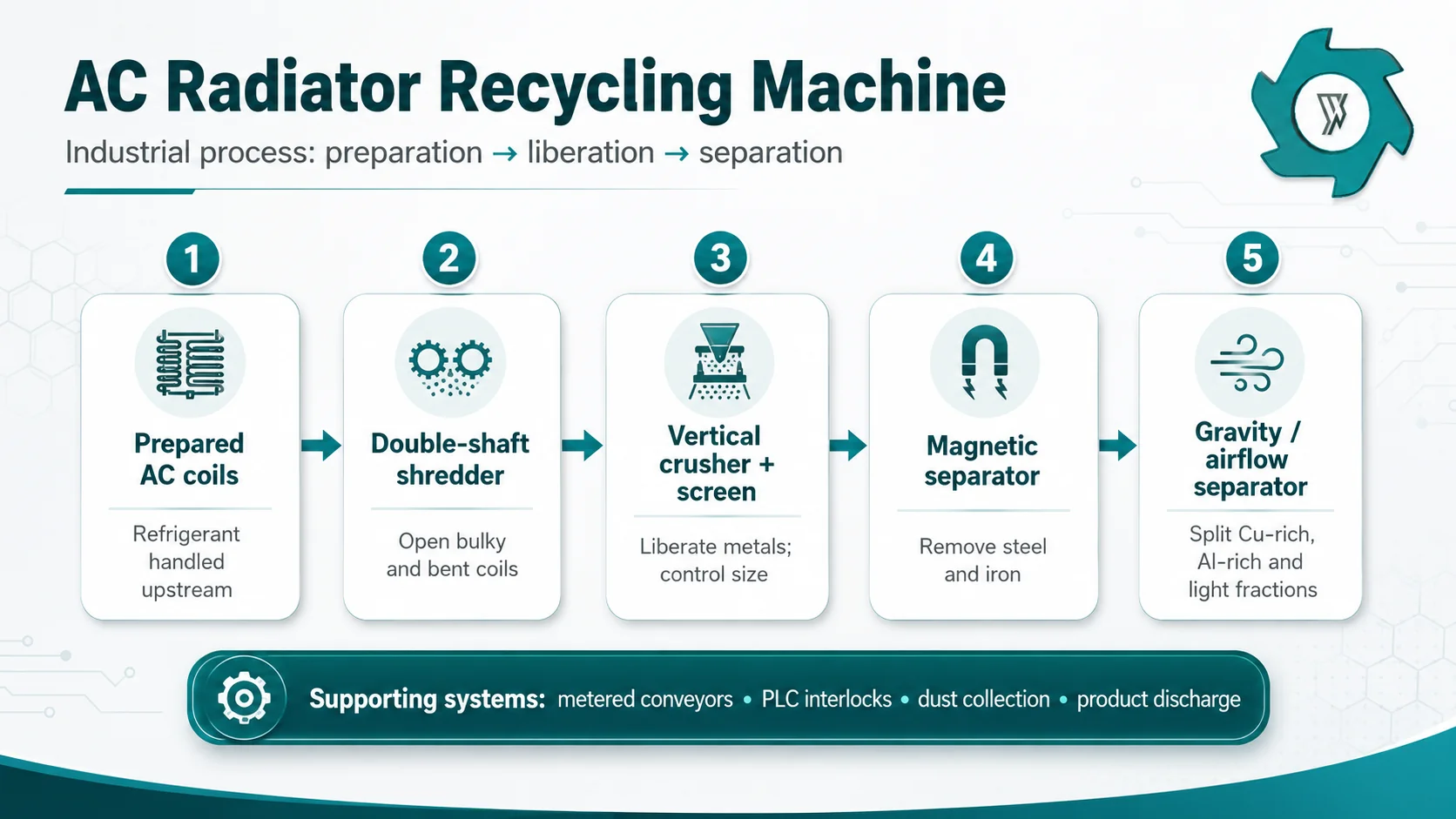
On the YUXI radiator line, AC condensers and evaporator coils sit within the wider radiator feed range. The published process uses a double-shaft shredder for primary opening, a vertical crusher for further liberation and sizing, magnetic separation for ferrous pieces, and specific-gravity separation for copper, aluminum and lighter material. Conveyors, PLC control and centralized dust collection support those core machines.
That sequence matters because copper tubes and aluminum fins do not separate cleanly just because the panel has been cut into chunks. The metals are mechanically bonded across a large surface area. Primary shredding exposes the structure. Secondary crushing does more of the separation work. Only after that does the final sorting stage have a realistic chance of producing cleaner fractions.
AC Coils Are Not One Material: Check the Construction First
A conventional condenser or evaporator is often described as “copper and aluminum,” and many scrap loads do contain copper tubes combined with aluminum fins. But that shorthand is no longer enough for equipment selection.
All-aluminum coil designs are also widely used. Carrier, for example, describes its microchannel heat exchangers as entirely aluminum.[1] The same recycling yard can therefore receive copper-tube/aluminum-fin coils, all-aluminum microchannel coils, older mixed constructions and units with steel or plastic still attached.
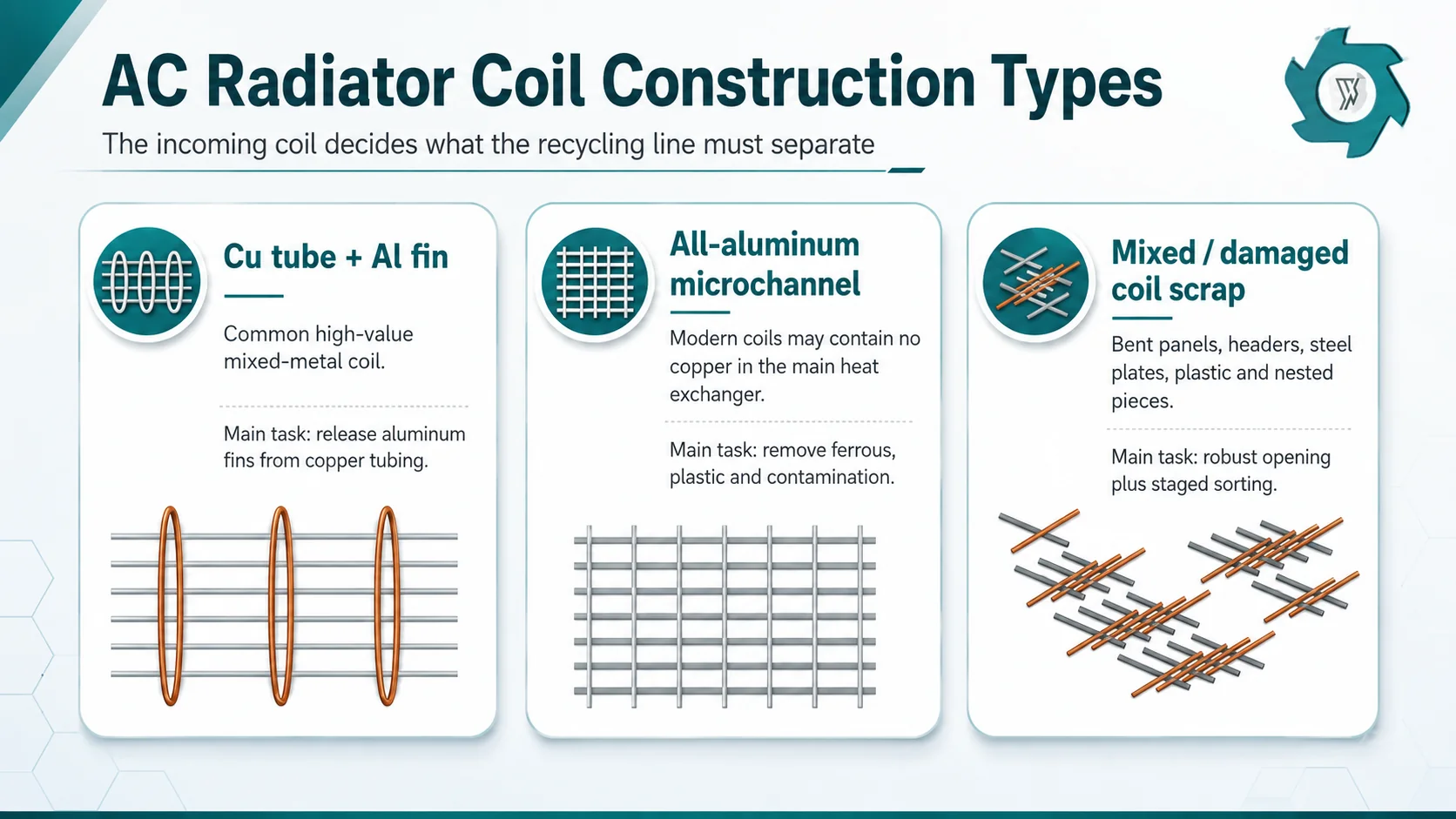
Copper tube + aluminum fin
This is the classic high-value AC-coil feed. The challenge is releasing thin aluminum fins from copper tubing without sending too much metal into fines or mixed pieces.
All-aluminum / microchannel
The value and separation target are different. The process may focus on removing steel, plastic and contamination rather than trying to split copper from aluminum that is not present in the main coil body.
Mixed or dismantling residue
Bent coils, headers, brackets, fan frames, plastics and nested pieces usually push the project toward robust primary opening and staged sorting.
When we review a sample set, three details are worth checking early: tube spacing, degree of deformation and the amount of non-coil material still attached. Those details often tell more about the correct processing route than the nominal size of the air conditioner.
Before the Coil Reaches the Shredder, the Refrigeration System Must Be Made Safe
An AC radiator recycling machine should receive a prepared heat-exchanger feed, not a sealed refrigeration system. For U.S. projects, EPA Section 608 requirements are especially relevant. EPA states that refrigerant must be recovered from air-conditioning and refrigeration equipment before disposal, and recovery equipment used for that work must meet applicable performance requirements.[2][3]
That does not mean every loose condenser coil arriving at a scrap plant still contains a refrigerant charge. Many have already been dismantled and evacuated upstream. The point is simpler: the recycling line should not be used as the place where refrigerant management is improvised.
Free oil or coolant residue should also be controlled. A small amount of surface contamination can become a much larger housekeeping issue after high-speed crushing. Steel frames, fan motors, heavy brackets, sealed components and bulky plastic housings may also need removal before the coil enters the line.
There Are Two Practical Routes for AC Radiator Recycling
Route 1: stripping for clean, regular coils
A stripping machine can make sense when the coil is flat, clean, pre-cut if required and built with a known tube pitch. The mechanism pulls or cuts the aluminum fin material away from the copper tubes. It is a relatively direct route and can preserve larger copper pieces.
The limitation is the feed window. Once the coil is badly bent, layered, crushed, inconsistent in tube spacing or still carrying frames and attachments, the operator spends more time preparing material and fighting misfeeds. At that point the apparent simplicity of the machine can disappear.
Route 2: shredding, crushing and physical separation
For mixed AC coils, deformed condensers, dismantling residues or a plant that needs continuous processing, a complete line is more forgiving. It does not rely on every tube entering a stripping channel in the same orientation. Instead, it breaks the structure, controls particle size and separates the liberated materials in stages.
Complete AC Radiator Recycling Process, Step by Step
1. Controlled feeding
Loose coils are bulky and springy. They can bridge, overlap and arrive at the shredder in sudden surges. A conveyor or controlled feeder should deliver material at a rate the cutting chamber and downstream crusher can actually absorb. PLC coordination helps reduce the stop-start pattern created by overfeeding one stage and starving another.
2. Primary double-shaft shredding
The first shredder opens full coils and reduces awkward dimensions. This is low-speed, high-torque work rather than final liberation. The goal is to create pieces that can move reliably into the next machine without long panels bridging a transfer point.
If you are comparing different cutting architectures, the site’s types of metal shredders guide explains why a double-shaft primary shredder behaves differently from a screen-controlled single-shaft unit or a high-speed crusher.
3. Secondary crushing and screening
This is where much of the useful liberation happens. The pre-shredded pieces are reduced further so aluminum fins, copper tube sections, steel fasteners and light non-metals are less physically locked together. Screening helps keep the final separator from receiving a stream that ranges from dust to large folded chunks at the same time.
Crushing harder can improve liberation up to a point, but it can also generate more fines, wear and dust. “Smaller” is not automatically “better.” The correct size is the one that gives the separator a stable, recoverable feed.
4. Magnetic removal of iron
Steel side plates, screws, brackets and other ferrous pieces should be removed before the non-ferrous separation stage. This reduces interference and keeps heavy magnetic material from circulating through equipment intended to split copper, aluminum and lighter fractions.
5. Specific-gravity or airflow separation
After sufficient liberation, copper and aluminum fragments behave differently under a controlled combination of vibration, air and gravity. The separator uses those differences to create heavier copper-rich and lighter aluminum-rich streams, while plastic and very light material are directed away from the metal products.
The word rich is deliberate. Real product quality depends on feed composition, particle-size distribution, separator loading, recirculation and how purity is sampled. A factory test should define those conditions rather than relying on a photograph of one handful of clean output.
6. Dust collection and product discharge
Transfer points, secondary crushing and screening can generate fines. Centralized extraction keeps the equipment area cleaner and helps control airborne material, but collector selection needs a process-specific review. Aluminum-bearing dust should never be treated as ordinary housekeeping dust simply because the incoming coil was a large metal object.
Main Equipment in an Industrial AC Radiator Recycling Line
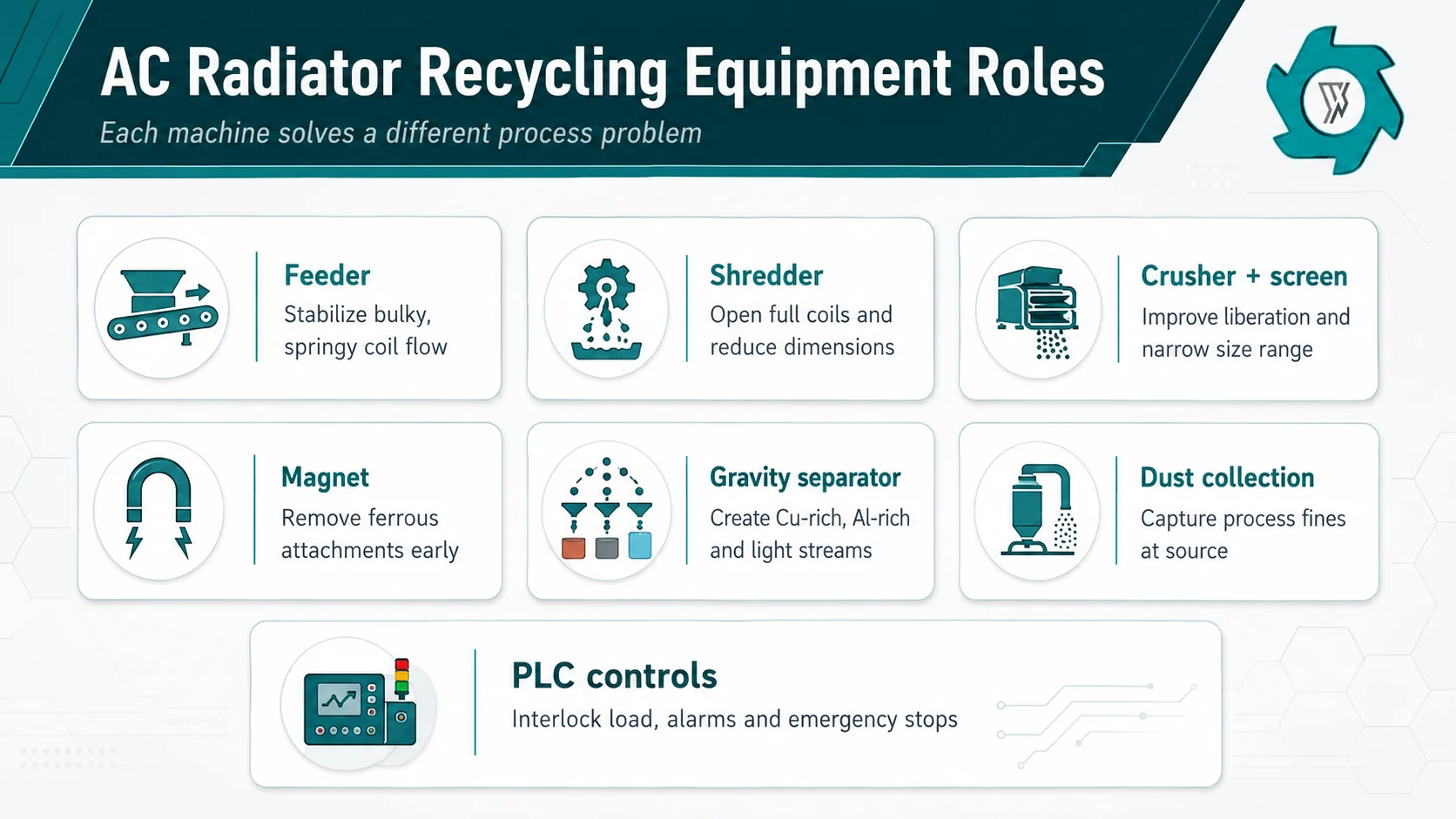
| Equipment | Main job | What to verify before purchase |
|---|---|---|
| Feeding conveyor | Meter bulky coils into the line. | Infeed width, loading method, anti-bridging behavior, speed control and interlock logic. |
| Double-shaft shredder | Open and reduce whole or deformed coils. | Maximum accepted dimensions, cutter arrangement, reverse logic, access for jams and expected wear with steel attachments. |
| Vertical / secondary crusher | Improve liberation and create a more controlled particle-size range. | Rotor/impact configuration, wear parts, screen arrangement, dust connection and oversize recirculation. |
| Magnetic separator | Remove iron and steel before non-ferrous sorting. | Feed depth, magnet position, discharge arrangement and access for cleaning. |
| Specific-gravity separator | Separate copper-rich, aluminum-rich and light fractions. | Required size range, feed distribution, adjustable air/vibration settings and product sampling method. |
| Dust collection | Capture fines from crushing, screening and transfer points. | Actual dust characteristics, pickup points, ducting, collector location, isolation/protection needs and local requirements. |
| PLC and electrical control | Coordinate feeding, load response, stops and alarms. | Interlocks, emergency stops, overload logic, fault history, local voltage/frequency and maintenance access. |
A machine list without interface data is incomplete. In practice, problems often appear between machines: a conveyor is too narrow for folded coils, a crusher receives long pieces the shredder was meant to shorten, or the separator sees a deep pulsing bed because the upstream discharge has no buffer. The project should be reviewed as a line, not as seven independent purchase orders.
Why Liberation and Particle Size Matter More Than a Purity Claim
The final separator cannot sort copper that is still physically wrapped in aluminum. That sounds obvious, yet it is one of the most common reasons a line appears to have a “separator problem.”
Imagine two particles leaving the crusher. One is a clean copper tube segment. The other is a copper tube segment still carrying a dense collar of aluminum fin material. Their behavior in an air-gravity system will not be identical. The second particle is a composite, so it can land in an intermediate zone or contaminate one of the products.
Screening helps because it narrows the range of particle behavior. A separator tuned for small, reasonably uniform pieces is easier to stabilize than one receiving thin foil-like fins, heavy copper chunks and large folded composites together.
This is also the point where over-crushing becomes expensive. Excessive size reduction can turn recoverable aluminum fin material into dust-sized losses and increase collector load. The right target is enough liberation for separation, not the smallest possible particle.
What Comes Out of the Line
A well-configured line can produce several physical streams rather than a single “recycled radiator” product.
Copper-rich fraction
Chopped copper tube and heavier copper-bearing pieces from conventional Cu/Al coils.
Aluminum-rich fraction
Fin material, aluminum fragments and all-aluminum coil pieces after ferrous and light contamination are reduced.
Ferrous fraction
Steel plates, screws, brackets and other magnetic pieces removed before the final non-ferrous split.
Light non-metal fraction
Plastic, insulation residue and other low-density material separated from the metals.
Intermediate / mixed fraction
Composite particles that may need recirculation or a secondary clean-up step if the sales specification is tight.
Dust and fines
Material captured or discharged from crushing, screening and extraction. It needs its own handling and safety review.
Do not define product quality only by appearance. A practical acceptance test records feed weight, final fraction weights, sampling method, visible composite pieces, recirculation and the operating settings used during the run. That makes the result repeatable.
What Changes AC Radiator Recycling Machine Capacity?
Two batches that both weigh one tonne can occupy very different volumes and demand very different work from the line. Flat condenser panels are light and bulky. Crushed nested coils may be denser but harder to feed. Steel frames increase load without increasing the non-ferrous value the buyer is trying to recover.
Other variables include maximum coil dimensions, copper/aluminum ratio, all-aluminum content, deformation, attached plastic, residual oil, target liberation size, screen condition and the stable loading limit of the final separator. For that reason, a supplier’s kg/h label should be treated as a starting point, not a universal rating.
The site’s metal shredder capacity guide explains the difference between nominal, peak and sustained throughput. The same principle applies here, but a radiator line has additional downstream bottlenecks. A complete-line test should prove the rate while the required product condition is still being met.
Safety, Dust and Maintenance Are Part of the Equipment Scope
Shredders, crushers, conveyors and separators introduce nip points, rotating parts and stored energy. OSHA’s general machine-guarding standard requires protection against hazardous machine motion.[4] Meanwhile, 29 CFR 1910.147 covers servicing and maintenance where unexpected energization or release of stored energy could injure employees.[5]
That becomes very practical during jam clearing. A long coil can bridge at a hopper or transfer. Reaching in, pulling material with a hook while the machine is capable of restarting, or opening a crusher access door without an energy-control procedure turns a production delay into a serious hazard.
Dust deserves equal attention. OSHA notes that materials such as aluminum can become explosible when finely divided and suspended under the right conditions.[6] The correct response is not to assume that every radiator line has the same dust hazard. It is to characterize the dust the process actually generates and engineer collection, housekeeping and fire/explosion protection around that result.
For aluminum-bearing fines, the site’s dust control and fire-risk planning guide provides a deeper planning framework. The plant layout should also leave service access around cutter chambers, screens, magnets, ducts and product outlets; the metal shredder installation guide is useful when foundation, access and commissioning interfaces are being reviewed.
What to Send for an AC Radiator Recycling Machine Quotation
A quotation gets more useful when the supplier can see the real material. “AC radiators, 1 t/h” leaves too many design decisions open.
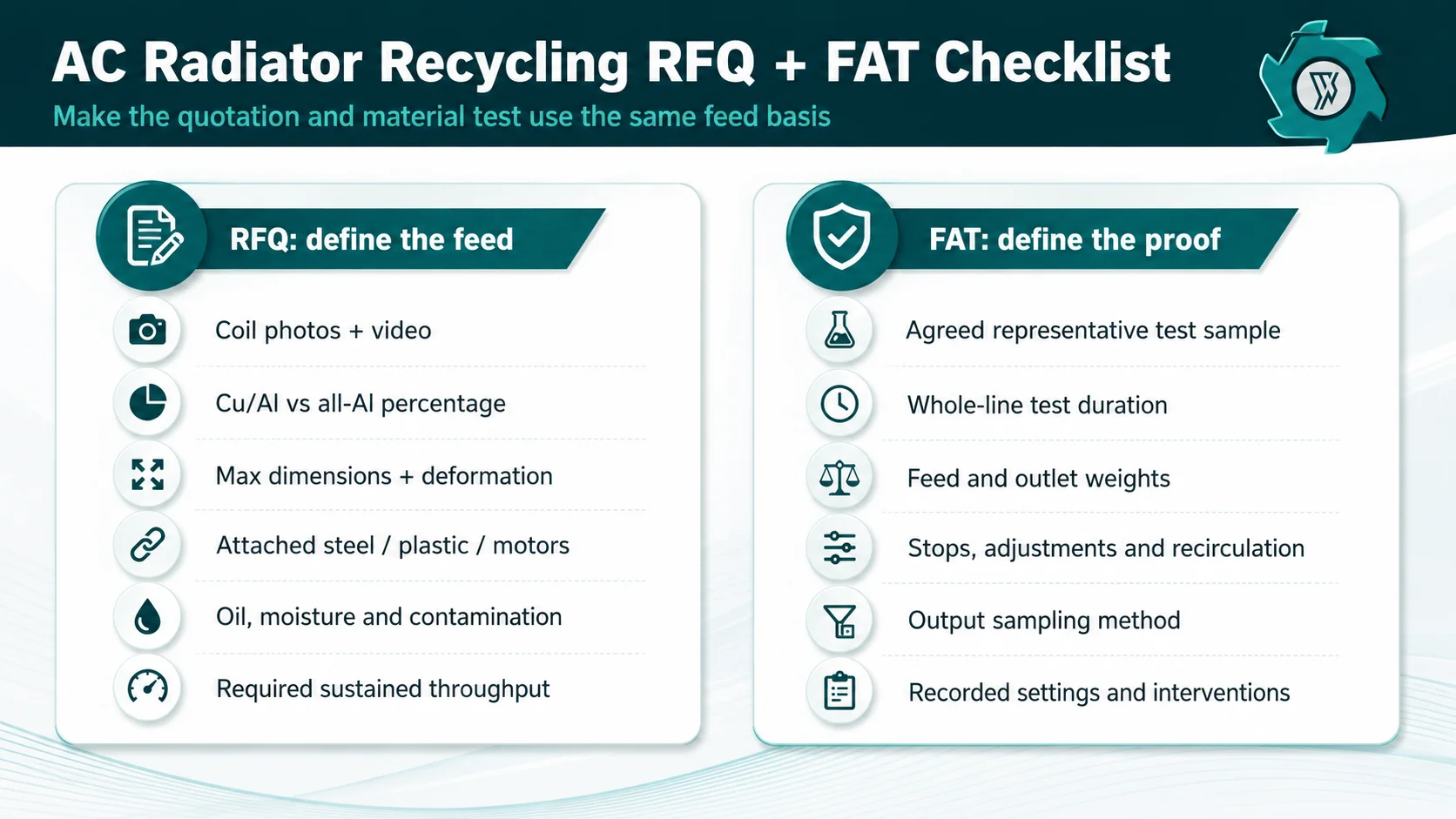
Feed data
- Photos and short video of normal and worst-case coils
- Condenser vs evaporator mix
- Copper-tube/aluminum-fin vs all-aluminum percentage
- Average and maximum dimensions
- Flat, bent, nested, compacted or baled condition
- Attached steel, plastic, motors, fans and headers
- Known oil, moisture or other contamination
Project data
- Required sustained hourly or shift input
- Target copper, aluminum, iron and residue products
- Acceptable contamination basis
- Operating hours and labor assumptions
- Power supply and electrical standard
- Available floor area and loading method
- Dust-control and local EHS requirements
For a factory material test, agree on the sample before the test begins. Record how much feed is used, how long the complete line runs, every stop or adjustment, output weights, recirculation and the sampling method for each product. A short video clip can be useful evidence, but it should not replace the numbers.
A common procurement mistake is sending the supplier the cleanest coil in the yard. That proves the easy case. A better sample includes the routine feed and some of the awkward material that is still expected in normal production.
Seven Mistakes That Make AC Radiator Recycling Harder Than It Needs to Be
- Assuming every AC coil contains copper.
- Feeding sealed refrigeration components into the recycling line.
- Buying a stripping machine for badly deformed mixed feed.
- Expecting the primary shredder to finish liberation.
- Over-crushing to chase a cleaner-looking product.
- Comparing capacity labels without the feed basis.
- Leaving guards, dust collection and maintenance access until the layout is finished.
Summary: Match the Machine to the AC Coil, Then Build the Process Around Liberation
An AC radiator recycling machine is only useful when it matches the coil entering it. Clean, flat and predictable copper-aluminum coils may be suitable for mechanical stripping. Mixed, damaged or industrial volumes are better treated as a complete size-reduction and separation problem.
For the complete route, the logic is straightforward: control the feed, open the coil, liberate the bonded metals, remove ferrous material, stabilize particle size, separate the non-ferrous fractions and manage the dust. The details—especially coil construction, deformation and target product—decide how each stage should be configured.
Need an AC Radiator Recycling Line Recommendation?
Send representative condenser or evaporator coil photos, dimensions, feed condition, target capacity and required output fractions. YUXI can review whether the material is better suited to a stripping route or a complete shredding and separation line.
FAQ: AC Radiator Recycling Machines
What is an AC radiator recycling machine?
It is equipment used to recover metal from discarded air-conditioner condenser and evaporator coils. Depending on the coil condition, the process may use a stripping machine for clean, regular copper-tube/aluminum-fin coils or a complete shredding, crushing and separation line for mixed, bent or contaminated material.
Can an AC radiator recycling machine process whole air conditioners?
The radiator recovery line is designed around the heat-exchanger section, not a complete air-conditioning unit. Refrigerant must be properly recovered before disposal. Compressors, fan components, electrical components, heavy frames and other unsuitable parts normally need to be handled separately before the coil enters the metal recovery process.
How are copper and aluminum separated from AC radiators?
In a complete mechanical line, the coil is first opened and crushed until copper and aluminum are sufficiently liberated. Ferrous parts are removed magnetically. A specific-gravity or airflow separation stage then sorts the remaining particles according to their physical behavior after sizing and liberation.
Do all AC radiators contain copper tubes and aluminum fins?
No. Copper-tube/aluminum-fin construction is very common, but modern HVAC equipment can also use all-aluminum microchannel or other all-aluminum coil designs. Feed composition should therefore be checked before a machine or separator route is selected.
Can a stripping machine handle bent or mixed AC coils?
Usually not as reliably as it handles clean, flat and dimensionally consistent coils. Tube spacing, coil thickness, deformation and attached frames can prevent stable stripping. Mixed or damaged material is generally a better candidate for a shredding and separation route.
What equipment is used in a complete AC radiator recycling line?
A typical industrial route can include metered feeding, a double-shaft shredder, a secondary or vertical crusher with screening, magnetic separation, specific-gravity or airflow separation, conveyors, centralized dust collection and PLC-based controls.
What controls the capacity of an AC radiator recycling line?
Capacity depends on coil dimensions, bulk density, deformation, steel and plastic attachments, residual liquid or oil, required liberation size, crusher loading, recirculation and the stable feed rate of the final separators. A catalog kg/h figure should be checked against representative material.
What information should I send before requesting a quotation?
Send photos or video of normal and worst-case coils, the percentage of copper-aluminum versus all-aluminum material, average and maximum dimensions, whether the coil is flat or deformed, attached steel and plastic, expected daily or hourly volume, expected output fraction, power standard, floor space and local dust control requirements.
External References
- Carrier — NOVATION Microchannel Coils
- EPA — Stationary Refrigeration Safe Disposal Requirements
- EPA — Refrigerant Recovery and Recycling Equipment Certification
- OSHA 29 CFR 1910.212 — General Requirements for All Machines
- OSHA 29 CFR 1910.147 — Control of Hazardous Energy
- OSHA — Combustible Dust: An Explosion Hazard