




 Request Quote



A useful industrial shredder manufacturer comparison starts where most brand lists stop. The question is not simply who builds the biggest machine. It is whether a supplier can take an awkward waste stream, define the real duty of the shredder, prove the configuration on representative material, and support the machine after it becomes part of a working recycling line.
That distinction matters because “industrial shredder” covers several very different machines. A screen-controlled single-shaft unit processing plastic purgings is solving a different problem from a slow-speed twin-shaft pre-shredder opening bulky waste. A four-shaft machine used for e-waste sizing has another operating logic again. Metal scrap, tires, RDF, wood, paper and mixed commercial waste also create different loads at the cutter, shaft, gearbox, bearing and discharge system.
How We Evaluated Industrial Shredder Manufacturers
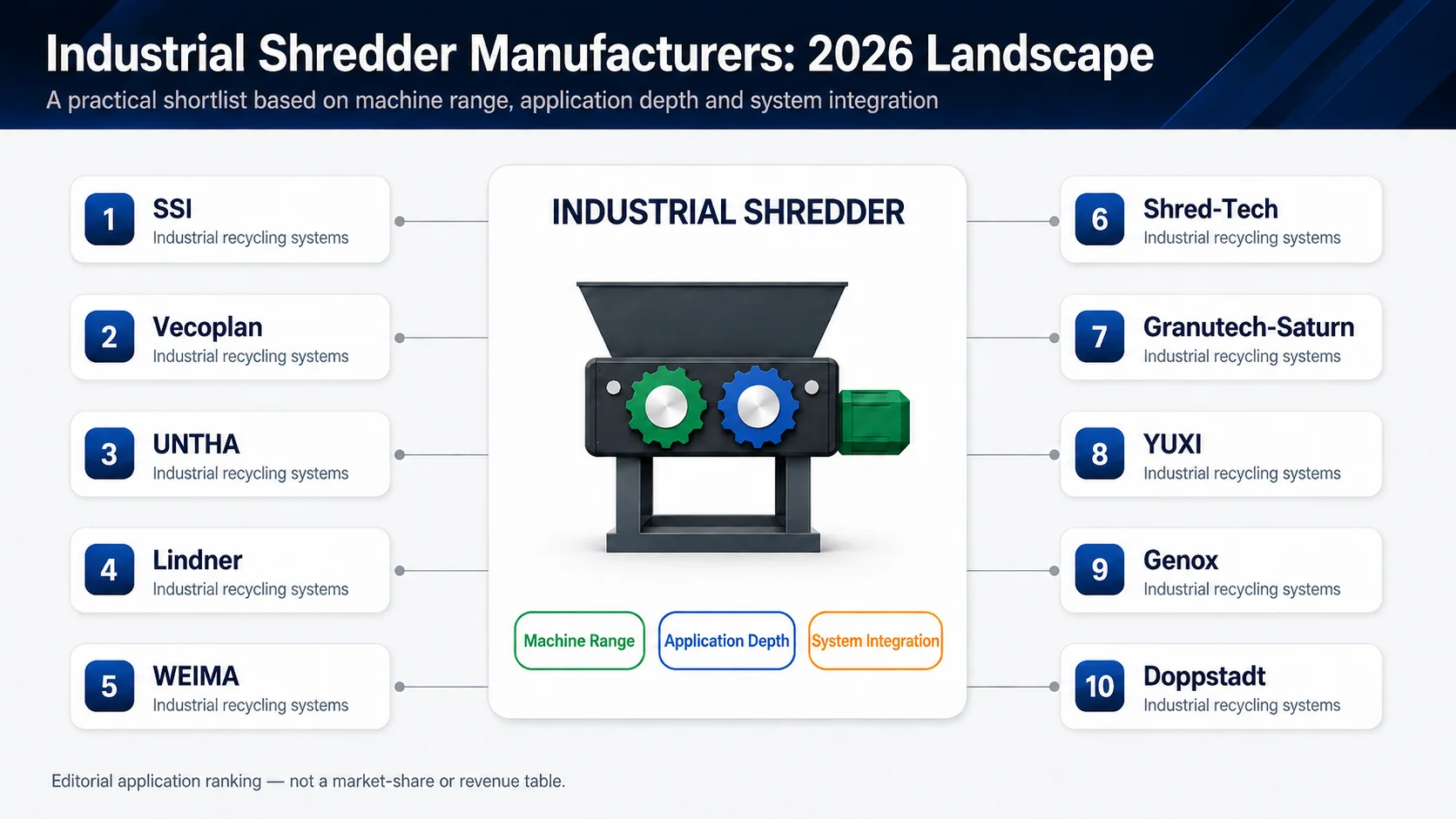
We looked for a real industrial shredder range, evidence across more than one material stream, the ability to integrate equipment beyond the cutting chamber, public technical information, service or commissioning capability, and a credible fit for buyers comparing capital equipment in 2026. We also checked current manufacturer websites rather than relying only on older list articles.
| Evaluation area | What matters in practice | Why it changes the shortlist |
|---|---|---|
| Machine range | Single-, dual-, three- or four-shaft platforms, primary shredders, secondary shredders, mobile options or complementary grinders. | A broad range reduces the chance that every inquiry is forced into one machine architecture. |
| Application depth | Published use on plastics, metal, tires, wood, RDF/SRF, e-waste, paper, biomass or mixed waste. | The same motor power can behave very differently on a different feed geometry or contamination level. |
| System integration | Feeding, conveying, screening, separation, granulation, fuel preparation or complete recycling lines. | The shredder is usually one stage in a process. Net plant output is limited by the complete line. |
| Testing and engineering | Material trials, test centers, application engineering, configuration options and documented acceptance criteria. | A good test exposes bridging, wrapping, reversals, fines and discharge bottlenecks before installation. |
| Service model | Commissioning, training, parts, field service, regional offices or remote technical support. | Wear parts and troubleshooting become operating issues long after the purchase order is signed. |
| Technical transparency | Clear machine categories, application limits, component information and realistic performance language. | Buyers need comparable data, not a collection of maximum numbers taken from different test conditions. |
Top 10 Industrial Shredder Manufacturers: Comparison Table
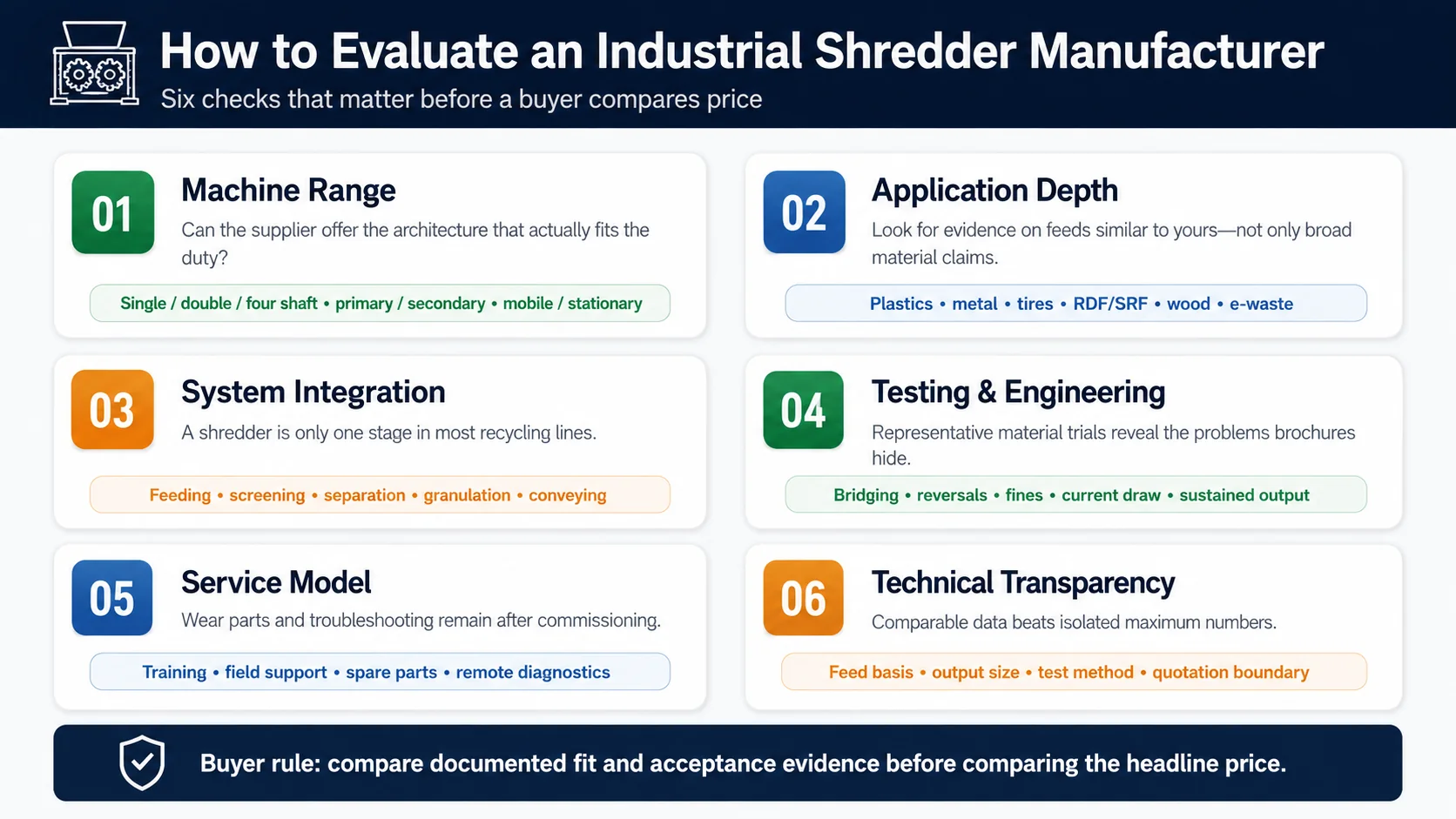
| Rank | Manufacturer | Base | Notable range | Best fit |
|---|---|---|---|---|
| 1 | SSI Shredding Systems | United States | 1-, 2-, 3- and 4-shaft shredders; primary reducers | Engineered heavy-duty and mixed industrial applications |
| 2 | Vecoplan | Germany | Primary and secondary shredding plus conveying and processing systems | Waste, RDF, plastics, wood and integrated processing |
| 3 | UNTHA | Austria | Industrial shredders from compact units to high-performance waste systems | Waste, recyclables, wood, plastics and alternative fuels |
| 4 | Lindner Recyclingtech | Austria | Stationary/mobile shredders and complete recycling systems | Waste, SRF/RDF, plastics and waste wood |
| 5 | WEIMA | Germany | Single- and multi-shaft shredders, granulators and compaction equipment | Plastics, wood, paper, biomass and industrial waste |
| 6 | Shred-Tech | Canada | Industrial shredders, slow-speed shredders and mobile shredding systems | Metal, tires, e-waste, paper, batteries and mixed industrial duties |
| 7 | Granutech-Saturn Systems | United States | Single-, dual- and quad-shaft shredders, grinders and granulators | Tires, e-scrap, metals and multi-stage recycling systems |
| 8 | YUXI Machinery | China | Single-, double-, four-shaft, plastic and hydraulic shredders plus recycling systems | Export projects needing machine selection and line integration |
| 9 | Genox Recycling Technology | China | Single/twin-shaft, pipe and pre-shredders plus crushers and complete systems | Plastics, e-waste, batteries, tires and industrial solid waste |
| 10 | Doppstadt | Germany | Mobile shredding and broader waste-processing equipment | Green waste, biomass, mixed waste and mobile processing |
Top 10 Industrial Shredder Manufacturers
1. SSI Shredding Systems
SSI remains one of the strongest reference points when a buyer needs a true industrial shredder rather than a general-purpose grinder. The company publishes one-, two-, three- and four-shaft shredders, primary reducers and high-density compaction systems. Its product pages describe applications ranging from alternative fuels and metals to medical waste and textiles.[1]
Why it ranks highly: the breadth of shredder architectures is unusual. That gives SSI more freedom to start with the process duty—primary reduction, controlled sizing, difficult mixed feed—before deciding which shaft arrangement is appropriate.
Best fit: demanding recycling, waste and destruction projects where the buyer expects application engineering and a heavy-duty, low-speed platform.
2. Vecoplan
Vecoplan develops machines and systems for shredding, separating, conveying and storing primary and secondary raw materials. Its shredding portfolio covers multiple waste and recyclable streams, including plastics, wood and waste prepared for material or thermal recovery.[2]
Why it ranks highly: Vecoplan is not just a cutting-chamber supplier.When the shredder must provide fuel for the separator,storage system,secondary shredder or fuel preparation line without generating new bottlenecks,its broader material processing portfolio is important.
Best fit: processors that want a mature European supplier for integrated waste, RDF/SRF, plastics or wood projects.
3. UNTHA
UNTHA focuses specifically on industrial shredding technology. Its current product and application material covers waste processing, recyclables recovery, wood, plastics and other industrial duties, with machines ranging from compact shredders to high-performance systems for continuous operation.[3]
Why it ranks highly: the company has deep specialization in low-speed shredding rather than treating shredders as a small side category inside a wider machinery catalog.
Best fit: buyers who want strong shredding specialization and are comparing long-term operating behavior, cutter configuration, drive concept and maintenance access—not only first purchase price.
4. Lindner Recyclingtech
Lindner’s portfolio includes stationary and mobile shredders as well as system solutions for plastics recycling, waste wood and substitute-fuel production. The company also designs larger project solutions rather than limiting its scope to stand-alone machines.[4]
Why it ranks highly: Lindner is especially relevant when the material stream moves between pre-shredding, screening, secondary reduction and fuel or recycling preparation. Its portfolio reflects that process-level view.
Best fit: municipal or commercial waste, RDF/SRF, plastic recycling and waste-wood projects where continuous line performance matters.
5. WEIMA
WEIMA manufactures shredding and compaction equipment and reports more than 40,000 machines placed on the market, with roughly 1,000 machines produced annually. Its German production includes single-shaft and multi-shaft shredders, granulators and compaction equipment. Public application pages cover plastics, wood, paper, biomass, metal and commercial or industrial waste.[5]
Why it ranks highly: WEIMA combines a substantial installed base with a wide range of industrial reference applications. It is particularly visible in factory scrap and in-house recycling, where the shredder has to run predictably beside production equipment.
Best fit: plastics, wood, paper, biomass and industrial production waste where controlled feeding and documented reference applications are important.
6. Shred-Tech
Shred-Tech started in 1978 and today offers industrial shredders, slow-speed shredders, mobile shredding trucks and collection systems. The company lists manufacturing and service operations in Canada, the United States, the United Kingdom/Europe and Thailand, and publishes application coverage for batteries, metals, paper, plastics, wood, tires and e-waste.[6]
Why it ranks highly: the combination of stationary industrial equipment and mobile shredding experience gives Shred-Tech an unusually broad service and application footprint.
Best fit: industrial recycling projects that value international service reach or have specialized destruction, e-waste, tire, battery, metal or paper requirements.
7. Granutech-Saturn Systems
Granutech-Saturn Systems traces its industrial recycling history to 1968. Its current product offering includes Saturn single-, dual- and quad-shaft shredders, grinders, granulators, powderizers and refiner mills, with complete systems for tires and other industrial recycling applications.[7]
Why it ranks highly: Granutech is particularly useful as a benchmark when the shredder is only the first size-reduction stage. Its downstream grinding and granulation portfolio makes multi-stage particle-size planning easier to discuss with one supplier.
Best fit: tire recycling, e-scrap, metal and other projects that may need two, three or four size-reduction stages.
8. YUXI Machinery
YUXI manufactures single-shaft, double-shaft, four-shaft, plastic and hydraulic shredders and combines them with recycling systems for metal scrap, plastics, tires, paper, RDF/MSW and other industrial waste. Its current industrial shredder manufacturer page emphasizes selecting the shredder configuration around the material type, feed size, target capacity, required output size and downstream process rather than recommending the same standard model for every inquiry.
Why it is on the list: the product range is wide enough to discuss several shredding architectures under one factory, and the same site shows complete recycling-system applications beyond stand-alone shredders. That makes YUXI relevant to overseas buyers who are comparing equipment plus line integration rather than only a single machine.
Best fit: export projects that need single-, double- or four-shaft options and want the shredder configured around a broader recycling flow.
9. Genox Recycling Technology
Genox publishes a broad range that includes single-shaft shredders, twin-shaft shredders, pre-shredders, dedicated large-pipe shredders, granulators and complete recycling systems. Its application categories include plastics, e-waste, tires, refrigerators, lithium-ion batteries, metal and industrial solid waste.[8]
Why it is on the list: Genox combines shredder manufacturing with downstream crushing and recycling-system integration. Its pipe-specific machines also show useful specialization beyond generic box-type shredders.
Best fit: plastics and electronics recyclers, battery projects and other buyers comparing Chinese system suppliers with broad equipment portfolios.
10. Doppstadt
Doppstadt’s current portfolio includes mobile shredding solutions as part of a broader range of waste and recycling equipment. Its equipment is commonly positioned around waste treatment, biomass and mobile material-processing workflows rather than only stationary factory shredding.[9]
Why it is on the list: some buyers do not need a fixed shredder bolted into a permanent line. Doppstadt is a useful benchmark when mobility, loader feeding, site changes and integration with screening or other mobile processing equipment are central to the project.
Best fit: green waste, biomass, mixed waste and contractors or processors that need mobile equipment.
Match the Manufacturer to the Shredder Type You Actually Need
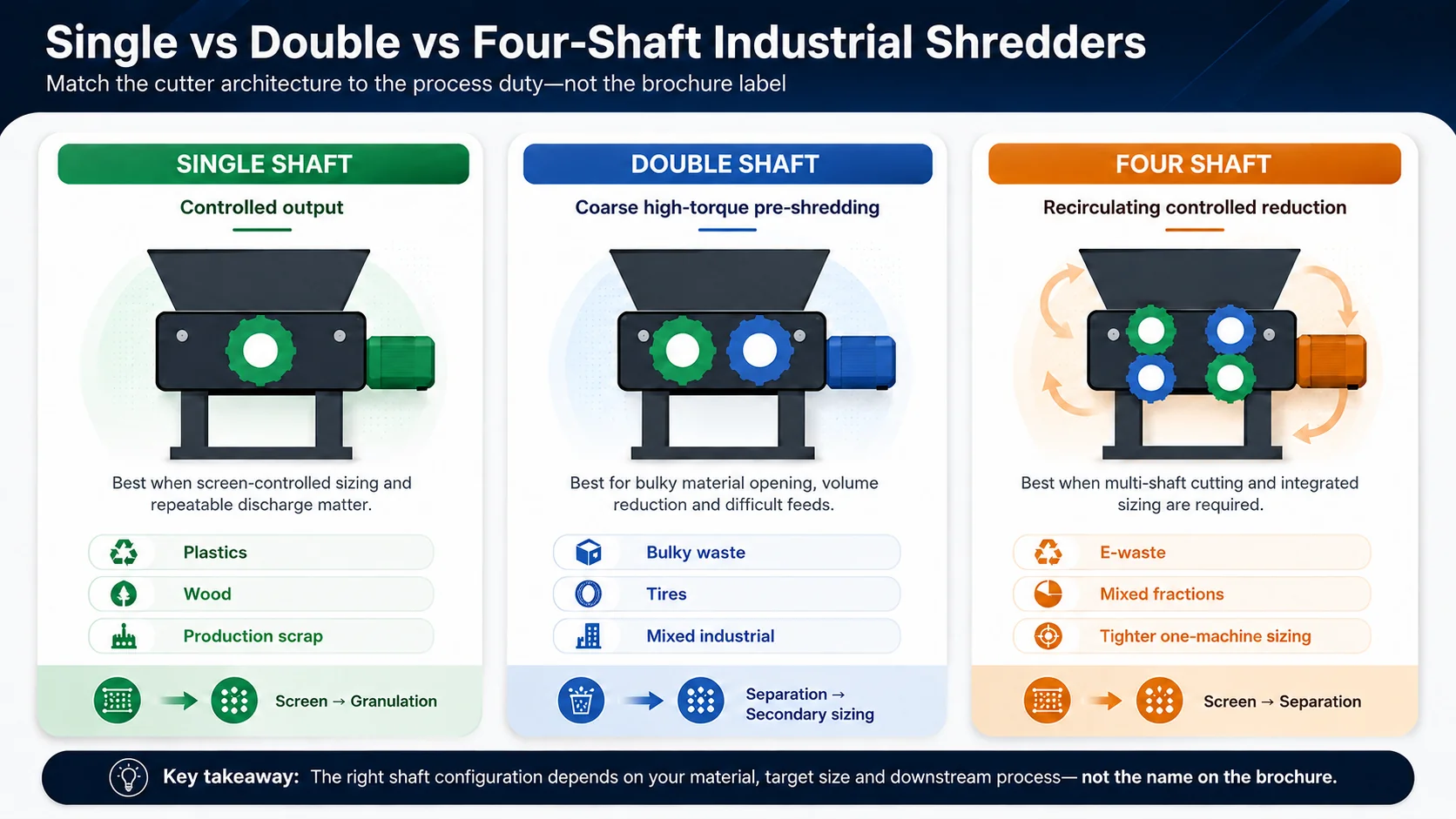
One reason manufacturer lists become misleading is that buyers often search the brand before defining the shredding duty. In practice, we normally recommend doing the reverse. Write the process requirement first, then see which suppliers have the right architecture and credible reference material.
| Shredding duty | Typical machine direction | What to ask the manufacturer |
|---|---|---|
| Controlled reduction of plastics, wood or production scrap | Screen-controlled single-shaft shredder | Rotor design, screen opening, pusher behavior, anti-wrapping measures, sustained output and discharge method. |
| Bulky waste opening and coarse volume reduction | Low-speed double-shaft or primary shredder | Cutter geometry, shaft torque, reversal logic, unshreddable protection, largest accepted feed and downstream sizing stage. |
| Mixed material with tighter one-machine sizing | Four-shaft or recirculating multi-shaft system | Integrated screen, recirculation load, cutter access, fines generation and realistic throughput at the required output size. |
| RDF/SRF preparation | Primary + secondary shredding, often with screening/separation | Input composition, final fuel specification, ferrous/non-ferrous protection, moisture, screen strategy and net line capacity. |
| Tire recycling | Primary tire shredder plus downstream separation/granulation | Tire mix, bead handling, recirculation, steel liberation, cutter wear and final product size. |
| Metal scrap pre-processing | Heavy-duty shear shredder or dedicated metal system | Maximum section thickness, hollow vs solid feed, sealed-container policy, tramp materials, shaft protection and downstream separation. |
If your immediate comparison is narrower, start with YUXI’s guide to single-shaft and double-shaft shredder types, then review the double-shaft metal shredder page for machine configurations, suitable materials and capacity ranges before shortlisting suppliers.
What to Send Industrial Shredder Manufacturers Before Requesting a Quote
The weakest RFQs say something like “We need a 5 t/h waste shredder” and attach one photograph. That sounds specific, but it leaves nearly every engineering variable open. Five tonnes per hour of loose film, tires, wood pallets, aluminum profiles and mixed C&I waste are five different machines.
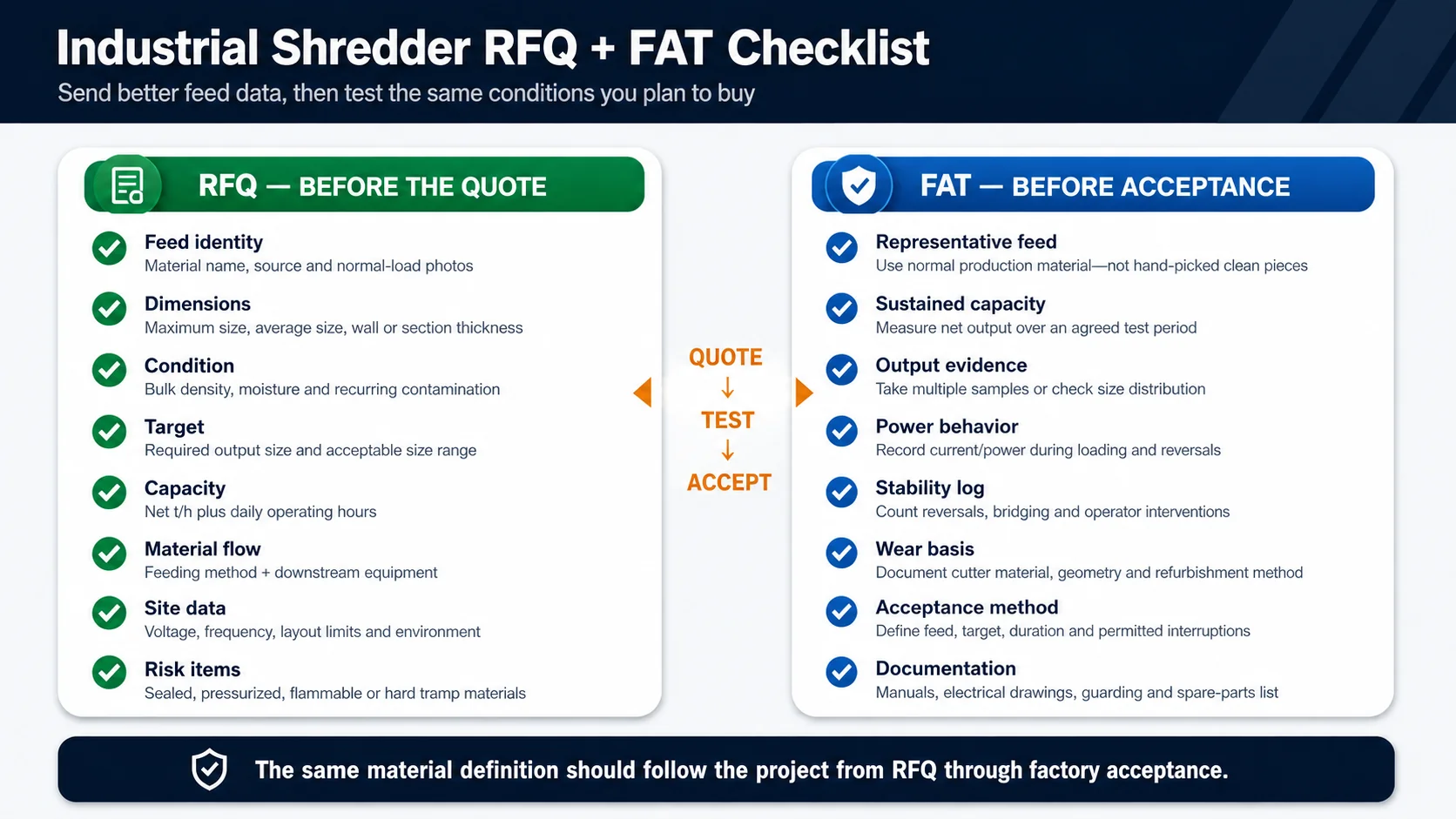
A better inquiry gives the supplier enough information to reject the wrong model early. We would send the following before asking for a final quotation:
- material name, source and several photographs from normal—not cleaned-up—loads;
- maximum dimensions, average dimensions, wall thickness or section thickness where relevant;
- bulk density, moisture and the contamination that regularly appears in production;
- required output size and whether a rough range is acceptable or a screen-controlled fraction is required;
- required net hourly output and daily operating hours;
- feeding method: conveyor, loader, grab, forklift, crane or manual;
- upstream sorting and downstream screening, separation, granulation, baling or storage;
- site voltage/frequency, layout limits, environmental conditions and installation location;
- known hazardous or prohibited items, especially sealed, pressurized, flammable or chemically contaminated containers;
- representative samples for a material test when the feed is unusual or expensive to get wrong.
Surprisingly, the hardest variable is often not the average feed. It is the worst material that arrives once or twice per shift. A small piece of hardened steel, a tangled textile bundle, a hidden shaft, a wet bale or a long springy profile can decide whether the machine reverses gracefully or loses production time.
How to Compare Factory Tests and Capacity Guarantees
A ten-minute demonstration is useful for seeing whether a machine can bite the material. It is not enough to prove a production rate. For a serious project, the material test should be structured so that two suppliers can be compared on the same basis.
| Test item | Weak evidence | Stronger evidence |
|---|---|---|
| Feed | Hand-picked clean pieces | Representative production sample with normal size variation and contamination |
| Capacity | Instantaneous peak | Sustained net output over an agreed test period |
| Output | One attractive handful | Multiple samples or a size-distribution check across the test |
| Power | Installed motor kW | Operating current or power trend during real loading and reversals |
| Stability | No record of interruptions | Reversals, bridging, clearing events and operator intervention logged |
| Wear | Generic knife-life claim | Cutter material, geometry, refurbishment method and reference wear basis documented |
For projects with a high cost of failure, write the acceptance method into the purchase contract. That does not mean demanding a magical guaranteed tonnes-per-hour number for every possible load. It means agreeing on a defined feed, target output, measurement period, permitted interruptions and the responsibility for upstream and downstream equipment.
Which Industrial Shredder Manufacturer Should You Shortlist?
Start with the material and process, then use the ranking as a filter—not as a purchase decision. SSI, Vecoplan, UNTHA, Lindner and WEIMA are strong benchmarks for mature industrial platforms. Shred-Tech adds broad international shredding coverage. Granutech-Saturn is especially relevant for multi-stage tire and industrial size reduction. YUXI and Genox deserve comparison when a buyer is considering export-oriented Chinese equipment and complete recycling systems. Doppstadt becomes more important when mobility and waste-processing flexibility are central to the business.
The final shortlist should probably be smaller than ten. Three or four suppliers are enough if they are quoting the same duty. Give them the same feed description. Ask them to test the same material. Require the same output definition. Then compare engineering assumptions, not marketing adjectives.
Compare an Industrial Shredder for Your Material
Send YUXI your material photos or videos, maximum feeding size, target capacity, required output size, operating hours and downstream process. The engineering team can recommend whether the project should begin with a single-shaft, double-shaft, four-shaft or another shredding configuration.
FAQ
What should I compare between industrial shredder manufacturers?
Compare material fit, shredder architecture, representative testing, sustained throughput, output control, cutter and drive design, guarding, controls, drawings, spare parts, commissioning, service coverage and the exact quotation boundary.
Is a single-shaft or double-shaft shredder better?
Neither of them is generally better. A single-shaft shredder is often selected when screen-controlled output is important. A double-shaft shredder is commonly used for slow-speed, high-torque coarse reduction of bulky materials. The correct choice depends on feed behavior and the next process.
Should I choose a local manufacturer or an overseas supplier?
Both use the same acceptance list.Local services can reduce response and parts logistics time, while overseas factories may provide different machine ranges or commercial structures.Compare documented machine fit, parts planning, commissioning responsibility and total landed project cost.
Why is a material test important before buying a shredder?
A representative test exposes the feeding behavior, reversals, bridging, cutter loading, discharge size, fines, current consumption and downstream bottlenecks that cannot be shown in the manual.This test is most useful when using normal production materials instead of small and clean samples.
What safety documents should an industrial shredder supplier provide?
Requirements vary by jurisdiction, but buyers should review guarding, emergency stops, electrical documentation, operating and maintenance instructions, energy-isolation provisions and applicable conformity documentation. The final plant still needs a site-specific risk review.
References
- SSI Shredding Systems, Industrial Shredder Products and Size Reduction Systems, current product overview reviewed August 2026.
- Vecoplan AG, Shredding Technology and system portfolio for recyclable and residual materials, reviewed August 2026.
- UNTHA shredding technology, Industrial Shredder Product Range, reviewed August 2026.
- Lindner Recyclingtech, Company and Shredding Systems Overview, reviewed August 2026.
- WEIMA, About WEIMA, manufacturing, machine portfolio and installed-base information, reviewed August 2026.
- Shred-Tech, About Shred-Tech and Industrial Shredders, reviewed August 2026.
- Granutech-Saturn Systems, Company History and Industrial Recycling Equipment, reviewed August 2026.
- Genox Recycling Technology, Industrial Shredder Machines and recycling systems, reviewed August 2026.
- Doppstadt, Core Shredder Line, twin-shaft shredding solutions for recycling and waste-management applications, reviewed August 2026.