




 Request Quote



A radiator line can look underloaded at one feed rate on one day and strained at the same rate on the next. Nothing in the machine has changed. The scrap has. A loose stack of clean AC coils, a batch of plastic-tank car radiators and a compacted load with heavy steel frames may all be sold under the same broad description, yet they occupy the feeder differently and put very different work into the shredder, crusher and separators.
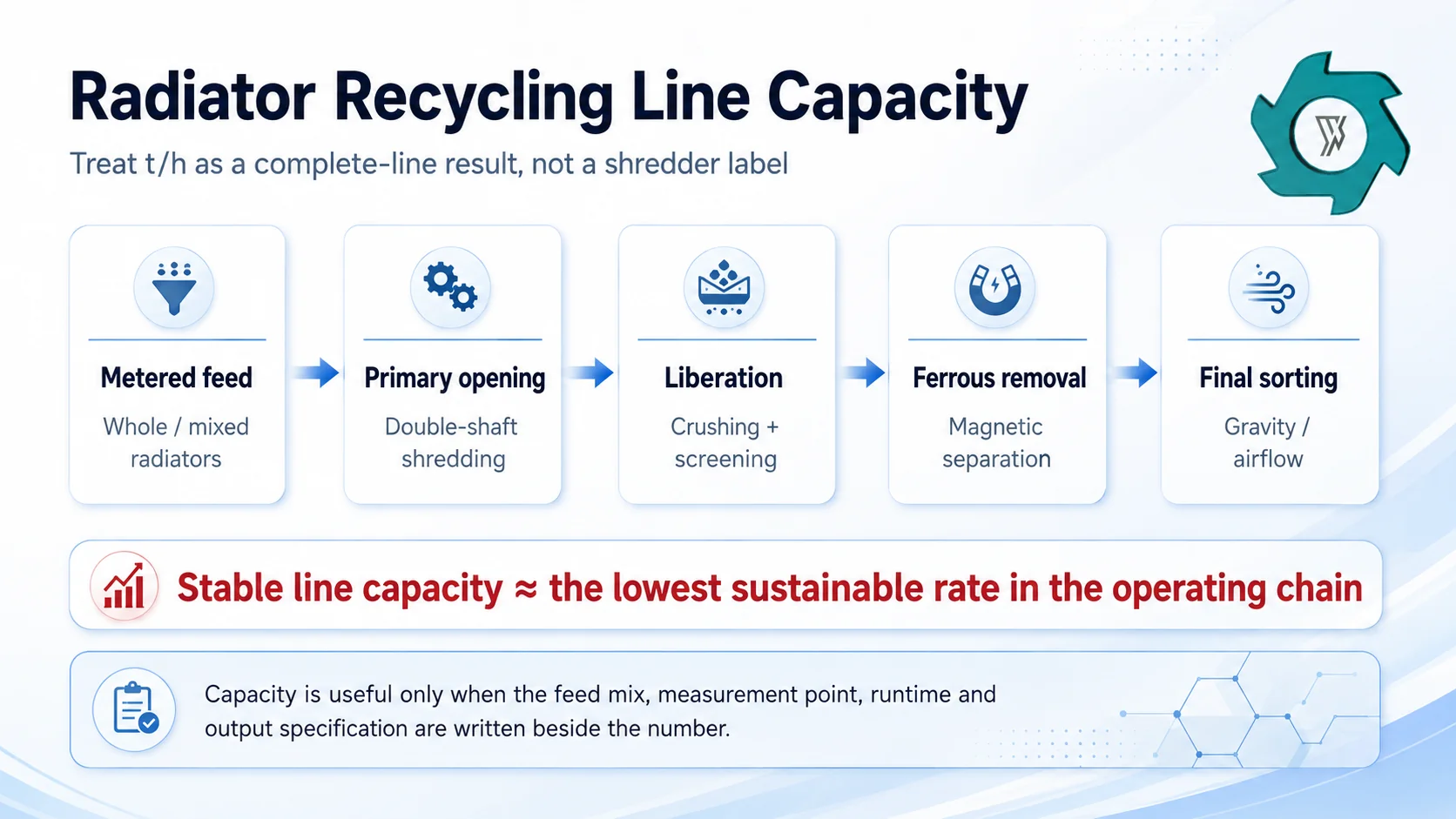
Why a 1000 kg/h Label Does Not Tell You the Whole Story
Search results for radiator recycling equipment show how broad the market language is. One supplier publishes complete-line classes of 400–500, 800–1000 and 1500–2000 kg/h, while another lists systems rated at 800–1000 and 1500–2000 kg/h.[1][2] A stripping-machine supplier describes a different kind of equipment at 300–1000 kg/h.[3] These figures are useful for orientation, but they are not a common test standard.
A flat, pre-cut coil fed by hand is not the same duty as deformed mixed radiators going through primary shredding, secondary liberation, magnetic removal and gravity separation. Even two complete lines may measure capacity at different points. One quotation can be based on feed entering the first machine. Another can be based on material leaving the last separator. A third may quote a short peak from a demonstration run.
For this reason, we would not reject or approve a line because a catalog says 800 kg/h, 1000 kg/h or 2000 kg/h. First make the supplier explain the material and the measuring boundary behind the number. The existing metal shredder capacity guide makes the same distinction for a single size-reduction stage; radiator recycling adds more downstream constraints because the material still has to be liberated and separated.
Start by Defining Which Capacity You Are Comparing
| Capacity term | What it means | Use it for |
|---|---|---|
| Nominal / catalog capacity | A supplier reference for a machine or line under stated or assumed conditions. | Shortlisting. It is not a performance guarantee unless the feed and test basis are attached. |
| Peak feed rate | The highest short-duration feed rate observed under defined conditions. It may not be sustainable once feed variation, downstream loading or normal interruptions are included. | Checking surge and feeder headroom, not shift output. |
| Machine discharge rate | Mass leaving one shredder or crusher during a defined run. | Checking that machine only. |
| Sustained complete-line throughput | Average gross feed processed while the agreed line operates normally and the required separation condition is maintained. | The most useful base figure for line sizing. |
| Shift input | Total mass processed in scheduled hours after normal loading, checks, cleaning and minor interruptions. | Labor, loader, storage and business planning. |
| Qualified product output | Mass of the copper-rich, aluminum-rich, ferrous or other accepted fractions after the specified separation steps. | Sales and recovery planning. It must be tied to a mass balance and an output specification. |
Two numbers can both be correct and still describe different things. If a test processes 6 tonnes of mixed radiators through the first shredder, that proves the shredder has accepted 6 tonnes. It does not prove the final gravity separator handled the same rate or that the copper and aluminum fractions stayed inside the agreed contamination limits.
Record productive runtime separately from scheduled time. A ten-minute stop to clear a bridge, clean a screen or adjust a separator should not disappear from the report. The net throughput can be shown, but the stop still matters when estimating what the plant will produce in a shift.
What Changes Radiator Recycling Line Capacity?
YUXI’s radiator solution page already points to the variables that matter: radiator type, deformation, oil or coolant residue, iron and plastic content, and the copper-versus-aluminum mix all affect capacity and separation quality. It also states that feed density, size, deformation, iron content, plastic content, target particle size, crusher load and separator feed stability change actual throughput. Those are not minor details. They are the capacity specification.
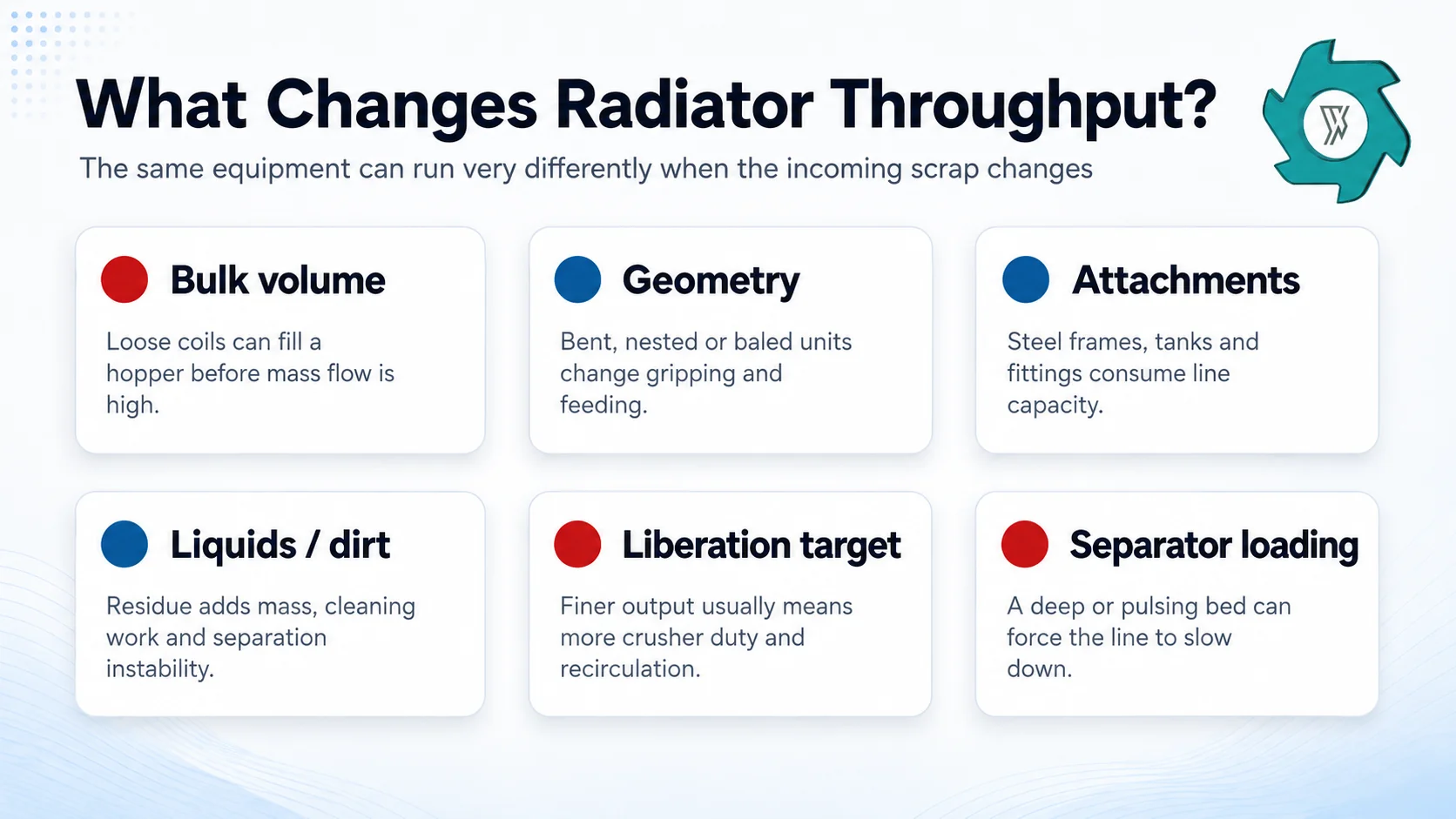
1. Radiator type changes both volume and breakage behavior
Copper-aluminum AC coils can be light and bulky. Automotive radiators may carry plastic side tanks, frames and fittings. All-aluminum and microchannel units fracture differently again. A mixed heat-exchanger load can contain several of these forms in the same bucket. The line is not processing the word “radiator”; it is processing geometry, joints, materials and trapped void space.
2. Loose bulk density controls the feed volume
Hoppers and belts receive cubic meters before the plant records tonnes. A light, open stack can fill the receiving area while the mass flow is still modest. A compacted or tightly nested load carries more mass in the same volume but can be harder to pull apart. A useful project review therefore needs both a mass target and a rough loose-bulk-density check under the handling method that will be used on site.
This calculation explains a common puzzle: a shredder motor can be running below its electrical limit while the line still cannot accept more kilograms per hour. The feeder or chamber may already be full by volume.
3. Maximum piece size matters more than the average
Averages are friendly numbers. The longest bent assembly is the one that bridges the hopper. A heavy steel bracket on one car radiator is the piece that creates a sudden torque spike. For capacity planning, record normal dimensions, maximum dimensions and the share of material close to that maximum. Photos of the worst normal feed are often more useful than a single average length.
4. Steel, plastic and residue use capacity without becoming copper or aluminum
Iron frames, screws, plastic tanks, rubber parts, dirt and residual liquid all travel through some part of the process. They add gross feed mass, occupy conveyors and affect crusher or separator loading. If the project business case is based on copper and aluminum output, gross radiator throughput and qualified non-ferrous output need separate columns.
5. The required liberation sets crusher duty
Primary shredding only needs to open bulky material enough for stable conveying and secondary processing. The later crusher and screen have the harder separation job: break enough copper-aluminum connections and create a particle range the magnetic and density stages can handle. A finer or more demanding output target can reduce t/h by increasing residence time, recirculation, wear and fines.
The radiator recycling process guide goes deeper into that liberation sequence. For capacity work, the important point is simpler: if the buyer changes the required output condition, the supplier is allowed to revisit the capacity figure.
6. Separator loading can become the limit before the crusher is full
A density or airflow separator does not benefit from an uncontrolled surge. If the feed layer becomes too deep or arrives in pulses, separation can deteriorate even though every upstream motor is still turning. In that situation the commercial capacity of the line is the rate at which product quality remains stable, not the highest rate the crusher can physically discharge.
Capacity Questions for Every Stage of the Radiator Line
The YUXI process uses feeding, double-shaft shredding, vertical crushing and screening, magnetic separation, specific-gravity separation and centralized dust collection. Each stage has a different reason for slowing the system down.
| Stage | Main capacity risk | Evidence worth requesting |
|---|---|---|
| Receiving / feeder | Bulky coils bridge, nested units arrive as slugs, or loader cycles create long empty gaps. | Feed video, hopper dimensions, normal bucket size, belt burden and feed-control logic. |
| Double-shaft shredder | Largest assemblies, heavy brackets or compacted material cause repeated reversals or low pull-in rate. | Representative feed run, reversals, load trend, stoppages and discharge size. |
| Vertical crusher / liberation | Target particle condition requires more residence or creates too much circulating oversize. | Net t/h at the agreed output size, screen condition, recirculation and fines fraction. |
| Magnetic separation | Ferrous pieces are buried under a deep layer or remain attached to non-ferrous fragments. | Ferrous product, carryover sample and burden depth at the target rate. |
| Specific-gravity separation | Feed arrives too deep, too uneven or outside a workable particle-size window. | Repeated copper/aluminum/residue samples while the full line runs at the target rate. |
| Dust / fines handling | Ducts, bins or filters load faster than they can be cleaned or discharged. | Collection points, bin cycle, observed pressure trend and housekeeping intervals. |
| Product discharge | Bags, bins or containers fill and stop the separator even though the upstream machines could continue. | Container volume, changeover method, loader availability and storage plan. |
How to Size Hourly Capacity from a Daily Production Target
A buyer usually starts with a daily or annual tonnage requirement, not with a machine rpm. Converting that business target into a useful continuous rate takes only a few steps, but one assumption must be kept visible: productive utilization.
Productive utilization is the share of the shift in which representative material is actually moving through the agreed process. It is not a universal radiator-industry constant. Loader delays, inspection, normal adjustments, screen cleaning, bin changes, wear and feed variation all influence it. Use a conservative planning case and then replace the assumption with measured data after commissioning.
An illustrative calculation
The following example is only a sizing method. It is not a published YUXI capacity rating.
| Planning item | Example | Result |
|---|---|---|
| Required gross radiator input | 8 tonnes per shift | 8.0 t |
| Scheduled shift | 8 hours | 8.0 h |
| Planning utilization | 75% | 6.0 productive h |
| Required sustained line rate | 8.0 t ÷ 6.0 h | 1.33 t/h |
If a supplier quotes exactly 1.0 t/h for this example, the project would miss the 8-tonne target unless real utilization is higher or the shift is longer. If a supplier quotes 1.5 t/h, that still does not finish the review. The next questions are whether 1.5 t/h is sustained on the same feed mix and whether the required copper and aluminum fractions remain acceptable at that rate.
Do not hide the distinction by multiplying a catalog number by eight hours and calling the result daily production. The operating window belongs in the calculation.
Complete-Line Capacity Is Set by the Slowest Stable Stage
It is tempting to size the whole project around the largest motor because shredders and crushers dominate the layout. The bottleneck can be much less dramatic. A screen may accumulate difficult flat pieces. A gravity separator may need a thinner bed. A conveyor may transfer material in pulses. A dust bin may need to be changed too often. Product discharge may stop because there is nowhere to put the aluminum fraction.
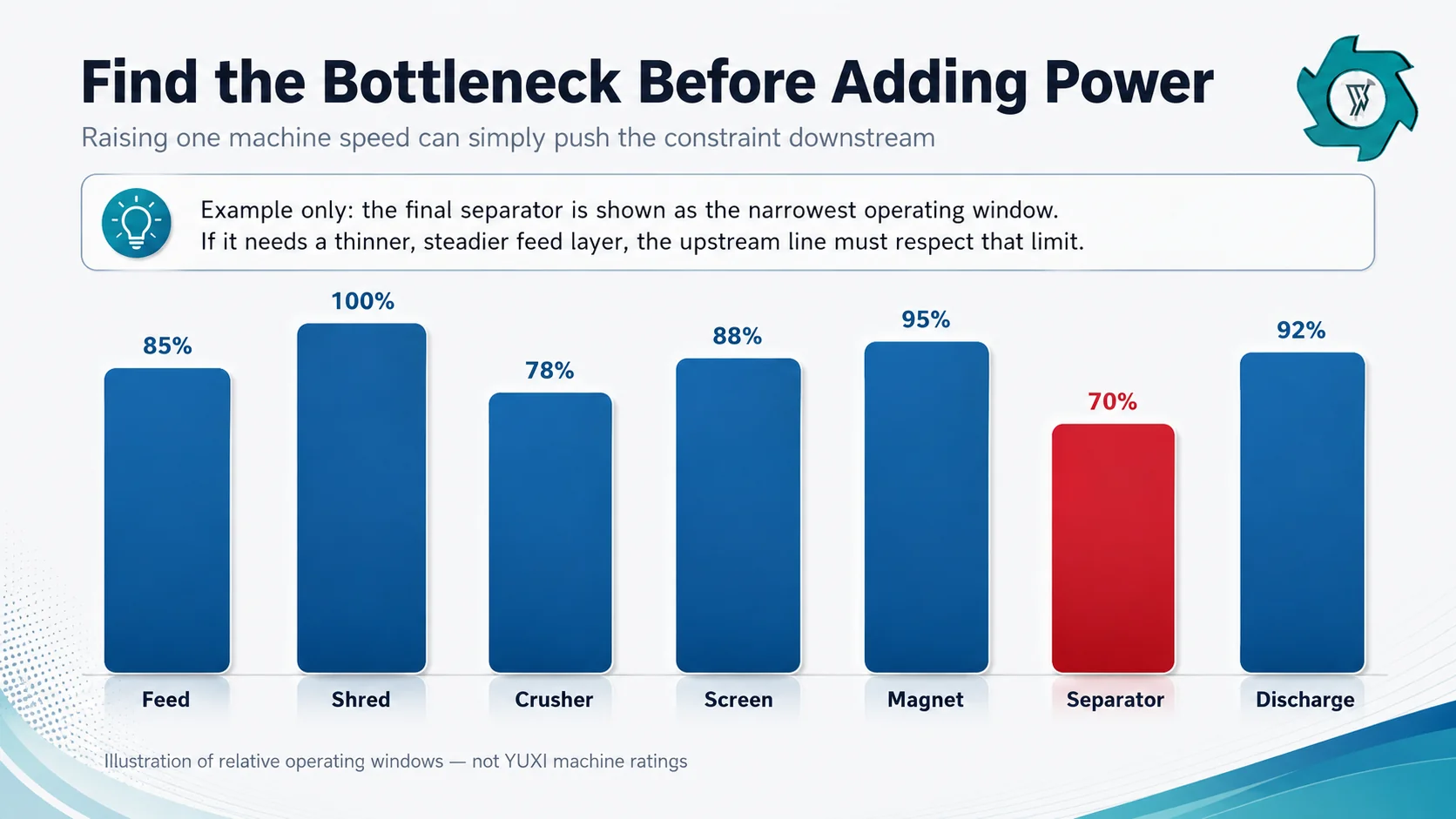
That minimum is not necessarily a permanent machine limit. It can move when the feed changes. A clean batch of flat AC coils may make the crusher the limiting point. A later batch of bulky car radiators can make feeding the problem. A high-plastic batch can increase light residue and disturb final separation. For mixed-feed projects, one “maximum capacity” number is less useful than a tested operating envelope.
Verify Radiator Capacity with a Representative FAT
A factory acceptance test is where a capacity claim becomes measurable. It does not need to be complicated, but the test plan should be written before the run. Otherwise it is easy to choose the cleanest material, stop the clock during inconvenient periods and weigh only the stream that makes the result look strongest.
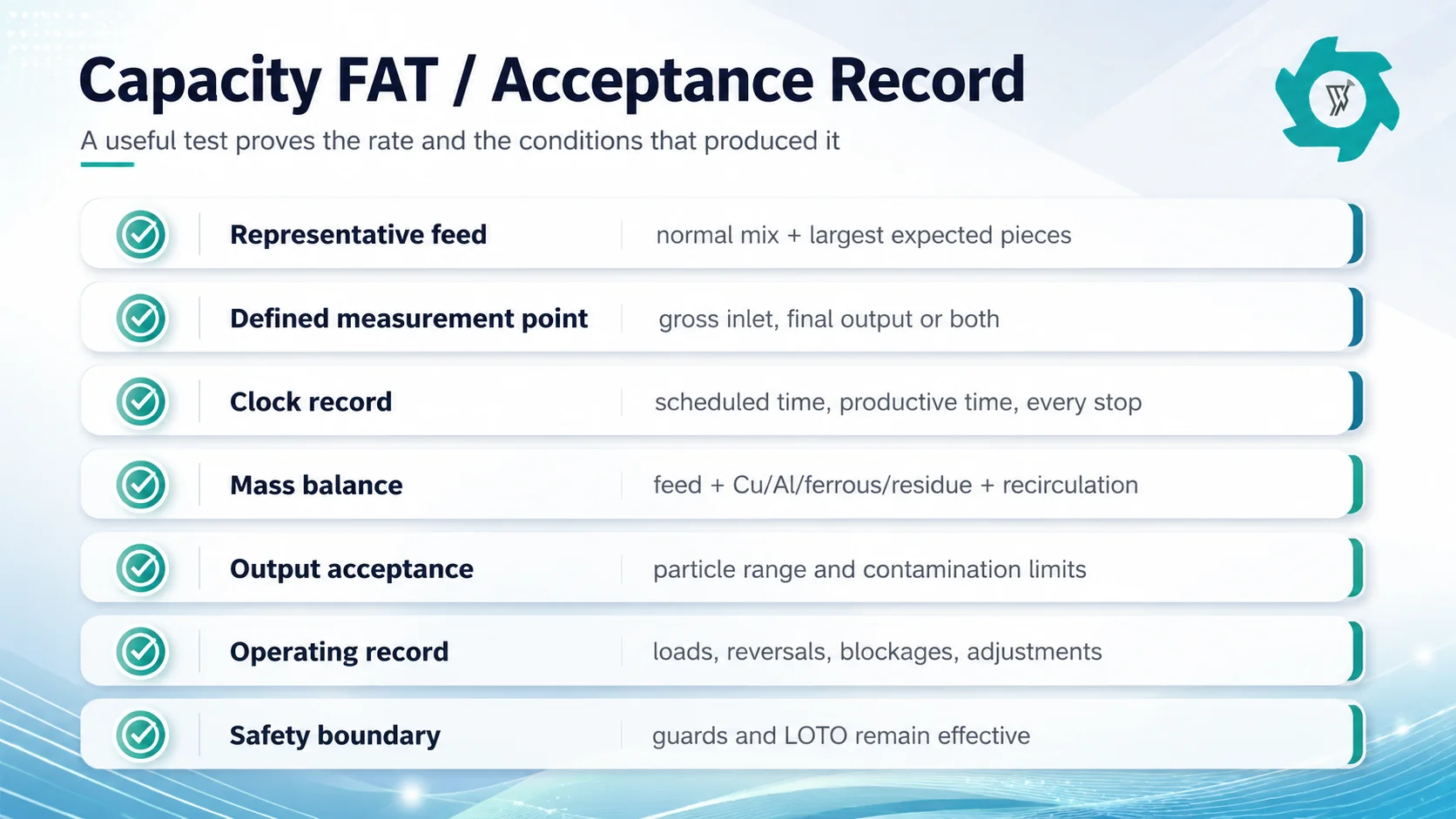
- Agree the feed envelope. State radiator types and approximate percentages, normal and maximum dimensions, loose or baled condition, attachments and unacceptable items.
- Use representative material. Include ordinary variation and some of the largest normal pieces. A demonstration on clean, pre-cut material is not enough if the production feed is mixed.
- Define the measurement point. Decide whether the target is gross inlet t/h, complete-line throughput, qualified product output, or a combination.
- Record the whole clock. Note test start and finish, productive runtime and every stop. State whether an interruption is included or excluded from the net rate.
- Keep the agreed process active. If recirculation, screening, magnetic removal and final separation are part of the purchased route, they should remain in the test.
- Weigh the important streams. Gross feed, copper-rich fraction, aluminum-rich fraction, ferrous product, light residue, fines and recirculation should be traceable enough to explain where the mass went.
- Sample output over time. One clean bucket at the beginning does not show whether separation remains stable through the full agreed test period. Take repeated samples at defined locations.
- Record intervention. Reversals, blockages, screen cleaning, manual spreading, settings changes and operator actions all help explain whether the rate will be practical on site.
Where capacity selection overlaps the wider purchase decision, the best companion question remains simple: does the proposed line handle the feed while still meeting the required product and operating conditions? That avoids turning the capacity test into a race that sacrifices separation quality.
Capacity Data to Send with a Radiator Recycling Line RFQ
| Data field | What to provide | Why it matters |
|---|---|---|
| Radiator mix | Car, AC, copper-aluminum, all-aluminum, industrial heat exchangers and approximate percentages. | Different constructions behave differently in feeding and liberation. |
| Feed geometry | Average and maximum L × W × H, loose or compacted condition, photos of largest normal pieces. | Controls hopper, chamber and bridging risk. |
| Attached material | Estimated iron, plastic tanks, rubber, fittings, fans, motors and other attachments. | Changes gross throughput, wear and downstream burden. |
| Liquids / dirt | Known coolant, oil, moisture, dirt and pre-drain procedure. | Affects handling, dust, cleanup and separation stability. |
| Daily production target | Tonnes per shift/day and planned shifts. | Lets the supplier calculate the required sustained rate rather than guess from a label. |
| Capacity boundary | Gross feed t/h, final fraction output, or both. | Stops suppliers from quoting different measurement points. |
| Output specification | Required copper-rich, aluminum-rich, ferrous and residue streams; particle range and contamination limits where relevant. | Determines liberation and separation duty. |
| Operating hours | Scheduled hours, expected maintenance windows and any batch changeovers. | Connects continuous rate with daily production. |
| Utilities and layout | Voltage/frequency, available power, floor area, height and product-storage method. | Can limit conveyor, dust and discharge arrangements. |
| Acceptance test | Sample material, duration, weighing method, stop handling and pass/fail rules. | Turns a sales estimate into a testable project condition. |
Do Not Build Capacity Around Unsafe Intervention
A throughput result is not useful if operators have to reach into moving equipment, bypass a guard or repeatedly clear jams without proper energy isolation. OSHA’s general machine-guarding rule requires protection from hazards including points of operation, nip points and rotating parts.[4] OSHA’s lockout/tagout standard applies to servicing and maintenance where unexpected energization, startup or stored energy could injure employees, and it specifically includes cleaning or unjamming when that exposure exists.[5]
This matters to capacity because an unstable feed can tempt a team to solve the problem manually rather than fix the feeder, hopper or control logic. A line that only reaches its headline t/h with unsafe intervention has not demonstrated practical capacity.
Incoming material also needs a defined pre-treatment boundary. Where heat exchangers remain part of refrigeration or air-conditioning appliances, U.S. EPA guidance says appliance recycling generally involves refrigerant recovery and removal of hazardous components before shredding evacuated appliances.[6] Local rules vary, but the capacity test should not assume untreated material that should not be entering the mechanical line in the first place.
Dust and fine aluminum also deserve separate design attention. If that becomes a major project issue, the published dust control and fire risk planning guide covers a broader planning framework. Capacity and dust extraction should be checked together, because an undersized residue or collection system can become another reason the line cannot sustain the target rate.
Seven Capacity Mistakes That Distort a Purchase Decision
1. Treating a catalog range as a guarantee
The feed and output conditions behind the number may be different from the project.
2. Multiplying peak t/h by shift hours
Shift output includes normal loading, checks, cleaning and interruptions.
3. Testing only clean AC coils
A mixed car-radiator load with tanks and steel can behave very differently.
4. Ignoring bulk volume
A low-density load can fill the feeder before the desired mass rate is reached.
5. Sizing from shredder capacity alone
The crusher, screen, separator, dust system or product discharge may set the real line rate.
6. Raising feed rate after product quality drops
More gross mass is not useful if copper, aluminum and residue streams cross-contaminate.
7. Leaving acceptance language until the end
The FAT becomes much easier when feed, runtime, weighing and pass/fail rules are agreed before the order.
Summary: Specify the Rate and the Conditions Beside It
A radiator recycling line does not have one meaningful capacity number for every radiator scrap stream. A good specification ties kg/h or t/h to the actual radiator mix, piece size, attachments, required liberation, separator loading, measurement point and productive runtime. It also states what final output must still be achieved while the line runs at that rate.
For purchasing, the safest sequence is: define the feed → calculate the required sustained rate from the daily target → identify the likely line bottlenecks → run representative material → record runtime and mass balance → accept the rate only when the output specification is also met. That gives operations and procurement a number they can both use.
Need a Capacity Review for Your Radiator Scrap?
Send representative material photos or video, your daily tonnage target, radiator mix, maximum piece size and desired output fractions. YUXI can use that information as the basis for a process and capacity discussion.
Radiator Recycling Line Capacity FAQ
What does radiator recycling line capacity actually mean?
It should mean a measured mass flow for a defined radiator mix, operating boundary and output condition. Buyers should separate nominal or peak feed rate from sustained complete-line throughput, shift production and qualified final fractions.
Why can the same radiator recycling line run at different kg/h rates?
Radiator type, bulk density, maximum dimensions, deformation, steel and plastic attachments, residual liquids, target particle size, crusher duty, recirculation and separator loading can all change the stable rate.
Is shredder capacity the same as complete-line capacity?
No. The complete line is limited by the slowest stable stage. Feeding, secondary crushing, screening, magnetic separation, gravity or airflow separation, dust handling and product discharge may set the actual rate.
How do I convert a daily tonnage target into the required hourly capacity?
Start with the required daily gross input, then divide by expected productive hours rather than scheduled hours. Productive hours are scheduled hours multiplied by an assumed utilization factor. Keep the assumption visible and validate it during testing.
Should I choose a line from a 500 kg/h, 1000 kg/h or 2000 kg/h label?
Not from the label alone. Suppliers use different feedstocks, measurement points and test durations. First define your feed envelope, output specification and sustained-rate acceptance test, then compare proposals on that same basis.
What should a radiator line capacity test record?
Record representative feed, measurement point, full test duration, productive runtime, every stop, feed and output weights, recirculation, output quality, operating adjustments and any intervention needed to keep the line running.
Does higher throughput always improve project economics?
No. A higher feed rate can reduce separation quality, increase recirculation or create more downtime if a downstream stage is overloaded. Commercially useful capacity is the highest rate that still meets the agreed product and operating requirements.
What information should I send for a capacity review?
Send material photos or video, radiator types and approximate percentages, average and maximum dimensions, loose or baled condition, attached iron and plastic, residual liquids, daily and hourly targets, desired output fractions, working hours, power standard and available layout.
External References
- HNHONEST. Copper and Aluminum Radiator Recycling Plant. Public supplier capacity classes used only as a market-label example.
- Optima Recycling. Scrap Radiator Recycling Machine. Public 800–1000 and 1500–2000 kg/h capacity ranges used only as market-label examples.
- Gomine Recycling Machinery. Scrap Radiator Recycling. Public stripper-machine capacity example used to show that equipment categories are not directly comparable.
- U.S. Occupational Safety and Health Administration. 29 CFR 1910.212 — General Requirements for All Machines.
- U.S. Occupational Safety and Health Administration. 29 CFR 1910.147 — Control of Hazardous Energy (Lockout/Tagout).
- U.S. Environmental Protection Agency. Appliance Disposal.