




 Request Quote



The list of industrial metal shredder manufacturers is only useful when comparing the same type of work.The double-shaft pre-shredding machine used for drum and electrical shells is not the same machine as the automobile hammer crusher,and should not be judged by the same brochure number.This 2026 shortlist still focuses on scrap metal processing and suppliers who can reliably support it.
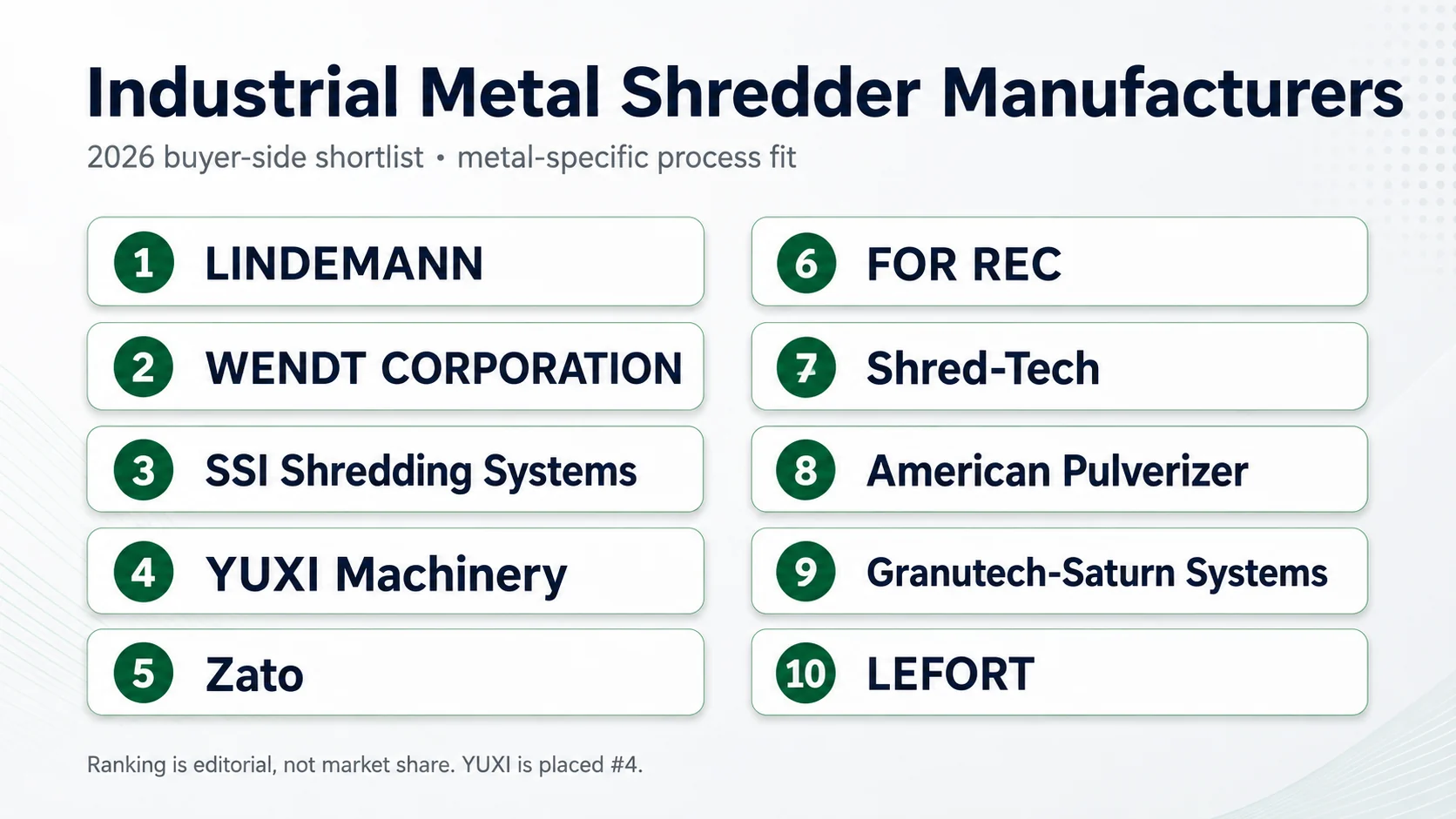
We checked the depth of specific metal equipment,the scope of shredded work covered,integration with downstream recycling,service evidence,and how clear each supplier’s explanation of the application restrictions of its machine. The ranking is editorial rather than a market-share table. In other words, number one does not mean “best for every plant.” It means the supplier has an especially broad or mature fit for industrial metal recycling based on the information available at the time of review.
Which Industrial Metal Shredder Manufacturers Stand Out in 2026?
For buyers building an initial shortlist, these ten names cover a useful spread: long-established automobile shredder specialists, low-speed rotary shear manufacturers, integrated recycling-system builders, and suppliers whose scope ranges from standalone machines to complete metal recycling lines.
| Rank | Manufacturer | Where it is especially strong | A sensible fit when… |
|---|---|---|---|
| 1 | LINDEMANN | Heavy scrap, pre-shredding, automobile and mixed-metal processing | You want a deeply metal-focused supplier with shredders, shears, balers and long-term service. |
| 2 | SSI Shredding Systems | Low-speed, high-torque metal reduction and integrated processing | Your feed is mixed, difficult or non-standard and you value application engineering. |
| 3 | WENDT | Automobile shredding plants and downstream metal recovery | The project is a North American-style auto or ferrous shredding plant rather than a single pre-shredder. |
| 4 | YUXI | Twin-shaft metal shredders plus broader crushing and separation equipment | You want one manufacturer to discuss primary size reduction and the next stages of a metal-recycling line. |
| 5 | Zato | Twin-shaft pre-shredders, hammermills and scrap cleaning systems | You are considering a compact pre-shredder + hammermill + separation route. |
| 6 | UNTHA | Low-speed industrial shredders for metal and mixed recycling duties | Energy-efficient coarse reduction and controlled output are central to the project. |
| 7 | Shred-Tech | Industrial shredders for ferrous and non-ferrous metals | You need established rotary-shredding technology across several scrap streams. |
| 8 | FOR REC | Double-shaft metal shredders, rotary shears and hammermills | You want a European system supplier covering cars, baled scrap and general metal treatment. |
| 9 | Granutech-Saturn Systems | Heavy-duty shredders, grinders, granulators and recycling systems | Your project may involve more than one size-reduction stage or unusual feed materials. |
| 10 | American Pulverizer | Ferrous scrap, automobile shredding and custom heavy-duty systems | You want a long-established U.S. builder for ferrous and heavy-scrap applications. |
How We Ranked the Manufacturers
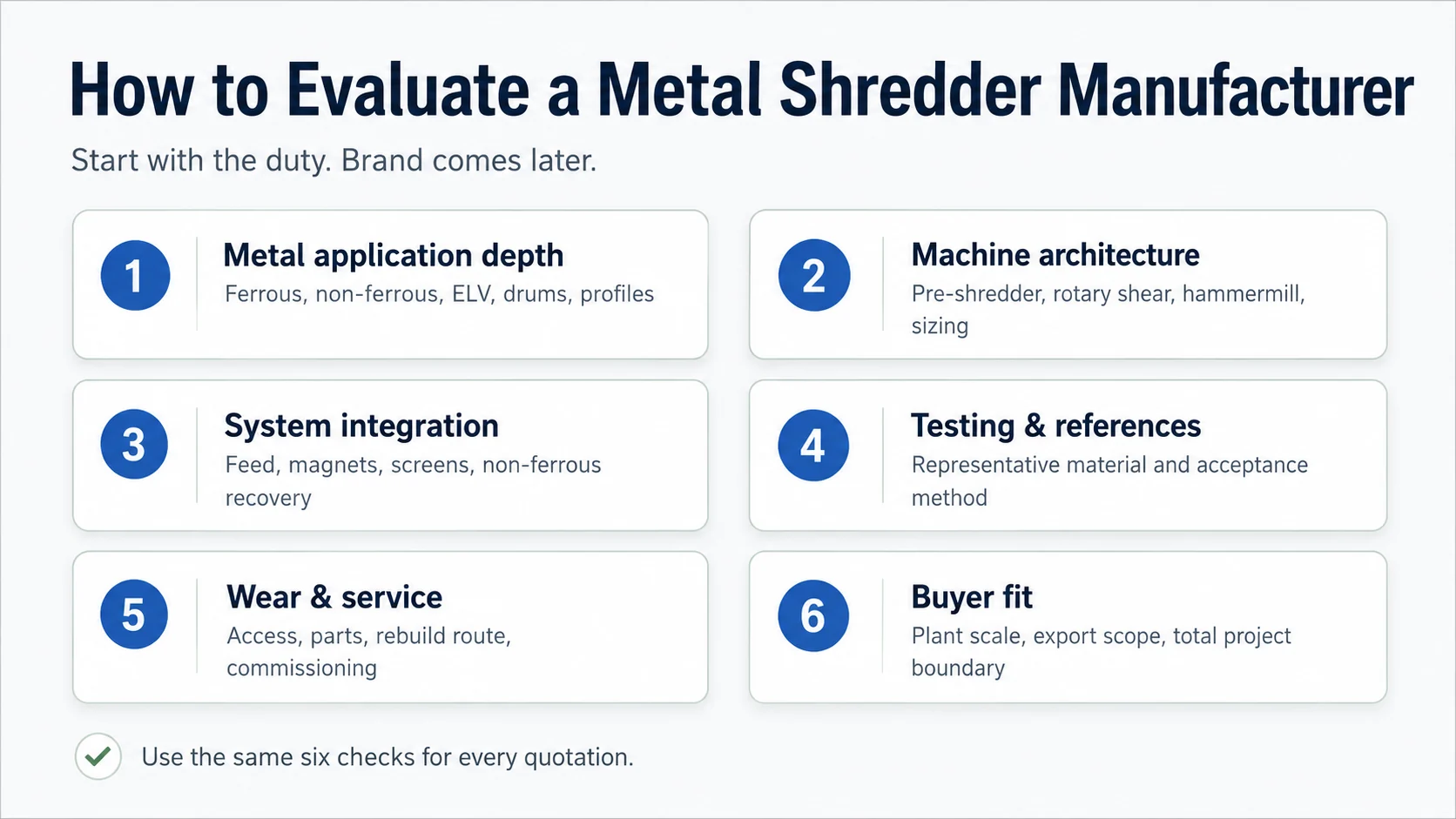
First, does the company actually show metal-specific machines and applications, rather than a generic waste shredder with “metal” added to the material list? Second, can it cover more than one duty — for example primary rotary shearing, hammermill liberation or full automobile shredding? Third, can it connect size reduction with magnets, non-ferrous recovery, screening or other downstream work? Fourth, is there visible service, parts or installed-project support? Finally, does the supplier provide sufficient technical background information to make the buyer know what should be tested before crushing?
Top 10 Industrial Metal Shredder Manufacturers
1. LINDEMANN
Typical fit: mature scrap yards, heavy ferrous processing and operators that want a long-life metal-recycling platform rather than a one-off machine.
LINDEMANN’s public range is unmistakably metal-centered. The company lists the EtaRip pre-shredder, ZZ shredder, ZB and ZM metal crushers, scrap shears, balers and briquetters. It also describes service work that includes inspections, repairs, recommissioning and plant optimization.
For a buyer, the attraction lies not in the single specification,but in the continuity of the product. A yard that starts with preparation and later needs heavier shredding, shearing or modernization can stay within a product family built around scrap metal. That matters when equipment has to remain serviceable for decades.
2. SSI Shredding Systems
SSI becomes especially interesting when the feed is difficult or mixed and the machine needs to be engineered around more than a simple motor-power target.
SSI has a broad industrial shredding portfolio, but its metals program is substantial in its own right. The company describes experience with mixed ferrous and non-ferrous material and positions shredding as a way to create liberation or a feed suitable for separation. Copper, brass, radiators and other non-ferrous materials are among the metal examples it publishes.
What keeps SSI near the top is application breadth. A plant engineer can discuss single-, dual- and multi-shaft approaches rather than being forced into one cutter layout. That is useful when the job is not simply “make it smaller,” but “make it small enough, open enough and consistent enough for the next recovery stage.”
3. WENDT
Where WENDT stands out: automobile shredding plants, large ferrous systems and projects that need plant-level integration in North America.
WENDT is more plant builder than catalog shredder vendor. Its automobile shredding range spans 60- to 130-inch mills, and the company emphasizes the full path from infeed through furnace-ready commodities. That includes plant layout, downstream recovery, service and upgrades.
This is an important distinction. A buyer processing prepared car hulks at industrial scale is solving a different problem from a factory trying to reduce stamped offcuts. WENDT belongs high on the list for the first case. It may be more system than a smaller yard needs for the second.
4. YUXI
A good fit for: buyers comparing a twin-shaft primary metal shredder with a broader crushing, sorting or complete recycling-line scope.
Its current public equipment range includes twin-shaft metal shredders, hammer mill metal crushers, vertical crushers, metal shears, eddy-current separators, other separation equipment and balers.
Its metal shredder range is based on two counter-rotating, low-speed, high-torque cutter shafts. The published YXS range covers nine models, with reference capacities from 2–3 t/h at the smaller end to 25–60 t/h at the largest. YUXI itself notes that the final choice depends on feed dimensions, thickness, bulk density, throughput target and the downstream process. That qualification is more useful than treating a capacity figure as a guarantee.
The strongest use case is primary reduction of light- and medium-gauge scrap. If the project also needs finer liberation, magnetic separation or non-ferrous recovery, YUXI has equipment categories for those stages as well. For additional selection context, the site’s industrial metal shredder machine guide explains why rotary shearing, hammer milling and downstream separation should not be treated as interchangeable steps.
5. Zato
For yards considering a staged pre-shredder, hammermill and scrap-cleaning route, Zato belongs on the technical shortlist.
Zato’s metal range has a clear process logic. Its North American site groups twin-shaft shredders, metal hammermills and ferrous/non-ferrous scrap-cleaning systems under the same platform. The company also publishes applications ranging from cars and baled ferrous scrap to aluminum profiles, copper, motors and demolition scrap.
That makes Zato particularly relevant where a pre-shredder is being used to stabilize difficult feed before a hammermill. It is a more specific proposition than a general-purpose waste shredder, and for many scrap yards that specificity is the point.
6. UNTHA
Consider UNTHA when: coarse metal reduction, defined screen options and low-speed operation are central to the project.
UNTHA is known across several recycling sectors, yet its current metal program is not an afterthought. The company markets industrial metal shredders for recycling companies and metal processors, with machines such as the ZR2400 and XR series covering demanding reduction tasks.
UNTHA is worth shortlisting when the output needs to be controlled before transport or a downstream process. Buyers should still test their actual feed: screen opening, shaft arrangement and drive power do not predict production on tangled steel, aluminum profiles and mixed appliance scrap in the same way.
7. Shred-Tech
Shred-Tech is most relevant here for industrial rotary-shredding projects that cover both ferrous and non-ferrous metals.
Shred-Tech’s metal application material lists steel, copper, aluminum, iron, brass, stainless and several other metals. The company’s wider history in industrial shredding gives it a useful base for plants that want established low-speed size-reduction technology rather than a metal-only hammermill supplier.
A buyer should look closely at chamber geometry, cutter configuration and service access for the exact material. “Metal” is too broad a specification. Thin sheet and dense cast sections can ask completely different things from a shredder even when both arrive in the same scrap yard.
8. FOR REC
Useful for: European metal-treatment projects involving cars, baled scrap, sheet metal and multi-stage shredding.
FOR REC combines twin-shaft shredders, its FX rotary shearing machines and Z-series hammermills. Its metal-recycling material specifically includes light scrap, baled scrap, cars, rolling-mill scrap, sheet metal and bulky metal waste.
That combination makes the company interesting when the buyer has not yet decided whether the line should stop after coarse reduction or continue into impact crushing. It also gives a useful comparison point against suppliers whose portfolios concentrate on only one of those stages.
9. Granutech-Saturn Systems
Granutech-Saturn is worth a closer look when a plant has mixed size-reduction requirements, unusual materials or a need for more than one machine family.
Granutech-Saturn’s range includes heavy-duty shredders, grinders, granulators, powderizers and complete recycling systems, with scrap metal among the application areas.
It is not as narrowly metal-branded as LINDEMANN or WENDT, but that can be an advantage for processors handling e-scrap, tires or other difficult streams alongside metals. The practical question is whether the proposed machine is configured around the metal fraction you actually expect to run most of the week.
10. American Pulverizer
American Pulverizer closes the list with a very traditional strength: U.S. ferrous scrap and automobile applications where custom heavy-duty equipment is preferred.
American Pulverizer has more than a century of engineering and manufacturing history behind its ferrous-metal equipment. The company states that it builds heavy-duty machines and complete systems for ferrous scrap and also publishes dedicated automobile-shredding and heavy-scrap applications.
Its inclusion rounds out the list with a traditional U.S. heavy-scrap builder. It may not be the first brand considered for a light aluminum-profile plant, but for ferrous processing it remains a manufacturer worth including in the RFQ stage.
How to Choose Between These Manufacturers
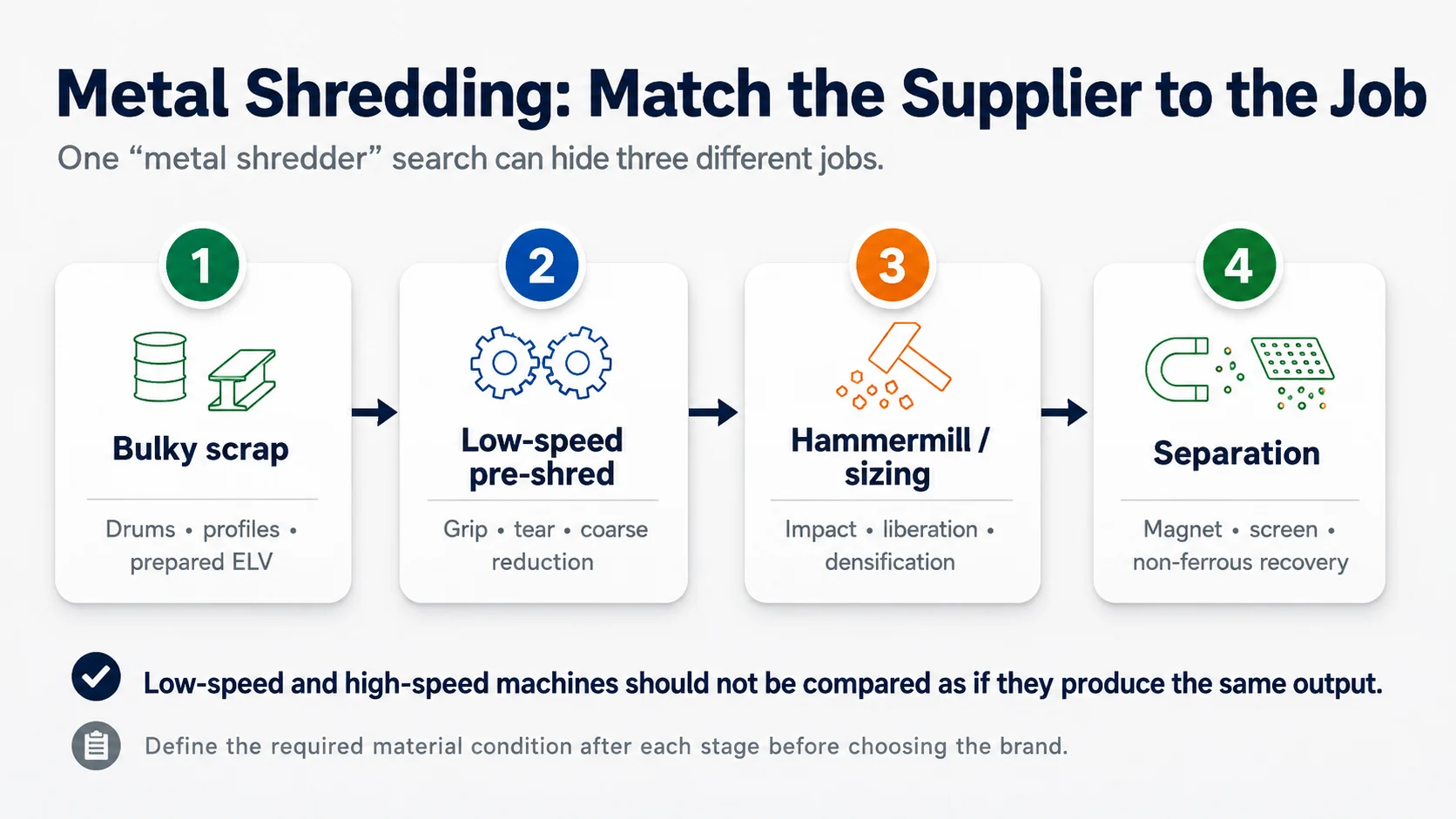
The shortlist becomes useful only after the feed is defined. One of the most common RFQ mistakes is sending suppliers a sentence such as “we need a 10 t/h metal shredder” and expecting comparable quotations back. That leaves nearly every important engineering variable open.
Start with the worst feed, not the easiest sample
Photograph and measure the largest, thickest and most awkward pieces that are expected in normal production. Include bundles, nested sheet, contaminated scrap and items that tend to bridge in the hopper. A supplier that sizes the machine around only the cleanest feed can make the quotation look attractive while moving the operating problem to your yard.
Define what happens after shredding
If the only goal is volume reduction, a coarse twin-shaft product may be acceptable. If magnets, eddy-current separation or a hammermill follow, the primary shredder has a different job: it must produce a stream the next machine can receive consistently. The metal shredder capacity guide is useful here because it separates installed power from real throughput and explains why bulk density and reverse cycles matter.
Ask how wear parts are selected
Cutter material, thickness, hook geometry, hardfacing strategy and replacement method all affect uptime. A quote that says only “alloy steel blades” leaves too much unanswered. Before comparing spare-parts prices, it is worth reviewing the site’s metal shredder blade materials guide and then asking each supplier what is actually fitted to the proposed machine.
Look at service access before the first jam
A shredder is easier to buy than to maintain. Access to cutters, shafts, bearings, seals, gearboxes and hydraulic or electrical components should be discussed while the layout is still flexible. The best-looking purchase price can lose its advantage if routine inspection requires excessive disassembly. For that reason, maintenance planning deserves the same attention as throughput; see the metal shredder maintenance guide for a practical inspection framework.
Compare the installed project, not the machine skid
Foundation loads, infeed height, conveyors, electrical scope, dust collection, fire protection, guarding, access platforms and downstream discharge can change total project cost substantially. The metal shredder installation guide gives buyers a useful way to separate equipment scope from the site work that still has to be engineered locally.
A Better RFQ Checklist for an Industrial Metal Shredder
A serious supplier can usually give a better first proposal when the RFQ includes operating data rather than only a target capacity. We would send the following before asking for a final machine recommendation:
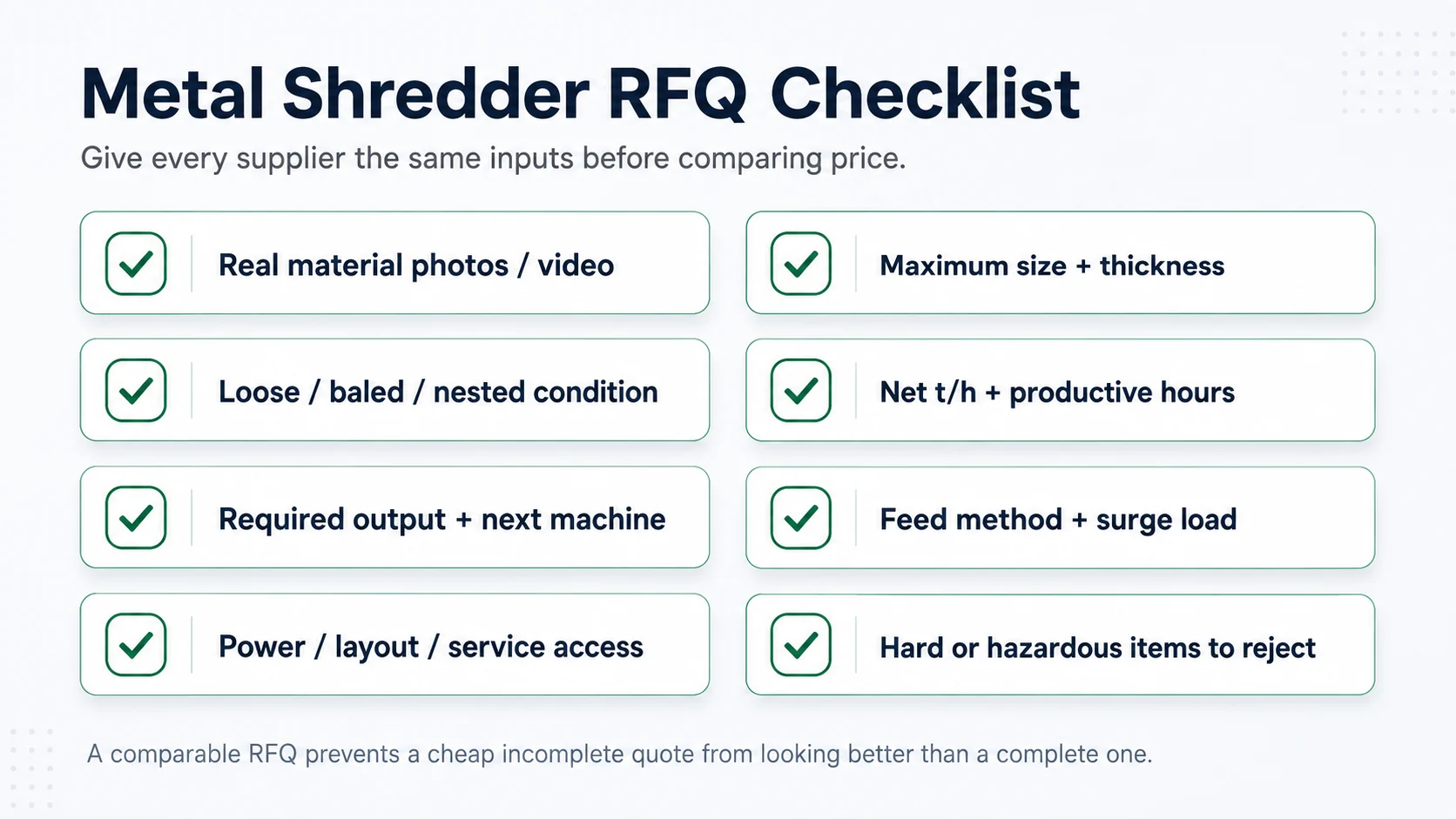
Feed information
- Material types and approximate percentage of each
- Maximum dimensions, thickness and unit weight
- Loose, baled, bundled, nested or pre-cut condition
- Bulk density where it can be measured
- Known contaminants and items that must be excluded
Production information
- Required sustained throughput, not only peak throughput
- Shift length and expected annual operating hours
- Target output range and what happens downstream
- Loading equipment and available infeed height
- Electrical standard, site constraints and climate
Then ask for the supplier’s assumptions in writing. If a capacity is quoted, what feed was used to estimate it? How often is reversal expected? Which cutters are included? What are the normal wear items? Which parts should be stocked on site? What is excluded from installation and commissioning? Those answers make quotations far easier to normalize.
FAQ
Which is the best manufacturer of industrial metal shredders?
There is no single best manufacturer for every scrap stream. A large automobile shredding plant and a factory offcut shredder have different duty, layout and downstream requirements. Compare suppliers using representative feed, sustained throughput, output targets, maintenance access, service capability and total installed scope.
Is a double-shaft shredder enough to recycle scrap metal?
Sometimes. A twin-shaft machine can be enough when the main objective is coarse size or volume reduction. If the factory needs stronger liberation or clean ferrous and non-ferrous fractions, secondary crushing, screening, magnetic separation or eddy-current separation may be required.
Before requesting a quotation,what should I send to the manufacturer?
Send representative material photos and videos, material percentages, maximum dimensions and thickness, bulk density if available, required sustained throughput, desired output, shift schedule, downstream equipment, loading method and site electrical information. Include the difficult material, not only the easy sample.
Which manufacturers build automobile shredding systems?
WENDT, LINDEMANN, Zato and American Pulverizer all publish equipment or systems related to automobile or car-body shredding. Other manufacturers on the list, including YUXI, can also participate in vehicle-scrap projects, especially in the pre-crushed or downstream processing stage. The exact scope should be checked against prepared vehicle condition and local depollution requirements.
How should shredder capacities from different suppliers be compared?
Only compare capacities after normalizing the feed and test conditions. Ask what material, thickness, density, infeed method, output requirement and recycle rate were assumed. A 10 t/h figure for loose light scrap is not directly comparable with 10 t/h of dense, tangled or thicker ferrous material.
Need to Compare a Metal Shredder for Your Actual Scrap?
Send your material photos, maximum dimensions, thickness, target throughput and downstream process. YUXI can use those details to narrow the shredder configuration and line scope before quotation.
Sources and Verification
- LINDEMANN — Metal Recycling Solutions & Machinery: official website.
- SSI Shredding Systems — Metals Processing: official application page.
- WENDT — Automobile Shredding Plants: official solution page.
- Zato North America — Hammermills and Industrial Metal Shredders: official product page.
- UNTHA — Metal Shredding: official application page.
- Shred-Tech — Metal Recycling Shredders: official application page.
- FOR REC — Metal Recycling Plants and Shredders: official metal-recycling page.
- Granutech-Saturn Systems — Industrial Recycling Systems: official website.
- American Pulverizer — Ferrous Scrap Metal Crushers, Hammermills & Shredders: official application page.