




 Request Quote



Choosing a radiator recycling line is not about finding the longest list of equipment, but about defining a process that still works when the actual waste arrives. A line that looks ideal on a quotation can become awkward very quickly if the supplier assumed flat air-conditioner coils while your yard receives bent car radiators, plastic side tanks, steel brackets and compacted mixed heat exchangers.
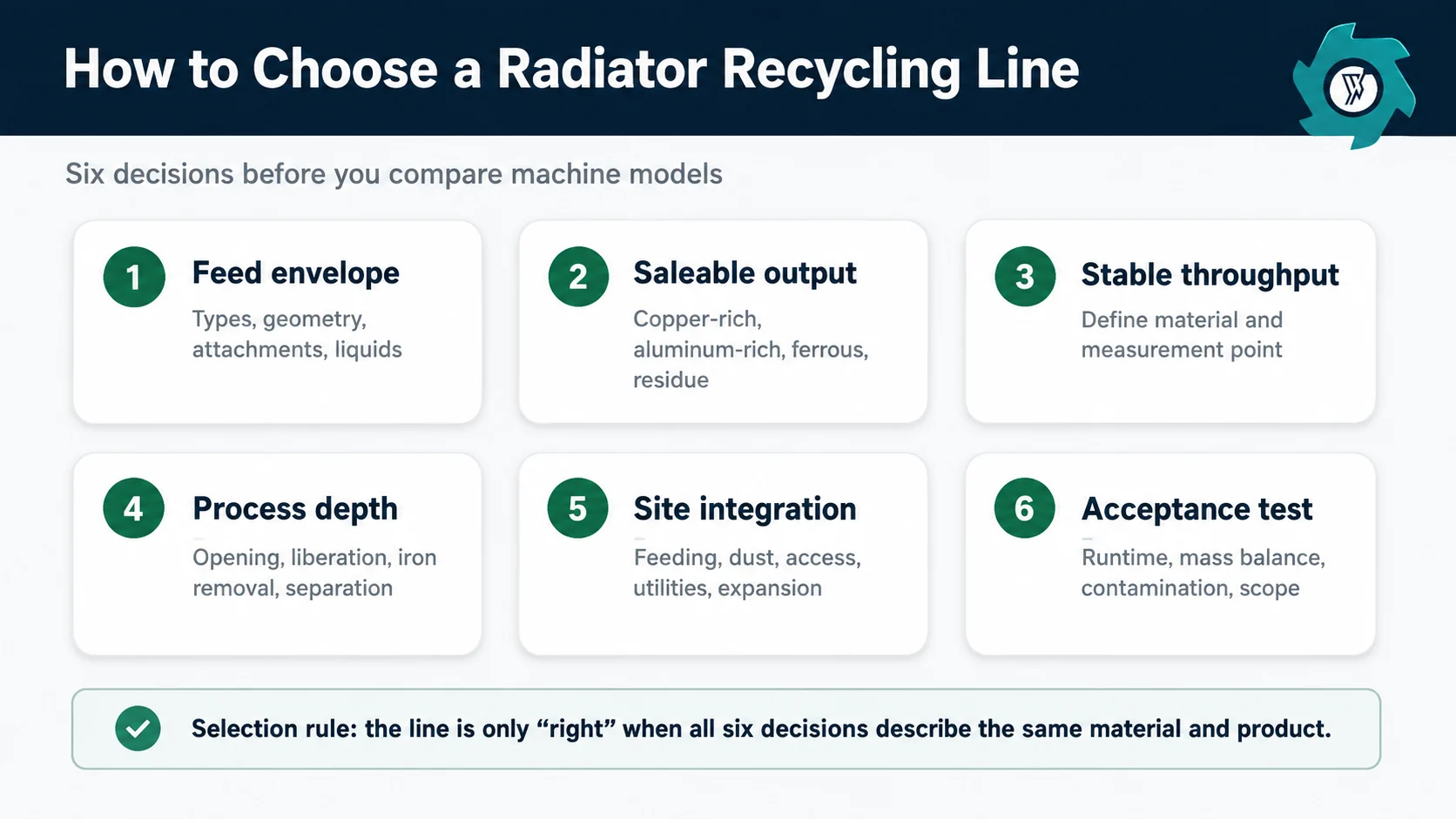
That is why we would not start a selection discussion with motor power or a headline tons-per-hour figure. First define the material the plant must accept, then the products you want to sell. After that, size reduction, separation, dust collection, controls and layout have something concrete to work around.
Define the Decision Before You Compare Machines
A complete radiator recycling line has a wider job than “separating copper and aluminum.” It has to receive an agreed range of radiator scrap, turn bulky composite material into a controllable stream, remove ferrous attachments, create enough liberation for downstream sorting, manage light non-metal material and dust, and produce fractions that your customer will actually buy.
YUXI’s published radiator recycling line is built around primary shredding, vertical crushing and screening, magnetic removal, specific-gravity separation and centralized dust collection. The page also states that feed composition, feed geometry and target output should be reviewed before the equipment is confirmed. That is the right engineering boundary for this selection guide: not “which separator has the highest advertised purity,” but whether the whole line is configured around one defined material problem.
If you need the detailed mechanical sequence and the role of liberation, the existing radiator recycling process guide covers that process step by step. Here we stay on the purchasing decision: what to specify, what to challenge in a quotation and what should be tested before acceptance.
1. Write the Feed Envelope Before You Ask for Capacity
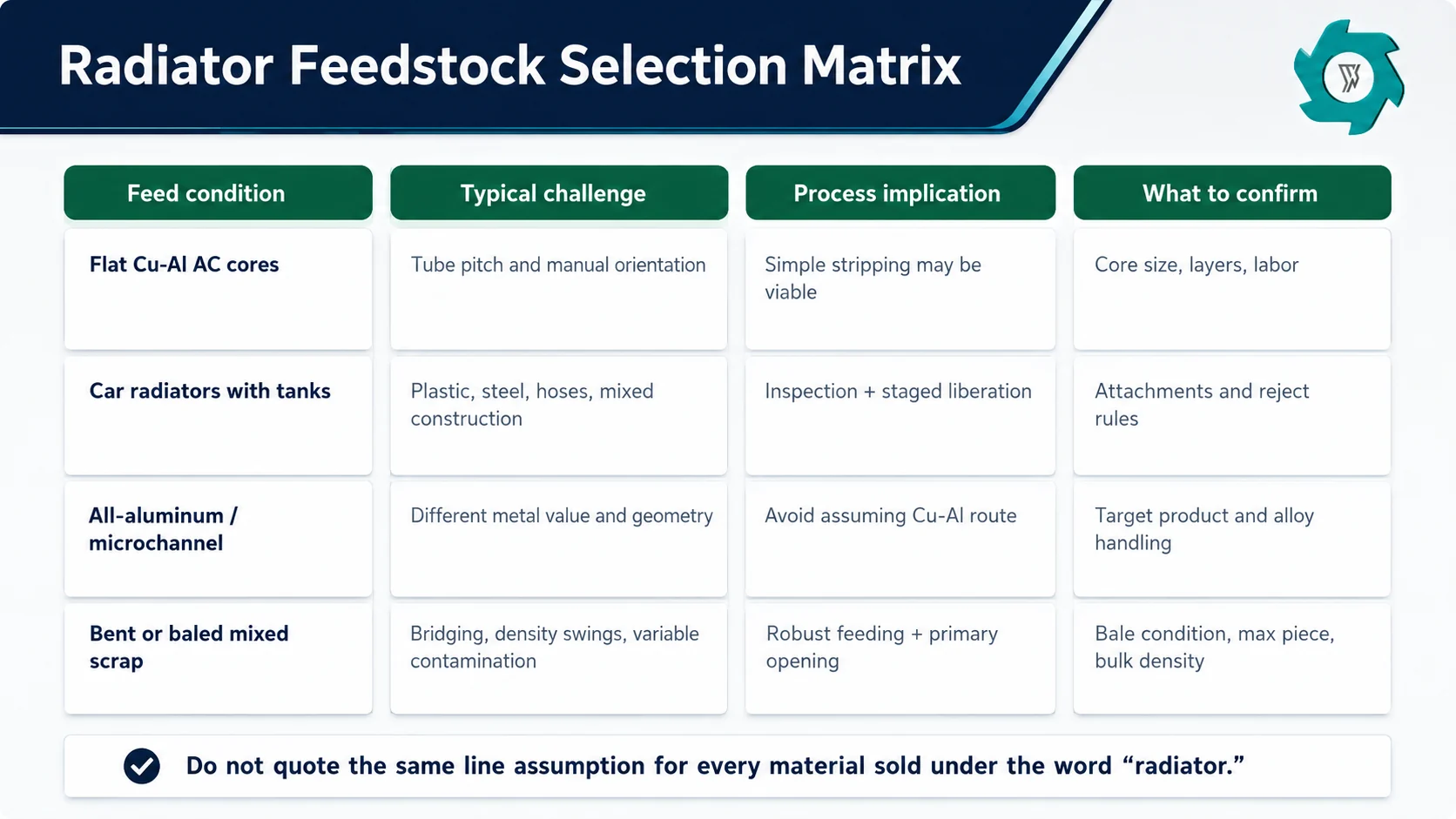
The word radiator hides too much variation. A flat copper-tube/aluminum-fin air-conditioner core, an all-aluminum automotive radiator and a baled mix of condensers, heater cores and plastic-tank car radiators behave differently in the hopper and in the crusher. Their metal value also sits in different places.
A useful feed envelope describes what the line must accept on a normal day and what it may see on a bad day. Include the percentage of each recurring radiator type, average and maximum dimensions, loose or compacted condition, approximate bulk density if known, steel frames, plastic tanks, fan assemblies, hoses, brass fittings, oil or coolant residue, and any foreign material mixed into the load. Photos help. A short loading video is often better because it shows nesting and stiffness that a still image misses.
| Feed question | Why it changes the line | What should appear in the RFQ |
|---|---|---|
| Which radiator types dominate? | Copper-aluminum cores, all-aluminum radiators and mixed heat exchangers do not have the same value or separation target. | Estimated percentage by mass of each regular feed family. |
| Loose, folded or baled? | Compaction changes gripping, bridging, instantaneous load and the way material enters the primary stage. | Photos, bale dimensions if applicable, and maximum single-piece condition. |
| How much steel and plastic remains attached? | Heavy ferrous attachments can increase wear and magnetic load; plastic tanks and light parts affect residue handling. | Typical and worst-case attachment description. |
| Any free liquid or sealed component? | Liquids complicate housekeeping and separation; sealed or pressurized items create a different safety problem. | Upstream draining and removal responsibility. |
| How variable is supply? | A narrow feed can justify a simpler plant. A changing feed mix needs more operating range and a stronger acceptance definition. | Seasonal or supplier-to-supplier variation, not only the “best” load. |
2. Define the Products You Will Sell, Not Just “High Purity”
Line selection becomes much easier when the commercial endpoint is clear. Do you want separate copper-rich and aluminum-rich fractions? Is a mixed non-ferrous product acceptable? Do you need a clean ferrous fraction? How much plastic or other light material can remain before the buyer discounts or rejects the load?
There is an important distinction here. ReMA/ISRI’s Talk specification for whole aluminum-copper radiators describes clean radiator scrap free of brass tubing, iron and other foreign contamination.[1] That is useful evidence that cleanliness changes scrap classification and value. It does not mean a chopped copper-rich or aluminum-rich product from a mechanical line should automatically be sold under the same specification. Once you change the material form, the outgoing product needs the specification agreed with its actual buyer.
For each fraction, write down the product name, sample location, maximum allowed unwanted material and the test method. “99% purity” without those details is only a headline. If one supplier hand-picks a 500-gram sample and another takes composite samples across a continuous run, the percentages cannot be compared.
3. Choose the Process Depth from the Liberation Duty
A separator cannot rescue material that was never liberated. Copper tube still wrapped in aluminum fin material behaves as a composite particle. Steel brackets still fixed to radiator sections remain mixed assemblies. The upstream stages have to create the physical condition that the separators are designed to handle.
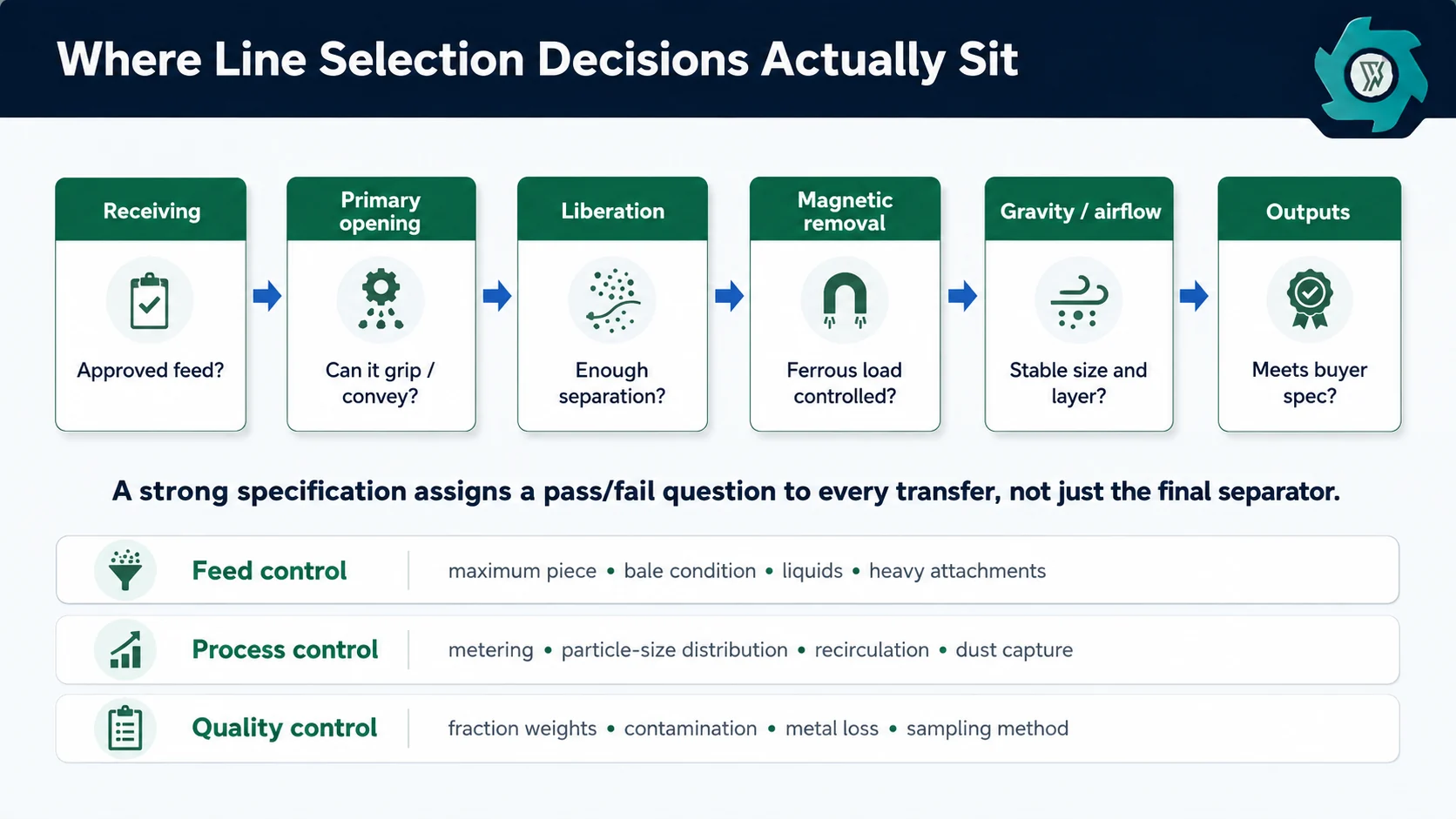
For mixed radiator scrap, YUXI’s published line logic uses a double-shaft shredder for primary opening, a vertical crusher and screen for further size reduction and liberation, a magnetic separator for ferrous removal, then specific-gravity sorting for the copper, aluminum and lighter fractions. Dust collection and PLC coordination support the connected process.
The decision is not “more stages are always better.” Every additional stage adds power, wear parts, transfer points, dust generation, controls and maintenance. The question is whether the simpler route can repeatedly produce the required liberation from your worst normal feed. If it can, extra complexity has no value. If it cannot, a cheap one-stage quotation is expensive in another way: recirculation, manual cleanup, downgraded product or unstable production.
| Process stage | Selection question | Evidence to request |
|---|---|---|
| Receiving and feeding | Can the approved radiator forms be loaded safely and evenly without repeated manual correction? | Feed demonstration with representative pieces; hopper and conveyor dimensions. |
| Primary size reduction | Does the machine open bulky or deformed scrap into a stable downstream feed? | Video or test data using similar geometry, not a different light scrap. |
| Secondary liberation and screening | Are copper, aluminum, iron and non-metal attachments sufficiently released for sorting? | Particle-size distribution and visual/mass-balance samples after the stage. |
| Magnetic removal | Is the ferrous load exposed and thin enough for reliable removal? | Magnetic product and carryover samples during a sustained run. |
| Gravity / airflow separation | Is the feed sized, dry enough and evenly presented for stable stratification? | Operating settings and repeated samples over time, not one clean bucket. |
| Dust and residue | Where do fines and light plastics go, and are they included in the mass balance? | Ducting scope, collection points, discharge arrangement and residue weights. |
4. Compare Sustained Line Capacity at the Same Measurement Point
Capacity is one of the easiest figures to compare badly. A supplier can report feed entering the shredder, product leaving the final separator, a short peak rate or a sustained rate over a longer run. Those values may all be written as t/h.
For a purchase decision, define the point that matters to your business. We normally prefer a complete-line basis: representative feed enters the approved system, normal separation and recirculation remain active, downtime is recorded, and output weights are measured. The exact test duration can be agreed project by project, but it needs to be long enough to expose feeding instability, screen loading, separator drift and normal operator intervention.
Also separate throughput from saleable output. A line can process a large mass and still lose value if too much copper reports to residue, aluminum carries excessive contamination, or a large mixed fraction needs manual rework. For this reason, a capacity acceptance sheet should sit next to a mass-balance sheet.
5. Check Feeding, Buffering and Separator Loading
Buyers naturally focus on the shredder and crusher because those are the visually dominant machines. In operation, the line often becomes unstable somewhere less dramatic: a hopper bridges, a conveyor dumps a surge, the crusher sees inconsistent loading, or the final separator receives a deep uneven bed.
YUXI’s solution page specifically connects even feeding, PLC control and downstream separator stability. That relationship deserves more attention in a purchase review. Ask how the line reacts when feed density changes, what prevents a sudden batch from overloading the next machine, where operators can see load conditions, and which machines are interlocked.
A well-sized separator can still underperform if the material arrives in pulses. Likewise, an oversized shredder does not automatically increase finished output if the secondary crusher, screen, magnet or gravity separator becomes the bottleneck. The useful capacity is the capacity of the connected line.
6. Treat Dust, Liquids and Unsafe Attachments as Selection Inputs
Radiator scrap is not always ready for a shredder when it reaches the yard. Free coolant or oil, large fan motors, thick structural brackets, sealed components and material from refrigeration or air-conditioning equipment may need upstream handling. Where stationary refrigeration or air-conditioning equipment is dismantled before coil recovery, U.S. EPA Section 608 safe-disposal requirements address refrigerant recovery before final disposal.[2] Vehicle air-conditioning systems fall under a different EPA program, and other countries apply their own rules.
Dust also needs to be discussed before the final layout. Secondary crushing, screening and transfers can generate fine metal and non-metal material. Ask where the supplier expects dust release, which points are enclosed or extracted, how filters discharge collected material, how ducts are cleaned and accessed, and what local hazard assessment is required for the actual dust generated. For a deeper planning framework, see dust control and fire-risk planning in aluminum recycling; a radiator line still needs a project-specific review because copper, plastic and residue fractions can change the dust profile.
OSHA’s scrap-metal recycling guidance highlights hazards associated with material handling, breaking and separating scrap, moving machinery, flying material, fire and noise.[3] OSHA also treats lockout/tagout and machine guarding as core controls where workers service or approach hazardous machinery.[4] A line proposal therefore needs room for guarding, isolation, access and housekeeping—not just a footprint that packs machines as tightly as possible.
7. Check the Plant Around the Machines
A radiator recycling line can fit on a drawing and still be difficult to operate. Maintenance doors may open into a wall. A screen may be removable only after another conveyor is dismantled. Product bins may block forklift traffic. Dust ducting may cross an overhead crane path. The equipment list can be correct while the plant is not.
Before layout approval, review receiving and storage, feeding direction, product discharge, residue removal, forklift routes, operator walkways, emergency access, maintenance pull-space, lifting points, electrical cabinets, dust ducting, foundations and future expansion. If the line is being integrated into an existing scrap or appliance facility, also check where shared magnets, conveyors, dust systems or downstream non-ferrous equipment create bottlenecks.
Utilities belong in the same review. Confirm local voltage and frequency, connected and expected running loads, compressed air if required, ventilation, dust-system interfaces, lighting around inspection points, drainage rules, and any local environmental or fire-code requirements. A quotation that stops at the machine terminal is not the same project scope as a quotation that includes all plant interfaces.
8. Normalize the Quotation Before You Compare the Price
Two suppliers can quote the same process names and still include very different boundaries. One price may include conveyors, platforms, electrical cabinets, dust collection, product bins, spare screens and commissioning. Another may cover only the four headline machines. The cheaper total is not necessarily the cheaper project.
| Quotation item | Questions to normalize |
|---|---|
| Equipment boundary | Are feeders, conveyors, magnets, screens, separator, dust collection, platforms and discharge systems included? |
| Electrical and controls | Which cabinets, PLC functions, sensors, interlocks, cables and field wiring are included? |
| Dust scope | Collector only, or also hoods, ducts, fan, discharge device, supports and controls? |
| Wear and spares | Which cutters, liners, screens, belts, bearings, filters and critical spares ship with the line? |
| Installation boundary | Who handles foundations, rigging, assembly, wiring, duct installation and local fabrication? |
| Commissioning | How many people, how many days, what material is required, and what is considered complete? |
| Acceptance | Where will capacity and product quality be measured, and what happens if the agreed criteria are missed? |
Price belongs after this normalization. A broader recycling-line quotation comparison framework can help with Incoterms, battery limits and installed-scope normalization, but the radiator-specific feed and output conditions in this article should remain the acceptance basis. Otherwise you are comparing scope omissions, not engineering efficiency.
9. Require a Representative Material Test and a Written FAT
A factory acceptance test is where the purchasing specification becomes useful. It should not be a demonstration with whatever material happens to be near the supplier’s workshop. Use feed that represents the project, including enough variation to test the agreed envelope.
Before the run, record material type, preparation performed, total feed mass, initial condition and any excluded items. During the run, record net operating time, stops, adjustments, recirculation and abnormal events. At the end, weigh the main product and reject streams, sample them using the agreed method and reconcile the mass balance as far as practical.
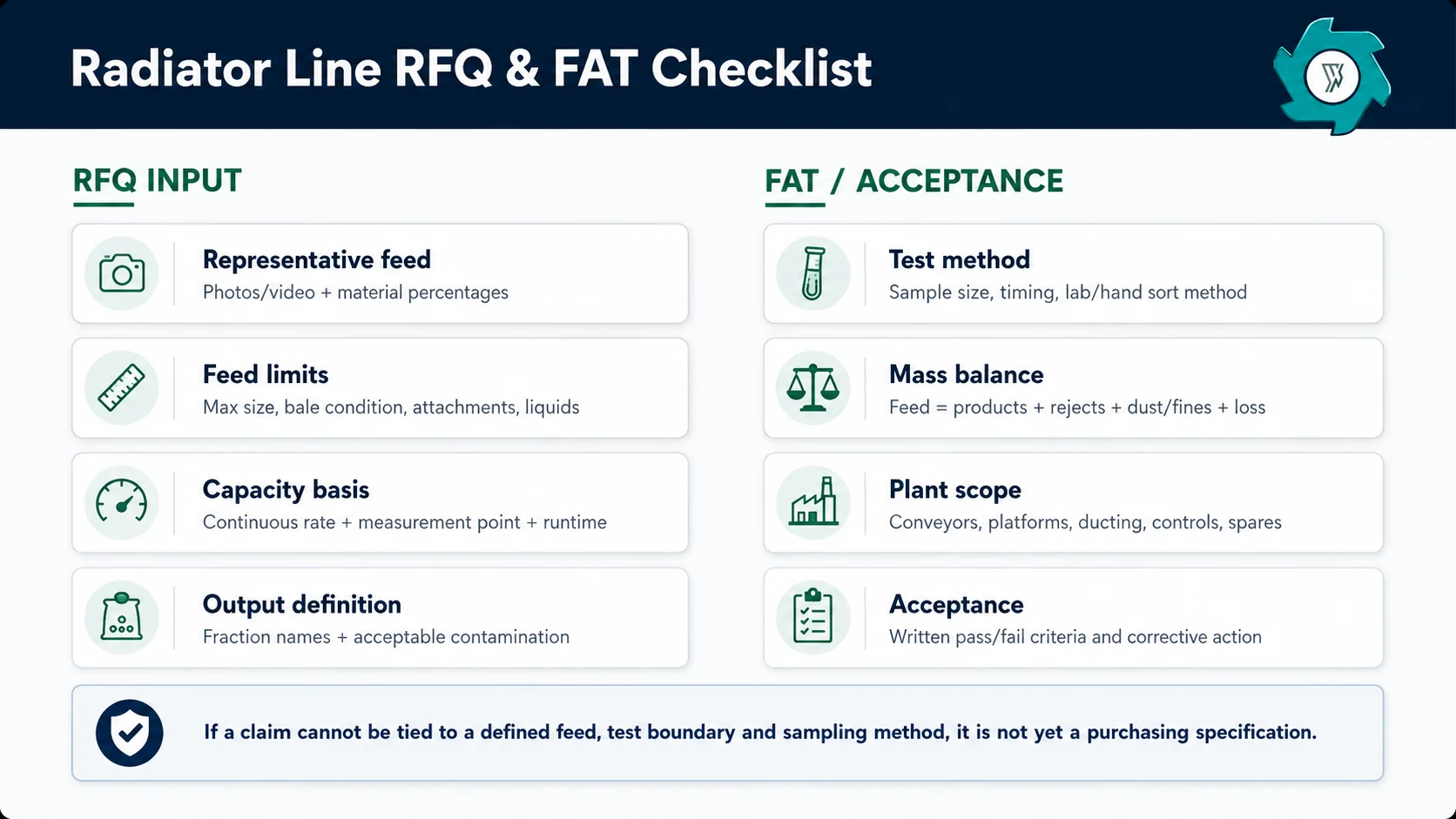
The FAT does not need to turn into a laboratory research program. It needs to answer the commercial questions you will face after installation: Can the line accept the material? Can it sustain the required rate? Are the fractions saleable? Where is the unrecovered value going? How much operator intervention is normal? Do the controls and dust interfaces behave as specified?
10. Evaluate the Supplier Behind the Equipment List
A radiator line is a connected system, so supplier evaluation should go beyond whether a factory can manufacture a shredder or separator. Ask who owns the process responsibility when one stage starves or overloads another. Ask whether the supplier will review your actual material before finalizing the flow. Ask which wear parts are considered routine and which require factory support.
Evidence worth requesting
- Photos or video of a complete radiator line, not only individual machines.
- Representative material test or comparable feed demonstration.
- General arrangement drawing with maintenance clearances.
- Electrical and control scope.
- Wear-parts list and recommended initial spares.
- Commissioning and operator-training scope.
Questions that expose gaps
- What material is outside the approved feed envelope?
- Which stage is expected to limit continuous throughput?
- How is recirculation handled and counted?
- Where is output quality sampled?
- What site work is excluded from the supply?
- What changes if my feed mix shifts next year?
One detail is easy to underestimate: remote troubleshooting and documentation. When a line stops six months after commissioning, the useful question is not whether the sales brochure said “24/7 service.” It is whether the maintenance team has electrical drawings, alarm logic, spare-part identification, set-point records and a clear escalation path.
Where the YUXI Radiator Recycling Line Fits
YUXI positions its complete radiator line for mixed car radiators, air-conditioner radiators, copper-aluminum radiators, all-aluminum radiators, heat exchangers and other mixed radiator scrap after appropriate feed review. The published process combines a double-shaft shredder, vertical crushing and screening, magnetic separation, specific-gravity separation, PLC coordination and centralized dust collection.
That published configuration is a process starting point, not a universal model specification. YUXI’s own solution page states that actual capacity and separation quality depend on the feed composition, geometry, trapped liquids, iron and plastic content, liberation and stable separator loading. It also recommends reviewing material photos, piece size, required throughput and preferred final products before confirming the equipment.
For a buyer, that means the useful next step is not asking for “the standard radiator line price.” It is sending enough project data for the configuration to be challenged against the real material. If the feed is narrow and clean, the line may be simpler. If it is baled, mixed and attachment-heavy, feeding and liberation deserve more engineering attention than a headline purity number.
Radiator Recycling Line RFQ Data Sheet
You do not need a long consultant report before contacting a supplier. The following information is enough to turn an early inquiry into a useful technical discussion.
- Material photos and video. Show several representative loads, not only the cleanest pieces.
- Feed mix by percentage. Car radiators, AC coils, all-aluminum radiators, mixed heat exchangers and other recurring material.
- Average and maximum dimensions. Include folded or baled condition and bale size where relevant.
- Attached material. Steel frames, plastic tanks, fan motors, hoses, brass fittings, rubber and other contaminants.
- Liquids and pre-treatment. State what is drained or dismantled before the radiator enters the recycling section.
- Target continuous throughput. Also state planned operating hours per shift and shifts per day.
- Required products. Copper-rich, aluminum-rich, ferrous, mixed non-ferrous or another buyer-defined fraction.
- Quality requirement. Define allowed contamination and the sampling/test method if already agreed with the product buyer.
- Site data. Available floor area, height, material-flow direction, power standard and any existing equipment to integrate.
- Commercial boundary. Delivery terms, installation responsibility, commissioning, training, spares and acceptance expectations.
Five Selection Mistakes That Create Expensive Changes Later
Buying the highest advertised capacity
The largest figure may refer to a different feed or a different measurement point. A slower line that continuously produces the required fraction can be commercially stronger than a higher inlet rate followed by manual cleanup.
Specifying purity without specifying the product
Purity of what, sampled where, and measured how? If those questions are not answered, the guarantee is too vague to protect either side.
Assuming all radiators need the same route
Clean flat copper-aluminum cores can support a different business case from baled mixed automotive scrap. Before freezing a complete-line specification, decide whether the feed is suitable for a geometry-dependent stripping or separator machine, or whether it needs full shredding, liberation and downstream separation.
Adding dust control after the layout
Late ducting changes frequently steal maintenance access and create awkward transfer enclosures. Plan capture points and service access while the machinery arrangement is still flexible.
Accepting a generic demonstration as the FAT
A polished video proves that a machine can run. It does not prove that your feed will meet your throughput and output requirements. Tie the acceptance test to representative material and written criteria.
Build a Radiator Line Around Your Actual Feedstock
Send representative radiator photos or video, feed percentages, maximum piece or bale size, target continuous throughput, required output fractions, available floor space and local power standard. YUXI can use that information to prepare a project-specific line recommendation and quotation basis.
Radiator Recycling Line Selection FAQ
What should I check first when choosing a radiator recycling line?
Start with the approved feed envelope: radiator types, percentage mix, average and maximum dimensions, whether material is loose or baled, attached steel and plastic, free liquids, and any items that must be removed before feeding. The same equipment list can perform very differently when those conditions change.
How do I compare capacity claims from radiator recycling line suppliers?
Make every supplier quote the same feed condition, measurement point and test duration. Ask whether the stated rate is short-term inlet feed, sustained complete-line throughput, or saleable output after separation and recirculation. Also record normal stops and reject handling during the test.
Do I always need both a shredder and a secondary crusher?
No. The process depth should match the feed and the required liberation. Mixed, deformed or attachment-heavy radiator scrap may need primary opening followed by secondary liberation, while a narrow and well-prepared feed may need a simpler route. A representative test is the safer basis for the decision.
What output specification should I give the supplier?
Define the fractions you intend to sell and what contamination is acceptable in each one. Examples include copper-rich, aluminum-rich, ferrous and light non-metal fractions. Do not use the word purity without a sampling method, sample location and agreed test procedure.
How should dust collection affect line selection?
Dust collection is part of the process interface, not an accessory to add after the layout is finished. Ask where the dust is generated, which points are enclosed or extracted, how collected material is handled, how filters are maintained, and how the system is interlocked with the production line.
What should a radiator recycling line FAT include?
A useful FAT defines representative material, pre-test preparation, test runtime, feed and product weights, downtime, recirculation, fraction sampling, contamination checks, dust and reject handling, and written pass/fail criteria. The results should be tied to the exact configuration being purchased.
Can a radiator recycling line process both car and air-conditioner radiators?
A configured line can be designed for both, but the feed mix needs to be stated. Car radiators may bring plastic tanks, steel brackets and mixed assemblies, while air-conditioner coils can have different tube spacing, oils and construction. The percentage of each stream can change the bottleneck.
What information should I send YUXI before requesting a line recommendation?
Send representative photos or video, material percentages, maximum dimensions, loose or baled condition, attached iron and plastic, residual liquids, target continuous throughput, desired output fractions, operating hours, available floor area and local power standard.
External References
- ReMA / ISRI Scrap Specifications — Talk: Aluminum Copper Radiators. Used to illustrate how buyer-seller scrap specifications define cleanliness and excluded contamination.
- U.S. EPA — Stationary Refrigeration Safe Disposal Requirements. Used for the refrigerant-recovery and safe-disposal boundary before processing stationary refrigeration and air-conditioning equipment.
- U.S. OSHA — Scrap Metal Recycling. Used for general recycling hazards around material handling and processing.
- U.S. OSHA — Recycling: Waste Management and Recycling. Used for lockout/tagout context during servicing and maintenance.