




 Request Quote


A radiator separator machine and a complete radiator recycling line can both recover copper and aluminum, but they solve different feedstock problems. The right choice starts with the shape and consistency of the scrap, not with the machine name on a quotation.
A buyer can make the wrong equipment decision before the first technical call. It often happens because two piles of scrap are described with the same words: “used radiators.” One pile may contain flat air-conditioner cores with predictable tube spacing. The other may contain bent car radiators, plastic side tanks, steel frames, fan brackets, mixed condensers and compacted material. Both contain valuable metal. They do not need the same preparation or separation logic.
Start by Separating Two Different Process Families
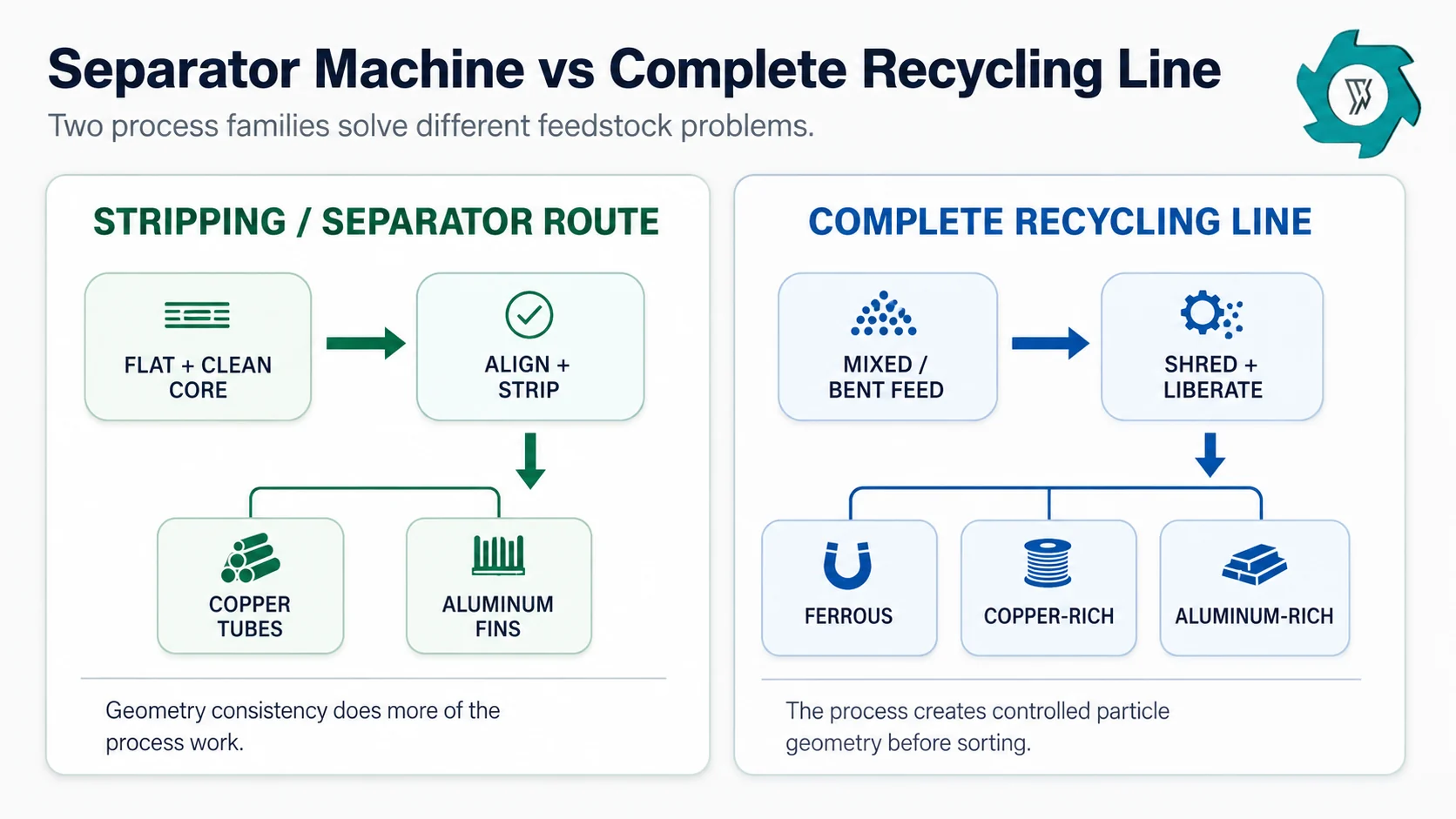
The phrase radiator separator machine is used loosely in the market. In this comparison it means a stripping-type machine that mechanically separates copper tubes from aluminum fins without first turning the whole core into a mixed granular stream. The operator presents a prepared radiator section to a set of blades or rollers whose geometry must match the core closely enough to pull the materials apart.
A complete radiator recycling line starts from a different premise. Instead of relying on the original core geometry, it deliberately breaks the composite structure apart. Primary size reduction opens the radiator, secondary crushing improves liberation, magnetic separation removes ferrous material, and downstream separation divides the liberated copper-rich, aluminum-rich and lighter fractions according to the selected process. Conveyors, controls and dust collection connect these stages into one continuous system rather than a group of isolated machines.
That difference matters because the two routes create their value in different ways. A stripping machine saves capital and process complexity by demanding more consistency from the feed. A complete line spends more equipment and plant scope to tolerate a wider feed envelope. Neither is automatically “better.” The better route is the one whose feed assumptions still hold six months after commissioning.
Radiator Separator Machine vs Radiator Recycling Line
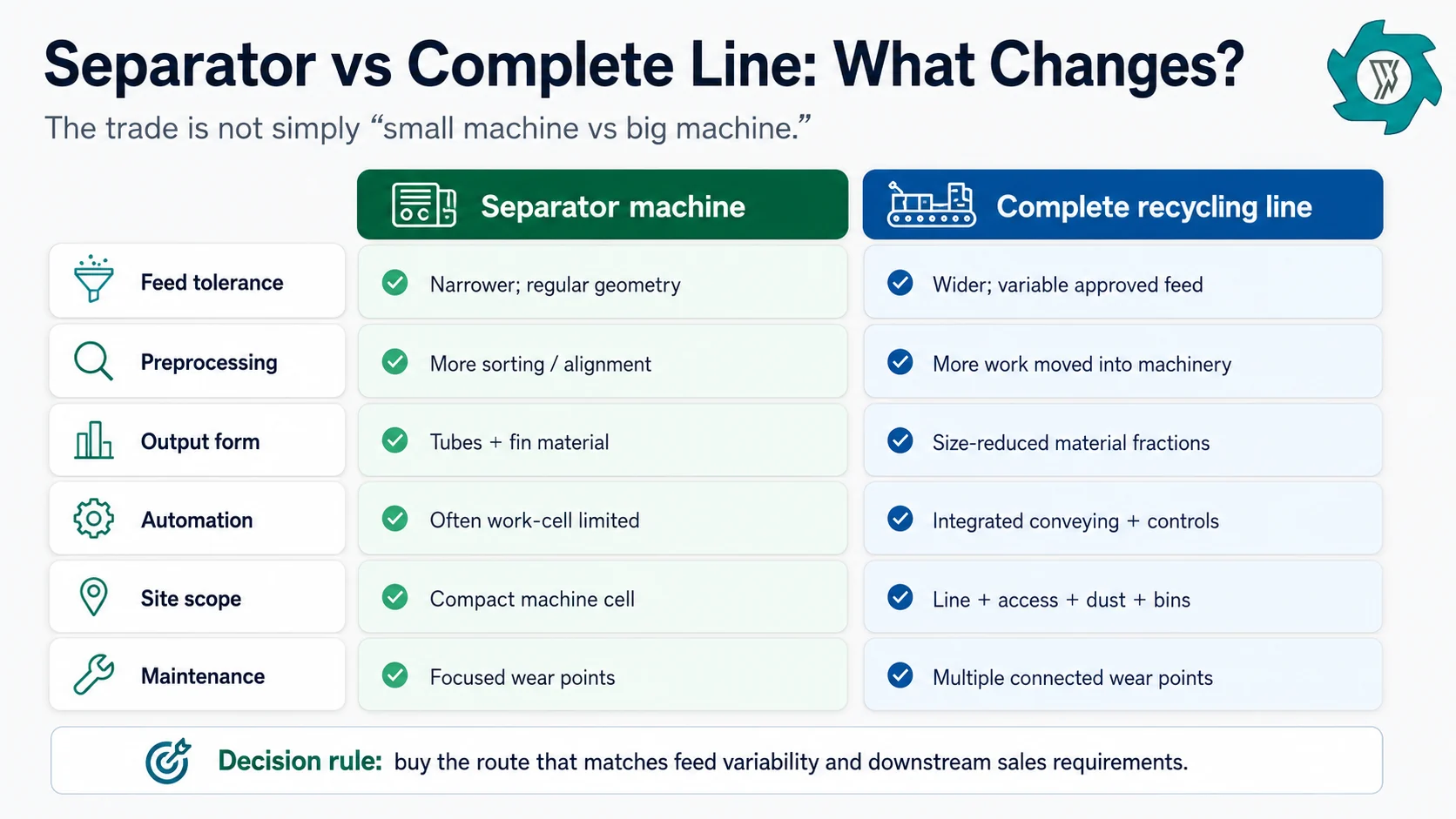
The table below is more useful than comparing motor power or a headline capacity because it shows what each equipment class asks from the material and the operator.
| Decision factor | Stripping / separator machine | Complete recycling line |
|---|---|---|
| Best feed condition | Flat, clean, intact and dimensionally consistent copper-aluminum cores. | Mixed, bent, folded, baled, dirty or attachment-heavy radiator and heat-exchanger scrap. |
| Dependence on tube geometry | High. Tube pitch, number of layers, core thickness and alignment can determine whether the material enters and separates correctly. | Lower after the material enters the approved feed envelope because the process creates a new particle geometry through size reduction. |
| Manual preparation | Usually more important. Pre-cutting, sorting and careful orientation may control actual throughput. | Still requires inspection and removal of unsafe items, but repetitive alignment is reduced once a suitable feed enters the line. |
| How separation happens | Mechanical stripping: pull tubes away from fins while the core structure is still recognizable. | Liberation plus staged physical sorting after shredding and crushing. |
| Typical metal form | Relatively intact copper tubes and separated aluminum fin material from suitable cores. | Size-reduced copper-rich, aluminum-rich, ferrous and light-residue fractions. |
| Feed flexibility | Narrower. Changes in construction can create extra sorting or make some cores unsuitable. | Wider, within the line’s approved material specification and crusher duty. |
| Automation potential | Often limited by manual material preparation and presentation. | Higher because feeding, conveying, crushing, separation and controls can be integrated. |
| Plant footprint | Small equipment footprint, although incoming sorting and work tables still require space. | Larger because conveyors, multiple machines, access zones, dust collection and product bins are part of the system. |
| Maintenance profile | Focused on stripping blades/rollers, guides, bearings and alignment. | Distributed across shredder cutters, crusher wear parts, screens, belts, separators, filters and controls. |
| When it becomes a poor fit | When the feed mix changes faster than operators can sort and prepare it. | When a recycler only handles a small, clean, homogeneous stream and cannot justify the additional plant scope. |
Choose the Route by Feedstock Condition, Not by the Word “Radiator”
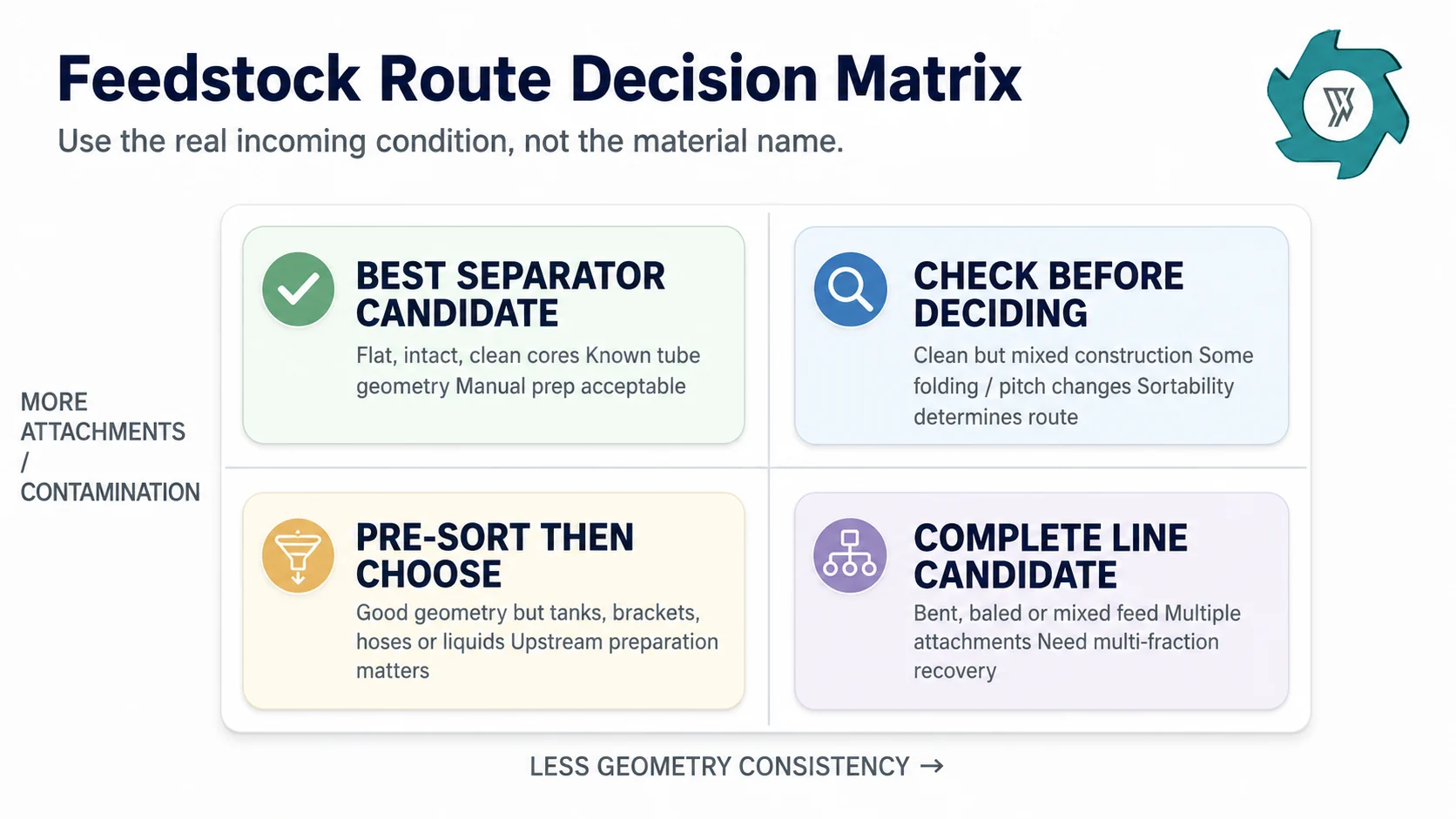
Radiators are composite materials, and their construction varies more than a purchase description may suggest. A mixed supply can include car radiators, AC radiators, copper-aluminum cores, all-aluminum radiators, industrial heat exchangers and heavily deformed scrap. That distinction matters because core geometry, attached materials and deformation determine how much preparation and liberation are required before the metal fractions can be sold separately.
Clean, flat copper-aluminum AC cores
This is the strongest case for evaluating a stripping machine first. When the cores arrive as flat panels, the copper tubes follow repeatable paths, and the material can be pre-cut to the machine’s feeding width, a simple separator can avoid unnecessary size reduction. Operators can visually check the feed before every pass, and the output may retain a form that local buyers already understand.
But “AC radiator” is not a guarantee of suitability. Some loads contain different tube pitches, multiple layer arrangements, flattened sections, soldered headers, steel end plates, oil residue or folded cores. If the material has to be divided into many small categories before the separator can accept it, the apparent simplicity of the machine is being paid for with labor and inventory complexity.
Mixed car radiators and condensers
Automotive material is usually a stronger candidate for a complete line when it arrives as a mixed dismantling stream. Plastic side tanks, steel brackets, fasteners, rubber pieces and varied metal construction make precise stripping less attractive. The process objective changes from “preserve the tube” to “liberate the useful metals and sort the resulting fractions.”
Bent, folded or baled radiators
Once transport or handling has destroyed the core geometry, a stripping machine loses the condition it relies on. Straightening each piece may cost more labor than it saves. A line designed with enough primary opening duty can accept deformation as part of the feed specification and then create a more controlled particle stream for the downstream stages.
All-aluminum radiators
Do not assume that a copper-aluminum separator is useful simply because the material is called a radiator. If the core is predominantly aluminum, the commercial goal may be contamination removal, size reduction or grade control rather than copper-tube extraction. A material test and the downstream buyer’s specification should determine whether this stream belongs in the same project.
Appliance and industrial heat exchangers
These streams can include coils, condensers, evaporators, frames and associated parts with very different dimensions. In a dismantling plant, the radiator line may be one downstream module rather than the first piece of equipment in the facility. Upstream dismantling quality then has a direct effect on the line’s stability.
The Hidden Difference Is Often Labor Before the Machine
A separator machine can look dramatically simpler because the complicated work happens before the material reaches it. Someone may need to identify the radiator construction, remove end plates, cut the core to width, separate one tube pitch from another and orient the piece correctly. If the feed is uniform, that preparation can be quick. If the feed varies, it can become the plant bottleneck.
This is why nameplate output by itself is a weak comparison. Imagine a separator that can mechanically process material faster than two workers can sort, cut and present it. The machine is not the actual capacity limit. The work cell is. A buyer should time the entire cycle from incoming pile to separated output, including rejected pieces and changeovers.
A complete line moves more of that work into machinery. Even so, it does not eliminate feed management. Oversized steel assemblies, sealed or pressurized components, free liquids and unknown items should not be treated as normal crusher feed. A well-designed receiving area still needs an approved-feed specification and a rejection route.
Compare the Output You Can Sell, Not Only the Input You Can Feed
The two process families can produce different physical forms even when both recover the same base metals. A stripping machine tries to preserve separation at the component level: copper tubes on one side, aluminum fin material on the other. That can be attractive if local buyers pay well for those forms and contamination is already low.
A complete line intentionally reduces the material. The output is therefore a set of processed fractions rather than recognizable radiator components. YUXI’s current line description includes copper-rich, aluminum-rich, ferrous and non-metal streams. Exact purity or recovery should not be assumed from the equipment list alone; it depends on feed composition, liberation, particle-size control, stable dosing and separator settings.
Before selecting equipment, ask the downstream buyer what actually changes the price. Does the buyer prefer whole copper tube, chopped copper-rich metal, aluminum fin, a dense aluminum-rich fraction or a broader non-ferrous mix? How much attached iron, plastic, moisture or mixed metal is acceptable? Will the material be hand-sorted again, granulated, melted or sold directly? Equipment choice should connect to that sales route.
The existing radiator recycling process guide explains the liberation and staged-separation mechanics in more detail.
Capacity Means Different Things on the Two Routes
A separator machine is often a work-cell capacity problem. The mechanical cycle may be fast, but the sustained rate depends on how many cores arrive already sorted, how quickly workers can cut and align them, how many are rejected for geometry, and how often settings change. A daily or hourly figure should therefore be tied to a defined core type and labor assumption.
A complete line is a system-capacity problem. The first shredder may be able to accept material faster than the crusher, screen or separator can process it. Stable output depends on balanced loading across the whole flowsheet. Bulky radiators also have a low and variable bulk density, so volumetric feeding can matter as much as the nominal weight rate.
For either route, ask the supplier to state the measurement point. Is capacity measured at the inlet, after manual preparation, after recirculation, or as saleable output? Is the feed flat AC core, mixed car radiator, a compacted bale or already-cut material? How many effective operating hours are assumed in a shift? These questions prevent a technically true number from becoming a commercially misleading comparison.
Automation is not the same as less total labor
A PLC and conveyors reduce certain handling tasks, but staffing depends on the plant boundary. Receiving, inspection, attachment removal, forklift movement, product collection, housekeeping, maintenance and quality checks still exist. Conversely, a simple stripping machine may fit a small recycler precisely because the company already has flexible manual labor and a clean source of cores. The right automation level is a business decision built on the actual workflow.
Site Scope: A Small Machine and a Line Need Different Buildings
The separator machine itself can occupy modest floor space, yet its work cell needs safe material staging, cutting or trimming space, operator clearance and containers for the two outputs. If several core types are sorted separately, the storage footprint can become larger than expected.
A complete line needs more deliberate layout. In addition to the main machines, allow for conveyors, product bins, dust extraction, electrical cabinets, maintenance pull space, forklift routes and safe access around guards. Future changes matter too. Leaving no space for a second separator, recirculation conveyor or larger dust collector can make a later upgrade unnecessarily expensive.
Maintenance changes from one wear point to a wear system
On a stripping machine, maintenance is concentrated around the parts that grip, guide and separate the core. Operators can often see wear directly in alignment or output quality. On a complete line, wear is distributed: shredder cutters, crusher wear parts, screens, bearings, belts, magnetic components, air system, filters and control sensors all influence performance. The maintenance program becomes more formal because one weak stage can restrict the whole line.
That does not make the complete line a worse investment. It means the buyer is purchasing feed flexibility and integrated processing by accepting a larger asset-management scope. That trade should be explicit in the decision.
A Hybrid Strategy Can Be Better Than Forcing Every Radiator Through One Route
Some yards do not need an all-or-nothing choice. If a meaningful share of incoming material is clean and uniform, it can be sensible to keep that material out of the shredder and process it on a stripping route. Mixed or damaged material can be accumulated for a separate crushing and sorting line. The point is not to own more equipment. It is to prevent easy feed from consuming heavy processing capacity while preventing difficult feed from blocking the simple machine.
This also creates an upgrade path for a growing business. A recycler with a stable HVAC contractor network may begin with a small separator work cell because the feed is predictable. If sourcing later expands into automotive dismantling, mixed appliance scrap or brokered heat exchangers, the feed envelope changes. The original machine can remain useful for the clean stream while a complete line is justified by the new mixed stream.
The reverse is possible too. A plant that already owns a complete line may discover that a subset of high-quality cores deserves a simpler treatment route because preserving tube form reduces unnecessary processing. The process should follow the material and buyer contract, not organizational habit.
Six Buying Mistakes That Make the Comparison Look Easier Than It Is
- Comparing purchase price before defining feedstock. A small stripping unit and a complete liberation-and-separation line are not competing quotations for the same process scope.
- Using a clean sample to represent a mixed supply contract. Demonstration material should represent the difficult and common parts of the feed, not only the easiest cores.
- Ignoring rejected pieces. If 20 different radiator constructions arrive but only a few fit the separator geometry, the rejected fraction needs its own labor, storage and sales route.
- Assuming more crushing always creates more value. Clean, uniform cores may not need a complete line. Unnecessary size reduction adds wear, dust and material handling.
- Assuming a complete line accepts anything called a radiator. Approved feed limits still matter. Free liquids, pressurized items and unusually heavy attachments require control before shredding.
- Buying to a capacity number without a test basis. Ask what feed, preparation level, operating period and output definition were used to support the rating.
What to Send Before Asking for a Separator or Line Recommendation
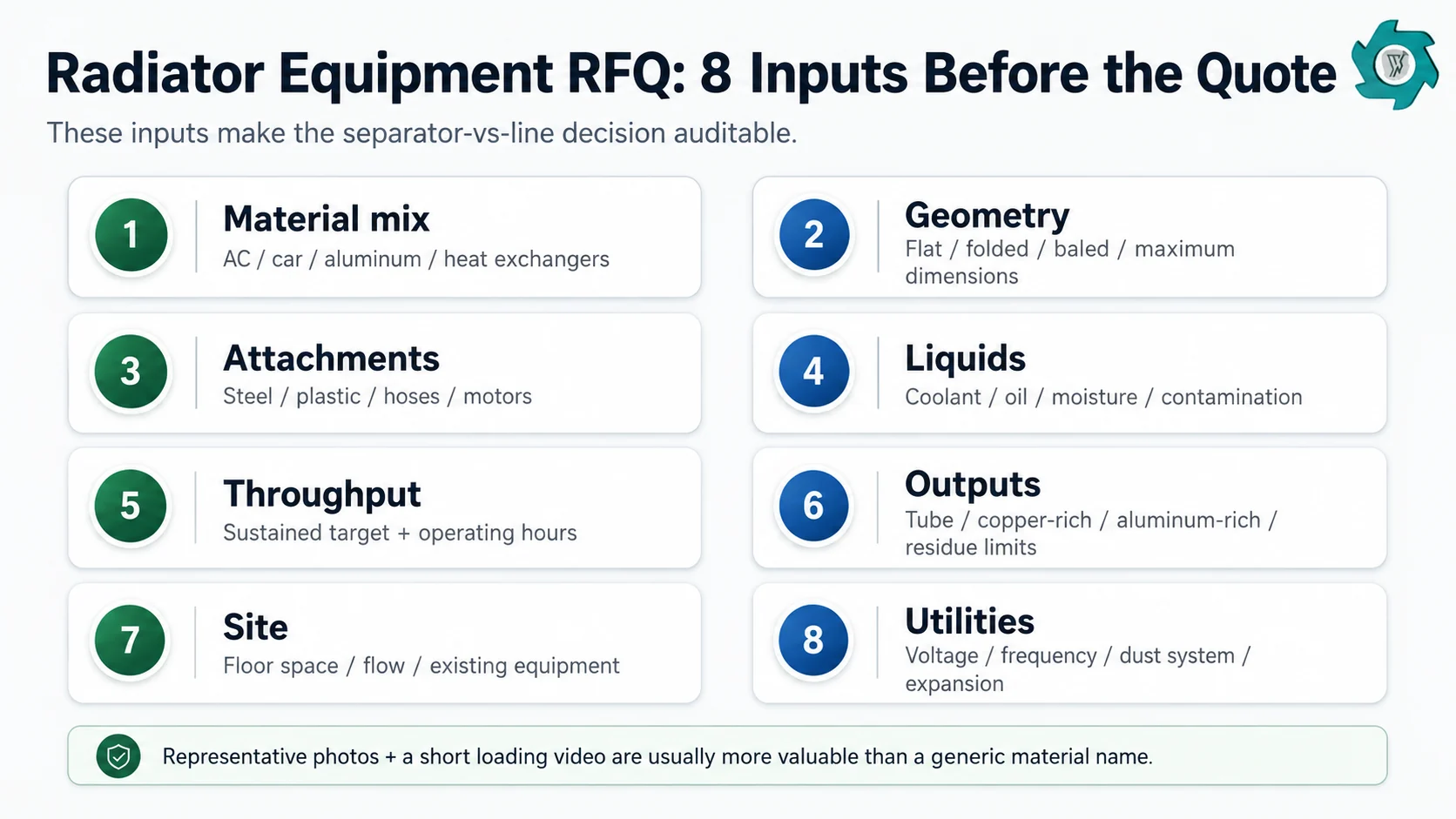
A supplier can only choose between the two routes when the material description is specific enough. A useful RFQ is not long, but it should remove the assumptions that cause most quotation errors.
Feed data
- Photos of the top, middle and bottom of a typical load.
- Short video showing how the radiators are currently stored and handled.
- Approximate percentage of AC, automotive, all-aluminum and other heat exchangers.
- Maximum length, width, thickness and typical unit weight.
- Flat, folded, nested, loose, compressed or baled condition.
- Tube spacing information if a stripping route is being considered.
- Attached steel, plastic tanks, hoses, motors and other accessories.
- Coolant, oil, dirt, moisture and other contamination.
Project data
- Required sustained throughput and operating hours per day.
- Target output form and buyer contamination limits.
- Available floor dimensions and material-flow direction.
- Local voltage, frequency and electrical standard.
- Existing conveyors, dust collection or downstream sorting equipment.
- Expected staffing and acceptable manual preparation.
- Whether the sourcing mix is stable or expected to broaden.
- Any future expansion already planned for the site.
For a serious comparison, ask the supplier to define the process boundary in the quotation: what the operator must do before the first machine, which equipment and auxiliaries are included, where each output fraction leaves the system, and which utilities, foundations, electrical work or other site work remain the buyer’s responsibility. This makes competing proposals much easier to compare than relying on the machine name alone.
Safety and Environmental Boundary Before Mechanical Processing
Neither equipment route should be treated as a disposal system for unknown assemblies. Free coolant and oil should be drained, and sealed or pressurized components should be identified and removed before mechanical processing. For HVAC and refrigeration equipment in the United States, EPA Section 608 prohibits intentional venting of regulated refrigerants and substitutes during disposal.[1] Local rules can differ, so refrigerant recovery and waste-fluid handling should be confirmed for the project location.
Machinery choice changes the hazard profile but does not remove it. OSHA notes common recycling hazards including moving machine parts and unexpected startup.[2] A stripping work cell needs guarding around the feed and separation mechanisms; a complete line adds conveyors, shredders, crushers and more maintenance isolation points. Guarding, emergency stops, lockout/tagout procedures, housekeeping and safe maintenance access belong in the equipment review, not as an afterthought after commissioning.
So Which One Should You Buy?
If your business receives a narrow, predictable stream of flat copper-aluminum radiator cores and you are comfortable with manual sorting and preparation, a separator machine can be the more rational first investment. It avoids processing stages you may not need.
If your supply is built around scrap yards, auto dismantlers, mixed HVAC contractors, appliance recyclers or brokers, assume that the feed will vary. In that case, a complete line is usually the stronger engineering starting point because the process is designed around liberation and staged sorting rather than perfect incoming geometry. The line should still be configured against representative material, not a generic catalog flow.
When the answer is not obvious, do not decide from the average radiator. Decide from the variability of the load. The machine has to make money on Monday’s good material and Friday’s awkward material without turning the receiving yard into a permanent sorting problem.
Send Your Radiator Mix Before Choosing the Machine
Share representative material photos or video, radiator types, dimensions, condition, target throughput, desired outputs, available floor space and power standard. YUXI can evaluate whether the project needs a complete crushing and separation line or whether part of the feed should remain on a simpler route.
FAQ
What is the main difference between a radiator separator machine and a radiator recycling line?
A radiator separator or stripping machine is a focused device for mechanically pulling copper tubes away from aluminum fins when the core is sufficiently flat, clean and dimensionally consistent. A complete recycling line is a multi-stage system that opens variable scrap, improves liberation, removes ferrous attachments and separates several material fractions.
Which option is better for clean air-conditioner radiators?
If the cores are intact, flat, clean and repeatable in construction, a stripping-type separator can be the simpler route. The final choice still depends on tube spacing, layer arrangement, required labor, throughput and what form of copper and aluminum the buyer wants to sell.
Can a radiator separator machine handle bent or baled radiators?
Not reliably as a general rule. Bending, folding and baling change the geometry that a stripping machine depends on. Mixed or heavily deformed material usually needs a process based on opening, shredding, crushing and staged separation instead of precise tube-to-blade alignment.
Does a complete radiator recycling line eliminate all manual sorting?
No. Automation can reduce repetitive handling, but representative feed inspection and removal of unsuitable items still matter. Free liquids, pressurized components, unusually heavy attachments and material outside the approved feed specification may require upstream handling.
Do the two routes produce the same kind of metal output?
Usually not. A stripping machine is attractive partly because it can recover relatively intact copper tubes and separated aluminum fin material from suitable cores. A crushing and separation line produces size-reduced copper-rich, aluminum-rich, ferrous and light-residue fractions whose exact condition depends on the feed and process settings.
Can a recycler start with a separator machine and add a complete line later?
Yes, if the site plan and sourcing strategy make that upgrade logical. A common planning approach is to keep clean, uniform cores on a simple route while reserving space and utilities for a future mixed-scrap line. The business case depends on how quickly the feed mix is expected to change.
How should capacity claims be compared?
First define the same feed condition and the same measurement point. A separator may be limited by manual pre-cutting and orientation, while a complete line may be limited by liberation or downstream separation. Ask whether the stated rate is inlet feed, sustained shift throughput or saleable output under representative material.
What information should I send before asking YUXI for a line recommendation?
Send representative photos or video, the percentage of each radiator type, maximum dimensions, loose or baled condition, attached steel and plastic, residual liquids, expected operating hours, target throughput, desired output fractions, available floor space and local power standard.
References
- U.S. Environmental Protection Agency. Stationary Refrigeration and Air Conditioning — Section 608. Accessed August 10, 2026.
- U.S. Occupational Safety and Health Administration. Green Job Hazards — Recycling. Accessed August 10, 2026.