




 Request Quote



The useful question is not “What does a radiator recycling machine cost?” It is “What process scope is needed for my radiator mix, and what will that scope cost after it reaches my floor and starts producing saleable metal?”
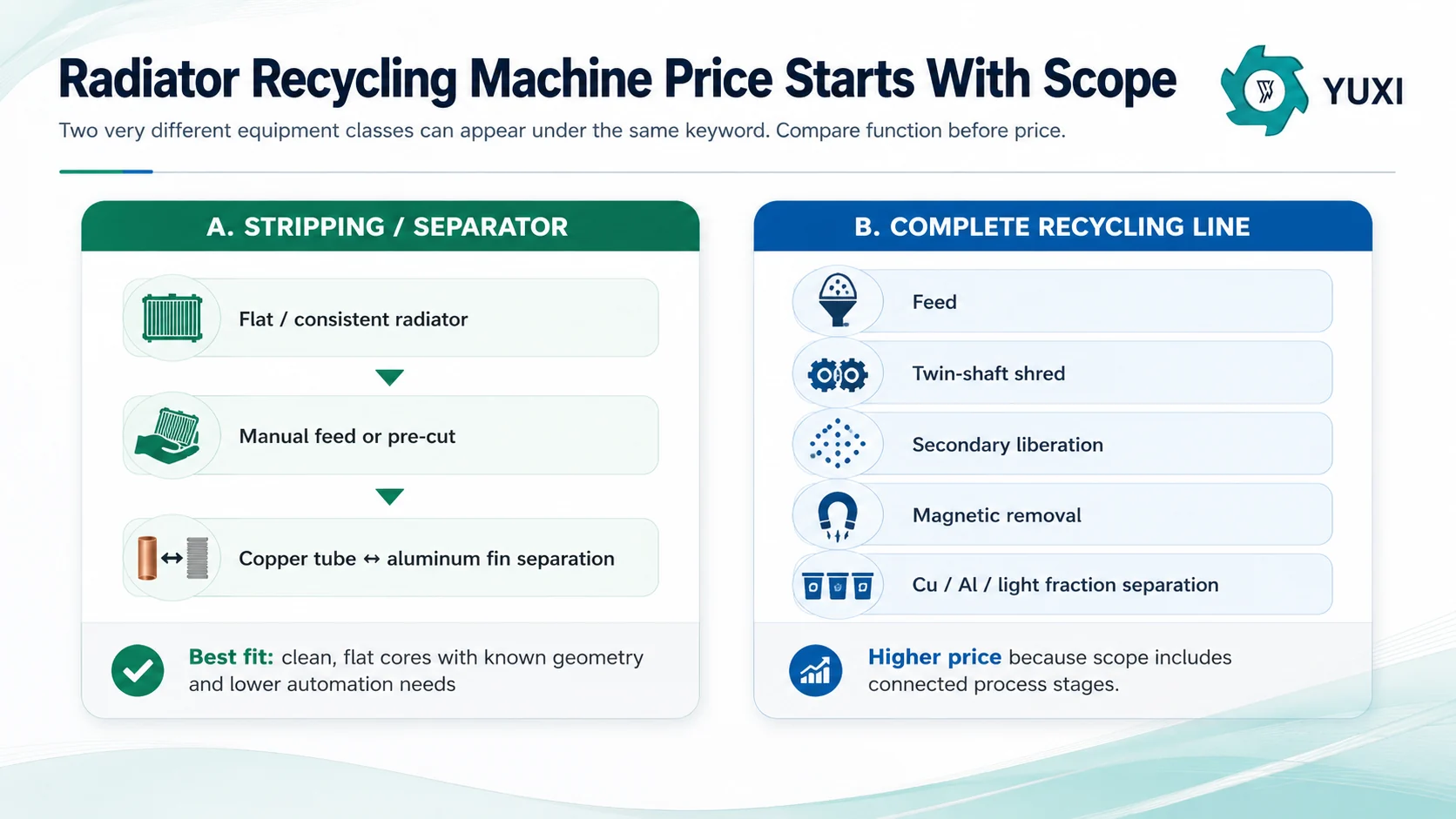
First Decide Which “Radiator Recycling Machine” You Are Pricing
This is the part that gets skipped in many online comparisons. There are at least two very different purchasing decisions hiding under the same keyword.
1. Radiator stripping or separator machine
A compact stripping machine can make sense when cores are flat enough to feed, tube spacing is known, and operators can pre-cut or orient the material. The machine mechanically pulls or separates copper tubes from aluminum fins. It is relatively simple, occupies little floor space and can be a practical low-capital route for consistent material.
The limitation is equally important. A stripper does not magically turn bent, baled or mixed radiator scrap into uniform feed. It also does not replace iron removal, secondary liberation or a downstream separation circuit when plastic tanks, steel brackets, dirt and mixed construction remain attached.
2. Complete crushing and separation line
For mixed or deformed radiator scrap, the project usually shifts from “pull the tubes out” to “liberate the composite and sort the fractions.” YUXI’s published radiator line uses feeding, double-shaft shredding, secondary vertical crushing, magnetic separation and specific-gravity/airflow separation, with centralized dust collection and PLC control. That sequence explains why a complete-line price cannot be compared with a bench-style separator.
If you need a technical refresher on what happens between incoming cores and separated fractions, the existing radiator recycling process guide covers the step-by-step mechanics. This article stays on the commercial side: what you are actually paying for.
Radiator Recycling Machine Price: A Current Market Snapshot
Online prices are useful as a sense check, but only if we keep the machine class beside the number. The examples below were visible on August 10, 2026. They are vendor or marketplace asking prices, not audited transaction prices and not YUXI quotations.
| Observed listing type | Example asking price | What the listing appears to cover | How to use the number |
|---|---|---|---|
| Small radiator separator / stripping machine | US$1,463–4,873 per set | VANER lists two radiator separator models for scrap AC/car radiator work, with model-dependent capacity.[1] | Use only as a benchmark for compact stripping equipment, not a mixed-scrap processing plant. |
| Marketplace radiator recycling equipment | Examples around US$10,000–50,000 | Made-in-China results include Wanrooe listings in this band for AC radiator recycling/separation equipment.[3] | Ask exactly which machines, conveyors, controls and separation stages are included. |
| Crushing + separation systems | Examples around US$45,000–98,500 | Current category results include a car-radiator crushing and separating system in this range.[2] | Closer to a complete-line discussion, but still not a delivered installed project price. |
| Higher-capacity / more integrated listings | Examples above US$100,000 | Individual listings currently include ranges such as US$120,000–155,000 and US$15,000–350,000.[2][3] | Use these figures only to understand the possible scope and capacity spread. Do not treat them as a market average or a YUXI quotation. |
There is a reason the range is so wide. Search results mix stripping machines, single shredders, separator modules, partially automated lines and complete plants. Some prices are FOB-style equipment offers; others are closer to multi-machine packages. Averages are nearly meaningless until the same feed, throughput, output and battery limits are imposed on every quote.
The 10 Factors That Set a Real Radiator Recycling Line Price
1. Feed condition
Clean, flat heat-exchanger cores are easier to handle than mixed automotive radiators with plastic tanks, fan shrouds, steel brackets, dirt and residual fluids. Dense bundles and baled cores also change how the first machine must grip and open the feed. Feed condition affects machine size, torque, wear and the amount of pre-sorting labor.
2. Required throughput — and how it is measured
“One ton per hour” is not enough information. Is that instantaneous feed into the first machine, stable line throughput over a full shift, or saleable product output after residue? Radiator bulk density, feed interruptions and manual preparation can create a large gap between those numbers. Ask for the measurement point and the test feed used to support the capacity claim.
3. Primary size reduction duty
A double-shaft shredder used to open long, nested or distorted radiator assemblies has a different chamber, drive and cutter duty from a small cutting device. Heavier recurring feed demands generally mean more structure, torque and wear allowance. Oversizing every component is expensive, but undersizing the primary stage creates jams, recirculation and lost uptime.
4. Secondary liberation
Copper tubes and aluminum fins must be sufficiently separated before a density-based separator can do useful work. If a coarse shred leaves metal locked together, a vertical crusher or other secondary liberation stage becomes part of the price. This is one of the biggest reasons a complete mixed-radiator line costs more than a stripping unit.
5. Separator combination and quality target
Iron removal is normally a different job from copper/aluminum/light-residue separation. A project that needs separate copper-rich, aluminum-rich and ferrous fractions requires more process control than one producing only a rough pre-concentrate. If the downstream buyer sets tighter contamination limits, the line may also need closer particle-size control, recirculation or an additional cleaning stage.
6. Dust collection and housekeeping design
Secondary crushing, screening and transfer points generate fines. A dust system is not an optional cosmetic add-on once the process creates airborne material. Hoods, ducting, collector type, fan, discharge arrangement, controls and fire-risk provisions can materially change the budget. For aluminum-rich fines, read the dust control and fire-risk planning guide before stripping cost out of the proposal.
7. Automation and interlocks
PLC control, motor protection, overload logic, feeder interlocks, alarms and a coordinated stop sequence add cost, but they also determine how the line responds to a jam or failed downstream machine. We have seen “cheap” proposals where every machine had a local starter and no useful line logic. That can work in a simple stand-alone cell. It becomes awkward on a connected recycling line.
8. Conveyors, chutes and platforms
They are easy to underestimate because they do not perform the headline separation. In practice, bad transfer geometry can spill material, overload a separator, complicate maintenance or require extra operators. A quotation that excludes support steel, access platforms and interconnecting conveyors may look significantly cheaper while moving the same cost to the site contractor.
9. Local electrical standard and site conditions
Voltage, frequency, transformer availability, motor starting method, enclosure requirements, cable distances and local panel standards affect the electrical scope. Workshop height, floor loading, crane channel and available dust-collector location can also force layout to change.
10. Spares, wear parts and service boundary
Knives, liners, screens, belts, bearings and filters are not theoretical future costs. They are part of operating a size-reduction line. A sensible purchase includes a startup spare package, wear-part drawings or part numbers, lead-time information and a clear warranty/service procedure. The lowest equipment subtotal can lose its advantage after the first unplanned stop.
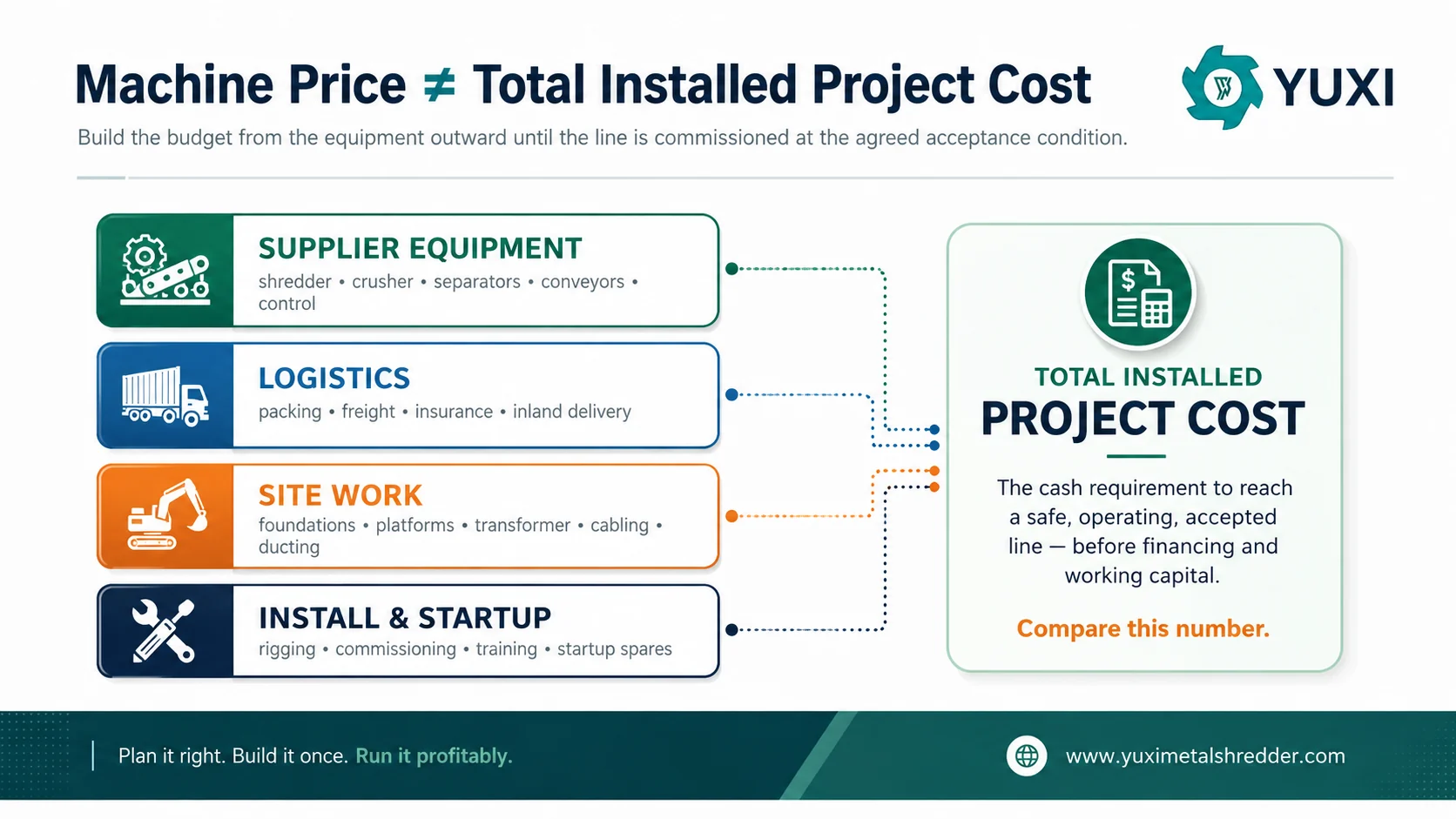
Machine Price Is Not the Same as Total Installed Project Cost
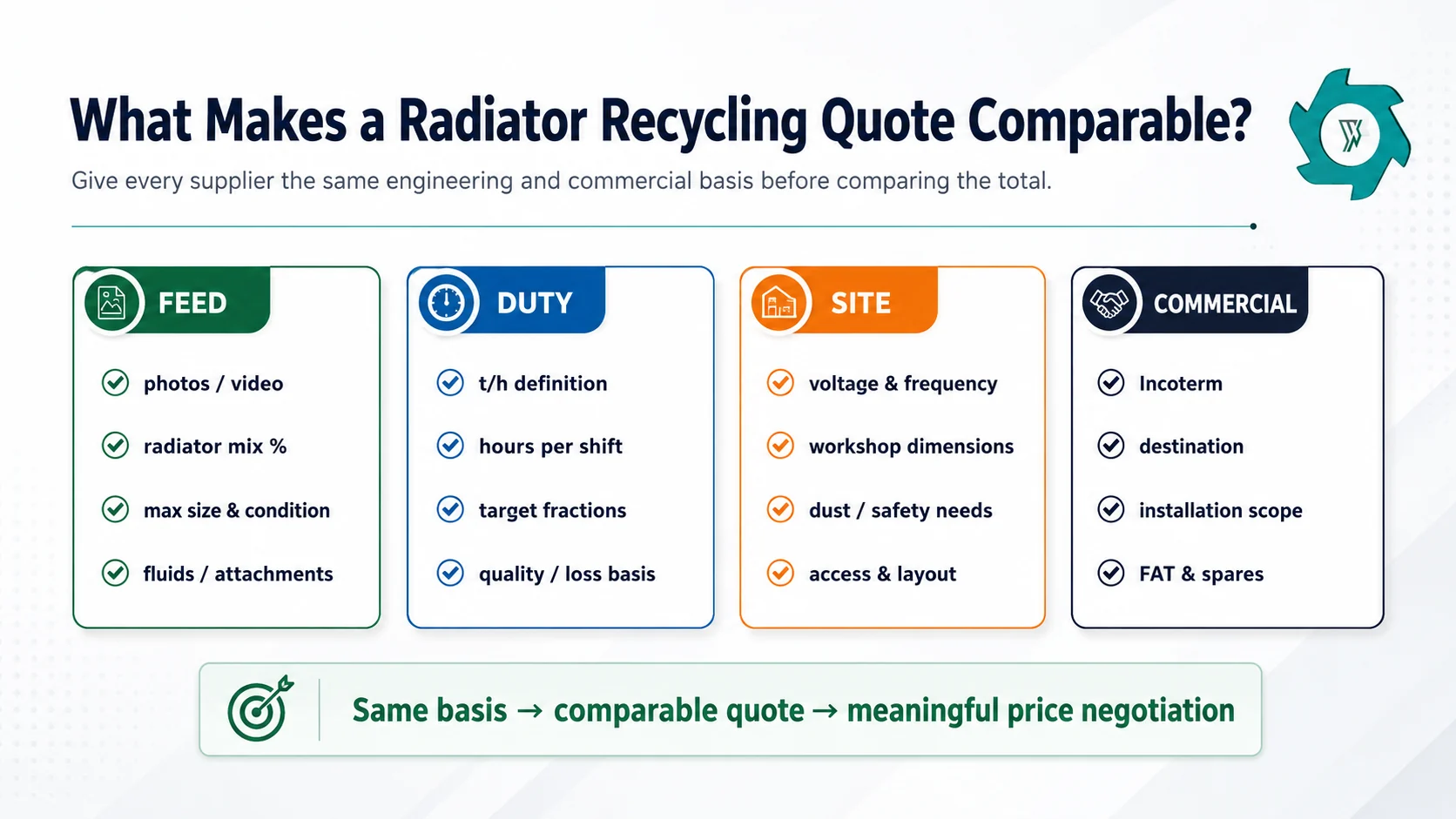
When two quotations differ by 25%, the first reaction is often to negotiate the expensive one. Before doing that, move both quotes into the same cost structure. The comparison method is similar to the framework in our recycling line quotation comparison guide: normalize feed basis, process scope, Incoterm, site work, acceptance and exclusions before comparing the totals.
| Cost layer | Typical items | Question to put in the RFQ |
|---|---|---|
| Supplier equipment | Feeder, shredder, crusher, magnet, gravity/air separator, conveyors, control system, dust equipment, platforms, startup spares | What exactly is included in the equipment list and quantity? |
| Export and logistics | Export packing, container loading, ocean/land freight, insurance, port handling | Which Incoterm and named place does the price use? |
| Import and inland delivery | Duties, taxes, customs brokerage, inland haulage, permits, unloading | Which costs remain with the buyer after arrival at the destination port? |
| Site construction | Foundations, floor strengthening, steel supports, drainage, equipment pads, access | What civil loads and foundation drawings will the supplier provide? |
| Electrical and utilities | Transformer, MCC or local panels, cable tray, cabling, compressed air, ventilation, lighting | Where is the electrical battery limit? |
| Environmental / safety systems | Dust collection, ducting, fire protection interface, refrigerant/fluid handling, guards, access control | Which safety and environmental systems are included, and which need local engineering? |
| Installation and startup | Rigging, mechanical/electrical installation, commissioning, training, acceptance test | How many supplier technicians, days and travel costs are included? |
Useful procurement number: ask your team to calculate Total Installed Project Cost, not just “machine price.” The correct total is the amount required to reach a safe, commissioned line at the agreed acceptance condition. Financing cost and working capital can then be added separately for the investment model.
How to Estimate Radiator Recycling Line Operating Cost
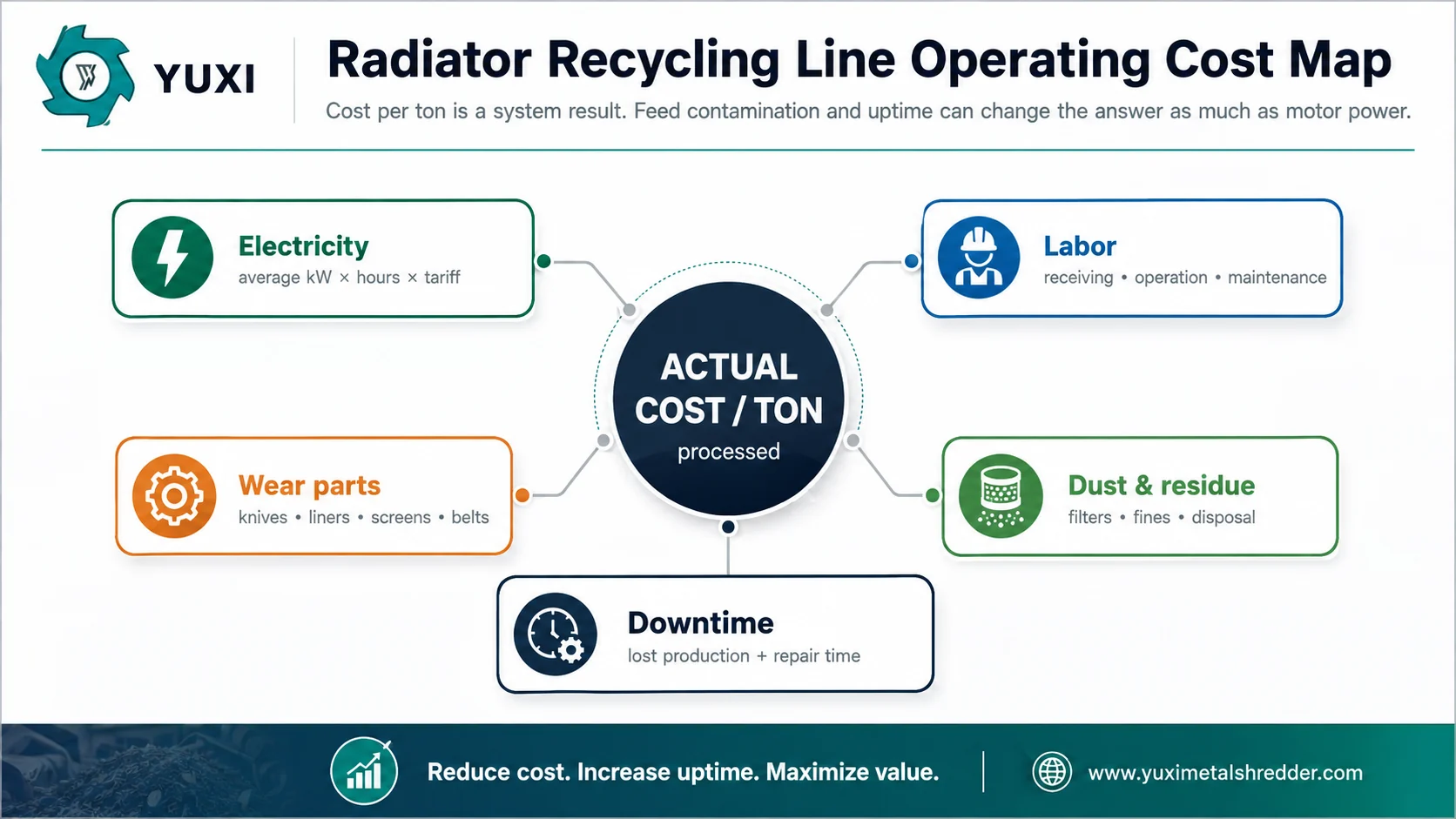
A line with a lower purchase price is not necessarily cheaper per ton. Operating cost should be built from the actual process route and local rates. Avoid universal “US$/ton” claims unless the calculation states the feed, utilization and local assumptions.
Electricity
Do not add every motor nameplate and assume the sum is the normal draw. Motors cycle and load differently. Ask for measured or expected average load by stage under representative feed, then apply your tariff.
Wear parts and routine spares
Primary cutters see different loads from crusher liners, screens or separator belts. Contamination matters. Steel attachments, dirt and foreign objects can shorten wear life and increase downtime. The useful quotation question is not “How long do knives last?” but “What feed and operating hours support that wear estimate, and what does one full replacement set cost?”
Labor
Do not count only the operator standing at the control panel. Labor can also include incoming inspection, material preparation, forklift or loader work, line monitoring, output checks, residue-bin handling, housekeeping and routine maintenance. The real labor cost depends heavily on how much preparation the incoming radiator scrap requires before it reaches the shredder.
Dust, fluids and residue
Filter media, collected fines, plastic-rich residue, contaminated dirt and residual fluids all need a destination. Disposal or treatment cost depends on the material and local regulation. If radiators arrive as part of refrigerant-containing appliances, refrigerant recovery before final disposal is a separate compliance step in the United States under EPA Section 608 requirements.[4]
Downtime
This cost is regularly ignored because it does not arrive as an invoice from the machine supplier. A stopped line still consumes labor, may interrupt feed contracts and can delay shipment of recovered metal. Put a realistic maintenance and unplanned-stop allowance in the financial model instead of assuming 100% mechanical availability.
Why the Cheapest Radiator Recycling Quote Can Become the Most Expensive
We have seen low quotations that were genuinely good value. We have also seen low quotations that were simply incomplete. The difference only becomes visible when the proposal is forced to answer the same engineering questions.
- The feed is easier than yours. A supplier tests clean flat cores while your plant receives mixed bent units with attachments.
- Capacity is measured at the wrong point. The advertised number is primary-machine feed rate, not stable saleable output.
- The separation target is vague. “Copper and aluminum separation” says nothing about remaining iron, locked metal or residue loss.
- Conveyors and platforms are missing. The buyer discovers after order that machines are quoted as islands.
- Dust collection is an option. Removing it lowers the quotation but does not remove dust from the process.
- Electrical scope ends at each motor. The local project then absorbs panels, cabling, interlocks and transformer changes.
- Shipping and installation are excluded. A low ex-works number is compared with another supplier’s delivered package.
- No representative FAT is defined. Performance arguments begin after the equipment ships.
Normalize those points first. Negotiate price second.
A Practical Payback Model Without Inventing ROI
Radiator scrap can contain valuable copper and aluminum, so buyers naturally ask how quickly a line pays back. The answer has to come from your own recovered-metal mass balance and sales terms. A universal ROI percentage would be misleading.
Step 1: build a material balance
Take a representative batch. Record incoming weight, separated copper-rich fraction, aluminum-rich fraction, ferrous fraction, saleable mixed metal if any, and residue. Do not use a supplier’s best sample if your purchasing mix is broader.
Step 2: apply realistic selling prices
The London Metal Exchange publishes global reference prices for copper and aluminum, but a radiator-recycling business does not automatically receive the LME headline value. Scrap grade, contamination, moisture, local premiums/discounts, transport, assay and buyer terms determine the actual settlement.
Step 3: subtract feedstock and processing costs
Step 4: convert the margin to annual contribution
Step 5: compare with total installed project cost
This is a screening metric. It ignores financing structure, tax, depreciation, working-capital changes and terminal value. Use a proper cash-flow model for an investment decision.
| Sensitivity variable | Low case | Base case | High case |
|---|---|---|---|
| Processed tons/year | Your conservative utilization | Your planned utilization | Your demonstrated upside |
| Net copper/aluminum selling price | Downside buyer settlement | Current contracted/expected settlement | Upside, still realistic |
| Recovered-metal yield | Mixed/dirty feed test | Representative feed test | Cleaner feed case |
| Operating cost / ton | High-cost case | Budget case | Improved utilization case |
| Installed project cost | Include contingency | Approved project budget | Only use lower case if scope is unchanged |
What to Send YUXI for a Useful Budgetary Quotation
A better RFQ can save several rounds of email and, more importantly, prevent a quote for the wrong machine class. Send the information below even if some values are approximate.
- Representative photos and a short video of the incoming radiator scrap.
- Approximate percentages of car radiators, AC condensers, copper-aluminum cores, aluminum-only heat exchangers and other material.
- Maximum dimensions, typical condition and whether material is flat, bent, compressed or baled.
- Known residual coolant, oil, refrigerant-system components, dirt, steel frames, plastic tanks or other attachments.
- Required throughput and planned operating hours per day/shift.
- Target output fractions and the contamination level your downstream buyer can accept.
- Local voltage, frequency and available transformer capacity.
- Workshop length, width, clear height, access doors and preferred material flow direction.
- Dust collection, noise, fire-risk or environmental requirements imposed by your site or authority.
- Destination city/port, preferred Incoterm and whether installation/commissioning support should be included.
Do Not Remove Safety and Compliance Scope Just to Hit a Machine Budget
A radiator line has rotating cutters, conveyors, transfer points and stored energy. OSHA’s recycling guidance emphasizes hazardous-energy control for servicing and maintenance, and scrap recycling work also exposes employees to moving-equipment and material-handling hazards.[5][6] Guards, safe access, interlocks and lockout provisions belong in the project scope, not in a later “if budget allows” list.
Material preparation matters too. In the U.S., EPA safe-disposal rules require refrigerant to be recovered from applicable refrigeration and air-conditioning equipment before final disposal, with requirements around recovery practices and equipment.[4] A radiator recycling line should not be priced as though upstream depollution and refrigerant handling do not exist.
Budget Decision Checklist
Before approving a radiator recycling machine purchase, you should be able to answer these five questions in one page:
- What exact feed is guaranteed to be accepted?
- What stable throughput and output condition are being accepted?
- Which equipment and site-work items are included or excluded?
- What is the total delivered and installed project cost?
- What low/base/high cash-flow assumptions support the investment?
If any of those answers is still vague, the project probably does not need a lower price yet. It needs a better specification.
Get a Radiator Recycling Line Budget Based on Your Feedstock
Send representative radiator photos or video, required throughput, target outputs, local power standard and destination. YUXI can prepare a project-specific equipment route and budgetary quotation.
Frequently Asked Questions
How much does a radiator recycling machine cost?
There is no single useful price because the keyword covers different equipment classes. Current vendor listings show small radiator stripping or separator machines in the low-thousands of U.S. dollars, while integrated crushing and separation systems can move into the tens or hundreds of thousands depending on scope. A YUXI price should be based on your feedstock, throughput, output target, electrical standard and project boundary rather than a marketplace average.
Why are online radiator recycling machine prices so different?
Many listings are not describing the same machine. Some are manual-feed stripping units for flat, clean radiators with known tube spacing; others include shredding, secondary crushing, magnetic removal, copper/aluminum separation, conveyors, dust collection and controls. Shipping terms, automation, platforms, installation and local electrical work also vary.
Is a radiator separator machine the same as a complete recycling line?
No. A stripping or separator machine can be economical for clean, flat and consistent radiator cores, but it cannot replace the complete production line when material is bent, baled, mixed, contaminated or still carries steel and plastic attachments. A complete line is designed around liberation and multiple separation stages.
Does the quoted machine price normally include shipping and installation?
Not automatically. A quotation must state the Incoterm and battery limits. Export packing, freight, insurance, duties, inland delivery, rigging, foundations, wiring, ducting, installation, commissioning and training may be included, optional or excluded. Compare total delivered and installed scope, not only the equipment subtotal.
What operating costs should I budget for?
The main operating-cost buckets are electricity, labor, cutters and wear liners, screens, belts and bearings, filters and dust handling, lubrication, routine spares, residue disposal, maintenance labor and downtime. Actual cost per ton depends on the feed condition, duty cycle, local wages and power tariff, and the condition in which recovered metals can be sold.
How can I estimate payback before buying a radiator recycling line?
Build the model from your own material balance and sales contracts. Estimate saleable copper, aluminum and ferrous fractions, realistic local selling prices, feedstock cost, variable operating cost, fixed operating cost, downtime and the total installed project cost. Run low, base and high scenarios. A simple payback is a screening metric, not a guarantee or a substitute for financing and tax analysis.
External References
- VANER Machinery — Radiator recycling machine. Vendor listing used only as a current example of small stripping/separator pricing; accessed 2026-08-10.
- Made-in-China — Radiator Recycling Machine marketplace results. Marketplace snapshot illustrating the very wide range of machine scopes and asking prices; accessed 2026-08-10.
- Made-in-China — AC Radiator Recycling Machine marketplace results. Marketplace examples including separator machines and higher-priced crushing/separation systems; accessed 2026-08-10.
- U.S. EPA — Stationary Refrigeration Safe Disposal Requirements. Current U.S. federal guidance relevant to refrigerant recovery before disposal.
- OSHA — Recycling: Waste Management and Lockout/Tagout. Primary OSHA guidance on hazardous energy control in recycling operations.
- OSHA — Scrap Metal Recycling. Primary OSHA overview of hazards in scrap metal recycling.