




 Request Quote



OCC recycling plant price is easy to underestimate when the first number on a quotation is treated as the project budget. The machine price can be important, but it is only one layer. Freight, foundations, field electrical work, dust and fire controls, installation, commissioning, spares and startup cash can sit outside the supplier’s quoted total.
This distinction matters because “OCC recycling plant” is used for several very different facilities. It may mean a baler-only operation, a shredding and sorting front end, a dry fiber-recovery line, or a wet paper-mill stock-preparation system. Search results often place those projects on the same page even though their direct outputs, utilities and equipment lists are different.
AF&PA reports that the United States recycled more than 33 million tons of cardboard in 2024, with a recycling rate of 69–74%.[1] That large material flow explains the commercial interest in OCC processing, but it does not create a standard factory design. A warehouse stream of dry flattened boxes and a mixed stream of dense wire-tied bales create very different capital requirements.
What Does “OCC Recycling Plant Price” Actually Mean?
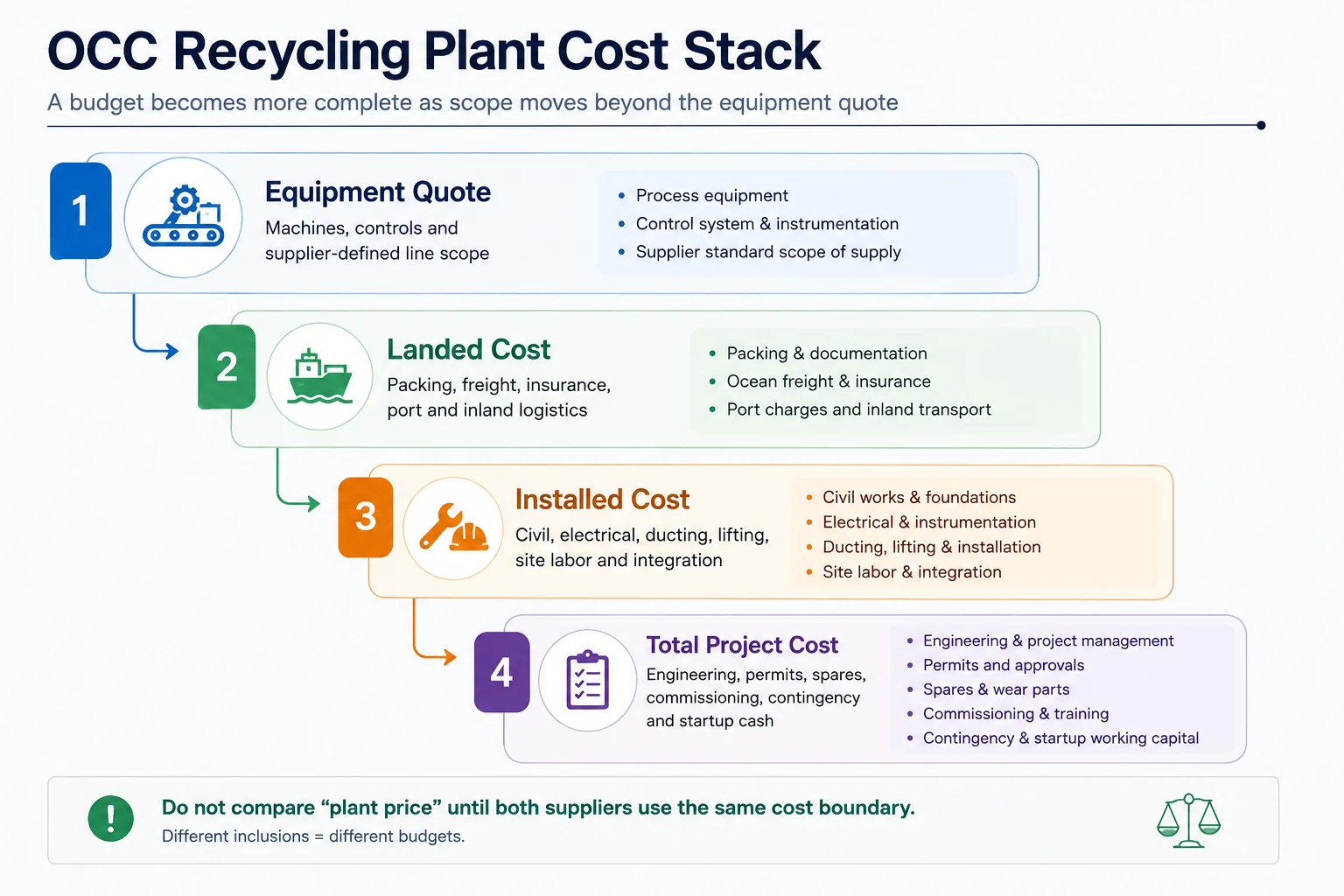
The safest way to discuss price is to name the cost boundary. We have seen purchase discussions go off course because one number was an EXW equipment package while another number included freight, site electrical panels and commissioning. Both suppliers could honestly call the number “plant price,” yet the buyer would still be comparing different things.
| Cost boundary | Usually includes | Usually does not prove |
|---|---|---|
| Machine price | One baler, shredder, separator or fiber-opening machine | Complete connected-line performance or site readiness |
| Line equipment price | Supplier-defined machines, conveyors and controls | Freight, local civil work or complete installation unless written |
| Landed cost | Equipment plus the agreed logistics path to the destination | Foundations, field wiring, ducting, erection or commissioning |
| Installed cost | Landed equipment plus the work required to erect and connect it | All owner costs, working capital or future operating expense |
| Total project cost | Installed plant plus engineering, permits, spares, startup and contingency as defined | A universal ROI or payback period |
| Startup cash requirement | Total project cost plus initial material inventory, payroll and operating liquidity where relevant | Long-term profitability without a separate operating model |
Why Online OCC and Paper Recycling Prices Conflict
Current search results reveal a scope problem rather than a clean price benchmark. Pages about “paper recycling plant cost” often describe hydrapulpers, screens, cleaners, refiners and even the paper machine itself. One current supplier article describes a complete recycled-fiber line that ends in stock ready for papermaking; a 2026 industry portal similarly budgets integrated wet-process plants with utilities, civil work and a paper machine.[6][7]
Those numbers are useful for one lesson: a wet recycled-paper mill is not a price proxy for a dry OCC preprocessing line. The direct products are different. The utility systems are different. The building and installation scopes are different. Copying a headline range from one into the other creates false precision.
The U.S. EPA’s recycling-infrastructure assessment makes the same broader budgeting point at system scale: infrastructure investment includes collection and many types of processing facilities, not only machinery.[2] Its national figures are not an OCC-plant price, but the framework reinforces why “equipment purchase” and “recycling infrastructure investment” should not be treated as synonyms.
Where the YUXI OCC paper dry pulping and cardboard recycling line can include inspection and bale opening, controlled feeding, primary shredding, magnetic separation, buffering and metering, dry fiber opening, dust and light-reject control, fiber collection, and final baling or bulk discharge. The solution page also states that the actual sequence is adjusted around feed condition, contaminants, required throughput and output.
A YUXI dry line should not be costed as if it includes a paper machine, hydrapulper loop, wet screening train, wastewater plant and every downstream papermaking utility. It should also not be reduced to the price of a shredder. If you are still deciding whether the facility needs only a baler, a shredder plus baler or a coordinated processing line, the industrial cardboard recycling machine guide defines those equipment boundaries before the budget is built.
Ten Factors That Change OCC Recycling Plant Price
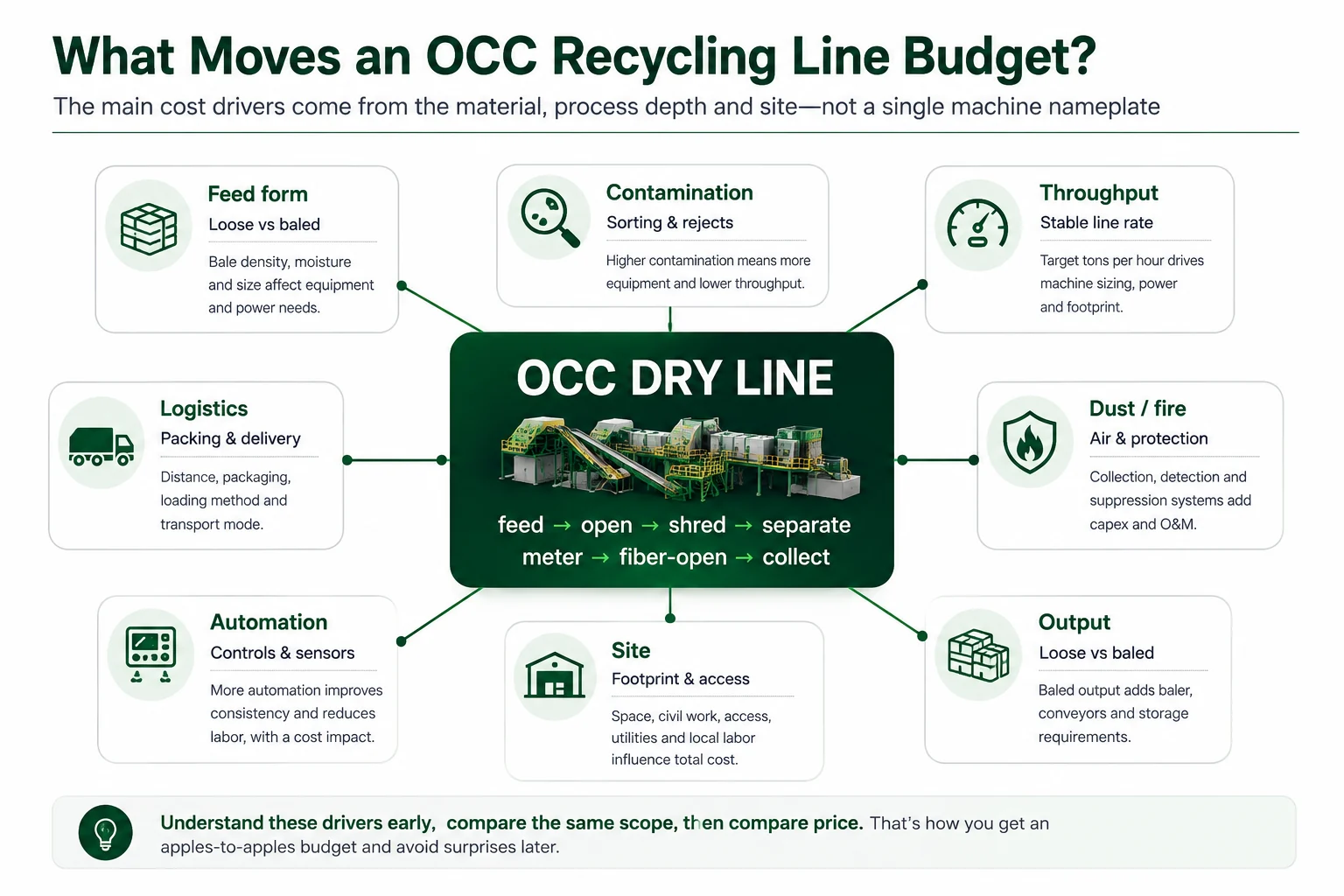
For a dry OCC project, price moves because the physical job changes. Asking for “5 tons per hour” is not enough. Two 5 t/h feeds can require different conveyors, opening access, dust extraction and reject handling.
1. Loose cardboard or compressed OCC bales
Loose, source-separated boxes can be easier to meter and inspect. Dense bales may require a receiving zone, safe wire removal, bale opening and surge control. That is additional equipment and additional operating space before the first shredder.
2. Contamination and inspection burden
Plastic film, wood, hard metal, wet-strength board, coatings and high moisture can change the front-end sorting and reject system. Better incoming material can sometimes remove equipment from a line; variable material can add sorting positions, magnets, air handling or reject conveyors.
3. Sustained throughput—not the fastest machine
The YUXI solution notes that actual capacity depends on feed density, bale size, moisture, contaminants, required shred size, fiber-opening degree, conveying and downstream collection. The budget should therefore be tied to sustained connected-line output, not the nameplate of one machine.
4. Required degree of fiber opening
Coarse preparation and a more intensively opened fiber-rich product are not the same duty. Rotor work, screen arrangement, recirculation and dust load can change as the output specification becomes more demanding.
5. Buffering and conveying
Cardboard is light and bulky. A line that repeatedly starves and surges can look inexpensive on the equipment list because the missing buffer is invisible. Conveyors, hoppers and level control add cost, but they can be what makes the expensive machines downstream operate steadily.
6. Dust and light-reject handling
Dust collection is not cosmetic. OSHA identifies machinery and combustible-material hazards in paper recycling and lists paper/pulp among materials that can present combustible-dust hazards when finely divided.[3][4] The required enclosure, extraction, ducting, filtration, housekeeping access, isolation and fire-protection measures depend on the actual process and local design requirements.
7. Output handling and baling
A loose discharge into an adjacent process has a different cost from automatic baling for truck transport. The final baler, buffer, tying system and bale handling area can be a substantial separate module.
8. Electrical standard and automation
Motor voltage, frequency, control architecture, interlocks, emergency stops, variable-speed drives, instrumentation and the split between supplier panels and owner field wiring should all be listed. “PLC included” says very little about the field installation budget.
9. Building and layout constraints
Low clear height, limited forklift aisles or an existing floor that cannot accept equipment loads can increase civil and installation work. A greenfield layout may spend more on a new building but less on awkward retrofits.
10. Destination and delivery scope
Machine origin, packing method, containerization, port pair, inland distance, unloading plan and Incoterm can materially change the amount paid before a machine reaches its foundation.
From Equipment Quote to Landed Cost
The first budget bridge is logistics. Do not add a generic freight percentage if a real shipping route can be priced. Record exactly where the supplier’s responsibility stops.
| Line item | Question to answer | Why it matters |
|---|---|---|
| Export packing | Are skids, moisture protection and container bracing included? | Large conveyors and ducts can change packing volume. |
| Ocean or land freight | Which origin, destination and container assumptions are used? | Freight is route- and date-sensitive. |
| Cargo insurance | Who arranges it and what value is insured? | Responsibility differs by commercial term. |
| Port/terminal handling | Which charges are in the quoted delivery term? | Local charges may sit outside the supplier offer. |
| Duties and taxes | Who is importer of record and what classification applies? | Country-specific treatment should be verified locally. |
| Inland haulage | Can the site accept the largest package? | Oversize loads, permits or escorts can change cost. |
| Unloading | Are crane, rigging and temporary storage arranged? | Delivery to site is not the same as placement on foundations. |
Landed cost = supplier equipment scope + packing + agreed freight/insurance + destination logistics + applicable import costsFrom Landed Cost to Installed Cost
Once equipment reaches the site, the project becomes a field-integration job. This is the stage most likely to be missing from an online machine price.
AACE cost-engineering guidance explains the general principle behind equipment-factored estimates: foundations, electrical work and other non-equipment items are required to complete an installation, and the basis of any factor must be understood.[5] We do not apply a generic chemical-process Lang factor to an OCC line here. The project is better served by building a site-specific list.
- Civil: equipment foundations, pits if any, floor reinforcement, housekeeping pads, drainage and access.
- Structural: platforms, stairs, guards, supports, maintenance access and local steelwork.
- Electrical: incoming distribution, transformers if required, MCC interfaces, field cable, cable tray, grounding and lighting.
- Air/dust: ducts, supports, collector placement, makeup air, exhaust route and any required protection devices.
- Utilities: compressed air, water where selected auxiliary systems need it, and service connections.
- Erection: crane time, rigging, mechanical assembly, alignment, field welding and contractor labor.
- Integration: controls checkout, interlocks, safety circuits, upstream/downstream interfaces and production data links where required.
From Installed Cost to Total Project Cost
Total project cost is the number used for the capital decision. Some companies include land and working capital; others keep them outside CAPEX. The accounting label matters less than making sure every cash requirement has an owner.
Total project cost = installed plant + owner engineering + permits/compliance + startup spares + training/commissioning + pre-operating costs + contingency + any explicitly included land/building/working-capital itemsEngineering and project management
Layout review, structural design, electrical engineering, hazard review, permitting documentation, contractor coordination and change control consume real project hours even when the equipment package is turnkey.
Permits, environmental and safety scope
The requirements are location-specific. Dust, fire protection, noise, traffic, stormwater, waste handling and building-code work can all affect schedule and cost. Budget them as project scope rather than hiding them in a generic contingency.
Commissioning, performance testing and ramp-up
Factory tests reduce uncertainty but do not eliminate site commissioning. The budget needs representative test material, operators, disposal routes for startup rejects, temporary adjustments and time to tune conveyors, sensors and air balance.
Spare parts and wear parts
A project that starts with zero critical spares can save money on the purchase order and lose it during the first unplanned stop. Separate commissioning spares, recommended operating spares and long-lead critical parts.
Contingency
Contingency is not permission to leave the scope undefined. It is an allowance for uncertainty that remains after known work has been estimated. The percentage should reflect project maturity and company estimating practice; this guide does not prescribe one universal percentage.
Working capital
If the business model requires buying OCC inventory before receivables begin, working capital can be a meaningful startup cash requirement. Keep it visible even if the accounting team classifies it outside fixed-asset CAPEX.
A Practical OCC Plant Budget Worksheet
Buyers often ask for a number, so the following example shows the mechanics without pretending to be a market quotation. Every amount is hypothetical. The purpose is to make the missing layers visible.
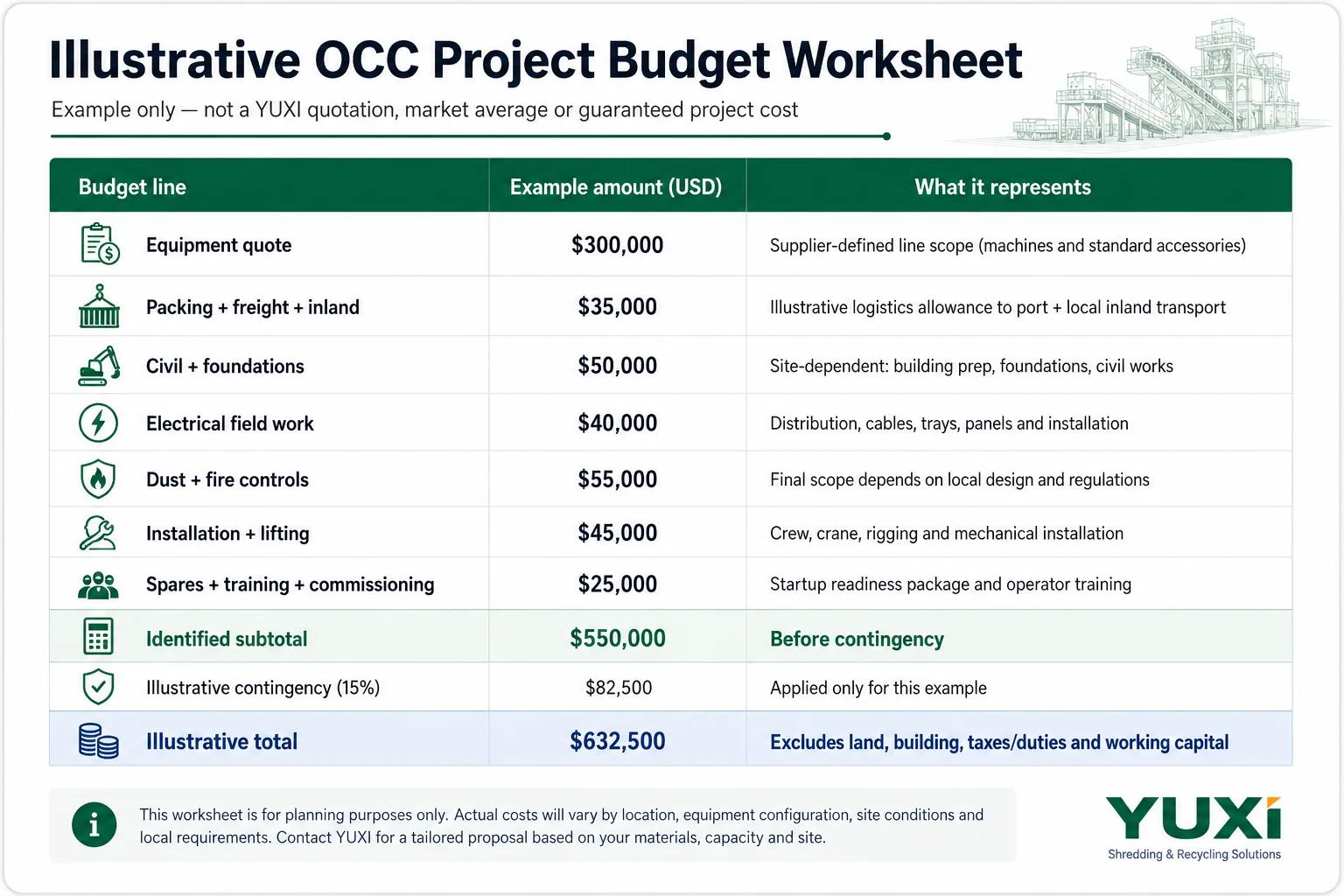
| Illustrative budget item | Example value | Comment |
|---|---|---|
| Equipment package | $300,000 | Placeholder supplier scope |
| Packing, freight and inland logistics | $35,000 | Placeholder route allowance |
| Civil and foundations | $50,000 | Site-specific placeholder |
| Electrical field installation | $40,000 | Distribution and field work |
| Dust and fire controls | $55,000 | Placeholder only; local design governs |
| Installation and lifting | $45,000 | Mechanical erection allowance |
| Spares, training and commissioning | $25,000 | Startup allowance |
| Identified subtotal | $550,000 | Before contingency |
| Illustrative contingency at 15% | $82,500 | Used only to demonstrate the calculation |
| Illustrative project total | $632,500 | Still excludes land, a new building, taxes/duties and working capital unless separately added |
The useful result is not “an OCC line costs $632,500.” It does not. The useful result is the structure: a $300,000 equipment decision becomes a larger capital decision once the site scope is exposed. Change the feed, country, building or process modules and the entire worksheet changes.
How to Compare OCC Plant Quotations on Equal Scope
A quotation comparison should be a matrix, not three totals in a spreadsheet. The most common “cheap quote” problem is not a lower price for the same plant. It is a shorter equipment list or a larger owner-supplied boundary.
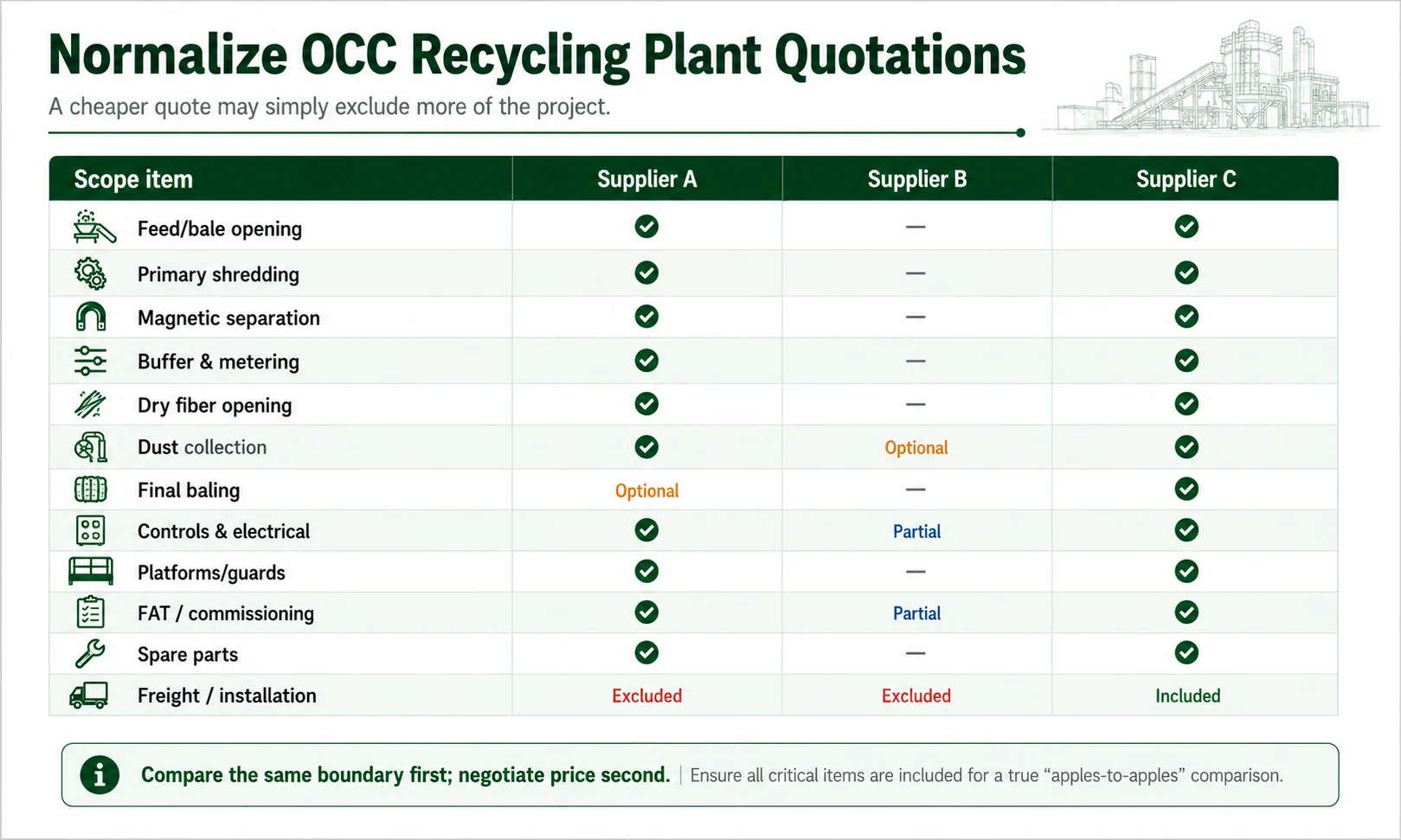
| Normalize this item | Supplier questions |
|---|---|
| Feed boundary | Loose cardboard, opened bales or wired bales? Who removes wire and large contaminants? |
| Output boundary | Shredded board, fiber-rich material, loose discharge or tied transport bales? |
| Capacity basis | Gross incoming mass, accepted feed or final product? Continuous test duration? |
| Conveying | Are all interconnecting conveyors, hoppers and supports included? |
| Metal protection | Is magnetic separation included and where is it installed? |
| Dust scope | Pickup points, ducts, fan, collector, supports and controls—or collector only? |
| Electrical | Machine wiring only, central panel, MCC, field cable, VFDs, transformer? |
| Safety | Guards, access platforms, emergency stops and required local interfaces? |
| Testing | FAT with representative material? SAT and acceptance criteria? |
| Documentation | Layouts, load data, electrical drawings, manuals and spare-parts list? |
| Commercial delivery | Incoterm, packing, freight, insurance, unloading and installation boundaries? |
| After-sales scope | Commissioning days, training, remote support and chargeable extensions? |
When the Lowest Equipment Price Can Increase Total Cost
A missing buffer creates a production bottleneck
A supplier removes the buffer hopper to lower the purchase price. On site, bales arrive in slugs, the fiber opener alternates between overload and starvation, and the owner later adds a hopper, steelwork and control changes under shutdown conditions. The retrofit is usually harder than including the function in the first layout.
Dust collection is treated as a future option
The process starts with open transfer points because the collector was outside the machine quote. Later, the site discovers that duct routes, structural supports, housekeeping access and fire controls need to be integrated around equipment that is already installed. The missing package was not “saved”; it was delayed.
Local electrical work is underestimated
A line quote includes a control cabinet, so the capital sheet shows “electrical included.” The owner later funds a transformer upgrade, MCC feeder, hundreds of meters of field cable, cable tray and contractor terminations. The supplier did include electrical—just not the same electrical boundary the budget assumed.
The answer is not to buy the most expensive quote. It is to compare the same finished project.
What to Send for a Useful Budgetary OCC Plant Quotation
A credible budget begins with real material. The YUXI OCC solution asks buyers to provide representative photos or samples, throughput, loose or baled feed form, bale dimensions, moisture and contaminants, required output condition, workshop size, local voltage and downstream use. Those inputs should also drive the cost model.
- Representative feed photos, video and—where practical—sample material
- OCC grade/source mix and normal versus difficult lots
- Loose or baled feed; bale dimensions, weight and wire condition
- Moisture range and recurring contaminants
- Required sustained hourly or daily output
- Required handoff product: loose, opened fiber-rich material or bales
- Available building footprint, clear height and floor constraints
- Local voltage/frequency and available electrical capacity
- Dust/fire design requirements known at the site
- Destination country, port preference and installation responsibility
- Required FAT/SAT, training, spare parts and documentation
With that information, a supplier can separate the machinery price from the project scope instead of hiding uncertainty inside one attractive headline number.
Build an OCC Project Budget From the Real Feed
Send YUXI your OCC material condition, bale data, target output, plant layout and destination. The quotation can then separate equipment scope, optional modules and project interfaces so your internal budget is based on a defined process rather than a generic online price.
OCC Recycling Plant Cost FAQ
How much does an OCC recycling plant cost?
There is no reliable universal price because “OCC recycling plant” can mean a baler, a shredding front end, a dry fiber-recovery line or a wet paper-mill stock-preparation system. Define the feed, required output, throughput and project boundary first, then compare supplier quotations on the same scope.
What is the difference between equipment price and total project cost?
Equipment price covers only the supplier-defined machinery and controls. Total project cost can also include packing, freight, duties and taxes where applicable, civil work, electrical distribution, ducting, dust and fire controls, installation, lifting, engineering, commissioning, spares, contingency and startup working capital.
Why do OCC recycling plant quotations vary so much?
Quotations may cover different process boundaries. One may include only a shredder and conveyor while another includes bale opening, magnetic separation, buffering, dry fiber opening, dust collection, baling, controls, platforms and commissioning. Material condition and local site requirements also change the design.
Does higher throughput always mean a proportionally higher price?
No. Capacity affects machine size, conveying, electrical demand and collection equipment, but project cost does not scale in a simple one-to-one ratio. A stable high-throughput line may also require larger buffers, dust handling, building access and utilities.
Should I use a cost per ton of annual capacity to budget an OCC plant?
Only as a rough screening metric after the process boundary is fixed. Cost per annual ton can be misleading when two plants produce different outputs or include different civil, utility, installation and environmental scopes.
What costs are commonly excluded from an equipment quotation?
Common exclusions include local foundations, building modifications, incoming power upgrades, field cable, compressed air, ductwork, fire protection, cranes, forklifts, installation labor, freight beyond the quoted Incoterm, permits, taxes or duties, test material, reject disposal, spares and working capital.
What information does YUXI need for a budgetary OCC line quotation?
Provide representative material photos or samples, loose or baled feed form, bale dimensions, moisture and contamination, required hourly or daily throughput, target output condition, downstream use, workshop dimensions, local voltage and destination country.
Is the example budget in this guide a YUXI quote?
No. The worksheet is a deliberately hypothetical calculation used to show how costs can accumulate from an equipment quote to a total project budget. It is not a YUXI offer, not a market average and not a prediction for a specific site.
References and Source Notes
- American Forest & Paper Association (AF&PA), “How Much Cardboard Is Recycled?” Reports a 2024 U.S. cardboard recycling rate of 69–74% and more than 33 million tons recycled.
- U.S. Environmental Protection Agency, U.S. Recycling Infrastructure Assessment. The national estimate is broad recycling-system infrastructure, not an OCC-line price benchmark.
- U.S. Occupational Safety and Health Administration, Recycling: Paper, covering machinery, crushing and combustible-material hazards.
- U.S. Occupational Safety and Health Administration, Combustible Dust: An Explosion Hazard. OSHA lists paper and pulp among materials that can present combustible-dust hazards in finely divided form.
- AACE International, Skills & Knowledge of Cost Engineering, 6th Ed. Equipment-factored estimating illustrates why non-equipment installation scope must be included when estimating total installed cost; no generic AACE factor is applied to the OCC example in this article.
- Parason, Paper Recycling Machine: The Complete Recycled-Fibre Line for Paper Mills, updated May 30, 2026. Used only to illustrate that many public “paper recycling plant cost” results describe wet stock preparation and paper-mill scope.
- World Paper Mill, Paper Recycling Plant Cost in India 2026. Used as a market-context example of an integrated wet-process project scope; figures are not treated as YUXI dry-line pricing.