




 Request Quote



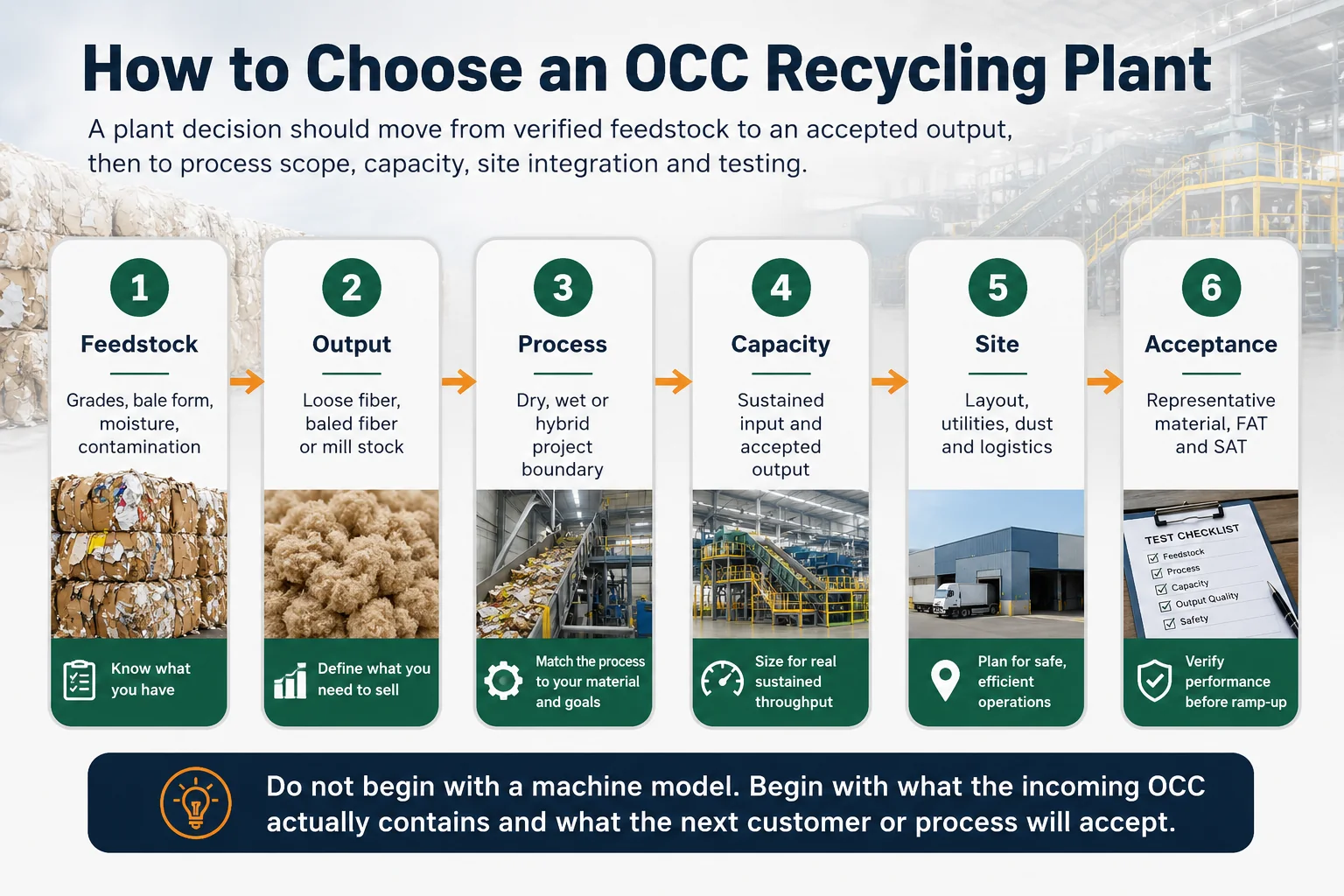
An OCC recycling plant should not be selected from a machine catalogue alone. The useful starting point is the material arriving at the gate, the product required at the handoff point, and the operating conditions between those two ends.
That sequence sounds obvious, but it is often reversed. A buyer receives three proposals carrying the same label—“OCC recycling plant”—yet one is mainly a baler system, one is a shredding and sorting front end, and one is a complete dry fiber-recovery line. Their prices cannot be compared until the work performed and the output condition are normalized.
1. Define the Product That Must Leave the Plant
The phrase OCC recycling plant does not describe one universal factory. It can refer to a collection and baling operation, a dry preprocessing line, a dry fiber-opening system, or a paper-mill stock-preparation plant. Those boundaries produce different materials and require different utilities, controls and acceptance tests.
| Required handoff product | What the plant mainly does | What it does not automatically do |
|---|---|---|
| Sorted, compacted OCC bales | Receiving, manual or mechanical sorting, consolidation and baling | It does not substantially open fiber structure or prepare paper-machine stock. |
| Size-reduced cardboard | Controlled feeding and shredding for volume reduction, metering or downstream separation | A shredder alone does not remove all contaminants or make recovered fiber. |
| Loose or baled dry fiber-rich material | Opening, size reduction, exposed-metal removal, metering, mechanical dry fiber opening, air handling and collection | It is not finished paper and normally is not pumpable paper-machine stock. |
| Wet, cleaned paper stock | Hydrapulping, screening, cleaning, stock conditioning and water-loop management | This is a paper-mill process boundary, not simply an added shredder or baler. |
If the buyer has not written an output specification, equipment selection is premature. “Reusable fiber” is still too broad. Ask whether the receiving customer wants loose material, bales, a maximum package size, a defined moisture basis, controlled metal and film content, a certain fiber-opening condition, or a furnish ready for further wet processing.
A separate site article compares dry OCC fiber recovery with wet stock preparation. The practical point here is simpler: decide where your project ends.
2. Build a Representative OCC Feed Profile
OCC is a traded recovered-paper category, but plant design needs more detail than a grade name. ReMA’s paper specifications provide a common grade language for recovered paper, including OCC, DS OCC and DLK. Final moisture, contamination and acceptance limits should still be written into the buyer–seller contract.[1] Your plant must be designed around the material actually received under those agreements.
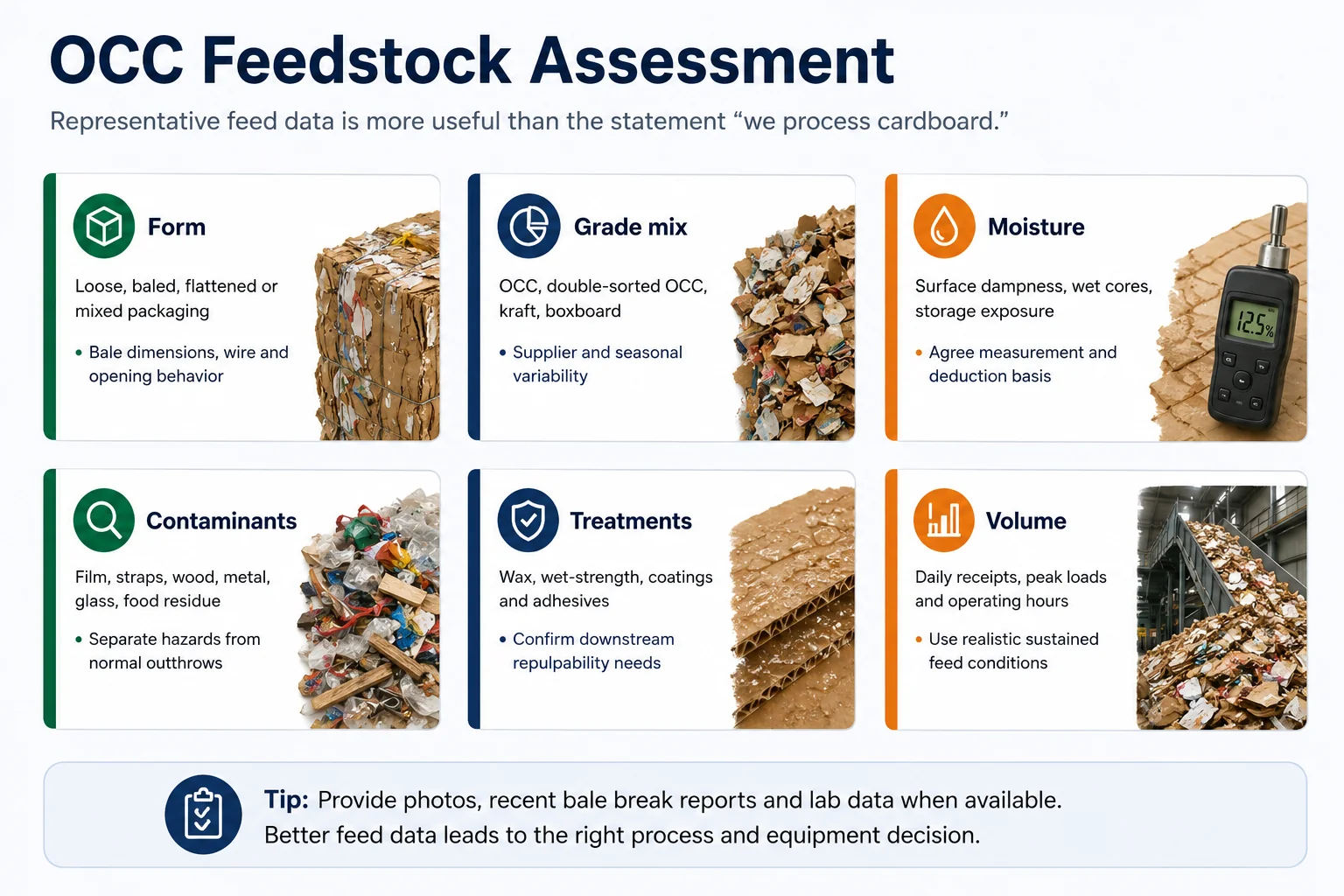
Start with at least several representative lots from normal suppliers and difficult suppliers. Record the material form, bale dimensions, approximate bale density, wire or strap type, moisture pattern, wrong-paper grades, plastic film, wood, metal, glass, food residue, coatings, adhesives and any recurring hard object. Do not average away the worst recurring condition. A line that runs clean distribution-center OCC may behave very differently when wet retail bales or mixed commercial packaging arrive.
Describe the bale, not only the paper
Bale condition controls receiving labor and the first equipment stage. Dense wired bales may need a controlled opening station, safe wire handling and enough floor area to expose the material before feeding. Loose OCC may need a different hopper and conveyor geometry. Broken or irregular bales can create surges that look like a shredder problem but are actually a receiving and metering problem.
Separate moisture from contamination
Moisture changes paid weight, storage behavior, dust generation, fiber condition and downstream acceptance. It should not be hidden inside a single “contamination percentage.” Agree how moisture is measured, where samples are taken, how wet cores are handled, and whether the commercial deduction is based on total load, affected bales or a laboratory result.
Identify coated and treated corrugated
Wax, wet-strength chemistry, barrier coatings and heavy adhesives may change repulpability and reject generation. AF&PA and the Fibre Box Association maintain a voluntary standard with test protocols for evaluating the repulpability and recyclability of coated or treated corrugated board and OCC equivalents.[2] A dry line cannot prove that every unknown treatment will behave acceptably in a receiving paper mill. That decision belongs in the feed specification and downstream qualification plan.
3. Choose the Correct Project Boundary: Dry, Wet or Hybrid
The correct route follows the required handoff product.
Dry preprocessing or dry fiber recovery
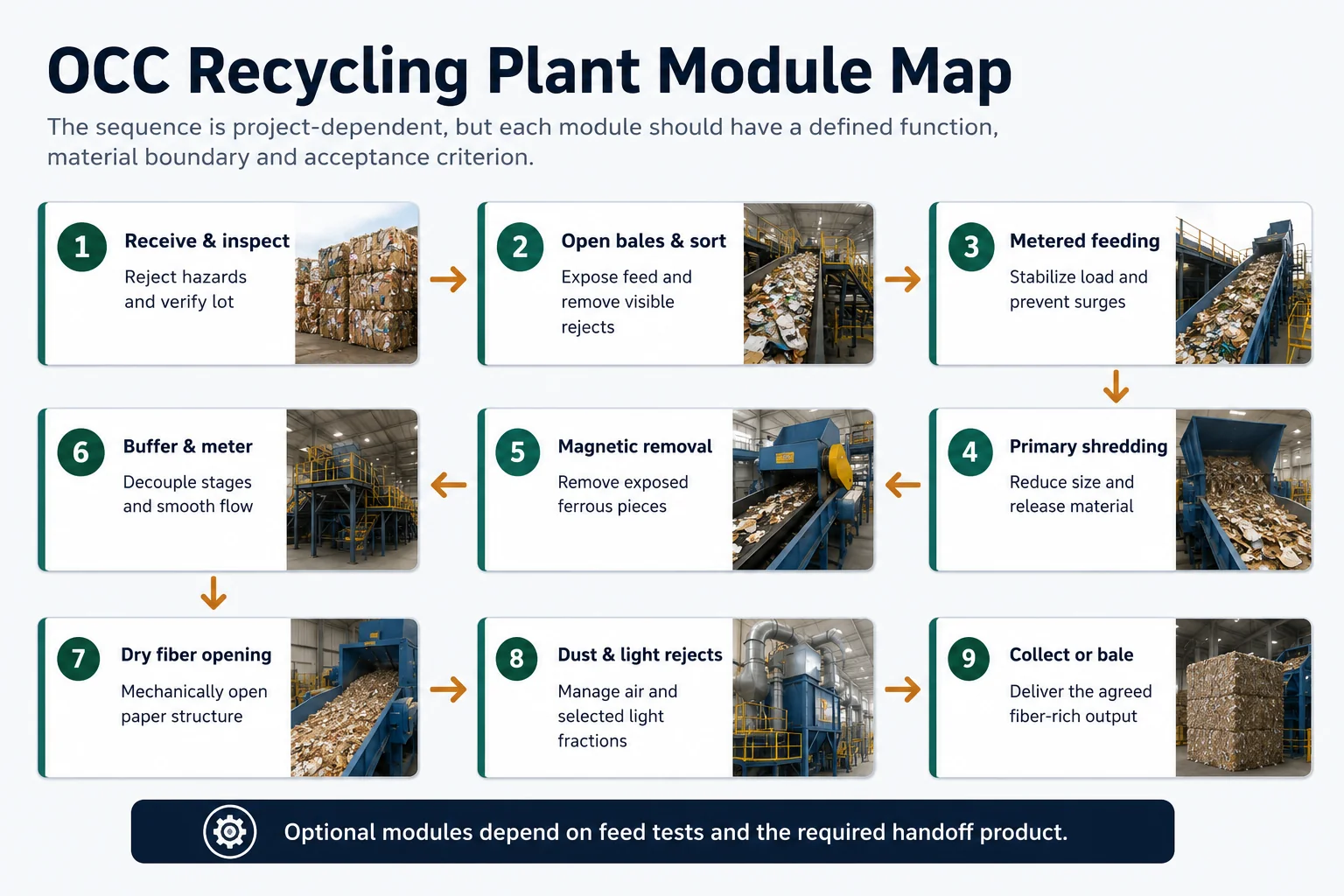
A dry line can receive, inspect, open bales, meter feed, reduce size, remove exposed ferrous pieces, mechanically open the paper structure, manage dust and selected light rejects, collect the output and optionally bale it. This boundary is useful when the site needs a transportable fiber-rich product or a controlled feed for another facility.
Wet stock preparation
AF&PA’s recycling process separates collection and sorting from the paper-mill stages in which recovered paper is mixed with water, pulped, screened, cleaned and formed into new paper.[3] A wet stock-preparation plant therefore brings pumps, chests, screens, cleaners, water treatment and mill-specific quality controls into the scope.
Hybrid route
A hybrid project may use dry receiving and preprocessing at one location, then send the prepared material to a paper mill for wet pulping and cleaning. This can improve handling and logistics without pretending that dry opening replaces mill stock preparation.
The published YUXI OCC paper dry pulping and cardboard recycling line is a dry-processing solution. Its public process logic includes inspection and bale opening, controlled feeding, primary shredding, magnetic separation, buffering and metering, mechanical dry fiber opening, dust and light-reject handling, collection and optional baling. The direct output is fiber-rich dry material rather than finished paper. That boundary should remain explicit in the quotation and acceptance test.
4. Size the Complete Plant on Sustained Flow
Capacity is one of the easiest numbers to misunderstand. A shredder may process a short test batch quickly, yet the complete plant may be limited by bale opening, bridge formation, hand sorting, dust-air balance, magnetic presentation, buffer discharge, fiber collection or baling. A complete plant rating should describe the operating boundary, not the fastest isolated machine.
| Capacity term | What to ask the supplier to state |
|---|---|
| Gross inbound OCC | Total material delivered to the receiving area, including moisture and later rejects. |
| Accepted input | Material released to the line after receiving inspection, rejected loads and pre-removal of large hazards. |
| Sustained feed rate | Rate maintained over an agreed test period with representative material and normal operator intervention. |
| Reject rate | Measured mass of removed wire, metal, film, wrong grades, dust and other rejects, with a defined moisture basis. |
| Accepted product | Usable loose or baled fiber-rich output that meets the written handoff specification. |
| Operating availability | Planned production time after agreed breaks, cleaning, maintenance and normal stoppages are defined. |
Do not convert a monthly target into a tons-per-hour request without checking receiving days, shift length, truck arrival patterns, changeovers, cleaning time and downstream storage. Plants commonly need surge capacity because inbound trucks arrive in peaks while the process wants a steady layer.
The most useful capacity calculation works backwards from saleable or usable output. Estimate the accepted yield range from representative tests, define realistic operating availability, then calculate the sustained feed requirement. Do not insert an assumed yield from another plant. Moisture, grade mix, coatings, pre-sorting and the output specification can move it materially.
5. Match Each Process Module to a Verified Function
A complete line is a chain of functions. Each module should solve a specific material problem and hand the material to the next stage in a controlled condition. Buying every optional machine is not good engineering; neither is deleting the buffer, access platform or dust system because it does not appear to make product.
| Module | Primary function | Selection questions |
|---|---|---|
| Receiving and inspection | Identify load, condition and hazards before material disappears into the process. | How are lots traced, sampled, quarantined, downgraded and rejected? |
| Bale opening and sorting | Release compressed material and create access for visible reject removal. | What bale sizes, wire conditions and operator access are expected? |
| Feeding conveyor | Present an even, controllable layer to the first machine. | Can it handle loose sheets, broken bales and low bulk density without surging? |
| Primary shredder | Reduce bulky OCC and open the stream for downstream handling. | What maximum feed condition is allowed, and what hard objects are excluded? |
| Magnetic separator | Remove exposed ferrous pieces after the material is opened. | Is the material thinly and evenly presented, and where does the ferrous reject go? |
| Buffer and metering | Decouple upstream surges from the fiber-opening stage. | How is bridging detected, and how is discharge controlled? |
| Dry fiber opener | Mechanically open paper structure to the agreed dry output condition. | What feed size, moisture and contamination limits apply? |
| Dust and light-reject system | Capture airborne material and manage selected light fractions. | Who sizes the airflow, ducting, filtration, explosion/fire measures and make-up air? |
| Collection or baling | Deliver a transportable, measurable product. | What output form, bale specification, storage method and load-out system are required? |
| Controls and interlocks | Coordinate starts, stops, overload response and safe access. | Are upstream/downstream interlocks, alarm history, isolation points and manual recovery modes defined? |
Buyers who only need volume reduction or shipment preparation may not need a full fiber-recovery line. The related industrial cardboard recycling machine guide separates the roles of a baler, a shredder and a complete line. That decision should be settled before a full-plant RFQ is issued.
6. Set Contamination and Output Criteria Before Selecting Equipment
Equipment cannot turn an uncontrolled inbound specification into a guaranteed product by itself. Receiving rules, supplier quality and process equipment have to work together.
Large visible hazards should be removed while they can still be identified. A magnetic separator can remove exposed ferrous pieces when the material is properly presented, but it cannot remove plastic film, moisture, glass, wood, wax, adhesives or non-ferrous hard objects. Air separation may remove selected light fractions, yet its performance depends on particle size, shape, moisture, loading and airflow.
Write an output specification that can be sampled
- Output form: loose, containerized or baled
- Measurement basis: as-received mass, dry mass or another agreed basis
- Allowed ferrous and non-ferrous hard objects
- Allowed film, straps, wood, glass and wrong-paper grades
- Moisture range and sampling method
- Fiber-opening or particle-condition description
- Maximum oversize pieces or unopened bundles
- Bulk density or bale dimensions when logistics depend on them
- Sampling frequency, sample mass, test method and dispute procedure
A visual sample can help explain the target, but it should not replace measurable criteria. “Looks clean” is difficult to defend during commissioning. The acceptance method should also state whether contamination is measured in the product, in the reject streams, or through a complete mass balance.
7. Plan Layout, Utilities, Dust and Safety as One System
An OCC plant is not only the row of machines shown on a general arrangement drawing. It includes truck access, receiving storage, quarantine, bale stacks, wire handling, inspection space, sorting access, forklift routes, process equipment, maintenance clearances, reject storage, finished-product storage, ducting, electrical rooms and fire-protection interfaces.
Layout around material movement
Keep uncontrolled receiving material separate from accepted feed and finished product. Provide a clear route for rejected loads and isolated bales. Avoid forcing forklifts to cross operator platforms or maintenance zones. Check building clear height for conveyors, separators, dust ducts and lifting equipment—not only machine height.
Confirm utilities at the project boundary
Ask for installed electrical load, expected operating demand, motor-starting method, cable and panel scope, compressed-air requirements, dust-system airflow, make-up air, lighting, drainage, heating or freeze protection where relevant, and data or remote-support requirements. The supplier should identify which loads are estimates and which are confirmed after final design.
Treat dust as an engineering input
Paper handling and size reduction can generate combustible fibrous dust. OSHA identifies combustible materials, moving machinery, unexpected startup and crushing hazards in paper recycling operations.[4] The final dust and fire strategy must be site-specific and coordinated with the local authority, insurer and qualified safety professionals. It may affect enclosure, extraction points, housekeeping access, duct routing, detection, isolation, venting or suppression, and the placement of collected dust.
8. Review Automation, Maintenance and Spare Parts Together
Automation should stabilize material flow and make faults visible. It cannot compensate for unknown feedstock, a hopper that bridges, or a dust system that was sized without the final process.
Useful control functions
For a coordinated line, review start-up and shutdown sequences, upstream/downstream interlocks, overload response, variable-speed feed control, high-level and low-level detection, anti-bridging logic, belt and rotation monitoring, alarm history, emergency-stop zoning, manual recovery modes and maintenance isolation. Ask what happens after a downstream trip. A good answer describes how upstream feed is stopped before material piles into a blocked transfer.
Maintenance access is a capacity feature
Knife inspection, conveyor tracking, bearing lubrication, magnet cleaning, dust-filter service and removal of wrapped film all consume time. A machine that is difficult to reach will be serviced late. Check lifting points, access doors, platform width, removable guards, pull-out space, component weight, required tools and whether routine cleaning can be done without opening the main process.
Ask for a line-level spare-parts plan
Separate commissioning spares, operating consumables, recommended one-year spares and strategic long-lead items. The list should include part numbers or drawing references, expected inspection intervals, storage requirements and replacement procedures. Do not accept a single “wear parts package” line item without knowing which machine and quantity it covers.
9. Normalize OCC Plant Quotations Before Comparing Price
Two proposals are comparable only when they include the same project boundary. One supplier may include conveyors, structures, dust collection, controls and commissioning; another may quote the shredder and baler only. The lower number is not automatically the lower delivered cost.
| Quotation category | Items to normalize |
|---|---|
| Process equipment | Machine list, material of construction where verified, feeding limits, included separators, collection and reject handling |
| Structures and access | Platforms, stairs, handrails, guards, supports, transfer chutes and maintenance lifting provisions |
| Controls | Main panels, local boxes, PLC/HMI scope, sensors, cables, field wiring, interlocks and software documentation |
| Dust and air | Pickup points, fans, ducts, filters, airlocks, collected-dust handling, fire/explosion interfaces and make-up air |
| Site work | Foundations, building changes, electrical distribution, compressed air, crane work, permits, fire system and local labor |
| Logistics | Export packing, containers, freight, insurance, port charges, inland delivery, duties and unloading |
| Services | Installation supervision, commissioning, training, travel, accommodation, test material and issue-closure period |
| Documentation | GA drawings, loads, electrical lists, manuals, spare-parts lists, maintenance schedules and as-built documents |
10. Write the FAT and SAT Before the Purchase Order
A factory acceptance test is not a demonstration video. It is an agreed test of the contracted scope under defined conditions. A site acceptance test confirms the installed plant after foundations, utilities, ducting, controls and downstream interfaces are complete.
Define the test material
State the OCC grade mix, loose or baled form, bale range, wire condition, moisture range, normal contamination and agreed difficult condition. Keep retained samples, load records and photographs. If the supplier cannot test the exact commercial material, identify the substitution and the remaining site risk.
Define the measurement method
Specify test duration, warm-up, permitted stoppages, feed weighing, product weighing, reject weighing, moisture sampling, contamination sampling, power measurement if required, staffing and reporting. Short bursts can hide bridging and filter loading. A meaningful test runs long enough to reveal the interaction between stages.
Define pass/fail criteria
- Sustained accepted-input rate under the agreed feed condition
- Accepted output mass and specification
- Reject streams and mass-balance reconciliation
- Oversize, unopened bundles and visible contamination
- Stable feeding and buffer behavior
- Dust capture at agreed observation points
- Alarm, interlock, emergency-stop and restart checks
- Noise or utility measurements only where the contract defines the method and boundary
- Documentation, training and punch-list closure
Do not use a universal purity or recovery guarantee copied from another feedstock. The pass criteria should come from the representative material test and the downstream buyer’s acceptance standard.
11. Common OCC Plant Buying Mistakes
Buying a headline machine instead of a process
A large shredder cannot fix unstable receiving, poor sorting access, a blocked transfer, undersized dust collection or an output baler that cannot keep up.
Using one clean bale as the design basis
Clean test material produces a clean demonstration. It does not show how the line reacts to wet cores, film wrapping, broken bales or supplier variability.
Comparing capacity without a mass basis
Gross inbound, accepted input, dry fiber and baled output are different numbers. Put all proposals on the same basis.
Treating dust control as an optional accessory
Dust changes equipment layout, airflow, building pressure, cleaning labor, fire strategy and sometimes the permitted operating condition. It should be designed with the process.
Assuming dry output is paper-machine stock
Mechanical dry opening can create a useful fiber-rich material. Wet pulping, screening, cleaning and stock conditioning remain separate functions when a paper mill requires pumpable stock.
Leaving reject handling off the drawing
Wire, metal, film, wood, dust and nonconforming paper need bins, access, weighing, storage and disposal routes. A plant that only draws the good product is incomplete.
Signing before the acceptance method is written
Vague promises become difficult to enforce after the equipment is built. Define the test lot, duration, measurements and remedies while the technical scope is still negotiable.
12. OCC Recycling Plant RFQ and Supplier Evaluation Checklist
Use one RFQ form for every supplier. Your internal team can weight the categories according to its own priorities, but the evidence requested should remain consistent.
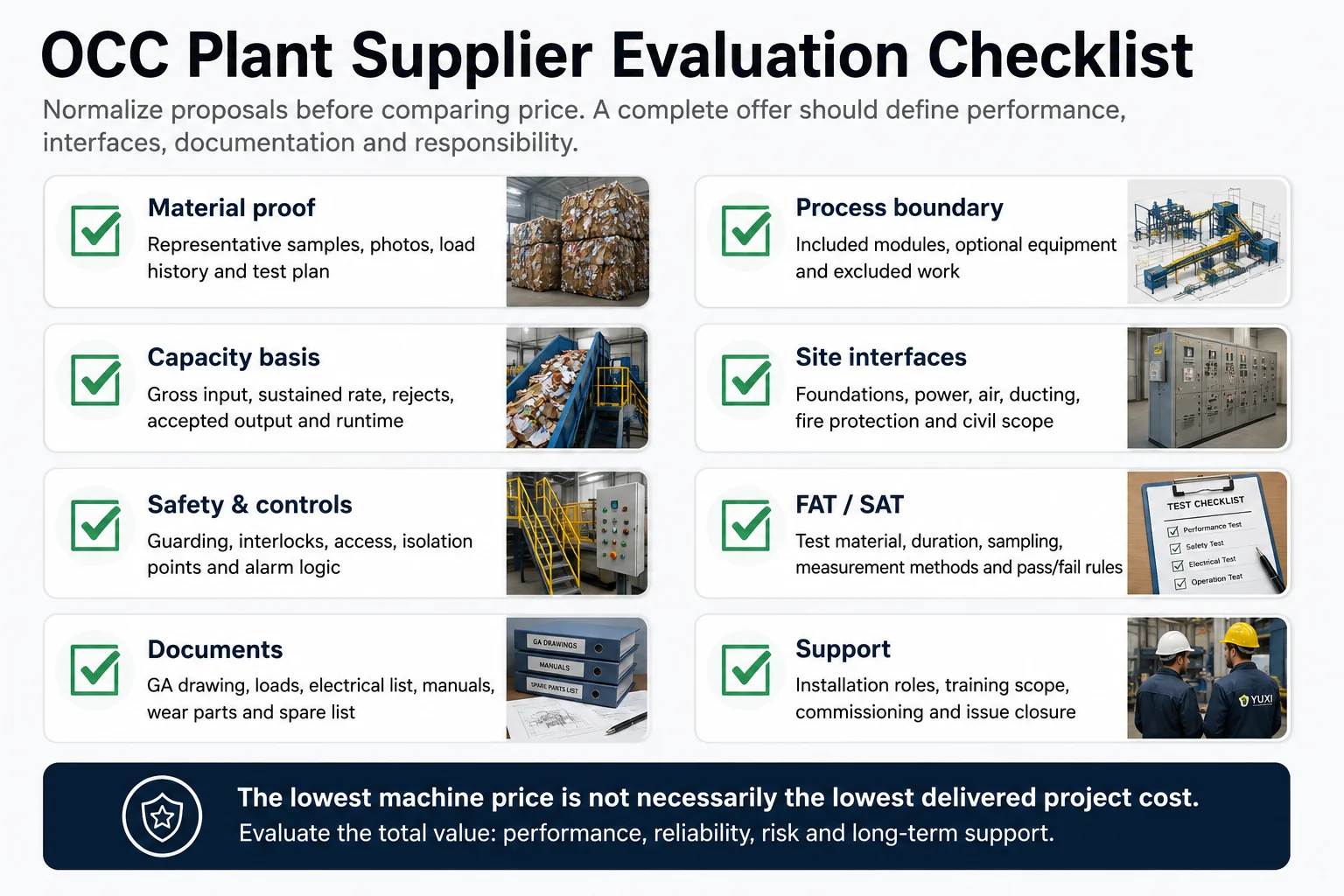
| RFQ section | Information to provide or request |
|---|---|
| Material | Photos, videos, grade mix, supplier mix, loose/baled condition, bale dimensions, wire, moisture, contamination and exclusions |
| Volume | Daily and monthly receipts, peak truck schedule, shifts, operating hours and seasonal variation |
| Required output | Loose or baled form, downstream customer, moisture basis, contamination limits, fiber condition and packaging |
| Process boundary | Dry, wet or hybrid; upstream receiving work; downstream storage, transport or mill interface |
| Capacity basis | Gross input, accepted input, sustained rate, accepted output, rejects, availability and measurement method |
| Site | Workshop plan, clear height, floor loads, truck and forklift routes, storage, climate and expansion area |
| Utilities | Voltage and frequency, available power, compressed air, ventilation, fire-water interface, drainage and communications |
| Safety | Guarding, platforms, isolation points, emergency stops, interlocks, dust/fire responsibility and local standards |
| Testing | Representative material, FAT/SAT duration, sampling, weighing, pass/fail criteria and correction procedure |
| Commercial scope | Incoterm, packing, freight, installation, commissioning, training, spares, warranty terms and exclusions |
13. When the YUXI Dry OCC Line Is a Practical Fit
The YUXI solution is relevant when a project needs a coordinated dry route from loose or baled OCC through controlled feeding, primary size reduction, exposed-ferrous removal, buffering, mechanical fiber opening, dust handling, collection and optional baling. It is particularly important that the buyer accepts the direct product as dry fiber-rich material for transport, sale or further processing.
It is not a substitute for a complete wet paper-mill stock-preparation system. It should also not be specified from a clean brochure sample when the commercial feed includes wet bales, treated corrugated or recurring hard contaminants. Final configuration, capacity and performance criteria require representative material data and a test plan.
When we review an OCC project, the most useful information is not a preferred machine model. It is the inbound material record, the required handoff product, the available building and utilities, and the commercial rule for accepting or rejecting the output. Those facts allow the line to be configured around a real process instead of an assumed one.
Request an OCC Recycling Plant Proposal
Send representative material photos or videos, bale details, moisture and contamination observations, daily volume, required output, workshop drawings, utilities and destination country. The proposal can then define the process boundary, included modules and the material test required before final selection.
Frequently Asked Questions
What is the first decision when choosing an OCC recycling plant?
Define the product that must leave the plant and who will accept it. A line that makes transportable dry fiber-rich material is not the same project as a paper-mill stock-preparation system that makes pumpable cleaned stock.
Does every OCC plant need a bale opener?
No. Loose feed may not need one, while dense wired bales often need controlled opening and safe wire management. The decision depends on bale form, size, density, wire condition, required sorting access and feeding method.
Can a magnetic separator remove all OCC contamination?
No. It removes exposed ferrous pieces under suitable presentation conditions. It does not remove moisture, plastic film, coatings, adhesives, glass, wood or non-ferrous hard objects.
What material should be used for a factory acceptance test?
Use representative normal and difficult feed lots that reflect the agreed bale form, moisture, contamination and grade mix. The contract should state quantity, test duration, sampling, measurement basis, permitted interruptions and pass/fail criteria.
What costs are often missing from an OCC plant quotation?
Common omissions include freight, duties, foundations, buildings, electrical distribution, compressed air, ducting, dust collection, fire protection, cranes, installation labor, testing material, reject disposal, spare parts and local compliance work.
What information should be sent to YUXI before requesting a proposal?
Send material photos and videos, grades and supplier mix, loose or baled condition, bale dimensions and wire, moisture and contamination observations, daily volume, operating hours, required output, downstream use, workshop drawings, utilities and destination country.
References and Source Notes
- Recycled Materials Association, “Paper Stock Specifications.” Used for the role of trade specifications and grade terminology; buyer–seller agreements remain controlling.
- American Forest & Paper Association and Fibre Box Association, “Voluntary Standard for Coated or Treated Corrugated.” Used for the repulpability and recyclability testing boundary for treated corrugated.
- American Forest & Paper Association, “Paper Recycling Process.” Used to distinguish collection and sorting from paper-mill pulping, screening and cleaning.
- Occupational Safety and Health Administration, “Green Job Hazards: Recycling—Paper.” Used for paper-recycling machinery, crushing, unexpected-startup and combustible-material hazards.