




 Request Quote



The OCC bale that looks easiest to approve can be the one that triggers a dispute later. Its outer faces are dry and brown, the wires look intact, and the supplier has used the correct grade name. Once the bale is opened, however, the core may contain film, boxboard, wet layers, food residue, wood or material from a different collection stream.
Incoming inspection is therefore not a quick visual check at the trailer door. It is a controlled decision process. The receiving team must determine whether the load matches the purchase agreement, whether it can be unloaded and handled safely, whether the material should enter the normal process, and what evidence is needed if the buyer requests an adjustment or rejects the shipment.
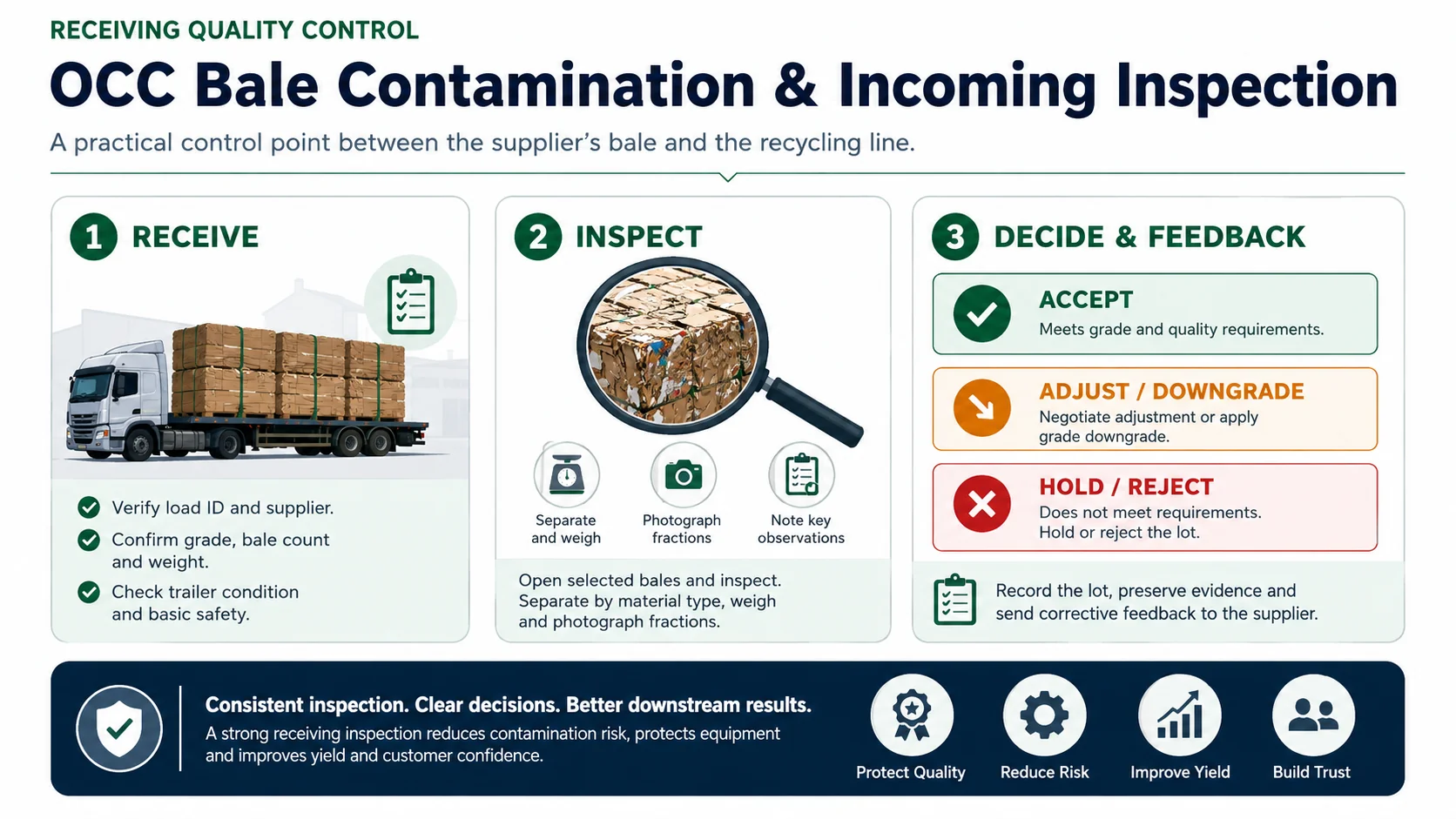
What Should an OCC Incoming Inspection Accomplish?
An OCC bale incoming inspection should verify the contracted grade and packing condition, identify moisture and unacceptable material, expose contamination hidden inside selected bales, and create enough evidence to accept, adjust, downgrade, quarantine or reject the load. The governing purchase agreement should define the grade, moisture basis, prohibited materials, inspection method, sample plan, notification window and commercial response.
Do not use a shredder as the inspection tool. Large contaminants are easier to recognize and remove before they are fragmented. Open and inspect representative bales first; only released material that meets the plant’s acceptance route should move to controlled feeding and downstream processing.
Incoming Inspection Must Produce a Decision, Not Just a Comment
“Some plastic was found” is an observation. It does not tell purchasing, production or the supplier what happens next. A receiving program needs a defined decision path. At minimum, the inspector should be able to answer five questions:
- Is the shipment the grade, supplier, purchase order and lot stated in the documents?
- Can the trailer, bales and wire be handled without exposing workers to an uncontrolled hazard?
- Does the opened material match the agreed paper composition and contamination limits?
- Should the material enter the normal line, a separate route, a quarantine area or a rejection process?
- What photographs, weights, samples and timestamps support the decision?
Production wants to know whether the feed will bridge, damage equipment or overwhelm reject handling. Quality wants a defensible sample and calculation. Purchasing needs a commercial response. The supplier needs specific corrective information rather than a general complaint.
We normally recommend a single lot record that follows the load from gate entry through final disposition. Separate handwritten notes, phone photographs and scale tickets tend to become disconnected when a claim is reviewed days later.
Write the Acceptance Rule Before the Truck Arrives
ReMA’s 2026 paper-stock guidelines state that the buyer–seller purchase or sales agreement is the governing transaction document. The guidelines also say deviations from a listed grade should be specified and agreed by both parties.[1] That principle should shape the receiving SOP. Inspectors should not be expected to invent a commercial rule while a trailer is waiting.
Minimum items for the purchase agreement or receiving specification
| Item | What to define | Why it matters at receiving |
|---|---|---|
| Grade and source | Current grade name, permitted sources and any buyer-specific exclusions | A label alone may hide a material stream that the plant does not accept. |
| Packing unit | Baled or loose, bale dimensions, approximate mass, wire or strap condition | Controls unloading, storage, opening method and sampling access. |
| Moisture | Limit, test method, sample location, calculation basis and adjustment rule | A surface reading and a wet core can lead to very different conclusions. |
| Outthrows | Wrong paper and treated paper that make the pack unsuitable for the agreed grade | These materials may still be paper but can reduce the value or usability of the furnish. |
| Prohibitives | Non-paper or damaging material and the allowed amount, if any | Some objects create wear, jams, contamination or equipment damage. |
| Zero-tolerance material | Immediate isolation and notification requirements | Hazardous, medical, food or harmful waste should not enter normal handling. |
| Inspection plan | Who may inspect, sample frequency, opened-bale method, photographs and retained samples | The result is difficult to defend if the method changes from one load to the next. |
| Disposition | Accept, adjustment, downgrade, diversion, hold, rejection and response times | Prevents an improvised decision from becoming a commercial dispute. |
The existing OCC 11, DS OCC 12 and DLK comparison covers the grade-origin and purchasing differences in more detail. This guide has a narrower purpose: how to verify the actual shipment that reaches the gate.
Classify OCC Contamination Before Choosing the Response
Receiving teams often place every unwanted item in one “contamination” bucket. That is convenient for a dashboard but weak for corrective action. The supplier cannot fix a moisture problem in the same way it fixes mixed paper, and a magnet cannot solve a film or wax problem. The inspection record should separate at least the following categories.
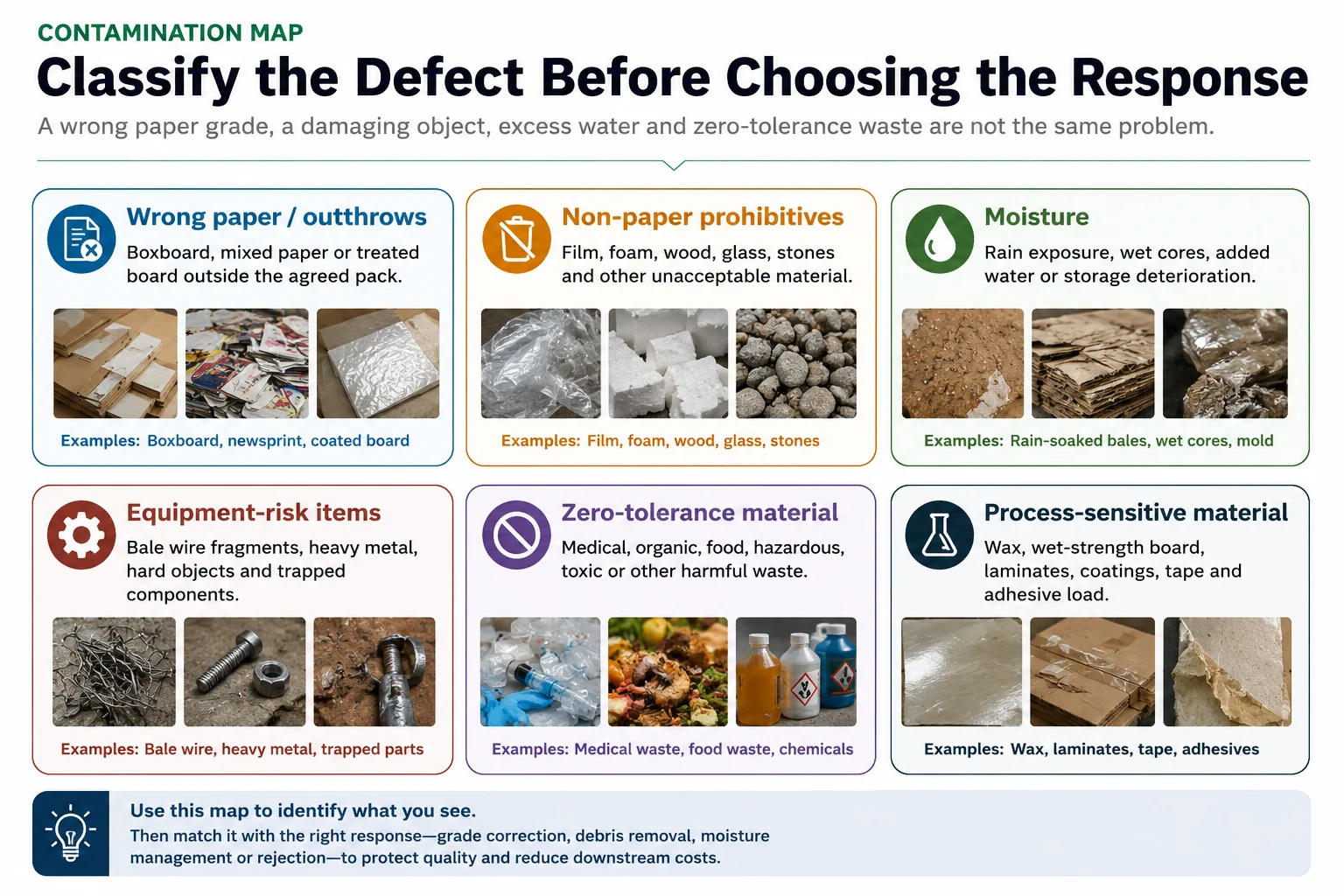
Wrong paper and outthrows
ReMA defines outthrows as papers that make a pack undesirable and unsuitable for use as the specified grade.[1] In an OCC load, this may include excessive boxboard, mixed office paper, paper tubes, coated or treated board, or another paper grade excluded by the contract. The material may be recyclable somewhere, but not necessarily in the buyer’s intended furnish.
Non-paper prohibitives
Film, foam, wood, glass, stones, textiles and similar items add weight without adding usable fiber. Some are visible during surface inspection; others collect in the bale core. ReMA’s definition also includes material that may damage equipment.[1] That makes classification more useful than appearance alone: a small dense metal object can create a greater operating risk than a larger sheet of light film.
Moisture and deterioration
Moisture can come from rain, outdoor storage, wet floors, process residue, deliberate wetting or biological deterioration. Record where it occurs. Uniformly damp board, wet outer faces and isolated saturated cores are different supplier and storage problems. Odor, heat, discoloration or loss of bale strength may indicate that the issue is no longer only a weight adjustment.
Process-sensitive paper products
Waxed, laminated, wet-strength, heavily coated or adhesive-rich packaging may look like ordinary corrugated material until it is opened. The acceptance decision should be based on the downstream process and buyer specification, not on color. A dry preparation plant can expose and separate some fractions, but it cannot guarantee that every coating or adhesive becomes harmless.
Wire, metal and hard objects
Bale wire is expected as packaging, but loose wire, cut wire fragments, heavy metal, stones or hard components can damage conveyors, cutters and fiber-opening equipment. Record packaging wire separately from unexpected metal contamination. The route for safe wire removal should be part of the receiving design.
Zero-tolerance material
ReMA describes zero-tolerance material as any amount of medical, organic, food, hazardous, poisonous, radioactive or toxic waste and other harmful substances or liquids.[1] A site procedure should define immediate stop, isolation, escalation and competent assessment. Do not continue opening the bale merely to complete a percentage calculation.
A Seven-Step OCC Receiving Inspection Workflow
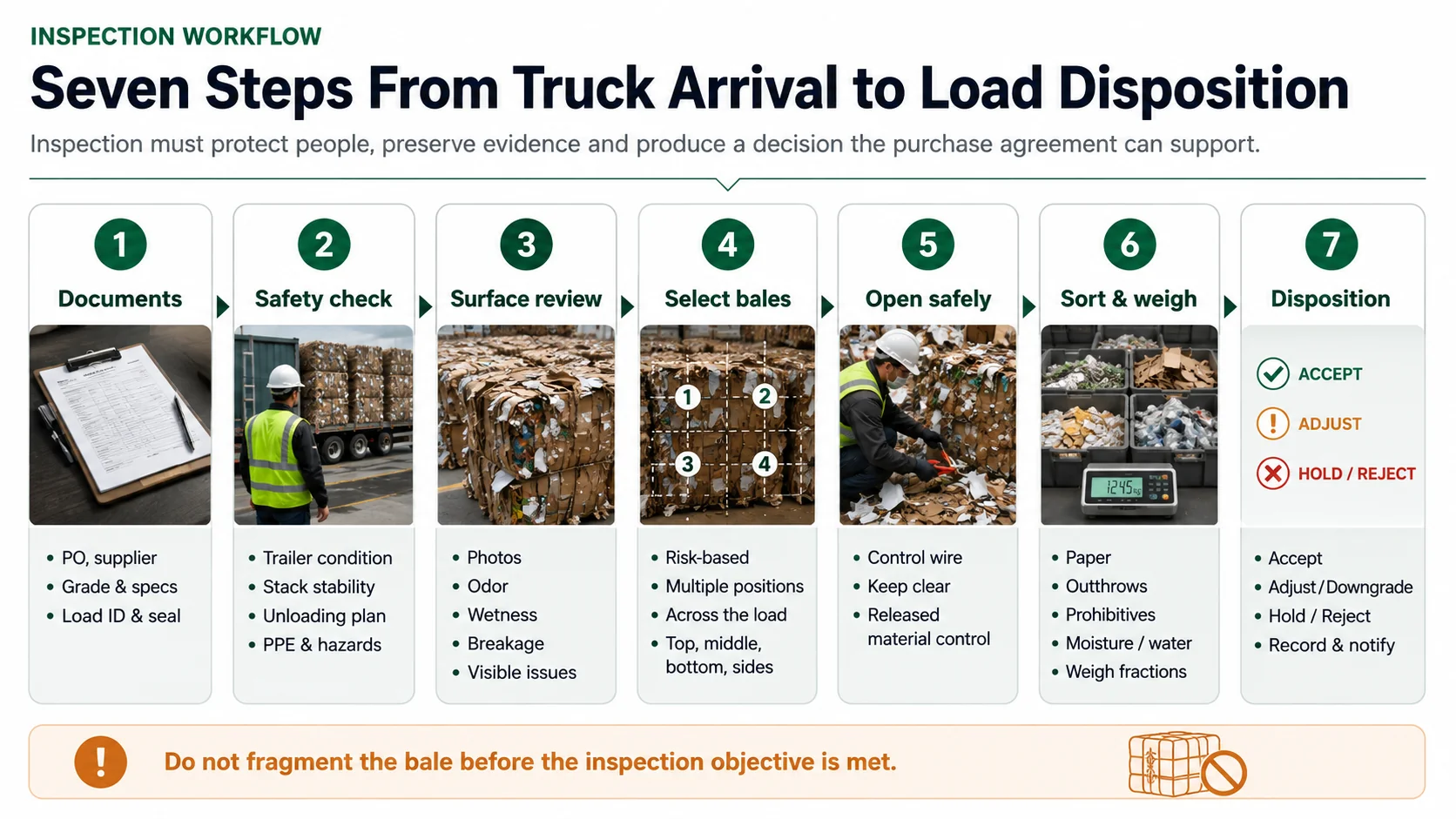
-
Verify the shipment identity
Match the purchase order, supplier, carrier, trailer or container number, stated grade, shipment date, bale count and declared weight. Create a unique receiving-lot ID before photographs or samples are taken. A photograph without a lot reference is weak evidence.
-
Check the unloading condition and visible hazards
Inspect the trailer floor, odor, water entry, shifted stacks, broken bales, protruding wire and unstable units before unloading. Decide the safe unloading sequence and quarantine location. ReMA’s guidelines call for clean transport units and loading that minimizes shifting and breakage.[1]
-
Record the outer condition
Photograph the trailer before disturbance, several bale faces, damaged packaging, wet areas, labels and visible contamination. Note weather and whether doors or roof panels show water entry. Surface condition is a screening observation—not proof of the core.
-
Select representative bales
Choose bales from more than one trailer position and more than one visible condition. A risk-based plan may include front, center and rear positions; upper and lower rows where safely accessible; and both normal-looking and suspect bales. Do not allow the supplier or loader to present only the easiest units.
-
Open the selected bales under a controlled method
Move the bale to a designated opening area. Control stored wire tension and released material. Keep the lot segregated and prevent contamination from the floor, previous grade or nearby waste. Spread enough of the bale to expose its internal distribution rather than judging one cut face.
-
Separate, identify and weigh the fractions
Use labeled containers or a clean sorting surface. Separate accepted OCC, other acceptable paper if the contract allows it, outthrows, prohibitives, free water or visibly saturated material, packaging wire and any zero-tolerance item. Record the scale ID, tare, gross and net weights.
-
Make and document the disposition
Apply the purchase agreement. Release accepted material to the defined route; keep disputed material identifiable and protected from further deterioration. ReMA says buyers should inspect while unloading, notify the seller immediately when a load appears nonconforming, and preserve disputed stock from external deterioration or contamination.[1]
Build a Sampling Plan That Represents the Load
There is no universal bale count that represents every OCC shipment. A load from a stable single-source distribution center is not the same risk as a mixed-supplier broker load with previous claims. The sample rate should be written around supplier history, material source, grade value, observed condition, lot size and the consequence of a wrong decision.
Use risk-based layers
Routine level
For a qualified supplier with stable results: identity check, surface inspection and the normal opened-bale plan.
Elevated level
For a new supplier, changed source, damaged trailer, moisture concern or recent deviation: open more bales and widen the positions sampled.
Containment level
For repeated failures or a severe defect: hold the lot, inspect under a documented containment plan and require corrective action before normal status returns.
Do not confuse a convenient sample with a representative one
The bale nearest the trailer door is easy to reach. It may also have been selected because it looks good. A proper plan should reduce selection bias. Random or stratified selection can be used, but the method must remain practical and safe. Record both the planned positions and the positions actually inspected.
We have also seen the opposite mistake: inspectors open only visibly bad bales and then apply the result to the entire load. Suspect bales are useful for finding a failure mode, but they do not automatically estimate the average composition. Keep “targeted defect investigation” separate from “representative load sampling” in the report.
Escalate when variability appears
If the first opened bales disagree sharply, the problem is not solved by averaging them and moving on. High variability may mean mixed sources, inconsistent sorting or deliberate layering. Expand the sample, preserve separate results by bale and decide whether the lot can still be treated as one population.
Measure Contamination Without Hiding the Denominator
A contamination percentage is only meaningful when the numerator and denominator are defined. The facility may calculate a receiving KPI as follows:
Contaminant fraction (%) = net mass of the defined contaminant fraction ÷ net mass of the original sample before sorting × 100
This is a practical site calculation, not a statement that every grade standard uses the same test. The record should identify whether the numerator is outthrows only, prohibitives only, combined nonconforming material, excess water, or a separate category. Do not combine all categories in the worksheet and then try to reconstruct them during a claim.Use the net sample mass after subtracting the tare of bins, pallets, containers and other weighing aids. The same denominator should be used for every reported fraction from that sample.
Record these weight fields
- Gross selected sample or opened-bale mass
- Tare of containers, pallets or sorting bins
- Accepted OCC mass
- Other acceptable paper mass, when allowed
- Outthrows by category
- Prohibitives by category
- Packaging wire and non-product packaging mass
- Free water or separately quantified excess moisture, when the method permits
- Unclassified residue, with photographs and notes
AF&PA’s recycling-rate methodology deducts unusable materials and net moisture from recovered-paper consumption calculations.[3] A receiving program is not the same calculation, but the underlying lesson is useful: gross bale weight is not automatically usable fiber weight.
Preserve the mass balance
The sum of all sorted fractions should reconcile with the original net sample within an agreed tolerance. A large unexplained difference may come from scale resolution, lost fines, wet floor contamination, incomplete tare subtraction or material moved before weighing. A clean percentage with a poor mass balance is not strong quality evidence.
Moisture Inspection Needs an Agreed Method and Basis
ReMA’s PS-2026 guidelines say paper should be packed dry and identify 12 percent as the maximum dry moisture limit. They also allow buyer and seller to agree to a different percentage and require the moisture percentage and test method to be confirmed in the purchase or shipping agreement.[1]
That wording matters. A moisture number without a method, sampling position or calculation basis is not enough. A handheld meter may be useful for rapid screening, but the buyer and seller should agree whether it is the claim method, how it is calibrated, which points are tested and what happens when surface and core readings disagree.
Useful receiving observations
- Weather during transport and unloading
- Standing water, roof leaks or wet trailer floor
- Wet exterior only versus wet bale core
- Temperature, odor, discoloration or biological deterioration
- Loss of bale integrity caused by saturation
- Difference between apparently dry and visibly wet units
- Time between unloading, testing and final disposition
If excess moisture is suspected, isolate the affected lot and apply the agreed test. Do not mix it into dry inventory and then attempt to prove the original condition later. ReMA’s guidelines allow a buyer to request an adjustment and, if settlement cannot be reached, reject a shipment when excess moisture is determined under the agreed method.[1]
Use a Written Load-Disposition Matrix
The inspection result should connect directly to a limited set of actions. Thresholds below are intentionally not supplied because the governing grade, buyer specification and commercial agreement must define them.
| Disposition | When it may apply | Required controls |
|---|---|---|
| Accept | Shipment meets the agreed grade, moisture, packing and safety requirements | Release to the designated inventory or processing route; close the lot record. |
| Accept with adjustment | A measurable deviation is commercially settled and material remains usable | Document the calculation, authorization, supplier agreement and final weight/value basis. |
| Downgrade or divert | Material is unsuitable for the ordered grade but acceptable for a defined lower-value route | Prevent mixing with compliant stock; identify the alternate buyer or process before release. |
| Hold / quarantine | Evidence is incomplete, a severe defect needs assessment, or supplier review is pending | Label and physically segregate the lot; protect it from weather and cross-contamination. |
| Reject | The load exceeds the agreed limit, contains zero-tolerance material, or cannot be safely/legally handled under the site plan | Notify the seller under the agreed timeframe; preserve evidence and control further handling. |
One frequent error is to process the material first and negotiate later. Once the bale has been shredded or blended into inventory, the original composition and ownership of the defect are much harder to prove. The hold point must occur before irreversible processing.
Turn Inspection Results Into a Supplier Quality Scorecard
A receiving program becomes more efficient when it changes supplier risk. Inspecting every supplier forever at the same intensity wastes labor and fails to reward stable performance. Conversely, reducing inspection after one clean load creates avoidable exposure.
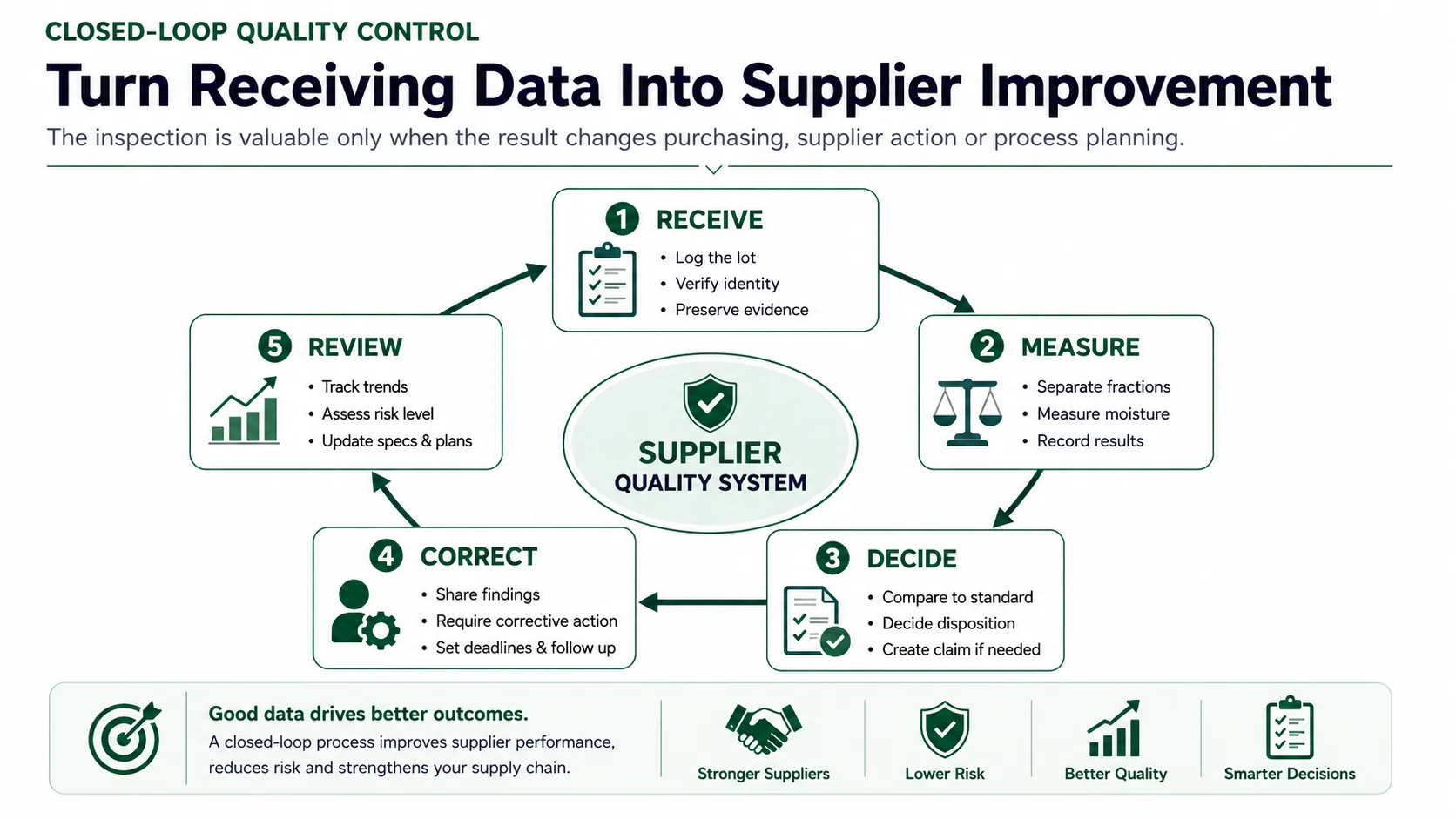
Useful scorecard fields
- Loads received and loads sampled
- Loads accepted, adjusted, downgraded, held and rejected
- Outthrows and prohibitives by mass and defect category
- Moisture deviations and affected bale pattern
- Zero-tolerance incidents
- Packaging, wire, breakage and trailer-condition defects
- Claim response time and closure quality
- Repeat occurrence after corrective action
- Completeness of shipping documents and lot traceability
Use trends, not only averages. A supplier with a low average contamination rate but repeated isolated severe defects may require stronger containment than a supplier with small, consistent and easily corrected deviations. The scorecard should support a defined escalation and reinstatement rule.
Send defect-specific feedback
“Improve quality” is not a corrective action request. Send the lot ID, bale positions, photographs, measured fractions, method, agreement reference and required response. Ask what changed in collection, sorting, storage, baling or loading. A corrective action should address the source of the defect and state how the supplier will verify the change.
Where Inspection Ends and Processing Equipment Begins
Receiving inspection does not replace process equipment, and process equipment does not replace receiving inspection. The correct sequence is to reject or isolate clearly unacceptable material, remove large visible hazards while they are identifiable, and then use equipment for the accepted material condition.
For compressed OCC, a bale opener or controlled opening station can expose the material and reduce sudden feed surges. A sorting platform provides access for visible plastics, wood and wrong grades. A magnetic separator can remove exposed ferrous pieces after the material has been opened, but it will not remove film, moisture, coatings, adhesives or non-ferrous hard objects.
The YUXI OCC paper dry pulping and cardboard recycling line places inspection and bale opening ahead of controlled feeding, primary shredding, magnetic separation, buffering, mechanical dry fiber opening, dust handling and collection. Its direct output is dry fiber-rich material rather than finished paper. The final equipment scope should therefore start with the accepted feed and the downstream customer’s required handoff condition.
For buyers still deciding whether the project needs a baler, a shredder or a coordinated line, the industrial cardboard recycling machine selection guide defines those process boundaries. Where a dry front end hands material to a paper mill, the separate guide to dry OCC fiber recovery versus wet stock preparation explains why dry opening is not the same as screened, pumpable paper stock.
Equipment data to collect from the inspection program
- Normal and worst-case bale dimensions and density
- Wire type, quantity and failure condition
- Largest hard contaminant found
- Film, light reject and treated-board patterns
- Moisture range and wet-core frequency
- Loose bulk behavior after opening
- Amount and destination of rejected material
- Feed variability by supplier and season
These data are more useful for line design than the statement “we process OCC.” They help define opening access, sorting labor, conveyor width, surge capacity, magnetic protection, reject handling and the material test plan without inventing a universal machine configuration.
Safety Controls Are Part of the Inspection Method
Paper bales are heavy stored-energy packages. OSHA notes that paper recycling activities involving transporting, compacting and baling machinery can be fatal, with hazards including moving parts, unexpected startup, crushing and combustible dust.[2] A receiving SOP should not ask an inspector to obtain a “representative sample” by entering an unsafe trailer, climbing an unstable stack or cutting wire without a controlled opening plan.
Controls to address in the site-specific procedure
- Forklift and pedestrian separation during unloading and sampling
- Trailer restraint, dock condition and communication with the driver
- Maximum safe bale stack and damaged-bale handling
- Designated wire-cutting position, tools and exclusion zone
- Control of material release when compressed bales open
- Machine guarding and lockout/tagout for bale openers, conveyors and shredders
- Jam-clearing and foreign-object removal procedure
- Housekeeping, dust collection and ignition-source control
- Isolation and competent response for unknown or hazardous substances
Common OCC Incoming Inspection Mistakes
Judging only the bale faces
The surface is a useful screening point, not a representative core sample. A clean wrapper can hide mixed or wet material inside.
Using the shredder to “see what is in the bale”
Shredding destroys distribution evidence, spreads contamination and can expose the machine to hard objects. Inspect before irreversible size reduction.
Reporting one combined contamination percentage
A total figure hides whether the problem was wrong paper, plastic, moisture, metal or zero-tolerance material. Keep categories visible.
Changing the method when a load looks bad
A targeted investigation may be necessary, but it should not be presented as the routine representative sample. Record the escalation and why it occurred.
Failing to define the moisture method
Buyer and seller may use different instruments, locations or calculations and both believe they are correct. Agree before shipment.
Processing disputed material
Once a lot is blended or shredded, evidence and commercial options narrow. Use a physical and system hold.
Keeping photographs without traceability
Every image should carry the lot, date, trailer, bale position and inspector reference. A folder of anonymous defects cannot support supplier improvement.
Ignoring repeat patterns
A load-by-load decision is necessary, but the supplier trend should change the next inspection plan. Otherwise the plant keeps rediscovering the same defect.
OCC Receiving SOP and Supplier RFQ Checklist
Before approving a supplier
- Declared material source and current trade grade
- Typical and worst-case bale photographs
- Bale dimensions, mass, wire or strap and loading pattern
- Known non-paper, treated board and moisture risks
- Supplier sorting, storage and contamination-control process
- Proposed grade, moisture, outthrow, prohibitive and zero-tolerance terms
- Inspection, sample, claim, adjustment and rejection method
- Corrective-action contact and response timeframe
At every receiving lot
- Purchase order, bill of lading, supplier, carrier and lot identity
- Certified incoming weight and bale count
- Trailer cleanliness, odor, floor, water entry and shifted-load condition
- Pre-unloading photographs
- Sample plan and selected bale positions
- Controlled wire removal and opening record
- Fraction weights, moisture result and mass-balance check
- Disposition authorization, supplier notification and retained evidence
An equipment supplier configuring an OCC processing line should also ask for this receiving information. It helps determine whether the front end needs simple conveying, controlled bale opening, a sorting position, additional reject handling or a representative material test.
Define the OCC Feed Before Configuring the Line
Send representative bale photos or video, grade and supplier mix, bale dimensions, moisture and contamination records, target accepted output, downstream use, working schedule and site constraints. YUXI can use those inputs to review the required receiving, opening, sorting and dry fiber-preparation scope.
Frequently Asked Questions
Can the outside of an OCC bale prove its quality?
No. The outer faces are useful for screening, but representative inspection normally requires selected bales to be opened so the core distribution can be examined.
How many OCC bales should be opened per load?
There is no universal number. Define a risk-based plan using lot size, supplier history, material source, observed condition and the consequence of accepting a bad load. Increase the sample when variability or a serious defect appears.
What is the difference between outthrows and prohibitives?
Outthrows are papers that make the pack unsuitable for the specified grade. Prohibitives are materials that can make the pack unacceptable or unusable, including materials that may damage equipment. The purchase agreement should apply the current grade definitions and any buyer-specific terms.
What moisture limit applies to recovered paper bales?
ReMA’s PS-2026 guidelines identify 12 percent as the maximum dry moisture limit, while allowing buyer and seller to agree to a different percentage and test method before shipment. The governing transaction documents should state the method and commercial response.
Can a magnetic separator remove OCC bale contamination?
It can remove exposed ferrous items under suitable conditions. It does not remove film, moisture, wax, adhesives, wrong paper, stones or every metal object. Inspection and source control remain necessary.
Should OCC bales be shredded before inspection?
Usually not. Large visible contaminants and bale-core patterns are easier to identify before fragmentation. Inspect and remove unacceptable material first, then apply size reduction to the accepted feed route.
When should an OCC load be quarantined?
Use quarantine when the evidence is incomplete, the lot may contain a severe or unknown defect, supplier review is pending, or the material must not enter normal inventory. The site procedure should define labeling, physical segregation and release authority.
What information helps a supplier design the receiving front end?
Provide bale size and mass, wire condition, supplier and grade mix, moisture range, contamination categories, hard-object history, opening method, target throughput, sorting labor, reject route and downstream output specification.