




 Request Quote



Three bales can all look like brown corrugated cardboard and still represent three different purchasing risks. OCC 11 is a broad post-consumer grade. DS OCC 12 is a tighter, specially sorted post-consumer grade. DLK is new converting scrap. Treating them as interchangeable usually leads to the wrong inspection plan, the wrong equipment scope, or a dispute at the receiving mill.
The practical comparison is not simply “good, better, best.” Each grade starts from a different material source and carries a different tolerance for wrong paper and damaging contaminants. That source difference matters more than bale color, average sheet size or how clean the outer face appears.
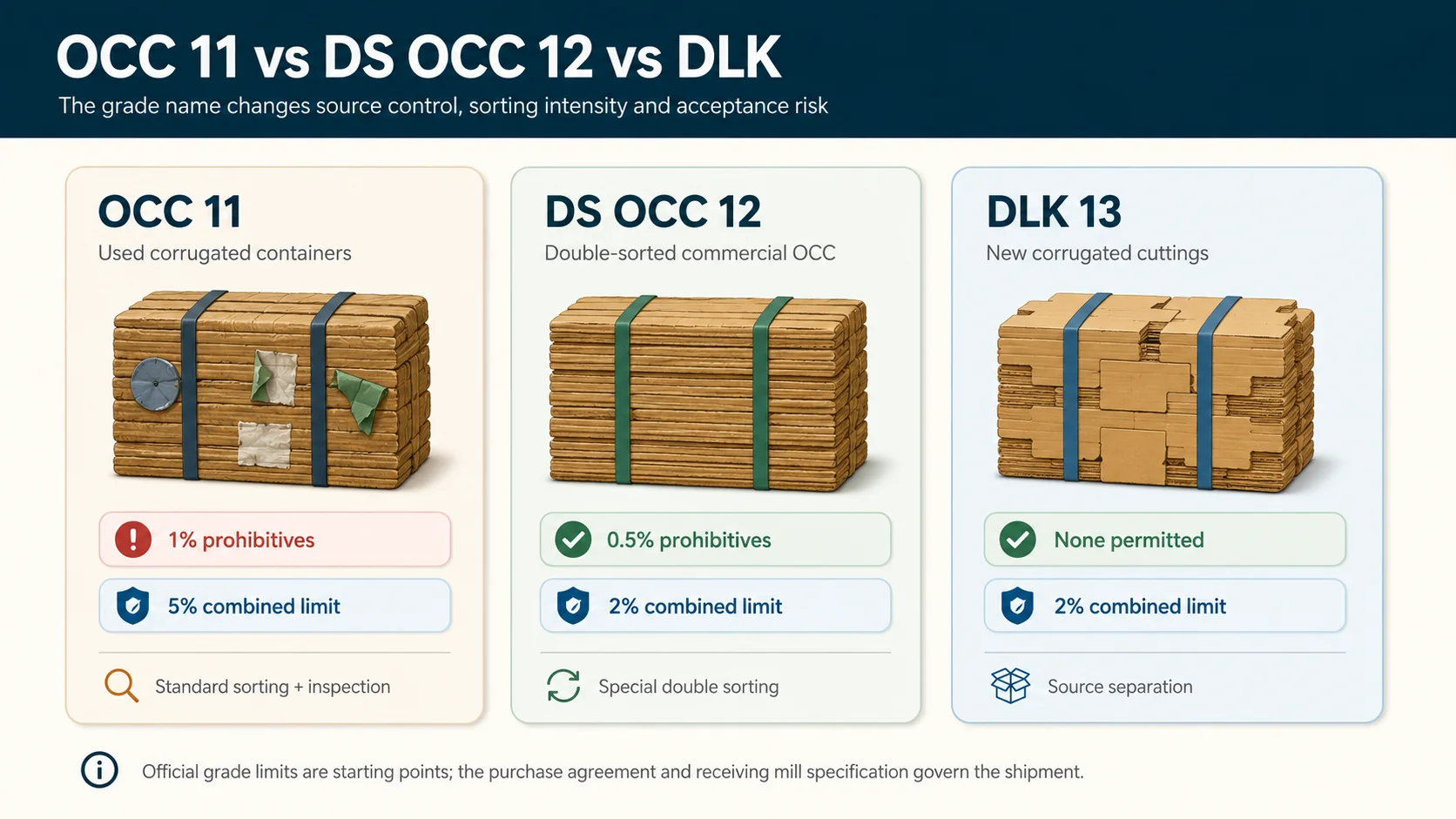
OCC 11 vs DS OCC 12 vs DLK: The Official Difference
The current ReMA/ISRI online specifications directory still lists item codes 11, 12 and 13 as Old Corrugated Containers, Double-Sorted Old Corrugated and New Double-Lined Kraft Corrugated Cuttings. The detailed grade pages use the definitions and tolerance limits effective July 14, 2022.[1][2][3]
| Factor | OCC 11 | DS OCC 12 | DLK Grade 13 |
|---|---|---|---|
| Official name | Old Corrugated Containers | Double-Sorted Old Corrugated | New Double-Lined Kraft Corrugated Cuttings |
| Material origin | Used corrugated containers | Used corrugated containers from supermarket, industrial or commercial sources | New corrugated cuttings from converting or box-manufacturing operations |
| Core fiber description | Corrugated containers with test-liner or kraft liners | Double-sorted containers with test-liner or kraft liners | New corrugated cuttings with test-liner or kraft liners |
| Special exclusions | Controlled by general outthrow and prohibitive limits plus the purchase agreement | Specially sorted to be free of boxboard, off-shore corrugated, plastic and wax | Treated medium or liners, insoluble adhesives, butt rolls, slabbed or hogged medium are not acceptable |
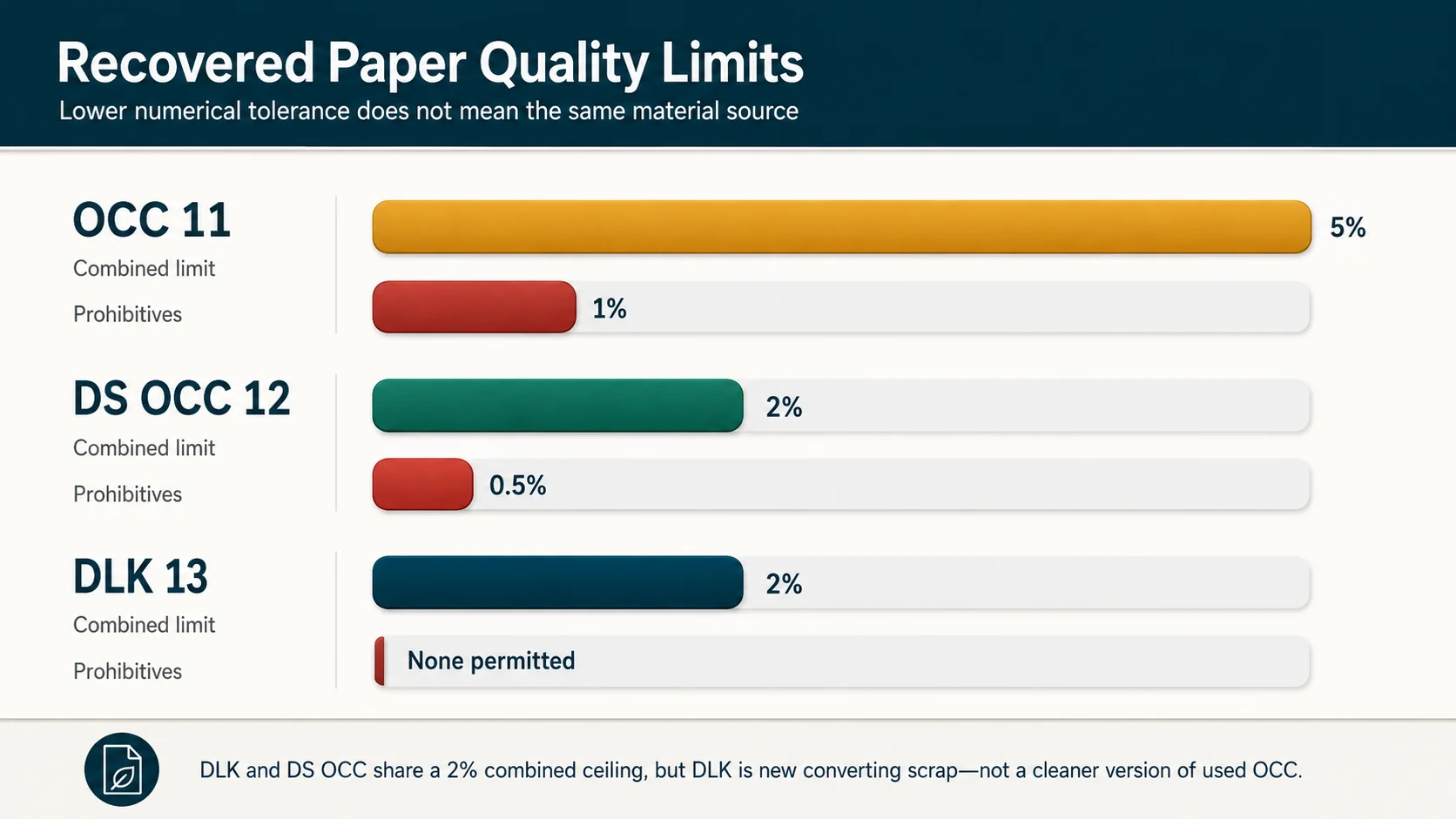
| Prohibitive materials | Maximum 1% | Maximum 0.5% | None permitted |
| Outthrows + prohibitives | Maximum 5% | Maximum 2% | Maximum 2% |
| Typical quality-control burden | Highest variability; inspect deeply | Tighter supplier and sorting control | Strong source traceability and contamination prevention |
| Can visual cleanliness prove the grade? | No | No | No; source documentation remains important |
OCC 11: The Standard Used-Corrugated Grade
Grade 11 OCC is the broadest of the three. Its official definition is concise: corrugated containers with either test-liner or kraft liners. The 1% prohibitive limit and 5% combined outthrow-plus-prohibitive limit leave room for normal imperfection, but not for uncontrolled mixed waste.[1]
In practice, this grade can arrive from distribution centers, retail stores, warehouses, municipal collection or industrial generators. Those sources do not create the same bale. A warehouse that flattens shipping cases indoors may produce dry, consistent material. A mixed-recycling facility may produce bales with more labels, boxboard, film and hidden non-paper items. Both may be sold as OCC 11, yet the front-end inspection burden is very different.
What processors should expect
- More variation in bale density, sheet size and folding pattern.
- Plastic stretch wrap, strapping, labels, tape and boxboard may appear.
- Moisture can vary between the bale surface and core.
- Staples, nails, wire fragments and hard objects require a defined removal route.
- Food-soiled, waxed, wet-strength or heavily treated board can create rejection risk.
That does not make OCC 11 a poor grade. It means the purchasing price, sorting cost, yield and reject burden must be evaluated together. A low-cost bale that needs extensive manual removal and produces a high reject fraction may be more expensive per accepted ton than a cleaner load.
DS OCC 12: Cleaner Because the Source and Sorting Are Controlled
DS OCC is not defined only by a lower contamination number. ReMA/ISRI describes it as double-sorted corrugated containers generated from supermarkets and/or industrial or commercial facilities. The material is specially sorted to be free of boxboard, off-shore corrugated, plastic and wax. Prohibitives are limited to 0.5%, while the combined limit is 2%.[2]
The phrase double-sorted should influence the entire operating plan. It implies a deliberate second quality-control step, not a cleaner-looking OCC bale selected from the yard. The exact arrangement can vary—source separation, floor sorting, conveyor sorting, bale opening and inspection, or a combination—but the finished pack must support the agreed grade.
Where DS OCC projects often fail
One common mistake is to mix several supplier streams and assume that a final magnet or air separator will restore Grade 12 quality. Ferrous removal can capture exposed steel. Air separation can remove selected light fractions. Neither machine can reliably identify every piece of boxboard, waxed corrugated, treated board or wrong fiber once the load has been aggressively shredded.
Another mistake is losing traceability after sorting. Clean bales can be stored beside standard OCC, loaded with shared equipment, or contaminated by a wet floor. The process needs controls after the sorter as well as before it.
DLK Grade 13: New Corrugated Cuttings, Not “Premium OCC”
DLK is frequently described in commercial conversation as a high-quality brown grade. That shorthand is useful only when the origin remains clear. Grade 13 consists of new corrugated cuttings with test-liner or kraft liners. It excludes treated medium or liners, insoluble adhesives, butt rolls, slabbed medium and hogged medium. Prohibitive materials are not permitted, and the combined outthrow-plus-prohibitive limit is 2%.[3]
The new-cutting requirement separates DLK from both OCC grades. It is normally generated by box plants and corrugated converting operations before the packaging enters use. Depending on the buyer’s specification, qualifying material may include clean trim, die-cut offcuts and other new production cuttings. The source and excluded materials still need to be verified.
Why DLK can need less sorting but more discipline
A stable converter can generate a predictable stream with little post-consumer contamination. That can reduce the need for heavy front-end sorting. However, the line must prevent contamination from entering a clean stream. Mixed production waste, treated board, hot-melt adhesive, floor sweepings, wood, plastic cores or maintenance debris can quickly damage a DLK pack.
DLK also should not be over-processed without a reason. Clean cuttings may feed directly to baling, conveying or controlled size reduction. Aggressive shredding can create more fines, increase dust load and make later visual inspection harder. The equipment route should start from the buyer’s required form, not from an assumption that every fiber stream needs a shredder.
Outthrows, Prohibitives and Zero-Tolerance Material
The terms are easy to repeat and easy to misunderstand. ReMA/ISRI defines outthrows as papers that make the pack undesirable and unsuitable for consumption as the specified grade. Prohibitive materials include materials that make the pack unacceptable when they exceed the allowed amount, as well as materials that may damage equipment. The paper-stock terms also define zero-tolerance material to include medical, organic, food, hazardous, poisonous, radioactive or toxic waste and other harmful substances or liquids.[3]
Outthrow example
Boxboard mixed into a DS OCC pack. It is paper, but it does not fit the specified grade.
Prohibitive example
Metal, plastic or another material that can make the pack unusable or damage processing equipment.
Zero-tolerance example
Food waste, hazardous liquids or other harmful substances that should not be treated as an allowable percentage.
AF&PA’s recyclability guidance explains that recovered paper is sorted before baling and that mill pulping and contaminant-removal stages separate items such as staples, plastic liners, coatings, tape and adhesives.[4] That downstream capability should not be used as an excuse for poor upstream control. Every unwanted kilogram adds handling, disposal, wear or process instability somewhere in the system.
Can OCC 11 Be Upgraded to DS OCC 12—or to DLK?
OCC 11 may sometimes be sorted into a pack that meets a buyer’s DS OCC requirement. Whether it qualifies depends on the actual composition after sorting, the excluded materials, the contamination percentages and the governing purchase agreement. The label cannot be changed merely because the material passed through a shredder, magnet or second conveyor.
Used OCC cannot be converted into DLK. DLK is defined by its origin as new corrugated cuttings. Cleaning a used box does not make it pre-consumer converting scrap. This distinction is important when a quotation promises to “produce DLK” from mixed OCC. The line may produce a cleaner corrugated fraction, but the material origin remains unchanged.
What equipment can legitimately change
- Open dense bales so hidden material becomes visible.
- Meter bulky sheets into a stable inspection or processing stream.
- Remove exposed ferrous contamination.
- Separate selected light fractions or size classes when the feed supports it.
- Reduce oversized cartons or cuttings for downstream conveying.
- Mechanically open fiber-rich material when the required output is a dry prepared fraction.
What equipment cannot prove by itself
- The original source of the material.
- Compliance with a grade across an entire truckload.
- Absence of wax, wet-strength treatment or insoluble adhesive in every piece.
- The mill yield, strength or furnish behavior without agreed testing.
- A trade-grade upgrade based only on particle size.
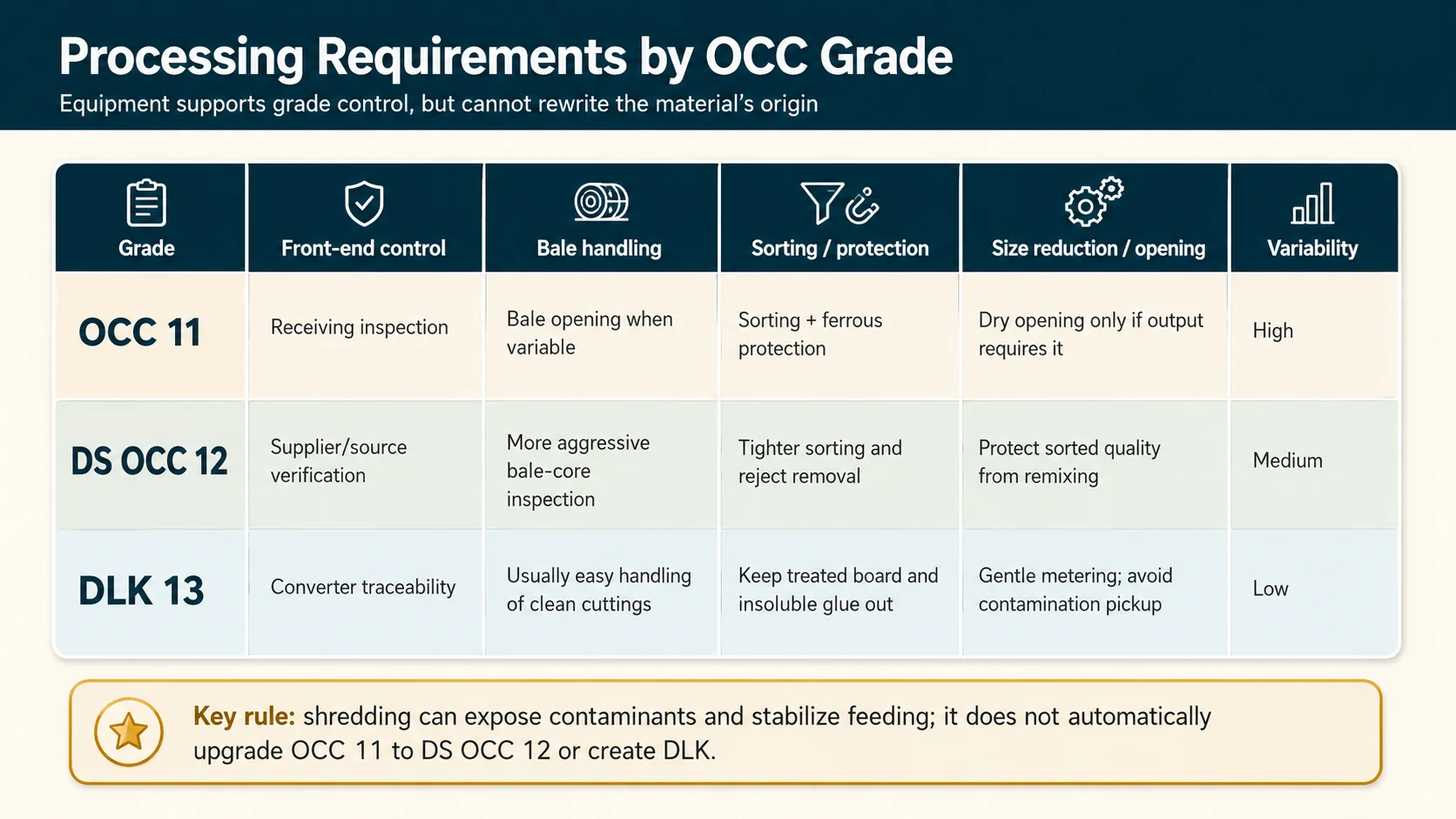
Processing Requirements Change With the Grade
A useful processing plan should preserve the value already present in the feed while removing the risks the buyer will not accept. That leads to different priorities for the three grades.
OCC 11 processing priorities
Start with receiving inspection, safe bale-wire handling and representative opening of variable loads. Remove obvious film, wood, metal and unacceptable board before aggressive size reduction. Where a dry preparation line is required, controlled feeding and buffering matter because loose cardboard has low bulk density and can surge or bridge. The guide to choosing an industrial cardboard recycling machine explains why a baler, a shredder and a complete line solve different process boundaries.
DS OCC processing priorities
Protect the double-sorted status. Supplier qualification and source segregation are often more valuable than another downstream machine. If bales are opened, the inspection method should be designed to identify boxboard, plastic, wax and nonconforming corrugated without fragmenting them too early. Sorted material should move through dedicated or cleaned conveyors and storage zones to avoid remixing.
DLK processing priorities
Keep converter scrap separate at the source. Identify treated grades and insoluble adhesive before they reach the clean cuttings stream. Clean trim may only need metering and baling. Shredding is justified when the cuttings bridge, are too large for the next conveyor, or must be mechanically opened for a defined downstream product. It is not automatically a quality upgrade.
How to Inspect and Sample OCC Bales
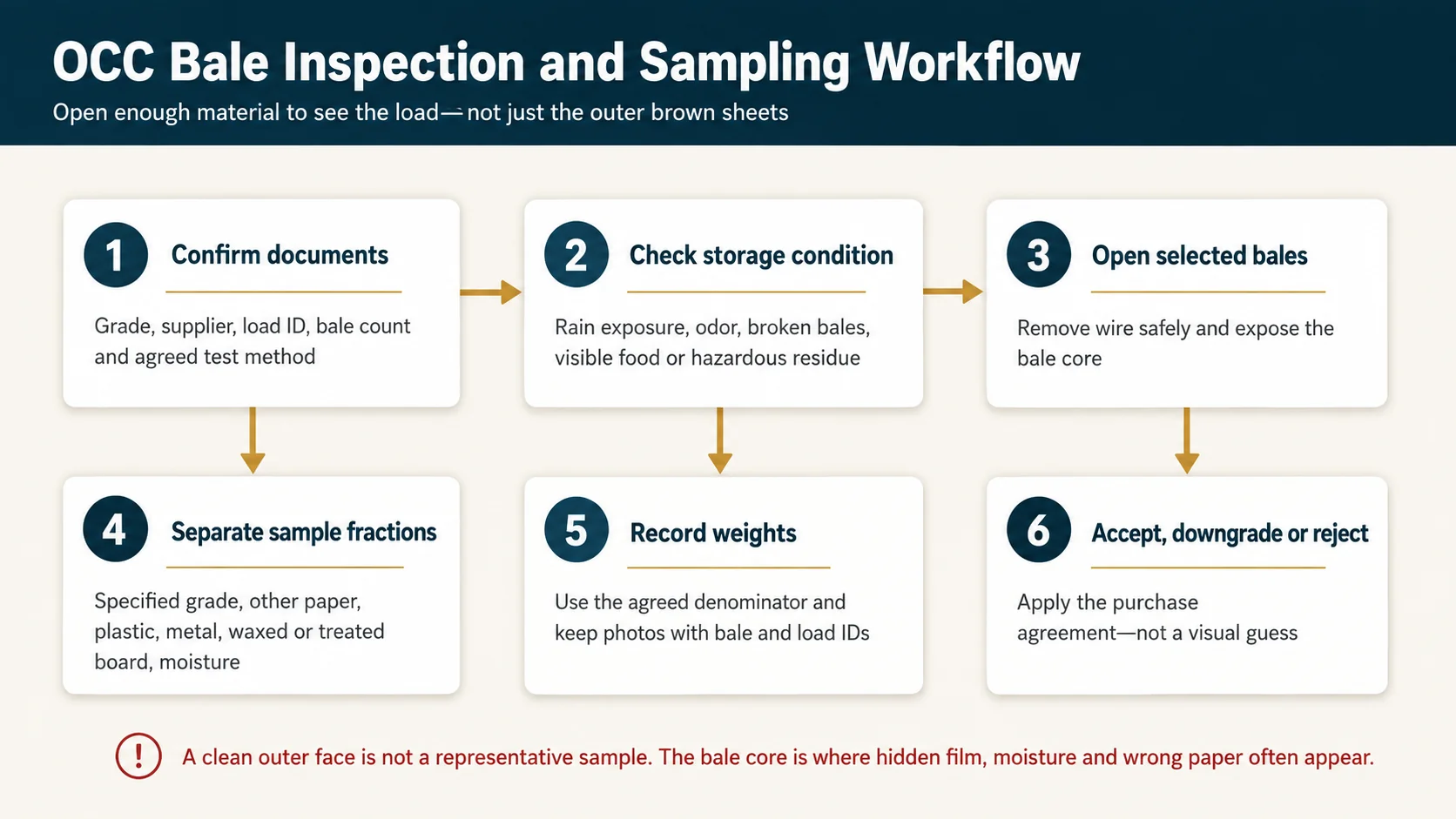
The outer layer of a bale is not a reliable sample. A bale that looks uniformly brown from the trailer door may still contain film, boxboard or wet material in the center. A receiving plan should define which bales are selected, how they are opened, how sample fractions are separated and which weight forms the denominator.
At receiving
- Confirm grade, seller, load number, bale count, gross and tare documentation.
- Check trailer cleanliness, odor, broken bales and obvious water exposure.
- Identify mixed-grade loads and keep each grade physically separated.
- Record bale condition before unloading changes it.
During bale opening
- Use a safe, documented method for wire or strap removal.
- Expose the bale core rather than sampling only loose surface sheets.
- Separate specified corrugated, other paper, plastic, metal, treated board and other rejects.
- Use agreed moisture locations and test procedures.
In the purchase agreement
The ReMA/ISRI terms state that paper should be packed dry and identify 12% as the maximum dry limit, while requiring buyer and seller to agree on the moisture percentage and test method. The same terms emphasize that the purchase or sales agreement is the governing document and should specify quality, quantity, packing unit and shipping terms.[3]
EPA’s paper-grade guidance makes the same practical point from the mill side: mills buy recovered paper according to recipes and specifications, while the grade inside a bale reflects the collection and processing used to recover it.[5]
What the Grade Means for Equipment Selection
The grade name should appear in the equipment RFQ, but it is not enough. Two OCC 11 projects can need different systems because one receives loose warehouse cartons and the other receives dense bales from variable suppliers. Equipment should be selected from the feed form, contamination, required output and acceptance test.
| Project condition | Likely process response | Why |
|---|---|---|
| Clean loose DLK cuttings | Metering and baling; optional controlled size reduction | Preserve a clean stream and avoid unnecessary fines |
| Consistent DS OCC bales | Bale opening, verification sorting, protected conveying and rebaling or downstream transfer | Confirm the double-sorted pack and prevent remixing |
| Variable OCC 11 bales | Inspection, bale opening, sorting platform, controlled feeding, optional shredding, ferrous removal and reject handling | Expose hidden variation and protect downstream equipment |
| Oversized cartons for dry fiber preparation | Metered primary shredding, magnetic protection, buffering and mechanical fiber opening | Stabilize geometry and feed rate before dry opening |
| Wet, waxed or heavily treated board | Test and define a separate route before final equipment selection | The material may fall outside normal OCC or DS OCC acceptance |
For projects that continue beyond baling, it is also important to define the handoff between dry preparation and paper-mill stock preparation. The comparison of dry OCC fiber recovery and wet stock preparation explains why loose or baled dry fiber-rich material is not the same accepted product as pumpable, screened paper stock.
Safety and dust are part of the line
Paper handling is not a low-risk activity simply because the material is lightweight. OSHA identifies moving machinery, unexpected startup, crushing hazards, bale handling and combustible dust among the hazards in paper recycling.[6] OSHA also lists paper and pulp among materials that can be explosible in dust form.[7] Bale opening, jam clearing, shredder access, dust collection and maintenance therefore need site-specific guarding, lockout and dust-hazard controls.
Where the YUXI OCC Dry Pulping Line Fits
The topic-appropriate pillar for this article is the YUXI OCC paper dry pulping and cardboard recycling line. Its published process combines controlled feeding, primary shredding, ferrous-metal removal, buffer and metering, mechanical dry fiber opening, dust management, collection and optional baling.
That line can support projects where corrugated boxes, kraft offcuts or selected paperboard waste must be opened, protected from metal, mechanically prepared and collected as a dry fiber-rich product. It does not turn a wrong feed into a compliant grade by itself. For OCC 11, DS OCC or DLK, the quotation still needs representative samples, bale details, moisture, excluded materials and the downstream buyer’s acceptance criteria.
RFQ and Purchase Agreement Checklist
Incoming material
- OCC 11, DS OCC 12, DLK or buyer-specific grade
- Loose, baled, trim skeletons or mixed forms
- Supplier and generation source
- Bale dimensions, mass, density and wire type
- Moisture range and storage history
Quality definition
- Outthrow and prohibitive limits
- Zero-tolerance exclusions
- Wax, wet-strength, coated and laminated board policy
- Boxboard and non-corrugated allowance
- Sampling, weighing and moisture method
Required process
- Bale opening and inspection depth
- Manual, mechanical or optical sorting scope
- Primary shredding requirement and target geometry
- Ferrous and light-reject handling
- Dry fiber opening, collection and baling
Acceptance test
- Approved representative feed lot
- Sustained throughput basis
- Accepted product and reject definitions
- Sampling points and frequency
- Downtime, utility and operator boundaries
The strongest RFQ describes a measurable material transformation. It does not ask a supplier to guarantee “Grade 12 output” from an unknown mix. It defines the feed, the process boundary and the method used to decide whether the outgoing pack meets the buyer’s contract.
Match the OCC Line to the Actual Grade and Output
Send feed photos or samples, bale data, contamination limits, required processing steps and the downstream acceptance specification so the line can be configured around a testable result.
FAQ
What is the main difference between OCC 11 and DS OCC 12?
OCC 11 is the standard old corrugated container grade. DS OCC 12 is generated from supermarket, industrial or commercial sources and specially double-sorted to exclude boxboard, off-shore corrugated, plastic and wax. Its limits are tighter: 0.5% prohibitives and 2% combined outthrows plus prohibitives, compared with 1% and 5% for OCC 11.
Is DLK the same as very clean OCC?
No. DLK is Grade 13 new double-lined kraft corrugated cuttings from converting operations. It is pre-consumer production scrap, not used boxes sorted to a higher cleanliness level.
Can a sorting line upgrade OCC 11 to DS OCC 12?
A controlled sorting operation may produce a pack that meets the receiving buyer’s DS OCC specification. The result must be verified by composition, exclusions, contamination percentages and the purchase agreement. Shredding alone does not upgrade the grade.
Can used OCC be processed into DLK?
No. DLK is defined by its origin as new corrugated cuttings. Used corrugated containers remain post-consumer recovered paper even after thorough cleaning.
What moisture limit applies to OCC bales?
The ReMA/ISRI paper-stock terms state that paper should be packed dry and identify 12% as the maximum dry limit. Buyer and seller should agree on the percentage and moisture test method in the purchase or shipping agreement.
Does every OCC grade need shredding?
No. Clean material that only needs transport densification may go directly to a baler. Shredding is selected when pieces are oversized, feeding is unstable, contaminants need to be exposed, or a defined dry-preparation output is required.
Why should bales be opened before judging quality?
Surface sheets may hide film, wrong paper, moisture and hard objects in the bale core. Representative opening and traceable weighing provide a stronger basis for acceptance, downgrade or rejection.
Which grade is best for a paper mill?
There is no universal answer. The mill should compare delivered price, fiber recipe, yield, reject cost, storage, pulper capability and finished-product requirements. A cleaner grade can reduce rejects, but only when its fiber properties and price fit the mill’s process.
References
- ReMA/ISRI Specifications — Old Corrugated Containers (OCC), Item Code 11. Official grade page.
- ReMA/ISRI Specifications — Double-Sorted Old Corrugated (DS OCC), Item Code 12. Official grade page.
- ReMA/ISRI Specifications — New Double-Lined Kraft Corrugated Cuttings (DLK), Item Code 13, including paper-stock transaction terms, moisture and definitions. Official grade page.
- American Forest & Paper Association — Design Guidance for Recyclability. PDF.
- U.S. Environmental Protection Agency — Paper Grades and Collection. Archived guidance.
- U.S. Occupational Safety and Health Administration — Recycling: Paper. Hazards and precautions.
- U.S. Occupational Safety and Health Administration — Combustible Dust: An Explosion Hazard. Overview.