




 Request Quote



A modular line and a turnkey line are not true opposites. Modular describes how the process is divided and expanded. Turnkey describes who is responsible for delivering a working result. The practical decision is therefore not “Which label sounds better?” but “Who owns the interfaces, and how much of the future process must be fixed now?”
That distinction matters in aluminum recycling because a line is rarely one machine. The feeder, shredder, magnet, screen, secondary crusher, eddy current separator, conveyors, dust points and control system must pass material to one another under real feed conditions. A buyer can purchase those sections gradually. A supplier can also deliver the same modular sections as one coordinated turnkey project.
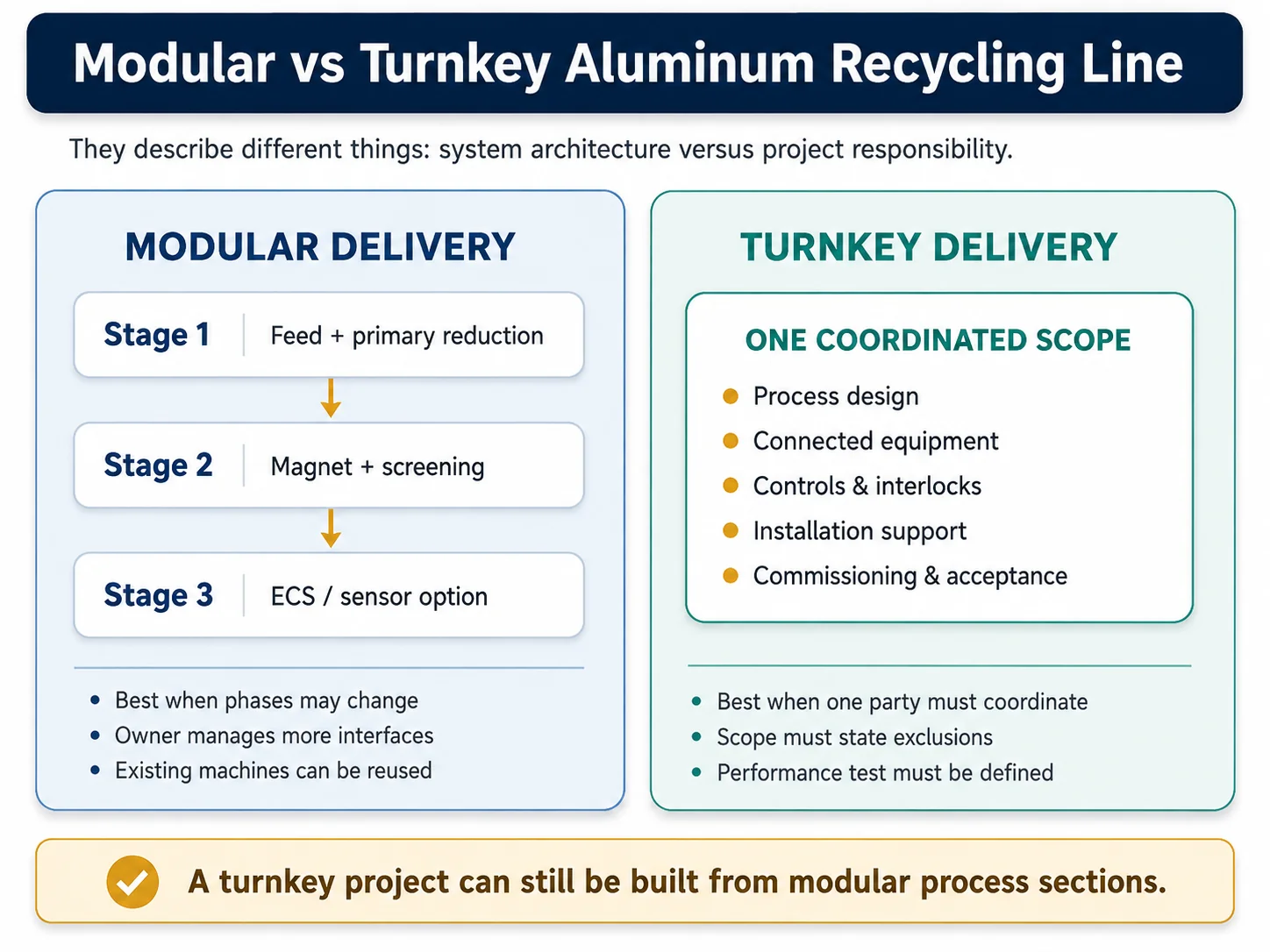
What “Modular” and “Turnkey” Mean in an Aluminum Recycling Project
Modular is a technical and procurement architecture
A modular aluminum recycling line is divided into functional sections that can be purchased, installed, bypassed or expanded with some independence. Typical modules might include receiving and controlled feeding, primary size reduction, ferrous removal, screening, non-ferrous separation, residue handling and baling. The boundaries should be physical, electrical and operational—not just boxes on a flow sheet.
In practice, modularity is useful when a plant already owns part of the process, when the feed contract is still developing, or when capital must be released in stages. It can also make replacement easier. A separator can be upgraded without replacing a shredder, provided the original transfer height, particle range, belt loading, controls and structure leave room for that change.
Turnkey is a responsibility and acceptance boundary
A turnkey project usually places coordinated responsibility for design, supply, installation-related services, testing and commissioning under one contract. The World Bank’s plant procurement documents describe specially engineered plant contracts around design, manufacture, delivery, installation, testing, commissioning and training, while also noting that some preliminary design or site preparation may remain with others.1 That last qualification is important: turnkey does not mean “everything visible on the site” unless the scope says so.
FIDIC material describes the attraction of single-point design responsibility but also the trade-off: the owner may have less control over the design process and more difficulty imposing later changes.2 For an aluminum line, this is why the buyer’s feed specification, product requirement, site data and acceptance criteria have to be stronger—not weaker—under a turnkey arrangement.
Modular vs Turnkey Aluminum Recycling Line: Side-by-Side
| Decision factor | Modular delivery | Turnkey delivery |
|---|---|---|
| Primary purpose | Phase, reuse or independently upgrade process sections. | Obtain one coordinated line and a defined handover result. |
| Owner involvement | High. The owner or consultant coordinates multiple technical interfaces. | Lower at interface level, but high-quality owner requirements are still essential. |
| Initial commitment | Can begin with the minimum justified process depth. | Usually requires more scope decisions before contract award. |
| Interface risk | Retained largely by the owner unless one integrator is appointed. | Shifted toward the supplier for included equipment and services. |
| Design flexibility | High between phases; later modules can follow operating evidence. | Changes after design freeze may be slower and commercially disruptive. |
| Controls | May involve separate panels, PLCs or signal gateways. | Normally one coordinated sequence, alarm philosophy and interlock plan. |
| Commissioning | Module tests must be combined into a complete process result by someone. | Integrated startup and line acceptance should be part of the defined scope. |
| Existing equipment | Well suited to documented existing machines. | Possible, but the supplier may limit responsibility around inherited equipment. |
| Expansion | A core reason for the architecture. | Can be excellent if expansion ports are included before fabrication. |
| Commercial comparison | Compare the final intended system, including repeated integration work. | Confirm exclusions; “turnkey” alone is not an inclusion schedule. |
The headline difference is easy to understand. The difficult part is lifecycle comparison. A modular first phase may reduce immediate expenditure, but temporary transfer conveyors, repeated engineering, duplicated control work and several mobilizations can raise the final installed cost. A turnkey line may carry a higher first contract value while reducing coordination work. Neither result is automatic.
For a cost-layer analysis, use the separate aluminum recycling plant cost guide.
When a Modular Aluminum Recycling Line Makes Sense
Modular delivery is strongest when uncertainty is real and manageable. It is weak when the word “modular” is used to postpone necessary interface engineering.
You already operate useful equipment
A recycler may already have a feeder, shredder, magnet or baler that performs its present duty reliably. Reusing it can be rational. The new supplier will need more than the machine name: actual feed opening, discharge size distribution, throughput basis, connected load, starting method, belt height, control signals, emergency-stop philosophy, drawings and maintenance envelope all affect integration.
That is usually where the first hidden risk appears. The existing machine may be mechanically capable but unable to exchange signals with the new line, or its discharge may overload the next conveyor in short surges. Modular integration succeeds when the old equipment is treated as an engineered interface, not as a free placeholder.
The feed contract is still changing
A plant processing known profile offcuts has a different uncertainty level from a yard buying mixed post-consumer aluminum from several sources. When contamination, density and product requirements are still moving, a staged line can prove the first bottleneck before the next separator is ordered.
This is not an argument for under-sizing foundations or controls. It is an argument for reserving the right things: motor-control capacity, conveyor corridors, platform extensions, dust take-off points, spare PLC I/O, data fields and bypass positions.
You have strong local engineering and maintenance capability
Modular purchasing transfers coordination work to the owner. A capable plant team may prefer that control, especially where local fabricators, electricians and civil contractors are established. The team can select best-fit equipment from several suppliers and keep standards aligned with the rest of the factory.
However, somebody must still own the line-level mass flow, sequence logic, accumulation points, emergency stops and performance test. Purchasing departments sometimes assume the plant engineer will “connect everything later.” That is not a project method; it is an unpriced integration package.
The investment must be released by phase
A first phase may stabilize feeding, reduce bulky material and remove ferrous attachments. A later phase may add screening and eddy current separation once representative operating data confirms the particle range and non-metal burden. This can protect capital from a premature deep-separation design.
Metso describes modular plant concepts as a way to shorten the path to production and support scalable automation.3 The principle transfers well, but only where interfaces were designed for the later state.
When a Turnkey Aluminum Recycling Line Makes Sense
The project is greenfield or highly integrated
When the line starts with an empty building—or when several reduction and separation stages must be balanced—the value of one integrator increases. Shredder discharge, magnetic removal, screen loading, recirculation and final sorting are one process. A single supplier can coordinate the equipment arrangement, transfer chutes, start-up sequence and accumulation logic around the intended feed.
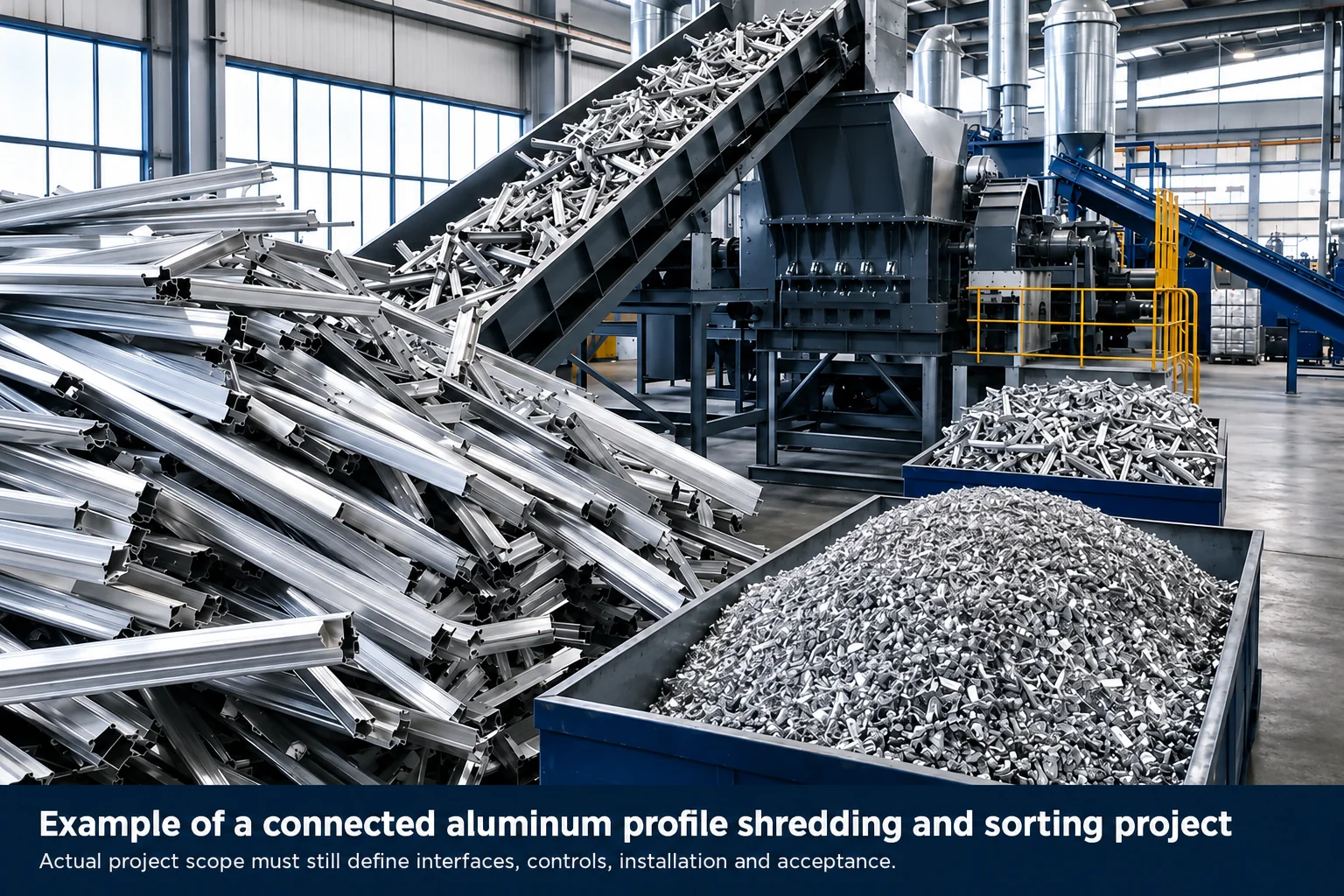
The owner wants one point for included performance
Turnkey delivery can make performance discussions clearer because the supplier cannot easily attribute a poor transfer, control mismatch or undersized conveyor to another equipment vendor—provided those items are actually in the supplier’s scope. This is particularly useful where the owner does not have a dedicated process-integration team.
The benefit is not the ability to avoid technical decisions. It is the ability to make those decisions once, at the correct boundary, and then hold one party responsible for coordinating them.
The startup date is commercially important
A coordinated manufacturing, delivery, installation-support and commissioning plan can reduce sequence conflicts. The supplier can align machine readiness, control testing, shipping packages and site startup. A fragmented order can still meet a fixed date, but the owner must manage dependencies across several contracts.
The acceptance result needs to be measured at line level
If the commercial objective depends on net throughput, stable material presentation, separated fractions and operator handover, module-by-module no-load tests are not enough. A turnkey contract can define one integrated site acceptance test. That test should use a representative feed and an agreed sampling method rather than a generic statement such as “high efficiency.”
The Most Practical Option Is Often Modular Turnkey
Many well-structured projects combine the two ideas. The supplier delivers an integrated core line as one coordinated package, but the line itself is divided into future-ready modules. Local contractors perform civil work and incoming utilities from supplier data. Optional separation or automation stages are reserved but not purchased until the feed and sales contract justify them.
Integrated core
Feeding, size reduction, magnets, conveyors and controls are balanced and commissioned as one line.
Local project work
Foundations, building changes, incoming power and permits remain with the owner under a clear data schedule.
Reserved expansion
Space, load, transfer elevation, PLC I/O and bypass arrangements are prepared for later modules.
This model avoids two extremes: purchasing an unnecessarily deep process on day one, or buying isolated machines that cannot later form a stable line.
The Responsibility Matrix Matters More Than the Label
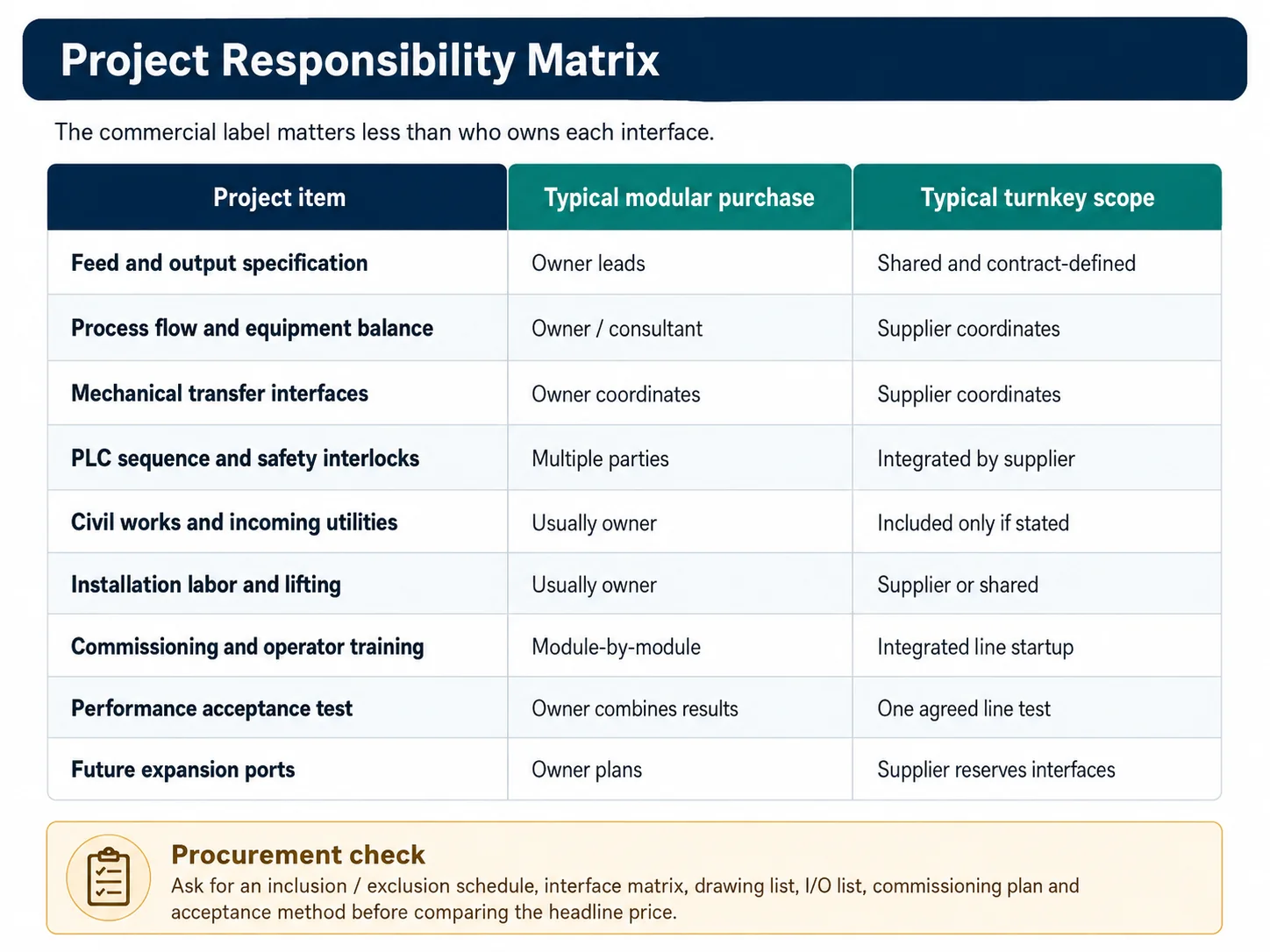
Before asking for a modular or turnkey quotation, write a responsibility matrix. A useful matrix names the deliverable, supplier input date, owner, review party and acceptance evidence. The following subjects should not be left to inference.
Process basis
Feed categories and proportions, largest pieces, density, attached materials, prohibited items, operating hours, output form and sampling method.
Mechanical interfaces
Transfer elevations, chute geometry, belt width, surge capacity, platforms, lifting points, access and guarding boundaries.
Electrical and controls
Power standard, motor starting, cabinets, cable scope, I/O list, interlocks, alarms, emergency stops, network and remote support.
Site and utilities
Foundations, floor loading, pits, drainage, compressed air, incoming power, transformer, ventilation, dust connections and fire services.
Installation
Supervision or labor, cranes, welding, anchors, consumables, tools, accommodation, local transport and site safety coordination.
Handover
Cold test, material test, training, manuals, drawings, spare parts, software backup, punch list, acceptance certificate and warranty start.
The World Bank plant document separates design services, plant supply, installation services and recommended spare parts in its pricing schedules.1 A commercial aluminum-line quotation does not need to copy that form, but the discipline is useful: separate scope categories make omissions visible.
For a quotation-by-quotation normalization method, use the dedicated aluminum recycling line quotation comparison guide. Here, the important point is that a modular quote and a turnkey quote cannot be compared until their responsibility matrices describe the same final result.
Commissioning and Acceptance: Where the Delivery Model Becomes Real
A line can be mechanically complete and still not be ready for production. Commissioning proves sequence, protection, material flow and operator readiness. Acceptance proves the specific contractual result.
Factory tests
A factory acceptance test may verify machine rotation, panel assembly, sensors, PLC logic, alarms and selected no-load sequences. Large connected lines are often partially assembled, so the FAT should state which interfaces are simulated and which will only be proven on site.
Site tests
Site commissioning normally progresses from inspection and energization to dry testing, interlock testing, single-machine material trials and then an integrated run. The plan should identify who supplies test material, loader operators, electricians, mechanics, lifting equipment and sampling labor.
Performance acceptance
The acceptance protocol should define the feed lot, preparation condition, test duration, stable operating period, net throughput calculation, output sampling, permitted stoppages and treatment of prohibited items. For separation claims, the sampling point and laboratory method matter as much as the number.
FIDIC’s overview emphasizes that taking over a turnkey facility follows successful completion testing and that the employer’s role concentrates on validating end performance, operability, maintenance and spares.2 That is a useful principle for recycling equipment even when the commercial contract is not a FIDIC form.
Safety verification belongs in the handover. OSHA notes that unexpected energization during servicing requires hazardous-energy control, and moving machine parts can cause severe injury.45 The line design should therefore support lockable isolation, guarded access, emergency-stop zoning and practical maintenance procedures. A late safety retrofit is an interface failure, not a minor accessory.
How to Keep a Modular Line Expandable
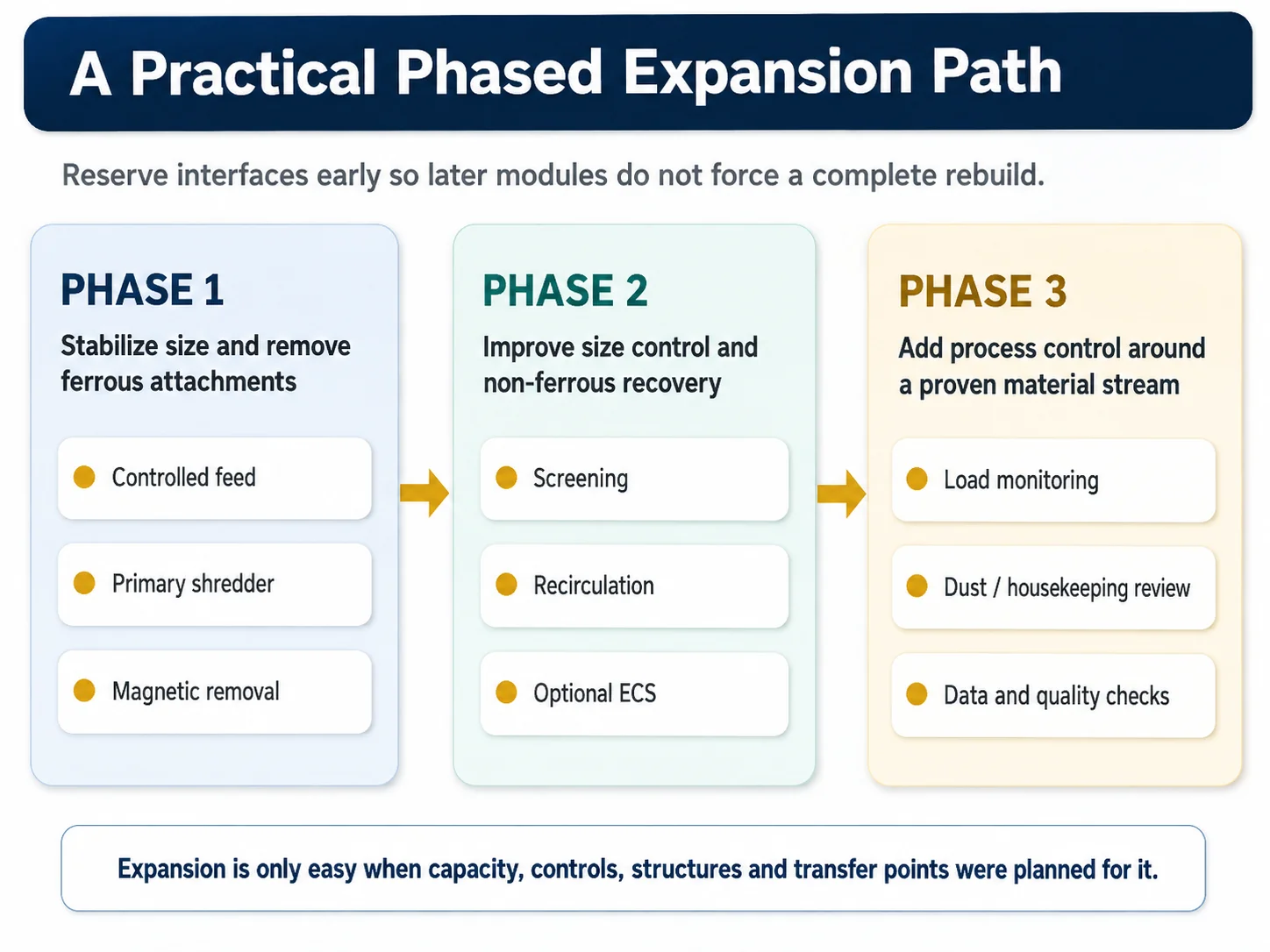
Expansion is easiest when the future process is considered during the first design freeze. The plant does not need to buy every future machine, but it should avoid creating physical and control dead ends.
- Reserve flow capacity carefully. A future separator may need a narrower and more stable particle range than the present discharge. The upstream screen and recirculation concept may therefore matter before the separator is purchased.
- Reserve structural capacity. Platforms, columns and foundations should be checked for the future conveyor or module rather than assumed to be extendable.
- Reserve electrical and control interfaces. Spare cabinet space, I/O, network ports, motor-control capacity and software structure reduce later disruption.
- Preserve maintenance access. Adding a module should not block rotor lifting, screen changes, conveyor take-up or safe cleaning routes.
- Document bypass operation. The plant may need to run while a later module is serviced. Bypass chutes and control modes should be deliberate.
Layout deserves its own calculation because loader routes, floor levels, maintenance pull space and building clearances can limit modular expansion. Use the separate aluminum recycling plant layout guide when placing the reserved modules.
Choose the Delivery Model from Capability and Risk
Choose modular delivery when:
- Useful existing equipment will remain in the process.
- The feed or output contract is still developing.
- The owner has a capable integration, electrical and maintenance team.
- Investment approval must be phased.
- Later upgrades can be supported by reserved interfaces and documented data.
Choose turnkey delivery when:
- The project is greenfield or contains several strongly coupled stages.
- One supplier should coordinate included mechanical, electrical and control interfaces.
- The owner has limited line-integration resources.
- A single startup plan and line-level acceptance test are commercially important.
- The feed, output and site requirements can be defined before design freeze.
Choose modular turnkey when:
- The core line needs one responsible integrator, but future stages should remain optional.
- Local civil and utility contractors are strong, while process integration should stay with the equipment supplier.
- The project wants a working first phase without locking the entire plant into one permanent configuration.
How YUXI Should Define a Modular or Turnkey Aluminum Line
YUXI’s public scrap aluminum recycling line is already organized around the feed and final product rather than one fixed machine arrangement. Profiles, mixed scrap, sheets, wheels and chips do not require the same route. The project may use primary shredding, optional secondary liberation, magnetic removal, screening, eddy current separation, baling or briquetting according to the material problem.
That process logic supports both delivery models. A modular proposal can separate the necessary first-stage equipment, justified options and future interfaces. A turnkey proposal can coordinate the selected modules, controls, drawings, commissioning and acceptance under one defined boundary.
The quotation should still avoid three claims:
- A fixed capacity without a comparable feed and output definition.
- A fixed purity or recovery rate without a sample method and selected technology.
- A claim that “turnkey” includes furnaces, civil works, utilities or permits unless each item is written into the contract.
Equipment selection is a separate engineering step. Buyers defining shredder, crusher, screen, magnet and separator duties can use the aluminum recycling equipment selection guide before the delivery boundary is finalized.
Define the Right Project Boundary Before Ordering
Send representative feed photos or video, material dimensions, contamination, target throughput, required output, workshop data, existing equipment and preferred responsibility scope. YUXI can separate the project into required modules, future options, owner work and supplier work.
Frequently Asked Questions
Can a turnkey aluminum recycling line also be modular?
Yes. Modular describes how the process is divided into sections, while turnkey describes who carries the coordinated delivery responsibility. A supplier can deliver modular process sections under one turnkey contract.
Is a modular aluminum recycling line always cheaper?
No. Phased purchasing can reduce the first order value, but duplicated engineering, temporary conveyors, repeated installation work and interface corrections can increase total project cost. Compare the same final scope and operating requirement.
Does turnkey include the building, foundations and power connection?
Only when the contract says so. Many equipment suppliers use turnkey to mean an integrated process line, while civil works, incoming utilities, permits, cranes and local labor remain the buyer’s responsibility.
Does turnkey include melting and casting equipment?
Not by default. A physical aluminum recycling line may cover feeding, shredding, magnetic separation, screening, eddy current separation, baling or briquetting. Furnaces, decoating, emissions control, alloy adjustment and casting are separate unless explicitly included.
Can an existing shredder or separator be integrated into a new line?
Often yes, provided its feed limits, discharge condition, capacity basis, electrical data, control signals, guarding and maintenance access are documented. The integration risk should be assigned before the order.
What should be included in the acceptance test?
The contract should define the test feed, preparation condition, test duration, stable operating period, throughput measurement, output sampling, allowed exclusions, safety conditions and the remedy if the agreed result is not achieved.
Which delivery model is better for mixed aluminum scrap?
A coordinated line is valuable when the feed requires several connected stages, but the decision still depends on feed stability, the owner’s engineering capability, existing equipment and expansion plans. Mixed scrap does not automatically require a full turnkey site.
Authority Sources and Scope Notes
- World Bank: Standard Bidding Document for Procurement of Plant Design, Supply, and Installation — scope structure for design, supply, installation, testing, commissioning, training and acceptance.
- FIDIC: The FIDIC Suite of Contracts — design-build and turnkey responsibility, owner control and completion-testing context.
- Metso: Concentrator Plant — industry example of modular plant delivery and integrated solution development.
- OSHA: Control of Hazardous Energy (Lockout/Tagout) — hazardous-energy control during service and maintenance.
- OSHA: Machine Guarding — safeguarding risks associated with moving machine parts.