




 Request Quote



Searching for the top scrap aluminum manufacturers often produces a confused list of smelters, scrap dealers and machinery companies. They are not interchangeable.
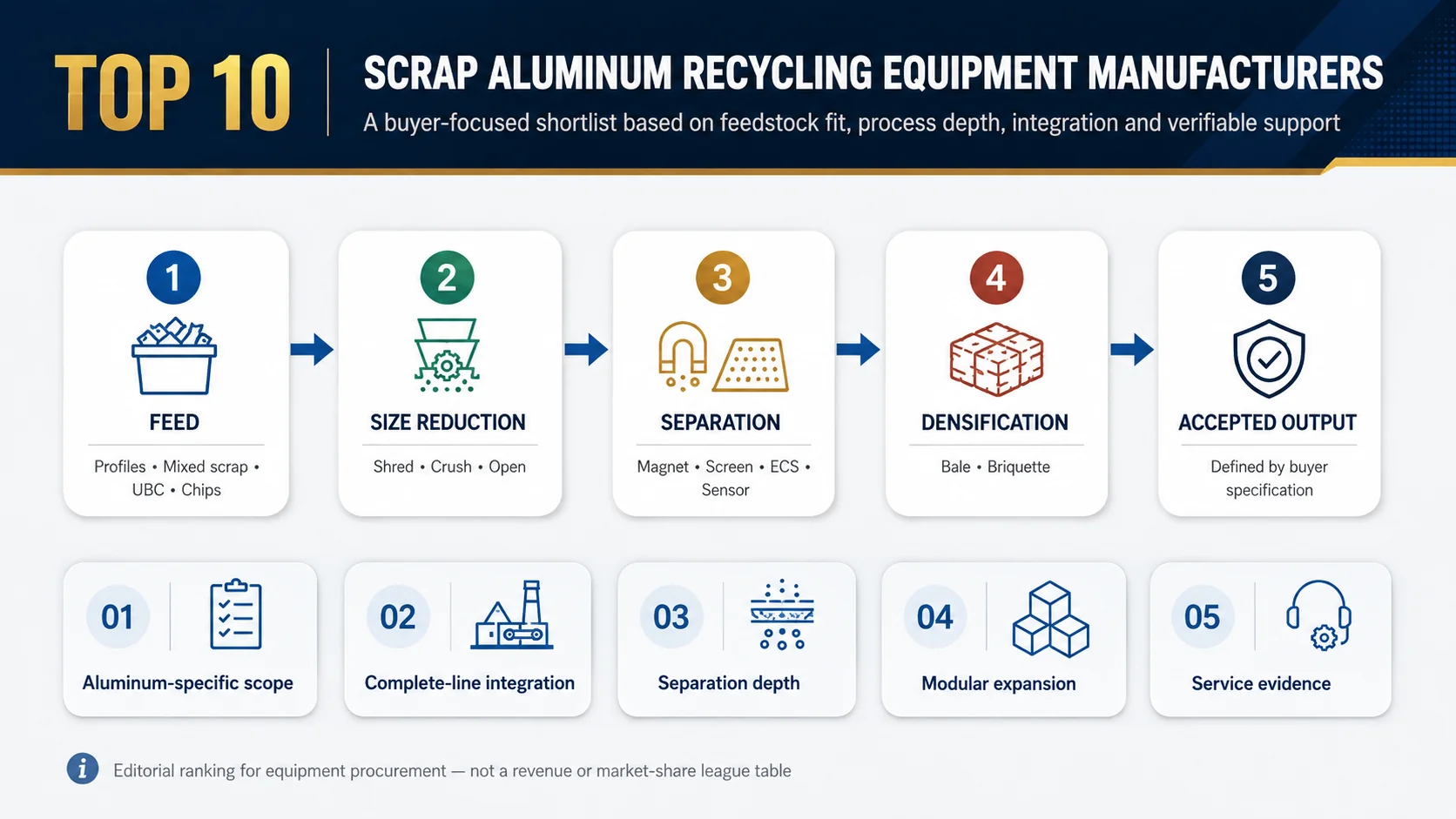
The ranking follows the processing route required by each feedstock: profiles and mixed scrap usually need liberation and separation; clean light scrap may only need inspection and densification; machining chips need fluid control and briquetting. A supplier that is excellent in one route may be the wrong choice for another.
What “Top” Means in This Manufacturer List
No independent database can prove that one recycling-equipment company is universally the “best.” Public websites describe different product boundaries, and not every supplier publishes comparable capacity, recovery or service data. A useful list therefore needs a disclosed method instead of unexplained brand names.
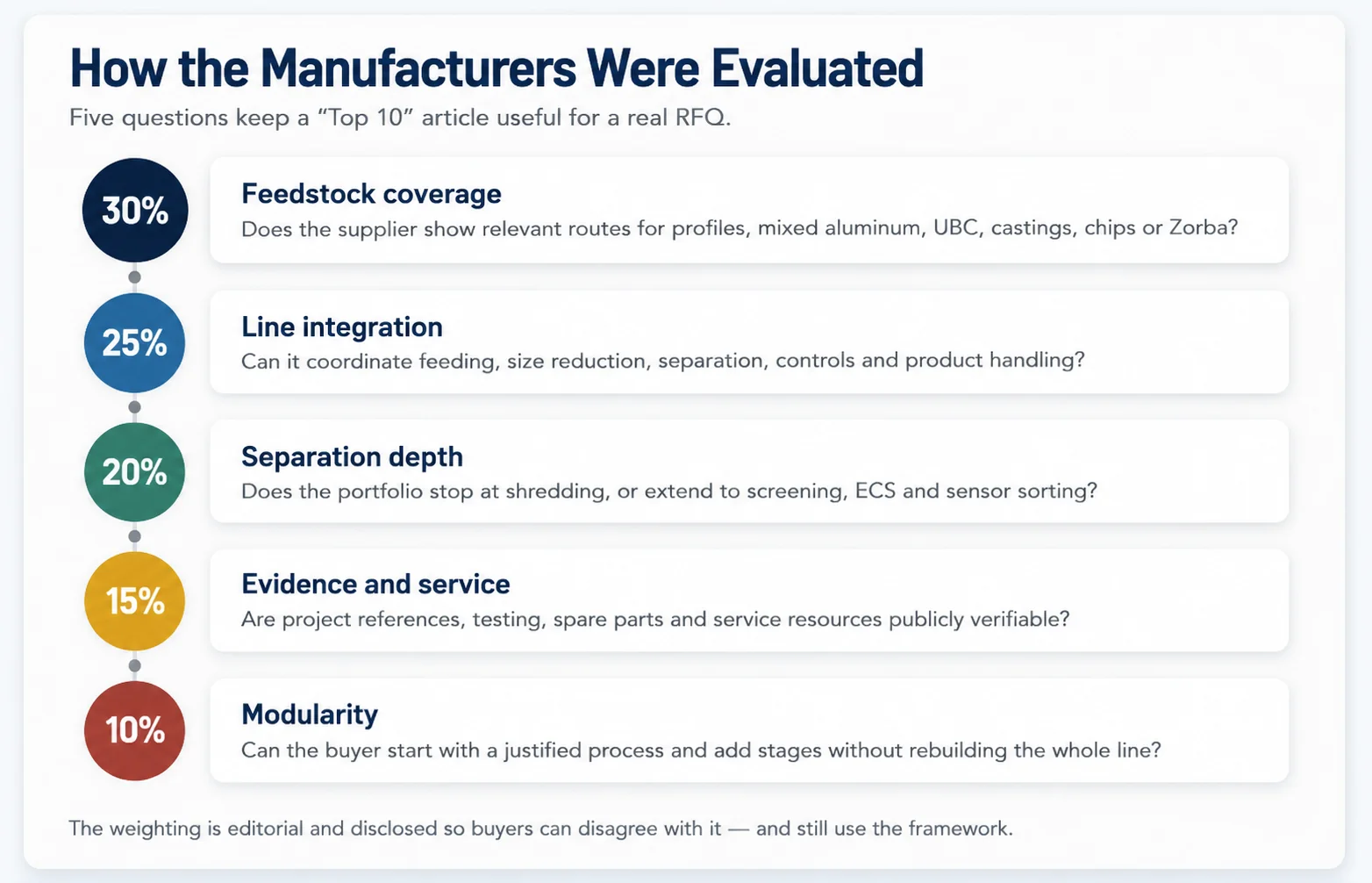
1. Aluminum feedstock coverage
Does the supplier show relevant routes for profiles, mixed aluminum, UBC, castings, chips, turnings or mixed non-ferrous fractions?
2. Complete-line integration
Can it coordinate feeding, size reduction, magnetic removal, screening, eddy current or sensor sorting, controls and product handling?
3. Separation depth
Some manufacturers stop at a shredder. Others can engineer downstream recovery, optical or X-ray sorting, densification or remelt interfaces.
4. Modularity and expansion
A practical supplier should be able to justify the first-stage process and explain how later modules will connect without creating avoidable rework.
5. Evidence and service
Official case studies, testing capability, spare-parts support and clear service scope are stronger evidence than an unsupported purity or capacity claim.
6. Procurement fit
The final ranking favors companies that help a buyer define feed, accepted output and scope—not simply companies with the largest machine.
Before using any list, first work through a structured aluminum recycling equipment selection process . The manufacturer should be shortlisted after the feed and product boundary are understood, not before.
Top 10 Scrap Aluminum Recycling Equipment
| Manufacturer | Country | Strongest project fit | Main point to verify |
|---|---|---|---|
| ELDAN Recycling | Denmark | Established ambient mechanical aluminum recycling systems with standard and customized configurations | Confirm whether the quoted figure is input to a single machine or sustained output from the complete line, and define how fines, attached steel and non-metal residue are measured during acceptance. |
| Danieli Centro Recycling | Italy | Large integrated recycling projects that may connect scrap preparation with downstream remelting | Separate the mechanical scrap-preparation scope from decoating, melting, casting, civil works and plantwide automation. |
| WENDT Corporation | United States | Shredding and high-value downstream recovery with advanced sensor-based sorting options | Define which sensors are in the base proposal, which material classes they identify, the particle-size window, expected belt loading and the number of recirculation passes used to reach the test result. |
| MTB Recycling | France | Turnkey aluminum treatment informed by first-hand recycling-plant operating experience | Ask which reference material most closely matches your feed, how the mass balance was sampled and whether the quotation includes all conveyors, dust interfaces, platforms, controls and residue handling shown in the process diagram. |
| YUXI Machinery | China | Configurable shredding, separation and baling lines for mixed project requirements | Ask for a written feed boundary, continuous line capacity, output specification and factory acceptance test. |
| FOR REC | Italy | Aluminum profile and mixed-aluminum lines using mechanical and sensor separation | Clarify whether “furnace-ready” is a general marketing description or a guaranteed specification for your buyer. |
| GME Recycling | Italy | Broad turnkey projects that can extend from scrap treatment into decoating and remelting sections | Normalize the proposal against a common equipment list. |
| Zato | Italy | Modular pre-shredding, hammer-mill processing and non-ferrous sorting | Ask for wear assumptions on the actual feed, the expected percentage of recirculation, screen strategy, fines generation and how the proposed sorter performs at the stated particle-size distribution. |
| LINDEMANN Metal Recycling Solutions | Germany | Heavy-duty shredding, baling and briquetting for industrial scrap operations | Do not assume the largest shredder is the best choice for aluminum. |
| WEIMA | Germany | Aluminum chips, swarf and turnings that need controlled shredding and briquetting | Test the real chip morphology and fluid loading. |
ELDAN Recycling
Denmark · Best fit: Established ambient mechanical aluminum recycling systems with standard and customized configurations
ELDAN is one of the clearest aluminum-specific equipment suppliers in the comparison. Its official material pages describe both standard systems and customized plants, with public reference capacities for several aluminum routes. That makes it easier for a buyer to understand the process boundary before discussing layout, utilities and local options.
Danieli Centro Recycling
Italy · Best fit: Large integrated recycling projects that may connect scrap preparation with downstream remelting
Danieli is a strong candidate when the recycling plant is part of a larger metals complex. Its published aluminum and non-ferrous portfolio extends beyond size reduction into densification and integration with thermal processing. That breadth is valuable for large projects, although it can be more scope than a regional recycler actually needs.
WENDT Corporation
United States · Best fit: Shredding and high-value downstream recovery with advanced sensor-based sorting options
WENDT is particularly relevant when the business case depends on recovering value from a mixed stream rather than simply reducing size. Its public pages combine shredding with downstream recovery, and the company works with sensor-sorting technology for more demanding non-ferrous applications. This can suit Zorba-type material, aluminum bales and mixed scrap where the final product specification justifies deeper separation.
MTB Recycling
France · Best fit: Turnkey aluminum treatment informed by first-hand recycling-plant operating experience
MTB is unusual because it presents itself both as an equipment manufacturer and as a recycler operating its own treatment activity. That operating feedback can be useful when a buyer wants practical discussion about wear, recirculation and product losses, not only catalog data. Its official aluminum pages cover several common scrap families and turnkey line development.
YUXI Machinery
China · Best fit: Configurable shredding, separation and baling lines for mixed project requirements
The page separates profile and mixed-scrap size reduction, light-scrap baling and chip-treatment routes, which is the right starting point for a project that may change by feedstock. It is especially relevant to buyers who want one supplier to coordinate several mechanical stages without moving directly into a very large mill-scale project. Buyers comparing YUXI can use the scrap aluminum recycling line page as a compact reference for the configurable process boundary.
FOR REC
Italy · Best fit: Aluminum profile and mixed-aluminum lines using mechanical and sensor separation
FOR REC deserves attention for profile, frame and mixed aluminum projects where liberation and sorting have to work together. Its published solutions show a modular sequence rather than treating one shredder as the complete answer. The availability of eddy current and X-ray options also makes it relevant where a buyer wants to move from basic ferrous removal toward a more controlled non-ferrous product.
GME Recycling
Italy · Best fit: Broad turnkey projects that can extend from scrap treatment into decoating and remelting sections
GME has one of the broadest published aluminum process scopes in this group. It can be a useful shortlist candidate when the buyer wants a coordinated plant rather than isolated machines, especially if the project may include thermal treatment later. The same breadth creates a procurement risk: proposals can look similar on the cover while containing very different boundaries.
Zato
Italy · Best fit: Modular pre-shredding, hammer-mill processing and non-ferrous sorting
Zato is a practical candidate where difficult feed needs staged size reduction before separation. Its Blue Devil, Blue Shark and sorting equipment form a recognizable pre-shred, refine and recover sequence. This is useful for profiles and mixed metal scrap that cannot be presented consistently to a separator in their incoming form.
LINDEMANN Metal Recycling Solutions
Germany · Best fit: Heavy-duty shredding, baling and briquetting for industrial scrap operations
LINDEMANN brings a long-established heavy-duty portfolio and is relevant when reliability, installed base and service structure carry more weight than finding the lowest-capital configuration. Its range covers both loose scrap processing and densification, which can help multi-stream yards standardize equipment and maintenance practices.
WEIMA
Germany · Best fit: Aluminum chips, swarf and turnings that need controlled shredding and briquetting
WEIMA is not positioned here as a full mixed-scrap sorting-line supplier. It makes the list because chips and turnings are often forced into the wrong equipment comparison. For machining waste, stable collection, fluid control, short and feedable chip form, and briquette handling can matter more than an eddy current separator. WEIMA has a focused public offering for that route.
Choose the Manufacturer by Scrap Aluminum Route
The strongest shortlist changes when the material changes. Long extrusion profiles bridge in a feeder. Thin sheet can become airborne or form a deep belt layer. Castings carry steel attachments. Chips hold cutting fluid and behave nothing like demolition scrap. Treating all of these as “aluminum” is how buyers end up comparing the wrong machines.
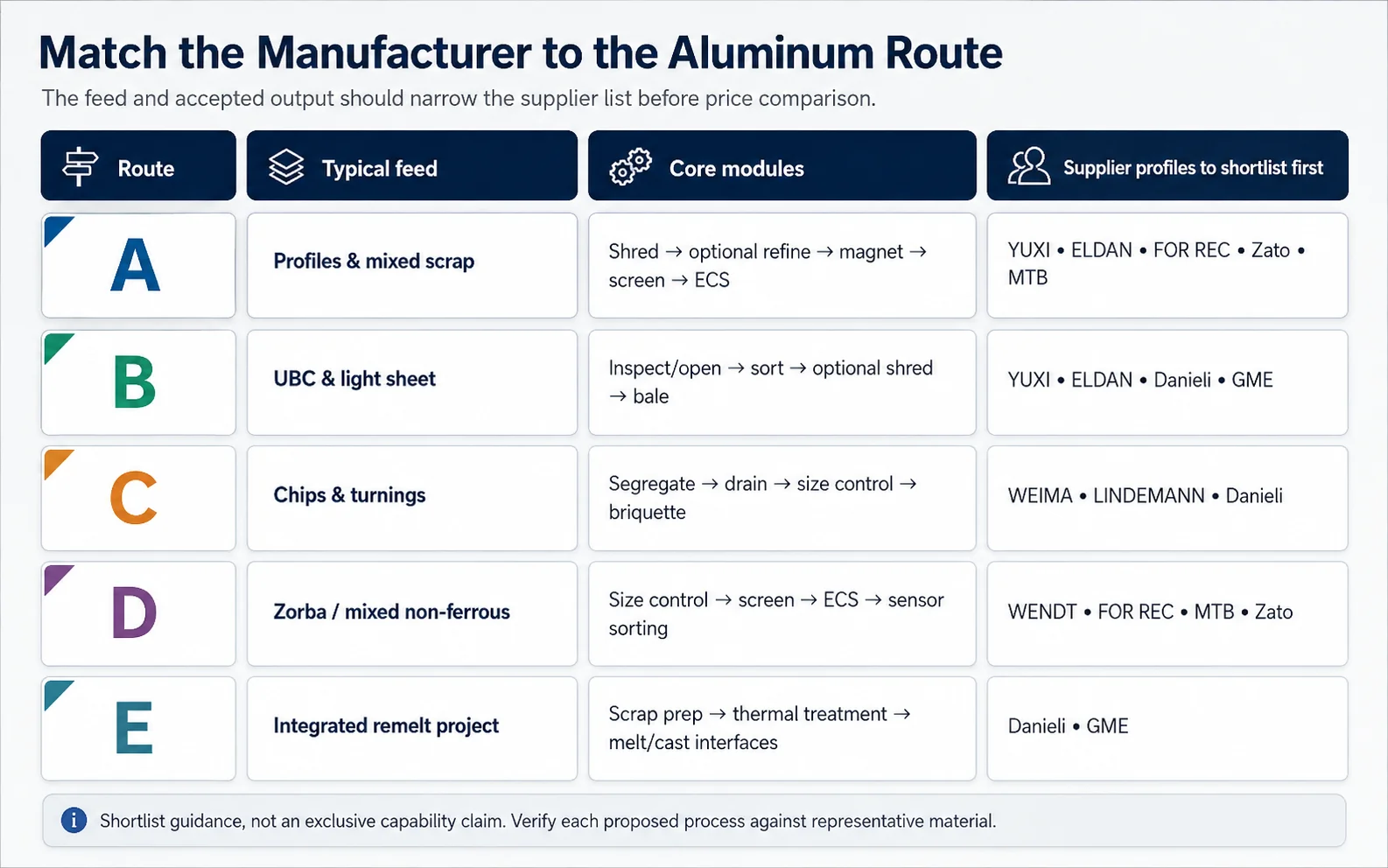
Profiles, frames and mixed demolition aluminum
Look for controlled feeding, a suitable metal shredder, optional secondary liberation, magnetic removal, screening and non-ferrous recovery. Ask how long pieces, steel fasteners, thermal-break polymers and fines affect the test.
Dense castings and difficult composites
A hammer mill metal crusher may be justified when impact and liberation are required, but it also changes wear, energy use and fines. The manufacturer should prove that the extra stage improves the accepted product.
Mixed dry recyclables and Zorba-type streams
Magnetic removal alone is not enough. A correctly prepared stream may need an eddy current separator and, where alloy or heavy-metal separation matters, additional sensor technology. Verify particle-size range, belt loading and recirculation.
Clean UBC, thin sheet and light scrap
Do not add a shredder by habit. Inspection, drainage, sorting, optional bale opening and metal baling machines may be enough. A manufacturer should explain what problem each additional stage solves.
Aluminum chips and turnings
Follow the dedicated aluminum chips recycling process: segregate by source, control fluid, shorten tangled material only when required, remove contamination and briquette under stable feeding conditions.
Integrated remelt projects
When the scope extends into decoating, furnaces, emissions treatment or casting, use suppliers that can define plantwide interfaces. Do not let “turnkey” replace a detailed responsibility matrix.
How to Compare Manufacturers Without Being Misled by the Quote
A manufacturer list is only the beginning. The proposal becomes useful when every bidder receives the same material evidence and is required to answer the same technical questions. Otherwise, a lower quotation may simply omit conveyors, dust interfaces, controls, platforms, testing or installation responsibility.
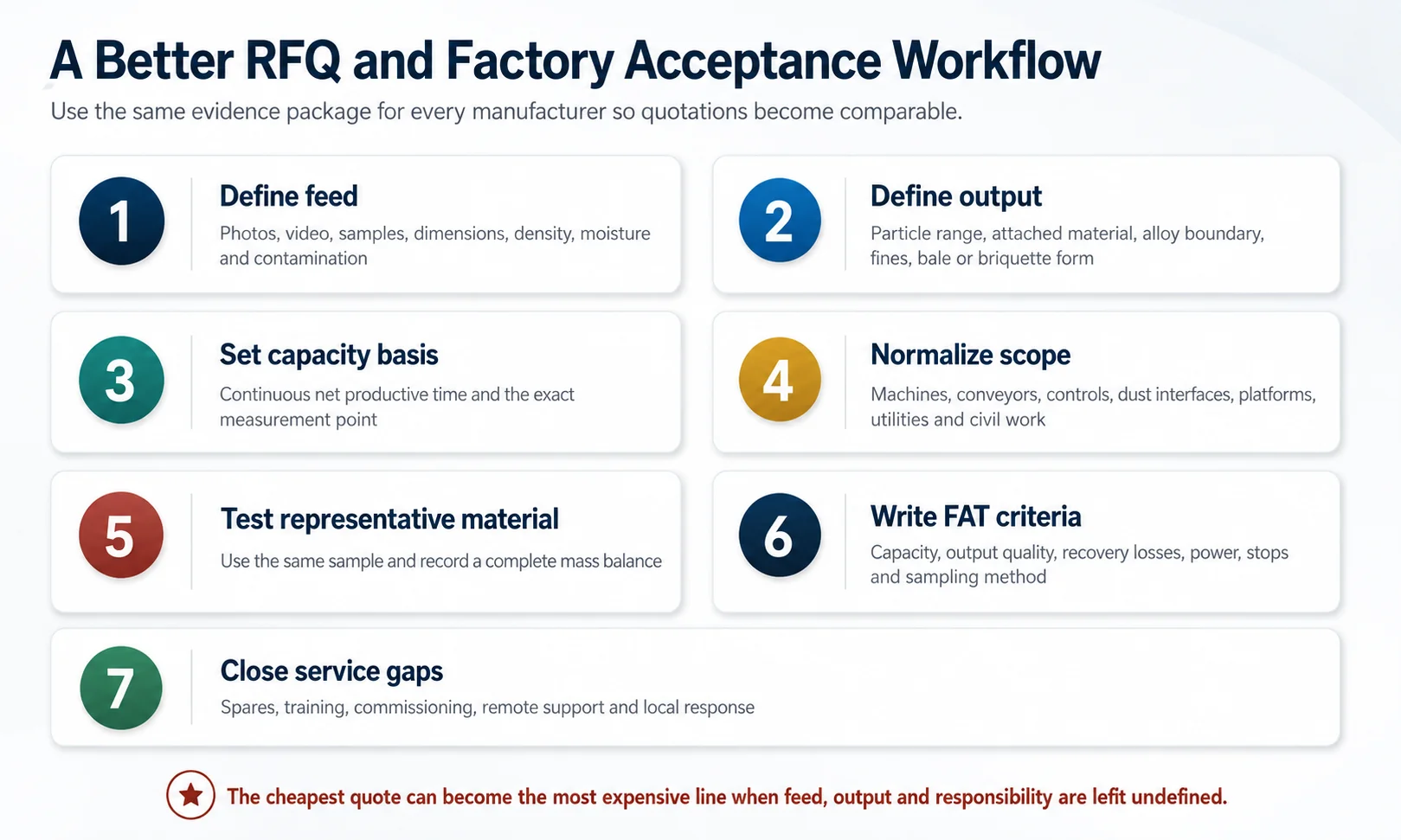
Send this information to every supplier
- Representative photographs, operating video and samples from more than one delivery.
- Material name, source, dimensions, bulk density, moisture, attached steel, plastics, rubber, dirt, oils and fines.
- Required continuous input rate, operating hours and the exact point where capacity will be measured.
- Required output form, particle-size distribution, allowable contamination, alloy boundary and recovery-loss measurement.
- Available building dimensions, floor loading, power, compressed air, water, access and local environmental constraints.
- Expected supplier boundary for foundations, structural steel, wiring, dust collection, fire protection, installation and commissioning.
- Spare-parts package, remote support, on-site service, training and response-time expectations.
Write a factory acceptance test before the purchase order
The FAT should use representative material and record starting mass, each product fraction, residue, fines, recirculated material, net productive time, stops and power conditions. Quality samples should have a defined size, frequency and method. The supplier and buyer should also agree what happens if the feed sample is outside the contracted range.
A detailed guide to comparing aluminum recycling line quotations can prevent a visually complete proposal from hiding an incomplete delivery boundary.
Where YUXI Fits in the Global Shortlist
YUXI is most competitive for buyers who need to build configurable mechanical lines around a defined aluminum feed rather than purchase a single advanced sorting module or an entire mill complex. Its public portfolio includes double-shaft shredding, hammer-mill refining, magnetic and eddy-current separation, conveyors, screening, baling and product-handling equipment.This allows a project team to combine only the stages justified by representative material.
The limitation should be stated just as clearly. A general scrap aluminum line page does not prove a guaranteed alloy split, fixed purity, fixed recovery or universal capacity. Projects involving machining-fluid recovery, briquetting, advanced X-ray or laser sorting, thermal decoating and remelting need an explicit scope review. A credible proposal should make those boundaries visible before price is discussed.
Send Your Feedstock, Not Just a Capacity Number
Share material photos, dimensions, contamination, bulk density, target output, operating hours and site conditions. YUXI can use that information to propose a justified shredding, separation or baling route and define what still needs a representative test.
FAQ
Who is the best scrap aluminum recycling equipment manufacturer?
There is no universal best manufacturer. The right supplier depends on the incoming aluminum form, contamination, required product, sustained capacity, project boundary, local service and acceptance method.
What equipment is normally included in a scrap aluminum recycling line?
A project may include receiving and inspection, conveyors, bale opening, primary shredding, optional secondary crushing, magnetic separation, screening, eddy current or sensor sorting, dust-control interfaces, product handling and baling. Chips and turnings normally follow a separate drainage, size-control and briquetting route.
Should I choose a turnkey supplier or buy separate machines?
A turnkey supplier can reduce interface risk, while separate machines can offer more flexibility or lower initial cost. Compare both options using the same final feed, output, controls, safety scope, installation responsibility and factory acceptance test.
How should two manufacturers’ capacity claims be compared?
Use the same representative feed and define continuous net productive time, measurement point, recirculation, output specification and allowed downtime. A peak shredder feed rate is not the same as saleable aluminum output from a complete line.
Does an eddy current separator sort aluminum alloys?
Not by itself. An eddy current separator can recover suitable conductive non-ferrous particles from a prepared non-metal stream. Alloy or heavy-metal separation may require additional sensor-based equipment, controlled particle presentation and a separate acceptance specification.
Official Sources Used for the Shortlist
The list relies on manufacturer-owned product and solution pages. Public claims were limited to what those pages support; no undisclosed sales, purity or market-share data were invented.
- ELDAN Recycling official equipment or aluminum-recycling page
- Danieli Centro Recycling official equipment or aluminum-recycling page
- WENDT Corporation official equipment or aluminum-recycling page
- MTB Recycling official equipment or aluminum-recycling page
- FOR REC official equipment or aluminum-recycling page
- GME Recycling official equipment or aluminum-recycling page
- Zato official equipment or aluminum-recycling page
- LINDEMANN Metal Recycling Solutions official equipment or aluminum-recycling page
- WEIMA official equipment or aluminum-recycling page
- The Aluminum Association — aluminum recycling overview
- OSHA — scrap metal recycling safety and health topics