




 Request Quote



On a dry OCC line, paper dust rarely behaves the way a neat equipment drawing suggests. Most of the board may travel quietly for several metres, then one transfer, one fiber-opening stage or one badly loaded chute suddenly throws fines into the air. That is why paper dust collection should be designed from the actual release points, not from a collector catalogue. Combustible-dust safety sits on top of that problem. It is related to capture, but it is not solved simply because a filter is installed.
Paper is one of the organic materials OSHA identifies as capable of producing combustible dust, and OSHA also discusses combustible-material hazards in paper recycling.[1][2] That does not turn every piece of corrugated board into an explosion hazard. It does mean that fine material created by shredding, dry fiber opening and repeated transfer should not be dismissed because the incoming bale looked harmless. Particle size, moisture and other physical characteristics matter. The useful question is not simply “is cardboard combustible?” It is “what fine fraction does this line create, where can it collect, and what can ignite it?”
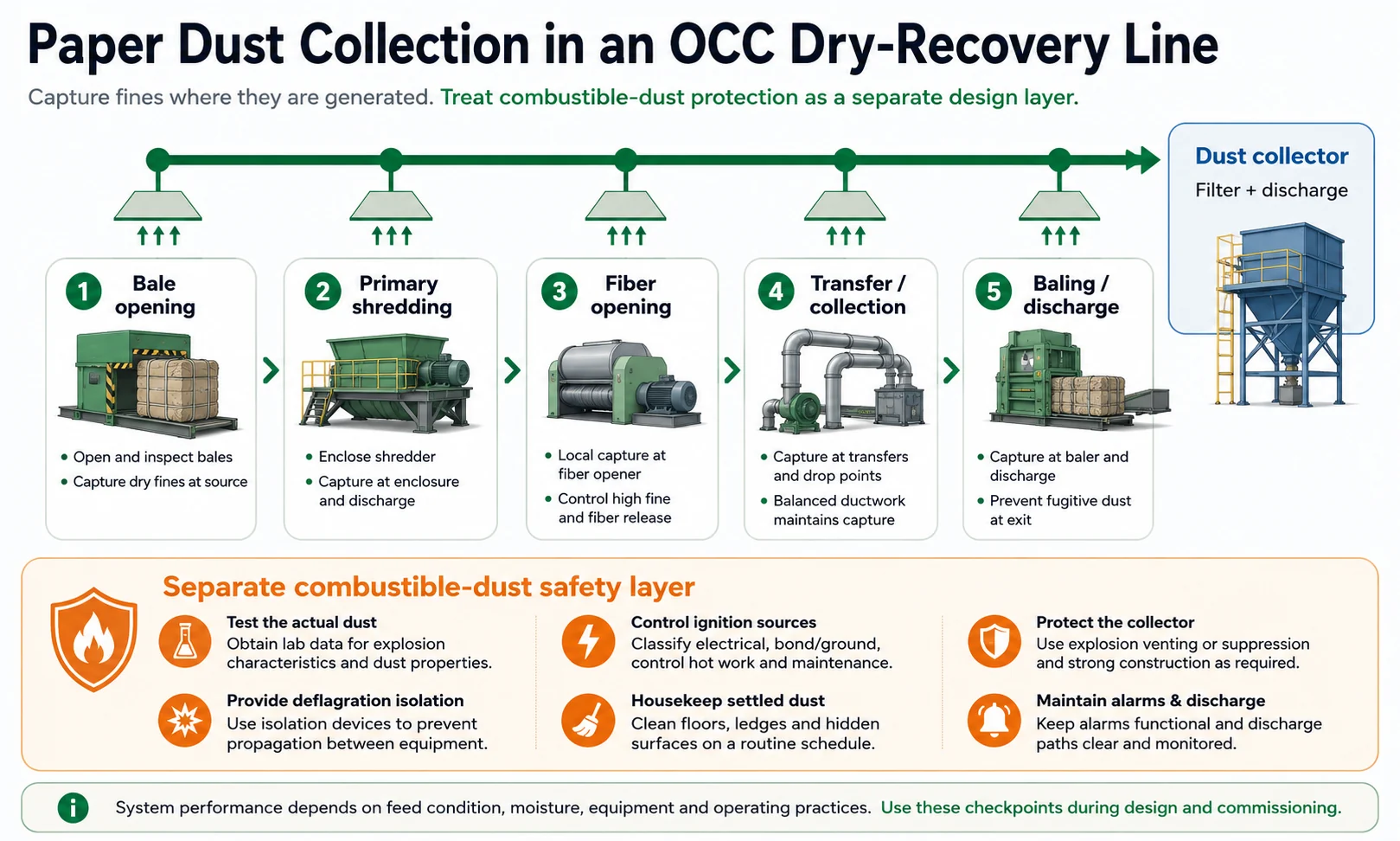
Where Paper Dust Appears in an OCC Dry-Recovery Line
The dust load is not uniform from the bale floor to the final fiber discharge. In fact, treating it as uniform is one of the quickest ways to end up with an oversized main collector and still miss the dirty transfer point. Whole corrugated sheets, torn pieces, opened fiber and collector fines all move differently.
Bale opening is a good example. A bale can look relatively clean from outside, yet when the compressed layers separate, old fines trapped between sheets are suddenly released. If the feed is dry, brittle or heavily handled, the plume can be more noticeable. The issue is usually worse when the bale is opened in bursts and the next conveyor is already full. Stable feeding helps the process and the dust system at the same time.
The primary shredder changes the character of the material. Tearing creates fresh edges and new fines. More importantly, the discharge is a moving-air zone: material leaves the cutting chamber, falls, changes direction and lands on another conveyor or into a chute. A hood placed somewhere above the machine may look adequate on a drawing but do very little at the actual release point.
Farther downstream, the dry fiber-opening section deserves even closer attention. This part of the line is intentionally breaking paper structure apart. The fraction becomes lighter and easier to entrain. If a plant only thinks about dust around the shredder and ignores this stage, the cleaner-looking front end can distract from the real downstream load.
| Process point | What tends to happen | What we would review |
|---|---|---|
| Bale opening / inspection | Compressed layers separate and old fines are disturbed. | Operator position, opening method, local enclosure, reject handling and floor cleanup. |
| Primary shredder discharge | Tearing produces fines; falling material creates air movement. | Discharge hood, seals, negative pressure and safe access for clearing jams. |
| Buffer and transfer points | Bridging or sudden release can create short dust peaks. | Drop height, chute shape, belt loading, branch balance and enclosure leakage. |
| Dry fiber-opening machine | Paper is mechanically opened into a lighter fraction. | Local capture, process air, usable-fiber carryover and filter loading. |
| Pneumatic / fiber collection | Fiber and fines are already moving with air. | Separation efficiency, fan position, filter duty and safe solids discharge. |
| Baler or loose discharge | Loose fiber falls, compresses and is handled during cleanup. | Transfer enclosure, floor accumulation and operator access. |
These are attention points, not universal dust-load ratings. A wet, heavy OCC stream can behave very differently from a dry stream of brittle cartons. Coatings, labels, tape, printing and dirt also shift the fines fraction. Machine settings matter too.
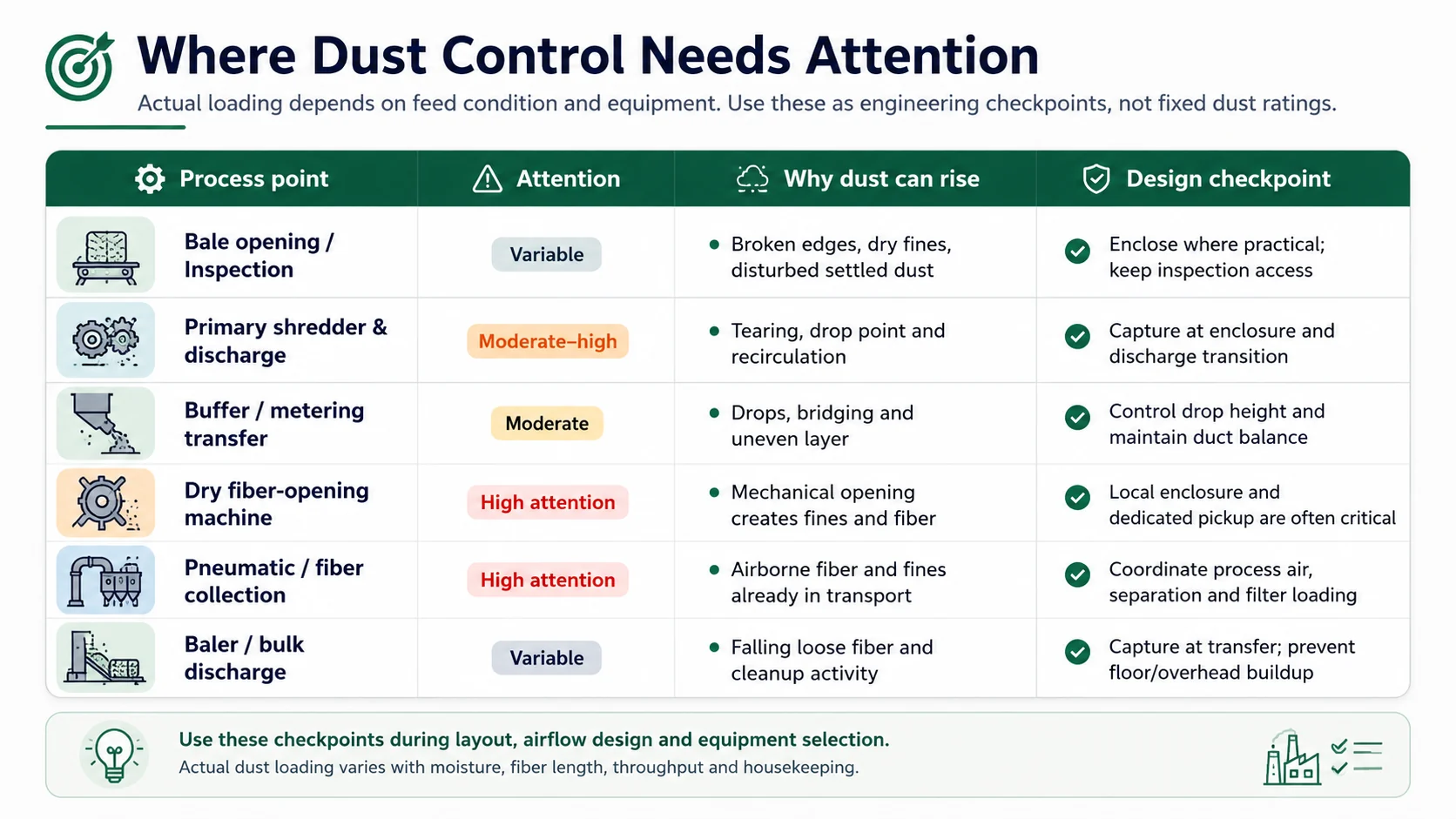
The distinction between dry fiber recovery and wet stock preparation also matters here. In a dry line, fine paper remains in a dry material-handling environment until it is captured or discharged. Wet systems have a different air-and-water boundary. Borrowing assumptions from a wet mill section can leave the dry side poorly understood.
Paper Dust Collection and Combustible-Dust Safety Are Two Different Jobs
One phrase causes a lot of confusion during equipment discussions: “explosion-proof dust collector.” It sounds reassuring, but it bundles several separate design questions into one label.
Dust collection job
The collection system has to stop fines from escaping where they are generated, keep the process area reasonably clean, control airborne material where worker exposure is relevant, and move captured dust and fiber to a controlled discharge point. This is mostly a question of hoods, enclosure, airflow, duct balance, filtration and solids handling.
Combustible-dust safety job
Safety starts with a different question: can the generated dust support a flash fire or deflagration under the conditions present? If the answer is yes, or cannot yet be ruled out, the design has to consider ignition control, confinement, deflagration protection, isolation and the chance of dust becoming airborne again elsewhere.
OSHA commonly illustrates the problem with the dust-explosion pentagon: combustible dust, oxygen, an ignition source, dispersion at a sufficient concentration and confinement.[2] A process does not need to “look explosive” during normal production for those elements to line up during a fault.
This is why filter efficiency alone is not a safety argument. A very effective collector may still contain a concentrated dust cloud inside a confined vessel. The reverse is also true: a collector fitted with a protection device does not make it acceptable for dust to leak from every transfer and settle on beams, cable trays and equipment.
Start With the Dust You Actually Produce
A clean piece of virgin corrugated board is a poor substitute for the material found in a commercial OCC stream. Incoming bales may carry printed surfaces, labels, adhesives, tape, fine dirt and variable moisture. Then the process itself changes the particle size as the board is shredded and mechanically opened.
That creates a sampling problem. If the hazard is associated with fine dust entering the collector, testing a piece cut from an incoming carton may tell you very little about that fine fraction.
Build a representative sample plan
Before sending material to a laboratory, decide which operating condition the sample is meant to represent. Normal production is one case. The driest acceptable feed may be another. Supplier changes, heavily printed stock, adhesive-rich cartons, screen changes or recirculated fines can all alter what reaches the collector. Samples also need to come from a safe location that actually represents the material of interest.
For some plants, that means more than one sample. A fiber-opener discharge can be useful for understanding what is being created mechanically, while collector-hopper material may better represent what the air system is retaining. The point is not to test everything. It is to avoid testing the easiest material just because it is easy to reach.
Use laboratory data when the hazard decision depends on it
OSHA technical material discusses laboratory testing as part of combustible-dust hazard evaluation, and its combustible-dust guidance refers to properties such as minimum ignition energy (MIE), minimum explosible concentration (MEC) and the dust deflagration index Kst.[2][3] Maximum pressure, particle-size distribution, moisture and ignition temperatures may also be relevant, depending on the protection method and design question.
There is an important practical consequence: do not lift a Kst value from a generic “paper dust” table and treat it as the design value for an OCC project. OSHA notes that dusts from the same base material can behave differently when their physical characteristics change.[3] A generic value can be useful for recognizing that a hazard may exist. It is a weak basis for final protection design when representative material can be tested.
For U.S. projects, NFPA 660 now provides the consolidated combustible-dust and particulate-solids framework. It is better described as a consensus standard and design reference than as “the OSHA law.” OSHA itself lists mandatory standards that can apply to different parts of a combustible-dust situation, including housekeeping, ventilation, hazardous locations, paper-related operations and hazard communication.[4][5] The adopted code, insurer and local authority having jurisdiction still have to be checked.
Design Source Capture Around the Material Flow
Once the process map is clear, dust capture becomes less mysterious. The objective is not to create the strongest possible suction. The objective is to capture the release where it occurs without stealing an unreasonable amount of saleable fiber or disturbing the process.
Get the hood close to the release point
A hood mounted high above an open conveyor often has to move a large volume of air before it has much influence on dust near the belt. Bringing the hood closer, enclosing part of the transfer or using curtains around the release zone usually makes the airflow easier to control. It also reduces the temptation to solve every weak pickup by increasing fan size.
Access is the compromise. Chutes need inspection, shredders need safe clearing space, and doors have to open. An enclosure that blocks normal maintenance will eventually be removed, left open or cut away. That is not a theoretical problem; it is a layout problem. The access door, hinge direction and service clearance should be drawn at the same time as the pickup.
Keep material flow steady
Dust collection reacts badly to process surges. A conveyor that runs half empty for several minutes and then receives a large dump from a bridging hopper creates two different air conditions. The dust system may be sized correctly for average throughput and still struggle during the short peak.
This is one reason metering matters beyond capacity control. The industrial cardboard recycling machine guide treats dust control as part of complete-line sizing rather than an isolated accessory. Stable feed gives the hood and branch airflow a repeatable condition to work with.
Define pickup points before routing the duct
Mark the pickup points on the general arrangement before the main duct is routed. For each branch, note the opening, enclosure, operating state, expected fiber carryover and maintenance access. Also note whether it runs continuously or only with a specific machine.
Only then does a fan number start to mean something. There is no responsible universal CFM value for “one OCC shredder” or “one dry pulper.” The airflow depends on opening size, leakage, process air, duct losses, how many branches operate together and how easily the paper fraction becomes entrained.
A quotation that gives one total airflow number but no pickup schedule is difficult to check. Two systems can show the same fan volume on paper and perform very differently at the farthest branch.
Coordinate Ductwork, Collector Location and Dust Discharge
The collector is not the system. It is one component in a pressure network that includes hoods, branches, elbows, dampers, filters, discharge devices and the fan. If one part is changed late, another part often pays for it.
Long horizontal runs, unnecessary elbows and branch take-offs added after the building layout is fixed can increase losses and create places where material settles. A filter also changes resistance as it loads. If the design has little margin, a branch that captured well during commissioning can become weak later while the main fan still sounds perfectly normal.
| Item | Question worth closing before purchase | Why it matters |
|---|---|---|
| Duct routing | Can the route maintain the required transport condition without avoidable bends or long flat runs? | Deposits reduce flow and add combustible inventory inside the network. |
| Branch balance | Which pickups run together, and how will balance be checked after installation? | Total airflow does not prove that the restrictive branch is receiving enough air. |
| Collector location | Indoors, outdoors, attached to the building or remote? | The answer affects duct length, maintenance access, weather exposure and deflagration-protection options. |
| Return air | Will filtered air be exhausted outside or returned to the building? | Return air changes both exposure and fire/deflagration consequences and should not be decided only on energy savings. |
| Solids discharge | Where do fines go after the hopper? | A blocked rotary valve, full bin or open bagging station can simply move the dust problem downstream. |
Collector location deserves an early decision. Outdoor siting can make some venting and safe-discharge arrangements easier, but it may add duct length, weather protection and winter maintenance. Indoor siting may shorten ducts but requires closer review of venting or suppression, isolation, occupied spaces and any filtered-air return. There is no one location that is automatically correct.
The discharge side is often overlooked during early quotes. A good collector connected to a poor hopper discharge still gives operators a dusty job. If a screw conveyor, rotary valve, compactor, bin or bag is part of the route, its capacity and failure mode belong in the design discussion.
Build Fire and Deflagration Protection in Layers
After the dust is characterized and the hazard analysis establishes a combustible-dust concern, protection should be built in layers. No single device covers every scenario.
Prevent credible ignition sources
Start with the sources that can realistically appear in the process. Foreign metal can enter OCC. Bearings can overheat. A jam can create friction. Electrical equipment may be exposed to dust. Hot work can occur during maintenance. Static and other ignition mechanisms may also have to be considered, depending on the system and material.
This is where basic process equipment condition matters. A dust-safety plan that depends on perfect maintenance while bearings, belts or cutting components are allowed to run badly is not a strong plan. Prevention has to survive normal production pressure.
Protect the collector for the actual hazard
Where a deflagration hazard exists, the collector or other enclosure may require engineered venting, suppression or another accepted protection method. The correct approach depends on dust properties, vessel strength, location, occupancy, vent path and the adopted code basis. A protection panel is not something to size from collector dimensions alone.
Stop propagation through connected ductwork
This part is easy to miss because the duct is visually just a pipe between machines. During a deflagration, it can also be a path for flame and pressure. Isolation is intended to keep an event in one part of the system from propagating into connected equipment or work areas. The required device and location depend on the system arrangement and hazard analysis.
Detect fire where the risk assessment justifies it
Some layouts may justify spark, ember, heat or smoke detection, or a suppression response, especially where material can carry an ignition source toward a collector. That decision should be connected to the real ignition scenario rather than added as a generic accessory.
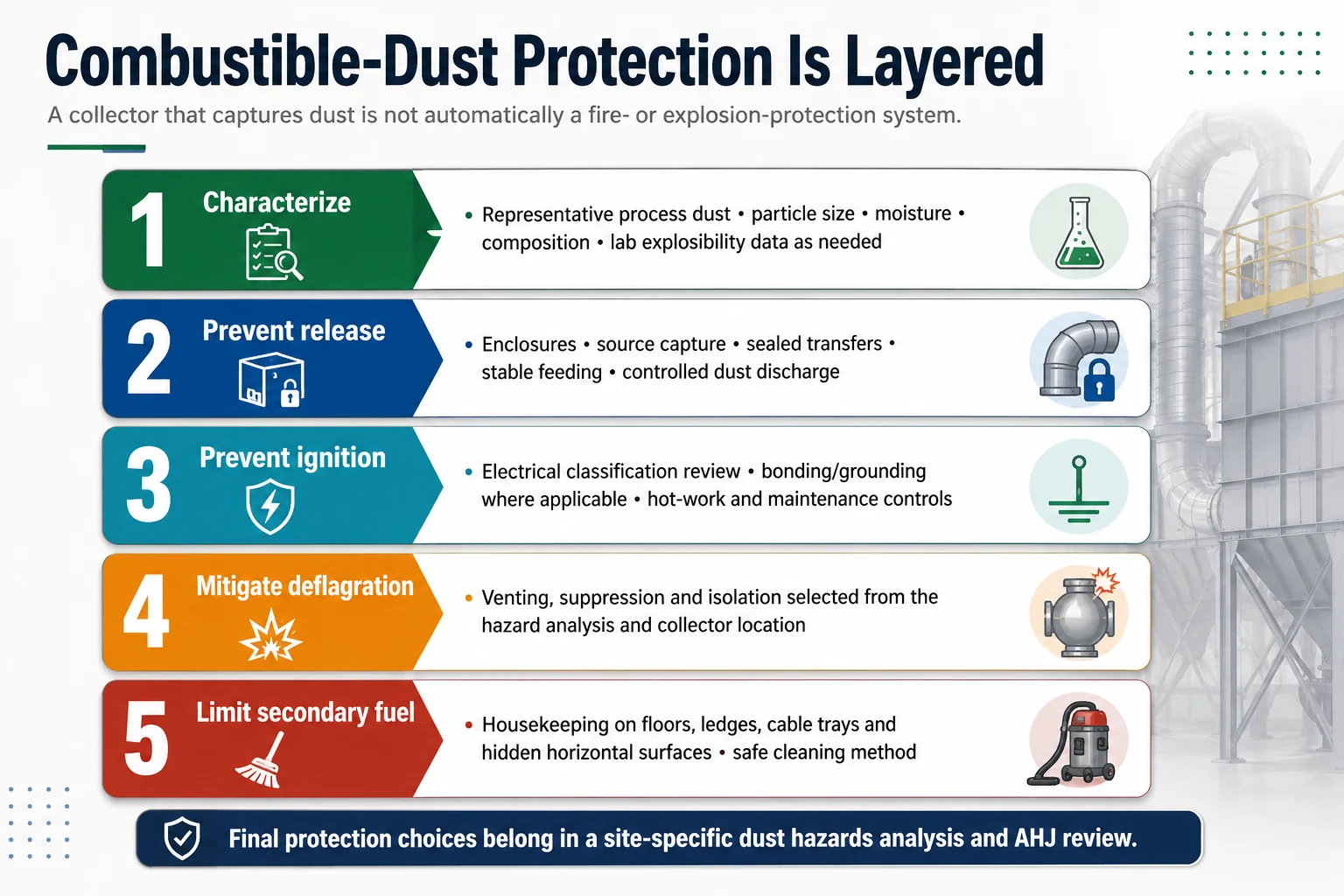
OSHA technical guidance discusses dust-tight equipment, deflagration relief, isolation, housekeeping and ignition control as parts of combustible-dust risk reduction.[3][6] Which of those measures applies to a particular OCC plant cannot be decided from an article or a collector brochure; it has to come from the site design basis and hazard review.
Housekeeping Controls the Fuel for a Secondary Explosion
A small primary event can disturb deposits on floors, beams, equipment tops and cable trays. Once that dust is suspended, the second event can involve a much larger area. The U.S. Chemical Safety Board has highlighted this secondary-explosion mechanism in combustible-dust incidents repeatedly.[7]
In OCC plants, cleanup is also a useful diagnostic. If the same ledge or machine top needs to be vacuumed every shift, that tells you something about the process. The pickup may be weak, a chute may leak, or the material may be escaping before the hood can capture it. Housekeeping should not become a permanent substitute for fixing a bad release point.
Write the cleaning method into the operating plan
The method matters. Routine compressed-air blowdown can take a settled layer and put it back into suspension. OSHA combustible-dust guidance recommends cleaning methods that do not generate dust clouds when ignition sources are present.[6] Any use of compressed air should therefore follow the site hazard assessment, applicable standards and the facility’s approved cleaning procedure. Facilities commonly prefer methods that collect the dust rather than redistribute it, with equipment and procedures selected for the assessed hazard.
Do not reduce housekeeping to one universal “safe dust thickness.” Surface area, dust density, dispersion potential and building geometry vary too much for that shortcut to be reliable. A site-specific program should define inspection areas, cleaning frequency, acceptable accumulation and who is responsible for high or hidden surfaces.
Interlocks, Alarms and Maintenance Keep the Design Working
A dust system can be correctly designed on day one and gradually stop doing its job. Filters load. Dampers move. Doors are left open. Flexible connections split. A hopper fills. A rotary valve stops. None of these failures looks dramatic at first, but each can change capture or safety performance.
That is why operators need a small set of conditions they can actually see and act on. Filter differential pressure is one. Fan or airflow status is another. Hopper-high level, rotary-valve status, fire-detection signals and protection-system faults may also belong in the logic, depending on the final design.
Interlocks should follow the process consequence. If loss of dust collection would quickly release fines from a fiber opener, continuing full production may not be acceptable. If a discharge valve stops, it may be better to stop upstream material before the hopper packs solid. The exact sequence is project-specific, but the logic should be written before commissioning rather than improvised after the first blockage.
Maintenance access needs the same realism. Filters need service space. Explosion-protection devices need inspection. Ducts may need cleanout points. Fans need bearing access. If technicians cannot reach these parts safely, preventive maintenance gets deferred and temporary fixes become permanent.
What to Put in an OCC Paper-Dust System RFQ
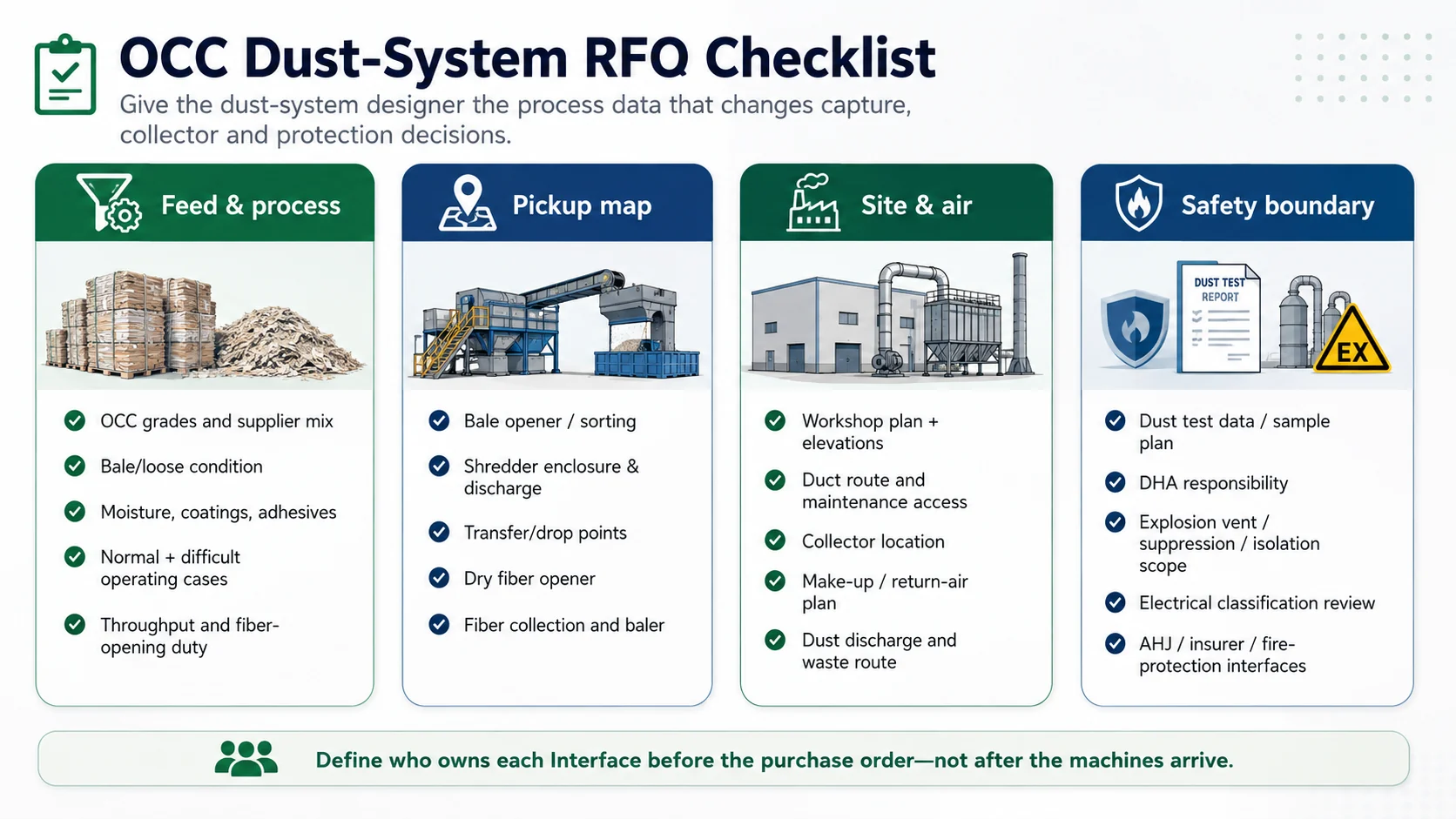
A dust collector quote should not sit beside the process-line quote with a vague note saying “by others.” That is how interface gaps appear. The RFQ should show what the process generates, where pickups are expected, what the site constraints are and who owns the hazard-analysis and protection decisions.
Feed and operating data
- OCC grades, supplier mix and the amount of variability expected.
- Baled or loose condition, bale dimensions and tying material.
- Observed moisture range, printing, coatings, tape, adhesive and dirt.
- Normal throughput plus difficult operating cases, not just nominal capacity.
- Required final dry-fiber condition and how fines are handled.
Dust pickup schedule
List the actual points: bale opening, shredder enclosure and discharge, transfer drops, buffer/metering transitions, dry fiber-opening equipment, pneumatic fiber handling and final baling or loose discharge. For each point, define enough geometry that the dust supplier can understand what is open, what is enclosed and what needs operator access.
Site and air data
- Building plan and elevations.
- Collector location options and weather conditions.
- Likely duct routes and maintenance clearances.
- Make-up air and any plan to return filtered air indoors.
- Collected-dust storage, discharge and disposal route.
Safety responsibility matrix
This is often the most valuable page in the RFQ. Put a name beside dust sampling, laboratory testing, dust hazards analysis, collector protection, isolation, electrical classification, local fire-code coordination, installation and acceptance testing. If the row says “TBD” for everyone, the risk has not disappeared; it has only been postponed.
Acceptance testing should resemble production closely enough to mean something. Confirm capture at the agreed points, branch balance or pressure readings, filter differential pressure, hopper discharge, alarms and interlocks. Any protection devices also need their approved functional checks. A ten-minute demonstration with unusually clean, damp cardboard is not a convincing acceptance test for a plant that normally runs dry, variable OCC.
Common Paper Dust Collection Mistakes in OCC Projects
Buying the collector by CFM alone
A large fan number can look impressive in a quotation. It says very little about whether the fiber-opener pickup or the remote shredder branch will capture properly. Ask to see the pickup schedule and design basis.
Putting one pickup at the end
Dust does not wait politely until the final baler. If it escapes at an upstream transfer, a downstream hood cannot pull it back through the building.
Testing the wrong sample
Incoming cardboard is convenient to sample. It may not represent the fine material generated after shredding and fiber opening. Match the sample location to the hazard question.
Calling the filter “explosion-proof”
This skips the important details. Filtration, deflagration protection, isolation and ignition control are separate functions. The quote should say which one is being provided and on what basis.
Ignoring the collector discharge
A full bin, failed rotary valve or dusty bagging station can turn a clean collector outlet into the dirtiest point on the plant floor. The solids route is part of the system.
Returning air indoors without review
Returning filtered air may have an energy benefit. It also changes the consequence of filter leakage or a fire/deflagration event. Treat it as an engineering and code decision, not the default.
Using compressed air as routine cleanup
Blowdown is fast, which is exactly why operators tend to like it. It can also redisperse dust. The cleaning procedure has to match the hazard assessment.
Adding ducts after layout approval
Late ductwork usually gets the leftover space. That can mean long runs, tight bends, blocked service doors or a collector placed where safe discharge is awkward. Reserve the route while the main line is still being arranged.
Where Dust Collection Fits in the YUXI OCC Dry Pulping Line
The current YUXI OCC paper dry pulping and cardboard recycling line presents the process as a connected sequence: bale handling and inspection, controlled feeding, shredding, magnetic separation, buffering and metering, mechanical dry fiber opening, dust/light-reject control, fiber collection and final baling or bulk discharge. The page also identifies dust collection and air handling as a core module, and points out that duct layout has to be coordinated with cleaning, access and fire-control provisions.
The final collector, duct network, protection devices, electrical requirements and building interfaces still depend on the OCC stream, generated dust, workshop and jurisdiction.
Plan the OCC Line and Dust System Together
Send YUXI representative OCC feed information, required throughput, workshop drawings and any existing dust-test or fire-protection requirements. The process layout can then reserve the pickup points, access space and dust-system interfaces before the final equipment arrangement is fixed.
Paper Dust Collection and OCC Safety FAQ
Is paper or cardboard dust combustible?
It can be. OSHA identifies paper among organic materials capable of producing combustible dust. The important part for an OCC plant is the fine fraction the process actually creates. Particle size, moisture and other properties can change the behavior, so representative material should be evaluated when the design decision depends on combustibility.
Does every OCC recycling line need explosion venting?
No. The requirement depends on whether a combustible-dust deflagration hazard exists, the collector or enclosure involved, its location, the dust properties, connected ductwork and the code basis. Venting is one possible protection method; suppression or other engineered methods may be appropriate in other cases.
Can a dust collector prevent a dust explosion by itself?
No. It can capture airborne fines, which is important, but that does not replace dust characterization, ignition control, protection of hazardous enclosures where required, isolation, housekeeping and safe discharge of the collected material.
Where should dust pickups be checked on an OCC line?
Start with bale opening, shredder discharge, transfer drops, buffer or metering transitions, the dry fiber-opening machine, pneumatic fiber handling and final discharge. The final pickup schedule should follow observed dust release and the actual enclosure geometry.
Should the dust collector be indoors or outdoors?
Outdoor siting may simplify some safe-discharge and venting arrangements but adds duct length and weather concerns. Indoor siting can shorten ducts but usually requires closer review of isolation, venting or suppression, return air and occupied-space exposure.
Can compressed air be used for paper-dust cleanup?
It should not be treated as the routine default. Blowdown can redisperse settled dust. OSHA guidance places conditions on compressed-air cleaning in combustible-dust situations, so the site hazard assessment and approved cleaning procedure should govern the method.
What dust tests might be needed?
The test set depends on the hazard question and protection method. Particle-size distribution, moisture, explosibility screening, Kst, maximum pressure, MIE, MEC and ignition-temperature data are among the properties that may be relevant. The responsible dust-safety professional or protection supplier should define the required basis for the actual sample.
What should be sent to YUXI for a dust-control review?
Send feed photos or video, OCC grade and supplier variation, bale condition, moisture and contamination observations, required throughput, workshop drawings, intended equipment sequence, existing dust-test data if available, collector-location constraints and the local fire/electrical design boundary.
External Engineering References
- U.S. Occupational Safety and Health Administration, Green Job Hazards — Recycling: Paper. Used for paper-recycling machinery, unexpected-startup and combustible-material hazard context.
- U.S. Occupational Safety and Health Administration, Hazard Communication Guidance for Combustible Dusts. Used for the dust-explosion pentagon, paper as an organic combustible-dust example, secondary-explosion mechanism and dust-property terminology.
- U.S. Occupational Safety and Health Administration, OSHA Technical Manual — Section IV, Chapter 6, Combustible Dusts. Used for hazard evaluation, testing, collector/isolation and housekeeping review points.
- U.S. Occupational Safety and Health Administration, Combustible Dust — Standards. Used to distinguish mandatory OSHA provisions that address aspects of combustible-dust hazards from consensus-code design references.
- National Fire Protection Association, NFPA 660, Standard for Combustible Dusts and Particulate Solids — official standard development page. Used for the current consolidated combustible-dust framework; project teams must confirm adopted requirements and edition with the AHJ.
- U.S. Occupational Safety and Health Administration, Combustible Dust in Industry: Preventing and Mitigating the Effects of Fire and Explosions. Used for dust-control, housekeeping, ignition-control and fire/explosion-mitigation practices; facility-specific applicability must be evaluated.
- U.S. Chemical Safety and Hazard Investigation Board, Combustible Dust Hazard Study. Used for the secondary-explosion mechanism and industry-wide hazard-recognition context.