




 Request Quote



A wired OCC bale looks like a convenient unit of feedstock. At the front of a recycling line, it is actually a compressed package, a batch of stored material, a source of ferrous tying wire and—until it is opened—an incomplete view of what the supplier delivered.
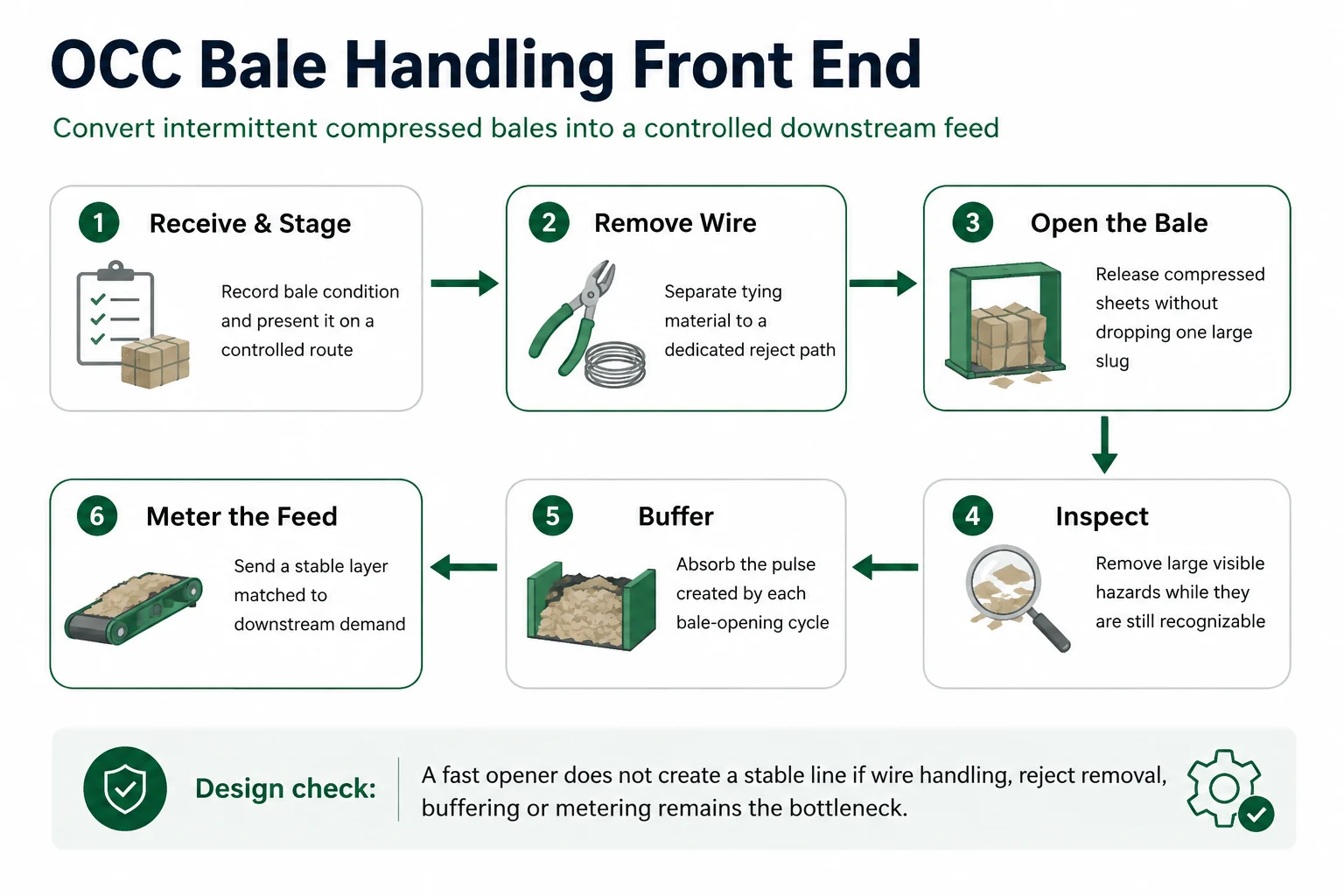
Why OCC Bale Handling Is a Process Section, Not One Machine
It is tempting to treat “bale opener” as a procurement item. In practice, the machine is only one part of the material handoff. A bale arrives as a dense unit that was designed for logistics, not for stable process feeding.
YUXI’s OCC paper dry pulping line places magnetic separation after opening and primary shredding, where ferrous pieces are more exposed.
Before the downstream line can work well, the front end has to change three things at once: containment, visibility and flow behavior.
Containment changes when the wires or straps are removed. Visibility changes when the compressed layers separate enough for operators or equipment to see foreign objects. Flow behavior changes when sheets, bundles and clumps stop moving as one bale and start moving as a bulk stream. These transitions do not always happen at exactly the same machine.
| Front-end function | Material condition before | Required condition after | Typical failure if omitted |
|---|---|---|---|
| Bale staging | Delivered bales with supplier-to-supplier variability | Stable, identifiable bales presented in a controlled sequence | Unstable stacks, blocked traffic routes or lost load traceability |
| Wire / strap removal | Compressed bale restrained by tying material | Tying material removed to a defined reject route | Entanglement, loose wire, machine contamination or unsafe manual recovery |
| Bale opening | Dense compressed block | Loosened sheets and clumps that can spread and be inspected | Large slugs, poor inspection access and inconsistent feed |
| Inspection / pre-sort | Newly exposed material | Large visible hazards and obvious off-grade material removed | Hard objects and bulky rejects reach size-reduction equipment |
| Buffering | Intermittent output from bale-opening cycles | Inventory available between upstream and downstream sections | Alternating surge and starvation |
| Metered feeding | Variable loose bulk material | Controlled layer or mass flow matched to downstream demand | Overload trips, bridging or low utilization |
The related industrial cardboard recycling machine guide separates the roles of a baler, shredder and complete line. Here the boundary is narrower: once the project will receive compressed OCC bales, how should that bale become a controlled feed stream?
Receiving and Bale Staging Come Before Bale Opening
We normally start a bale-handling discussion with photographs of the actual bales, not with a drawing of the opener. The important details are mundane: maximum dimensions, approximate weight or density, number and location of wires, whether bales hold their shape, how often wires arrive broken, whether the bale faces are wet, and how much forklift space is available.
The front end also has to coexist with warehouse traffic. OSHA’s general material-handling rule requires safe clearances for mechanical handling and says stacked bundles must be stable and secured against sliding or collapse.[1] Paper-recycling operations add a specific warning: moving equipment, unstable material stacks, compacting machinery and unexpected machine startup can all create fatal hazards.[2]
Record the bale before the wire is cut
A useful receiving log is short enough that operators will actually use it. Record supplier or load ID, bale condition, visible contamination, broken or loose wires, wet faces, unusual deformation and any bale that cannot be presented to the normal opening station. If a later opened bale reveals an unacceptable core, this record lets the plant trace the problem back to the load rather than treating every reject as an anonymous process loss.
We have seen front-end proposals spend pages on motors and almost nothing on the damaged-bale case. That is backwards. A bale that has already lost one wire may not sit, lift or open like the “perfect” bale used in the equipment brochure. The layout needs a defined quarantine or manual-recovery position so the operator is not forced to improvise beside a live conveyor.
Bale Wire Removal: Remove the Restraint Without Creating a New Hazard
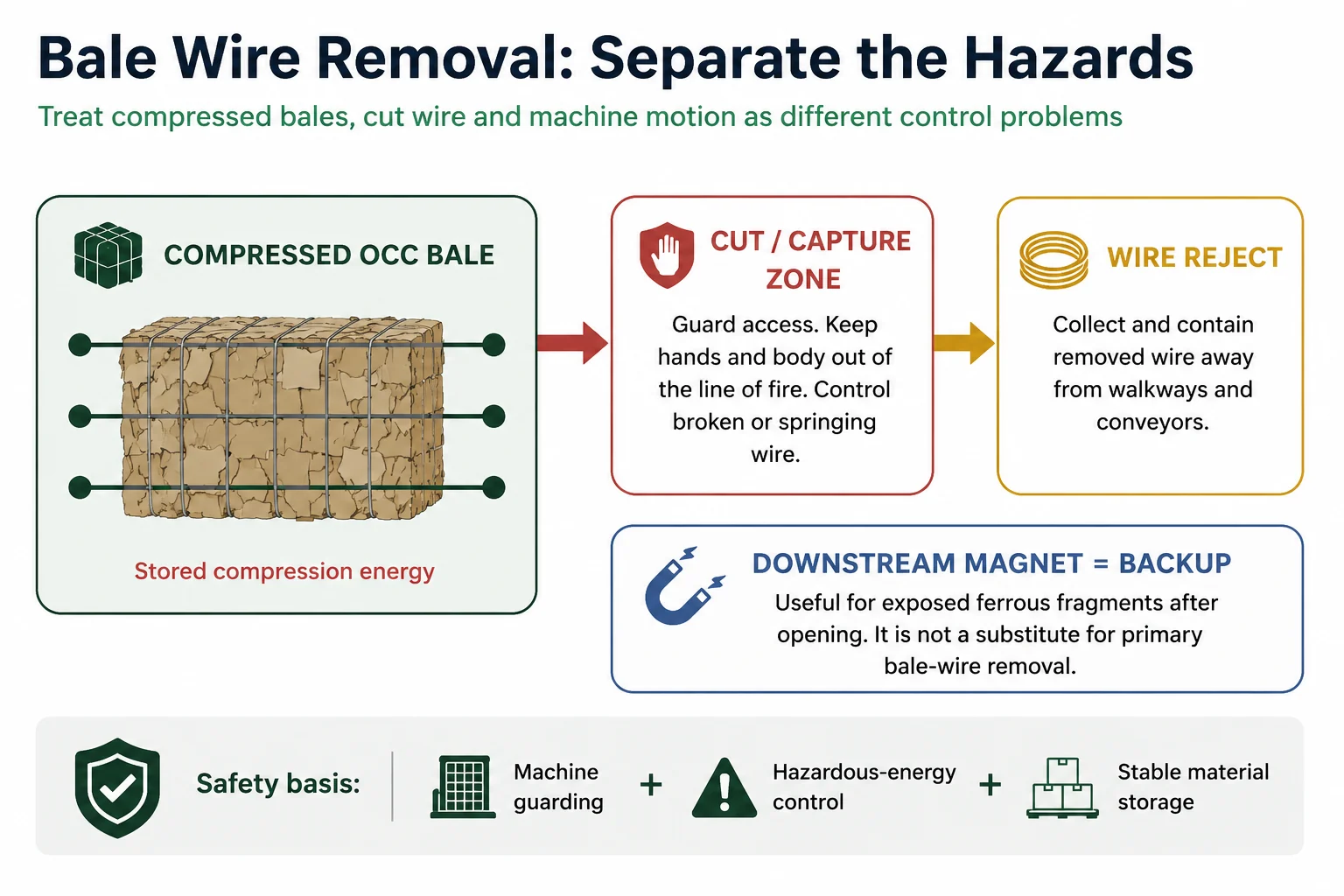
Wire removal is not simply a cleanliness step. The wire is restraining compressed material, so cutting or releasing it changes the mechanical condition of the bale. A damaged or highly compressed bale can shift when restraint is removed. The wire itself can spring, drag, coil, fall into an aisle or remain partly buried in the cardboard.
That is why the wire-removal method should be discussed together with bale positioning, guarding, operator access and the reject route. OSHA’s machine-guarding standard requires protection from hazards such as points of operation, ingoing nip points and rotating parts.[3] For servicing, unjamming and similar work where unexpected startup or stored energy could cause injury, OSHA 1910.147 requires hazardous-energy control procedures.[4]
Manual, assisted or automatic wire removal?
There is no single correct automation level. A low-volume facility with consistent bales may use a controlled manual or assisted opening station. A higher-volume line may justify mechanical wire cutting, capture and collection because repeated manual intervention becomes the bottleneck. Automation is especially useful when the plant wants a repeatable sequence and a dedicated wire-discharge path.
However, the RFQ should describe the function rather than naming a mechanism. “Automatic dewirer” is still incomplete. Ask how the bale is detected and positioned, how wire is cut, how the loose ends are controlled, how complete removal is checked, where the recovered wire is discharged, what happens when the bale arrives skewed, and how operators recover from a missed or broken wire.
Do not ask the magnet to do the dewirer’s job
YUXI’s OCC process places magnetic separation after opening and primary shredding, where ferrous pieces are more exposed. That sequence is logical. A magnet is a separation device; it is not a safe primary method for releasing the restraint around an intact compressed bale. Even if a later magnet catches wire fragments, the intact wire may already have wrapped, dragged or interfered with the upstream equipment.
We would therefore write two separate acceptance criteria: one for primary tying-material removal at the bale front end, and another for ferrous-fragment control after material opening. Mixing the two makes supplier responsibility unclear.
Bale Opening and Primary Shredding Are Different Functions
People often use “bale breaker,” “bale opener” and “shredder” loosely. The names matter less than the material state each stage must produce.
A bale opener primarily breaks the coherence of the compressed pack. It should release sheets and clumps far enough that the material can spread, be inspected and be fed without dropping an intact or nearly intact block into the next machine. A shredder primarily reduces size. It may also open bundles as a side effect, but that does not automatically give the front end safe wire handling or useful inspection access.
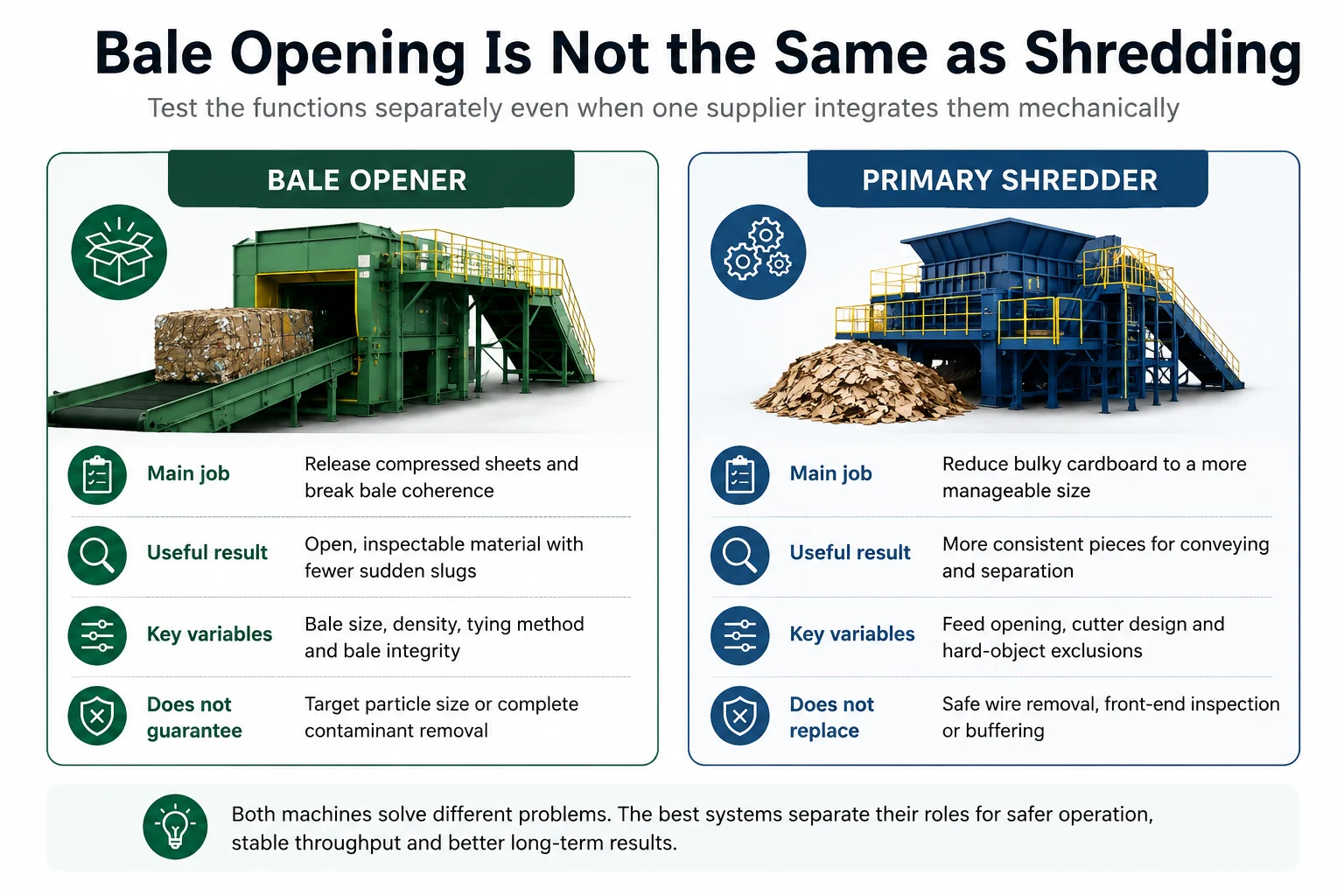
| Question | Bale opener / breaker | Primary shredder |
|---|---|---|
| Primary purpose | Release a compressed unit into a looser bulk stream | Reduce bulky cardboard into a smaller and more manageable size range |
| Most important feed data | Bale size, density, integrity, tying method and how the bale releases | Maximum feed opening, cardboard structure, hard-object exclusions and required output size |
| Best success indicator | No intact bale core; material can spread and be inspected or metered | Stable size reduction without unacceptable overload, wrap or damage |
| What it does not prove | It does not prove downstream particle size or fiber condition | It does not prove safe wire removal or incoming-material quality |
The opener also affects labor. If it leaves large compressed slabs, operators may keep pulling them apart by hand on the sorting conveyor. If it is too aggressive for the project goal, it can create unnecessary fines or make visible contaminants harder to recognize. The right degree of opening is therefore a handoff requirement, not an abstract “more is better” setting.
Inspection Is Most Useful After the Bale Becomes Visible
The outside of a bale can tell you a great deal about storage condition and obvious contamination. It cannot prove what is in the core. Opening creates the first practical chance to see bulky plastic, wood, stones, ropes, liquid containers, wrong paper grades or other objects that were hidden inside the pack.
This does not mean every small contaminant must be hand-picked at the front end. The objective is to remove what is safer or cheaper to remove while it is still large and recognizable. A large wooden block that can be lifted from an opened bale is a different problem after it has entered a shredder. So is a long rope, a bundled film mass or a piece of metal that does not belong in the feed.
AF&PA describes the broader U.S. cardboard-recycling path as collection, sorting and removal of non-cardboard material before the processed cardboard is sent to mills.[5]
Give rejects somewhere to go
A sorting position without reject logistics quickly becomes a housekeeping problem. Provide containers or chutes for the reject categories the plant actually expects, and place them so an operator can remove an item without carrying it across a conveyor or forklift lane. Recovered bale wire should have its own contained path; bulky wood or hard objects may need another.
We also recommend recording why a material was rejected. “Contamination” is too broad for supplier feedback. Film, wet board, wrong grade, wood, metal and liquids have different causes and may require different purchasing responses.
Metered Feeding Is What Turns Bale Cycles Into Line Throughput
Bale handling is inherently intermittent. A forklift places a bale. The bale is positioned. Wire is removed. The pack opens. Then a large amount of loose material becomes available over a relatively short time. The next bale creates another pulse. Downstream equipment usually prefers something closer to a continuous load.
This is the job of surge capacity and metering. A buffer stores enough opened material to bridge the gap between bale-opening cycles, while a controlled conveyor or feeder releases material at a rate the next machine can accept. YUXI’s published OCC line explicitly includes both controlled feeding and a later buffer/metering stage to reduce surges and starvation.
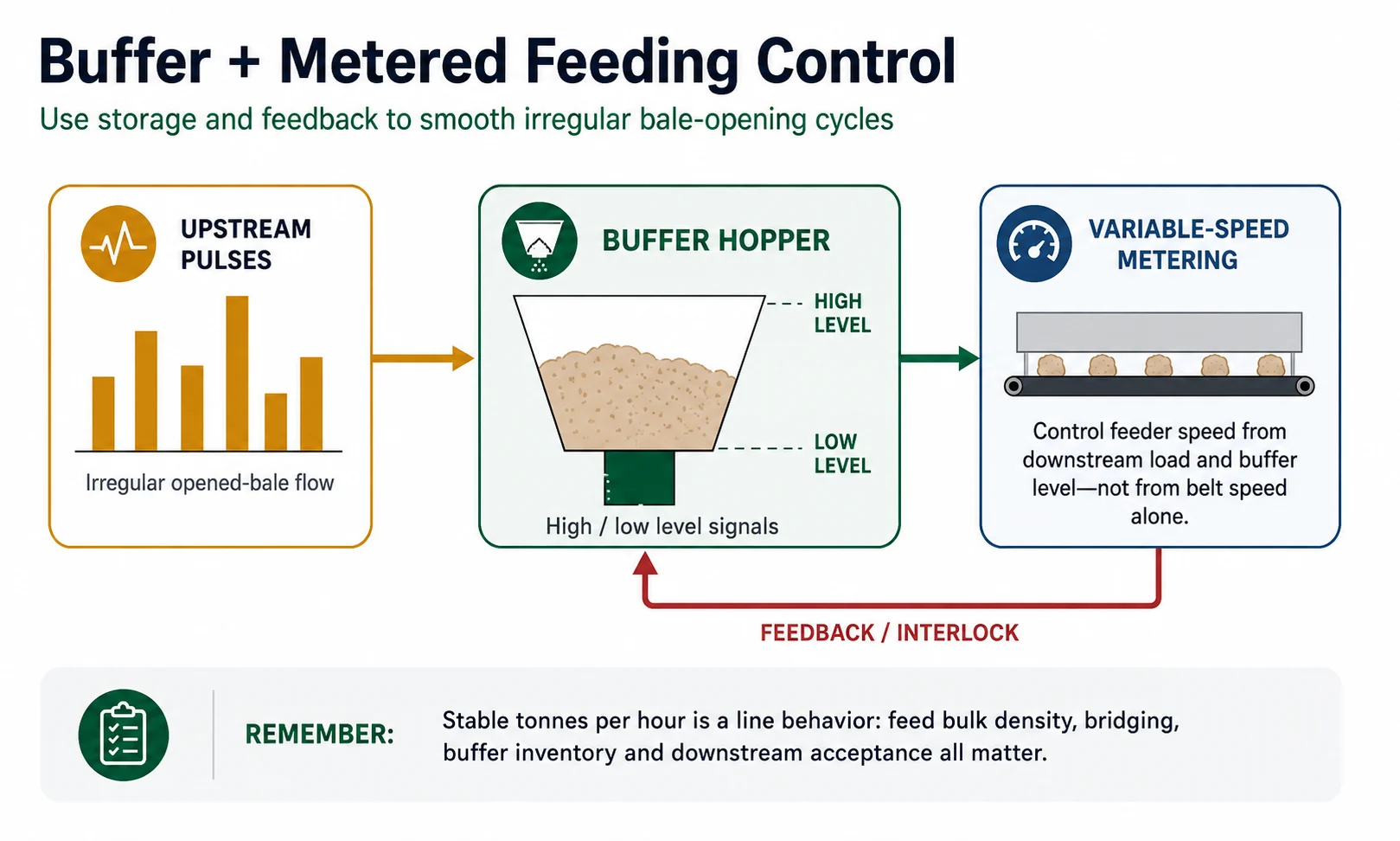
Belt speed is not the same as feed rate
Cardboard is low-density and irregular. Two apparently full conveyors can carry very different mass flow if one contains flat sheets and the other contains fluffy, opened clumps. That is why quoting only belt width and speed does not define production capacity.
A more useful specification describes the operating window: representative bale type, material condition after opening, minimum and maximum feed demand, expected buffer level range, how bridging is detected, how the feeder responds to downstream load, and what happens when the downstream machine stops.
This is deliberately not a sizing formula for a specific hopper. Actual buffer volume depends on bulk density, bale cycle time, downstream demand, bridging behavior, wall angle, discharge geometry and acceptable residence time. The engineering principle is simpler: do not let the downstream machine experience the full amplitude of every bale-opening cycle.
Use feedback, not a fixed-speed conveyor
A metering conveyor is most useful when it is part of the line controls. Level switches or continuous level measurement can tell the PLC whether the buffer is filling or emptying. Downstream motor load, feeder current, material-level signals or other process variables can be used to slow or stop upstream feeding according to the machine design.
In practice, a feeder running steadily at a conservative rate is usually more useful than a nominally high-capacity belt that alternates between an empty chamber and overload trips. The hourly average matters more than the short-term peak.
Controls and Interlocks Should Follow the Material Flow
A front-end control sequence usually makes more sense when it starts from the downstream machine and works backward. The downstream section proves it is ready; the metering feeder is enabled; the buffer level allows the opener to run; and the receiving conveyor accepts the next bale only when there is somewhere for the opened material to go.
The exact PLC logic is project-specific, but several questions belong in every controls review:
- What permissives must be true before a bale can enter the wire-removal or opening station?
- Does a downstream overload slow the feeder first, or trip the whole upstream section immediately?
- How does the system prevent the opener from emptying another bale into a full buffer?
- Are open guards, access doors and emergency stops integrated into the safety circuit?
- What is the restart sequence after a fault, and how does it avoid a second surge?
- Which recovery tasks require lockout/tagout rather than a normal production stop?
- Can operators see alarm history and distinguish low material level from a jam?
OSHA specifically includes cleaning and unjamming among servicing activities where unexpected energization or startup can require hazardous-energy control.[4] NIOSH has also documented crushing and amputation hazards around scrap-paper balers when safeguarding or energy control is inadequate.[6] A bale-handling line is not a baler, but the lesson transfers: a production stop button is not the same thing as a verified energy-isolation procedure.
Front-End Layout: Keep Material, Wire and People on Deliberate Routes
Bale-handling drawings should show more than machine footprints. Add the forklift approach, bale staging rectangle, damaged-bale area, operator position, guard boundaries, wire-reject bin, sorting rejects, maintenance pull space and access to isolation points.
The line-of-fire around wire release deserves special attention. The operator should not have to stand between a bale and a fixed structure, lean across a conveyor, or walk through the path used to discharge recovered wire. Similarly, the sorting position should not push operators into the forklift lane every time they empty a reject container.
Material route
Bales move one direction: receiving → staging → dewire → opening → inspection → buffer → metered feed. Avoid backtracking with a damaged bale through the normal production lane.
Reject route
Wire, hard objects and bulky contaminants need separate destinations. Their bins should be removable without stopping or crossing the main material flow where practical.
People route
Provide guarded access to inspection points and safe observation positions. Maintenance access should not depend on climbing over stored bales or conveyors.
Recovery route
Define where a skewed bale, broken wire or jammed bundle goes. The abnormal case should have a planned recovery method before commissioning.
RFQ and FAT/SAT Checklist for OCC Bale Handling
A supplier cannot design this section from “OCC, 5 t/h” alone. Even if two plants target the same average mass flow, one may receive small, dry, tightly formed bales from a single warehouse while another receives larger variable bales with broken wires from several suppliers. Their front ends should not be assumed identical.
Feed data to include in the RFQ
- Normal, minimum and maximum bale dimensions
- Approximate bale weight or density range, if measured
- Wire, strap or tying material type; typical quantity and location
- Frequency of broken, loose, skewed or partially opened bales
- Moisture observations and seasonal changes
- Visible film, wood, metal, wrong grades and other recurring contamination
- Forklift, loader or conveyor method used to present bales
- Scheduled hours, target sustained feed and downstream machine demand
- Available footprint, clear height, access doors and traffic constraints
Write acceptance tests around behavior, not brochure names
| Test item | What to observe | Acceptance language to define before purchase |
|---|---|---|
| Bale presentation | Normal and difficult bales enter without unstable manual repositioning | Agreed bale envelope, damaged-bale procedure and permissible operator interventions |
| Wire removal | Wire is cut/released and transferred to the reject route | Test bale count, missed-wire definition, fragment handling and safe recovery method |
| Bale opening | No persistent intact bale cores reach the next stage | Define acceptable remaining bundle size or visual opening condition |
| Inspection access | Operators can identify and remove the agreed large contaminants | Platform/access scope, reject containers and line speed during sorting |
| Buffer | Opening pulses are absorbed without overflow or chronic starvation | Level range, alarm points, bridging response and stop logic |
| Metered feeding | Downstream machine sees a controlled load | Sustained test period, measurement point, permitted interruptions and feeder range |
| Interlocks | Upstream equipment responds correctly to downstream faults | Cause-and-effect list for overload, full buffer, open guard and emergency stop |
| Recovery | Jam or broken-wire case can be made safe before intervention | Isolation points, written procedure, access and restart sequence |
For FAT, use representative bales—not only freshly prepared clean samples. For SAT, repeat the important abnormal cases in the installed layout: a full buffer, a downstream stop, a damaged bale and a wire that does not release normally. Those are the moments when controls, access and material routing prove their value.
Common OCC Bale-Handling Design Mistakes
1. Feeding an intact wired bale toward the shredder
This transfers a front-end handling problem into a size-reduction machine. Even when a shredder can physically pull at the bale, intact tying wire can create entanglement and unsafe recovery work. Define primary wire removal before relying on downstream magnetic separation.
2. Treating “bale opener capacity” as line capacity
An opener can discharge material faster than the downstream line can consume it. That peak rate is not useful production if the result is a full buffer, repeated stop/start operation or an overloaded shredder. Measure sustained flow through the complete front-end boundary.
3. Installing an opener without enough surge volume
If every bale-opening event immediately reaches the feeder, the downstream load mirrors the bale cycle. A modest buffer often does more for stable throughput than simply increasing opener motor power.
4. Specifying a metering belt without defining the material state
Loose sheets, opened clumps and partially intact bundles have different bulk densities and bridging behavior. A belt speed in meters per minute does not define tons per hour unless the material presentation is also defined.
5. Hiding wire and reject handling from the layout
A plan may show a clean line of conveyors while the real plant accumulates coils of wire beside the operator. Every reject stream needs a container, removal method and traffic route.
6. Designing only for the best bale
Supplier variability appears at the receiving end first. If the line has no safe method for a broken wire, wet bale or collapsed pack, operators will create one under production pressure. That is exactly the case the engineering review should solve.
Where OCC Bale Handling Fits in the YUXI Dry Line
The published process starts with inspection and bale opening, then controlled feeding, primary shredding, magnetic separation, buffer and metering, mechanical dry fiber opening, dust/light-reject control, collection and optional baling.
That sequence is important because it defines the front-end boundary clearly. Bale handling does not make finished paper, and bale opening is not dry pulping. Its job is to present the accepted OCC to the rest of the line in a condition that can be processed more steadily and inspected more effectively.
YUXI does not publish one universal bale-opener configuration for every OCC project. Its solution page states that bale opening, sorting and buffer/metering are project-dependent modules, and that actual capacity depends on feed density, bale size, moisture, contamination, size-reduction requirements, conveying and downstream collection. That is the correct engineering position. The supplier should size the front end from the actual bales and the required handoff to the next machine.
OCC Bale Handling FAQ
Does every OCC recycling line need a bale opener?
No. Loose cardboard and already-opened material may be fed without a dedicated bale opener. Dense compressed bales often need a controlled opening method when wire removal, inspection access or surge control cannot be handled safely and consistently at the receiving station.
Should bale wire be removed before an OCC shredder?
As a front-end design rule, intact bale wire should normally be removed before the bale enters shredding equipment. The exact procedure depends on the bale and machine design. A downstream magnet can collect exposed ferrous fragments, but it should not be treated as the primary method for removing intact tying wire.
Can a magnetic separator remove all bale wire?
No. Magnetic separation is most effective after the material has been opened and the ferrous item is exposed to the magnetic field. Intact wire around a compressed bale can remain entangled with paper, create handling problems or reach a machine before it is well presented to the magnet.
What is the difference between a bale opener and a shredder?
A bale opener mainly releases compressed material and breaks the coherence of the bale so sheets can spread, be inspected and feed more evenly. A shredder changes material size. Some systems combine functions, but the process requirements should still be written separately.
Why is a buffer hopper used after bale opening?
Bale opening is naturally intermittent: one bale releases material, then there is a pause while the next bale is positioned or prepared. A buffer gives the metering conveyor inventory to work with, reducing both sudden surges and starvation of the downstream machine.
How should OCC metered feeding capacity be specified?
Specify a sustained operating range using representative material, not only a belt speed or an empty-machine maximum. State bale dimensions, bulk behavior after opening, moisture and contamination, test duration, measurement point, allowed interruptions, buffer level limits and downstream load criteria.
What should be checked during a bale-handling FAT or SAT?
Verify the agreed bale range, wire-removal method, safe recovery from damaged bales, reject path, opener behavior, buffer-level logic, metering range, overload response, upstream and downstream interlocks, emergency stops, jam-clearing procedure and sustained material flow with representative feed.
What information should be sent to YUXI for an OCC bale-handling proposal?
Send clear bale photos or video, normal and maximum bale dimensions, approximate bale weight or density if known, wire or strap type, number and condition, supplier variability, moisture and visible contamination, required throughput, downstream equipment, workshop layout and forklift or loader access.
Plan the Bale Front End Around Your Actual OCC
Send bale dimensions, photos or video, wire details, contamination observations, required feed rate and workshop layout. YUXI can review the front-end sequence together with the downstream OCC process instead of treating bale opening as an isolated machine.
References
- U.S. Occupational Safety and Health Administration. 29 CFR 1910.176, Handling materials — general. Source.
- U.S. Occupational Safety and Health Administration. Green Job Hazards — Recycling: Paper. Source.
- U.S. Occupational Safety and Health Administration. 29 CFR 1910.212, General requirements for all machines. Source.
- U.S. Occupational Safety and Health Administration. 29 CFR 1910.147, The control of hazardous energy (lockout/tagout). Source.
- American Forest & Paper Association. How Much Cardboard Is Recycled? 2024 Statistics. Published August 12, 2025. Source.
- National Institute for Occupational Safety and Health. Control of Scrap Paper Baler Crushing Hazards. DHHS (NIOSH) Publication No. 97-113. Source.