




 Request Quote


Putting a complete refrigerator straight into a shredder is a poor way to define a recycling process. The machine may be physically capable of gripping the cabinet, but the real question comes earlier: what condition should the appliance be in before mechanical size reduction starts?
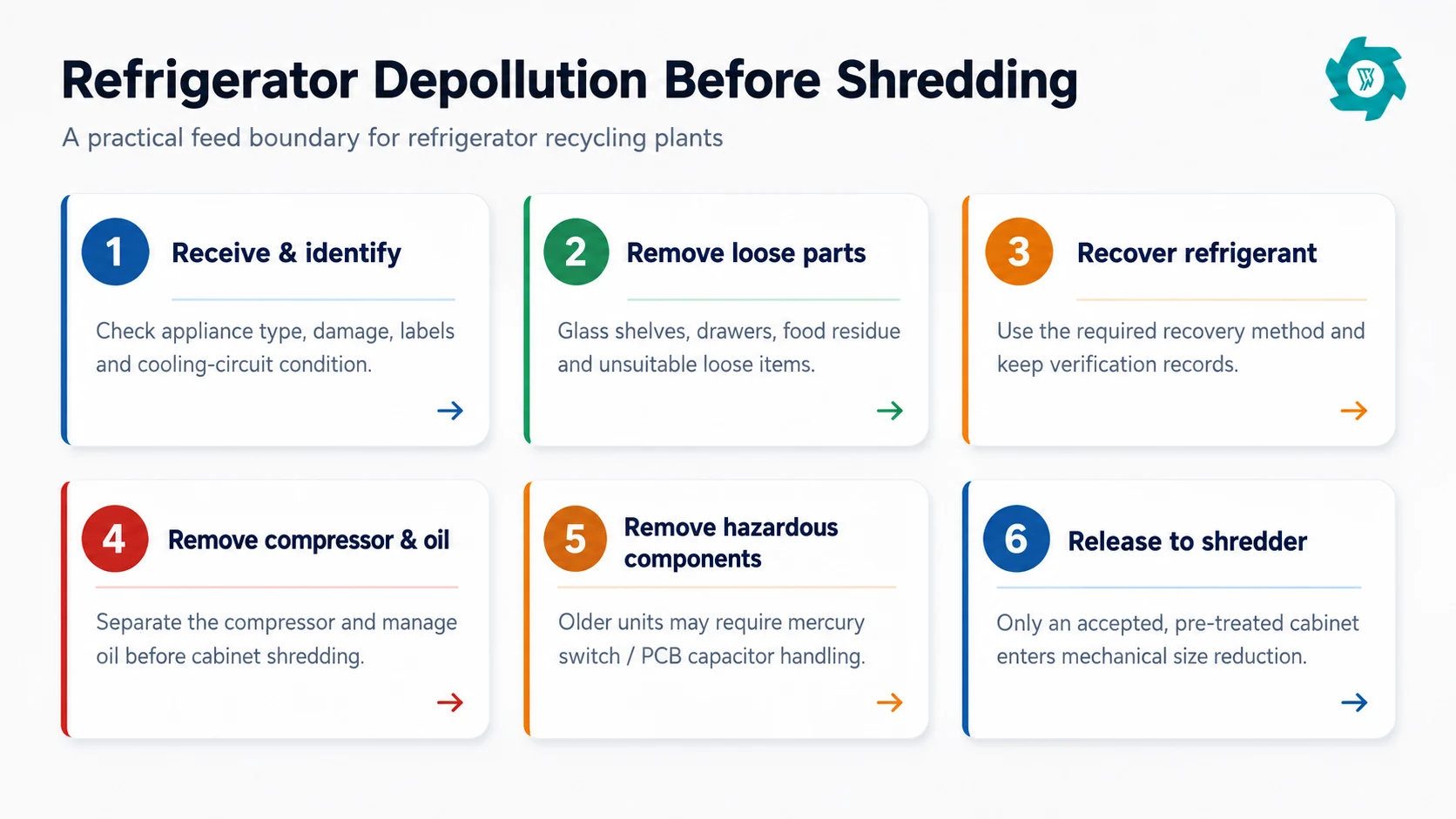
For a refrigerator recycling plant, that upstream work is usually described as depollution, pre-treatment or dismantling. It covers the jobs that separate refrigerant, compressor oil, certain hazardous components and unsuitable loose parts from the cabinet before the body enters the shredder.
Why depollution comes before the shredder
A refrigerator body is not just thin steel sheet. It arrives with a sealed cooling circuit, compressor, oil, plastic liner, insulation foam, wiring, shelves, drawers and, depending on age and design, components that need separate environmental handling. Once all of that is fragmented, the plant has fewer options. A leaking liquid becomes contamination across conveyors. Glass becomes fine breakage. A component that could have been lifted out in seconds becomes mixed with hundreds of kilograms of shredded material.
That is why the YUXI refrigerator recycling process separates complete end-of-life appliances from pre-treated cabinets. The mechanical section starts after refrigerant recovery, compressor handling, oil management and removal of unsuitable loose parts. If the buyer wants to receive intact refrigerators, the upstream dismantling and recovery stations have to be included in the project scope rather than assumed to happen inside the shredder.
This supply boundary also affects cost. A project quoted for already evacuated cabinets is not directly comparable with one that includes depollution benches, refrigerant recovery equipment, compressor handling, oil collection and the labor needed to run those stations. Our separate guide to refrigerator recycling plant cost explains why this difference can make two apparently similar quotations look far apart.
What must be removed before shredding?
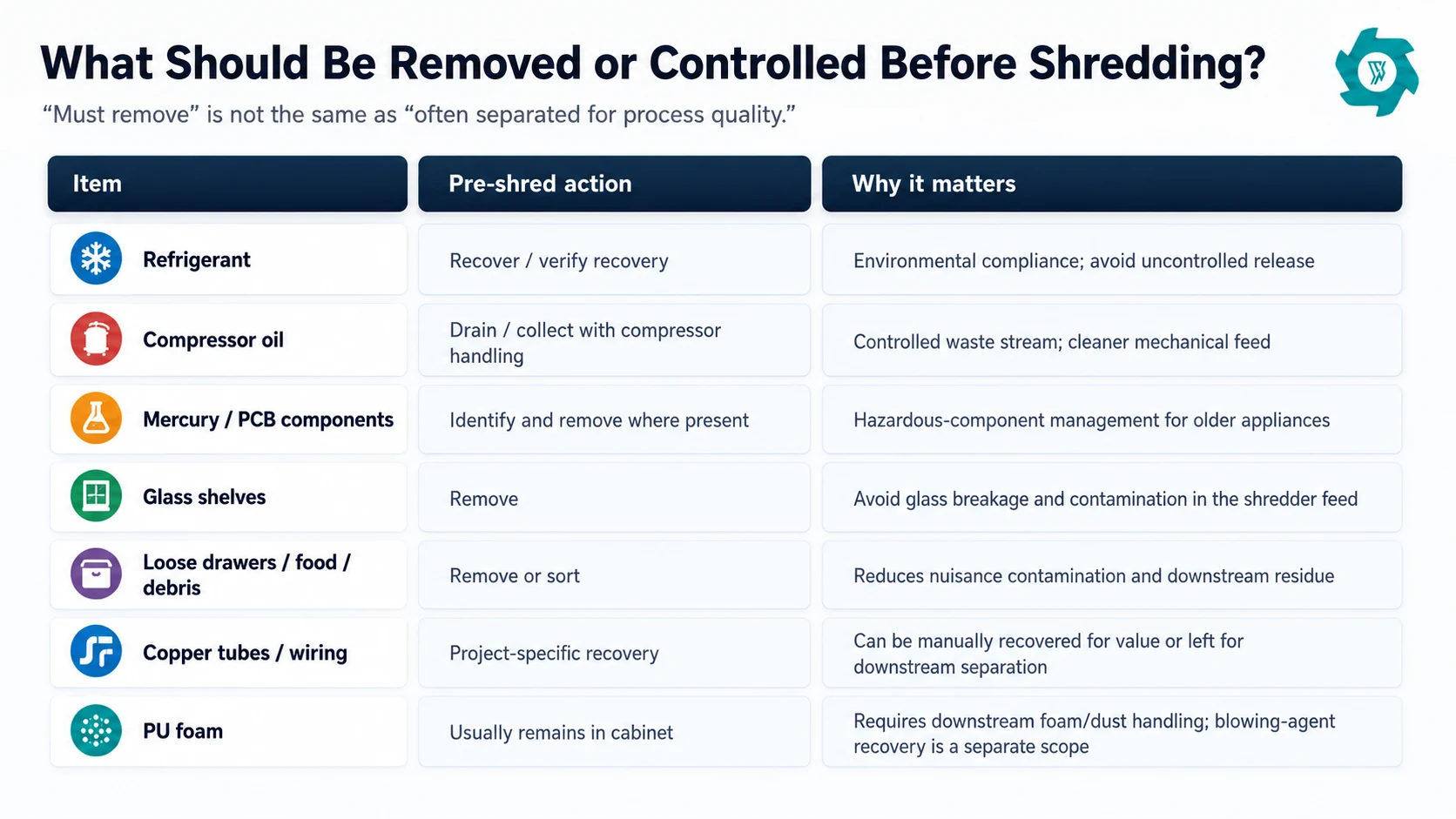
The safest answer is not a universal seven-item checklist. Some items are regulatory or environmental controls, while others are removed because they improve material quality, reduce damage or make the line easier to operate. For U.S. projects, the following distinction is useful.
| Item | Typical pre-shred action | Reason |
|---|---|---|
| Refrigerant | Recover, or verify prior recovery | Required safe-disposal control; avoids uncontrolled release |
| Compressor oil | Drain or collect as part of compressor handling | Controlled waste stream and cleaner shredder feed |
| Mercury-containing components | Identify and remove where present | Hazardous-component management, especially on older appliances |
| PCB-containing capacitors | Identify and remove where applicable | Separate regulated handling for older equipment |
| Glass shelves | Remove | Reduces breakage, contamination and unnecessary fines |
| Loose drawers, food and debris | Remove or sort | Housekeeping and downstream product quality |
| Compressor | Normally remove before cabinet shredding | Allows oil handling and separates a dense, valuable component from light cabinet feed |
| PU insulation foam | Usually remains in the cabinet for the mechanical line | Requires downstream foam and dust handling; blowing-agent recovery is a separate project scope |
1. Refrigerant: recover it before final disposal
Refrigerant is the first boundary to settle because it changes both compliance and plant design. U.S. EPA safe-disposal rules place responsibility on the final person in the disposal chain to ensure that refrigerant is recovered from household refrigerators and freezers before final disposal. If recovery happened upstream, the final disposer needs the required verification rather than simply relying on a sticker.
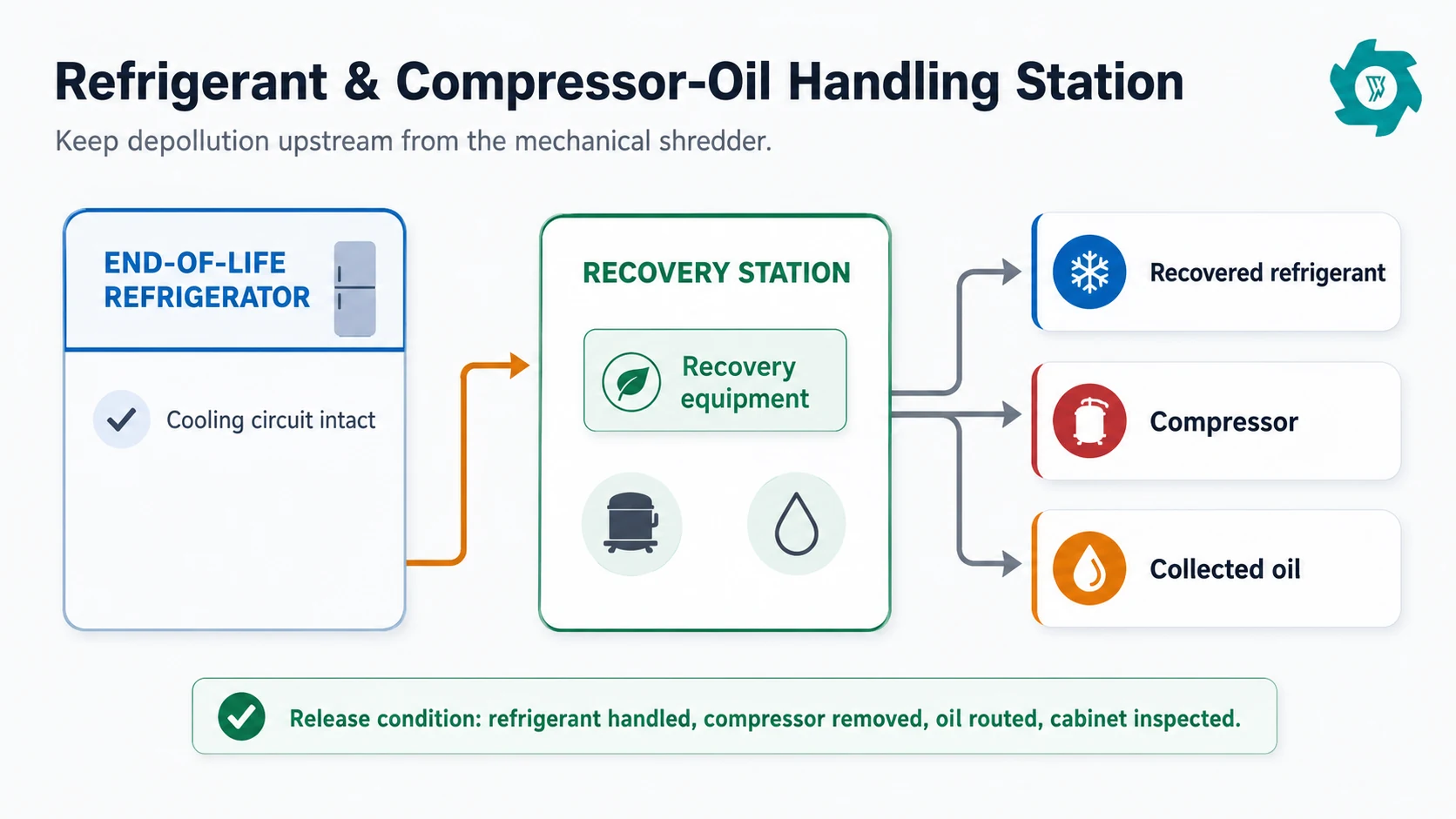
In practical plant terms, this means an intact refrigerator should stop at a recovery station before it reaches mechanical shredding. The cooling circuit is accessed using the appropriate recovery equipment and the recovered refrigerant is routed for the required downstream management. Only after that step should the cabinet move on to compressor removal and the remaining pre-treatment jobs.
There is an additional process issue with modern hydrocarbon refrigerants. EPA lists R-600a (isobutane) for household refrigerators and classifies it as A3; current EPA rules also describe isobutane and propane as flammable refrigerants. A recycling line should therefore identify the expected refrigerant mix and design the recovery, ventilation, ignition-control and emergency procedures around the real incoming appliances. The shredder should not be used as a substitute for that upstream risk control.
2. Compressor and oil: treat them as a separate stream
Once the refrigerant has been handled, the compressor is normally removed from the refrigerator cabinet. That is useful for more than one reason. The compressor is a dense assembly containing steel, copper-bearing motor material and residual oil. Leaving it attached changes the mechanical load compared with an evacuated sheet-metal cabinet and makes oil release much harder to control.
EPA guidance for appliance disposal states that compressor oil is one of the hazardous components that must be removed from appliances before disposal under the applicable U.S. rules. From an operating point of view, collecting the oil at a dedicated station is much simpler than trying to catch it after a hammer crusher has spread it over metal, plastic and foam.
3. Older appliances need a hazardous-component check
Age matters. EPA notes that older refrigerated appliances may contain mercury in switches or relays and PCBs in certain capacitors. These parts should not be treated as ordinary metal contamination. A receiving and dismantling procedure needs a way to identify the appliance types and vintages that may require separate removal.
This is one reason a mixed collection stream can be more difficult than a fleet of known commercial units. The outside dimensions may look similar, yet the internal components and refrigerant technology can be very different. A plant buying used appliances from many sources should build identification and exception handling into the receiving station, not leave the operator at the shredder hopper to make the decision.
Do not turn this into a claim that every refrigerator contains mercury or a PCB capacitor. Many do not. The correct engineering rule is to establish a screening method for the appliances that may contain them and route identified components to the correct downstream handler.
4. Glass shelves and loose interior parts are usually removed
Glass shelves are easy to overlook because they are not part of the cooling circuit. They are still poor shredder feed. A shelf that breaks during loading produces sharp fragments and fines that add no value to the metal separation train. Removing shelves manually is usually a simple way to keep the cabinet feed cleaner.
Drawers, bins and loose plastic pieces are more of a project choice. If the plant already has a buyer for clean plastic components, hand removal can preserve a better product than shredding them together with foam and liner material. If labor is tight and the downstream separation system is designed to handle that plastic, some components may remain. The key is to make the choice deliberately and keep the feed definition consistent.
Food residue, packaging, bottles, loose household waste and other foreign material should be taken out during receiving. A refrigerator recycling line is not a mixed municipal-waste line. Anything that carries moisture, odor or unrelated contamination through the shredder will usually cost more to manage later.
5. Wiring, circuit boards and copper tubing: remove for value when it makes sense
These components sit in a different category from refrigerant or oil. They are not all automatically “must remove before shredding” items. Many plants take them out because they are accessible and have a clearer value as separated material.
Power cables, small circuit boards, copper tubes and easily reached wiring can often be recovered on the dismantling bench. Doing so reduces the amount of non-ferrous material that has to be liberated and sorted later. On the other hand, tubing embedded in the cabinet structure may be better left for the mechanical line if manual removal is slow or damages the panel.
This is where equipment scope and labor cost meet. The more material recovered by hand, the less work some downstream separators have to do, but dismantling time per appliance increases. Our refrigerator recycling equipment guide breaks down the jobs of the shredder, secondary crusher, magnetic separator, eddy current separator and foam-handling section, which helps decide what is worth removing upstream.
6. What about polyurethane insulation foam?
Foam needs careful wording because two different questions are often mixed together. The first is mechanical: should the polyurethane foam be stripped from the refrigerator before shredding? In many industrial lines, no. The foam remains bonded inside the cabinet and is liberated during secondary crushing, then removed by airflow and collection equipment.
The second question is environmental: should the blowing agent contained in that foam be recovered? That is a different project scope. EPA’s U.S. appliance-disposal page states that federal rules do not generally require foam treatment, while the former Responsible Appliance Disposal program promoted foam and blowing-agent recovery as a best practice. A plant designed for enclosed foam blowing-agent recovery is therefore not the same system as a conventional refrigerator line that separates PU foam mechanically and controls dust.
For projects outside the United States, local WEEE and fluorinated-gas requirements can be more stringent. The buyer should state the jurisdiction and the required emissions approach before the supplier sizes the shredder enclosure, air system, foam collection, gas treatment and monitoring devices.
7. Do doors need to be removed?
Not necessarily. Doors are sometimes removed for transport, for manual access or because a particular facility has a separate treatment route. In a cabinet shredding line sized for refrigerator bodies, the door itself can often remain as part of the evacuated, inspected cabinet.
What matters more is what is attached to it. Glass, electronic displays, large loose assemblies, water filters or other components may need to be removed depending on the model and the agreed feed specification. The same principle applies to shelves and interior fittings: do not write a dismantling rule based only on the word “door.” Write it around the components and hazards that the line is actually expected to receive.
How depollution affects line capacity
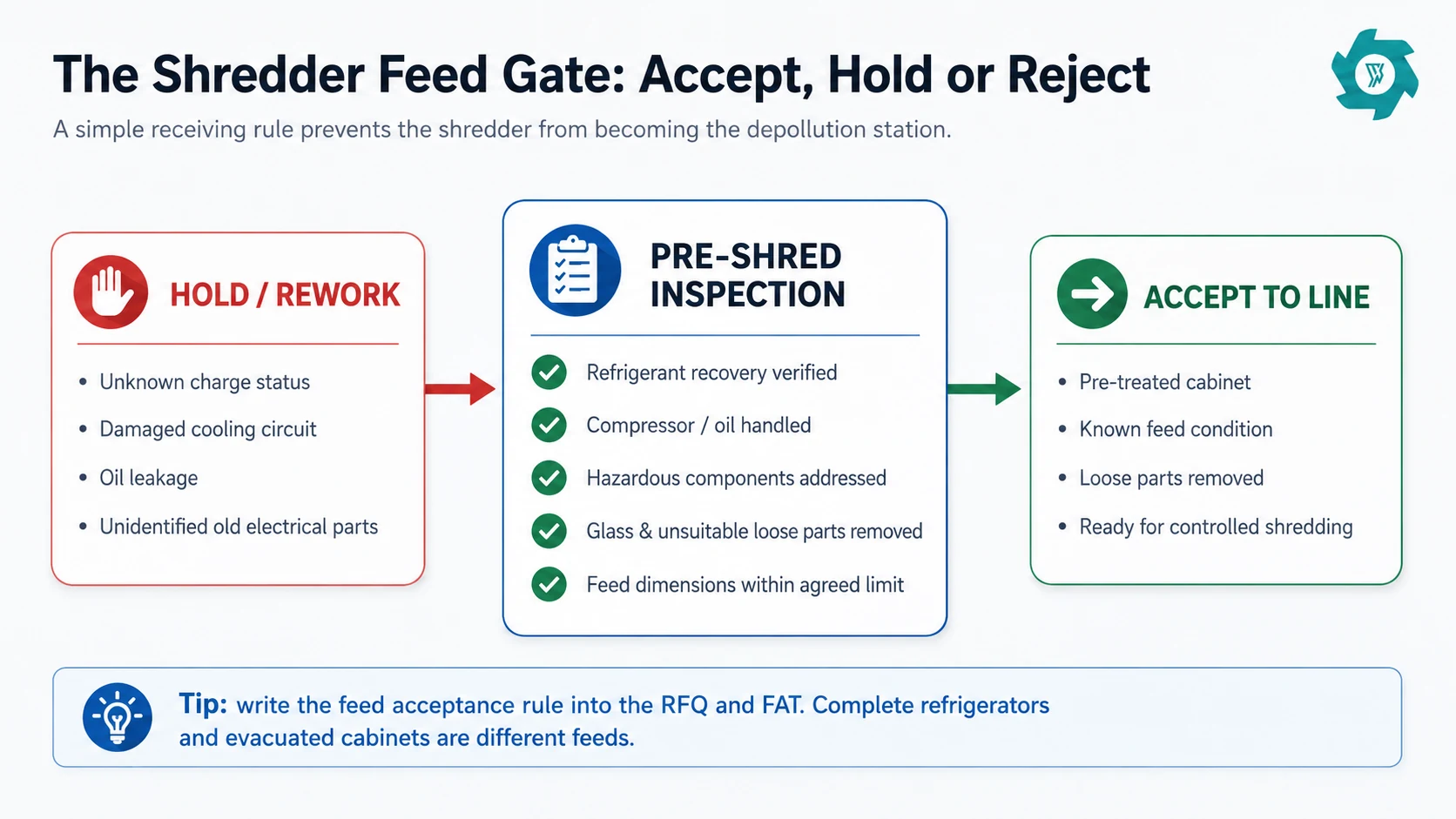
Depollution is often the hidden bottleneck in a refrigerator recycling project. A shredder may be able to process a high mass rate, but the full plant cannot sustain that number if the dismantling stations cannot supply prepared cabinets fast enough.
For that reason, capacity should be checked in two ways: appliances per hour and tonnes per hour. The first helps size receiving, recovery and manual workstations. The second is more useful for shredder, crusher, conveyor and separator loading. Average appliance weight, freezer ratio, oversize units and the number of components removed by hand all change the relationship between the two figures.
How to lay out the depollution area
The dismantling area should not be an afterthought squeezed between receiving and the shredder. A workable layout normally needs space for incoming inspection, units awaiting refrigerant recovery, treated units awaiting dismantling, removed compressors, oil containers, separated electrical components, glass, loose plastics and non-conforming appliances.
Material flow should avoid backtracking. Operators should not have to move a refrigerator past the shredder and then bring it back because the charge status is unknown. Likewise, recovered components need labeled destinations so the dismantling bench does not become a pile of mixed parts.
Maintenance and emergency planning also belong here. Recovery equipment, lifting aids, cutting tools and any powered dismantling fixtures require their own safe-energy procedures. The finished installation should address guarding, access and lockout/tagout around conveyors and mechanical equipment rather than assuming the machine supplier’s guards cover the whole plant.
Questions to put in the RFQ
When we review a refrigerator project, these questions usually expose the real scope faster than asking for motor power:
- Will the plant receive complete appliances or already evacuated cabinets?
- Who is responsible for refrigerant recovery and the verification records?
- Which refrigerants are expected, including hydrocarbon units?
- Are compressors removed on the line, and how is oil collected?
- How will older appliances with possible mercury or PCB components be identified?
- Which loose parts are removed manually: glass, drawers, wiring, circuit boards, copper tubes?
- Does the project require mechanical foam separation only, or controlled blowing-agent recovery?
- What is the maximum cabinet size after pre-treatment?
- What throughput is required at the depollution stations and at the mechanical line?
- What feed sample will be used during the FAT?
Bottom line
A refrigerator shredder should receive a prepared feed, not solve every problem that arrives with an end-of-life appliance. Refrigerant recovery belongs upstream. Compressor and oil handling should be separated from cabinet crushing. Older units need a hazardous-component check. Glass and unsuitable loose items are usually removed before size reduction. Other components, such as wiring and accessible copper, are removed when the value and labor balance supports it.
Define the Right Pre-Treatment Scope for Your Refrigerator Line
Send YUXI photos of the incoming refrigerators, refrigerant status, appliance size range, required throughput and the components you plan to remove manually. We can use that feed definition to configure the dismantling boundary, shredder and downstream separation section.
FAQ
Can a complete refrigerator go directly into a shredder?
It should not be treated as unrestricted shredder feed. Complete refrigerators normally need receiving inspection, refrigerant handling, compressor and oil management, and removal of unsuitable or controlled components before the cabinet enters mechanical shredding.
Does every refrigerator need the compressor removed before shredding?
For a conventional refrigerator cabinet recycling line, compressor removal is normally part of pre-treatment. It makes refrigerant and oil handling easier and keeps a dense component out of the light cabinet feed. The exact project boundary should still be written into the specification.
Must PU foam be removed before the refrigerator is shredded?
Not usually. In many mechanical lines the foam remains in the cabinet, is liberated during crushing and is then separated by airflow. A system designed to recover foam blowing agents is a different environmental and equipment scope from ordinary foam separation.
Why are glass shelves removed before shredding?
Glass adds little value to the metal recovery process and can create sharp fragments and fines. Removing it upstream is usually a simple way to reduce contamination in the mechanical line.
Are mercury and PCB components found in all refrigerators?
No. They are mainly a concern for certain older appliances. The practical requirement is to have a screening method that identifies units or components that may contain them and routes those items for appropriate handling.
What should be written in a shredder feed specification?
State the appliance types, refrigerant recovery status, compressor and oil condition, removed components, excluded materials, maximum cabinet dimensions, average unit weight and the required sustained throughput. That makes the mechanical-line duty clear.