




 Request Quote



Ask three suppliers for a refrigerator recycling plant price and the numbers can look as if they belong to three different industries. Often, they do not describe the same project.
One proposal may start with refrigerators that have already been evacuated and stripped of compressors. Another may include refrigerant recovery, oil handling and a dismantling station. A third may add platforms, dust extraction, foam collection, electrical cabinets, installation and commissioning. Looking only at the total on the last page hides those differences.
Why Refrigerator Recycling Plant Prices Vary So Much
Most of that price spread comes down to what is actually included. Some suppliers use “refrigerator recycling plant” for the shredding and separation section only. Others mean a line that takes in complete end-of-life appliances, while a turnkey proposal may also cover site work and commissioning.
A complete refrigerator is not quite the same feed as ordinary light scrap. In the United States, the refrigerant has to be recovered before final disposal, and the disposer must make sure that step has been completed. EPA guidance also points to compressor oil and other components that need proper handling. In practice, all of this adds equipment, labor, records and storage before the cabinet enters the refrigerator recycling line.
Practical rule: a price is only meaningful after the feed condition, capacity basis, recovered products and supply boundary are written down.
Start With the Supply Boundary, Not the Machine List
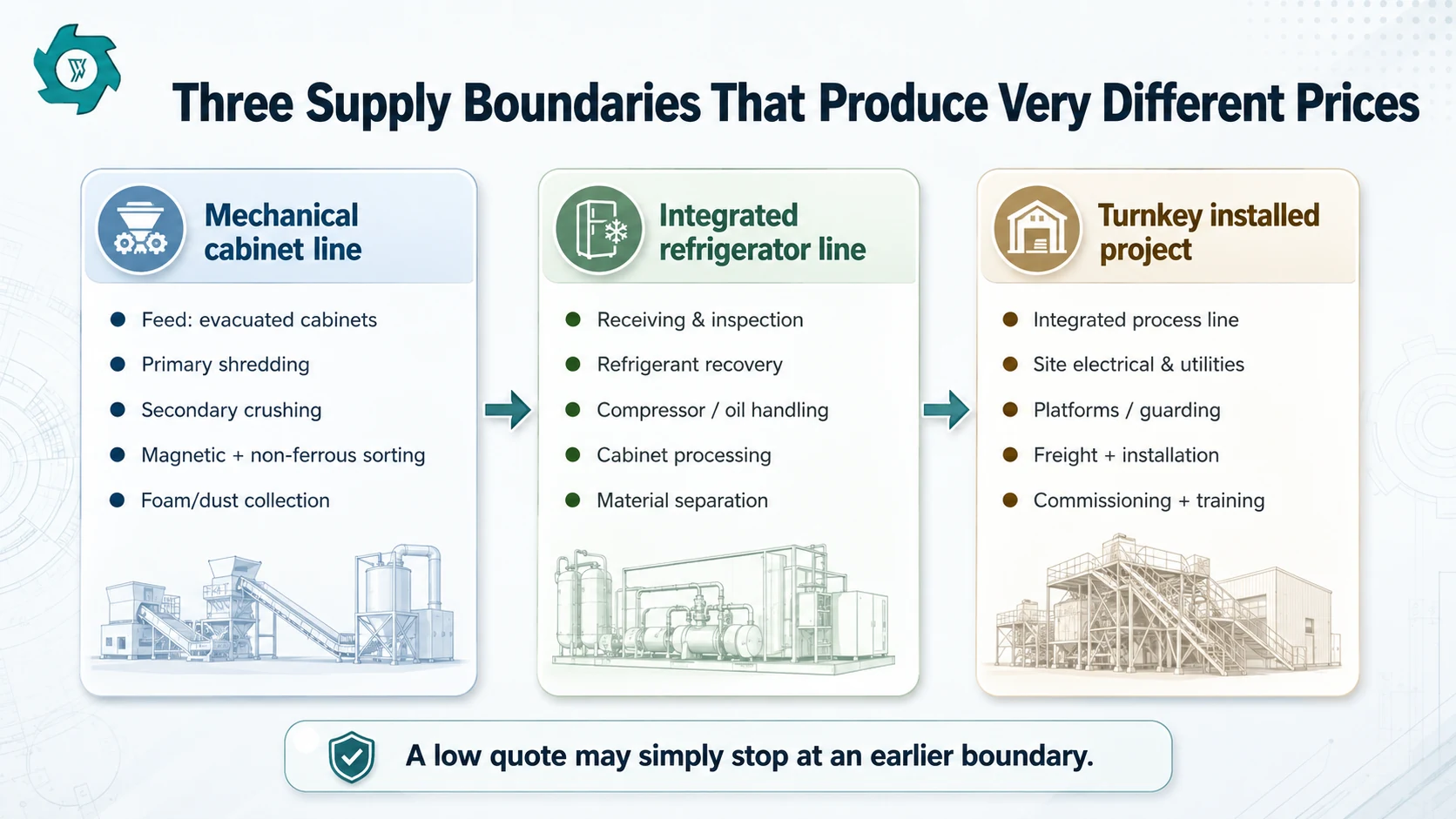
For cost comparison, we normally split refrigerator projects into three boundaries.
1. Mechanical line for pre-treated refrigerator cabinets
This is the narrowest scope. Refrigerant has already been recovered, the compressor and oil have been handled, and unsuitable loose parts have been removed. The mechanical line then handles primary shredding, secondary liberation, foam extraction, ferrous recovery, non-ferrous recovery and dust control.
2. Integrated refrigerator recycling line
This adds receiving, inspection, dismantling, refrigerant recovery, compressor removal and oil handling before the cabinet enters mechanical processing. The added equipment may not be the largest machinery in the plant, but it changes labor flow, storage, safety controls and the definition of what can enter the shredder.
3. Turnkey installed project
A turnkey budget goes beyond the process machines. It may include steel platforms, access stairs, guarding, ducting, foundations, electrical distribution, cable trays, compressed air, fire or gas monitoring where required, freight, rigging, installation supervision, commissioning, training and initial spare parts.
What Drives the Equipment Price?
Feed condition and pre-treatment
A line designed for evacuated refrigerator bodies is not equivalent to a line intended to receive complete appliances. The quotation should state whether refrigerant recovery equipment, dismantling benches, compressor handling and oil collection are included.
Appliance mix matters too. A stable stream of household refrigerators and freezers is easier to define than a mixed white-goods stream containing washing machines, commercial cabinets and oversized units. The wider the feed envelope, the more attention has to go into opening size, conveyor width, overload protection and manual inspection.
Capacity: units per hour is not enough
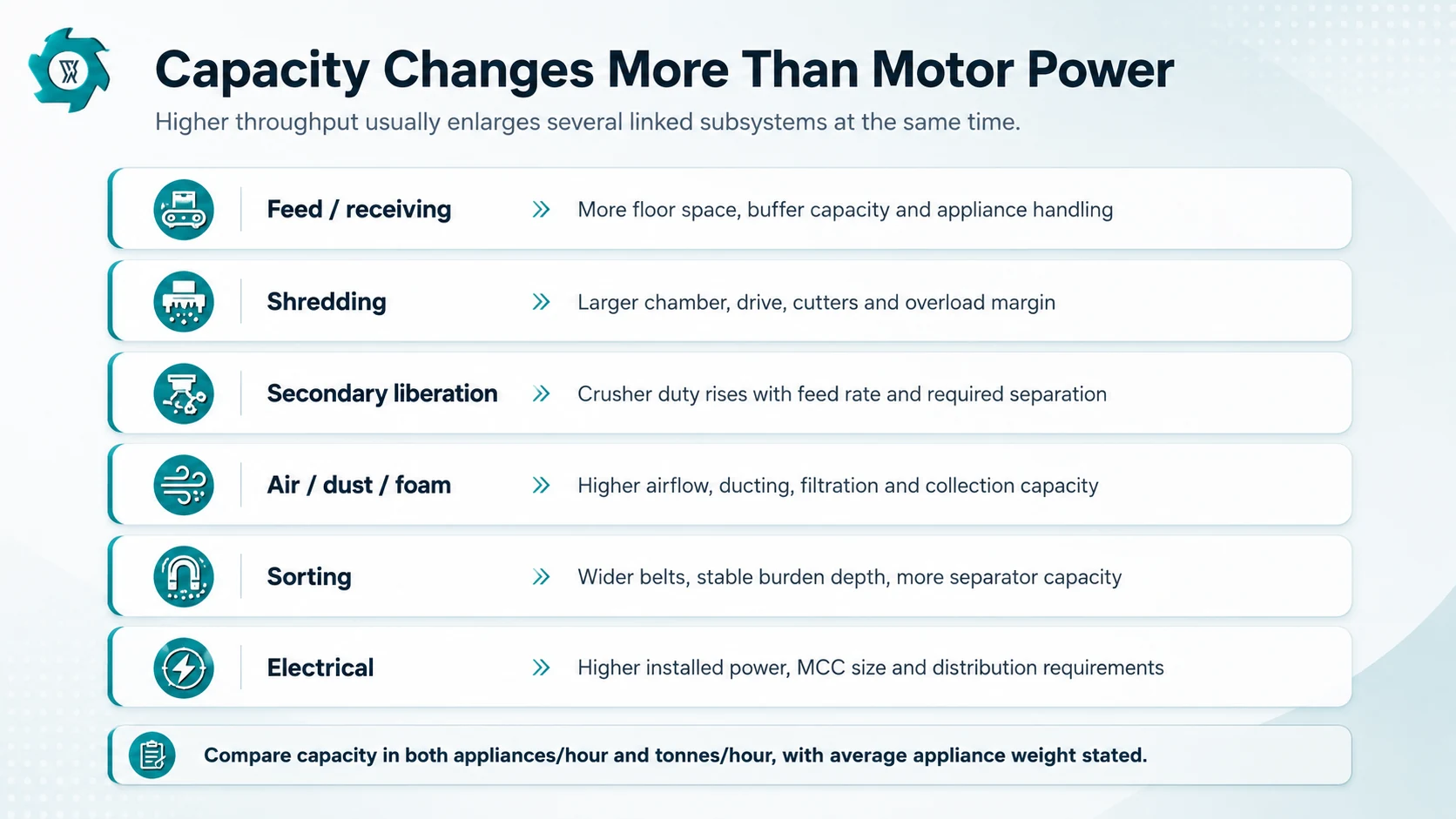
Refrigerator plants are often discussed in units per hour, but unit count alone can mislead. A compact domestic refrigerator and a large freezer do not put the same mass through the shredder. Capacity should be stated in both appliances per hour and tonnes per hour, together with the average appliance weight and the assumed pre-treatment condition.
Increasing throughput does more than increase motor size. Receiving buffers get larger. Conveyors widen. The primary shredder needs more working volume and torque margin. The secondary crusher has to liberate more material. Air separation and dust extraction need more airflow. Magnetic and eddy-current separators need enough belt width and burden control to avoid simply carrying a deeper layer of material.
Primary shredding and secondary liberation
The first shredder opens the cabinet. The second size-reduction stage has a different job: freeing steel sheet, plastic liner and foam so downstream separation can work. A lower-cost proposal that stops after coarse shredding may look attractive until the buyer discovers that the final material is still too composite for the intended buyers.
When comparing this part of the quotation, look beyond installed kilowatts. Chamber dimensions, cutter arrangement, expected primary output size, access for maintenance, overload logic and spare cutter strategy all affect both capital cost and downtime risk. A separate guide on metal shredder blade materials explains why blade specification should be matched to the actual scrap duty rather than chosen from hardness alone.
How far the plant separates the material
A basic line can recover ferrous metal and remove light foam. A deeper separation train may add eddy-current recovery, air classification, gravity or other fine-separation stages. The more products the buyer wants to sell separately, the more equipment and control points are usually required.
This is where product specifications should replace vague phrases such as “high purity.” Does the plant need a ferrous fraction suitable for a local steel scrap buyer? Is a mixed copper/aluminum conductive fraction acceptable, or must those metals be separated further? How much foam carryover can the plastic buyer tolerate? The answer changes the separator count, material recirculation and sometimes the number of operators.
Foam, dust and gas handling
Polyurethane insulation is light, bulky and dusty after crushing. It can dominate ductwork and collection design even though it is not the heaviest recovered material. Cyclones, filters, fans, enclosed transfer points, foam compaction and housekeeping provisions can therefore be a substantial part of the plant.
There is also a regulatory distinction worth keeping clear. In the United States, EPA rules require refrigerant recovery before disposal. Federal rules do not generally require recovery of the blowing agent inside appliance foam, although EPA has treated foam recovery as an environmental best practice in its Responsible Appliance Disposal guidance. A project that includes controlled foam blowing-agent recovery is therefore a different technical and cost scope from a conventional foam-separation system. State or local requirements can be stricter, so the buyer should define the governing jurisdiction before final design.
Automation and control philosophy
Automation is rarely an all-or-nothing choice. A plant may automate feeding and still leave certain dismantling jobs to operators. The controls can also watch machine load, trigger reversals, monitor temperature and alarms, and show line status from one place. None of that means every operator has to disappear from the process.
More automation can take repetitive handling out of the job and keep the downstream separators fed more evenly. The tradeoff is extra sensors, actuators, electrical hardware and engineering work. What matters is whether those controls solve a real bottleneck or safety issue. If the task still changes with every batch of incoming refrigerators, automating it may not give much back.
What Is Usually Outside the Equipment Price?
Many project overruns do not come from the shredder. They appear between the factory quotation and the first week of production.
| Cost area | Often included? | What to confirm |
|---|---|---|
| Ocean or inland freight | Varies | Incoterm, container count, oversized cargo, destination handling |
| Import duties and taxes | Usually buyer-side | HS classification and local tax treatment |
| Foundations and civil work | Often excluded | Loads, anchor plan, pits, drainage and floor reinforcement |
| Electrical distribution | Partly included | Transformer, MCC interface, field cable, cable trays and local code |
| Ducting and extraction | Varies | Supply boundary between machine vendor and local contractor |
| Rigging and erection labor | Varies | Crane, forklift, local labor, travel and accommodation |
| Commissioning and training | Sometimes | Duration, feed samples, performance test and operator training |
| Initial spares and wear parts | Varies | Cutter set, screens, belts, filters, sensors and critical bearings |
For a U.S. installation, machinery safeguarding and hazardous-energy control should also be considered during layout and commissioning. OSHA’s recycling guidance specifically points to guarding of moving machine parts and lockout/tagout procedures for unexpected startup. Guards on the supplied machines are only part of the finished installation; conveyor transfer points, platforms, access doors and the plant’s own maintenance procedures still need to be addressed on site.
So, What Should You Budget for the Plant?
There is no single figure that fits every project. Public listings are still useful as a rough starting point, as long as the scope behind each price is kept in view.
| Publicly advertised category | Observed listing range | Why it is not a turnkey budget |
|---|---|---|
| Single machine / compact or partial refrigerator equipment | About US$15,000–60,000 | May represent one machine, small capacity, or a limited process section |
| Compact to mid-size line listings | Roughly US$65,000–255,000 | Scope, capacity and pre-treatment inclusion vary widely |
| Large / integrated automated line listings | Roughly US$290,000–850,000 | May still exclude freight, local installation, civil work and utilities |
These ranges are useful for one purpose: they show that asking “What does a refrigerator recycling plant cost?” before defining scope can produce a tenfold spread. They should not be used as a YUXI quotation, a final investment budget or a guarantee that two systems at the same advertised price perform the same work.
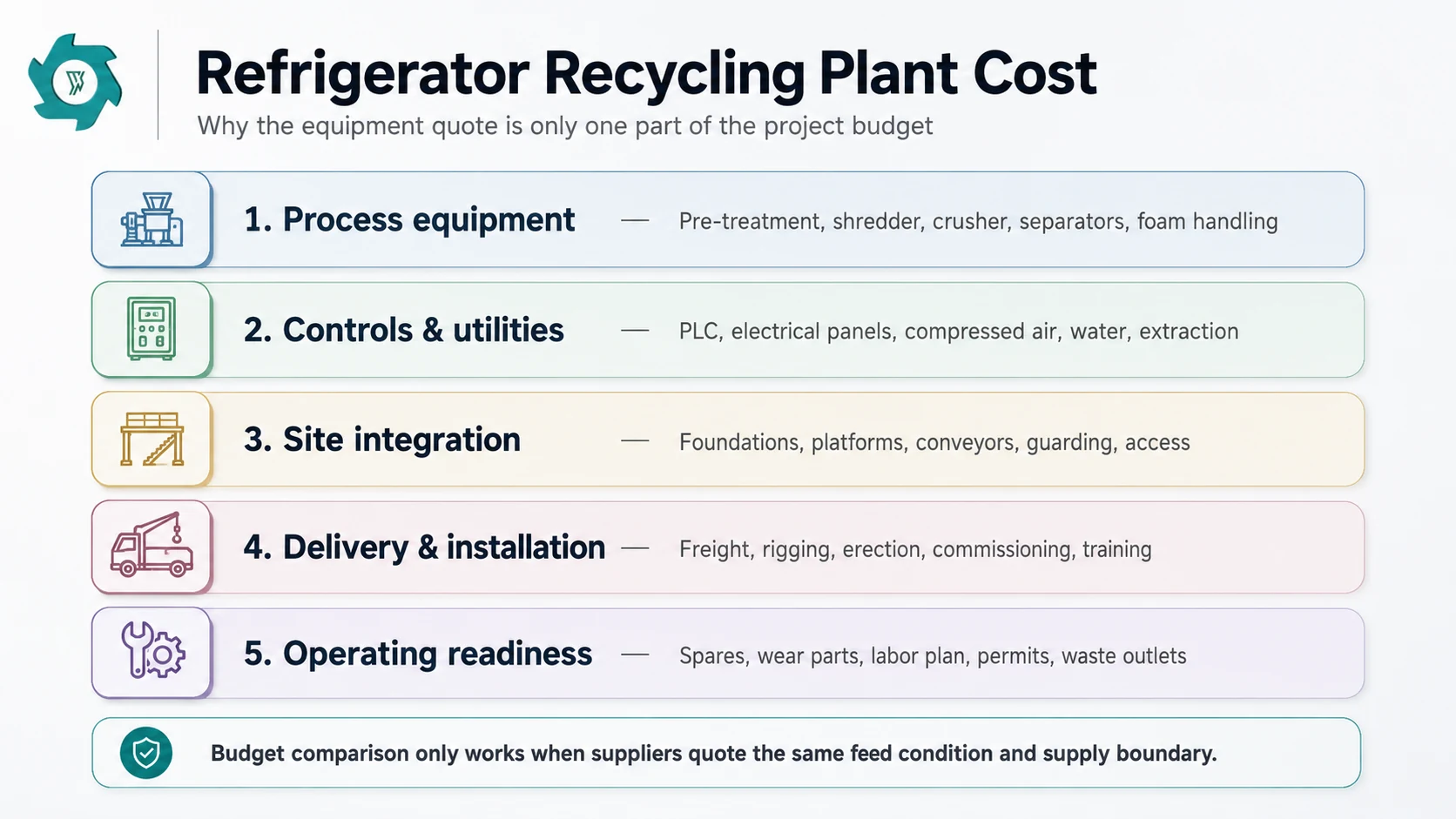
A more useful budget separates the project into four buckets: the process equipment itself, the equipment delivered to site, the installed plant, and the money needed to get ready for operation. With those figures split out, it becomes much easier to see what belongs in the supplier’s scope and what the buyer will arrange locally.
Capital Cost Is Only Half the Selection Problem
A lower purchase price can be rational if the plant already has labor, refrigerant recovery equipment, dust extraction or downstream sorting. It can also be false economy if the missing items are exactly what the project needs.
Operating cost is driven by electricity, labor, cutter and wear-part consumption, filter media, maintenance time, residue disposal, refrigerant handling and the value of recovered fractions. Product quality matters because small gains in separation may be worth more than modest energy savings if they turn a mixed fraction into something a local buyer pays more for.
There is also a capacity utilization question. A 100-unit-per-hour line running short shifts on inconsistent feed can have a worse cost per processed refrigerator than a smaller line kept steadily loaded. Before selecting capacity, work backward from the annual incoming volume, expected working days, shift length, maintenance allowance and realistic collection peaks.
How to Compare Two Refrigerator Recycling Plant Quotations
Put the quotations side by side and normalize them before discussing price. We would check these points first:
- Feed definition: complete refrigerators, evacuated cabinets, freezer ratio, oversize units and excluded materials.
- Capacity basis: appliances/hour, tonnes/hour, average unit weight and sustained versus peak rate.
- Pre-treatment scope: refrigerant, compressor, oil, glass, circuit boards, wires and loose plastics.
- Output definition: ferrous, mixed non-ferrous, separated copper/aluminum, plastics, foam and residues.
- Dust and foam system: airflow, filtration, foam collection/compaction and whether blowing-agent recovery is part of the project.
- Electrical scope: installed power, control voltage, local standard, MCC boundary and field wiring.
- Installation scope: freight, foundations, steelwork, ducting, erection, commissioning and training.
- Acceptance test: what feed will be used, for how long, and which output or throughput measurements will be recorded.
That comparison often reveals that the lowest quote is not actually lower. It is simply shorter.
Information to Send Before Requesting a Price
A useful RFQ does not need to be long, but it does need to remove the assumptions that change the plant.
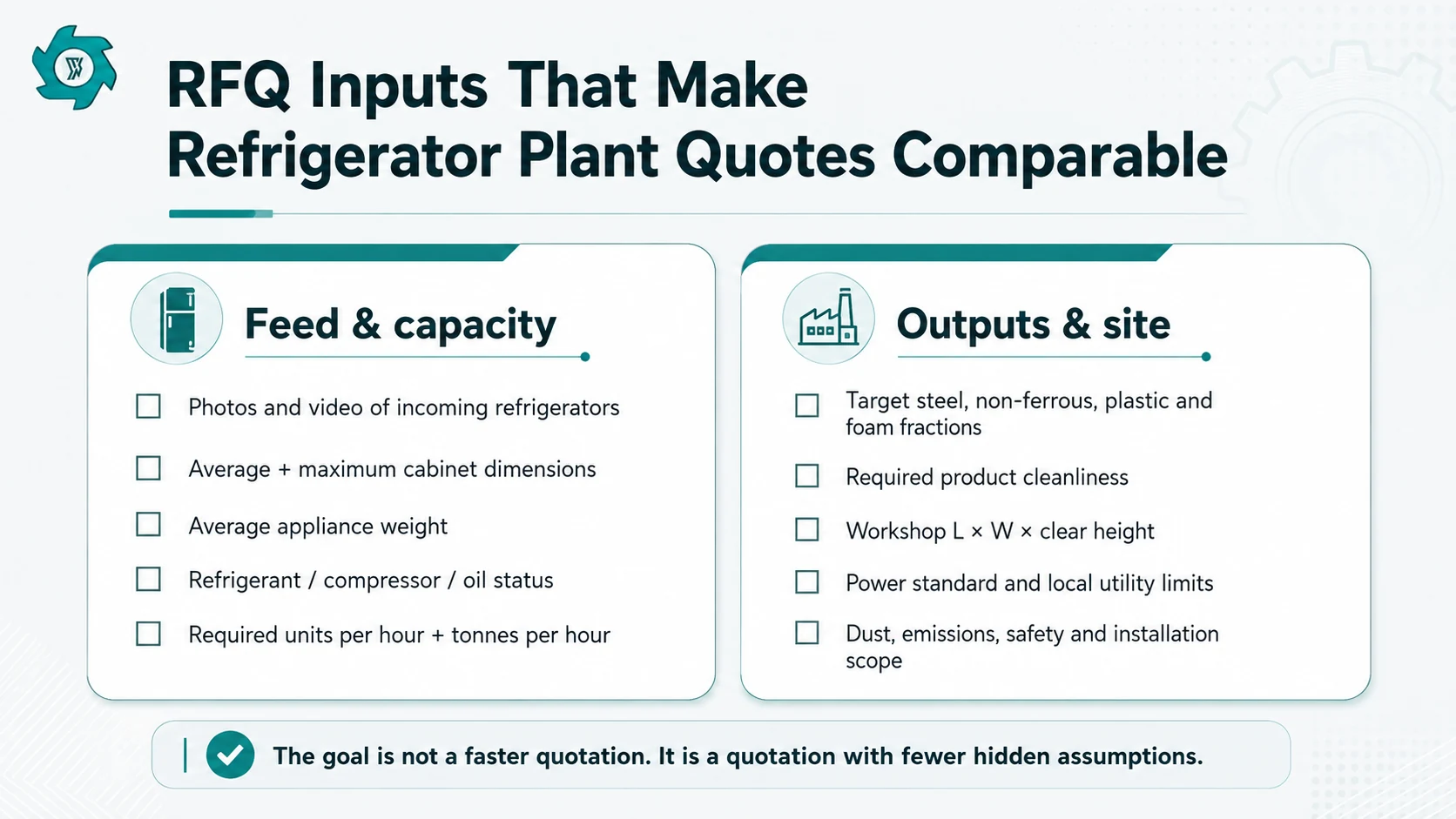
- Photos and short videos of the incoming refrigerators and freezers.
- Average and maximum appliance dimensions.
- Average appliance weight, if available.
- Whether refrigerant, compressor and oil are already removed.
- Required sustained capacity in appliances/hour and tonnes/hour.
- Target recovered products and acceptable contamination.
- Workshop length, width, clear height and preferred material flow.
- Power frequency, voltage and available utility capacity.
- Local dust, emissions, fire, safety and refrigerant-handling requirements.
- Required installation, commissioning and operator-training scope.
For a serious project, we would also agree on the proposed factory acceptance test feed sample. Refrigerator construction varies by age, manufacturer and region, so the test material should resemble the buyer’s actual stream rather than a hand-picked set of easy cabinets.
FAQ: Refrigerator Recycling Plant Cost
How much does a refrigerator recycling plant cost?
There is no single reliable price without defining scope. Public listings range from tens of thousands of U.S. dollars for partial or compact equipment to several hundred thousand dollars for larger automated systems. A turnkey installed project can cost more once freight, civil work, electrical integration, installation and commissioning are included.
Why can two refrigerator recycling line quotations differ so much?
The most common reason is that they include different process boundaries. One may start with pre-treated refrigerator cabinets, while another includes refrigerant recovery, compressor handling, dismantling, foam collection, dust control and installation services.
Does higher capacity always mean a much higher plant price?
Usually the cost rises, but not in direct proportion to units per hour. Higher throughput can enlarge the shredder, crusher, conveyors, separators, airflow system, dust filtration and electrical distribution at the same time. Feed weight and construction also matter.
Is refrigerant recovery included in every refrigerator recycling plant?
No. Some mechanical recycling lines assume the cabinets have already been evacuated and the compressor has been removed. An integrated project can include refrigerant recovery and oil handling, but that boundary must be stated in the proposal.
What hidden costs should I add to the machine quotation?
Common additions include freight, duties, foundations, platforms, electrical field work, ducting, rigging, installation labor, commissioning, operator training and initial spare parts. Local permitting and environmental controls may also affect the budget.
What should I send a supplier to get a more accurate quotation?
Send feed photos, maximum appliance size, average weight, pre-treatment condition, required units/hour and tonnes/hour, target output fractions, workshop dimensions, power standard and the installation or safety requirements that apply at the site.
Build a Refrigerator Recycling Plant Budget Around Your Real Feed
Send YUXI your refrigerator samples, pre-treatment condition, target capacity, required recovered products and workshop dimensions. We can use the same assumptions to define the process boundary and prepare a project-specific equipment proposal.
Sources and Technical References
- U.S. EPA, Stationary Refrigeration Safe Disposal Requirements.
- U.S. EPA, Appliance Disposal.
- OSHA, Waste Management and Recycling Hazards.
- Made-in-China, Refrigerator Recycling Price Listings, reviewed only to illustrate the spread of publicly advertised equipment prices. Listing prices and scopes may change over time.