




 Request Quote



Top 10 Scrap Metal Baler Manufacturers to Shortlist
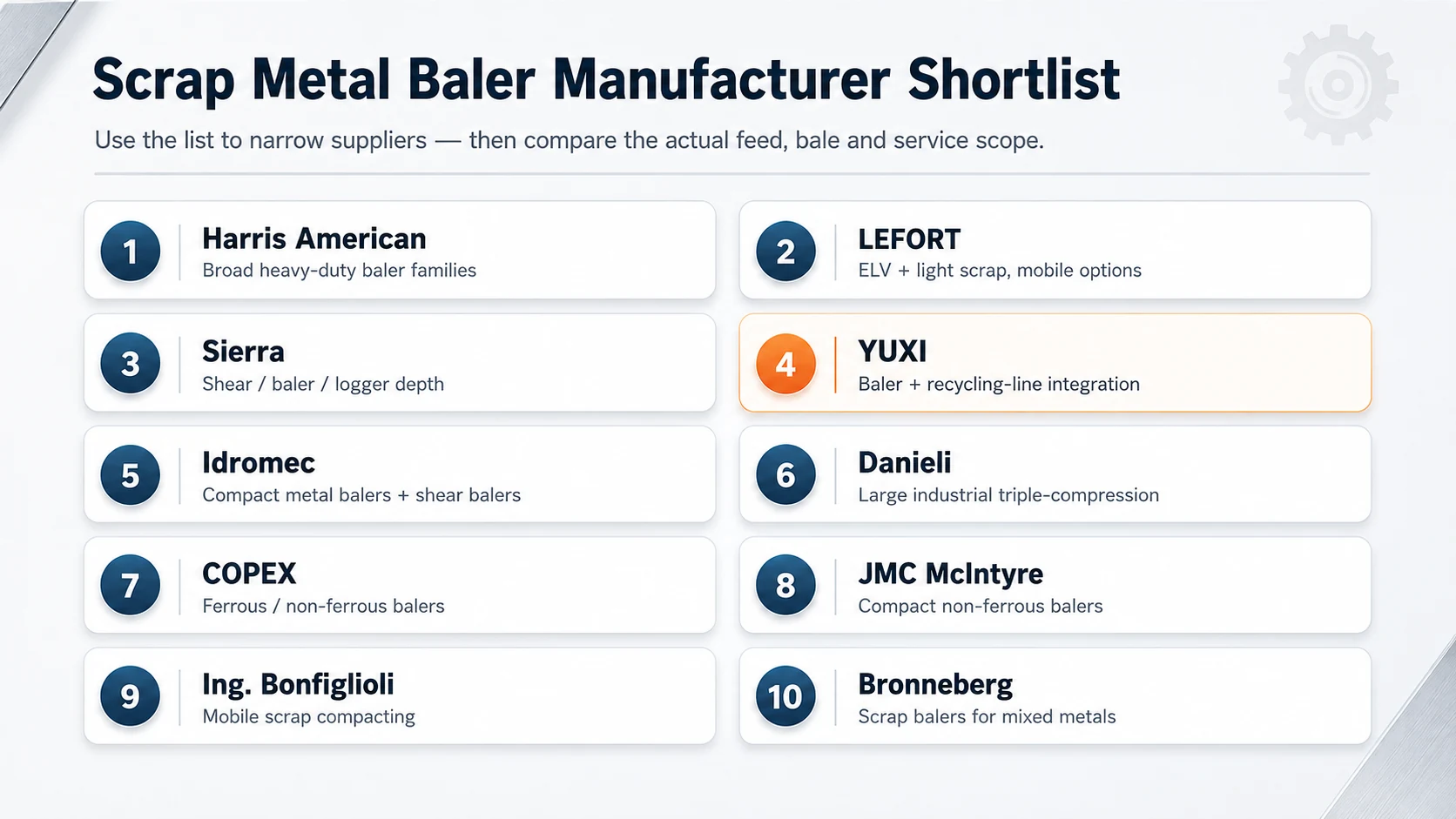
A manufacturer list is useful only when the machines are being judged against the same job. A compact non-ferrous baler, an ELV baler, a three-compression production press and a shear/baler/logger may all be sold under the phrase “scrap metal baler,” but they solve different problems. This ranking therefore looks at manufacturer fit rather than treating one catalog number as proof that a brand is better than another.
How We Ranked Scrap Metal Baler Manufacturers
First, we checked whether each company currently publishes equipment specifically relevant to scrap-metal densification. Then we compared the breadth of that range and the type of yard it appears designed to serve.
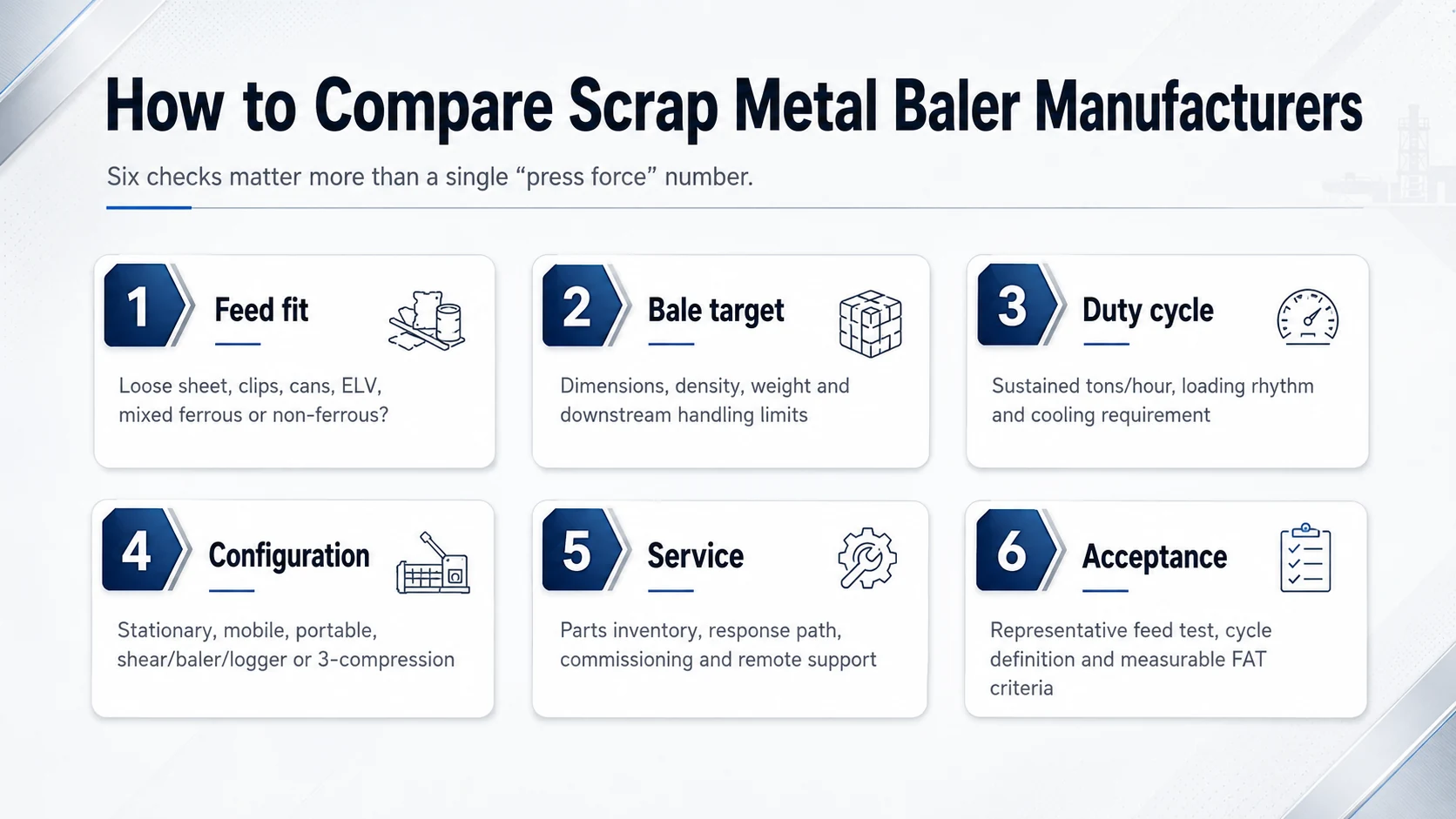
Six factors carry the most weight: dedicated scrap-metal baler coverage; ferrous and non-ferrous feed range; stationary, mobile or combined shear/logger configurations; the amount of usable engineering information published; visible parts or service support; and the ability to integrate the baler into a wider recycling process. Price is not scored because most heavy scrap equipment is configured project by project and public list prices would create false precision.
If you are still deciding whether the project needs a baler at all, read the metal baling machine buying guide first. That page deals with machine sizing. This article stays focused on which manufacturers deserve a place on the RFQ list.
Top 10 Scrap Metal Baler Manufacturers: Comparison
| Rank | Manufacturer | Country | Strongest fit | What stands out | Main point to verify |
|---|---|---|---|---|---|
| 1 | Harris American | USA | Heavy ferrous, non-ferrous and high-volume yard operations | Broad baler families plus shear/logger/baler equipment | Exact machine family, service plan and bale requirement |
| 2 | LEFORT | Belgium | ELV, light scrap and mobile yard processing | Stationary, mobile, portable and tracked balers | Whether a baler, shear-baler or tracked unit best fits the site |
| 3 | Sierra International Machinery | USA | Scrap yards needing portable or combined processing | Shear/baler/loggers, portable baler/loggers and two-ram balers | Real production on your feed and local parts coverage |
| 4 | YUXI Machinery | China | Projects combining baling with shredding or separation | Metal balers within a broader metal-recycling line portfolio | Representative-feed test, final configuration and destination-market service |
| 5 | Idromec | Italy | Metal balers and heavier shear-baler projects | Dedicated metal balers plus multiple shear-baler families | Machine class and mobility/power option for the material |
| 6 | Danieli Centro Recycling | Italy | Large industrial and steel-linked recycling projects | Triple-compression balers and broad recycling plant capability | Project boundary, civil scope and actual required densification |
| 7 | COPEX | France | Ferrous/non-ferrous recovery and industrial baling | PCC, PCV and other metal-oriented baler families | Feed envelope, automation level and service coverage |
| 8 | JMC McIntyre | United Kingdom | Compact to medium non-ferrous and general scrap baling | 2035, 5025 family and heavier Hippo-style machines | Chamber size, lid shear and cycle against oversized feed |
| 9 | Ing. Bonfiglioli | Italy | Mobile car and scrap compaction | Portable balers with diesel/electric choices | Mobility advantage versus stationary production requirement |
| 10 | Bronneberg | Netherlands | Professional mixed-metal and non-ferrous yards | Dedicated scrap balers and compactors | Model-specific throughput and after-sales support in your region |
1. Harris American
Best for: buyers who want a deep North American baler portfolio for demanding ferrous, non-ferrous and industrial recycling duties.
The company publishes horizontal balers, two-ram balers, ferrous balers, specialty balers and shear/logger/baler equipment, rather than stretching one general-purpose press across every scrap stream.[1] That matters in a real RFQ. A yard can begin with the material and required bale, then select the appropriate machine family instead of forcing the purchase around a single chamber design.
For heavy ferrous work, Harris also publishes equipment intended for severe scrap duties, including side-squeeze and other ferrous-processing systems. The breadth makes Harris a strong benchmark supplier: even if you eventually buy elsewhere, its product segmentation is useful for checking whether competing quotations are actually comparable.
Verify before buying: do not assume the largest Harris machine is the correct benchmark. Ask the supplier to state sustained output on your scrap, bale density, loading assumptions, cooling arrangement, service interval and which components are stocked near your plant.
2. LEFORT
Best for: ELV processors and light-scrap yards that place high value on mobility and integrated yard processing.
LEFORT is a specialist name in scrap recycling, and its baler range is clearly positioned around end-of-life vehicles and light scrap. The current range can be configured stationary, mobile, portable or on tracks, with one or two baling rams depending on the job.[2] That range of formats is the reason LEFORT ranks ahead of manufacturers whose balers are primarily fixed industrial presses.
The useful question is not “Is LEFORT better?” It is “Does the site make money by moving the machine to the scrap?” A tracked or transportable unit can solve a very different operating problem from a stationary press fed by a fixed material handler. For multi-yard work, demolition contracts or ELV flow, that distinction can dominate the purchasing decision.
Verify before buying: define how often the machine will move, what loading equipment follows it, road/transport constraints, and whether the operation really needs shearing as well as baling.
3. Sierra International Machinery
Best for: scrap processors comparing portable baler/loggers, heavy shear/baler/loggers and two-ram balers under one supplier.
Sierra’s current catalog spans shear/baler/loggers, two-ram balers and portable baler/loggers.[3] The published RB, S and T families also make it easier to see how the company separates portable logging/baling work from larger shearing duties. That clarity is valuable because “tons per hour” can mean very different things depending on whether the machine is baling light ferrous, logging appliances or shearing prepared scrap.
Some Sierra product pages publish material examples and separate production ranges for shearing, baling and logging. Those numbers should still be treated as manufacturer data, not as a guaranteed plant result, but they give a buyer something concrete to challenge during the RFQ.
Verify before buying: ask for production references on feed similar to yours and confirm what portion of the quoted output depends on preloading, operator skill, crane cycle and material preparation.
4. YUXI Machinery
Best for: projects where baling is one stage of a wider metal-recycling route rather than the only machine being purchased.
YUXI Machinery publishes hydraulic metal baling machines alongside metal shredders, hammer mills, shears and separation equipment. On the current site, the baler is positioned for compressing scrap steel, aluminum and other metal waste into dense blocks for handling, transport and smelting logistics.
A plant dealing with bulky mixed scrap may need coarse shredding before separation; a clean aluminum offcut stream may simply need densification. Keeping both routes under one engineering discussion can be useful when the incoming material is still being defined.
In practice, we would not recommend choosing a YUXI baler from press force alone. The chamber, feed opening, hydraulic cycle, bale discharge, cooling, shift pattern and actual loose bulk density need to be discussed together. The site’s own scrap metal baler working-principle guide is useful background, but the purchase decision should move quickly from theory to a material-specific test plan.
Verify before buying: request a written configuration tied to feed photos or samples, target bale size/density, sustained capacity, power standard, commissioning scope, spare-parts package and support arrangements for the destination country.
5. Idromec
Best for: buyers who want a dedicated metal baler range and a path upward into heavier shear-baler equipment.
Idromec publishes metal balers for aluminum scrap, cable, steel and sheet metal, with several box and bale-size options and electric or diesel power choices.[4] It also builds multiple shear-baler families. That combination gives the company a useful position between compact densification work and heavier scrap processing.
One point worth noticing is how the range forces an early process decision. If the material is already sized and simply needs a dense shipping package, a metal baler may be enough. If oversize structural scrap is regularly entering the box, the project may actually belong in the shear-baler category. Buyers sometimes discover that difference only after comparing quotations.
Verify before buying: make the supplier classify your feed as baler duty or shear-baler duty in writing and explain the wear, power and cycle assumptions behind that decision.
6. Danieli Centro Recycling
Best for: large industrial recycling projects, especially when scrap preparation may connect with broader steelmaking or plant integration.
Danieli Centro Recycling publishes triple-compression baling presses for ferrous and non-ferrous scrap where high densification and production capacity are required.[5] The wider Danieli organization also covers major recycling and steel-plant systems, which makes this supplier especially relevant when the baler is part of a large capital project rather than a stand-alone yard purchase.
The trade-off is scope. A large supplier can engineer a very broad project, but a small or medium scrap yard may not need that level of integration. The RFQ should therefore separate the baler itself from optional conveyors, civil works, controls, material handling and downstream plant interfaces.
Verify before buying: define the battery limits. State exactly who supplies foundations, electrical distribution, oil cooling, feeding, discharge handling, automation interfaces, commissioning and performance testing.
7. COPEX
Best for: ferrous and non-ferrous recyclers needing dedicated metal balers with strong densification and industrial automation options.
COPEX publishes PCC, PCV and PACK METAL baler families for metal applications, with PCC lid balers positioned for bulky and heterogeneous ferrous and non-ferrous waste.[6] The company also builds shear-balers and other heavy recycling machinery, so it belongs on a shortlist where the project may extend beyond simple clean production scrap.
COPEX is a good example of why the word “baler” needs a modifier. A packaging-metal baler, a general metal lid baler and a heavy scrap shear-baler may sit on the same manufacturer’s website. They should not sit on the same RFQ line unless the material and output are truly comparable.
Verify before buying: require the quotation to name the machine family, compression method, allowable oversize and exactly what happens when non-conforming scrap enters the chamber.
8. JMC McIntyre
Best for: non-ferrous yards and processors that value compact balers, straightforward material handling and a range that scales upward.
JMC McIntyre’s current baler offering includes compact machines such as the 2035, several 5025 variants and larger units such as the Hippo. The 5025 Terminator, for example, is published as a universal metal baler with a surrounding sorting table, bale track and semi-automatic option.[7]
This range is especially relevant to copper and aluminum processors that do not need a huge ferrous shear-baler. A smaller chamber and shorter handling path can be an advantage if the feed arrives in manageable pieces. It becomes a disadvantage when operators routinely try to stuff long, nested or oversize scrap into a machine built for another job.
Verify before buying: compare chamber opening and lid shear against the largest real item, not the average piece. Also check how the bale exits and whether the receiving forklift or grab can handle it safely.
9. Ing. Bonfiglioli
Best for: scrap operations that want mobile compacting equipment for cars and general metal scrap.
Ing. Bonfiglioli publishes compacting balers designed for scrap from industrial plants, demolition and disposal sites, with mobile units and diesel or electric power options.[8] This makes the company particularly interesting when the baler needs to travel or operate without a conventional fixed plant layout.
Mobility can be valuable, but it should not be treated as a free feature. A mobile unit carries structural, transport and service implications. If the material never moves and production is steady, a fixed machine with optimized feeding may offer a simpler path. If the work follows demolition or multiple scrap sources, mobility can change the economics completely.
Verify before buying: compare total tons handled per shift, including travel, setup and loading – not just the press cycle once material is already in the box.
10. Bronneberg
Best for: professional scrap processors looking for dedicated balers for iron, aluminum, copper and mixed metal streams.
Bronneberg publishes scrap balers and compactors for metal recycling, including models intended for voluminous iron and metal scrap and non-ferrous materials.[9] The company also sells broader recycling equipment, which can be useful for yards where baling sits next to cable, sorting or other preparation work.
Bronneberg closes the Top 10 not because the equipment is “worse,” but because this ranking gives extra weight to the breadth and visibility of heavy scrap baler families. For a specific non-ferrous or European recycling project, the practical ordering may be very different.
Verify before buying: ask for the closest installed reference to your material, target bale and working hours, plus the parts and field-service path for your location.
How to Choose Between These Manufacturers
Once the shortlist is down to three or four suppliers, brand reputation should become less important and operating boundaries should become more important. We normally start with the scrap stream, because that quickly eliminates attractive but unsuitable machines.
Start with the material you actually receive
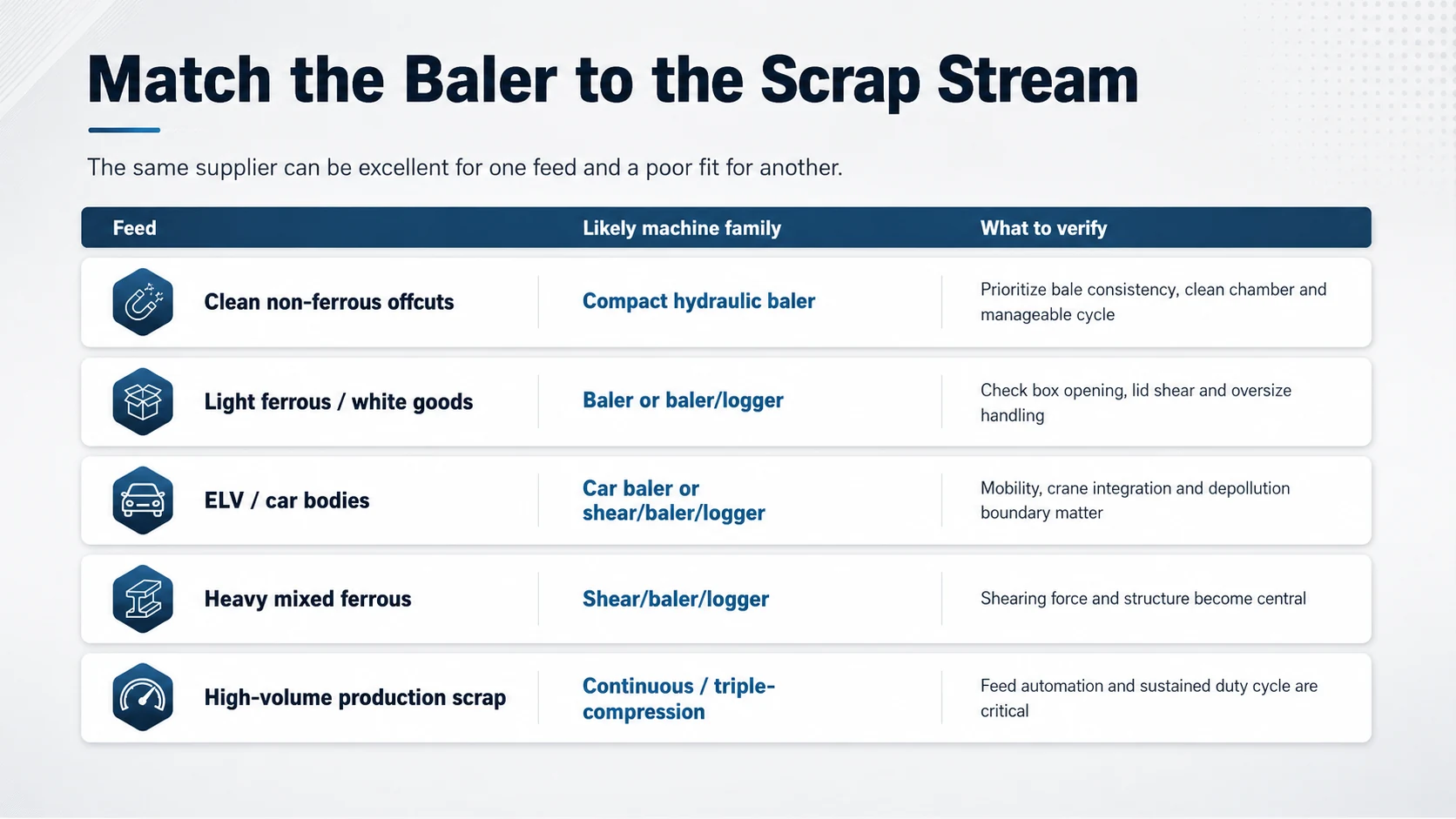
Clean aluminum clips, loose cans, radiator scrap, steel turnings, white goods and prepared car hulks behave differently in a loading box. Record the largest piece, typical piece, loose bulk density, nesting tendency, spring-back, contamination and any object that operators currently have to cut by hand. If aluminum sheet and foil are a major feed, the decision between shredding, shearing and baling is discussed in the aluminum sheet and foil scrap recycling guide.
Define the bale before the machine
A vague request for “high density” is not enough. State bale cross-section, acceptable length range, target weight, minimum or preferred density, whether tying is allowed, and how the bale will be picked up. A steel mill specification, export container limit or internal furnace-charging requirement may change the best chamber and compression sequence.
Separate peak cycle from sustained output
Catalog cycle time is useful, but the plant sells tons, not empty-cylinder movements. Ask how many tons per hour the machine can sustain on your feed after loading, door movement, compression, ejection and normal hydraulic temperature are included. Then compare that number to the actual material arriving each shift. Sometimes the smaller press wins because it is fed continuously while the larger one waits for enough scrap to fill its box.
Choose the machine family before comparing motor power
A dedicated baler is usually the simplest choice when material is already suitable for densification. A baler/logger handles bulkier light scrap. A shear/baler/logger becomes attractive when the same yard also needs to cut prepared ferrous material. A continuous or triple-compression press makes more sense when production scrap is consistent enough to justify automated feeding. Complete vehicle operations may need a different workflow again; the vehicle recycling equipment guide explains where balers and shredders fit around depollution and dismantling.
Put service into the comparison table
A baler is a hydraulic production asset. A hose, seal, valve, sensor or cooling problem can stop the whole material flow. Ask where critical spare parts are stocked, which items are proprietary, who performs commissioning, how remote diagnostics work, what drawings and PLC backups are delivered, and how warranty response works in your country. This is one area where a lower equipment price can disappear quickly if the support model is vague.
RFQ and FAT Checklist for Scrap Metal Balers
The fastest way to get ten incomparable quotations is to send ten manufacturers a one-line request for “a 10 ton/hour metal baler.” Instead, send the same boundary to every supplier. That forces the discussion onto the machine duty rather than the sales brochure.
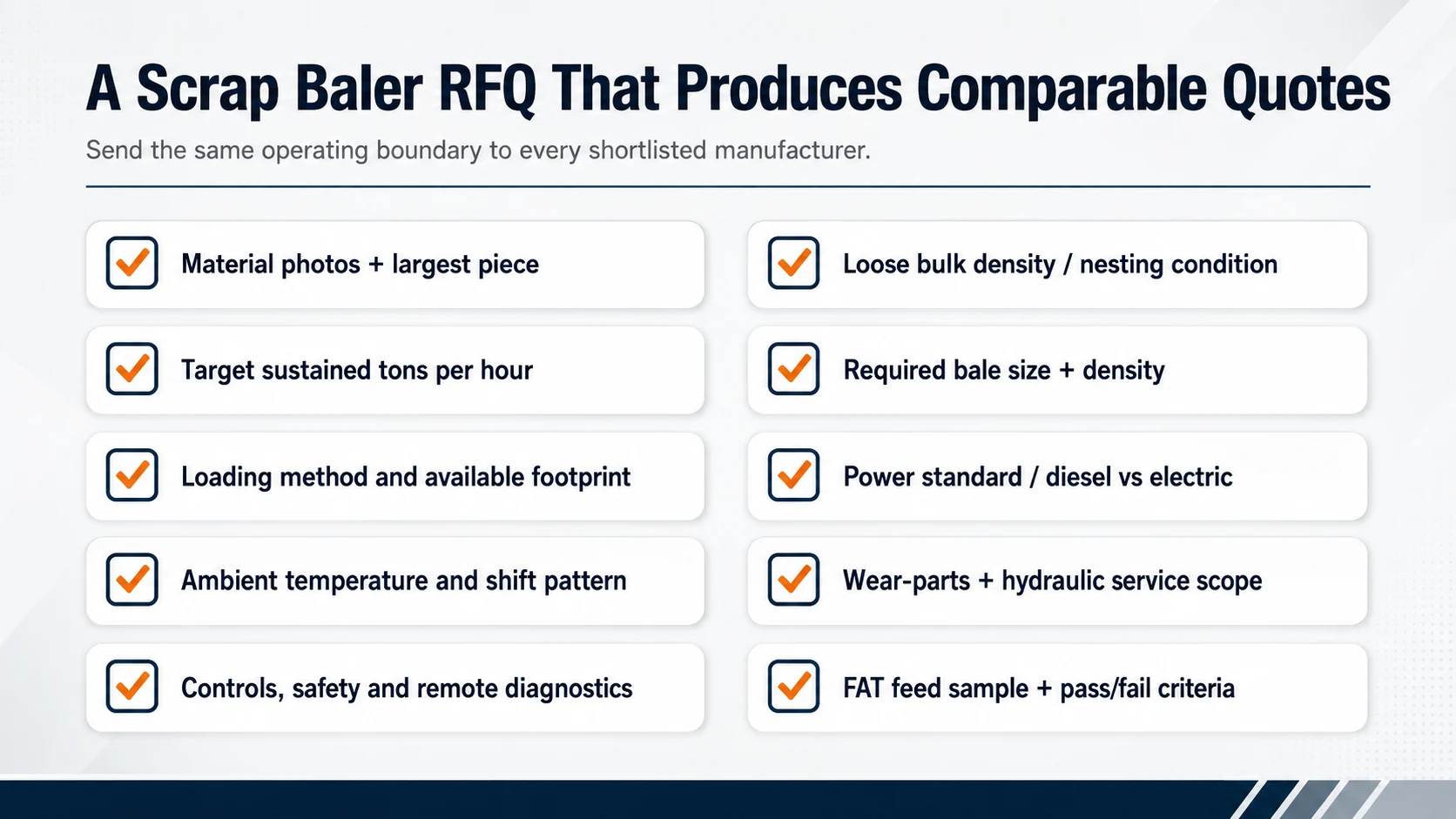
- Feed: scrap types, photos/video, largest and typical dimensions, contamination, temperature, oil/moisture, and whether pieces are loose, nested or bundled.
- Volume: daily tonnage, required sustained tons per hour, number of shifts, peak arrival pattern and expected future growth.
- Bale: required dimensions, weight and density; tying or no tying; downstream forklift, grab, container or furnace constraints.
- Loading: crane, material handler, conveyor or manual loading; available drop height and feed opening.
- Utilities: voltage/frequency, available electrical capacity, diesel preference if relevant, ambient temperature and cooling-water restrictions.
- Site: footprint, floor or foundation limits, access for installation, weather exposure and any mobility requirement.
- Controls and safety: PLC/HMI language, remote diagnostics, guarding, emergency stops, access interlocks and destination-market compliance scope.[10][11]
- Service: recommended spare parts for one and two years, consumables, hydraulic filtration, wear liners, cylinder/seal service and response path.[12]
- FAT: agreed feed sample, test duration, measured tons, bale density method, cycle temperature, rejected oversize rules and pass/fail criteria.
That last point is the most important. A FAT should not be a short video of the baler closing on clean factory scrap if your real feed is mixed, springy and oversized. The test sample needs to resemble the material that will actually determine production.
Which Manufacturer Fits Which Buyer?
| Buyer situation | Manufacturers worth starting with | Why |
|---|---|---|
| Large North American ferrous yard | Harris, Sierra | Deep scrap-yard equipment ranges and strong heavy-processing orientation |
| ELV / car-body processor | LEFORT, Sierra, Ing. Bonfiglioli | Mobile and combined baler/logger/shear approaches |
| Integrated metal recycling line | YUXI, Danieli, COPEX | Broader process-equipment scope beyond baling alone |
| Non-ferrous / compact-yard baling | JMC McIntyre, Idromec, Bronneberg | Dedicated compact-to-medium metal balers and mixed-metal coverage |
| High-volume industrial scrap with strong densification target | Danieli, COPEX, Harris | Industrial baler families and high-density project orientation |
Do not treat this second table as a final award list. It is a way to reduce the first round of calls. A manufacturer can move several positions once your location, service network, bale specification and feed test are added.
Compare a Scrap Metal Baler Around Your Real Feed
Send YUXI your scrap photos or video, largest piece size, daily tonnage, target bale dimensions, power standard and destination country. We can use those inputs to define the baler duty first, then decide whether the project also needs shearing, shredding or downstream separation.
Scrap Metal Baler Manufacturer FAQ
Who is the best scrap metal baler manufacturer?
There is no universal best manufacturer. Harris American, LEFORT and Sierra are strong shortlists for established heavy scrap and yard equipment, while YUXI is a practical option when the project also needs shredding, separation or broader recycling-line integration. The right supplier still depends on the actual feed, target bale, throughput, location and service requirement.
What should I compare between scrap metal baler manufacturers?
Compare the material envelope, chamber size, compression sequence, sustained throughput, bale dimensions and density, drive and cooling system, loading method, wear protection, safety controls, spare-parts plan, commissioning scope and the acceptance test. Comparing only press force or motor power can hide major differences in the real machine duty.
What is the difference between a metal baler and a shear/baler/logger?
A metal baler is mainly selected to densify loose scrap into compact bales. A shear/baler/logger adds cutting and logging capability for bulkier or heavier ferrous scrap. It is more versatile, but it also changes the investment, operating complexity and maintenance scope.
Should a small scrap yard buy the highest-capacity baler it can afford?
Not automatically. Oversizing can increase capital cost, idle hydraulic power, infrastructure demand and maintenance without improving revenue. A smaller baler that matches the daily tonnage, loading rhythm and buyer bale specification can be the better commercial choice.
References
- Harris American – ferrous balers.
- LEFORT – balers.
- Sierra International Machinery – shear/baler/loggers.
- Idromec – metal balers.
- Danieli Centro Recycling – baling presses.
- COPEX – metal balers.
- JMC Recycling – 5025 Terminator metal baler.
- Ing. Bonfiglioli – scrap balers.
- Bronneberg – metal balers.
- OSHA 29 CFR 1910.212 – machine guarding.
- OSHA 29 CFR 1910.147 – hazardous energy control.
- OSHA Scrap Recycling Safety – scrap recycling hazards.