




 Request Quote


A refrigerator recycling line is not one machine with a long conveyor attached. The line has three jobs: make incoming appliances safe to process, open the cabinet so its materials can be separated, and recover the different fractions without carrying too much foam or plastic into the metal streams.
Start With the Line Boundary, Not the Machine Catalog
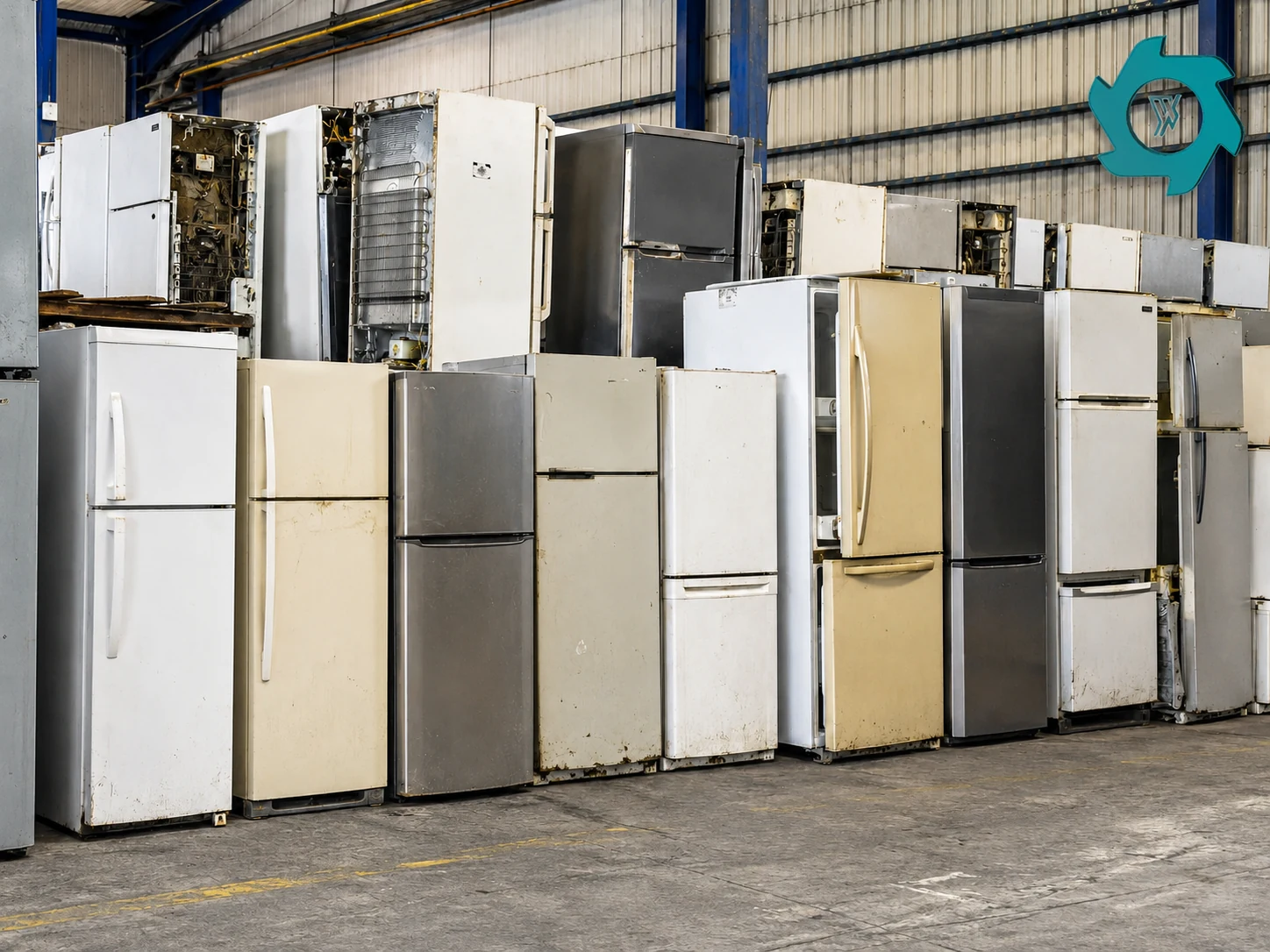
The most useful way to describe refrigerator recycling equipment is by the condition of the material at each handoff. The receiving team handles intact appliances. The depollution area removes refrigerant, compressor oil and components that should not enter the shredder. The mechanical section then reduces the cabinet, releases attached materials and separates steel, non-ferrous metal, plastic and foam.
YUXI’s waste refrigerator recycling line follows this same split between upstream pre-treatment and downstream mechanical processing. For equipment selection, that distinction matters more than whether two proposals happen to list the same shredder power.
Refrigerator Recycling Equipment List at a Glance
| Stage | Equipment | Main function | When it is required |
|---|---|---|---|
| Receiving | Roller table / infeed conveyor | Controls appliance movement and creates a steady work sequence | Almost every continuous line |
| Pre-treatment | Dismantling platform | Removes loose parts, glass, drawers, wiring and selected components | Complete or partially prepared appliances |
| Depollution | Refrigerant recovery unit | Recovers refrigerant from the cooling circuit before mechanical processing | When refrigerant remains in incoming units |
| Depollution | Compressor removal and oil station | Removes compressors and manages compressor oil | When compressors arrive attached |
| Feeding | Heavy-duty conveyor | Meters prepared cabinets into the primary shredder | Continuous mechanical lines |
| Primary size reduction | Double-shaft shredder | Opens bulky cabinets and tears them into manageable pieces | Core mechanical equipment |
| Secondary liberation | Hammer / vertical crusher | Breaks attachments and releases metal, plastic and foam | When higher liberation is needed before sorting |
| Light fraction removal | Air / foam separator | Extracts low-density PU foam from heavier material | Core for foam-insulated cabinets |
| Ferrous recovery | Magnetic separator | Removes steel and iron from the crushed stream | Core after adequate liberation |
| Non-ferrous recovery | Eddy current separator | Recovers conductive non-ferrous pieces from non-metal material | When aluminum/copper-bearing recovery is required |
| Fine sorting | Airflow / gravity separator | Cleans mixed light and heavy fractions where density contrast is useful | Project-specific |
| Foam handling | Foam compactor / densifier | Reduces storage and transport volume of collected foam | Useful where loose foam volume is a bottleneck |
| Emission control | Dust and gas collection | Captures airborne fines and supports controlled treatment of process air | Normally integrated into enclosed processing |
| Material transfer | Conveyors, screws, bins | Moves separated fractions without remixing them | Every multi-stage line |
| Control and safety | PLC, interlocks and sensors | Coordinates start/stop logic, load response, alarms and shutdowns | Every automated line |
1. Receiving Conveyor and Dismantling Platform
The first machines do not increase metal recovery directly, but they decide whether the rest of the line receives a predictable feed. Roller conveyors or powered infeed tables move refrigerators through inspection and pre-treatment without requiring operators to drag bulky cabinets across the floor. The dismantling position gives operators room to remove shelves, glass, drawers, cables, circuit boards and other parts that are better taken out before shredding.
A plant that buys pre-treated refrigerator bodies may not need a full dismantling section. Even then, it is worth keeping an inspection point before the shredder. One refrigerator with an unexpected loose cylinder, large glass panel or unremoved component can interrupt a line that otherwise runs clean material all day.
2. Refrigerant Recovery Equipment
This stage belongs upstream of size reduction whenever refrigerant remains in the cooling system. The recovery station should be treated as a process boundary, not as a decorative accessory on the quotation. Ask what appliance connections are expected, how recovered refrigerant is collected, how operators verify completion, and what records or site procedures are needed under the buyer’s local requirements.
3. Compressor Removal and Oil Handling
Compressors are dense, valuable assemblies, but they also contain oil and are a poor match for a cabinet shredder that has been selected around thin steel skins, plastic liner and insulation. Removing them upstream has two benefits: it isolates a separate recoverable component and keeps an avoidable mass of oil and heavy parts out of the cabinet-processing section.
The exact station can be manual, assisted or integrated with a dedicated handling fixture. What matters is the interface. The cabinet should leave this station in the agreed condition, and the compressor plus collected oil should have their own downstream route.
4. Heavy-Duty Feeding Conveyor
Once the cabinets are prepared, the infeed conveyor becomes the metering device for the mechanical line. Its job is not merely to move material. It prevents the primary shredder from seeing a burst of two or three cabinets followed by an empty period, which makes headline throughput difficult to reproduce in normal operation.
Check belt or slat width against the largest cabinet dimension, the loading method, incline, side containment and the distance operators must maintain from the shredder opening. Feeding is one of the places where a layout drawing is more useful than another page of motor specifications.
5. Double-Shaft Refrigerator Shredder
The primary shredder is the first major size-reduction machine. Two counter-rotating shafts pull the prepared cabinet into the cutting chamber and tear the shell into pieces that can be conveyed and processed by the secondary stage. For bulky appliance scrap, low-speed, high-torque shearing is useful because the material is hollow, folded and irregular rather than a uniform sheet.
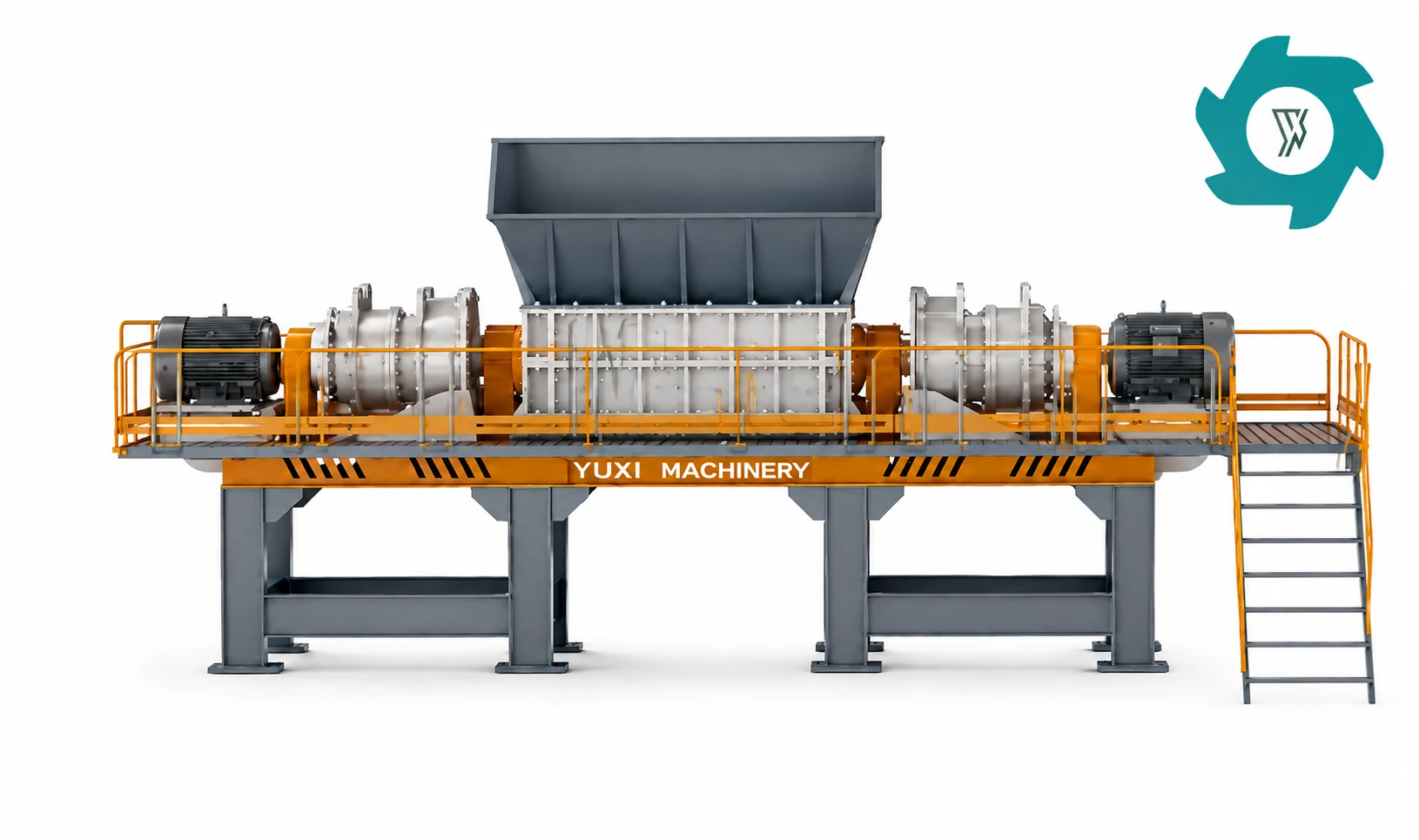
A shredder should be selected around the largest cabinet that will actually arrive, not the average photograph in a brochure. Chamber opening, cutter arrangement, shaft torque, reversal logic and discharge condition all matter. Buyers comparing shredder types can also use YUXI’s metal shredder machine page to see how feed dimensions, thickness, throughput and downstream process are connected.
6. Secondary Crusher: The Liberation Machine
Primary shredding makes refrigerators smaller. Secondary crushing makes the mixed structure easier to separate. Those are different objectives.
A hammer-type or vertical crusher receives the coarse shred and applies higher-energy impact, kneading or repeated breakage. The aim is to detach steel sheet from plastic liner, release embedded foam, break attached non-ferrous pieces free, and produce a burden that downstream separators can actually classify. If the crusher is skipped, a magnet may recover obvious steel while valuable non-ferrous pieces remain trapped in mixed composites.
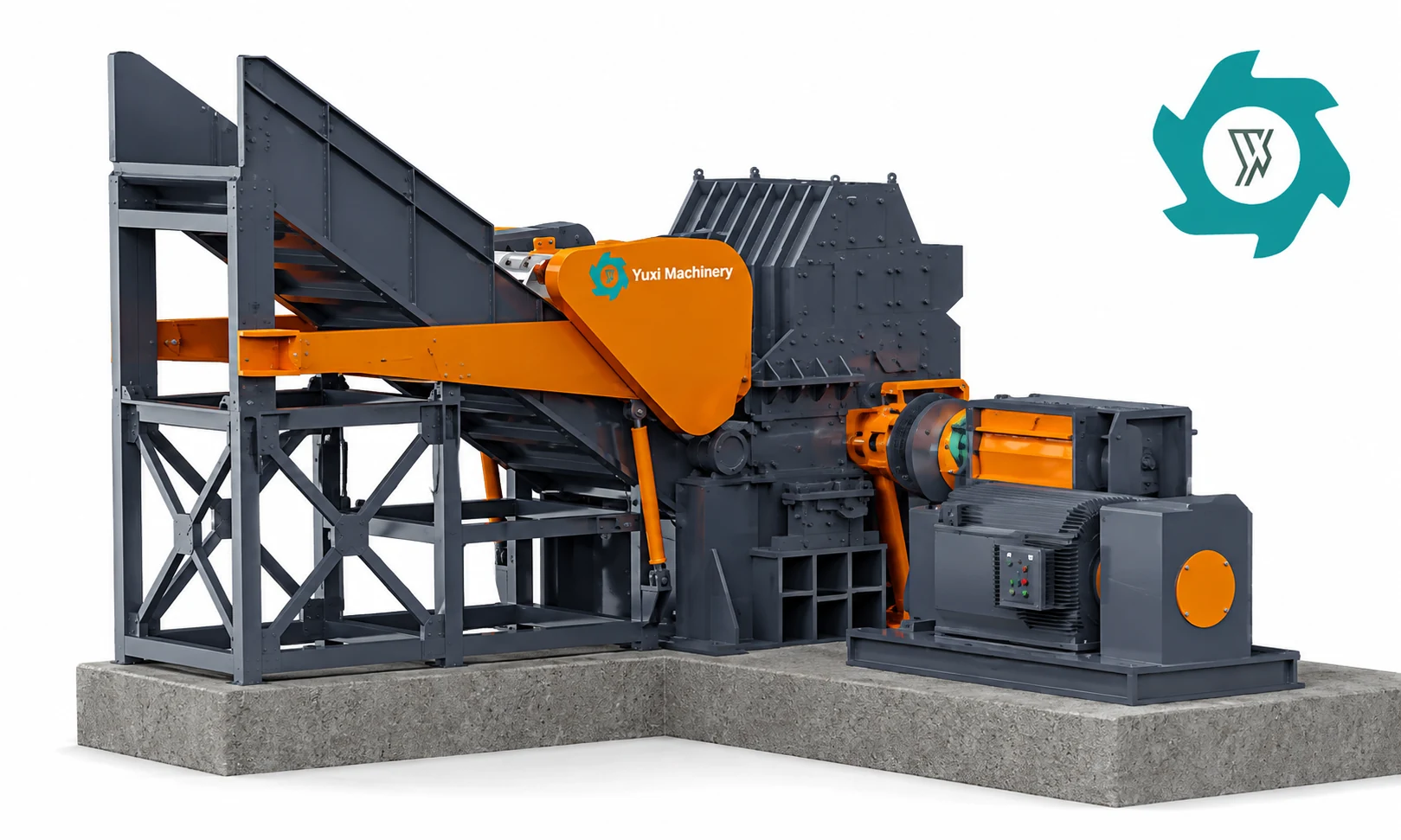
Do not specify the crusher by motor size alone. Ask for the expected feed size from the primary shredder, target discharge range, recirculation strategy if any, wear parts, maintenance access and the amount of fines the process can tolerate.
7. Foam and Air Separation System
Polyurethane insulation is the fraction that makes refrigerator recycling different from many ordinary white-goods lines. Once liberated, the foam is light, bulky and easily carried by air. A controlled airflow stage uses that density difference to pull foam away from heavier metal and plastic pieces.
The separation equipment may include ducts, a zig-zag or air classifier, cyclone, rotary valve, filter and dedicated collection path. These components should be reviewed as one airflow system. A fan can move foam, but the plant still needs to capture it, avoid uncontrolled escape and keep the heavier product stream stable.
8. Magnetic Separator for Ferrous Steel
After the cabinet is sufficiently opened, a drum or overband magnet removes the ferrous fraction. This is usually the highest-mass metal stream in refrigerator cabinets, so taking it out early simplifies everything that follows.
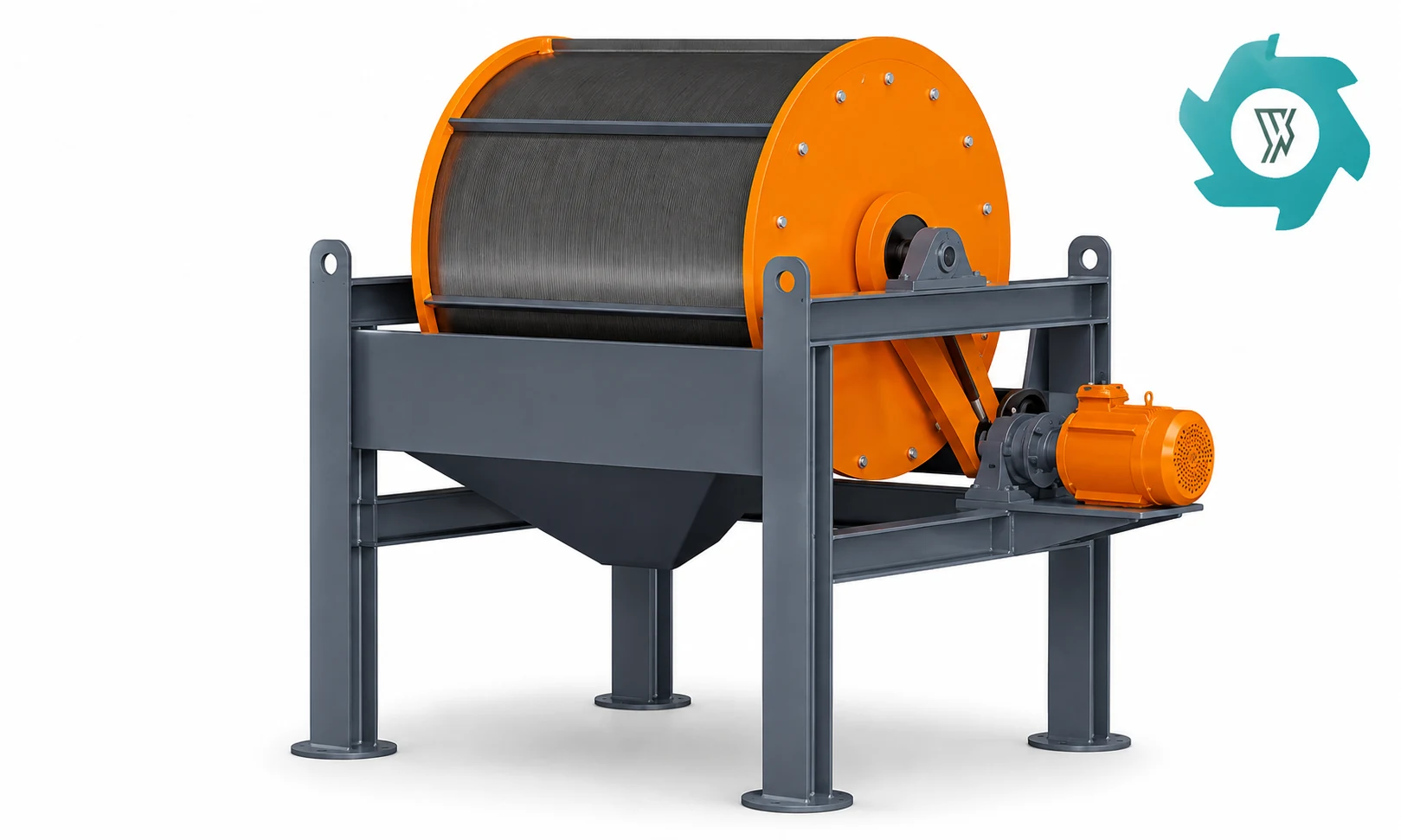
Magnet strength matters, but feed presentation matters too. A deep, tangled burden can carry plastic and foam into the steel product or hide smaller ferrous pieces under non-magnetic material. The upstream crusher, conveyor loading and belt speed are therefore part of the magnetic separator’s real performance.
9. Eddy Current Separator for Non-Ferrous Recovery
Once ferrous metal has been removed, an eddy current separator can recover conductive non-ferrous pieces from a suitable mixed stream. In refrigerator recycling that may include aluminum and copper-bearing pieces released during crushing. The machine creates a changing magnetic field at the belt discharge, which changes the trajectory of conductive particles relative to plastic and other non-metal material.
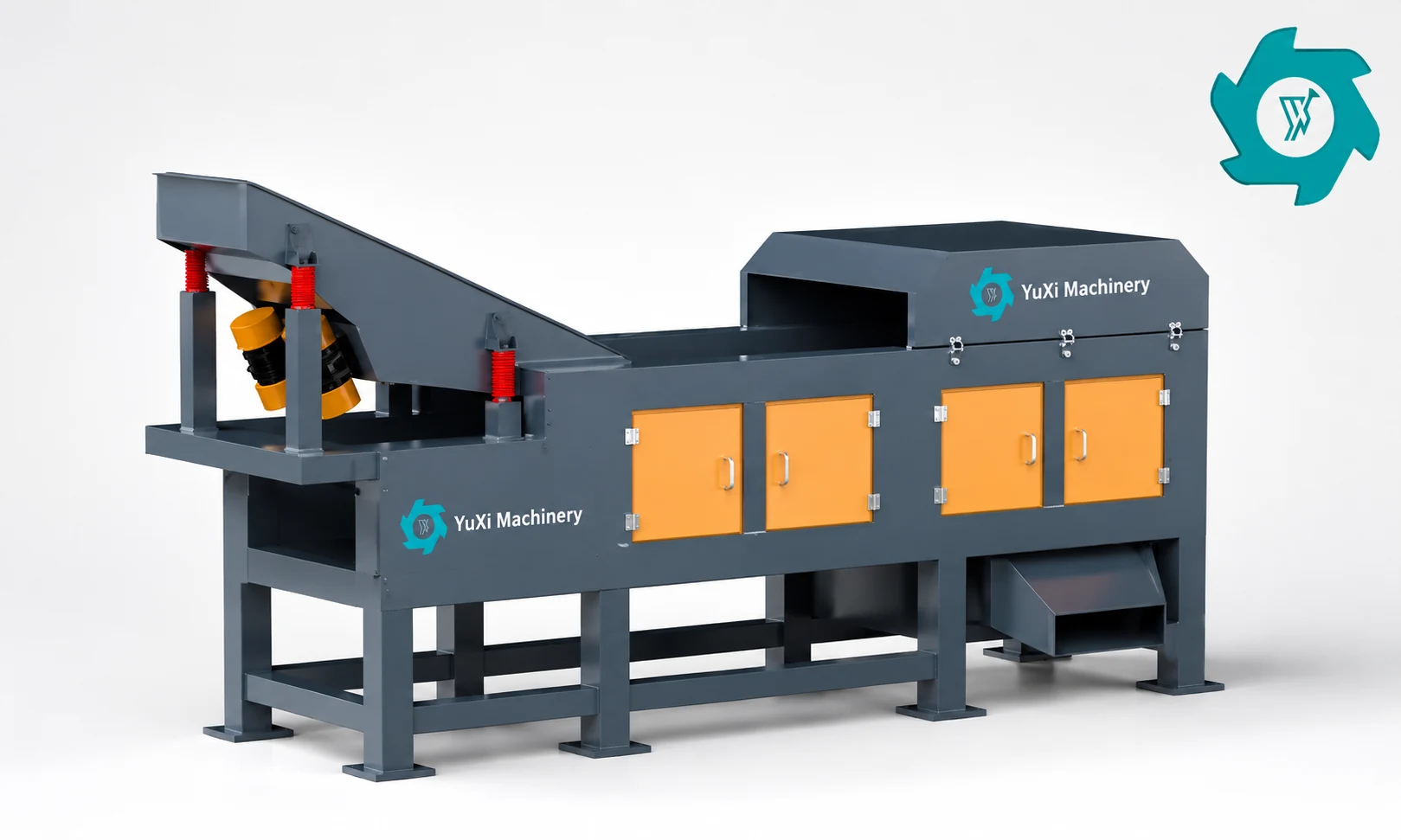
The separator does not automatically turn every conductive piece into a finished copper or aluminum grade. Particle size, shape, burden depth and remaining attachments affect the split. YUXI’s eddy current separator page is useful when reviewing this downstream stage as a separate machine rather than treating it as a generic “metal sorter.”
10. Optional Airflow or Gravity Cleaning
Some projects need another cleaning step after magnetic and eddy current separation. This is where an airflow or gravity separator may be added, but it should have a defined separation problem to solve. It is not automatically necessary because the line contains plastic.
For example, a light fraction containing residual foam and plastic may respond well to air classification. A mixed granular fraction with a useful density contrast may justify gravity separation. The right question is not “Can we add another separator?” It is “Which unwanted material remains in which product, at what particle size, and can density or aerodynamic behavior separate it?”
11. Foam Compactor or Densifier
Loose recovered foam can become a logistics problem long before it becomes a separation problem. It occupies storage volume quickly and is awkward to transfer in open containers. A compactor or densifier reduces that volume after the foam has been collected.
This machine is downstream handling equipment, not a substitute for the foam separator. If the foam stream is still contaminated with large pieces of steel or plastic, compaction only makes the contamination harder to inspect. Keep separation and densification as two separate acceptance points.
12. Dust Collection and Process-Air Treatment
Crushing insulation, brittle plastics and surface contamination creates fines. The dust system is therefore part of the process, not just housekeeping. Extraction points are normally placed around crushers, transfer points and air-separation equipment, then connected to appropriate collection and filtration equipment.
Older refrigerators may also involve blowing agents in insulation foam, while some appliance streams can introduce flammable gases. Gas monitoring, ventilation, containment and treatment requirements should be engineered around the actual incoming appliance population and local rules. A supplier should not promise one universal configuration for every country and every refrigerator age.
13. Conveyors, Screws, Bins and Product Discharge
Material handling equipment looks secondary on a quotation because it does not “recover” anything. In practice it decides whether recovered fractions stay separate. Steel, non-ferrous metal, plastic and foam should each have a defined discharge route with enough buffer volume to prevent operators from mixing products again when one bin fills.
Ask how material leaves every separator, where sampling can be performed, how a blocked chute is accessed, and whether a forklift or loader can exchange containers without stopping the entire line.
14. PLC Controls, Interlocks and Monitoring
The control system ties the machines together. If a downstream conveyor stops, upstream equipment should not keep feeding until material packs into the transfer. If the shredder loads heavily, feed should slow or pause. Emergency stops and access doors need a defined interlock philosophy rather than a collection of independent switches.
Projects with combustible gas or process-air concerns may add temperature, gas concentration or other monitoring. The sensor list should follow the risk assessment and equipment design. It should not be copied blindly from a different plant processing different refrigerators.
Which Machines Can Be Removed From the Line?
This is often the fastest way to expose whether a quotation has been built around the customer’s feed or around a standard equipment package.
| Incoming feed | Equipment usually retained | Equipment that may sit outside YUXI’s mechanical scope |
|---|---|---|
| Complete refrigerators | Full receiving, depollution, shredding, crushing, foam and metal-separation route | Only equipment already provided by the buyer after interface review |
| Refrigerators with refrigerant removed but compressors attached | Inspection, compressor/oil handling, mechanical processing | Refrigerant recovery station |
| Pre-treated empty cabinets | Feeding, shredder, crusher, foam removal, magnetic/non-ferrous separation, dust control | Dismantling and depollution stations |
| Coarse shredded refrigerator material | Secondary liberation, foam removal, metal separation and product handling as required | Primary cabinet shredder and most upstream stations |
Removing equipment is only valid when the missing function already happens somewhere else. If a buyer says “we do not need refrigerant equipment,” the next question is not price. It is who recovers the refrigerant, at what point, and what feed acceptance rule proves the cabinet is ready for shredding.
How to Size the Equipment as One Line
Machine-by-machine capacity tables can be misleading because refrigerators arrive as units while downstream separators see kilograms of mixed fragments. Use both appliances per hour and tonnes per hour. Then add average appliance weight, the expected mix of refrigerators versus freezers, largest cabinet size, and the percentage of time spent on pre-treatment.
For the mechanical section, define the maximum feed size entering the shredder and the expected size leaving each reduction stage. For separators, define particle-size range, burden depth and the target product split. A 2 t/h separator can still become a bottleneck if it receives a poorly liberated, high-volume foam-rich burden that was never represented in the capacity calculation.
What to Put in an RFQ for Refrigerator Recycling Equipment
A useful RFQ gives the supplier enough information to draw the process boundary before discussing models. Send representative photos or video, not only a list of appliance brands. Include damaged units, unusually large freezers and the dirtiest feed you expect to accept.
- Incoming appliance types and the approximate refrigerator/freezer mix
- Average unit weight and maximum external dimensions
- Exact pre-treatment condition at the supplier’s feed point
- Refrigerant and compressor handling responsibility
- Required sustained units/hour and tonnes/hour
- Target products: steel, non-ferrous fraction, plastics, foam and dismantled components
- Acceptable cross-contamination in each saleable fraction
- Available footprint, clear height and material-loading method
- Electrical standard and available utilities
- Local dust, gas, fire, noise and environmental requirements
- Shift length, maintenance staffing and spare-parts expectations
- Feed samples and acceptance criteria for the factory test
For the primary size-reduction section, YUXI’s guide to types of metal shredders can help separate the function of a low-speed double-shaft machine from higher-speed secondary crushing before the final equipment route is fixed.
How to Compare Two Refrigerator Recycling Equipment Proposals
Put the proposals side by side, but do not begin with total installed power. First check whether they start with the same feed and finish with the same products. If one proposal begins after depollution and another includes refrigerant recovery, compressor removal and foam handling, the prices and capacities are not comparable yet.
Then trace one refrigerator through the line. At each machine, write down what enters, what the machine changes, what leaves, and what the next stage needs. This simple handoff check catches missing conveyors, undefined foam routes, separators placed before adequate liberation and product streams with nowhere to go.
Refrigerator Recycling Equipment FAQ
What equipment is needed to recycle refrigerators?
The equipment depends on feed condition. A complete plant may include receiving and dismantling stations, refrigerant recovery, compressor and oil handling, conveyors, a primary shredder, secondary crusher, foam separation, magnetic separation, eddy current separation, dust and gas treatment, foam compaction and central controls. A plant receiving pre-treated cabinets can start further downstream.
Can complete refrigerators go directly into a shredder?
They should not be treated as unrestricted shredder feed. Refrigerant, compressor oil and unsuitable loose or hazardous components need to be handled according to the agreed pre-treatment procedure before the cabinet enters the mechanical size-reduction section.
How is polyurethane foam removed from shredded refrigerators?
After the cabinet structure is opened and crushed, airflow equipment can lift and extract the low-density polyurethane foam from heavier metal and plastic pieces. The collected foam may then be transferred to a cyclone, filter or compaction stage depending on the line design.
Why are both a magnetic separator and an eddy current separator used?
They do different jobs. A magnetic separator removes ferrous steel. An eddy current separator is placed later to recover conductive non-ferrous pieces such as aluminum and copper-bearing material from a prepared non-metal stream.
How should refrigerator recycling line capacity be specified?
State both appliances per hour and tonnes per hour, and add the average unit weight, maximum cabinet dimensions and exact pre-treatment condition. That prevents a capacity figure for evacuated cabinets from being compared with one for complete appliances that still require depollution and dismantling.
Configure the Equipment Around Your Actual Refrigerator Feed
Send YUXI representative appliance photos, pre-treatment condition, maximum cabinet size, required throughput, target recovered fractions and workshop dimensions. The equipment list can then be built around the real process boundary instead of a standard machine package.