




 Request Quote



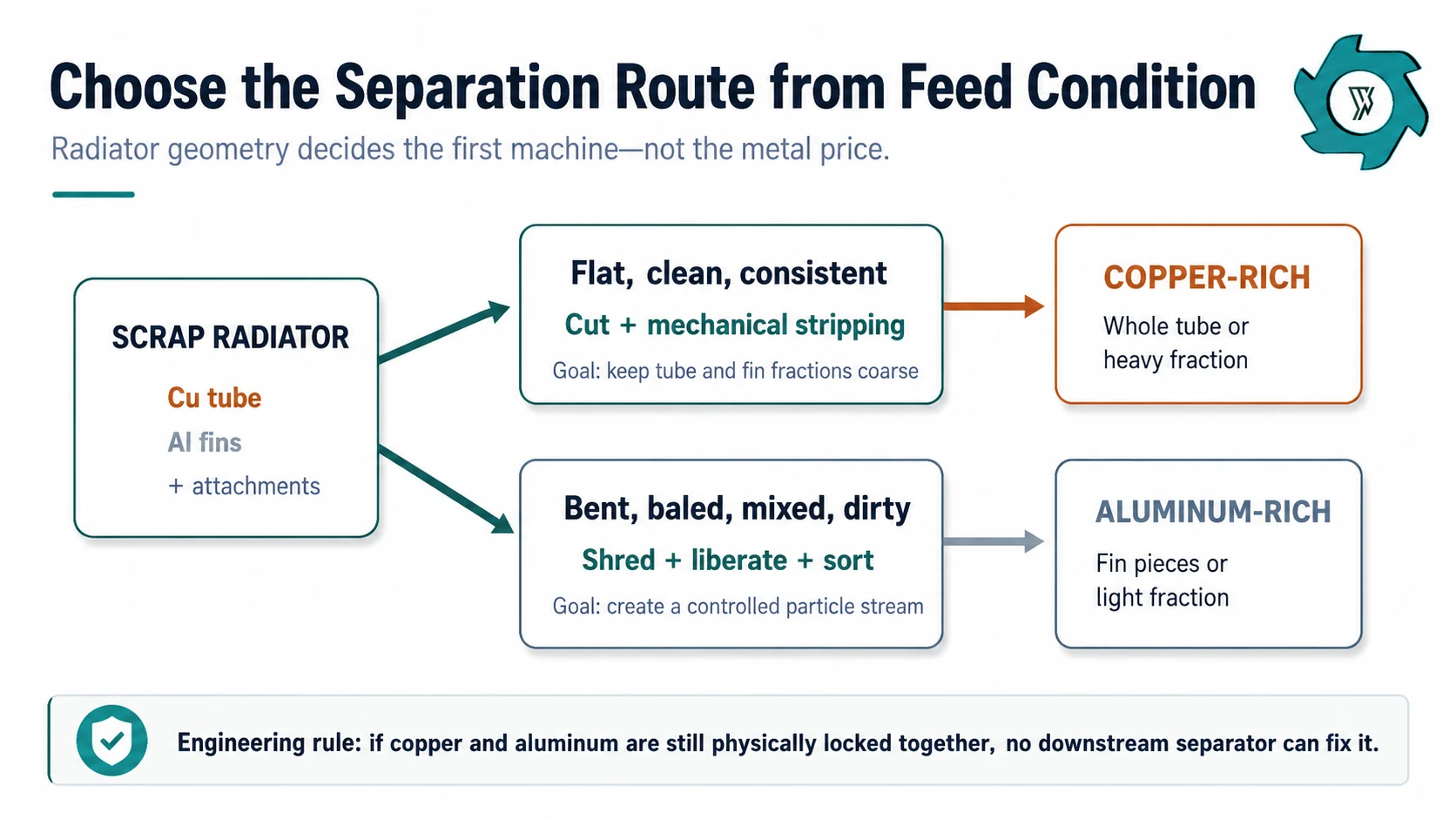
Separating copper and aluminum from scrap radiators is straightforward only when the radiator itself is straightforward. A clean, flat air-conditioning coil with copper tubes and aluminum fins can often be cut and mechanically stripped. A bent car radiator, a baled heat exchanger or a mixed batch with steel frames, plastic tanks and dirt is a different job: the metals first have to be liberated by controlled size reduction, then iron is removed magnetically and the remaining fractions are sorted by their physical behavior.
Start by Identifying What Is Actually in the Radiator
The phrase scrap radiator covers several materials that should not automatically be mixed into one purchasing specification. An air-conditioner condenser or evaporator may have copper tubes mechanically bonded to thin aluminum fins. Many modern automotive radiators are mainly aluminum with plastic end tanks. Older or heavy-duty units may bring copper/brass construction into the same yard. All-aluminum heat exchangers add another route.
YUXI’s copper aluminum radiator recycling line is designed around this variation: feed composition, deformation, attached iron, plastic and the target output all change the required configuration. The immediate separation question is therefore not “copper or aluminum?” but “are the two metals present, are they physically locked together, and what else is still attached?”
| Incoming radiator condition | Practical separation route | Main limitation |
|---|---|---|
| Flat, clean Cu-tube / Al-fin core | Cut to accepted width, align and mechanically strip | Tube spacing, deformation and manual preparation |
| Bent or crushed Cu-Al radiator | Shred, secondary-crush, screen, remove ferrous, then gravity/air sort | Whether copper and aluminum are fully liberated |
| Modern Al/plastic car radiator | Remove gross attachments, then recover an aluminum-rich fraction | There may be little meaningful copper to recover |
| Mixed radiators and heat exchangers | Complete line with feed control and staged separation | Changing composition can change separator settings and product split |
Method 1: Strip Clean Copper-Tube / Aluminum-Fin Radiators
For intact air-conditioning coils, the least complicated route can also be the best one. The core is cut into a size that the stripping machine accepts, then fed so the cutter or separating mechanism pulls the copper tube away from the aluminum fin pack. The copper remains comparatively coarse, while the aluminum leaves as fin or block-like material.
This route has an important advantage: it avoids turning clean metal into unnecessary fines. It also keeps the product easy to inspect. But the feed tolerance is narrow. Stripping-machine product descriptions commonly state that these units work best on undeformed, dimensionally consistent radiators and are usually designed around specific tube-center distances. A radiator that has been crushed by a grapple or compacted for transport may no longer align with the stripping mechanism. [1]
In practice, stripping works well when a recycler controls the incoming material. It becomes awkward when the yard buys mixed scrap by weight and cannot guarantee shape. If this is the decision you are facing, the existing radiator separator machine vs recycling line guide compares the two equipment scopes in more detail.
Use the stripping route when geometry is predictable. Do not select it because it is cheaper and then try to force mixed, folded or baled radiators through it. The labor used to sort, cut and reject unsuitable pieces becomes part of the real operating cost.
Method 2: Liberate and Sort Deformed or Mixed Radiator Scrap
When copper tubes and aluminum fins are crushed together, separation starts with a different problem: the metals are still mechanically locked. No air table, magnet or other separator can classify a composite piece as two clean products. The process first has to open the assembly and break the joints until copper, aluminum, steel and light material behave as individual particles.
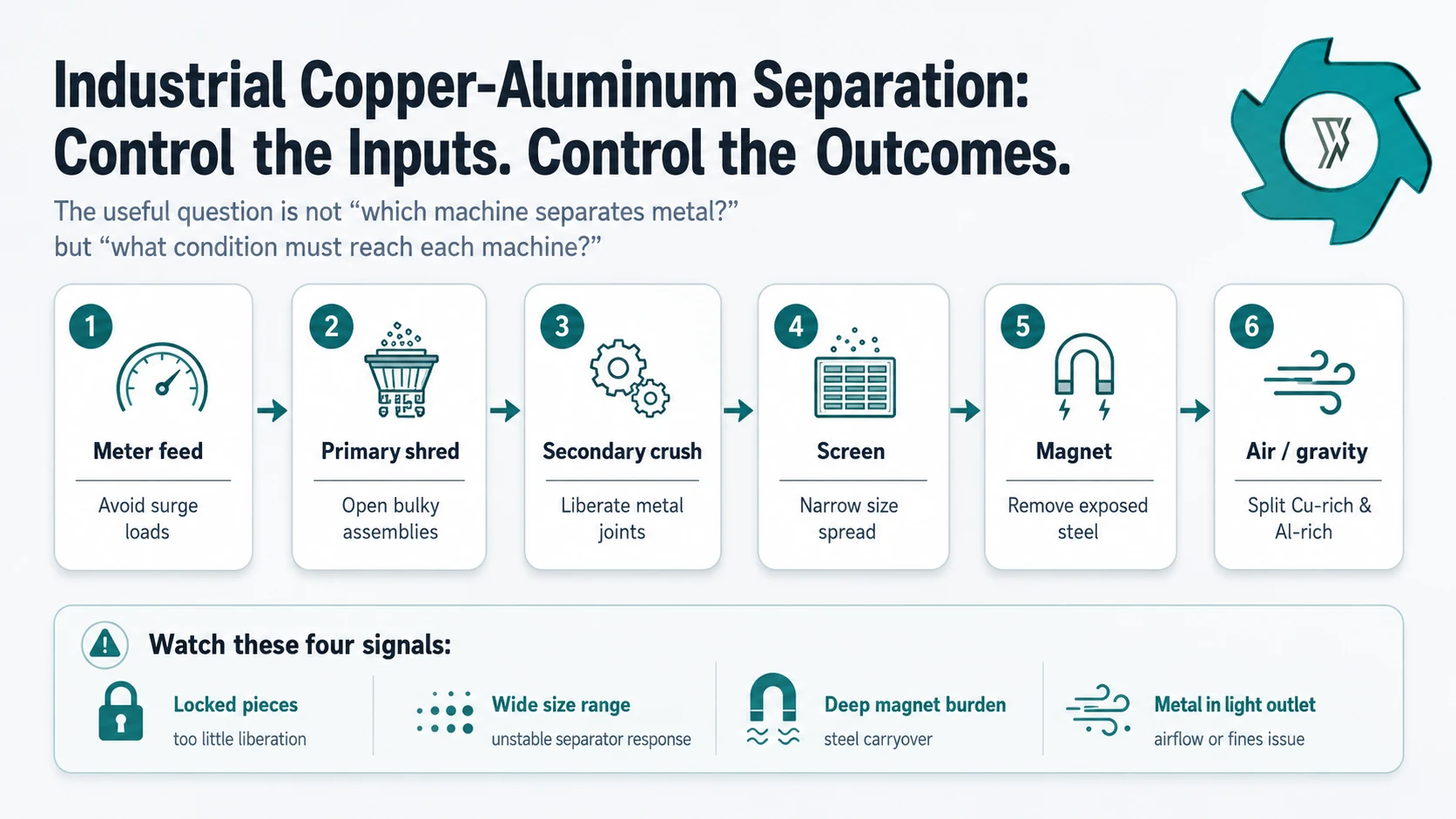
A complete route typically uses controlled feeding, low-speed primary shredding, secondary crushing and screening, magnetic removal, then an air- or specific-gravity-based non-ferrous separation stage. This is also the logic published on YUXI’s pillar page. The purpose of the shredder is not final purity; it makes bulky radiators manageable. The secondary crusher does more of the liberation work. Screening then narrows the size distribution so the final separator is not asked to compare a large copper fragment with aluminum foil dust in the same bed.
1. Meter the radiator feed before the shredder
Radiators are bulky for their mass and can overlap or nest. A conveyor loaded in surges may make the shredder alternate between empty running and overload while the downstream separator sees a pulsing bed. We normally prefer a boring, steady feed over a dramatic peak-rate demonstration. Stable dosing gives every later stage a more repeatable job.
2. Use primary shredding to open the assembly
The primary shredder should reduce the whole radiator to pieces that can be conveyed and accepted by the secondary crusher. It is not necessary—or usually desirable—to make the smallest possible piece at this stage. Over-shredding thin aluminum can create more fines before the copper-aluminum connection has actually been opened.
3. Let secondary crushing do the liberation work
Here the target changes from “make it smaller” to “break the remaining material connections.” Look at the discharge rather than only the screen opening. If a large percentage of pieces still contain copper tube with aluminum fin attached, the final separator will inherit that problem.
The broader mechanical sequence is covered in the site’s radiator recycling process guide.
4. Screen before asking gravity or airflow to do precise work
Copper is much denser than aluminum—NIST’s material constants list copper at about 8.960 g/cm³ and aluminum at about 2.699 g/cm³. That density contrast is useful, but particle size and shape still control how fragments behave in airflow and on a vibrating separation surface. A broad mix of long wire-like copper, flat aluminum foil, thick headers and very fine dust will not respond as cleanly as a screened fraction. [2]
This is a common commissioning mistake. The operator sees aluminum in the copper-rich outlet and immediately increases air. The symptom changes, but metal then starts leaving with the light residue. Before chasing settings, first check whether the separator is receiving the particle size range it was designed for.
5. Remove iron only after it has been exposed
Steel frames, screws and clips are easy for a magnet only after the crusher has freed them from the radiator structure. Feed depth matters too. A magnet buried under a deep, uneven bed can leave steel in the non-ferrous stream even when the magnet itself is strong enough.
6. Separate the copper-rich and aluminum-rich fractions
After iron is removed and the size range is controlled, specific-gravity or air separation can exploit the different mass, density, shape and suspension behavior of the remaining particles. The correct setting depends on the actual feed. There is no useful universal “airflow percentage” that can be copied from one radiator batch to another.
Why Liberation Matters More Than a Purity Claim
Buyers often ask one number: “What purity can the machine reach?” That sounds sensible, but it hides two separate questions. First, are copper and aluminum actually free from one another? Second, once they are free, how much of each metal reports to the correct outlet?
A product can look clean in a photo while still losing valuable copper in the aluminum fraction or aluminum in the light residue. We have found that three shop-floor checks are more revealing than a single purity headline:
- Locked pieces: sample the crusher discharge and look for copper still attached to aluminum.
- Cross-contamination: sample both non-ferrous outlets, not only the better-looking one.
- Metal loss: inspect the light residue and ferrous product for recoverable copper or aluminum.
Those checks also tell you where to adjust. If locked pieces are common, changing the gravity separator is unlikely to fix the root cause. If liberation is good but copper still follows aluminum, the particle-size window, feed depth or separator setting deserves attention.
Troubleshooting Copper–Aluminum Cross-Contamination
| What you see | Likely process issue | What to check first |
|---|---|---|
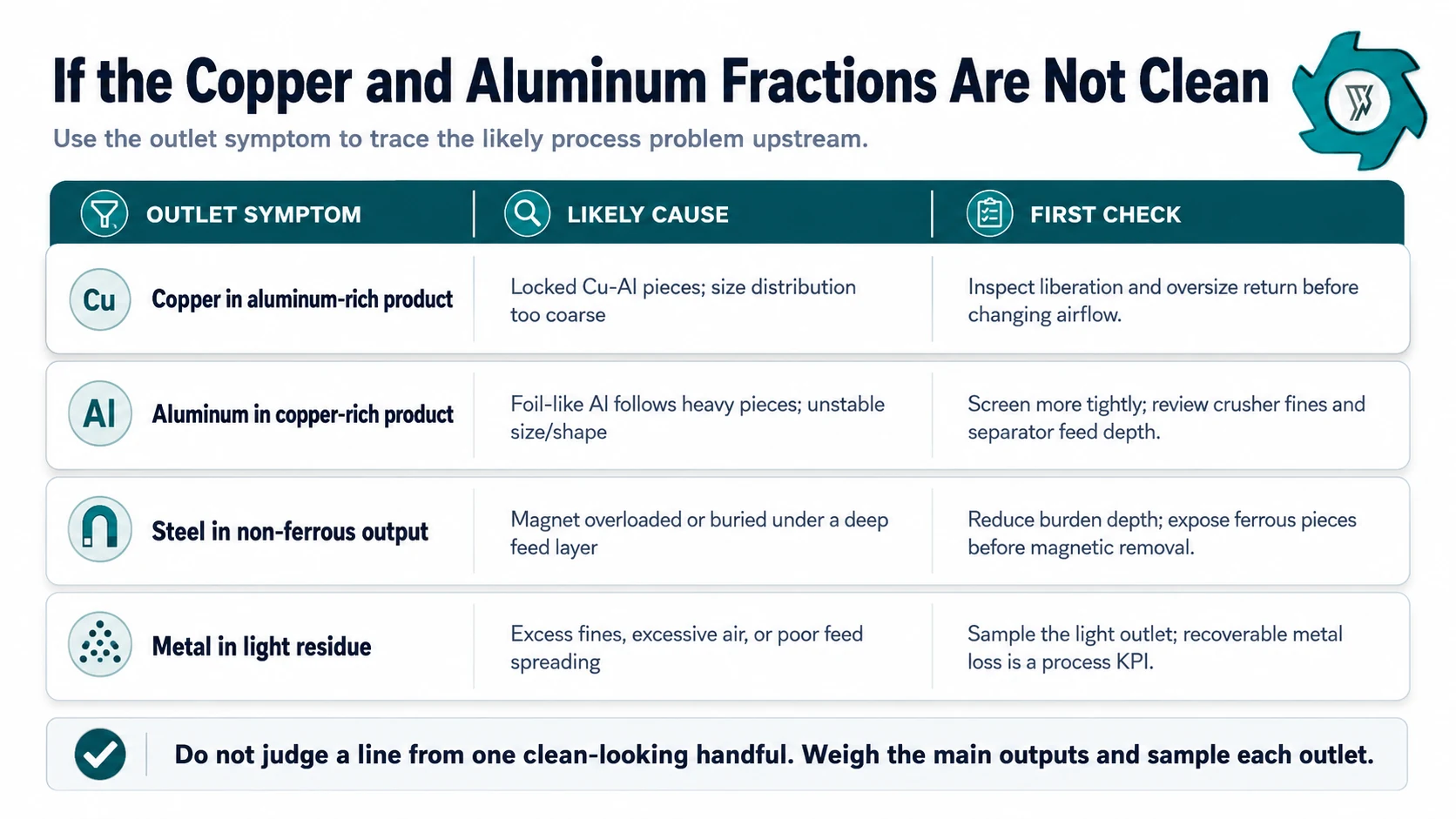
| Copper pieces in the aluminum-rich product | Incomplete liberation or oversize composite pieces | Crusher discharge, screen oversize and recirculation rate |
| Thin aluminum in the copper-rich product | Wide size/shape spread, unstable bed or too many foil-like fines | Screened fraction, crusher fines and burden depth |
| Steel in either non-ferrous outlet | Ferrous pieces not exposed or magnet loaded too deeply | Magnet feed layer, belt coverage and upstream liberation |
| Visible metal in light residue | Airflow too aggressive, fine metal generated, uneven feed | Light-outlet sample, airflow, fines percentage and feed spreading |
| Good result for 10 minutes, poor result over a shift | Feed mix changes or the line is being run above stable separator capacity | Lot composition, feed rate trend, screen loading and operator adjustments |
Different Radiators Need Different Separation Targets
AC condensers and evaporator coils
If the core is flat and clean, stripping can preserve coarse copper tube and aluminum fin fractions with relatively little downstream work. Once those coils are folded, oil-contaminated, mixed with steel casing parts or baled, the complete-line route becomes easier to automate.
Car radiators
Do not assume every car radiator contains a valuable copper tube network. Many modern units are aluminum with plastic tanks, while older and heavy-duty material can be different. The car radiator recycling machine guide explains those construction differences and why the wrong material assumption can lead to the wrong separator.
Mixed heat exchangers and yard scrap
This is where a complete line earns its place. The system can tolerate more feed variation, but the operator still has to track what is changing. A batch with more steel attachments will load the magnet differently. A batch with more thin fin material can create a different amount of light fraction. A batch with copper/brass units will change the heavy non-ferrous outlet. The settings should follow the material, not the calendar.
Manual Separation Still Has a Place—at Low Volume
There is nothing technically wrong with manual dismantling when the volume is low, labor is available and the radiator is easy to work on. A worker can remove plastic tanks, steel frames and sell a clean core without buying a complete processing line. The economics change when material arrives continuously or when the units are dirty, bent and inconsistent.
The mistake is treating manual work as “free.” Sorting, cutting, turning the core to align tube spacing, rejecting unsuitable pieces and cleaning the workplace all consume time. For a serious comparison, record kilograms processed per paid labor-hour and the percentage of incoming radiators that require a different route. That number makes the manual-versus-mechanical decision much clearer.
Pre-Treatment Before Mechanical Separation
Mechanical recycling should begin only after the radiator is safe to feed. Drain free coolant or oil, remove components that retain pressure, and keep unrelated hazardous items out of the shredder. EPA materials on automotive and industrial waste management encourage recycling of used antifreeze and note that handling requirements can depend on the waste characteristics and local rules. [3]
From a machine standpoint, liquids are a practical problem even before compliance is considered. They spread dirt across conveyors, change the behavior of fine material, complicate dust collection and make housekeeping harder.
Radiator recycling also combines moving conveyors, cutting equipment and high-energy crushing. OSHA’s scrap-metal-recycling guidance highlights moving machinery, unexpected startup, fire/explosion hazards and combustible dust among the hazards that need control in these facilities. Fine aluminum is particularly important: a material that is difficult to ignite as a solid sheet can behave very differently when it becomes a dispersed fine dust. [4]
How to Test Whether the Separation Line Is Actually Working
A factory test should use the material you normally buy, not the cleanest radiator available for the demonstration. Include the normal mix of bent units, steel clips, plastic attachments and any copper-bearing material that will genuinely enter production. Then weigh the input and the main outputs.
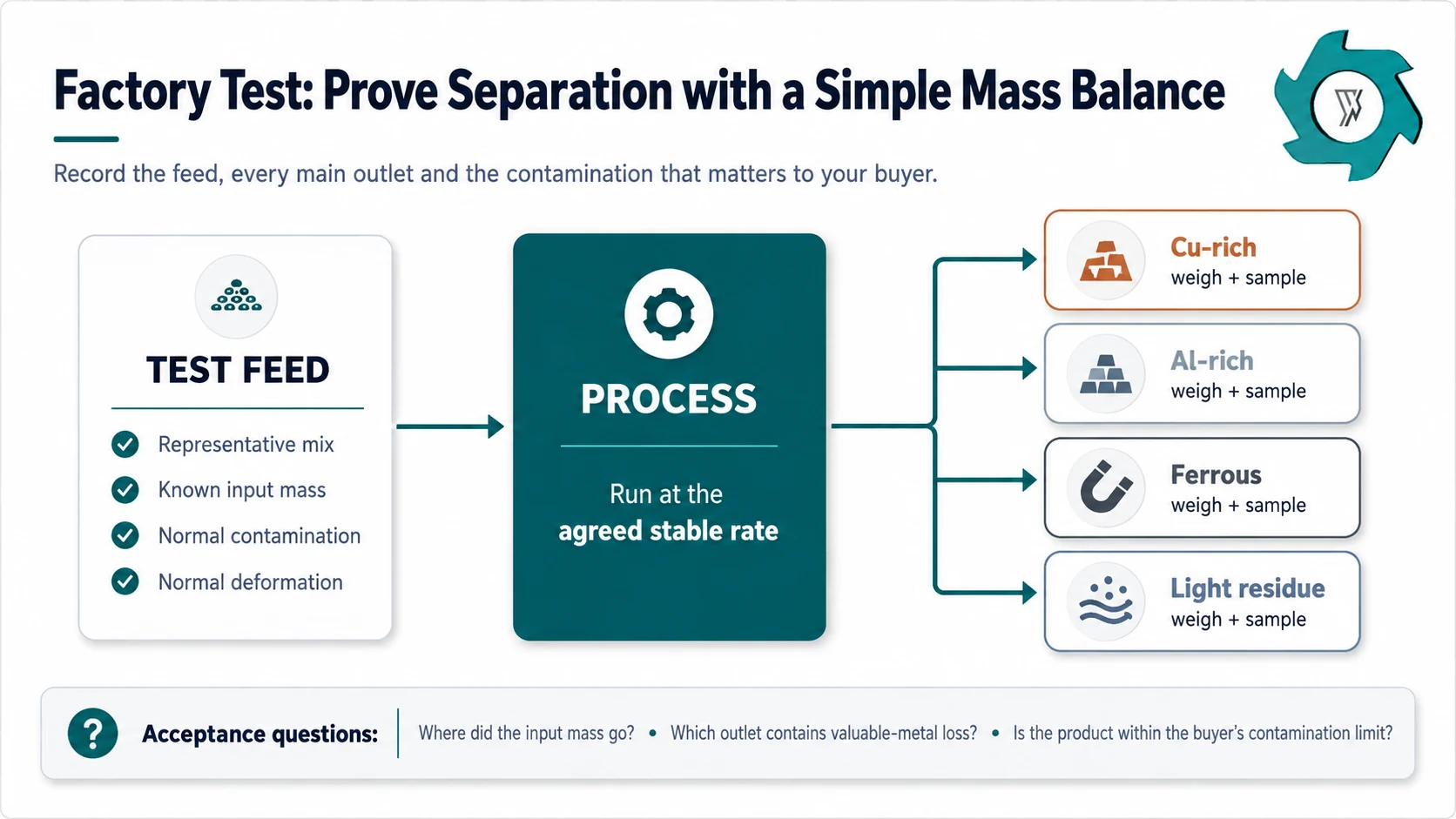
For a basic mass balance:
- Record the total test-feed mass and describe the material mix.
- Run at the proposed stable rate, not only the highest short burst.
- Weigh copper-rich, aluminum-rich, ferrous and light/residue outputs.
- Sample each outlet for the contamination that affects its sale value.
- Record recirculation, stoppages, jams and manual picking during the test.
The main outputs should roughly reconcile with the input. If they do not, ask where the missing mass went—dust collection, retained material, unweighed oversize or another outlet. A glossy copper pile is not enough evidence for a capital-equipment decision.
Which Separation Route Should You Choose?
| If your operation looks like this… | Start with this route | Reason |
|---|---|---|
| Small volume of clean, flat AC coils | Manual preparation + stripping machine | Preserves coarse metal and minimizes equipment scope |
| Flat coils but several tube spacings | Stripping machine only after sample verification | Geometry acceptance may be the bottleneck |
| Bent, damaged or baled Cu-Al radiators | Complete shredding and separation line | Material must be liberated before sorting |
| Mixed car radiators, AC coils and heat exchangers | Complete line with pre-sort rules | Variation exceeds a stripping machine’s practical feed envelope |
| Mainly modern aluminum/plastic car radiators | Configure for aluminum recovery, not assumed copper recovery | The commercial target follows actual construction |
For purchasing, write the feed envelope first: representative photos, the percentage of recurring radiator types, normal and maximum dimensions, whether material is loose or baled, attached steel/plastic, residual liquids, target tons per hour and the fractions you want to sell. The site’s radiator line selection guide provides the wider RFQ framework.
What to Ask a Supplier Before You Buy
A useful quotation should answer more than motor power and nominal capacity. Ask what radiator condition the line accepts, what preparation is required, which stage is responsible for copper-aluminum liberation, the controlled particle-size range before final separation, how ferrous material is removed, what happens to oversize, and how the factory acceptance test will measure output quality.
We also recommend asking for the rejection rules. What should never enter the line? How much attached structural steel is acceptable? Can a baled radiator be fed directly, or does it need opening first? Those answers prevent a common dispute where the equipment works on the supplier’s sample but the plant’s normal feed falls outside the test basis.
Summary: Separate the Metals by Solving the Feed Problem First
There are two practical mechanical routes for separating copper and aluminum from scrap radiators. Clean, flat copper-tube/aluminum-fin cores can often be cut and stripped directly. Mixed, bent or deformed radiators usually need primary shredding, secondary liberation, controlled screening, magnetic removal and then gravity/air separation.
The important engineering point is easy to miss: the final separator cannot correct a copper-aluminum connection that was never broken. Check liberation, particle size, feed depth and metal loss before chasing a single “purity” number. Then verify the proposed line with a representative batch and a simple mass balance.
Need a Copper–Aluminum Separation Route for Your Radiator Scrap?
Send YUXI representative radiator photos, feed condition, expected throughput and the metal fractions you want to sell. The engineering team can review whether a stripping route or a complete shredding-and-separation line fits the material.
FAQ
What is the easiest way to separate copper and aluminum from an AC radiator?
If the coil is flat, clean and has a tube spacing accepted by the machine, cutting and mechanical stripping can be the simplest route. It keeps copper tube and aluminum fin material relatively coarse. Bent, crushed or mixed coils are usually better handled by a complete liberation and sorting process.
Can a shredder separate copper from aluminum by itself?
No. A shredder opens and reduces the radiator so the materials can be liberated. Final separation requires additional stages such as screening, magnetic removal and density/air-based sorting. The shredder prepares the feed; it does not create two clean non-ferrous products on its own.
Why is copper still mixed with aluminum after crushing?
The most common causes are incomplete liberation, an overly broad particle-size distribution or composite oversize that bypasses recirculation. Check the crusher discharge first. If copper and aluminum remain physically attached, changing the final separator setting will not solve the root problem.
Do all scrap car radiators contain copper and aluminum?
No. Many modern automotive radiators are primarily aluminum with plastic tanks, while older or heavy-duty units may use other constructions, including copper/brass. Identify the actual feed mix before designing the separation route.
Should coolant be removed before radiator recycling?
Yes. Free coolant and other liquids should be drained and managed under applicable local requirements before mechanical processing. Liquids also make conveyors, screens, dust collection and housekeeping harder to control.
How can I verify copper and aluminum separation during a factory test?
Use representative material, weigh the input, weigh the main output fractions, sample each outlet for cross-contamination, and record stops, recirculation and manual picking. A mass balance shows where valuable metal is going more reliably than one product photo.
References
- Gomine Recycling Machinery — Radiator Separator Machine. Used only to cross-check typical stripping-machine feed limitations.
- NIST — X-Ray Mass Attenuation Coefficients, Table 1. U.S. National Institute of Standards and Technology.
- U.S. EPA — Typical Wastes Generated by Industry Sectors.
- U.S. OSHA — Scrap Metal Recycling.