




 Request Quote



“We need 80 refrigerators per hour” sounds like a complete capacity specification. It is not. Eighty compact household units and eighty large freezers can put very different mass loads through the same shredder, crusher, separators and foam-handling system. The number also changes meaning depending on where you start counting: complete appliances at receiving, or refrigerator cabinets after refrigerant recovery and component removal.
For a refrigerator recycling project, we normally treat capacity as two numbers that must travel together: units per hour (UPH) and mass per hour. For international equipment proposals, that mass figure is commonly stated in metric tonnes per hour (t/h). U.S. buyers may also use short tons per hour, so the RFQ should spell out which “ton” is intended.
Why Units per Hour Alone Can Mislead
Units per hour is useful because refrigerators arrive, get inspected and are dismantled as individual appliances. It helps plan receiving lanes, operators, lifting equipment and pre-treatment stations. But downstream machinery does not “feel” a unit count. It sees weight, dimensions, material structure, bulk volume and momentary load.
This is why the YUXI waste refrigerator recycling line selection page asks buyers for both appliances/hour and tonnes/hour, plus appliance dimensions and pre-treatment condition. The same page also warns that a capacity for evacuated cabinets is not directly comparable with a figure for complete refrigerators that still need dismantling and refrigerant handling.
Public market specifications show the same problem. Some refrigerator recycling suppliers publish 25–100 units/h or 50–60 and 80–100 units/h classes. A European cooling-device project published by URT gives both figures: 3–4 t/h and approximately 80–100 units/h for that particular feed and process. The useful point is not that every plant should match those numbers. It is that a unit rate becomes far more informative when a mass rate and feed definition sit beside it.
The Basic UPH-to-TPH Conversion
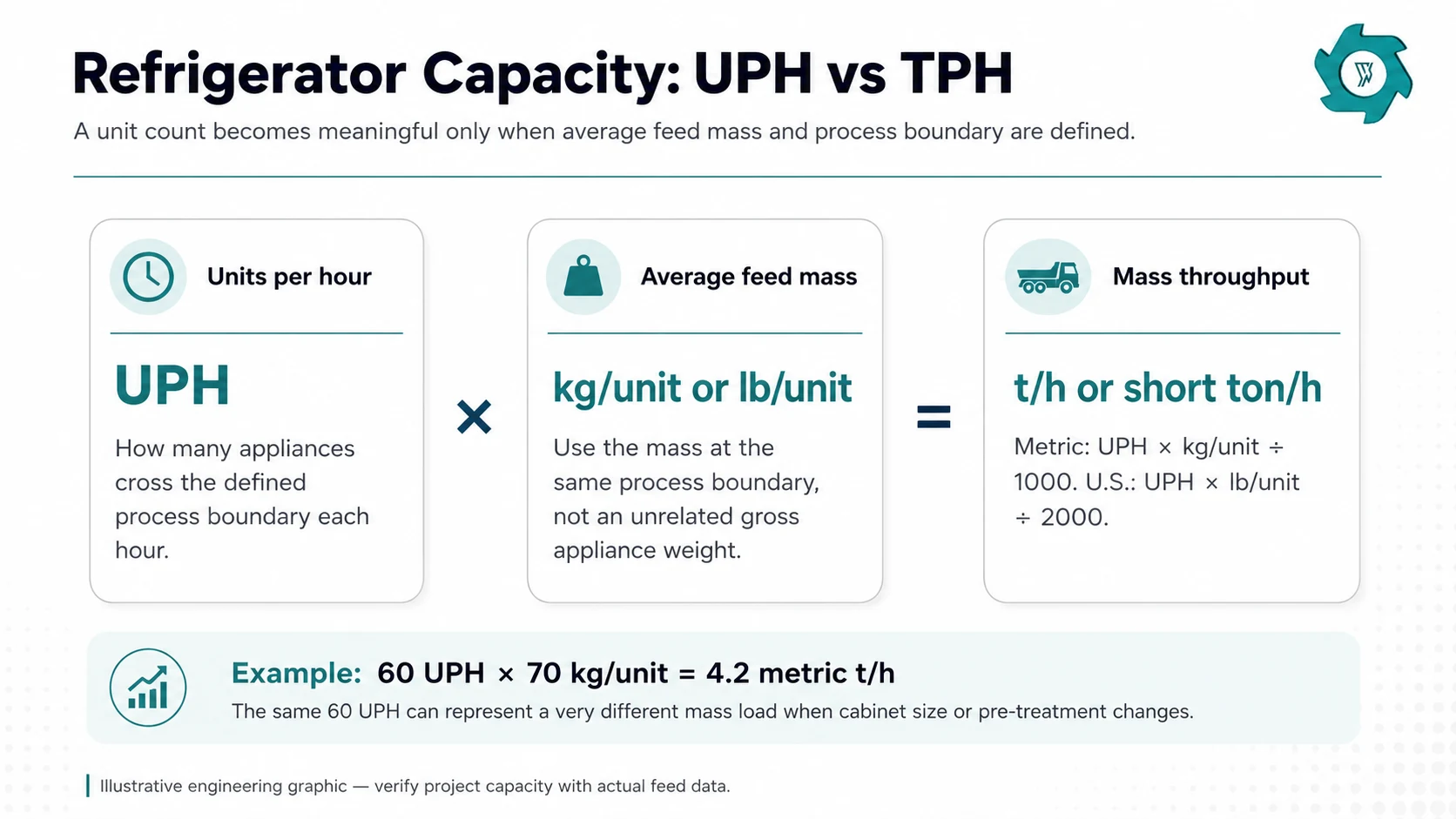
If the same process boundary is used for both measurements, the conversion is simple:
Metric tonnes per hour = Units per hour × average feed weight (kg/unit) ÷ 1,000
U.S. short tons per hour = Units per hour × average feed weight (lb/unit) ÷ 2,000
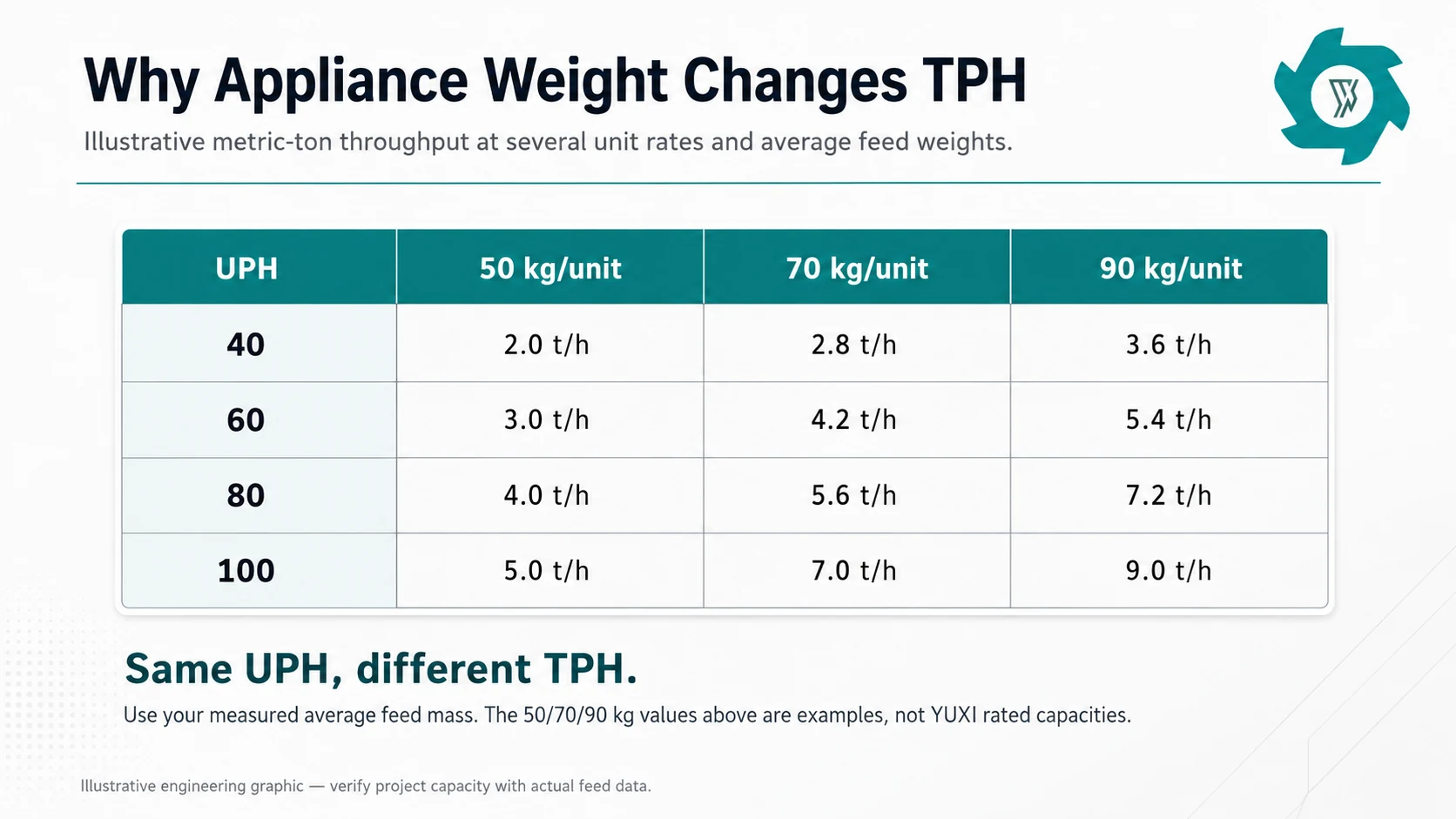
Suppose a representative pre-treated refrigerator cabinet stream averages 70 kg per unit. At 60 units/h, the mechanical line receives about 4.2 metric t/h. If another project also asks for 60 units/h but its average cabinet weighs only 50 kg, the mass load is 3.0 t/h. The unit count is identical; the shredder and downstream burden are not.
Use the Weight at the Correct Process Boundary
A complete refrigerator at the receiving door includes the compressor, oil, refrigerant circuit, shelves, drawers, glass, wiring and other removable parts. The primary shredder may see only the cabinet after some of those items have been taken out.
Imagine a site where complete incoming appliances average 75 kg, but the prepared cabinets entering the mechanical section average 48 kg after depollution and dismantling. At 60 units/h, receiving is handling 4.5 metric t/h of gross appliances while the shredder section is seeing only 2.88 metric t/h. Both numbers can be correct. They describe different boundaries.
For U.S. projects, this distinction is not just a production-planning issue. EPA safe-disposal rules require refrigerant recovery from applicable appliances before final disposal, and EPA guidance describes refrigerant and hazardous-component handling before appliance shredding. A quotation for already prepared cabinets is therefore not equivalent to an integrated plant that starts with complete end-of-life refrigerators.
What Should Count as One “Unit”?
Before comparing UPH, define the appliance mix. A small top-freezer refrigerator, a side-by-side unit, a chest freezer and a commercial cabinet are all one physical appliance, but they are not equal loads. Oversize units can also slow manual stripping, loading and primary shredding even when their weight is not extreme.
A practical RFQ should describe the normal mix rather than hide it behind one average. We would ask for photos, the approximate share of refrigerators versus freezers, the largest dimensions, and a measured weight range. If commercial or unusually large cabinets occur regularly, list them separately. If they are rare, define how they will be handled instead of allowing a few outliers to distort the entire capacity target.
UPH, TPH and the Real Bottleneck Are Three Different Things
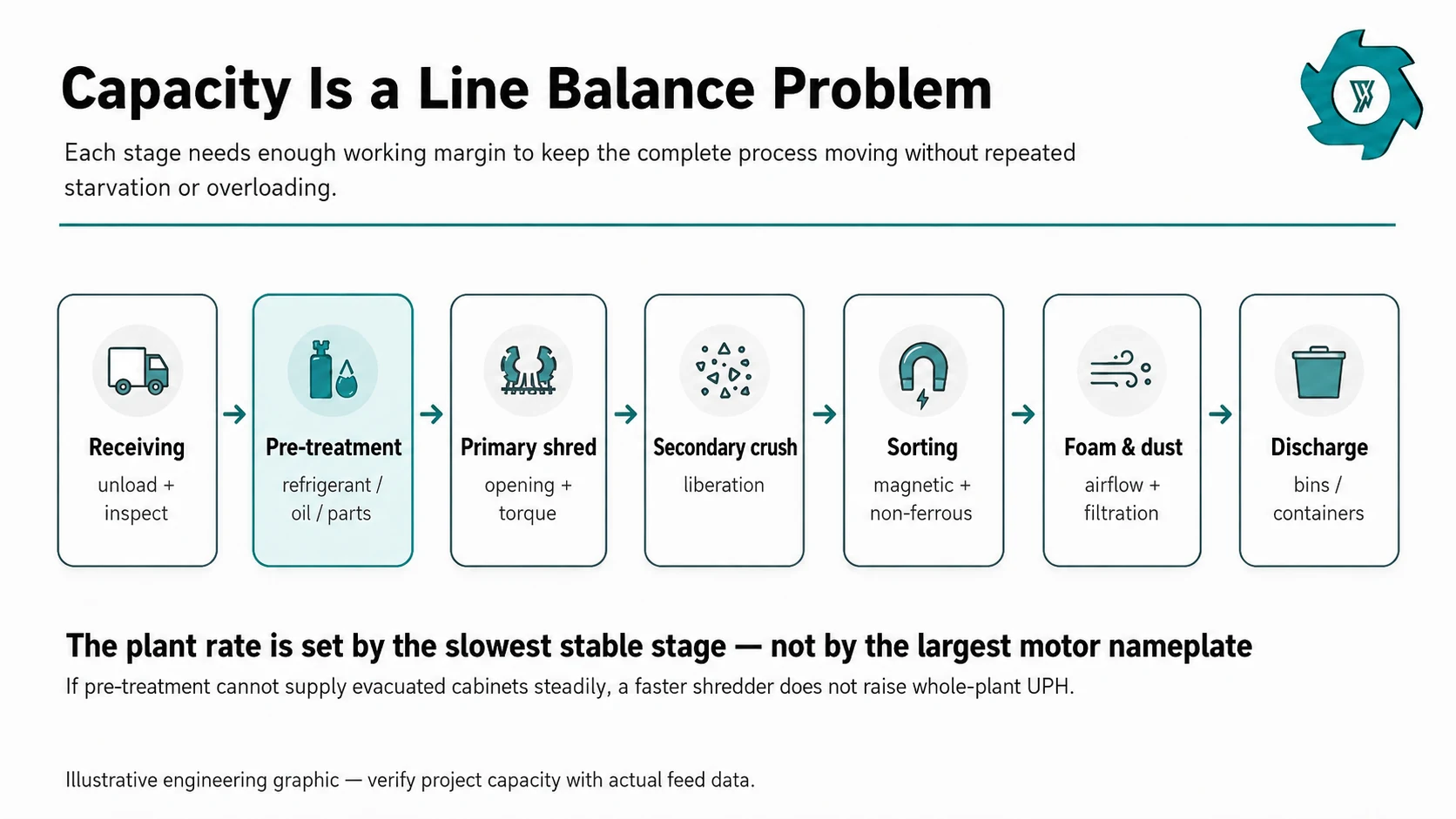
A complete line only runs as fast as its slowest stable stage. The primary shredder may have enough torque and chamber volume for the target mass flow, yet the plant can still miss the promised UPH because the pre-treatment area cannot supply cabinets consistently. The opposite can happen as well: operators prepare units quickly, but the crusher, foam extraction or separator belt becomes overloaded once the heavier part of the feed mix arrives.
The most common capacity checks include:
- Receiving and inspection: Can the site unload, identify and buffer appliances fast enough without mixing unsuitable feed into the line?
- Pre-treatment: Are refrigerant recovery, compressor removal, oil handling and loose-part removal paced for the requested UPH?
- Primary shredding: Is the opening, cutter arrangement and drive margin suitable for the largest normal cabinet as well as the average one?
- Secondary crushing: Can the liberation stage accept the actual mass flow without forcing a coarse product just to maintain speed?
- Separation: Magnetic and non-ferrous separators need controlled burden depth. Pushing more t/h onto the same belt can reduce separation quality even if material keeps moving.
- Foam and dust handling: PU foam is light but voluminous. Airflow, cyclones, filters and collection containers can become a throughput limit that is easy to miss in a weight-only calculation.
- Discharge and logistics: Full bins, blocked transfer points or slow container changeovers can stop an otherwise adequately sized process.
If you need a machine-by-machine view of those stages, see the refrigerator recycling equipment guide. It separates the jobs of pre-treatment, primary size reduction, secondary liberation and physical separation instead of treating the plant as one large shredder.
Peak Capacity vs Sustained Capacity
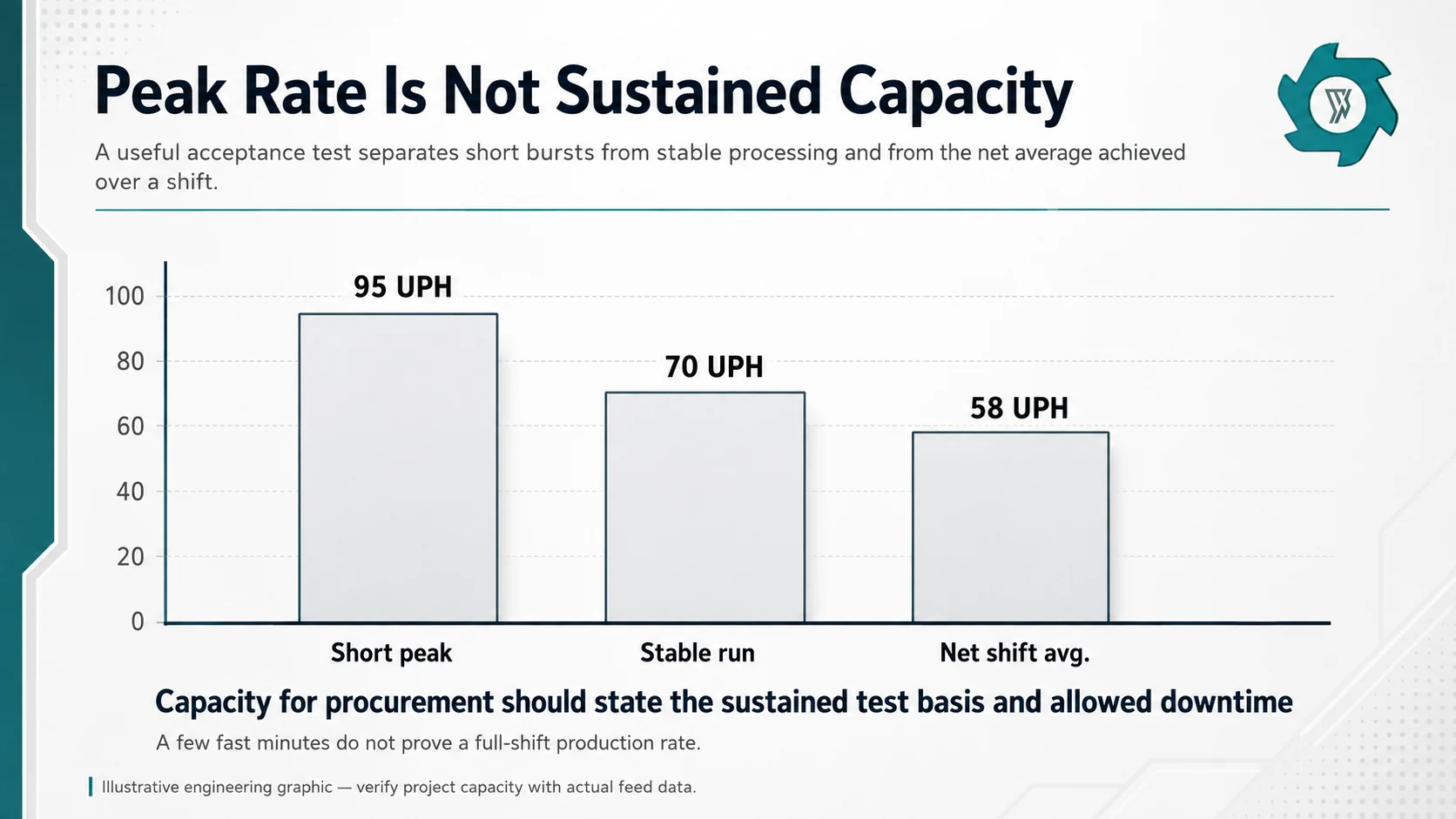
A supplier can sometimes feed a line very quickly for a few minutes. That does not prove the same rate can be held through a normal production period. Refrigerators arrive unevenly, cabinet sizes change, cutters encounter thicker sections, filters load, bins fill and operators need time for inspection and component removal.
For procurement, we prefer the phrase sustained capacity. The proposal should state the feed condition, the test duration, the warm-up or stabilization period, what planned interruptions are allowed, and how throughput will be measured. A short “instantaneous maximum” can still be useful for buffer design, but it should not be confused with the rate used for annual production planning.
How to Convert Annual Refrigerator Volume Into a Plant Capacity Target
Many buyers begin with an annual collection contract rather than an hourly target. In that case, work backward from the number of appliances that must actually be processed during productive hours.
Required UPH = Annual units ÷ (working days × shifts/day × productive hours/shift × planned utilization)
For example, 100,000 appliances per year processed over 250 working days, one 8-hour shift, with 80% planned utilization, requires an average of about 62.5 units during productive scheduled time. That does not mean a 63-UPH nameplate is enough. You still need margin for collection peaks, maintenance, feed mix and future growth.
The mass check comes next. If the representative process-boundary weight averages 65 kg/unit, 62.5 UPH corresponds to roughly 4.1 metric t/h. Now the project team has two connected targets instead of one vague capacity number.
Why a Higher UPH Can Increase More Than Shredder Size
Higher throughput rarely means “same line, larger motor.” More units per hour can require larger receiving buffers, more pre-treatment positions, wider conveyors, a larger shredder working chamber, more secondary-crushing capacity, higher air volume for foam extraction, larger filters, wider separators and faster discharge logistics. Electrical distribution and floor space can change too.
This is one reason plant price does not rise in a perfectly linear way with UPH. The refrigerator recycling plant cost guide explains how capacity interacts with process boundary, dust and foam systems, automation, installation scope and downstream separation.
A Better Capacity Specification for Supplier Quotations
Instead of writing only “80 refrigerators per hour,” put the following items on the same page of the RFQ:
| Capacity item | What to define | Why it matters |
|---|---|---|
| UPH target | Sustained appliances/hour and any short peak requirement | Sets handling and count-based workflow |
| Mass target | Metric t/h or U.S. short ton/h | Sizes the mechanical and separation load |
| Average weight | Measured at the stated process boundary | Connects UPH to TPH |
| Feed boundary | Complete appliances or pre-treated cabinets | Prevents mismatched capacity claims |
| Appliance mix | Refrigerators, freezers, commercial units, oversize share | Explains weight and cycle-time variation |
| Pre-treatment | Refrigerant, compressor, oil, glass and loose parts removed or not | Defines upstream labor and mass reduction |
| Output requirement | Required recovered fractions and contamination limits | Stops “capacity” from being achieved by sacrificing separation |
| Acceptance test | Representative feed, duration, measurement method, allowed stops | Turns a brochure number into a testable promise |
How We Would Check Capacity Before Freezing the Line Design
First, establish the feed boundary. Then weigh a representative batch rather than relying on a brochure estimate or a single appliance. From that sample, calculate both gross incoming mass and the mass that will actually enter the shredding section after pre-treatment.
Next, map the requested rate through each process stage. If the target is 80 units/h, ask whether receiving, depollution, cabinet feeding, shredding, crushing, air separation and discharge can all hold that pace with the same representative mix. Any stage that depends heavily on manual work needs its own labor and cycle-time check.
Finally, agree on the factory acceptance test basis before the equipment is built. The test should use feed that resembles the customer’s real stream, not only easy, uniform cabinets. Record units processed, feed weight, run time, stoppages and the condition of the recovered fractions. That is much more useful than arguing later about what “80 units per hour” was supposed to mean.
FAQ: Refrigerator Recycling Plant Capacity
Is units per hour or tons per hour more important?
Neither should stand alone. UPH is useful for appliance handling and pre-treatment planning, while TPH describes the mass load on shredding, crushing and separation equipment. A good capacity specification includes both, together with average feed weight and process boundary.
How do I convert refrigerator units per hour to metric tons per hour?
Multiply units per hour by the average feed weight in kilograms, then divide by 1,000. For example, 60 units/h at an average 70 kg per unit equals 4.2 metric t/h. Use the weight at the same point in the process where the capacity is being stated.
Why can two 80-UPH refrigerator lines need different equipment?
The appliance mix may have different average weight, cabinet dimensions, freezer share and pre-treatment condition. Those differences change mass flow, shredder loading, foam volume and separator burden even when the unit count is identical.
Should complete refrigerators be included in the shredder capacity figure?
Only if the proposal clearly includes the upstream pre-treatment needed before mechanical shredding. If refrigerant recovery, compressor removal and oil handling occur before the shredder, the capacity basis should state whether UPH refers to complete incoming appliances or prepared cabinets.
What is the difference between peak and sustained capacity?
Peak capacity is a short-duration maximum. Sustained capacity is the rate the complete line can hold under the agreed feed condition for the defined test period. Annual production planning should be based on sustained and net operating rates, not a brief peak.
What should be included in a refrigerator recycling capacity test?
Define representative feed, average weight, pre-treatment condition, run duration, allowed stoppages, units processed, total mass processed and the required output quality. The same basis should be written into the quotation and acceptance procedure.
Size the Line Around Your Real Refrigerator Stream
Send YUXI your appliance photos, weight range, refrigerator/freezer mix, pre-treatment condition, annual volume and target UPH/TPH. We can use the same capacity basis to check line balance, equipment configuration and the proposed acceptance test.
Sources and Technical References
- U.S. EPA – refrigerant safe-disposal requirements.
- U.S. EPA – appliance disposal guidance.
- URT – cooling-device capacity example.
- 3E Machinery – refrigerator line capacity classes.
- Henan Honest – refrigerator plant capacity example.