




 Request Quote


A refrigerator recycling line should be chosen from the condition of the incoming appliances and the products the plant needs to sell. That sounds obvious, but it is where many quotations drift apart. One supplier may be pricing a mechanical line for evacuated cabinets; another may be including refrigerant recovery, compressor handling, foam-gas control and more of the installed project. Both documents can still carry the same heading: “refrigerator recycling line.”
For that reason, the useful question is not simply which shredder is larger or which separator claims the highest recovery. The job is to define the process boundary, find the real bottleneck, and make every supplier quote against the same feed and acceptance conditions. YUXI’s waste refrigerator recycling line already shows the full route from pre-treatment through shredding, foam collection and physical separation. This guide focuses on the purchasing decisions that sit behind that route.
In this guide
- Use a selection sequence, not a machine list
- Freeze the feed specification first
- Define the depollution and supply boundary
- Size capacity around the bottleneck
- Write the output contract before selecting separators
- Treat foam, refrigerant and dust as process design inputs
- Match each machine to one measurable job
- Check layout, utilities, access and controls
- Normalize quotations before comparing price
- Use FAT criteria that can actually be measured
- RFQ checklist
- FAQ
Use a Selection Sequence, Not a Machine List
A buyer can collect ten equipment lists and still not know which line fits. The reason is that a list describes hardware, while selection depends on cause and effect. If refrigerators arrive complete, the project begins with depollution. If cabinets arrive evacuated and stripped, it begins much later. If the buyer accepts a mixed copper-and-aluminum-rich fraction, one separation route may be enough. If the sales contract demands individual metals, the downstream route becomes more demanding.
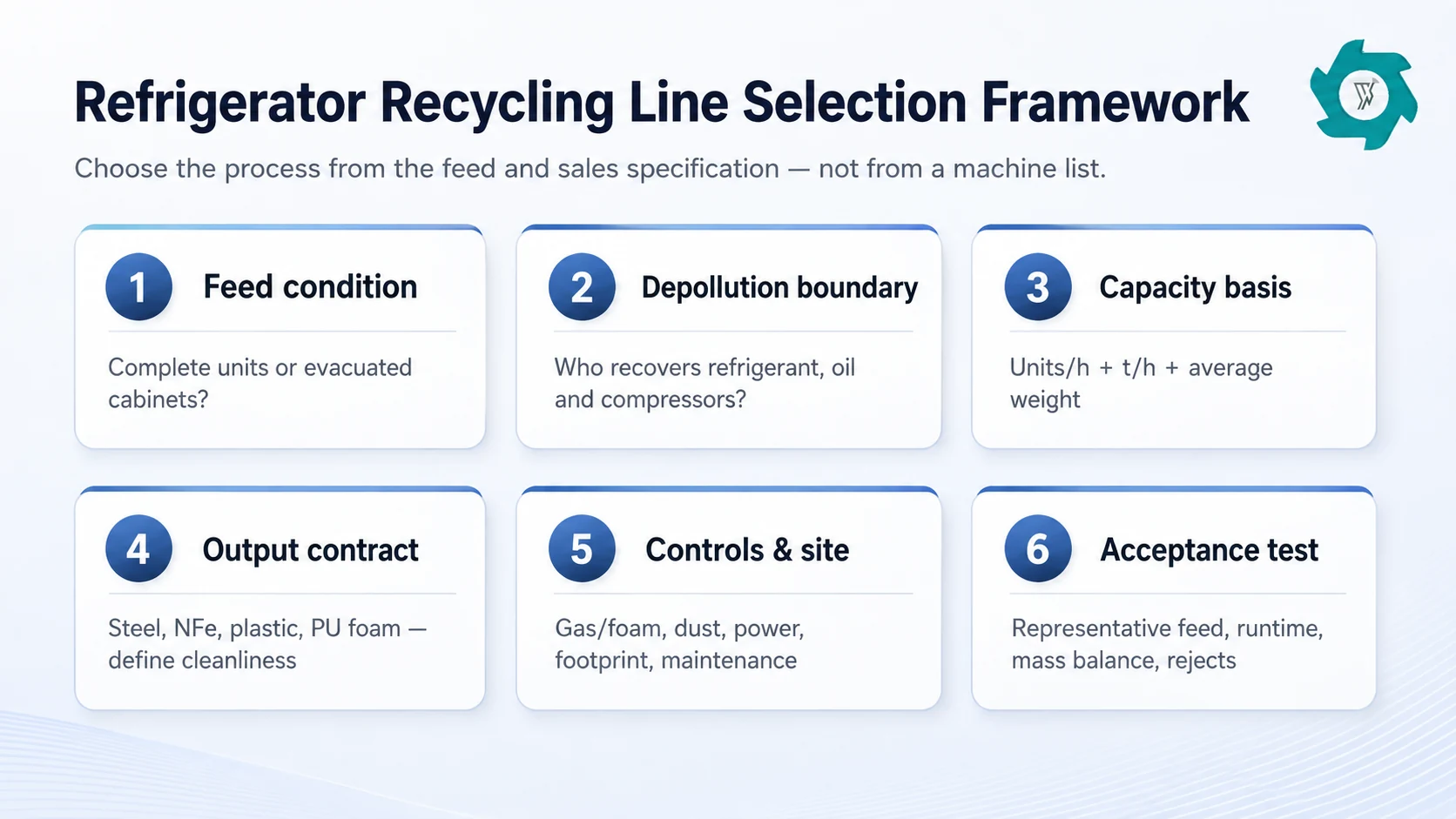
We prefer to freeze six decisions in order: feed condition, pre-treatment boundary, capacity basis, output specification, environmental/site controls, and acceptance method. Only after those are stable does it make sense to discuss drive power, cutter geometry, separator width or conveyor length.
1. Freeze the Feed Specification First
“Waste refrigerators” is not a complete feed description. A purchasing specification should say what arrives at the line, what has already been removed, and what variation is normal during a shift. This matters because cabinet dimensions and construction affect feeding, while retained components change safety, labor and separation duty.
Start with photos and video, but add numbers. Record the average and maximum cabinet dimensions, the approximate weight distribution, the ratio of refrigerators to freezers, and the share of commercial units if they are part of the stream. Then record what is still attached: compressor, oil, refrigerant charge, glass shelves, drawers, circuit boards, loose wiring, copper tubes and any non-standard additions.
| Feed question | Why it changes line selection | What to put in the RFQ |
|---|---|---|
| Complete units or pre-treated cabinets? | Changes the process boundary and the equipment required before shredding. | State the exact condition at the mechanical-line inlet. |
| Largest appliance | Affects hopper opening, feed conveyor, shredder chamber and bridging risk. | Give L × W × H for the largest regular unit, not only the average. |
| Average unit weight | Connects units/hour to tonnes/hour and exposes inconsistent capacity claims. | Use weighbridge or sample data if available. |
| Refrigerator/freezer mix | Changes cabinet density, foam quantity and handling rate. | Give a normal mix and a worst credible mix. |
| Retained loose components | Glass, electronics and other parts may require manual removal or a separate route. | List what is allowed and what is prohibited. |
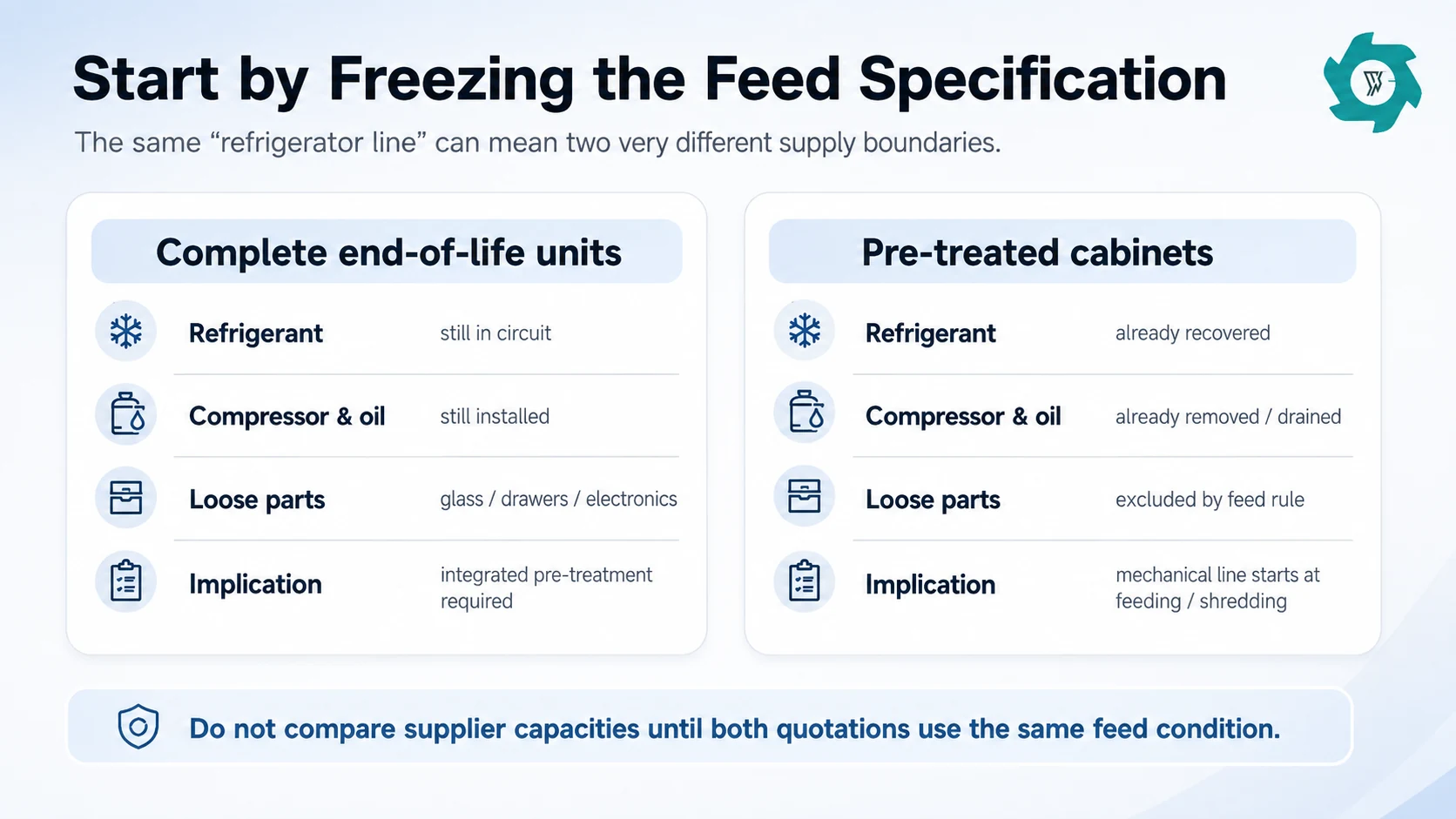
Selection rule: the feed specification should be tight enough that a supplier can reject a non-conforming FAT sample for a stated reason. If “normal refrigerator scrap” is the only definition, the specification is too loose.
2. Define the Depollution and Supply Boundary
This is the point that deserves more attention than a brochure comparison. In the United States, EPA safe-disposal rules cover refrigerant-containing appliances, and EPA describes appliance recycling as refrigerant recovery and removal of hazardous components before shredding evacuated appliances. Recovery equipment is also subject to EPA requirements. The exact compliance path depends on the appliance and facility, so the supplier quotation should not be used as a substitute for the plant’s regulatory plan.
For a U.S. project, also ask who owns the recovery equipment, hoses and containers; who provides ventilation; how removed oil is collected; what operator procedures are assumed; and where the mechanical line is interlocked with upstream stations. If the feed may include flammable refrigerants or if blowing agents in foam create a gas-management concern, that must be identified during design rather than discovered at commissioning.
3. Size Capacity Around the Bottleneck
Refrigerator lines are often discussed in appliances per hour, while shredders and separators are discussed in tonnes per hour. Both are useful, and neither is enough by itself. A plant can own a shredder with ample mechanical capacity and still miss the production target because inspection, refrigerant recovery, compressor removal, foam handling or material discharge limits the connected line.
Use a simple conversion as a reasonableness check. If the average incoming refrigerator weighs 55 kg and the pre-treatment section handles 80 units per hour, the nominal mass flow before removed components is about 4.4 t/h. The actual cabinet flow into the shredder will be lower after compressors and loose parts are removed. That is why a quotation stating only “5 t/h” can be difficult to compare unless the feed point is defined.
Published industrial examples also show how widely capacity can vary by concept and project. ANDRITZ has reported fridge plants around 70 and 120 appliances per hour, while URT publishes a 4 t/h combined cooling-device project. These are useful reference points, not sizing rules for a YUXI project. The relevant capacity is the one demonstrated with the buyer’s agreed feed condition.
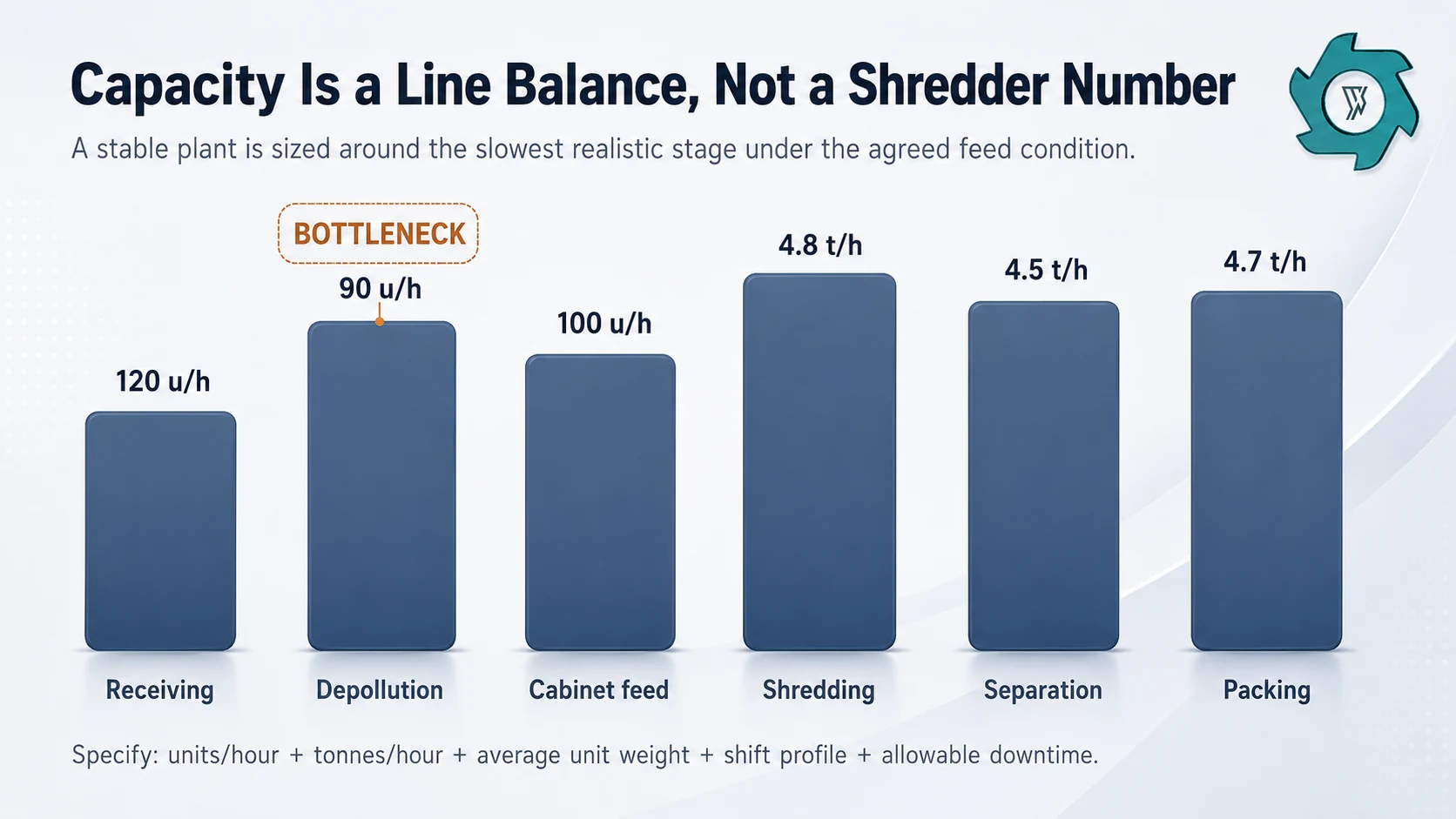
Specify capacity in four pieces
- Units per hour: useful for receiving, inspection and manual/automatic depollution.
- Tonnes per hour: useful for shredding, conveying and downstream separation.
- Average and maximum unit weight: connects the two capacity measures.
- Operating profile: hours per shift, shifts per day, planned cleaning and maintenance windows.
Do not add an oversized shredder simply to make the brochure number look safer. Oversizing can increase installed cost without fixing the actual bottleneck. The same logic applies when selecting a shredder on its own; YUXI’s guide on how to choose a metal shredder is useful for the primary size-reduction stage, but the refrigerator project still has to be balanced as a complete process.
4. Write the Output Contract Before Selecting Separators
A separator cannot be judged without knowing what the buyer wants to sell. “Recover copper, aluminum, iron and plastic” is still too broad. After crushing, copper and aluminum may be recovered together as a conductive non-ferrous fraction unless the project includes additional sorting. Plastic may still contain foam or metal attachments depending on liberation and air separation. Fine residue may carry recoverable metal if the cut size and screen strategy are not matched.
Talk to the downstream buyer before freezing the line. Ask which fractions they will purchase, what contamination they penalize, whether mixed non-ferrous is acceptable, and how they sample loads. Then translate those commercial requirements into the process specification.
| Recovered stream | Selection question | Evidence to request |
|---|---|---|
| Ferrous steel | How much non-metal carryover is acceptable? | Sample weight, visual condition, agreed contamination method. |
| Non-ferrous fraction | May copper and aluminum remain mixed? | Mass of recovered NFe and composition of the sample. |
| Plastic fraction | Is a mixed plastic stream saleable locally? | Residual metal/foam level and downstream outlet. |
| PU foam | How will it be collected, densified or otherwise handled? | Collection method, gas/dust treatment scope and residue route. |
| Residue/fines | What loss of metal is acceptable? | Representative residue sample and mass-balance check. |
One common buying mistake is to specify “98% recovery” without defining the denominator, sampling method, or product. Recovery of ferrous steel is not the same metric as purity of a non-ferrous fraction. A useful guarantee names the stream, test method, feed sample and test duration.
5. Treat Foam, Refrigerant and Dust as Process Design Inputs
Polyurethane insulation is not just another light contaminant. When foam is liberated, it creates a light fraction and dust load that can dominate the conveying and collection design. Older appliances may also contain blowing agents in the foam. Industrial refrigerator-recycling suppliers such as ANDRITZ, FOR REC and URT describe gas recovery, foam handling and process enclosure as central parts of their systems. That is a useful reminder for any buyer: foam handling should not appear as a small accessory line at the end of the quotation.
Ask where foam is released, how it is separated from metals and plastics, where negative pressure is maintained, how duct velocities are selected, where filters are located, and what happens when the dust system trips. If the project includes gas recovery or treatment, ask for the design basis: assumed refrigerant/blowing-agent mix, monitoring points, alarm logic, ventilation philosophy and equipment responsibility.
6. Match Each Machine to One Measurable Job
Once the upstream boundary and output contract are clear, the equipment list becomes much easier to judge. Each machine should have a sentence explaining what problem it solves and what condition it passes to the next stage.
| Machine or system | Job in the line | Questions worth asking |
|---|---|---|
| Receiving / dismantling station | Creates a controlled feed and removes components that should not enter shredding. | How many operators? What is removed? Where are recovered fluids and parts stored? |
| Refrigerant recovery section | Handles the cooling circuit before mechanical processing where included in scope. | What refrigerants are assumed? What certified equipment is required? What records are needed? |
| Primary double-shaft shredder | Opens bulky pre-treated cabinets into manageable pieces. | Largest cabinet, cutter configuration, overload logic, chamber access, expected primary size range. |
| Secondary crusher | Improves liberation between steel sheet, liner plastic and insulation. | Required input size, discharge range, wear parts, fines generation and maintenance access. |
| Magnetic separator | Removes ferrous steel from the mixed stream. | Burden depth, belt speed, magnet location and carryover checks. |
| Air / foam separation | Extracts light PU foam and dust from denser fractions. | Air balance, cyclone/filter scope, foam discharge and trip logic. |
| Eddy current separator | Recovers conductive non-ferrous material from non-metals. | Particle size distribution, feed presentation, splitter adjustment, required NFe product. |
| PLC and interlocks | Keeps connected equipment within a controlled operating sequence. | Load feedback, reverse logic, alarms, permissives, emergency stops, fault history. |
Primary shredder blade material and geometry can matter because refrigerator cabinets combine thin steel sheet, plastic liner, insulation and occasional retained metal attachments. But cutter specification is only one part of the selection. The line is successful when the shredder produces a stable feed that the secondary crusher and separators can handle. YUXI’s metal shredder blade materials guide gives more detail on the wear-versus-toughness tradeoff for appliance scrap.
7. Check Layout, Utilities, Access and Controls Before the Layout Is “Final”
A 2D line drawing can look tidy and still be difficult to operate. Refrigerator plants need room for irregular incoming units, removed compressors and components, maintenance lifting, foam collection, ducting, bins or bunkers for separated products, and safe access around moving equipment.
Before approving the general arrangement, walk through four routines on paper: normal loading, a shredder jam, separator cleaning, and removal of a major wear part. If a forklift, crane or maintenance crew cannot reach the component without dismantling unrelated conveyors, the layout is not finished.
Utilities to confirm
- Incoming voltage, frequency, available transformer capacity and motor-starting constraints.
- Compressed-air pressure and consumption for valves, filters or sorting auxiliaries.
- Dust-extraction and process-gas interfaces, including duct responsibility.
- Drainage and storage requirements for recovered oil and cleaning water, if any.
- Building clear height, floor loading, foundation requirements and anchor scope.
- Ambient temperature range if gas treatment, cooling or hydraulic systems are temperature-sensitive.
Controls deserve their own review. The operator should not have to discover an upstream overfeed only after the downstream separator floods. Ask how conveyor speed, shredder load, crusher load, foam extraction and separator feeding are coordinated. Also ask which faults stop the full line, which faults allow a controlled empty-out sequence, and how alarms are recorded.
8. Normalize Quotations Before Comparing Price
Two prices are comparable only after the project boundary is comparable. Build a spreadsheet with one row per responsibility. Do not limit it to major machines. Include support steel, platforms, stairs, guarding, ducting, dust collector, electrical cabinets, field cables, sensors, compressed-air piping, spare wear parts, freight, installation supervision, commissioning, training and acceptance testing.
Also normalize the assumptions. One quote may assume that refrigerators are already evacuated and stripped. Another may include labor-saving pre-treatment. One may place foam compaction outside the price. Another may include it. A low number can be correct and still be incomplete for the buyer’s intended plant.
| Comparison line | Supplier A | Supplier B | Buyer note |
|---|---|---|---|
| Feed condition | Pre-treated cabinet | Complete refrigerator | Not comparable until boundary is aligned. |
| Capacity basis | t/h at shredder | units/h at receiving | Add average weight and same measurement point. |
| Foam / gas scope | Foam separator only | Foam + gas treatment | Check local requirement and operating cost. |
| Electrical scope | Main cabinets | Cabinets + field cable | Identify local electrical contractor scope. |
| FAT | No feed test stated | 2-hour test | Agree sample, duration and metrics. |
Price should be discussed after the line performs the same job on paper. Otherwise the comparison rewards omissions.
9. Use FAT Criteria That Can Actually Be Measured
A factory acceptance test is most useful when it checks the risks that mattered during selection. Bring or define a representative feed mix rather than a few clean, easy refrigerators. If the supply is normally a mix of refrigerators and freezers with a defined maximum size, the test sample should reflect it.
For a connected mechanical line, the FAT can record feed weight, runtime, stoppages, primary discharge condition, secondary particle-size distribution where relevant, recovered ferrous mass, recovered non-ferrous mass, foam fraction, residue and visible cross-contamination. If the test includes upstream depollution or gas systems, the measurement plan needs to be agreed with the responsible technical and compliance teams before the test.
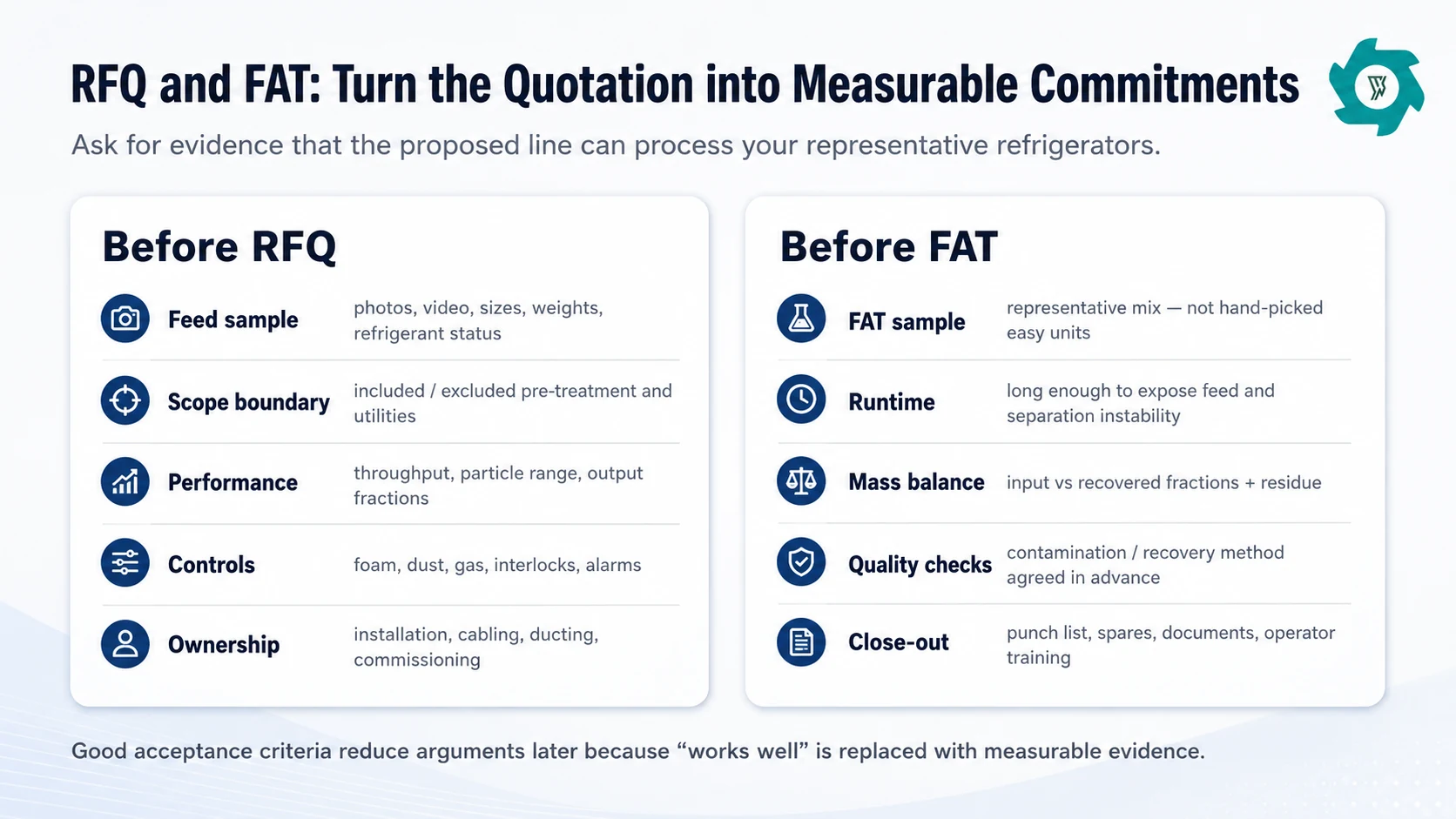
Three FAT questions that prevent vague results
- What exactly is the sample? Record unit count, total mass, size range, appliance mix and pre-treatment condition.
- How long is the test? A short demonstration may show that machines rotate; it may not expose feeding, heat, dust or separation instability.
- How is pass/fail decided? Define throughput, stoppage allowance, product sampling and any recovery or contamination metrics before material is loaded.
Photographs and operator comments are still useful, but they should sit beside the measured results, not replace them.
10. Refrigerator Recycling Line RFQ Checklist
The fastest way to receive a useful proposal is to send a small engineering package instead of a one-line capacity request. The following list is enough for an initial process discussion and highlights the items that usually change the line.
- Representative photos and videos of incoming refrigerators and freezers.
- Average and maximum dimensions; average and maximum unit weight.
- Share of refrigerators, chest freezers, upright freezers and any commercial cooling units.
- Exact condition at line inlet: refrigerant status, compressor status, oil status and loose-part removal.
- Target units/hour and tonnes/hour, plus shift length and annual operating days.
- Required saleable fractions and acceptable cross-contamination.
- Whether mixed copper/aluminum is acceptable or further separation is required.
- Required foam handling, dust control and any process-gas treatment scope.
- Workshop length, width, clear height, column positions and available maintenance access.
- Power standard, available electrical capacity, compressed air and other utilities.
- Local environmental, fire, building and occupational-safety requirements to be reflected in the design.
- Required project boundary: equipment only, mechanical/electrical installation, commissioning, training and spare parts.
- Proposed FAT feed sample, runtime, measurements and pass/fail criteria.
If some information is still unknown, mark it as open rather than allowing each supplier to make a different assumption. Open questions are visible; hidden assumptions usually surface after the purchase order.
FAQ: Choosing a Refrigerator Recycling Line
What is the first thing to confirm when choosing a refrigerator recycling line?
Confirm the feed condition. A line for complete end-of-life refrigerators needs a different pre-treatment and safety boundary from a mechanical line that receives cabinets after refrigerant recovery, compressor removal and oil handling.
Should refrigerator recycling capacity be compared in units per hour or tonnes per hour?
Use both. Units per hour is useful for receiving and depollution labor, while tonnes per hour is useful for shredding and separation. Also state average unit weight and the agreed feed condition.
Can complete refrigerators be fed directly into a shredder?
A buyer should not assume unrestricted direct shredding. In U.S. appliance disposal, refrigerant recovery requirements apply before disposal, and the project should define how refrigerant, compressor oil and other unsuitable parts are handled before the mechanical section.
How do I compare two refrigerator recycling line quotations fairly?
Normalize the scope first. Put feed assumptions, included machines, dust and gas systems, electrical scope, platforms, ducting, spare parts, installation, commissioning and acceptance criteria into one comparison sheet.
What output specifications should be agreed before ordering?
At minimum, define the saleable fractions you expect, the acceptable contamination in each fraction, whether copper and aluminum may remain mixed, how PU foam will be handled, and where residue is allowed to go.
Why is a factory acceptance test important for this equipment?
A FAT can show whether the connected line feeds steadily, liberates the cabinet, removes foam and steel, recovers the expected non-ferrous fraction, and operates under the agreed load. The sample and measurement method should be agreed before the test.
What information should I send a supplier for line selection?
Send representative refrigerator photos and videos, size and weight range, refrigerant and compressor status, expected monthly supply, target units/hour and tonnes/hour, output requirements, building dimensions, electrical standard, local environmental requirements and your preferred project boundary.
Configure a Refrigerator Recycling Line Around Your Feed
Send YUXI your appliance photos, pre-treatment condition, target throughput, required output fractions and workshop dimensions. We can use the same information to define a clear process boundary and prepare a line configuration for technical review.
References
- U.S. EPA — Appliance Disposal: refrigerant recovery and disposal context for refrigeration appliances.
- U.S. EPA — Refrigerant Recovery and Recycling Equipment Certification: recovery-equipment requirements and certification framework.
- ANDRITZ — Recycling Plants for Refrigerators: industrial examples of sealed refrigerator processing, gas recovery and recovered fractions.
- URT — Fridge Recycling: refrigerator disposal plant concepts and blowing-agent handling.
- FOR REC — Refrigerator Recycling Plant: depollution, shredding, foam extraction and non-ferrous separation example.