




 Request Quote



A straw line succeeds or fails at the front end. The key is not simply choosing a larger shredder; it is turning irregular, tightly compressed bales into a controlled mass flow without carrying bindings into the rotor, flooding the next machine or creating avoidable fines.
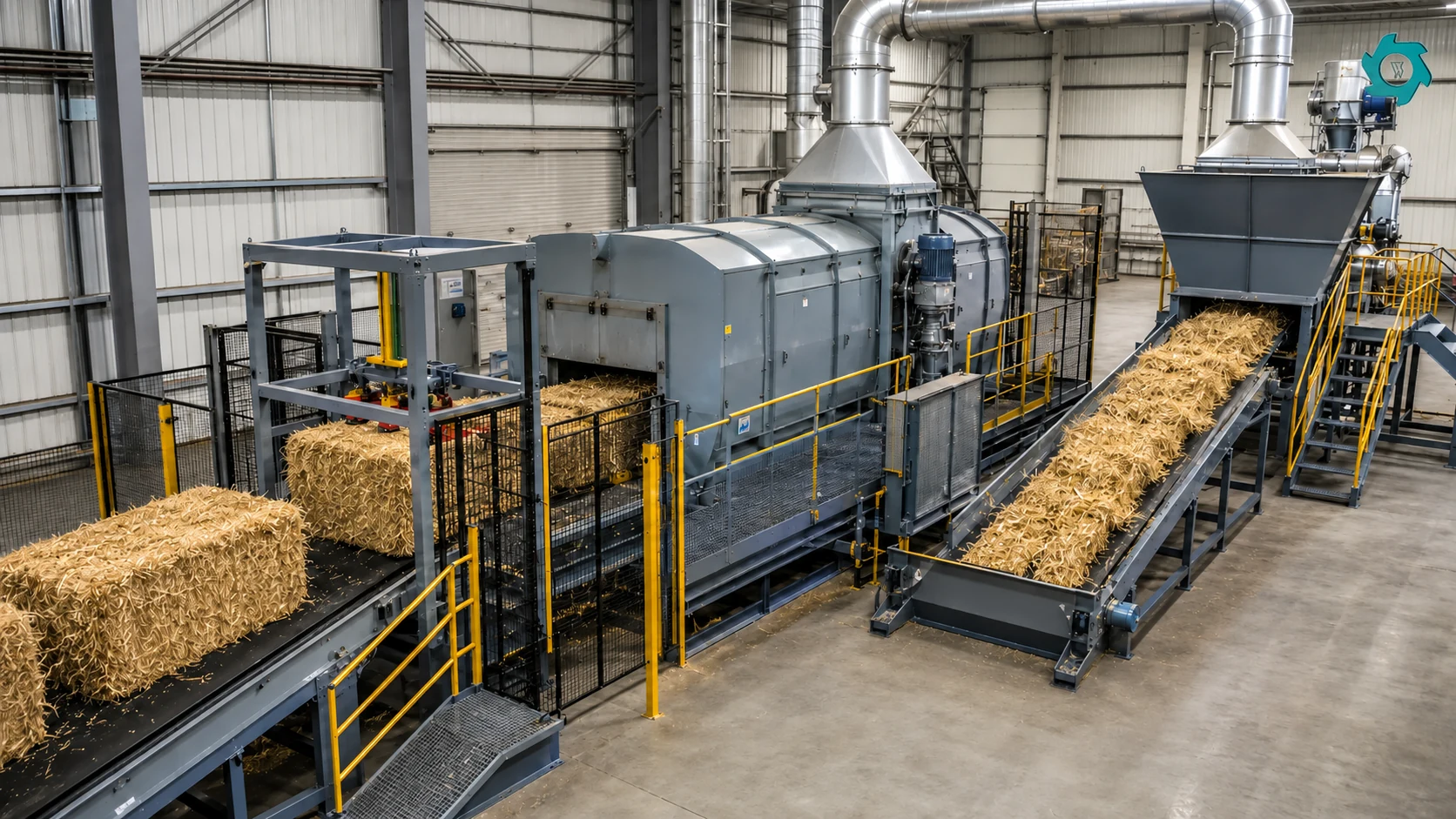
Start with the bale, not the machine list
Baling is simply a way to store and transport straw; it does not mean every bale has the same material condition. Even with the same crop type, different batches can vary in compaction, moisture, cut length, binding method, and contamination, all of which can affect how the material performs during processing. That variability is exactly why the front end of a biomass shredding and recycling line must be configured around representative bales rather than a catalog capacity.
Build a bale acceptance specification
A useful RFQ does not say only “wheat straw” or “rice straw.” Record the range that the line must accept and separate normal operating material from occasional exceptions.
| Input field | Why it matters | What to record |
|---|---|---|
| Bale format | Sets conveyor width, opening and handling method | Round or square; minimum, typical and maximum dimensions |
| Bale mass and density | A dense bale can create a short-duration torque and flow spike | Mass distribution, not one average value |
| Moisture | Changes mass, cutting behavior, screen performance and storage risk | As-received range and sampling method |
| Bindings | Twine or wire can wrap, contaminate product or damage downstream equipment | Material, count, location and removal method |
| Contamination | Soil, stones and metal alter wear and safety requirements | Allowed, rejected and separately handled items |
| Required output | Determines whether opening, primary cutting or fine milling is justified | Downstream use plus particle-size test method |
The densest recurring bale often sets opening torque; the longest recurring fibers expose wrapping risk; and the wettest accepted bale may determine whether a screen continues to pass material. DOE-supported work on bale deconstruction identifies uneven flow, surging and changing biomass properties as practical barriers to throughput, quality and reliability.1
A practical process for baled straw
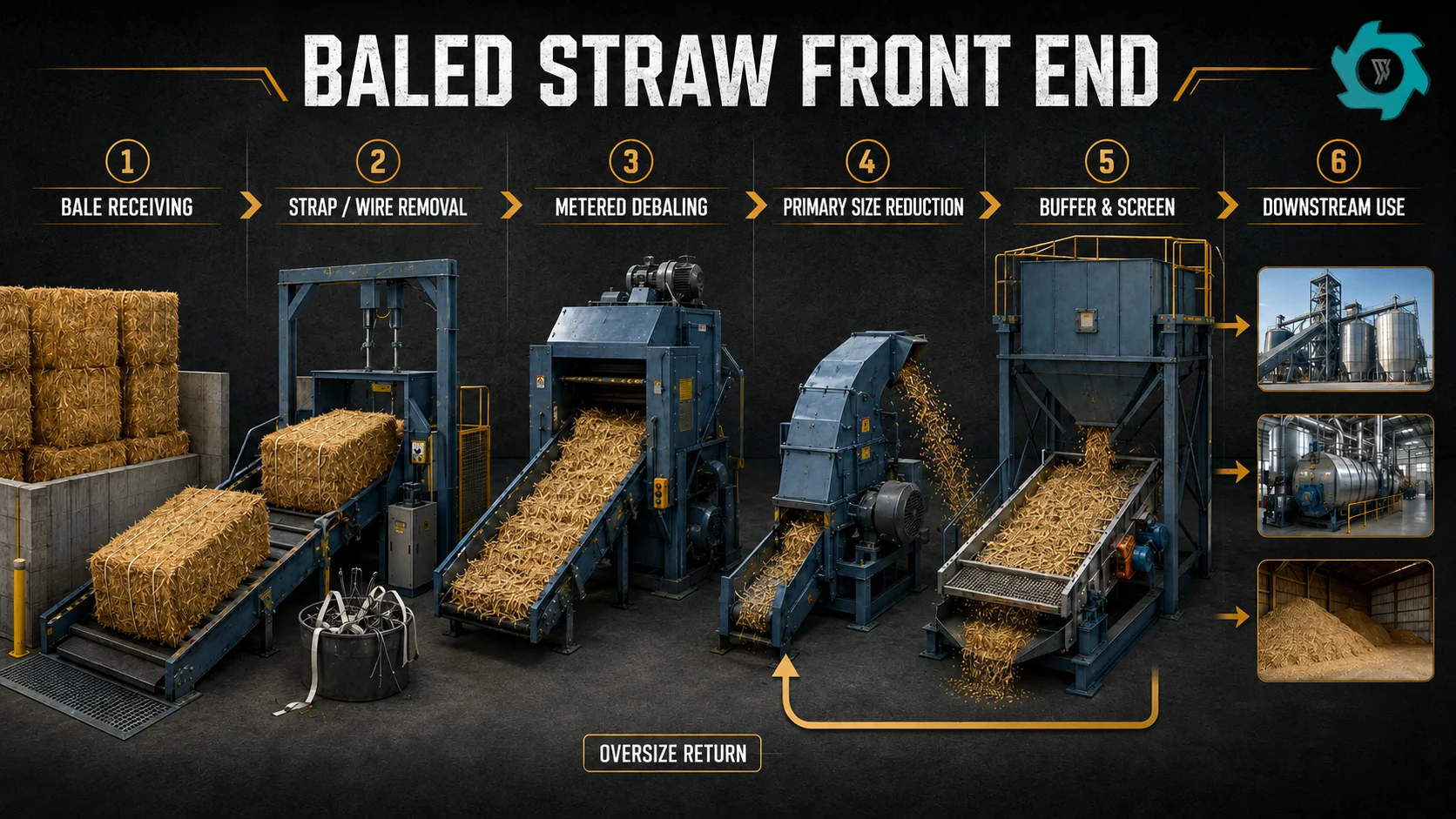
- Receive and stage. Keep enough floor or conveyor accumulation to prevent the loader or forklift cycle from becoming the line’s hidden capacity limit. Identify wet, moldy, burned or contaminated bales before they enter the process.
- Remove and contain bindings. Define whether twine, plastic straps or wire are removed manually, mechanically or by a combination. Provide a collection point and a verification step.
- Deconstruct the bale. A debaler or controlled opener should pull the bale apart without releasing the entire compressed mass as one slug. The objective is flow control, not final particle size.
- Meter the loosened straw. Use conveyor speed, live-bottom action, level sensing or load feedback to keep the primary machine loaded steadily. A short buffer between opening and cutting can absorb front-end variation.
- Perform primary size reduction. Select cutting action and clearances around fiber length, moisture and required discharge. Low-speed shear can be useful where controlled opening and reduced fines matter; higher-speed impact has a place when a much finer product is genuinely required.
- Screen only for a defined reason. The screen should protect a downstream specification. Oversize return must be measured because high recirculation consumes capacity and can turn acceptable material into fines.
- Buffer or transfer downstream. Use a bin, walking floor, screw, belt or pneumatic transfer only after checking bulk density and flow behavior. Prepared straw remains a variable bulk solid.
DOE research on improved bale deconstruction emphasizes uniform flow, contaminant removal and avoiding unnecessary high-speed processing that generates fines.2
Specify capacity on a dry-mass basis
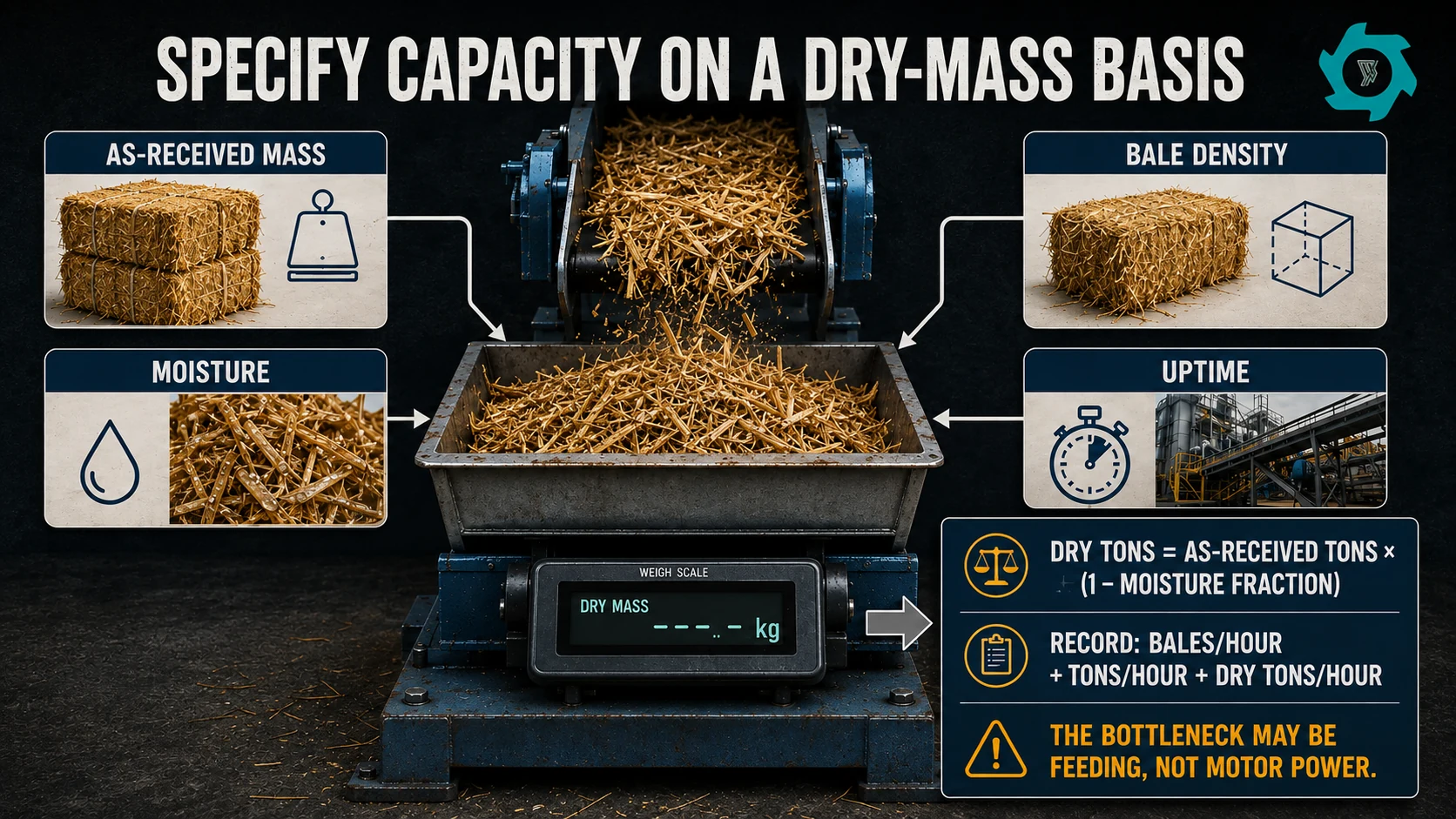
“Five tons per hour” is incomplete when moisture can change. For a measured lot:
Dry mass = as-received mass × (1 − moisture fraction)
If 10 metric tonnes arrive at 18% moisture on the agreed wet basis, the lot contains 8.2 dry tonnes. Use the project’s agreed moisture method and units in the purchase specification.
Report three capacity values during testing: bales per hour, as-received tonnes per hour and dry tonnes per hour. Then state whether the figure is an instantaneous run rate or net shift output. Net output includes planned loading, binding removal, cleaning, reversals and minor stops. Nameplate rotor throughput does not.
Information-gain checkpoint: Build a one-shift mass balance. Record incoming bale count and mass, accepted product, oversize return, captured fines, removed bindings, rejected contamination and unaccounted loss. This exposes whether the line is limited by bale logistics, opening, cutting, screening or housekeeping.
Convert the capacity target into a front-end rhythm
A mass target becomes much more useful when it is converted into the number of bales that must be received, stripped and opened. Use the lightest normal bale—not the heaviest bale—to check whether the handling system can keep up:
Required bale rate = target as-received mass flow ÷ light normal bale mass
For example, a line targeting 6 metric tonnes per hour and receiving 400 kg bales must average 15 bales per hour, or one bale every four minutes. At 300 kg per bale, the same mass target requires 20 bales per hour, or one every three minutes.
That interval is the front-end takt time. It must accommodate unloading, identification, binding removal, abnormal-bale diversion and placement onto the infeed. If binding removal routinely takes longer than the available interval, adding shredder power will not recover the missing production. The front end needs parallel work positions, better staging or a different debaling method.
| Rhythm check | Calculation | Design question |
|---|---|---|
| Bales per hour | Mass target ÷ light normal bale mass | Can receiving and binding removal sustain this rate? |
| Minutes per bale | 60 ÷ required bales per hour | Is there enough time for inspection and controlled placement? |
| Dry mass per bale | As-received bale mass × (1 − moisture fraction) | Will seasonal moisture change the useful output? |
| Net shift target | Dry mass rate × scheduled hours × planned utilization | Does the business case use a realistic uptime assumption? |
Size the buffer by minutes of protection, not just cubic meters
Usable buffer mass = design mass flow × protection time
At 6 t/h, five minutes of protection represents 0.5 tonnes of as-received straw. If the loosened straw bulk density used for design were 60 kg/m³, that mass would occupy about 8.3 m³ before allowing for unusable volume, uneven filling or the need to keep agitators and level sensors clear.
Too little buffer allows every debaler surge to reach the shredder. Too much poorly designed storage creates a new bridging and fire-load problem. The useful target is enough residence time to decouple normal upstream variation while still achieving reliable live-bottom discharge. Ask the supplier to state gross volume, usable working volume, assumed bulk density, high and low level setpoints, and the time the downstream machine can run between them.
Quantify bale variability before selecting the line
Averages hide the range that controls feeding. For a trial lot of at least several dozen representative bales, weigh each bale individually and record moisture by source or storage group. Then calculate a simple variability ratio:
Bale mass spread = 95th-percentile bale mass ÷ 5th-percentile bale mass
A ratio close to 1 indicates a relatively consistent handling load. A wider spread means that bale count is a poor proxy for tonnage and that conveyor speed alone may not stabilize mass flow. This is not a universal acceptance limit; it is a way to compare lots and expose how much control authority the debaler and buffer need.
Also separate moisture variation from mass variation. A heavier bale may contain more dry straw, more water, or both. Plot bale mass and moisture together. If the heaviest bales are also the wettest, an as-received throughput test can look strong even while dry-mass output and screen performance deteriorate.
Choose equipment by duty
Feeding and debaling
A wide belt may carry a complete rectangular bale well but still fail to meter loose straw. A chain conveyor tolerates demanding service but needs guarding and a transfer that does not trap fiber. A walking floor or live-bottom bin can reduce bridging after the bale has opened.
Primary shredder
Check chamber opening, cutter engagement, shaft-end protection, reversal logic and access for wrapped fiber when specifying an industrial shredder. Long straw may bend and pull before it cuts. More motor power does not automatically correct poor engagement or a front end that alternates between starvation and slug feeding.
Fine mill
Add a fine mill only when the downstream process requires it. A hammer mill is a different duty from low-speed bale opening, and machine selection must reflect the actual material and required output. Further reduction generally raises energy use, wear and dust; it can also increase sensitivity to moisture. DOE testing has documented relationships among moisture, screen size, grinding energy and particle size in corn-stover preprocessing.3
Screen and buffer
A screen is useful only when its cut supports downstream acceptance. Wet fibers may smear or blind apertures; long flexible pieces can orient and pass unpredictably. Define the sampling and sieve method, then verify that the buffer volume is based on low bulk density rather than mass alone.
Control the line as a system
Level, torque, motor current or mass-flow signals can slow the debaler before the primary machine repeatedly reverses. High-high level should stop upstream feed in a controlled sequence. Restart logic should clear the affected section without releasing accumulated straw as a new slug.
Separate loader starvation, binding-removal delay, bridging, wrapping, overload reversal, screen cleaning and downstream blockage. Otherwise a line can appear to have a “shredder capacity problem” when the shift log actually shows inconsistent loading.
A control sequence buyers can request
| Observed condition | Automatic response | Operator evidence |
|---|---|---|
| Downstream buffer reaches high level | Slow or pause the debaler while keeping the safe discharge sequence | Trend of level and upstream run command |
| Primary shredder load rises above the working band | Reduce metering speed before an overload reversal is required | Motor load, torque proxy and conveyor speed on one timeline |
| Repeated reversals occur in a short period | Stop upstream feed and call for inspection rather than cycling indefinitely | Alarm identifies reversal count and affected machine |
| Screen return rises | Warn the operator and cap fresh feed if recirculation threatens line capacity | Return conveyor load or measured return sample |
| Dust extraction is unavailable | Apply the site-approved permissive or controlled shutdown | Clear interlock status; no silent bypass |
Translate downtime into lost dry tonnes
Downtime minutes are easier to prioritize when converted into production at risk:
Lost dry tonnes = dry-mass target × downtime minutes ÷ 60
At a 4 dry t/h target, a 12-minute binding-related stop represents 0.8 dry tonnes of theoretical lost production before restart effects. Apply the same method separately to starvation, wrapping, screen cleaning and downstream blockage. Do not monetize the result unless the site has an agreed contribution margin; the dry-tonne comparison alone is enough to rank improvement work.
This method often changes the priority list. A dramatic overload that occurs once a week may cost less output than repeated two-minute starvation gaps on every bale. The shift log should therefore record start and end time, reason code, affected zone and whether material had to be cleared before restart.
Dry straw dust needs a site-specific safety review
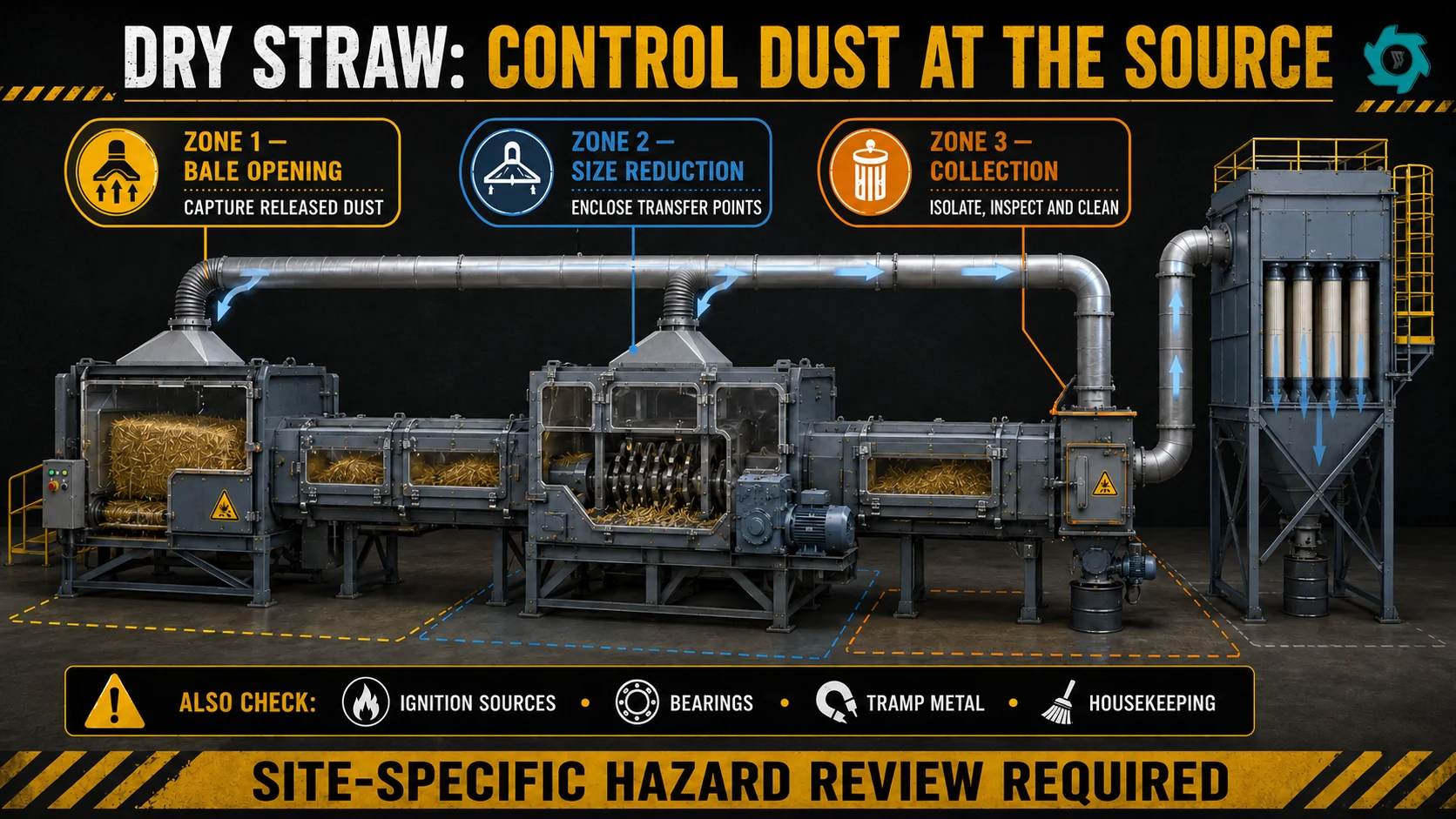
Dry agricultural fibers can generate combustible dust. OSHA’s technical guidance discusses fire and dust-explosion prevention in agricultural and food processing, including hazardous-location equipment and deflagration controls where applicable.4 The final system must be designed by qualified parties for the site, material and local rules.
At minimum, the hazard review should cover dust capture points, duct transport, collector location or isolation, ignition sources, hot bearings, tramp metal, electrical classification where required, housekeeping, fire detection, emergency stops and safe maintenance. Do not solve an indoor dust problem by moving uncontrolled dust to another part of the plant.
Use a worst-case FAT, not a clean demonstration bale
A useful factory acceptance test includes normal material and the recurring difficult end of production. Agree on lot size, conditioning, measurement method and pass/fail criteria before the test.
| Test lot | Question answered | Record |
|---|---|---|
| Normal bale mix | Can the line maintain a steady burden? | Mass, time, stops, reversals and discharge variation |
| Densest accepted bales | Can the opener prevent slug loading? | Peak load, opening behavior and downstream level |
| Highest accepted moisture | Will material discharge and screen without chronic blockage? | Screen condition, residue and net output |
| Longest-fiber condition | Where does wrapping occur? | Shaft ends, bearings, transfers and cleanup time |
| Binding challenge | Does the removal and verification method work? | Bindings recovered and bindings found downstream |
Inspect the machine after the run. Material packed behind cutters or around shaft ends may not reduce the short test rate, yet it can become a maintenance problem over a full shift. If the project also compares suppliers, use the broader industrial shredder evaluation criteria to review test evidence, integration and service scope rather than comparing motor ratings alone.
Write acceptance criteria that cannot be passed by a short peak
Use a sustained test window long enough to include multiple bales, binding removal, normal control responses and at least one planned inspection. Define capacity as accepted output over elapsed test time, not the fastest five-minute interval. The contract should also state:
- Which feed lots are supplied and who confirms their moisture and mass;
- Whether capacity is reported as received or on a dry basis;
- The allowed oversize and fines fractions and the sampling method;
- Which stops are excluded, if any, and how exclusions are documented;
- The maximum permitted binding carryover under the agreed inspection method;
- Where electrical energy is measured and which auxiliary equipment is included;
- The inspection points for wrapped or retained material after shutdown.
Record both gross feed and accepted product. A line should not pass merely by feeding fast while accumulating a high screen return, excessive fines or material inside the equipment. The most useful FAT result is a compact mass balance with a reason for every material stream.
An RFQ data block that improves supplier comparisons
These fields force suppliers to use the same project boundaries, reducing the risk of comparing capacity figures measured under different conditions.
| RFQ field | Buyer entry | Supplier response required |
|---|---|---|
| Feed envelope | Crop, bale dimensions, mass percentiles, moisture range, fiber condition | Accepted range and excluded conditions |
| Bindings | Twine, plastic strap or wire; pieces per bale | Removal scope, verification and disposal point |
| Contamination | Soil, stone and metal limits | Detection, separation and protection included |
| Capacity boundary | Bales/h, as-received t/h, dry t/h and net shift target | Guaranteed measurement point and utilization assumptions |
| Output specification | Downstream use, particle-size method, oversize and fines limits | Process stages needed to meet the specification |
| Utilities boundary | Site voltage, air, extraction and available space | Connected load, typical demand and auxiliary scope |
| Acceptance test | Representative and difficult lots | Test duration, instruments, pass/fail values and inspection |
Shift KPIs that reveal the real bottleneck
- Incoming bales, as-received mass and dry mass
- Net running time and scheduled production time
- Starvation minutes and overload/reversal count
- Binding-removal delays and bindings recovered downstream
- Oversize return as a share of screen feed
- Captured fines, rejected contamination and cleanup mass
- Accepted product mass and particle-size result
- Cleaning time by location and wrapping found at inspection
If the debaler surges, tune opening and metering. If the screen return is excessive, revisit the cut or aperture. If dry-ton output falls while as-received tonnage stays constant, moisture has changed the apparent result. The response is then tied to evidence rather than guesswork.
FAQ
Can a primary shredder accept a complete straw bale?
Sometimes, but acceptance is not the same as stable production. A complete bale can create a short, dense load that causes surging, reversals or downstream overload. Industrial lines usually perform better when bindings are removed and the bale is opened and metered before final size reduction.
Should straw-line capacity be stated in bales per hour or tons per hour?
Use both, and add dry tons per hour when moisture varies. Bales per hour describes handling frequency, as-received tons per hour describes the load entering the plant, and dry tons per hour makes different moisture conditions easier to compare.
Does every straw recycling line need a hammer mill?
No. Add fine milling only when the downstream process requires a smaller or tighter particle-size distribution. Unnecessary milling raises power use, wear and fines generation.
What should be tested during a straw-line FAT?
Test the normal bale, the densest recurring bale, the highest expected moisture condition and the most difficult binding or contamination condition allowed by the contract. Record net mass, running time, stops, reversals, oversize return, fines and residue at shaft ends.
Where should dust be captured in a dry straw line?
Compressed material tends to release more dust during bale opening, dropping, cutting, screening, and transfer, so these points deserve closer attention. Dust-control and fire-protection measures should be designed around the actual site risks rather than selected from a generic equipment setup.
Configure the line around representative bales
Send bale dimensions, mass range, moisture, binding type, contamination, target size, downstream use and required net output. YUXI can use those details to define a practical feeding, opening, shredding and discharge scope.
Engineering References
- U.S. DOE, Biomass facility — bale deconstruction.
- U.S. DOE, Bale flow — material handling.
- DOE BETO, Feedstock review — preprocessing context.
- OSHA, OSHA manual — dust hazards.