




 Request Quote



A shredder and a hammer mill solve different material problems. The useful choice is usually made at the handoff between them: after bulky material has become feedable, but before unnecessary fine grinding turns into dust, heat and downtime.
A biomass project should begin with the next process, not the machine name. A boiler, pellet press, compost operation and storage system each tolerate a different particle shape, moisture range and oversize share. The biomass shredding and recycling line is therefore best viewed as a configurable sequence: receiving and feeding, primary reduction, separation, optional fine milling, screening and transfer.
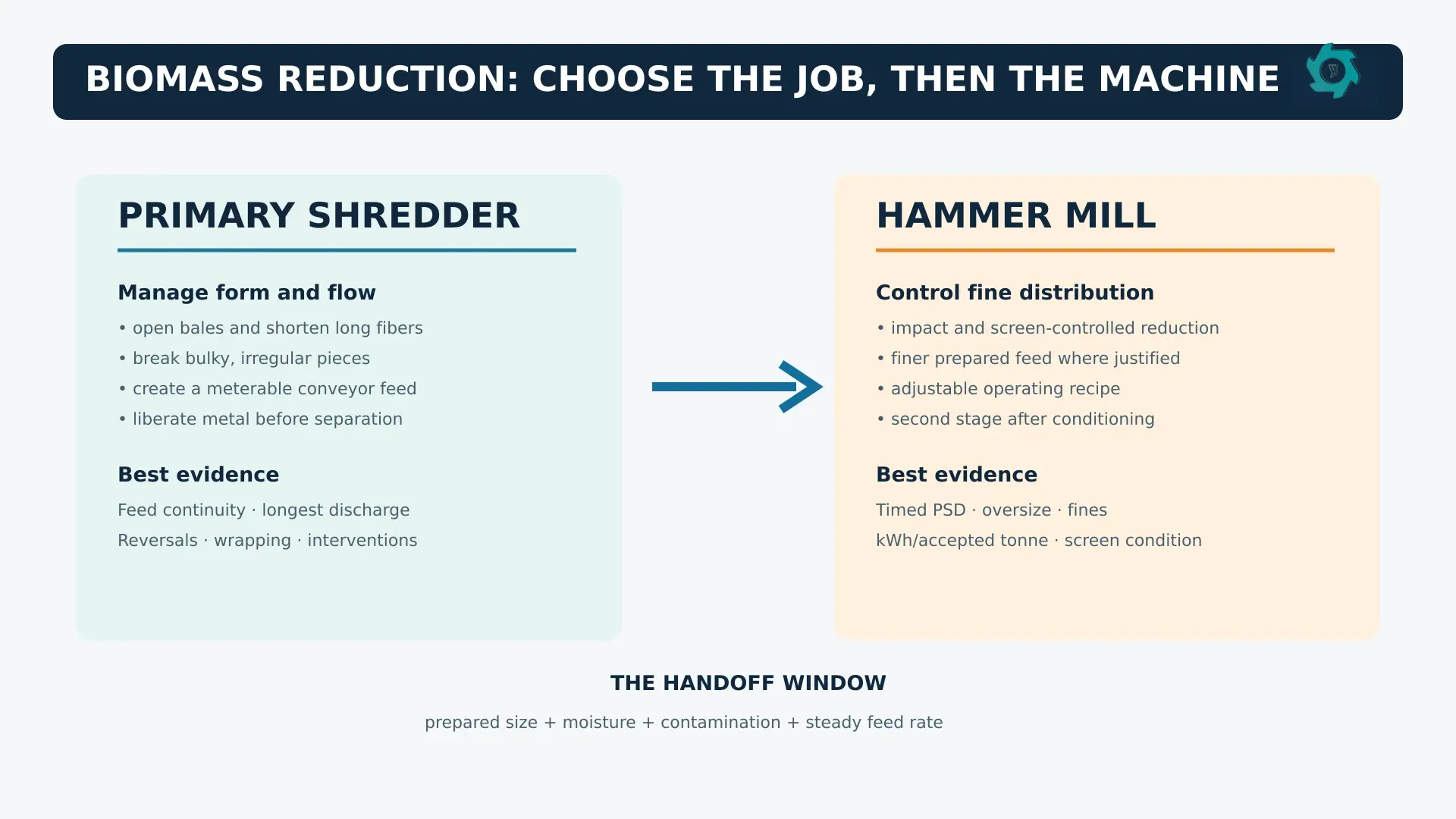
The reduction sequence should follow the material’s behavior and the downstream specification. It is not a contest between two interchangeable machines.
Why the comparison is often framed incorrectly
A dry, pre-sized wood chip may enter a hammer mill with little difficulty, while the same mill can struggle when it receives wet bagasse, wire-bound stalk bundles or a surge of long straw. A high-torque shredder may accept that difficult material, but it does not automatically create the narrow particle-size distribution needed by a pellet die or a tightly specified combustion system.
The practical division is by function. A shredder applies slow-speed cutting, tearing and compression to reduce form and create a manageable feed. A hammer mill relies on repeated high-speed impact and a screen to retain material until it has passed the chosen opening. The second mechanism is valuable when a fine distribution matters; it is unforgiving when the feed bridges, smears, wraps or carries abrasive contamination.
Research from Argonne notes the appeal of both high-capacity shredders and hammer mills, but also identifies hammer-milling concerns with high-moisture feed, fines generation and size control. Rotary-shear and knife-based systems can make a narrower, lower-fines product in appropriate cases. That is a reminder to define the desired product first—not proof that one machine universally wins.1
Start with four material facts, not a capacity headline
| Question | What it changes | What to record in an RFQ |
|---|---|---|
| What arrives at receiving? | Determines hopper, conveyor, opening size and whether primary reduction is needed. | Bale dimensions; longest stalk or branch; loose/baled form; photos and short video. |
| How does it behave when wet? | Wet elastic fiber can fold, smear across screens and compact in transfer points. | Normal, minimum and maximum moisture—not one annual average. |
| What contamination is credible? | Soil drives wear and ash; wire and nails change the protection and separation requirement. | Estimated share and type of stones, metal, twine, film and treated wood. |
| What does the next process accept? | Sets the real output target and determines whether fine milling adds value. | PSD range, maximum oversize, fines limit, moisture band and permitted contaminants. |
For example, low-density straw may fill a conveyor while moving surprisingly little dry mass. A larger motor will not correct a feed-volume limitation. Conversely, a hammer mill can show a respectable average kW reading while a wet pocket repeatedly blinds the screen. Those are different bottlenecks, and they call for different evidence. For a material-specific upstream example, see the corn stalk recycling line guide.
Where a biomass shredder earns its place
Put the shredder at the front when the first task is to make irregular material predictable. This includes opening dry bales, shortening long crop residues, reducing branches, breaking pallet sections and turning bulky green waste into material that can be conveyed and metered. In this position, the relevant performance measures are not merely tonnes per hour: look at feed continuity, reversal frequency, longest discharge pieces, wrapping events and the condition of the discharge stream.
Shredder strengths
- Broad infeed tolerance: a suitable chamber and cutter arrangement can accept variable form that would not feed a fine grinder steadily.
- Lower-speed control: torque and cutting action are useful against long, bulky or compacted pieces.
- Better process access: the primary stage is the natural place to install metal removal after liberation, particularly for mixed wood and pallets.
- Staging flexibility: a coarse product may be adequate for compost, storage-volume reduction or some fuel-preparation routes; a later mill can remain bypassed until its value is proven.
That last point saves projects from a common mistake: specifying final size at receiving. A primary shredder should normally target the coarsest cut that gives stable transfer and enables the next unit operation. For pallet work, this often means shred first, remove liberated ferrous material, then decide whether further sizing is worth the wear. The wood pallet recycling machine guide explains why magnetic separation belongs in the process.
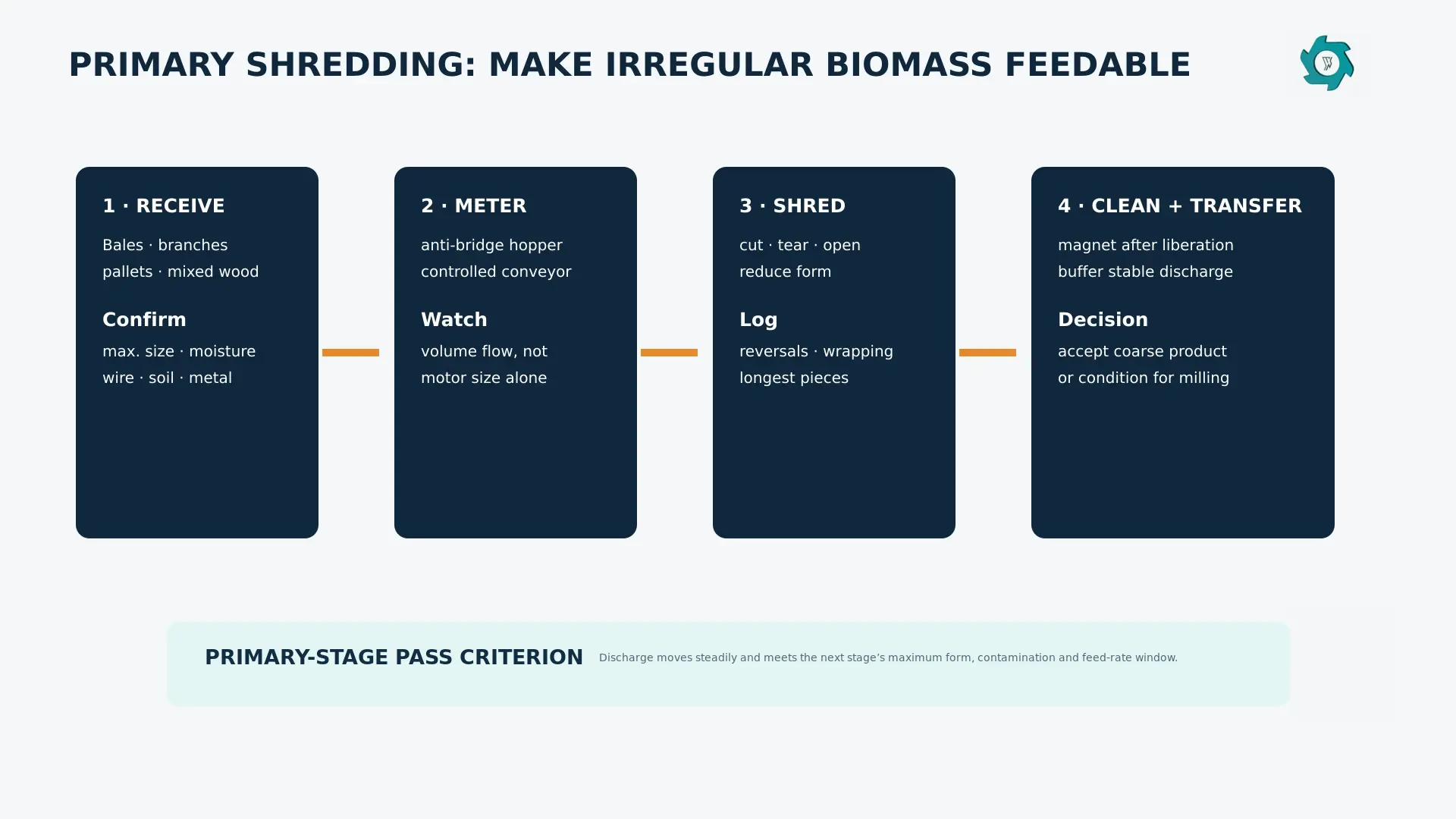
A primary shredder manages form and flow. It should be evaluated with feed behavior, discharge condition and interventions, not only a nominal output size.
Where a hammer mill earns its place
A hammer mill becomes appropriate when the downstream process has a clear reason to demand a smaller, more controlled distribution. Pellet production is the familiar example, but some fuel systems, densification routes and conversion processes also need that control. The mill’s screen is a classification device as much as a size-reduction component: material remains in the mill until it can pass the opening. This makes the actual distribution, fines share and screen condition more meaningful than the screen label alone.
The decision should be based on a representative product sample. A 6 mm screen does not certify a 6 mm maximum particle size, and it says nothing about fines or long-fiber tails. Timed samples should show a practical distribution such as d10/d50/d90 or an agreed sieve report, plus oversize. Screen size, moisture, feed rate and feedstock type should all be treated as operating variables; reducing screen size can raise specific grinding energy.2
Hammer-mill strengths
- Fine, repeatable reduction: when feed is prepared, hammer action and screening can produce a useful, controlled fine fraction.
- Direct PSD adjustment: product changes can be trialed through the agreed screen and operating recipe—then confirmed by samples.
- Useful second-stage role: placing it after drying, cleaning and primary reduction limits exposure to the material conditions that cause unstable operation.
Match the machine to the material state
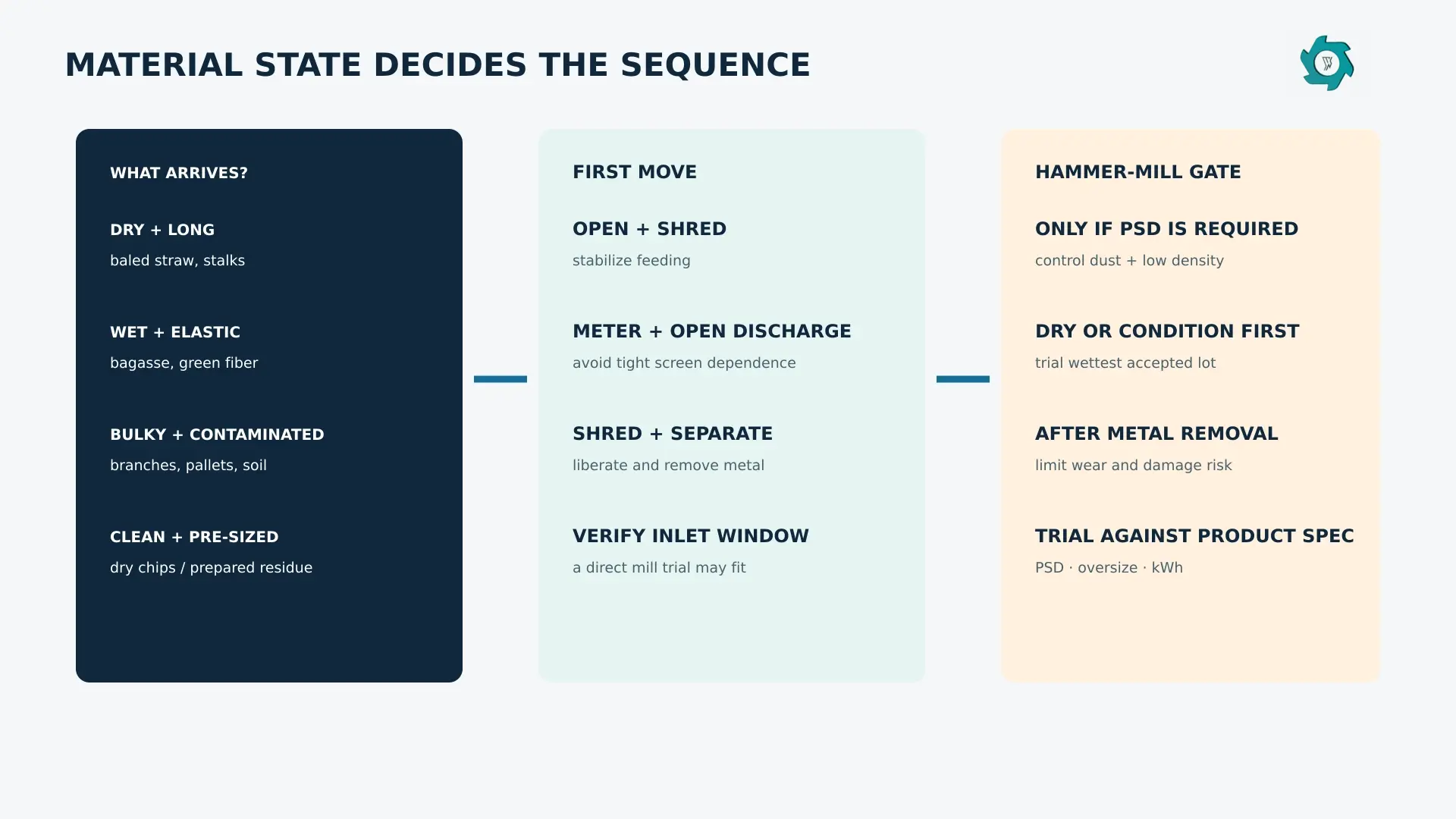
Material condition changes the correct sequence. “Biomass” is too broad a description for machine selection.
| Material state | First useful reduction step | Fine milling decision |
|---|---|---|
| Dry baled straw | Open and meter; shred if long fibers prevent consistent feeding. | Add only when the destination requires a proven finer PSD; manage dust and low bulk density. |
| Wet bagasse / green fiber | Wide, steady feed and open discharge; reduce form without relying on tight screens. | Usually after drying or a separate conditioning step. Trial smearing and screen behavior on the wettest accepted lot. |
| Branches and green waste | Primary shredder sized for maximum diameter, forked pieces and soil risk. | Often unnecessary for compost. Add only if a downstream specification supports it; see green waste processing. |
| Clean, dry wood residues | Shred when form or piece size requires it; chip-like material may enter a mill directly. | Use a representative trial to balance desired distribution against wear, dust and energy. |
| Pallets and mixed waste wood | Shred, liberate and magnetically separate nails/fittings. | Fine mill only after metal removal and after treated/coated wood acceptance is defined. |
The handoff point is the real design decision
In a two-stage line, the best engineering question is: what must be true at the hammer-mill inlet? Turn that into an acceptance window. It should cover maximum piece length and thickness, moisture range, contamination status, feed rate, bulk-density behavior and the condition of any returned oversize. A buffer between stages may be more valuable than a bigger hammer mill because it turns an intermittent shredder discharge into a stable, metered mill feed.
There are three possible outcomes after primary shredding:
- Accept the shredder product. The downstream operation handles the coarser material; do not add fine grinding simply because it was included in an early concept.
- Screen and separate. Remove metal, reject prohibited material or recirculate only the oversize fraction. This limits needless passes through the fine mill.
- Condition then hammer mill. Dry or stabilize the feed, establish the mill-inlet window and run the fine stage with a stated PSD target.
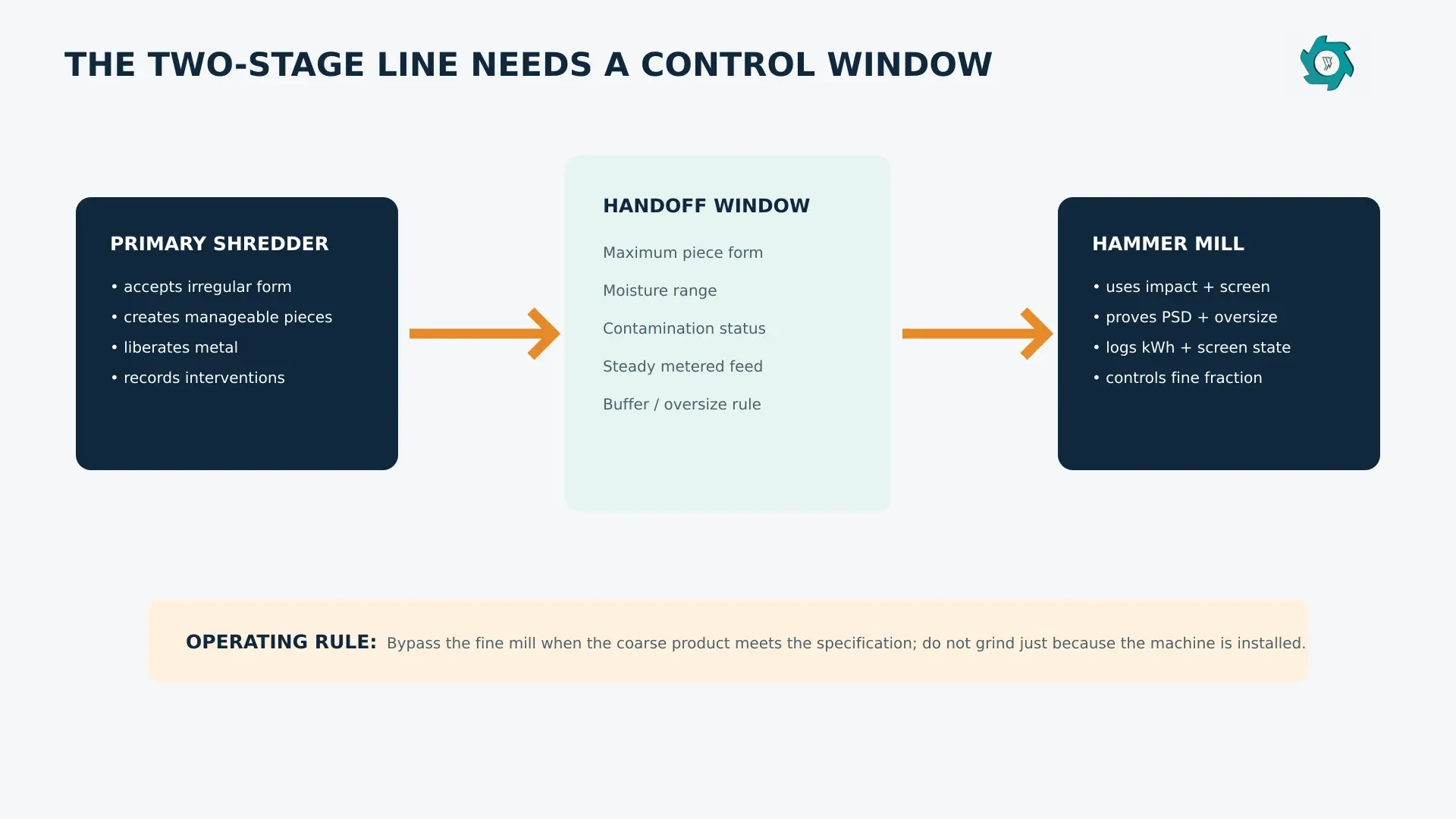
The value of a two-stage line comes from an agreed handoff window, not from running every machine on every lot.
What a meaningful trial must prove
Use a representative lot, state the process boundary and report wet input and dry-matter basis separately. Very wet biomass can otherwise make a capacity figure look larger without delivering more usable material.
| Record separately | Why the buyer needs it |
|---|---|
| Input mass, moisture method and sample times | Shows whether capacity is reported on a wet or dry basis and whether the lot was representative. |
| Accepted product, oversize/return and collected fines | Separates useful product from recirculation and dust-generating fractions. |
| Ferrous output, other rejects and retained material | Shows contamination handling and where material remains in the process. |
| Unexplained difference | Must be reported separately, with an agreed tolerance and investigation rule. |
| Running time and elapsed time | Prevents stops, clearing and reversals from disappearing behind a nameplate t/h claim. |
| kWh, product temperature, PSD and intervention log | Connects output quality to the conditions that produced it. |
For dry material, dust is also an operating and safety issue. Sites handling combustible dust should evaluate hazards and controls around dust-producing equipment and collection systems. The test report should make the dust boundary visible rather than treating captured material as invisible loss.3
Cost model: compare accepted feed, not only machine power
Hammer milling can increase electrical use, wear parts, heat and dust load. Shredding may require more front-end volume, torque and material-specific cutter design. Neither cost should be compared in isolation. Calculate cost per tonne of accepted downstream feed, then include rejected material, oversize circulation, operator interventions, screen/cutter changes and dust collection. This exposes a line that looks fast at the first machine but yields little stable product after screening.
Run at least three cases: normal material, the wettest accepted material and the most contaminated accepted material. If fine grinding only works in the normal case, it is not a robust design condition. A simple production rule is useful: retain the coarsest configuration that meets the downstream specification with a workable margin. Extra fineness that is not paid for by the next process is usually just added energy and dust.
Buyer checklist before selecting either machine
- Ask for a written output specification from the next process, including PSD, oversize, moisture and contamination limits.
- Provide photos and a representative sample description.
- State feed form, maximum dimensions, normal/min/max moisture and expected contaminants.
- Define which machine may be bypassed and under what recipe conditions.
- Specify a timed acceptance test with separate mass routes and a declared energy boundary.
- Require an intervention log: bridge clearing, wrapping removal, reversals, screen cleaning and metal-removal events.
FAQ
Can a shredder replace a hammer mill?
Yes when the downstream process accepts the shredder product. No when a controlled fine distribution is genuinely required. Confirm the next process’s PSD and oversize limits before deciding.
Can a hammer mill process wet biomass?
It may process some wet material, but wet, elastic fibers often reduce stability by smearing or blinding screens. Test the wettest accepted condition and consider drying or conditioning before fine milling.
Should every biomass line use two stages?
Keep the sequence as simple as the product specification allows. Primary shredding alone may be enough for flow control, compost feed or coarse fuel preparation.
Get a Quote Now
Send material photos, delivery form, moisture range, contamination, required accepted-feed rate and the downstream size specification. A practical recommendation starts with the handoff conditions, not a generic machine model.
References
- Argonne: size reduction.
- DOE: project evidence.
- OSHA: combustible dust.