




 Request Quote


A green waste recycling process has to do more than make branches and leaves smaller. It must turn an unstable seasonal mixture into a feedstock that can be blended, aerated and screened without carrying plastic, soil or persistent oversize through the whole composting cycle.
The shredder prepares structure; it does not manufacture finished compost. Biology, time, temperature, moisture, oxygen and curing still decide whether the material stabilizes. The process described here therefore connects mechanical preparation to the composter’s actual recipe and product specification.
Unlike relatively uniform crop-residue streams, collected green waste can shift from wet grass and matted leaves to forked branches and soil-bearing root material within the same season. The preparation line therefore has to coordinate receiving, shredding, compost blending and final screening as one operating system.
Start With the Delivered Green Waste, Not the Annual Tonnage
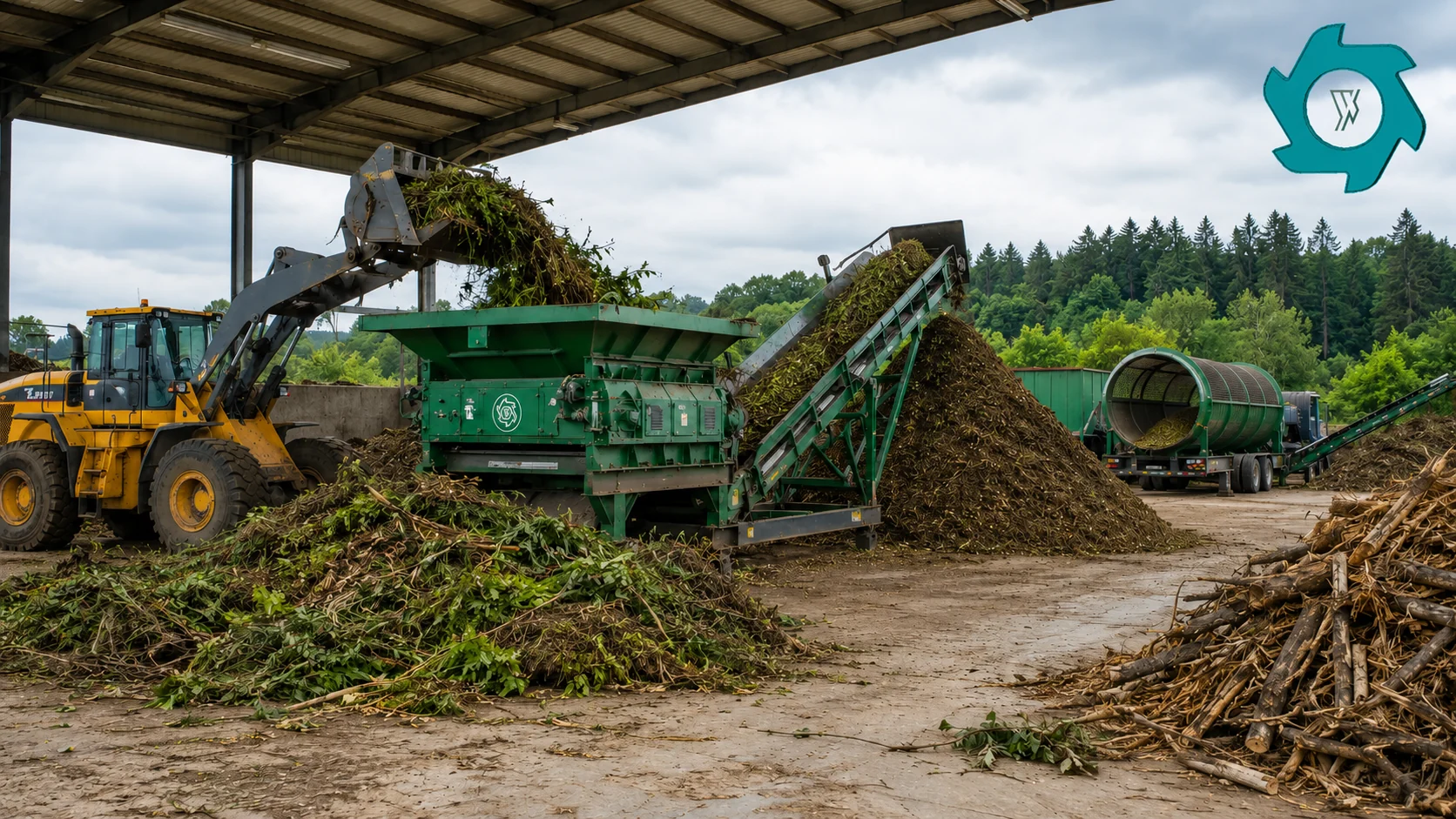
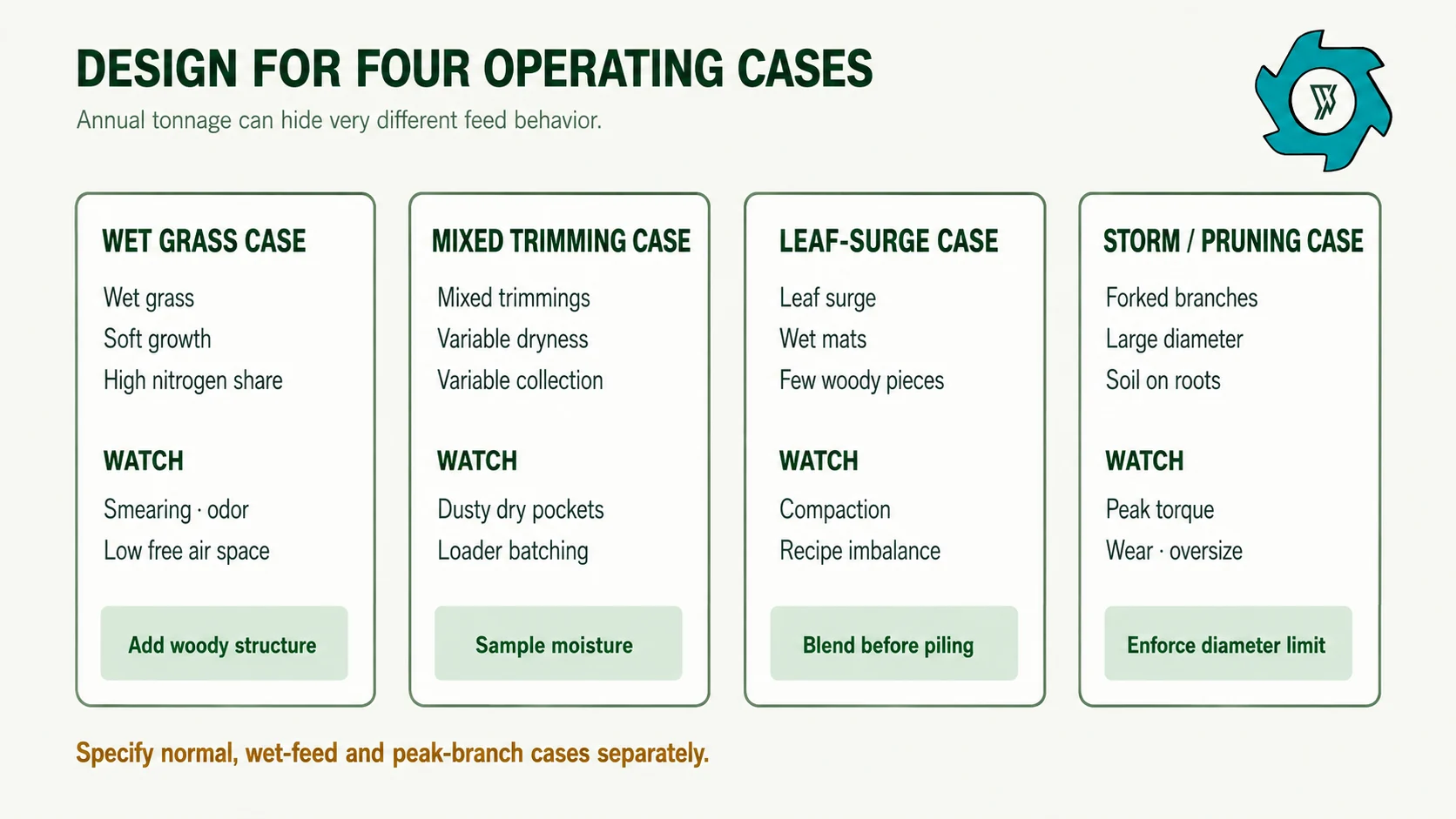
“Green waste” is a collection label, not a machine specification. A curbside leaf surge behaves differently from a storm-cleanup load full of forked limbs. Fresh grass adds moisture and nitrogen; woody prunings add carbon and free air space; roots may introduce abrasive soil and stones. Plastic bags, wire, plant pots and treated timber create separate contamination or acceptance problems.
The broader biomass shredding and recycling line explains why feedstock, moisture, bulk density and final use control the equipment route. For a green waste project, convert those categories into measurable receiving rules:
- normal and peak tonnes per operating day, plus delivery-hour peaks;
- loose bulk density by season, not a catalogue assumption;
- normal, wet-weather and drought moisture cases;
- maximum branch diameter, length and share of forked pieces;
- soil, stone, film, metal and other contaminants reported separately;
- destination of each load: compost blend, mulch route, reject or quarantine.
Add a simple load code—leaf-rich, grass-rich, mixed pruning, woody or storm debris—and photograph representative loads. That small change helps operators explain later shifts in throughput, screen yield, odor or pile structure.
A Defensible Green Waste Recycling Process
A robust route is usually: receive and classify → inspect and remove prohibited material → meter feed → primary shred → remove liberated metal where relevant → blend into a compost recipe → actively compost and cure → screen → send accepted product forward and manage oversize by cleanliness and value.
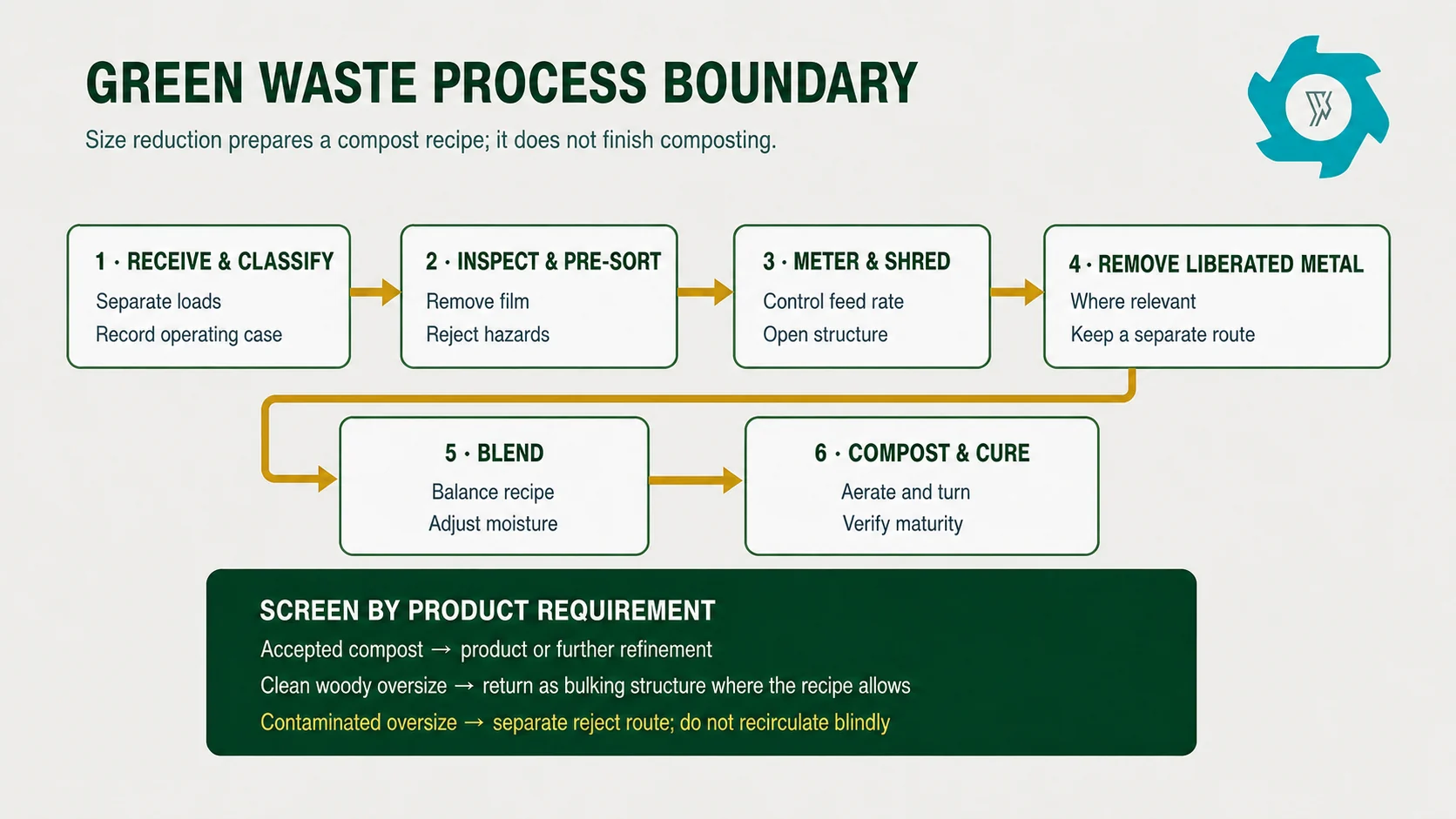
1. Receive, separate and inspect
Keep woody material separate from wet grass and leaf-dominant loads where the yard layout permits. The U.S. EPA describes composting as managed aerobic decomposition, and CalRecycle identifies moisture, carbon and nitrogen content, physical characteristics and contamination as important feedstock properties.1,2
Inspection should occur before the hopper. A shredder can hide plastic film inside a shredded matrix, making later removal harder. Define a quarantine area for suspect loads and a visible removal route for film, pots, wire, stones and unacceptable wood. Magnets help with liberated ferrous pieces, but they cannot correct poor receiving control.
2. Meter the loader-fed stream
Loader bucket count is useful for workflow, but it is not a reliable mass measurement when leaf, grass and branch density changes. A buffer hopper or walking-floor feed should prevent bucket surges from forcing repeated reversals. The operator must be able to see the hopper and stop feeding before the chamber becomes a storage bin.
3. Shred only as far as the compost duty requires
Smaller particles offer more surface area, but aggressive reduction can produce a dense fraction that sheds structure and restricts airflow. The US Composting Council’s yard-waste best practices identify particle size, oxygen, moisture and carbon-to-nitrogen ratio as adjustable composting factors.3
For heterogeneous branches and soft organics, low-speed, high-torque primary shredding provides controlled opening and size reduction. Screen-controlled secondary sizing should be added only when a downstream requirement justifies the extra energy, wear, fines and blockage risk. Buyers dealing mainly with dry, baled fibers can compare the different front-end problems in the straw recycling line guide.
Set the Shred Size From Pile Behavior
Do not write an RFQ around a single output dimension without defining how it will be measured. Leaves and grass do not form stable geometric particles at all. Specify a sampling method and report mass by agreed size classes, with long pieces and fines recorded separately.
| Observation | Likely process meaning | Trial response |
|---|---|---|
| Branches remain too long to mix or turn | Insufficient opening or excessive bypass | Adjust cutter/screen route and verify on the largest accepted branch class |
| Wet fraction smears or blinds a fine screen | Aperture is being used outside the wet-feed envelope | Use a more open route, reduce screening duty or move sizing later |
| Pile compacts and loses air space | Too many fines or too little woody structure | Preserve a coarser fraction and rebalance the recipe |
| Clean woody oversize remains after curing | Slowly degradable bulking fraction | Return a controlled share if clean; track repeated recirculation |
| Screen reject contamination rises each cycle | Recirculation is concentrating foreign material | Stop blind return and separate a reject route |
Field rule: Run two controlled trials: the coarsest setting that mixes reliably and the next finer practical setting. Compare tonnes processed, energy, reversals, fines yield, porosity indicators, screen performance and compost handling.
Screen Before Composting, After Curing—or Both?
There is no universal answer because the two positions solve different problems. Pre-screening may remove excessive soil or an unwanted fine fraction from contaminated incoming material. It can also discard compostable organics when used without a clear cut-point and destination. A coarse scalping duty should not be confused with final product grading.
Post-curing screening separates the accepted compost fraction from large, incompletely decomposed or foreign material. EPA guidance notes that finished compost is often screened and that large organic particles may be added to the next batch; it also explains that a balance of large and small particles supports porosity.4 That return must remain conditional: only clean woody oversize should be considered as structure. Film-rich or stone-rich material is a reject, not “free bulking agent.”
| Screen location | Primary purpose | Main risk to control |
|---|---|---|
| Before shredding | Scalp soil/fines from visibly dirty root or sweepings loads | Wet blinding and loss of usable organics |
| After primary shredding | Control a mechanical feed fraction or close a shredder loop | Repeated circulation, excess fines and wet screen blockage |
| After active composting and curing | Meet product grading and recover clean woody oversize | Contaminant concentration in the return fraction |
Prepare a Compost Recipe, Not a Uniform Shred Pile
Leaves, grass and branches contribute different moisture, nutrient and structural characteristics. NC State Extension summarizes the biological need for balanced carbon and nitrogen, oxygen, moisture and suitable temperature.5 Mechanical equipment cannot replace those controls, but it can make recipe control repeatable.
Use separated stockpiles and loader or conveyor batching to build a mix. Grass-rich material often needs dry woody structure; leaf surges may need deliberate blending before they mat; woody loads may need moisture or a nitrogen-rich component selected under the facility’s permitted feedstock rules. Treat any numerical C:N or moisture target as a site recipe to validate through sampling.
The operational record should link each windrow or pile to its ingredient batches. Record formation date, approximate recipe, moisture checks, turning or aeration events, temperature history, odor observations and any added water. That traceability separates a preparation-line issue from a compost-management issue.
Equipment Selection and Layout Checks
| Stage | Equipment direction | Selection evidence |
|---|---|---|
| Receiving | Weighing, separated bays, quarantine and reject containers | Peak queue, loader route, load inspection and stormwater controls |
| Feeding | Loader hopper, walking floor or heavy conveyor | Largest forked branch, live volume, anti-bridging behavior |
| Primary size reduction | Low-speed, high-torque shredder | Wet grass case, woody peak case, cutter access and reversal log |
| Contaminant removal | Manual station, magnet and defined reject routes as applicable | Contaminants measured separately; safe access and guarding |
| Screening | Trommel, star or other screen selected by duty | Moisture envelope, cut point, product yield, oversize cleanliness |
| Compost handling | Mixing, windrow formation, turning/aeration and water control | Recipe and permitted operating method |
Leave physical room for the reject container, screen oversize, clean woody return, loader turning and safe maintenance. A line that fits on a drawing can still fail when a loader crosses pedestrian access or when screen changes block the only material route. For broader feedstock comparisons, the agricultural waste recycling line article covers crop residues, while the rice straw recycling machine guide addresses low-density and silica-bearing straw.
Capacity Must Be Reported on a Declared Basis
Green waste capacity can be expressed as incoming wet tonnes, volume per hour, accepted shredded tonnes or final screened compost. These values are not interchangeable. Moisture loss and biological mass loss occur during composting, while rejects and oversize change the saleable-product yield. State the measurement boundary next to every performance figure.
A representative factory acceptance test (FAT), or a site acceptance test (SAT) where applicable, should include at least a wet leafy/grass case and a woody peak case within the agreed branch limit. Do not mix them into one favorable average. The test should run long enough to expose feeding interruptions, wrapping, screen blinding and retained material.
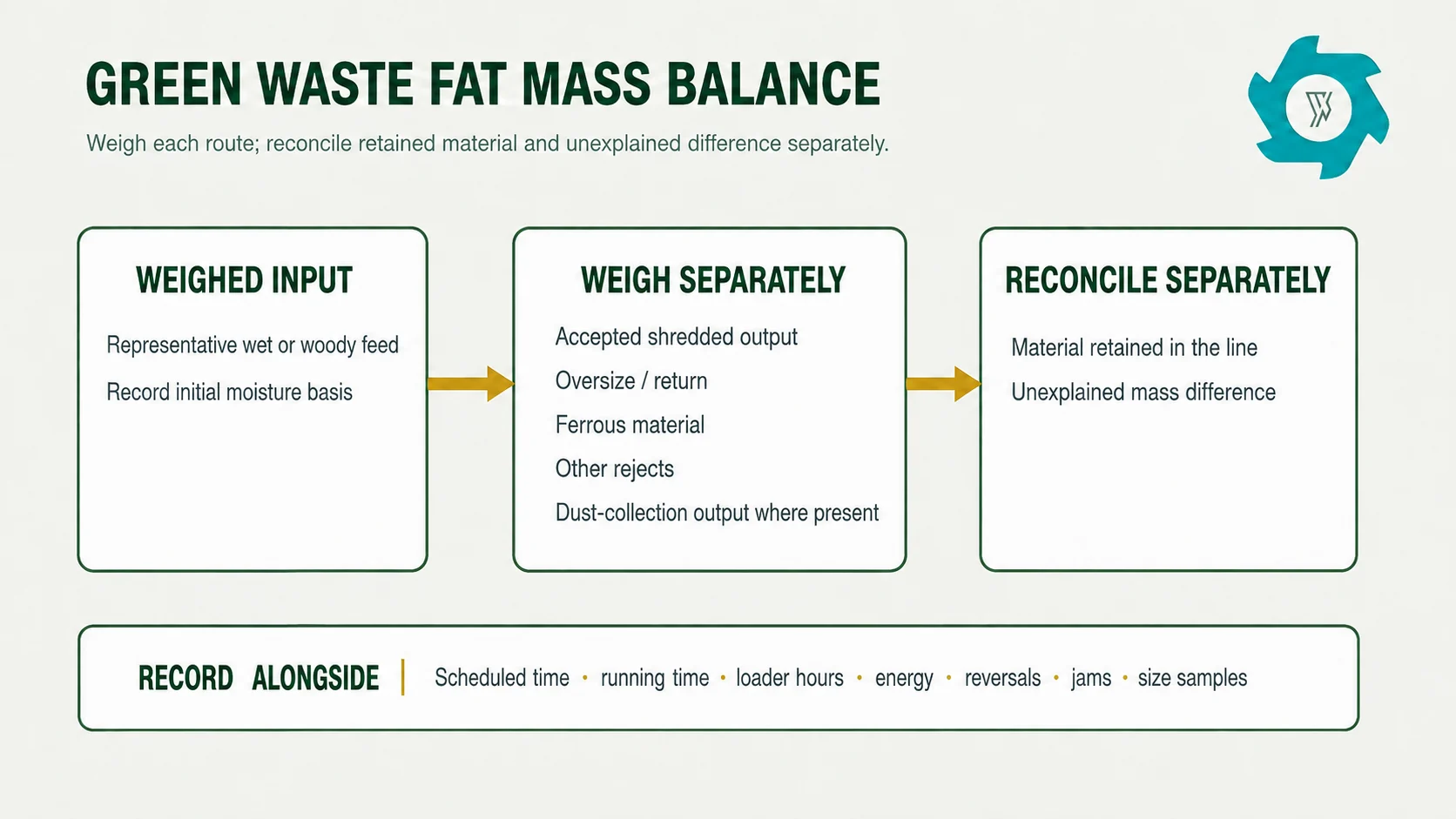
Report weighed incoming feed, accepted shredded output, oversize or return, ferrous material, other rejects, dust-collection output where present and material retained in the line. Log scheduled time, actual running time, loader hours, reversals, jams by cause, screen cleaning, interventions, energy boundary and size samples. If moisture changes during the test, retain samples so wet-basis and dry-matter comparisons are not confused.
Safety, Dust, Fire and Biological Exposure
Dry woody fines can create combustible dust and fire hazards; wet organics can create slippery surfaces, bioaerosol exposure and odor. Risk controls must follow the actual facility, local law and a site-specific hazard assessment. OSHA identifies wood dust as one of the materials that can become explosible when finely divided and suspended in air under suitable conditions.6
Guard conveyors, shredder access and screens; provide emergency stops and energy isolation; control loader–pedestrian interaction; and define procedures for uncrushable objects, chamber clearing and pile fires. Dust collection does not replace housekeeping, and water application should not be improvised where it could create electrical or process hazards.
RFQ Information That Produces a Better Proposal
- Provide photos and representative samples for each seasonal load class.
- State maximum branch diameter, forked-piece frequency and prohibited materials.
- Give normal and worst-case moisture, contamination and bulk-density evidence.
- Define whether screening occurs before processing, after shredding or after curing—and why.
- Specify the composting method, recipe constraints and desired final product grading.
- Request performance reporting by declared mass boundary, not a single headline capacity.
- Include layout, loader, power, noise, dust, stormwater, fire and maintenance constraints.
Background on supplier evaluation is available in the industrial shredder manufacturer comparison, but final selection should rely on material-specific evidence rather than brand position alone.
FAQ
Should green waste be screened before or after composting?
Coarse pre-screening can remove soil or fines when incoming contamination justifies it, but final product screening normally follows active composting and curing. The right sequence depends on the feedstock, contamination and finished-compost specification.
How fine should green waste be shredded for composting?
There is no universal target. The material must be small enough to mix and decompose but coarse enough to preserve air space. Set a trial range with the composter, then measure oversize, fines, porosity and pile performance instead of specifying one nominal cutter size.
Can grass, leaves and branches use the same shredder setting?
Wet grass can smear, leaves can mat and forked branches create peak torque. A mixed stream needs controlled batching, a defined maximum branch diameter and operating settings proven across the seasonal feed envelope.
Should screened woody oversize be returned to the compost mix?
Clean woody oversize can provide structure and may be returned when the recipe allows. Contaminated oversize should follow a separate reject route, and repeated recirculation should be monitored because contaminants and resistant pieces can accumulate.
What should a green waste shredder FAT measure?
Use representative wet and woody feed cases. Record weighed input, every output route—including dust-collection output where present—retained material, moisture basis, running time, loader time, energy, reversals, jams, screen blinding and size samples. Reconcile unexplained mass difference separately.
Plan a Green Waste Preparation Line
Send representative feed photos, seasonal moisture, maximum branch size, contamination, required throughput and the compost screening target.
References
- EPA composting: basics.
- Feedstock profiles: organics.
- USCC BMPs: practice.
- Composting approaches: methods.
- Large-scale composting: operations.
- Combustible dust: hazard.