




 Request Quote



A sugarcane bagasse shredder is selected around material behavior. Fresh mill bagasse is damp, compressible and springy. It can sit over a hopper outlet, arrive as dense plugs, smear across small screen openings and then expand after the cutter releases it. A reliable line therefore begins with controlled receiving and discharge.
This passage concentrates on the mechanical preparation boundary from mill discharge or storage reclaim to a measured, size-controlled feedstock. It does not treat a shredder as a complete pellet, briquette, paper-pulp or boiler-fuel plant. For the broader equipment boundary, see the biomass shredding and recycling line.
Why Bagasse Needs Its Own Process Route
Bagasse leaves cane crushing as a heterogeneous mat of rind fragments, pith and fibers. Published reviews often describe mill-run material at roughly half moisture, but that figure is a context value rather than a purchase specification.1 Actual moisture, density and compaction change with extraction practice, drainage, storage time, rain exposure and reclaim method. A line proven on loose, partly dried fiber may behave very differently when a loader presents a wet slab cut from a compacted pile.
The main distinction from dry straw is the way wet fiber deforms. Dry stalks tend to bend, snap and produce fines. Wet bagasse can fold, squeeze and recover. This shifts attention from nominal chamber power to the entire flow path: hopper geometry, live-bottom action, burden depth, cutter bite, clearance around shafts, discharge opening and the ability of the next conveyor to take away expanded material.
The existing agricultural waste recycling line guide compares several crop residues. Here, bagasse is treated as a single process family and separated into operating states that can be tested.
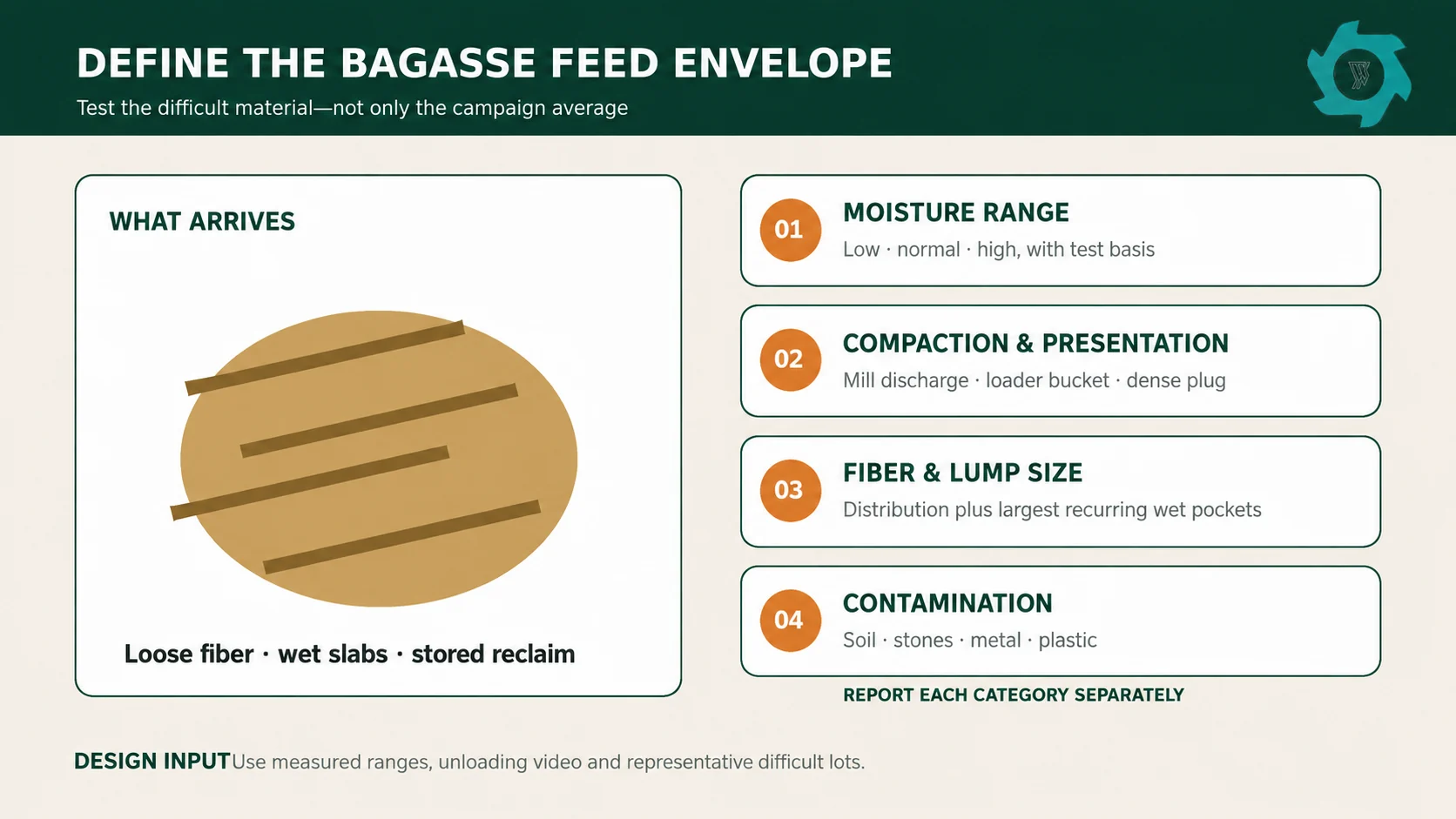
Define a Bagasse Feed Envelope Before Choosing the Shredder
Ask the mill or feedstock supplier for representative lots across the campaign. Samples alone are not enough; videos of unloading, pile reclaim and natural break-up expose bridging and compaction. Record at least the variables below.
| Feed variable | What to record | Why it changes the design |
|---|---|---|
| Moisture | Normal, low and high results; sampling point; wet-basis method | Changes mass, elasticity, smearing, drying duty and the meaning of tonnes per hour |
| Presentation | Loose discharge, conveyor mat, loader bucket, compacted block or stored pile | Determines hopper opening, live-bottom action and pre-opening need |
| Bulk density | Several measured loads in natural condition | Sets conveyor volume and residence time; handbook values can hide compaction |
| Fiber and lump size | Distribution plus largest recurring wet plugs | Affects cutter bite, bridging span and motor load peaks |
| Foreign material | Soil, stones, tramp metal, plastic and maintenance debris, each reported separately | Controls wear protection, inspection and separation |
| Temperature and storage age | Fresh discharge versus reclaimed inventory | Storage can change moisture distribution, biological activity and fire response |
| Receiver specification | Allowed size, oversize, moisture, ash-forming contamination and fines | Prevents needless fine reduction and defines the acceptance test |
Keep an agreed “hold or alternate route” condition for material outside the validated window. That may mean blending under a documented recipe, bypassing a moisture-sensitive sizing stage, returning the lot to storage or rejecting contamination that creates a damage risk.
Use the Correct Process Order
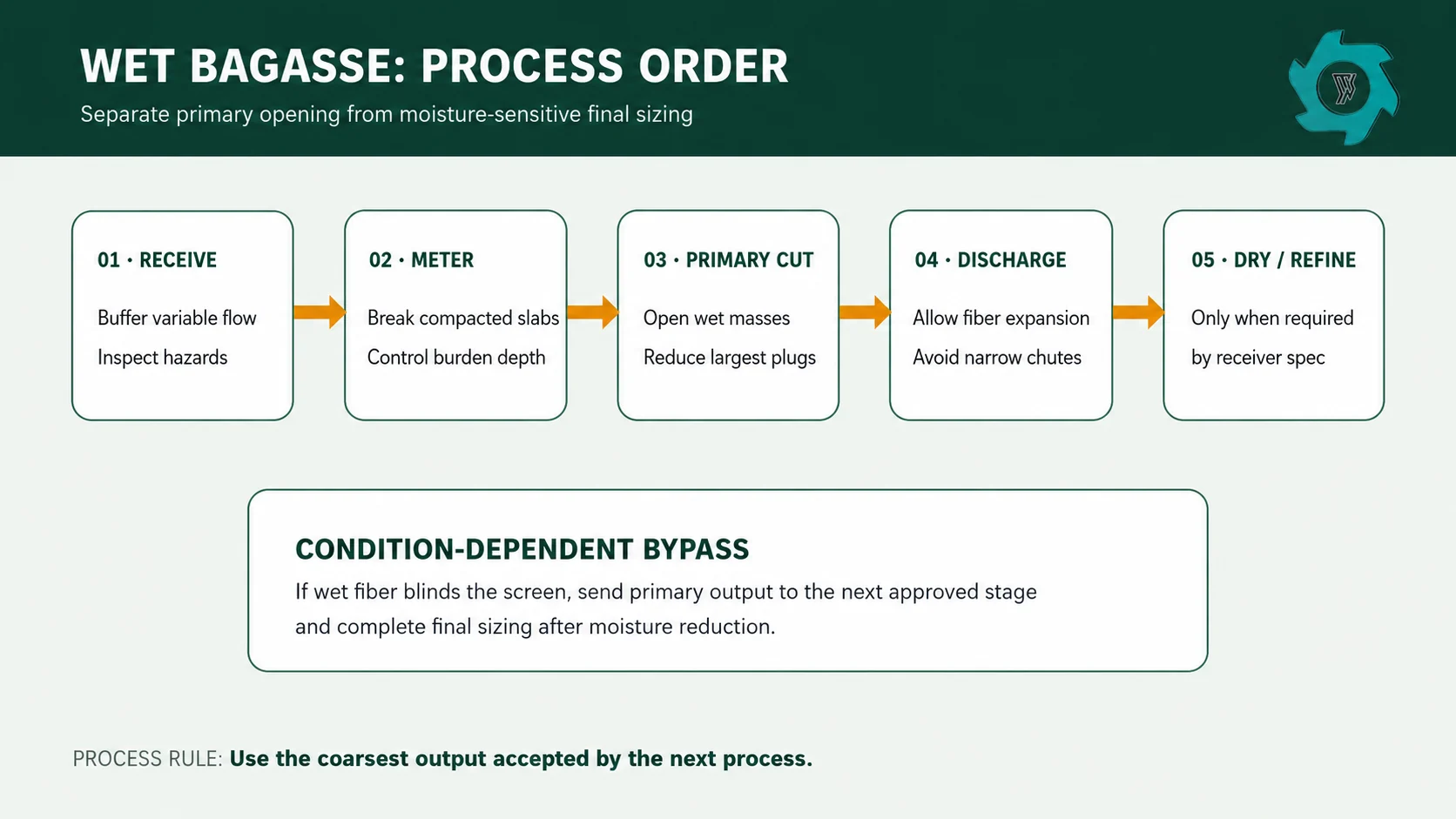
A practical wet-bagasse route usually separates opening from final sizing:
- Receive and buffer. Decouple irregular mill discharge or loader cycles from the cutter.
- Inspect and remove obvious hazards. Keep stones, large metal and maintenance debris out before size reduction where practical.
- Meter and pre-open. Break compacted slabs into a controlled burden rather than dropping full buckets into the chamber.
- Primary shred or cut. Open wet masses and reduce the largest recurring pieces to a size the next stage can accept.
- Discharge positively. Design for expansion after the cutting zone; avoid a narrow transfer that becomes the real choke point.
- Dry, screen or refine only as required. Put fine sizing after moisture reduction when wet screening is unstable and the downstream process permits this order.
A dryer may impose its own maximum feed dimension, while a combustion system may accept relatively coarse fiber. The receiving process decides the useful endpoint. The same rule applies when comparing the more brittle feed behavior described in the rice straw recycling machine guide: do not copy a dry-straw screen configuration into a wet-bagasse project without testing.
Design Feeding Before Adding Shredder Power
Prevent bridging and bucket shock
A wide hopper does not automatically prevent bridging. If sloped walls compress fiber toward a small outlet, the hopper can create a self-supporting mat. A moving floor, live bottom or controlled pusher should disturb the full active zone and deliver a repeatable burden. Loader operators need a maximum bucket presentation rule.
Install level or load feedback where it can regulate the infeed. Motor-current control is useful, but it reacts after material has reached the cutter. Combining upstream level, belt loading and shredder load gives the control system time to slow the feed before an overload reversal.
Control wrapping without unsafe clearing
Long fibers can wind around exposed rotating parts, shaft ends and poorly protected bearings. Reduce snag points, provide accessible inspection, and document isolation before manual clearing. Automatic reversal can release some overloads; it is not permission to reach into a hopper or remove guards. The guarding, emergency-stop and lockout arrangement must be assessed for the final installation.
Keep the outlet more open than intuition suggests
Wet fiber compressed inside the chamber expands at discharge. A small chute, sharp direction change or slow takeaway conveyor can back up into an otherwise capable shredder. During trials, record material depth and accumulation at every transfer. If the outlet repeatedly runs full while the drive is below its limit, more installed cutting power will not solve the bottleneck.
Choose Coarse Cutting, Fine Sizing or a Two-Stage Route
| Route | Best fit | Main caution |
|---|---|---|
| Primary opening only | Dryer, boiler, composting or another receiver accepts coarse opened fiber | Verify maximum plug size and uniform delivery, not only visual appearance |
| Wet primary cut + screening | A tested open screen can remove unacceptable oversize at the stated moisture | Small apertures may blind or smear; return flow can inflate apparent throughput |
| Wet opening + drying + final sizing | Fine, controlled material is required and dryer accepts primary output | More equipment, transfers and dust/fire controls; define moisture between stages |
| Condition-dependent bypass | Seasonal moisture makes one fixed route unreliable | Requires validated recipes, interlocks and separate output verification |
Use the coarsest size that the receiver accepts. Fine reduction increases exposed surface and may help later processing, but it also increases energy, cutter interactions, fines and transfer duty. If the business case depends on finer material, compare a coarse baseline with the proposed second stage using the same feed lot and measure the gain in accepted product—not merely a smaller sample photographed after the test.
Dry, baled residues present a different opening problem. The baled straw processing guide is useful for bale presentation and tie control, but its dry-fiber assumptions should remain separate from a mill-run bagasse guarantee.
State Capacity on Both Wet and Dry-Matter Bases
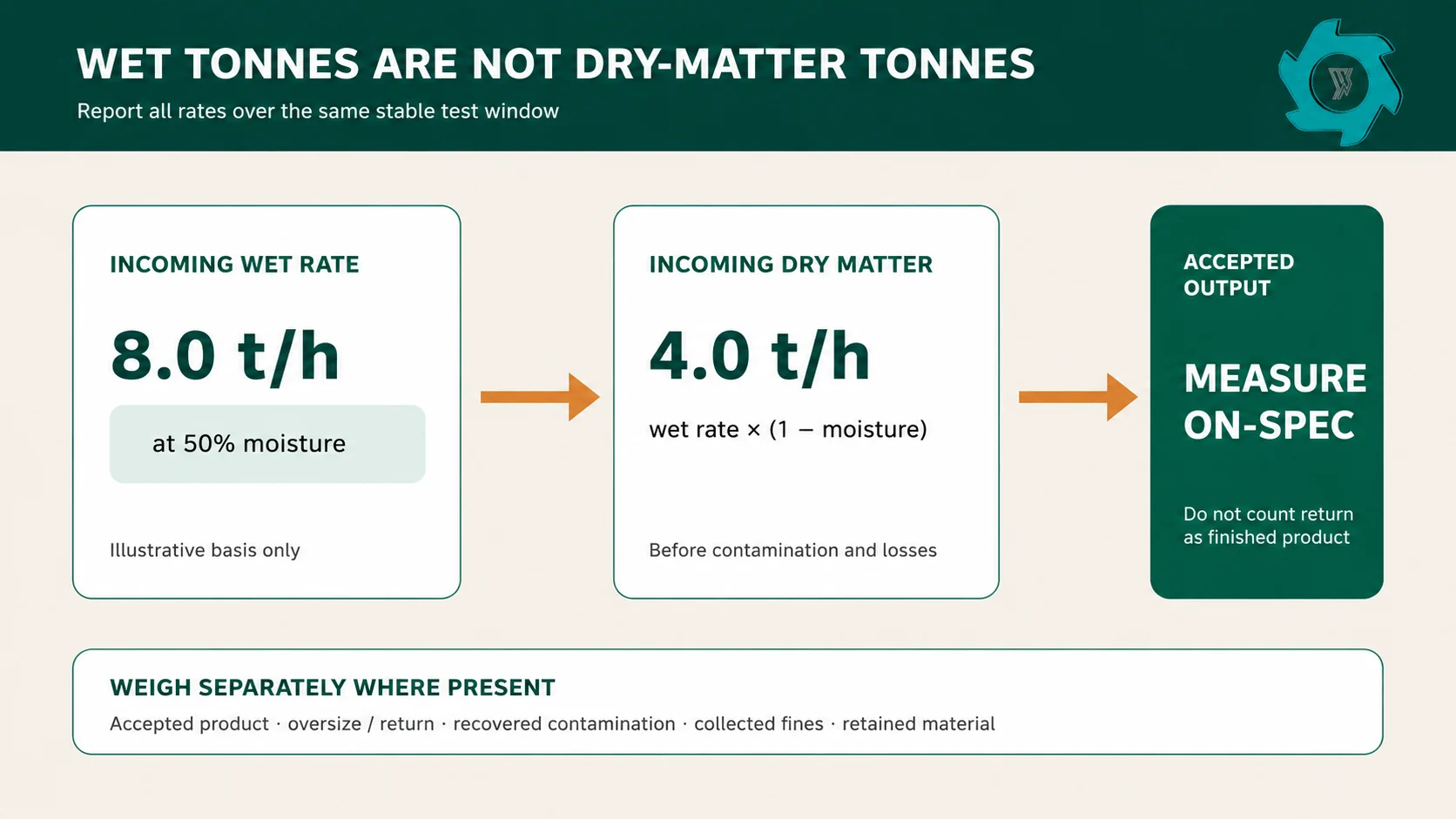
“Ten tonnes per hour” is ambiguous when water may account for a large and variable share of incoming mass. A wetter test batch can make the scale rate look higher even though the line delivers less dry fiber. Report three numbers over the same stable period:
Incoming wet rate = measured incoming mass ÷ stable operating timeIncoming dry-matter rate = incoming wet rate × (1 − moisture fraction, wet basis)Accepted output rate = accepted on-spec output mass ÷ stable operating time
Example: a line receiving 8.0 wet t/h at 50% moisture carries about 4.0 t/h of dry matter before accounting for foreign material and measured losses. At 55% moisture, the same wet scale rate carries only 3.6 dry t/h.
Do not mix moisture methods or sampling times. Incoming and outgoing moisture may differ because of drainage, evaporation or storage. If the test needs a dry-matter balance, take representative samples from each measured stream and state the laboratory method.
Run a FAT That Includes the Difficult Moisture Band
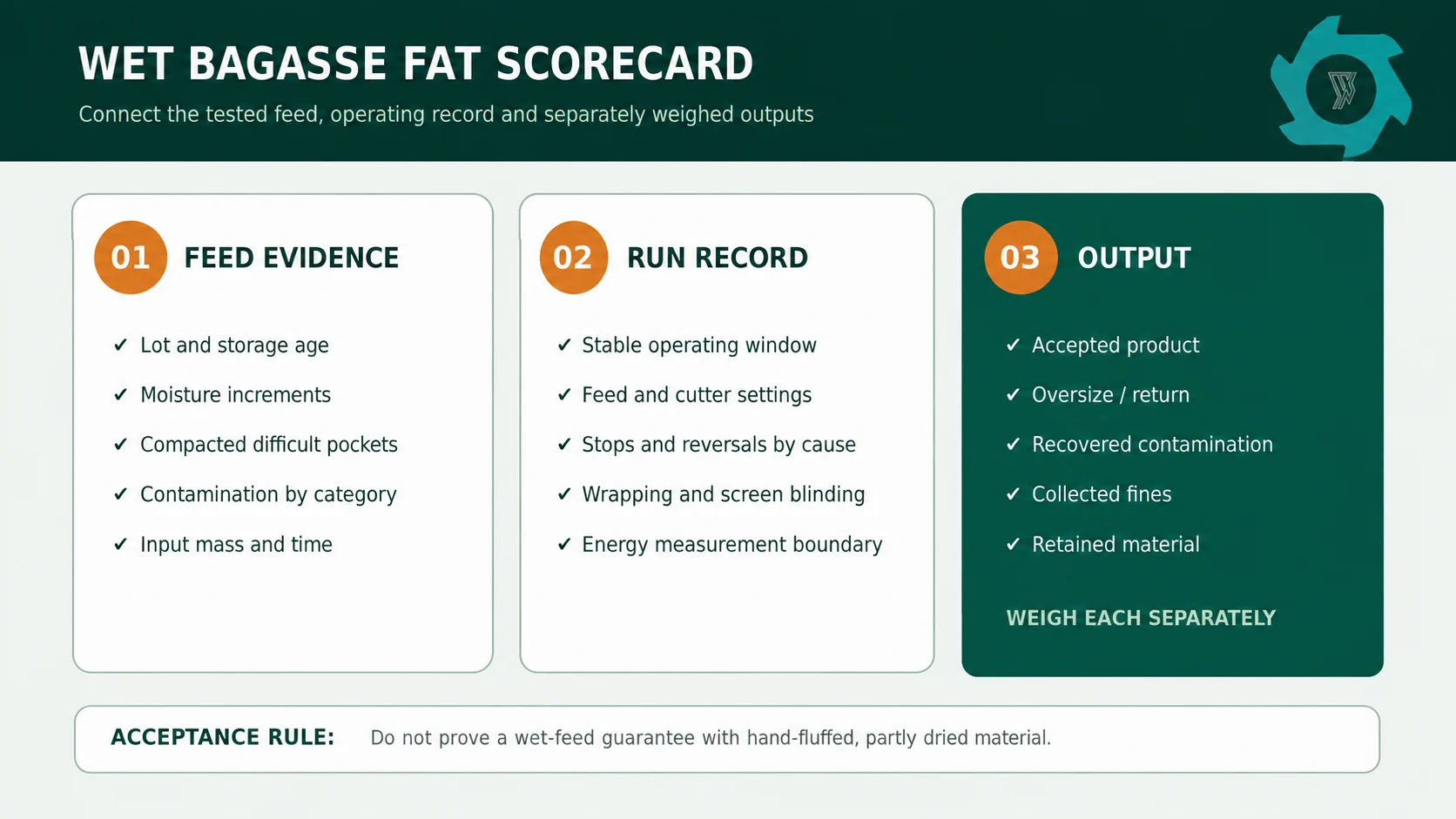
A short demonstration with hand-fluffed bagasse will not validate a mill line. Reserve enough material to reach stable operating conditions and include representative compacted pockets from the difficult end of the agreed feed envelope.
- Identify each feed lot, source, storage age, presentation and sampling location.
- Measure moisture using the agreed basis and take multiple increments across the lot.
- Record incoming mass, stable run time and every interruption by cause.
- Weigh accepted product, oversize or return, recovered contamination, collected fines and retained material separately where present.
- Sample particle size from a moving stream at timed increments.
- Record feed setting, cutter configuration, reversals, manual interventions, motor load and energy boundary.
- Inspect wrapping points, screen blinding, material left in conveyors and the clean-out condition.
- Reconcile measured outputs against measured input and investigate the unexplained difference.
If oversize crosses a belt scale twice, counting both passes inflates the result. Contract language should say whether capacity means incoming wet feed, dry-matter feed or accepted on-spec product, and whether planned and unplanned stops are included.
Manage Water, Dust, Fire and Housekeeping as One System
Wet bagasse may create little airborne dust at receiving, yet drying and later fine reduction can change that hazard quickly. OSHA identifies combustible dust as a fire and explosion hazard and recommends evaluating the material, processes and places where dust can accumulate.2 A site-specific dust hazard assessment should therefore cover the whole route, including dryers, screens, transfer points, collectors and storage.
At the wet end, focus on drainage, slip hazards, microbial degradation, corrosion and material retention. Avoid hidden ledges where damp fiber can build up. Define inspection and clean-out access without requiring entry into hazardous zones. At the dry end, address dust capture, housekeeping, ignition sources, electrical classification where applicable, isolation and explosion protection through qualified local engineering.
Stored biomass can self-heat under some conditions. Temperature trends, inventory age, pile management and first-in/first-out practice should be integrated with the facility fire plan. Do not assume that high incoming moisture removes every fire risk, particularly after drying or during extended storage.
Specify the Line From Evidence, Not a Generic Model Name
For a useful proposal, supply:
- normal and worst-case bagasse photos and videos, including reclaim;
- moisture results and test basis across the processing campaign;
- bulk density from actual loader buckets, containers or belt samples;
- largest recurring compacted pieces and fiber condition;
- contamination types and separately measured quantities;
- required wet-feed, dry-matter and accepted-output rates;
- downstream maximum size, oversize, fines, moisture and contamination limits;
- available footprint, elevation, utilities, drainage and dust/fire constraints;
- the proposed FAT boundary and acceptance calculations.
Do not borrow a capacity value from a corn-stalk project. Stalk diameter and seasonal toughness create a different cutting case, as shown in the corn stalk recycling line guide. The better comparison is a trial on the buyer’s own bagasse at the moisture and compaction conditions that matter.
Frequently Asked Questions
Can wet bagasse go directly into a shredder?
Yes, if the receiving, metering, cutter arrangement and discharge path have been tested on the stated moisture and compaction range.
Should bagasse be shredded before or after drying?
Primary opening or coarse size reduction before drying can improve handling and expose surface area, while final sizing is often more stable after moisture has been reduced. The correct order depends on dryer feed limits, fire controls and the final particle specification.
What usually limits bagasse shredding capacity?
Volumetric feeding, hopper bridging, compacted wet pockets and downstream discharge often limit accepted output before installed motor power is fully used.
How should bagasse shredder capacity be stated?
State the incoming wet tonnes per hour, incoming dry matter per hour and accepted on-spec output over the same stable test period, together with moisture results and treatment of stops, retained material and recirculation.
Does a bagasse shredder produce boiler-ready or pellet-ready fuel?
Not by itself. Fuel acceptance may also require moisture control, removal of foreign material, screening, drying, fine grinding, densification or other downstream steps defined by the receiver.
Configure a Bagasse Line Around Your Real Feed
Send representative material data, moisture range, delivery form, required output and downstream limits. YUXI can review the receiving, shredding, bypass and testing boundary for your project.
Engineering references
- Bagasse preprocessing: review.
- Combustible dust: hazard.