




 Request Quote



A useful scrap-shear shortlist starts with the material, not the largest force number. This 2026 buyer’s guide compares ten manufacturers, then shows how to test feed limits, usable throughput, maintenance access and total project scope before awarding an order.
How this shortlist was built
This editorial shortlist compares manufacturers by scrap-shear relevance, architecture breadth, evidence buyers can request, integration capability and likely project fit.
Top 10 scrap metal shear manufacturers in 2026
| Rank | Manufacturer | Relevant equipment focus | Buyer fit |
|---|---|---|---|
| 1 | LEFORT | Broad shear-baler portfolio with mobile and stationary configurations | High-volume yards comparing mobility, compression geometry and integrated feeding |
| 2 | YUXI Machinery | Scrap-metal size-reduction and line-integration capability | Projects needing a shear evaluated with upstream handling and downstream shredding or separation |
| 3 | Harris | Heavy scrap processing systems and established recycling-equipment support | Buyers prioritizing large-project engineering and regional service structure |
| 4 | COPEX | Heavy-duty scrap shears and press-shear engineering | Dense ferrous scrap and projects that require close study of compression and cut cycle |
| 5 | Danieli Centro Recycling | Integrated scrap-processing equipment within a wider metals group | Steelworks and large recyclers seeking plant-level integration |
| 6 | Idromec | Mobile, semi-mobile, stationary, side-compression and inclined shear ranges | Buyers comparing several architectures within one supplier portfolio |
| 7 | Sierra International Machinery | Portable and stationary scrap-processing equipment | North American yards where mobility and dealer/service access influence selection |
| 8 | Ing. Bonfiglioli | Scrap shears, balers and recycling machinery | Yards needing a compact equipment shortlist across cutting and densification |
| 9 | Bronneberg Recycling Machinery | Recycling systems including scrap shears and related equipment | European projects valuing application engineering and line compatibility |
| 10 | JMC Recycling Systems | Metal recycling machinery and smaller-yard equipment coverage | Operators comparing shear scale, auxiliary equipment and practical support |
1. LEFORT
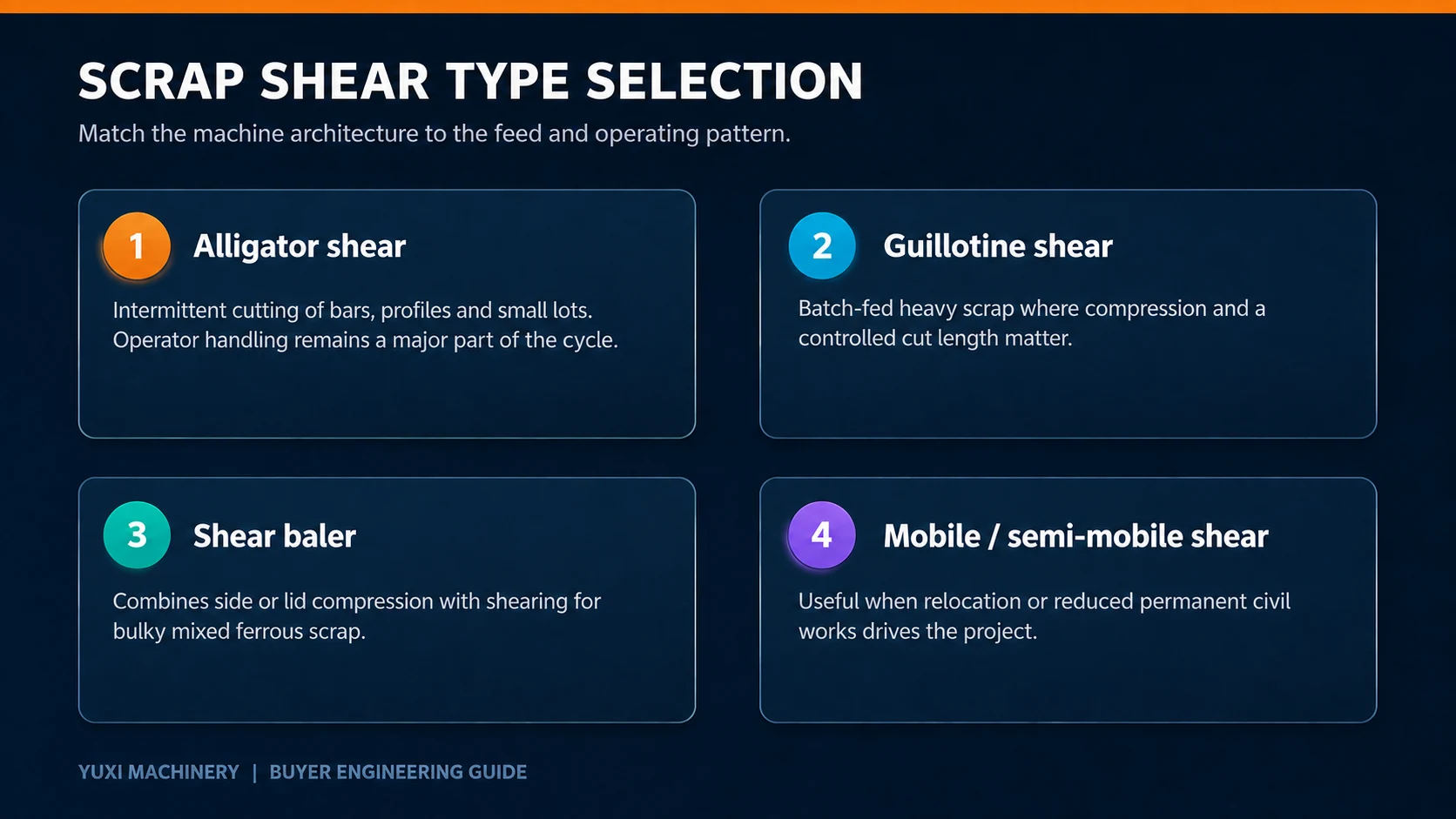
LEFORT takes first place because its public product positioning spans several scrap-shear and shear-baler formats rather than a single machine pattern. That breadth is useful when a buyer is still deciding between a mobile unit, a stationary installation and a high-production system. The procurement question is not whether the company offers a large machine; it is which compression box, blade opening, cycle logic and service arrangement match the yard’s actual mix.
2. YUXI Machinery
YUXI is placed second for buyers who want to evaluate shearing as one stage in a larger scrap-processing route. Its strongest fit is not a claim that one shear handles every metal. It is the ability to discuss how bulky feed is prepared, when a shear should precede another reduction stage, and what downstream result the project needs. YUXI’s related size-reduction page provides the adjacent context: a shear makes controlled cuts, while a shredder repeatedly grips and tears material into a less regular but more open stream.
For an RFQ, YUXI should still be asked for material-specific evidence: the maximum recurring section, boundary pieces, accepted-feed throughput, compression sequence, blade access, hydraulic heat balance and a test plan using representative scrap. If the incoming stream includes depolluted vehicle frames, the separate vehicle recycling equipment guide helps define what should be dismantled, sheared, baled or shredded before the final machine scope is fixed.
3. Harris
Harris is a logical early candidate for large recycling projects, especially where buyers value established heavy-equipment engineering and a structured service network. Its evaluation should focus on the exact shear family offered, local response coverage, civil requirements and the division of supply between the shear, material handler, conveyors and downstream processing.
4. COPEX
COPEX is relevant to heavy ferrous applications and buyers examining robust press-shear configurations. A technical comparison should move beyond headline force and examine box dimensions, compression direction, blade width, stroke timing and how distorted or layered scrap behaves before the cut.
5. Danieli Centro Recycling
Danieli Centro Recycling fits large recyclers and steelworks that may value plant-level integration as much as the standalone shear. This can be an advantage when feed preparation, stock handling and furnace-charge requirements must be connected. It also means the buyer should obtain a clear battery-limit document so that foundations, loading equipment, discharge handling and controls are not left between suppliers.
6. Idromec
Idromec is notable for presenting mobile, semi-mobile, stationary, side-compression and inclined shear configurations. That range makes it useful for architecture comparison. Buyers should ask how each format changes loader travel, batch formation, usable box volume, output consistency and maintenance access—not merely compare listed tonnage.
7. Sierra International Machinery
Sierra is relevant for yards that put portability, North American market support and practical scrap handling near the top of the decision. Confirm which feed classes have been demonstrated, how mobility affects throughput and stability, and what site services remain necessary after delivery.
8. Ing. Bonfiglioli
Bonfiglioli belongs on shortlists that include both cutting and densification duties. The useful distinction is whether the proposed machine performs occasional sizing, sustained production shearing or combined compression and shearing. Ask for the proposed cycle mapped against the yard’s loader and incoming pile geometry.
9. Bronneberg Recycling Machinery
Bronneberg is relevant where buyers want application support across several metal-recycling machines. Its shear proposal should be judged on exact scope, installed references with comparable feed, spare-parts availability and compatibility with existing handling or separation equipment.
10. JMC Recycling Systems
JMC rounds out the list for operators comparing a broader range of yard equipment and smaller-to-mid-scale applications. The deciding evidence should include duty cycle, operator exposure, guarding, blade change procedure and local service—not brand familiarity alone.
Do not compare shear force alone
A 700 MPa plate, a hollow tube, tangled light sheet and a dense mixed bundle load the blade and compression box differently. Ask the supplier to state the force curve or minimum available force across the useful cutting stroke, not only the peak cylinder calculation.
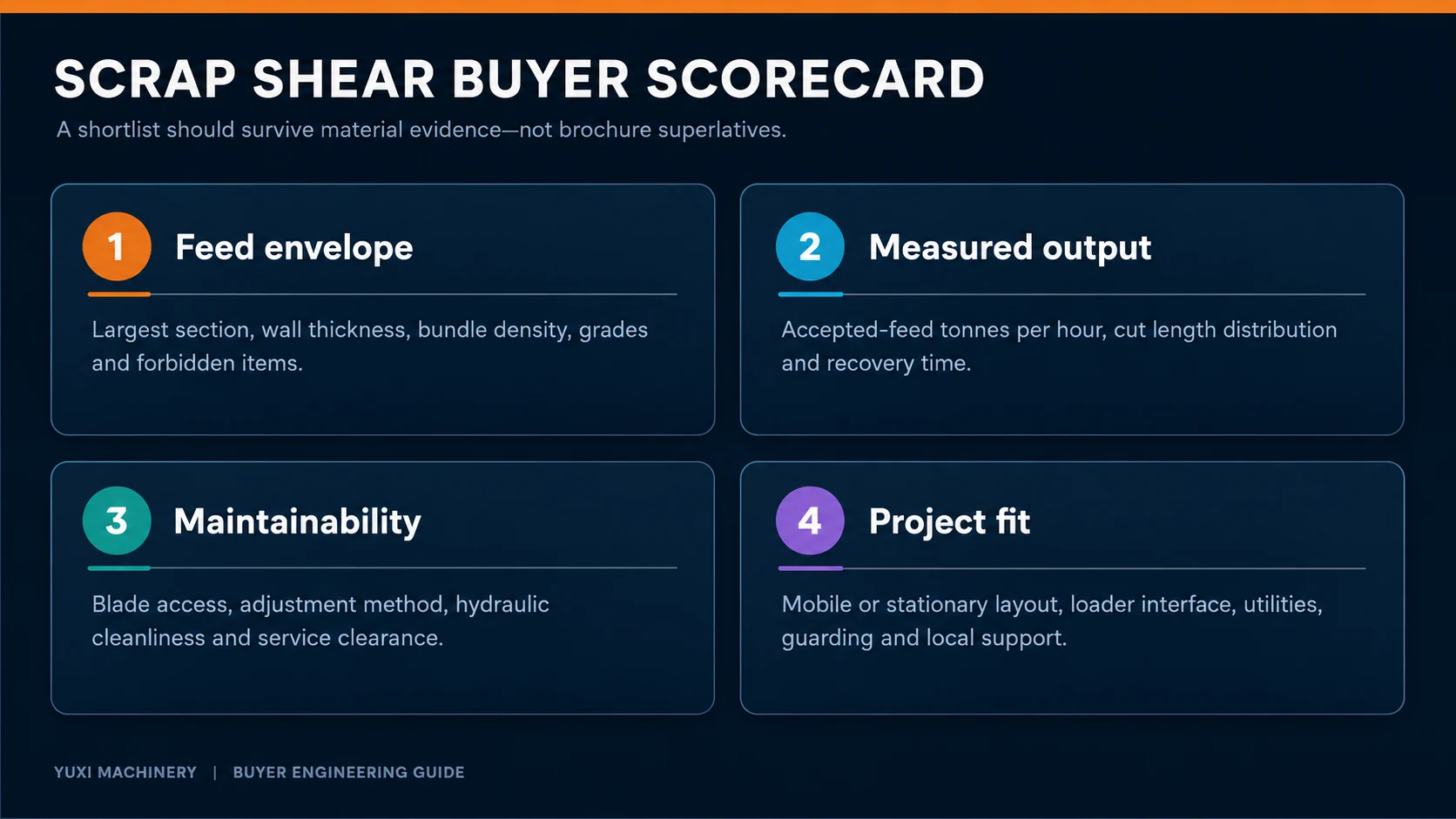
Then define the feed envelope in measurable terms: steel grade or strength range, maximum single-section dimensions, wall or plate thickness, maximum bundle density, longest piece, contamination rules and items that require pre-cutting. When the job is rough opening rather than repeatable length control, the comparison with an industrial metal shredder manufacturer may be more relevant than buying a larger shear.
A better throughput definition
Request throughput as accepted-feed tonnes divided by total observed time. Total time should include loading, compression, cutting, normal repositioning, planned pauses during the test, jams and recovery. Report excluded pieces separately.
A compact production record can use:
Net accepted throughput = accepted batch mass ÷ elapsed test time
Track effective cuts per hour, median loading time, reorientation events, jam count and output oversize beside that number. This exposes whether a higher theoretical cutting rate is being lost because the loader cannot form the batch or the material repeatedly bridges.
Run a material-specific FAT
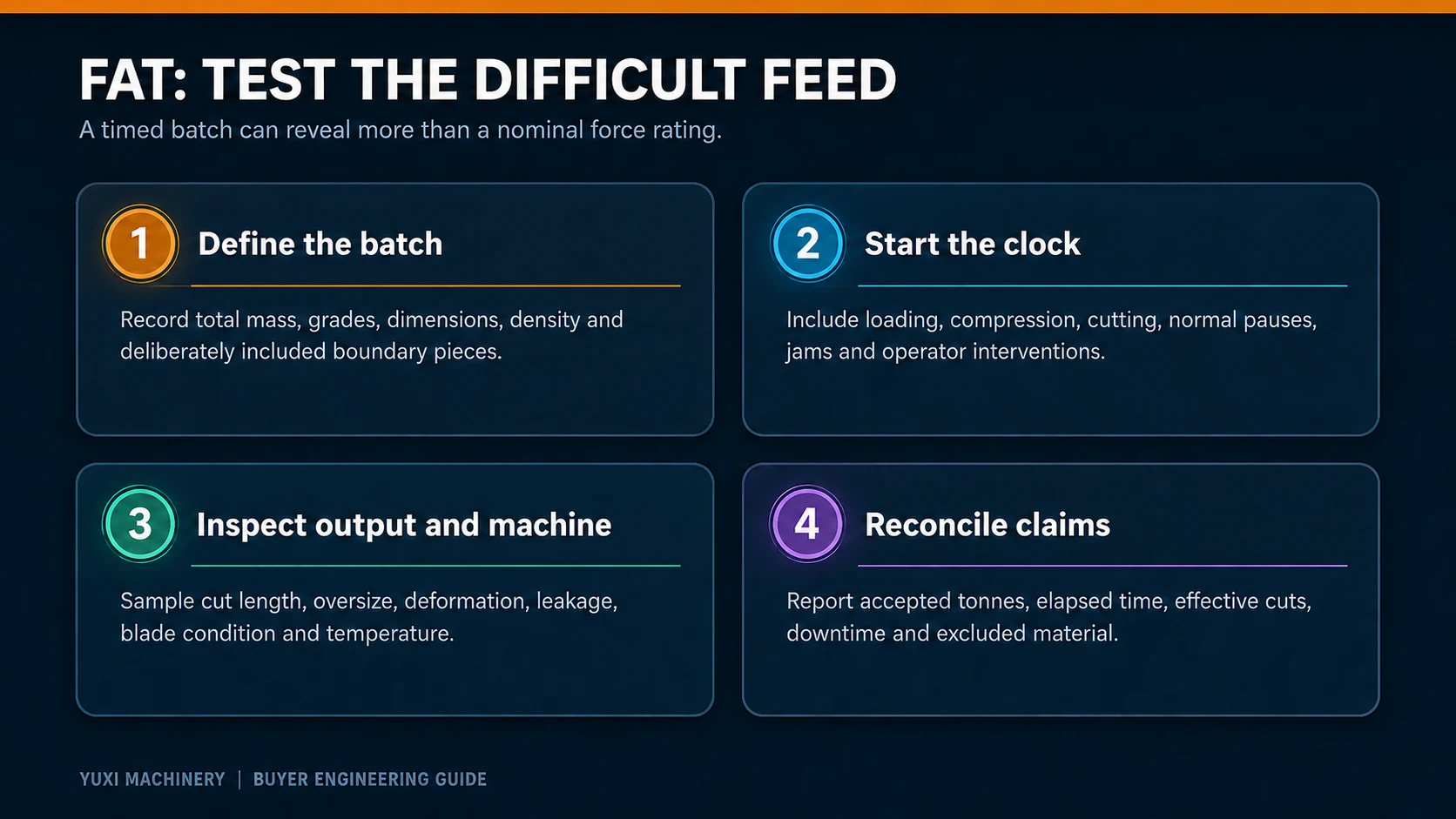
Send a manifest and photographs before the factory acceptance test, then freeze the test batch definition. Include normal scrap and a small, clearly identified set of boundary pieces. Weigh the batch. Record the start and finish time continuously. Video the compression and cutting sequence from a safe location. Sample the discharged pieces and inspect the blades, guides, structure, hydraulic system and leakage points after the run.
The FAT should have pre-agreed pass/fail values for accepted throughput, maximum output length or oversize fraction, stable oil temperature, alarm recovery, leakage, abnormal deformation and safety-function checks.
Use three feed recipes instead of one convenient test pile
A more revealing FAT uses three separately weighed recipes. The first is the recurring production mix. The second concentrates the awkward but accepted shapes—long profiles, springy sheet, nested tube or irregular fabrications. The third contains agreed boundary pieces at the maximum claimed section or density.
| Test recipe | Purpose | Record separately | Decision signal |
|---|---|---|---|
| A: normal mix | Estimate ordinary shift performance | Mass, elapsed time, loader cycles, cut count, oversize | Basis for expected production |
| B: handling challenge | Expose bridging and reorientation losses | Re-grips, box refill time, interventions, rejected pieces | Loader and chamber compatibility |
| C: boundary feed | Check the edge of the accepted envelope | Piece dimensions, position, pressure trace, alarms, recovery | Accept, pre-cut or prohibit |
This structure creates a feed-acceptance map rather than one throughput number. It also prevents easy light scrap from supporting a guarantee intended for dense or awkward feed.
Balance the loader and shear before buying more cutting force
A shear can only cut the batches that the loader forms. If the machine completes compression and cutting faster than the next charge arrives, additional hydraulic capacity may sit idle. Use a simple balance check:
Loading utilization = average batch-loading time ÷ total observed cycle time
If loading occupies most of the observed cycle, investigate grapple volume, pile layout, operator sightline, chamber opening and the number of re-grips. If cutting and recovery dominate, examine compression sequence, stroke time, discharge clearing and jam handling.
Convert a brochure guarantee into an acceptance clause
A stronger clause names the material recipes, accepted dimensions and density range; defines when timing starts and stops; states whether normal operator interventions remain on the clock; fixes the sampling method for output length; and identifies the remedy if the result falls short.
For variable scrap, avoid demanding one guaranteed number for every possible mix. Use a performance envelope: a minimum rate for Recipe A, a lower minimum or maximum intervention count for Recipe B, and a pass/fail acceptance rule for individual Recipe C boundary pieces. A ten-minute run may reveal function, but it is weak evidence for a full shift because it rarely captures heat balance, changing pile geometry or routine interruptions.
Normalize quotations with a scope-adjusted cost
Two bids are not comparable when one includes foundations, guarding, cooling and commissioning while the other stops at the machine frame. First bring each offer to the same battery limit. Then calculate an evaluation cost rather than relying on purchase price:
Scope-adjusted evaluation cost = quoted price + missing site scope + initial critical spares + estimated commissioning gap
Keep energy, wear and utilization in a separate annual model so uncertain assumptions remain visible. Use the same electricity tariff, labor rate, shift schedule, blade-change assumption and accepted-feed tonnes for every supplier. Run at least three cases—base, difficult-feed and low-utilization.
| Normalization item | Supplier A | Supplier B | Evidence required |
|---|---|---|---|
| Machine and standard controls | Included / excluded | Included / excluded | Signed scope and I/O list |
| Hydraulic cooling for site ambient | Duty and limit | Duty and limit | Heat-balance calculation |
| Guarding and access platforms | Boundary | Boundary | General-arrangement drawing |
| Foundation and embedded parts | Boundary | Boundary | Loads and civil drawing |
| Commissioning and performance test | Days and acceptance scope | Days and acceptance scope | Commercial schedule |
Build a feed-envelope register after commissioning
Maintain a short operating register linking each incoming grade or shape to the result: accepted directly, accepted after pre-cutting, loading-intensive, high-wear, or prohibited. Add a photograph, dimensions, typical batch mass, observed rate and intervention note. After several months, this becomes more valuable than the original brochure because sales staff and operators can price and route unfamiliar loads using plant evidence.
Use the register to protect the guarantee boundary too. If a new high-strength or sealed item appears, quarantine it until the site has checked depollution, stored energy and machine suitability. “Metal” is not an adequate feed description. When the shear supplies a larger recovery line, map every accepted category to the next stage using the steel scrap shredding process; a cut length that is convenient for transport may still be unsuitable for controlled shredder feeding or downstream separation.
Maintenance access changes lifetime output
Blade life alone is a poor comparison because feed cleanliness, cutting position, blade material, edge geometry and operator practice change wear. Ask instead how blades are rotated or replaced, which clearances are adjusted, what lifting devices are required, how long a planned change takes and which guards must be removed. Hydraulic oil sampling points, filtration indicators, cooler cleaning access and hose routing deserve the same attention.
If the plant later needs deeper liberation rather than only cut length, review the separate scrap metal crusher application guide. A shear, low-speed shredder and hammer mill solve different process problems; forcing one machine to do all three jobs usually creates recirculation, wear or poor downstream separation.
Total-cost questions for the final two suppliers
| Cost area | Evidence to request | Common omission |
|---|---|---|
| Production | Accepted-feed throughput, utilization assumption, loader cycle and shift model | Quoting theoretical cuts per minute as tonnes per hour |
| Wear | Blade set price, usable edges, change labor, guide and liner scope | Blade claim without feed definition |
| Hydraulics | Installed power, average measured demand, cooling duty and filtration plan | Ignoring ambient temperature and oil cleanliness |
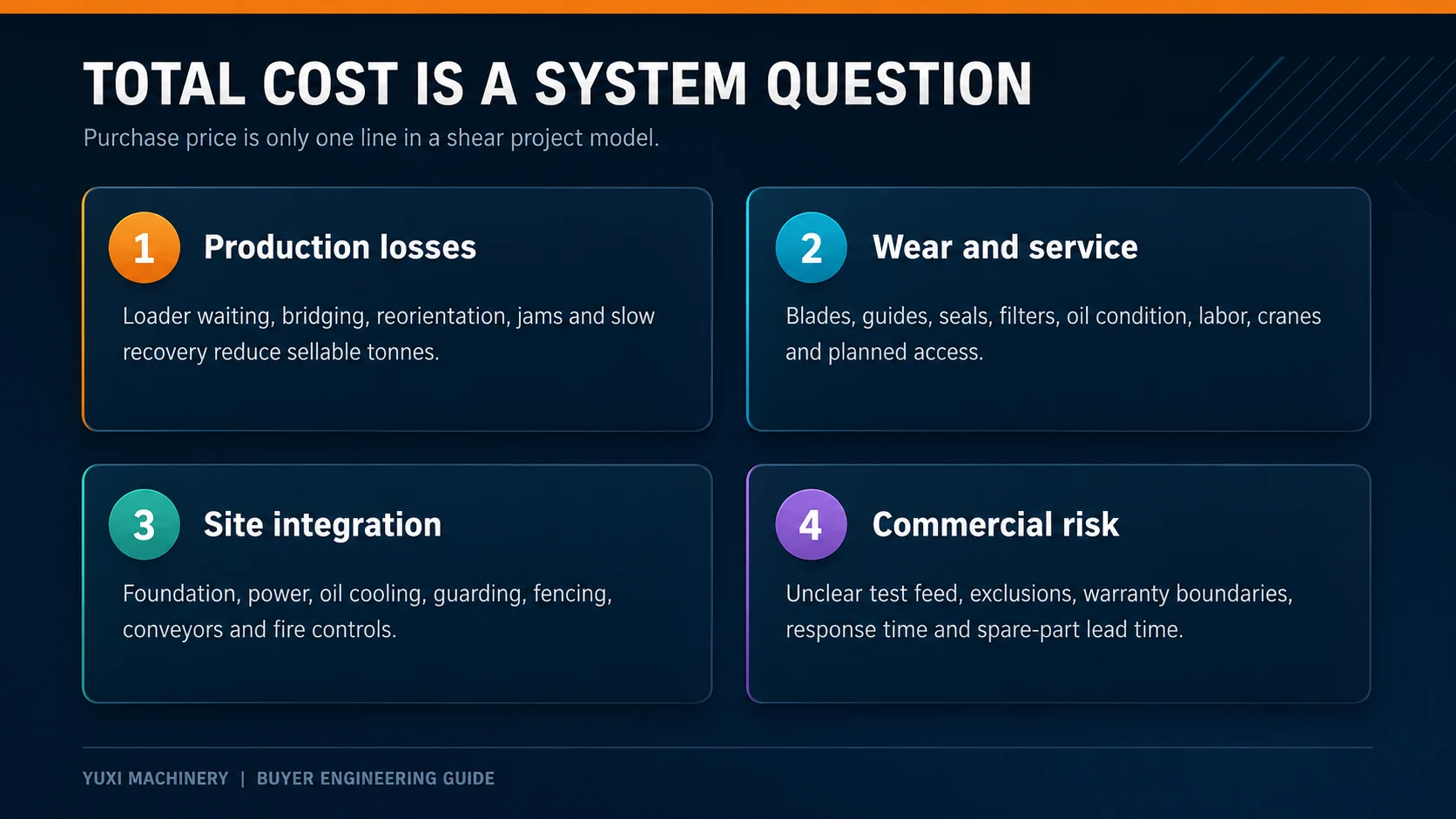
| Integration | Foundation loads, fences, service clearances, loader and discharge interfaces | Comparing machine price without site works |
| Support | Response time, remote diagnostics, commissioning days and critical spares | Warranty language without remedy or timing |
Route scrap by geometry before it reaches the shear
Grade names alone do not predict handling. Two loads sold under the same ferrous grade can create different chamber behavior when one consists of short plate offcuts and the other contains long channel, nested tube and springy sheet. A receiving rule should therefore classify geometry as well as grade.
| Observed feed condition | Likely handling issue | Routing decision to test | Evidence to retain |
|---|---|---|---|
| Short, dense, repeatable sections | High local blade load | Direct shear only inside the agreed material-strength and section limit | Grade, section drawing, cut position and pressure trend |
| Long beams, rail-like pieces or pipe | Poor chamber presentation and projection outside the safe loading zone | Pre-cut, dedicated long-material procedure or reject | Maximum length, loader sequence and safe-position rule |
| Springy sheet and light tangled scrap | Low batch density, rebound and repeated re-grips | Compression trial; compare shear-baler or shredder route | Batch mass, re-grips and usable chamber fill |
| Nested tube or closed fabrications | Hidden contents and unpredictable collapse | Inspect, open or reject before mechanical processing | Receiving inspection and prohibited-item record |
| High-strength or unknown alloy | Force and blade-edge demand may exceed the ordinary grade assumption | Quarantine until material identity and supplier acceptance are confirmed | Material certificate, test result or written supplier decision |
Reverse-check the quoted cutting force
Do not attempt to validate a shear from cylinder force alone. The buyer should ask the supplier to work backward from the proposed feed: identify the assumed material strength, section geometry, number of simultaneous sections, blade clearance, effective cutting position and design margin. Then request the corresponding calculation basis or application sign-off.
This reverse check exposes three common mismatches. First, the quotation may use mild-steel assumptions while the yard regularly receives higher-strength sections. Second, the headline force may be available only near one part of the stroke. Third, a bundle may place several sections under the blade at once even though the sales example shows a single piece. The useful deliverable is a signed accepted-feed table tied to a machine configuration.
Bridge test throughput to a realistic shift target
A short FAT produces an observed rate, not a shift guarantee.
Expected shift tonnes = observed accepted-feed rate × scheduled hours × availability × operating utilization
Availability covers time when the shear is mechanically ready. Operating utilization covers ready time lost to pile changes, loader conflicts, grade changes, inspections and other normal site constraints. Keep the two factors separate because the remedies differ.
Use a 90-day ramp-up baseline
For the first 90 days of operation, keep the same basic records each shift: accepted tonnes, scheduled versus actual run time, loader hours, energy use, blade reversals or rotations, jam causes, unscheduled maintenance, hydraulic temperature, and rejected feed. Segment the data by feed recipe or geometry class.
Review the baseline at 30, 60 and 90 days. A falling rate with stable feed may point to blade clearance, wear or hydraulic condition. Stable cutting time with rising loader time suggests pile presentation or grapple mismatch. Rising temperature only on dense batches may require a duty-cycle and cooling review. The purpose is not to create a large dashboard; it is to separate machine, material and handling losses before they become accepted as “normal.”
Add hold points to the purchasing decision
| Hold point | Release evidence | Do not release when |
|---|---|---|
| Technical bid | Accepted-feed table, GA drawing, utility list and documented exclusions | Capacity or force is quoted without a feed basis |
| Design approval | Foundation loads, guarding concept, loader envelope and maintenance clearances | Access or battery limits remain unresolved |
| FAT | Three-recipe result, alarms, safety functions and post-test inspection | Representative feed is substituted or interventions are removed from the clock |
| Shipment | Closed punch list, manuals, critical spares and preservation plan | Safety or performance-critical actions remain open |
| Site acceptance | Installed performance under agreed utilities, feed and operating conditions | The plant cannot reproduce the documented test boundary |
Safety documents belong in the technical bid
A shear project contains severe crushing, cutting, stored hydraulic energy and ejected-material hazards.1 The bid package should include the machine risk assessment, safeguarding concept, safety-related control description, emergency-stop zoning, isolation points, residual-risk list and safe procedures for clearing jams and changing blades. ISO 12100 provides a methodology for machinery risk assessment and risk reduction.2 For US sites, OSHA requires guarding against point-of-operation, ingoing nip, rotating-part, chip and spark hazards, while servicing work must be addressed through hazardous-energy control.34
RFQ checklist
- What exact grades, shapes, dimensions, wall thicknesses and densities are accepted?
- Which recurring pieces require pre-cutting or must be rejected?
- Where in the useful stroke is the quoted cutting force available?
- Is throughput based on accepted feed and full elapsed test time?
- What output-length distribution is expected from the proposed cycle?
- How are blade clearance, rotation and replacement completed safely?
- What ambient condition and duty cycle size the hydraulic cooler?
- Which foundations, guards, loader, discharge equipment and controls are excluded?
- Can the FAT use a weighed, representative batch with boundary pieces?
- What response time and critical-spares stock are committed in writing?
Build the shortlist around your scrap
Send YUXI the feed mix, largest recurring pieces, photos or video, target tonnes per shift, desired cut length and site constraints. The engineering discussion can then separate what should be sheared from what is better handled by shredding, crushing or baling.
FAQ
What is the difference between a scrap shear and a metal shredder?
A scrap shear compresses and cuts material in strokes, usually to prepare a controlled length. A metal shredder grips, tears and repeatedly reduces bulky material, producing a less regular but more open stream for later handling or separation.
How should scrap-shear capacity be compared?
Compare accepted-feed mass divided by total observed time during a representative test. Include loading, compression, cutting, normal pauses, jams and recovery, then report output oversize and excluded pieces separately.
What should be tested before buying a hydraulic scrap shear?
Use a weighed batch that represents normal feed and includes agreed boundary pieces. Verify throughput, output length, oil temperature, alarm recovery, leakage, blade condition, safety functions and the time needed for normal interventions.
Is the highest cutting force always the best choice?
No. Force must be available at the useful cutting position and matched to material strength, section geometry, compression, blade opening and duty cycle. Excess nominal force does not correct poor feeding or an unsuitable machine architecture.
External References
- OSHA recycling: hazards.
- ISO 12100: risk.
- Machine guarding: safety.
- Lockout tagout: energy.