




 Request Quote

Product Center
-
- Biomass Shredding and Recycling Line
- OCC Paper Dry Pulping & Cardboard Recycling Line
- Scrap Aluminum Recycling Line
- Waste Car Recycling Line
- Waste Refrigerator Recycling Line
- Copper Aluminum Radiator Recycling Line
- Motor Rotor Recycling Line
- Copper Wire Recycling Line
- Waste Ink Cartridge Recycling Line
- Aluminum UBC Scrap Recycling Line
Get a Quote
Contact Us


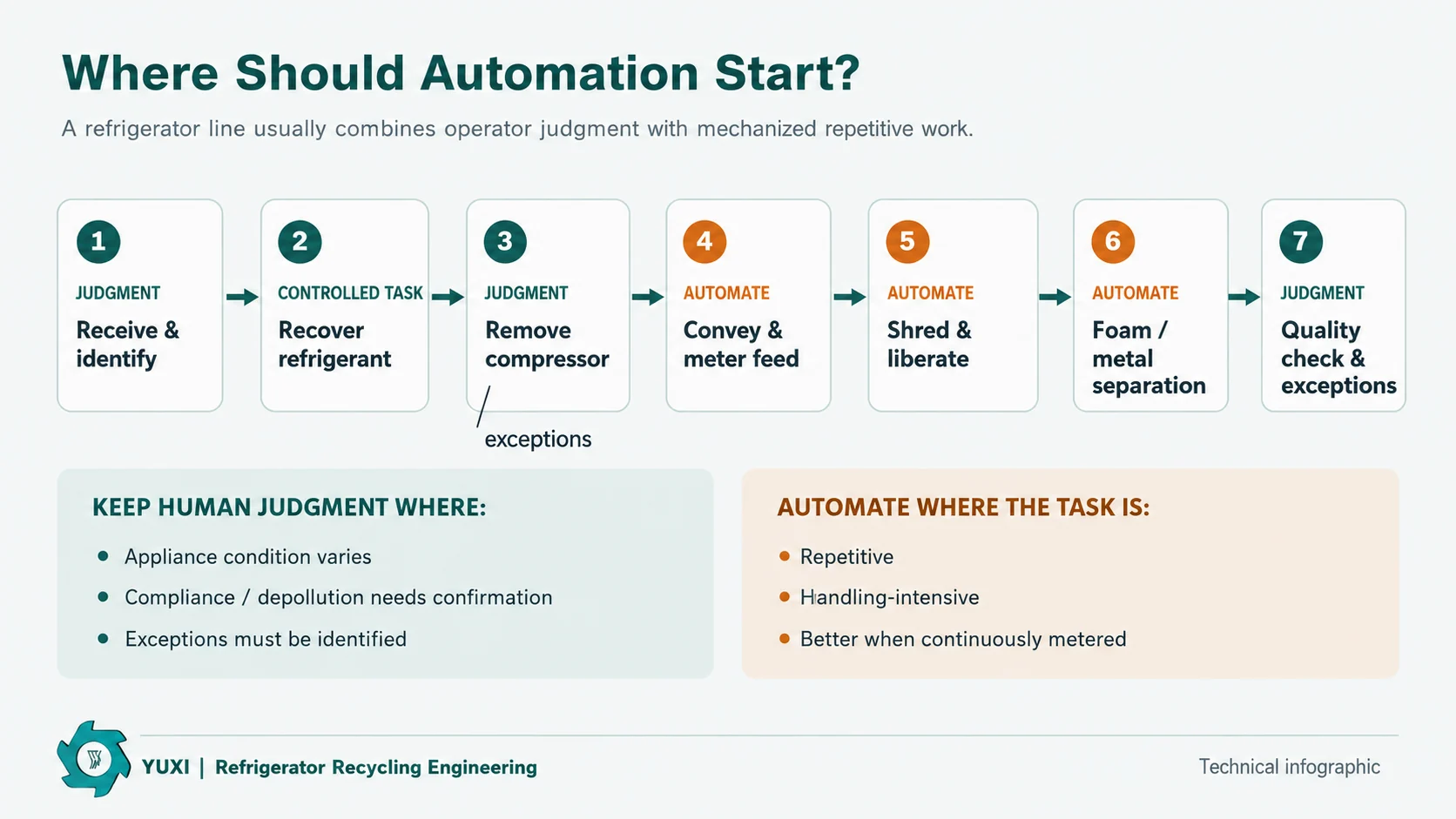
Manual dismantling and automated refrigerator recycling are not mutually exclusive. For most real plants, the better question is where manual judgment should stop and automated material handling should begin. Variable appliances, compliance checks and unusual components still benefit from trained operators. Repetitive conveying, cabinet size reduction, foam extraction and metal separation are much easier to standardize mechanically.
A manual-heavy system can be sensible for low or intermittent volumes. A highly automated system becomes more attractive when feed is reasonably predictable, throughput is sustained and the plant has the maintenance skills to support more conveyors, sensors, drives and control logic. Between those two sits the configuration we see most often in serious project discussions: a hybrid line.
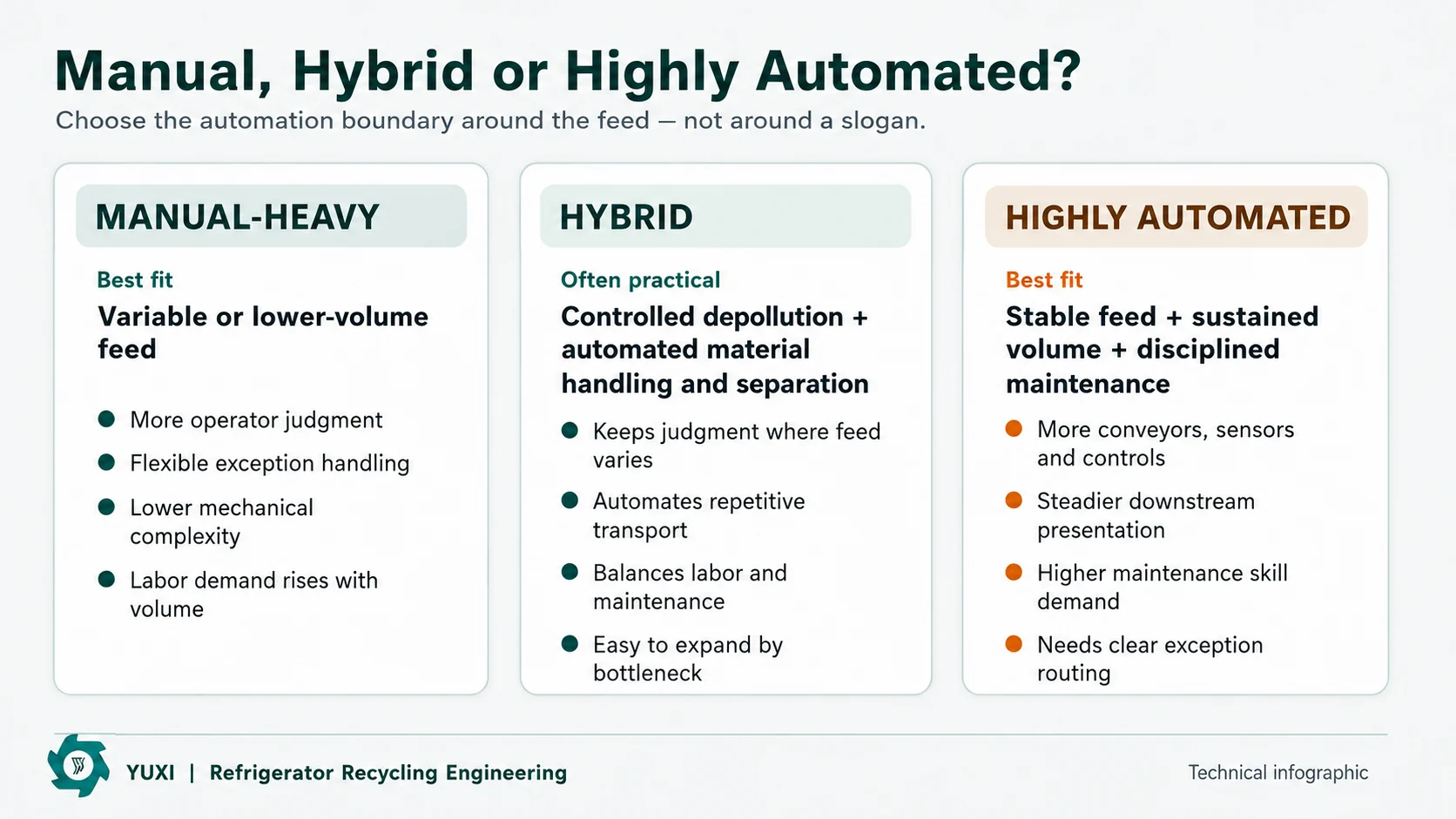
YUXI’s waste refrigerator recycling line already separates the project into upstream pre-treatment and downstream mechanical processing. The mechanical section can receive prepared cabinets, while a complete-appliance project adds receiving, refrigerant handling, compressor/oil work and dismantling upstream.
What “Automated Refrigerator Recycling” Actually Means
Automation is often described too loosely. A plant with a PLC and several conveyors may still depend heavily on manual depollution. Another facility may buy pre-treated refrigerator bodies and operate an almost continuous shredding and separation section with few people near the process equipment.
It is more useful to divide automation into three layers:
- Handling automation: roller tables, conveyors, metered feeding, discharge conveyors and bin routing reduce lifting, dragging and repeated forklift movement.
- Process automation: shredding, secondary liberation, foam extraction, magnetic separation and eddy current separation perform repeatable physical work once the feed is inside an agreed envelope.
- Control automation: interlocks, load monitoring, alarms, sequenced start/stop logic and emergency shutdown coordinate the connected machines. On the YUXI pillar page, central control is presented as a way to monitor and coordinate the shredder, crushers, conveyors and separators rather than as a substitute for upstream inspection.
None of those layers means that a complete refrigerator can simply bypass depollution. In the United States, EPA safe-disposal rules make the final person in the disposal chain responsible for ensuring refrigerant is recovered before final disposal.1 EPA also describes appliance recycling as refrigerant recovery and removal of hazardous components followed by shredding of evacuated appliances.2 In the EU, WEEE treatment rules similarly require selective treatment and proper extraction/treatment of qualifying gases in refrigeration circuits and foams.3
Where Manual Dismantling Still Makes Sense
Manual work is easy to criticize because labor is visible on every shift. Yet some refrigerator tasks remain highly variable. Door construction changes. Compressor access changes. Units arrive damaged. Loose shelves, food waste and non-standard objects appear unexpectedly.
1. Receiving and exception identification
A camera, barcode system or database can help classification, but a recycling plant still needs a route for appliances that do not match the expected stream. The value of a manual inspection point is not that humans are “better than automation” in the abstract. It is that the feed is uncertain. If a unit arrives with an unexpected component, severe damage or unrelated material inside, the line needs a reject or rework decision.
2. Depollution and controlled component removal
This article does not repeat the complete removal list because that is already covered in the refrigerator depollution guide. The important comparison point is that these tasks have a different operating character from downstream shredding. They involve identification, access, recovery equipment, records and handling decisions. Mechanization can assist the operator, but the plant still has to verify that the required work has actually been completed.
3. Selective recovery of accessible value
Some operators remove accessible wiring, copper tubing, circuit boards or reusable parts before cabinet shredding. Whether this makes economic sense depends on labor cost, local material value, customer specifications and how much additional recovery the downstream system can already achieve. The decision should be based on measured value per operator minute, not on the assumption that “more dismantling is always better.”
4. Low or irregular plant loading
If refrigerator arrivals are seasonal or intermittent, a large automated front end can spend too much time idle. A manual-heavy cell may be easier to staff around actual receipts. When volume grows, manual capacity often scales by adding workstations and people, while mechanical handling can increase flow without increasing direct handling in the same proportion.
Where Automation Usually Earns Its Keep
Automation becomes more convincing once the task is repetitive, physically demanding and easier to define. That is why the strongest automation opportunities usually sit after the appliance has reached a controlled pre-treatment condition.
Material handling and line pacing
Refrigerators are bulky. Moving them between stations can consume labor without creating any recovery value. Roller tables, conveyors and controlled feed sequences can reduce unnecessary lifting and waiting. More importantly, they can create a steadier handoff to the shredder.
Cabinet shredding and secondary liberation
Once a cabinet is cleared for mechanical processing, size reduction is a machine duty. Low-speed primary shredding opens the cabinet; secondary crushing or liberation breaks more of the attachment between steel skin, plastic liner and insulation. The goal is not simply to make smaller pieces. It is to prepare a stream that air, magnets and eddy currents can separate consistently.
Foam, ferrous and non-ferrous separation
Air systems exploit density and aerodynamic behavior. Magnetic separation removes ferrous metal. Eddy current separation ejects conductive non-ferrous pieces. Automation does not guarantee product purity, but it can give the separators a more repeatable material layer than irregular hand sorting alone.
Dust collection and central control
Automated equipment adds hazards as well as productivity. Moving parts, nip points and stored energy require guarding and safe maintenance procedures. OSHA notes that machinery hazards must be safeguarded and that lockout/tagout is required to control hazardous energy during servicing.4 A central control system is therefore valuable when it coordinates safe sequencing and alarms, but it must sit inside a wider safeguarding and maintenance program.
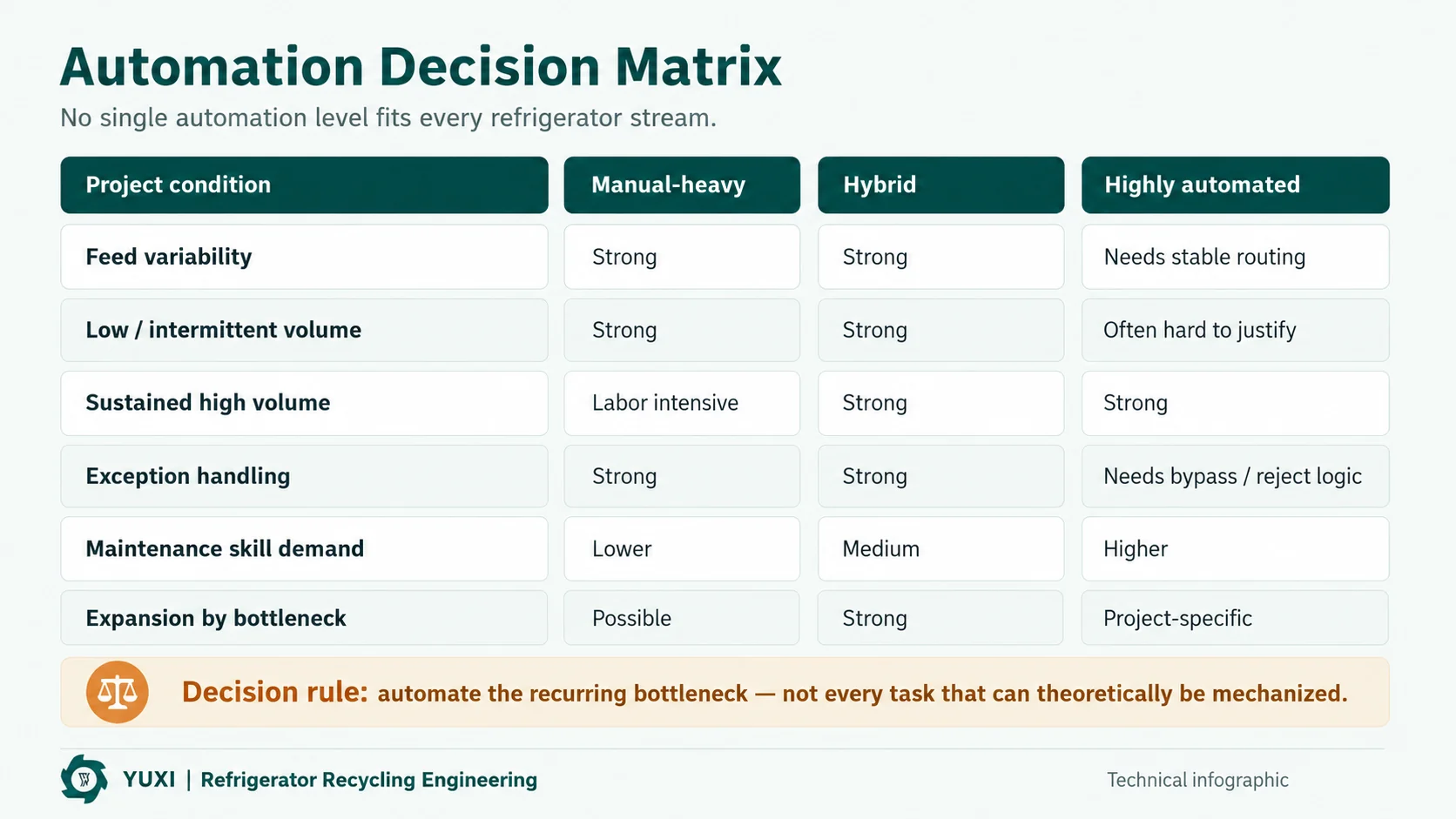
Manual vs Automated Refrigerator Recycling: Side-by-Side
| Decision factor | Manual-heavy | Hybrid | Highly automated |
|---|---|---|---|
| Feed variability | Handles exceptions well | Good balance when exceptions are routed manually | Works best with a defined feed envelope and reject logic |
| Labor profile | More direct handling and dismantling labor | People concentrated at judgment and QC points | Less repetitive handling, but more controls/maintenance skill |
| Throughput scaling | Often requires more stations and operators | Can automate the current bottleneck first | Strong when sustained volume keeps the line utilized |
| Capital intensity | Lower mechanical scope | Moderate and modular | Higher equipment, controls and integration scope |
| Maintenance complexity | Lower machine count | Balanced | More sensors, conveyors, actuators and interlocks to maintain |
| Output consistency | Depends heavily on operator method | Good when downstream feed is stabilized | Potentially very consistent inside the design feed window |
| Exception handling | Flexible | Flexible with bypass/rework route | Must be engineered into the line |
| Best-fit plant | Intermittent or highly variable feed | Most mixed commercial operations | Stable, sustained feed with strong maintenance support |
The Hybrid Line Is Often the Most Practical Design
People handle the tasks where the feed varies or a decision has to be made. Machines handle the tasks where repetition, force, continuous motion or controlled separation dominate.
A typical hybrid boundary can look like this:
- Operator receives and identifies the appliance.
- Refrigerant recovery and required pre-treatment are completed at dedicated stations.
- Operators remove defined components and route exceptions.
- Prepared cabinets transfer to a conveyor or controlled infeed.
- Shredding, liberation, foam extraction and metal separation run as a connected mechanical section.
- Operators sample output quality, clear approved stoppages under safe procedures and route off-spec material for rework.
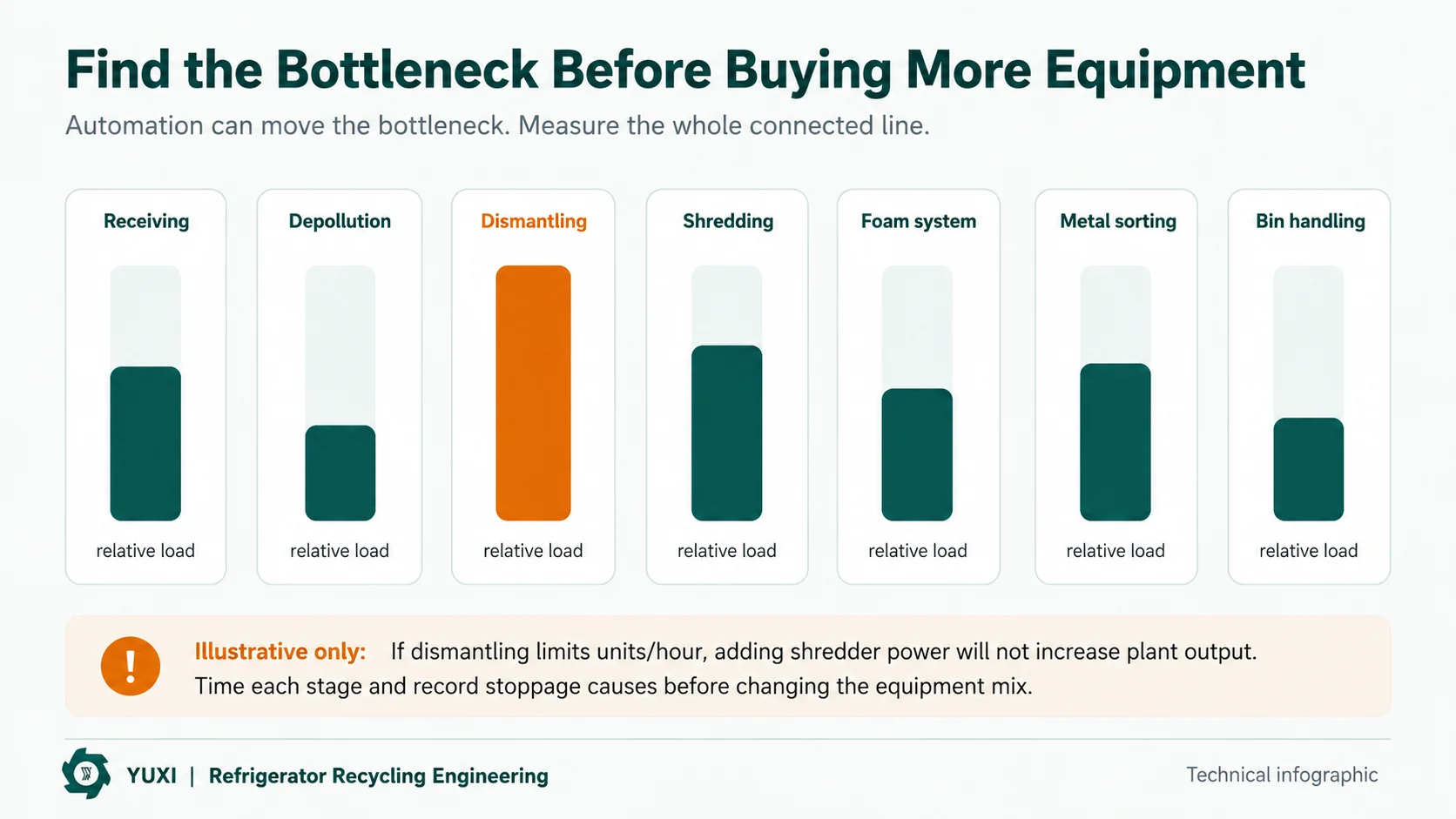
If the bottleneck is front-end depollution, add or redesign that capacity. If the shredder is waiting but the foam circuit is overloaded, increasing upstream feed will make the problem worse. If finished-material bins interrupt production, improving discharge logistics may create more useful capacity than buying a larger crusher.
Choose by Feed Profile, Not by “Automation Percentage”
Before requesting an automatic line, define the feed. “Waste refrigerators” is not enough. A purchasing team should know whether complete appliances or pre-treated cabinets arrive, how much the unit mix varies, the normal and maximum cabinet size, the share of freezers or commercial units, and which components are still attached.
The refrigerator recycling capacity guide explains why units/hour and tonnes/hour should be stated together. That point becomes even more important when comparing automation. A front-end depollution cell is naturally discussed in appliances per hour, while shredders and separators are often discussed by mass flow. One number does not describe both duties.
Calculate Automation Value Without Fake Payback Claims
Automation proposals often become unreliable when a generic payback period is treated as a product specification. Labor rates, shift patterns, annual utilization, material value, energy price, maintenance skill and disposal cost vary too much between plants.
A better calculation starts with your own operating data:
Annual automation value = labor hours avoided × loaded labor rate + value from usable throughput + value from improved product consistency + avoided handling/downtime costs − added maintenance and utility costs.
Each term should be measured against the same feed and operating boundary. If the plant currently spends operator time dragging appliances between stations, handling automation may have value even before the shredder changes. If labor is not the bottleneck, then “labor saving” should not be the main justification.
For a deeper breakdown of labor, wear, electricity, downtime and utilization, see the refrigerator recycling operating-cost guide. The key point here is narrower: automate a cost or capacity constraint that actually exists.
Automation Can Move the Bottleneck
A faster transfer conveyor can starve at depollution. A larger shredder can wait on manual dismantling. A more aggressive feed rate can overload foam extraction. Faster separation can fill product bins sooner and create more forklift interruptions.
Measure each stage separately. Record operator minutes per unit, queue length, stopped time, alarm cause, jam-clearing time, product-bin changes and maintenance interruptions. Then compare the connected line, not individual machine nameplates.
Safety and Compliance Do Not Disappear with Automation
Automation can reduce repeated lifting and keep people away from some process zones, but it also introduces more powered motion, transfer points and stored energy. Guarding, emergency stops, access control, lockout/tagout and safe jam-clearing procedures need to be designed around the actual line.4
EPA’s appliance-disposal guidance remains relevant regardless of the automation level because refrigerant recovery is a disposal-chain responsibility in the U.S.1 For buyers in other regions, the design basis should identify the local refrigerant, WEEE, environmental, fire and worker-safety rules before the equipment boundary is frozen.
That is also why a supplier should not promise that an equipment package is automatically “compliant everywhere.” The line can provide guarding, controls, ventilation interfaces and gas/dust management according to the agreed project specification, but the facility owner still needs a site-specific compliance plan.
What to Ask a Supplier Before Paying for More Automation
(1)What exact feed condition enters the automated section?
(2)Which tasks remain manual, and why?
(3)Where are rejected or unusual appliances routed?
(4)What part of the stated capacity depends on manual depollution?
(5)Which station is expected to be the practical bottleneck?
(6)How are conveyors interlocked with shredder and downstream equipment?
(7)What happens after an overload, jam or emergency stop?
(8)Which guards and access doors require safety interlocks?
(9)What maintenance access is required around conveyors, shredder, crusher, foam system and separators?
(10)How many operators are assumed, and what work is each operator actually doing?
(11)What factory acceptance test feed will be used?
(12)How will output quality and stoppage time be measured during the test?
Common Buying Mistakes
Buying “full automation” before defining the feed
The word automatic cannot compensate for a vague feed specification. The more rigid the automated route, the more important it is to define what the line will accept and how exceptions are handled.
Assuming fewer operators always means lower cost
Automation can replace repetitive handling while adding electrical, controls and maintenance work. Compare total labor hours by skill type rather than counting only people standing at the dismantling bench.
Comparing complete-appliance capacity with cabinet-line capacity
A line that receives complete refrigerators has more work in front of the shredder than a line receiving already evacuated cabinets. Normalize the boundary before comparing units/hour.
Automating around the wrong bottleneck
If depollution limits flow, installing a faster separator does not solve the problem. Use shift data first.
Forgetting the reject route
Real appliance streams contain exceptions. A highly automated line needs a practical bypass, hold area or rework route so one unusual unit does not stop the entire process.
How YUXI Can Configure the Automation Boundary
YUXI can configure the refrigerator project around the buyer’s actual pre-treatment condition rather than forcing every facility into the same front end. A plant that already receives prepared cabinets may need only the mechanical shredding, foam collection and separation section. A plant receiving complete end-of-life refrigerators may require an integrated upstream area for receiving, dismantling, refrigerant handling, compressor handling and oil collection before mechanical processing.
At the beginning of a project, it is important to define the material size and condition, pretreatment method, target capacity, recovery requirements, available space and power supply, as well as local safety and emissions standards. Representative photos or videos of the feed material should also be provided. This information helps determine which steps are best handled manually and which should be mechanized or automated.
Define the Right Automation Level for Your Plant
Send your refrigerator feed condition, capacity target, desired outputs and workshop constraints. YUXI can prepare a process boundary and equipment configuration around the real bottleneck.
Frequently Asked Questions
Is automated refrigerator recycling completely labor-free?
No. Even a highly automated line still needs receiving, inspection, exception handling, maintenance, quality control and compliance procedures. The useful question is which repetitive tasks should be mechanized.
Does automation remove the need to recover refrigerant first?
No. Automation does not change the requirement to manage refrigerant before final disposal or uncontrolled mechanical processing. The exact compliance route depends on the jurisdiction and facility.
When is manual dismantling still a good choice?
Manual-heavy processing can make sense when feed volume is intermittent, appliance designs vary widely, valuable parts are removed selectively, or the plant already has trained dismantling labor and only needs downstream cabinet processing.
What is a hybrid refrigerator recycling line?
A hybrid line keeps people at inspection, depollution and exception-handling points while using conveyors, shredders, air systems, magnetic separation, eddy current separation and central controls for repetitive mechanical duties.
How should I compare labor savings from automation?
Use measured operator minutes per accepted unit, loaded labor cost, actual annual volume, maintenance labor, utility changes, downtime and recovered-product value. Do not rely on a generic payback period.
What information should I send before asking for an automation proposal?
Send representative appliance photos and videos, feed condition, appliance mix, average and maximum dimensions, annual volume, required units/hour and tonnes/hour, target outputs, workshop layout, utilities and local safety or environmental constraints.
References
- EPA Safe Disposal — refrigerant disposal requirements.
- EPA Appliances — appliance disposal guidance.
- EUR-Lex WEEE — selective treatment rules.
- OSHA Guarding — machine guarding basics.
Online Message