




 Request Quote



A rice straw recycling machine does not create one universal end product. Its job is to convert a seasonal, low-density and often contaminated field residue into a controlled feedstock that a pellet mill, digester, pulper, compost operator or mushroom grower can actually accept. The downstream contract should therefore determine the cut, cleaning and conditioning steps.
Is this topic different from a general straw recycling line?
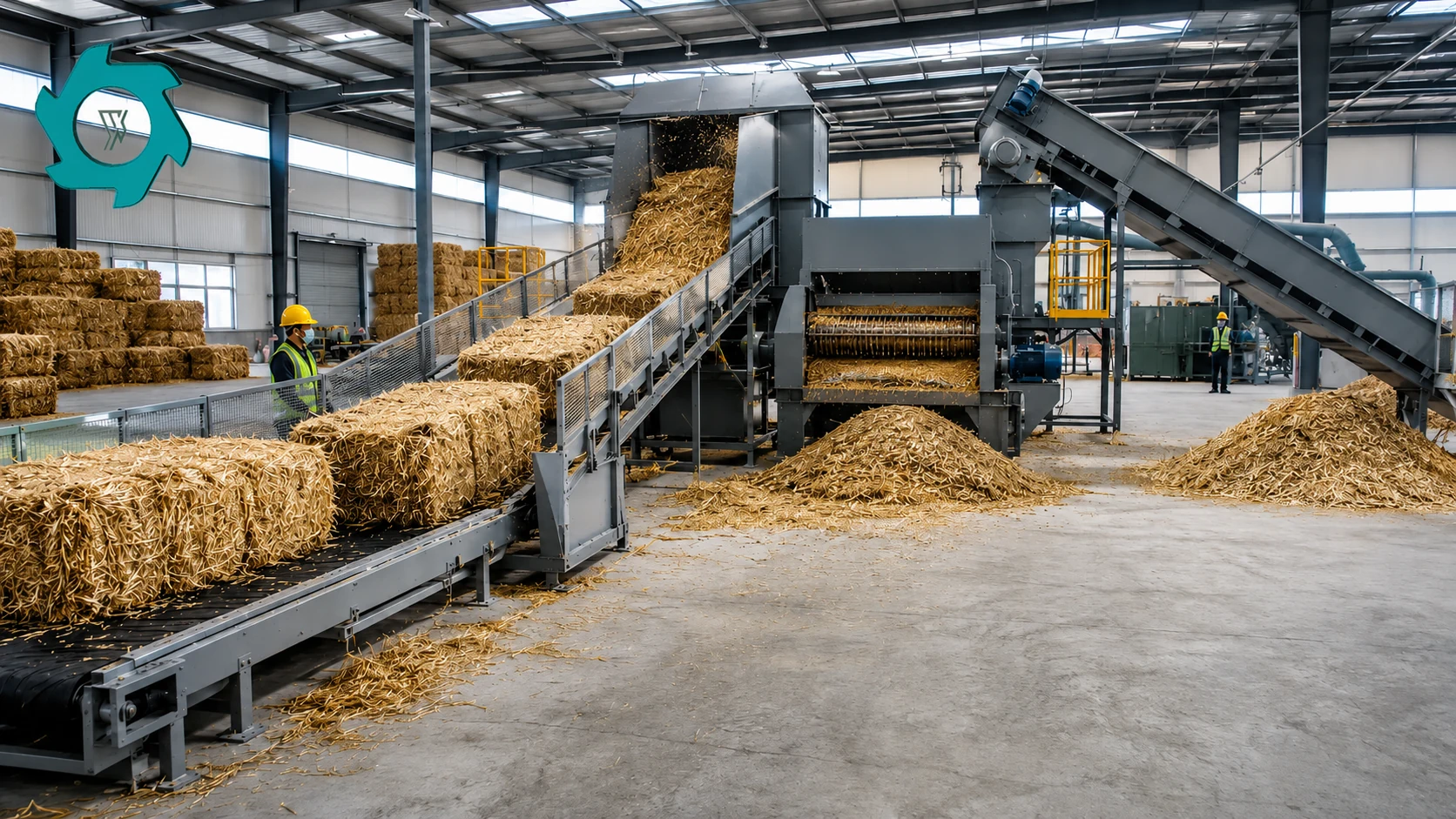
A general guide to an agricultural waste recycling line must compare crop residues with very different behavior. A guide to processing baled straw at industrial scale naturally concentrates on bale receiving, binding removal, opening and steady feeding. This article starts after that shared foundation and asks a narrower question: what changes when the feed is specifically rice straw and the prepared material may go to several very different users?
The distinction matters. Rice straw may contain soil, moisture, and minerals that affect ash, equipment wear, and product quality. It consists mainly of the stems and leaves left after harvest, while rice husks are removed during milling.
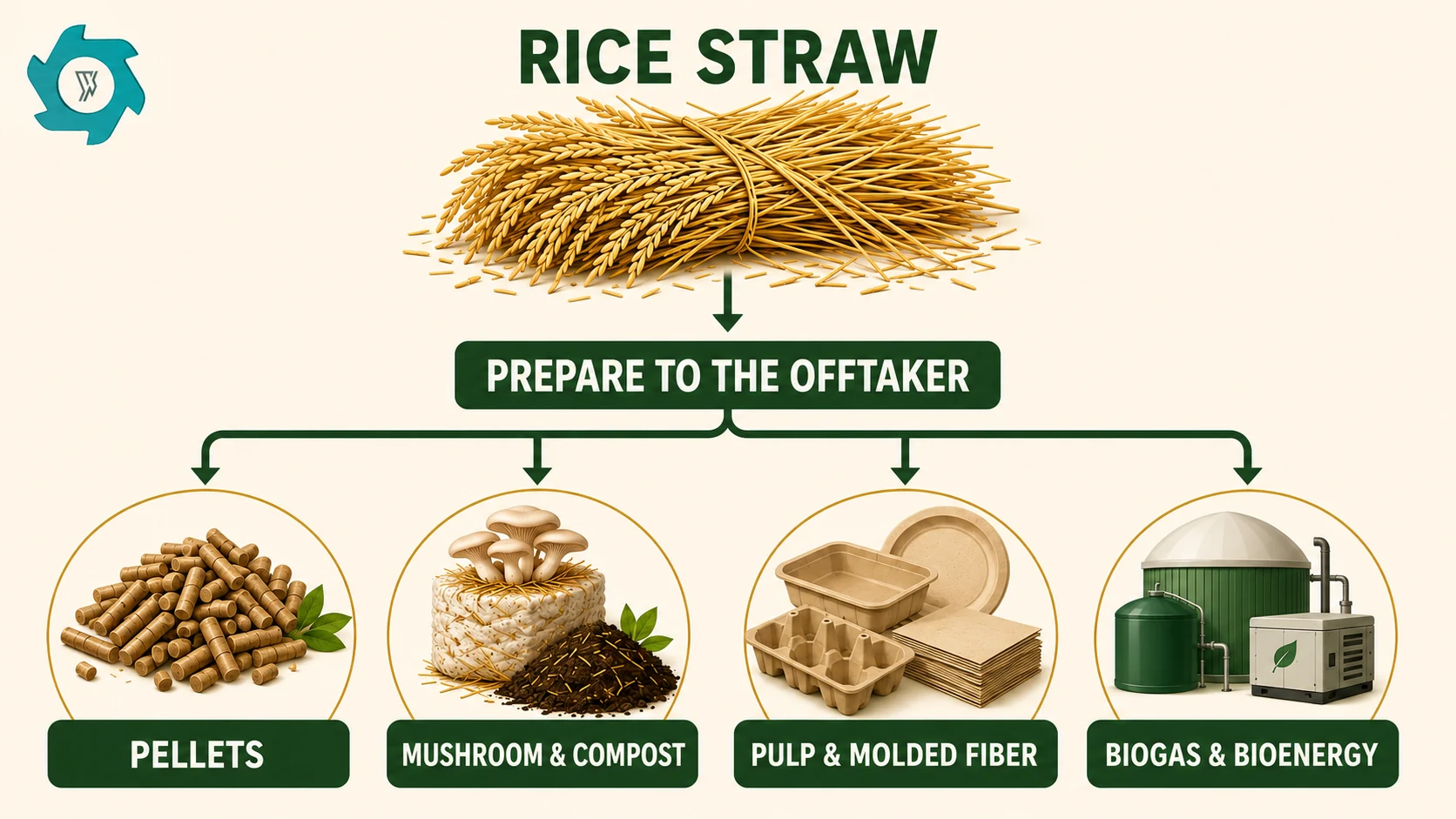
Start with an offtaker specification
IRRI identifies options including compost, biochar, mushroom production, livestock feed, heating, electricity, biogas, building materials and biofiber.1,2 That list describes possible value chains, not products that fall out of the same machine. Each route has its own acceptance boundary.
| Downstream route | What the mechanical line should control | What usually remains outside the line |
|---|---|---|
| Pellets or briquettes | Stable feed rate, defined moisture window, contaminant removal, controlled particle distribution | Drying where required, densification, cooling, durability and fuel-quality testing |
| Combustion or gasification | Consistent size, limited soil and tramp material, documented moisture and ash sample | Fuel qualification, boiler or gasifier compatibility, emissions and ash management |
| Pulp or molded fiber | Clean fiber, limited dirt and plastics, cut length suited to pulping trials | Washing, chemical pulping, screening, bleaching or fiber formulation |
| Mushroom substrate or compost | Opening, mixing consistency, cut that supports wetting and handling | Recipe, pasteurization or sanitation, inoculation, biological residence time and maturity control |
| Anaerobic digestion | Repeatable particle size and contaminant control; wet preparation if specified | Pre-treatment chemistry, slurry formulation, digestion and gas cleanup |
| Ruminant feed | Only food/feed-grade handling under an approved formulation and contaminant plan | Nutritional treatment, ration design, safety and regulatory approval |
Project boundary: shredding or cutting prepares rice straw. It does not by itself make certified fuel, finished compost, safe animal feed, pulp or a guaranteed biogas substrate.
Define the rice straw feed envelope
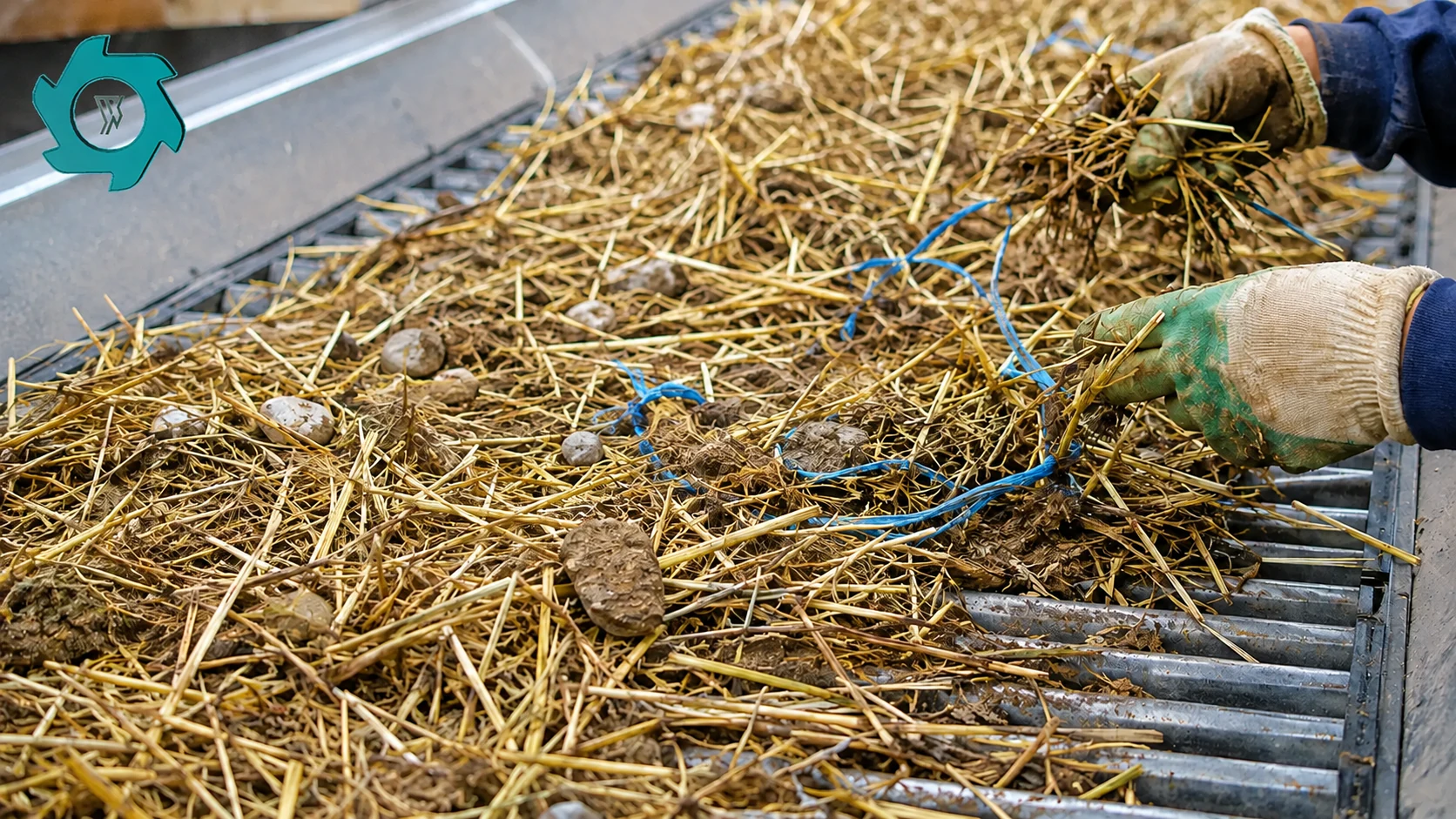
Catalog capacity is not a feed specification. Before choosing equipment, sample material across fields, suppliers, harvest methods and storage ages.1 At minimum, document presentation, bale dimensions and mass, moisture, long-stem fraction, soil and stone content, twine type, metal risk, visible mold and seasonal delivery volume.
Dirt adds dead weight, accelerates abrasive wear and follows the product into ash or process residue. A machine trial that weighs gross bales but does not measure removed soil can make both throughput and yield look better than they are. The same applies to rain-wet straw: extra water raises as-received tonnage while reducing the dry fiber processed per hour.
Dry-matter throughput = as-received throughput × (1 − moisture fraction)
Use three receiving classes instead of one vague specification
A single pass/fail limit can create an avoidable argument at the weighbridge. A more useful receiving plan divides deliveries into three operational classes. Run material fits the normal settings. Condition material is still usable, but must be isolated for drying, blending, extra cleaning or a slower feed setting. Reject material presents a safety, quality or equipment risk that the agreed line cannot manage.
| Receiving class | Typical evidence | Plant response | Why it adds value |
|---|---|---|---|
| Run | Moisture, bale format and contamination remain inside the normal envelope | Process under the standard recipe | Provides a repeatable baseline for throughput and quality |
| Condition | Recoverable wetness, excess loose soil or an unusual but approved bale | Quarantine; dry, blend, clean or change settings under a recorded recipe | Prevents usable straw from being mixed blindly with normal feed |
| Reject | Prohibited wire, hazardous contamination, severe decay or material outside the machine boundary | Keep out of the line and follow the site’s reject procedure | Stops production pressure from overriding safety and contract limits |
These are decision categories, not universal numerical standards. A pulp buyer, fuel user and mushroom grower may place the same delivery in different classes because the consequence of dirt, moisture or biological deterioration is different.
Rice straw process: from field residue to controlled feedstock
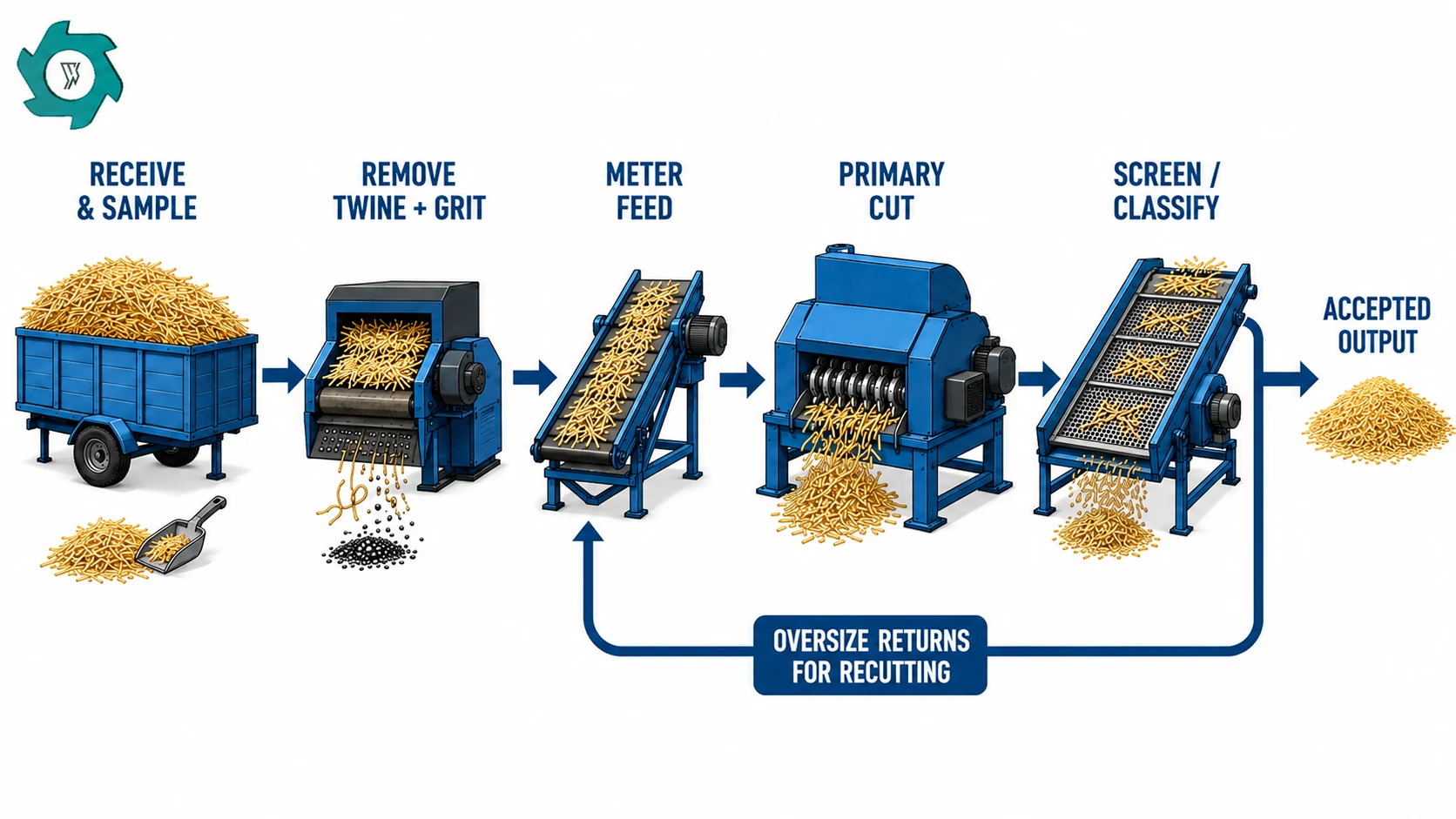
1. Receive, isolate and sample
Keep wet, moldy or visibly contaminated loads separate until accepted. A composite sample should represent the whole lot rather than the clean surface of one bale. Record net straw mass after rejected bindings and foreign material are removed.
2. Remove bindings and coarse contaminants
Twine can wrap around shafts and bearing areas. Wire can damage cutters. Stones and soil raise wear and may compromise the receiving process. Provide a visible removal route and a safe reject point before the primary machine.
3. Open and meter the straw
Compressed bales should not be treated as uniform blocks of production. Opening loosens the bale; metering converts it into a controlled mass flow. Level sensing, conveyor load feedback and drive-current interlocks can help prevent the next machine from being starved for several seconds and then hit by a dense plug.
4. Make the primary cut
Long, fibrous straw usually calls for cutting and shearing. A low-speed primary cutter or shredder can reduce length while limiting unnecessary fines. The exact rotor, cutter clearance, speed and screen arrangement must be tested with representative rice straw. Buyers comparing a shortlist of industrial shredder manufacturers should ask each supplier to define the tested feed and accepted output, not simply quote installed motor power.
5. Screen by useful output, not nominal hole size
Fibrous pieces do not behave like rigid cubes. A long sliver may pass a screen depending on orientation, while fluffy material can blind or bridge an opening. Measure the actual length distribution in the accepted product. Return only genuine oversize for recutting; sending all material through repeated cutting wastes energy and produces fines.
6. Add secondary milling only when the offtaker needs it
Fine milling may be required ahead of some densification or conversion processes, but it should not be automatic. Every extra reduction stage increases dust, wear and specific energy. If coarse chopped straw already meets the composting or substrate specification, a hammer mill can become cost without value.
Design the line around reversible and irreversible decisions
Conveyor speed, screen selection and some cutter settings may be changed between campaigns. A narrow building bay, undersized dust duct, buried conveyor, fixed storage geometry or a fine mill installed in the only available flow path is much harder to correct.
| Decision | Relatively reversible? | Procurement implication |
|---|---|---|
| Feed and discharge conveyor speed | Usually, within drive and mechanical limits | Specify the useful control range and interlock logic |
| Replaceable screen or classifier setting | Often | Price change parts and define safe access time |
| Bypass around fine milling | Only if designed in | Add the bypass before the layout is frozen when multiple markets are realistic |
| Dust pickup locations and duct capacity | Difficult after installation | Base the design on transfer points and the finest intended operating recipe |
| Storage volume and first-in/first-out flow | Difficult | Size from seasonal arrivals and maximum safe residence assumptions, not average hourly output |
| Foundation, headroom and maintenance pull space | Expensive to change | Check the largest service envelope before civil work begins |
Calculate saleable output, not only machine throughput
A line can show a high feed rate and still perform poorly if a large share becomes reject, dust, off-spec fines or circulating oversize. For a buyer, the more useful KPI is saleable—or at least downstream-accepted—dry output.
Accepted dry yield = accepted dry output ÷ dry straw fed
Saleable dry throughput = dry feed rate × accepted dry yield
Keep “accepted” and “saleable” separate when the prepared straw still requires downstream validation. A pellet mill may accept the physical size but later reject a fuel lot on ash or moisture. A pulper may accept clean cut straw but obtain a different yield after chemical processing. Mechanical line acceptance should therefore use properties it actually controls, while the commercial contract records the final offtaker tests.
A full campaign dashboard should show at least four numbers together: dry feed, accepted dry output, oversize recirculation and final reject/fines.
Sample fibrous output without favoring the easy fraction
Rice straw separates during handling. Short pieces and soil-rich fines settle differently from long, fluffy stems, so a handful from the top of a pile is not a defensible product sample. Take timed increments from the moving accepted-output stream across the full test period. Combine and reduce those increments using an agreed method, then keep a sealed retention sample.
For screen and recirculation checks, collect synchronized increments from accepted product, oversize return and fines or dust discharge. The sampling windows must refer to the same operating period; otherwise a surge in one stream can be compared with a quiet period in another. Report particle length by agreed classes rather than describing the product as a single nominal millimeter size.
- Start sampling only after the line reaches documented steady operation.
- Include normal feed variation; do not select only the cleanest bales.
- Record the exact observation time and net mass represented by each stream.
- Do not return the collected oversize to the process until its sample mass is recorded.
- Photograph abnormal wrapping, plugging or contaminant events and link them to the time log.
How rice straw chemistry changes equipment decisions
Mechanical preparation cannot remove every fuel-quality problem. Silica and alkali-rich ash in rice straw can affect the operation of thermal systems. The extent of ash deposition, agglomeration, and corrosion is usually influenced by both the feedstock chemistry and the actual conversion conditions.2 A shredder supplier should not promise boiler compatibility from particle size alone.
First, design the line to reduce avoidable soil and produce stable moisture and size. Second, send representative samples to the intended fuel user or an independent laboratory for ash and fuel evaluation. Washing or chemical demineralization, where considered, is a separate process with water, effluent, yield and cost implications.
Feed and biological routes need the same discipline. Untreated rice straw is low in protein and not easy to digest. Chopping makes it easier to handle and mix, but it does not improve these nutritional limitations or solve problems such as contamination or an unsuitable feed ratio.3
Match the equipment list to the duty
Opening, cutting, screening and transfer points may release combustible biomass dust, so dust collection and fire controls should be based on a site-specific hazard assessment.4
| Equipment | Required duty | Buyer evidence |
|---|---|---|
| Receiving conveyor or floor | Accept stated bale/loose-feed range without unsafe manual intervention | Minimum and maximum bale dimensions, mass and presentation |
| Bale opener | Loosen compressed straw without uncontrolled surges | Video and mass-flow record using representative bales |
| Inspection and cleaning station | Remove twine, tramp metal, stones and visible rejects | Reject categories, access, guarding and disposal route |
| Metering conveyor | Deliver stable load to the cutter | Control philosophy, sensor locations and overload response |
| Primary cutter/shredder | Produce the agreed length distribution | Trial output sample, cutter configuration, wear assumptions |
| Screen/classifier | Separate accepted material from oversize or fines | Mass balance by output stream, not screen aperture alone |
| Dust and fire controls | Manage hazards at opening, transfers, cutting and screening | Site-specific hazard review, capture points and interlocks |
The current YUXI biomass shredding and recycling line can be configured around feeding, primary shredding, optional secondary processing, screening, dust control and discharge.
Use a mass balance for acceptance testing
A useful trial runs long enough to include normal loading variation, not only a short clean-bale demonstration. Weigh the feed and each meaningful output stream over the same observation period:
- Accepted prepared straw;
- Oversize returned for recutting;
- Fines or dust collected;
- Twine, stones, soil and other rejects;
- Unaccounted material within an agreed tolerance.
Record stops, reversals, bridging events, manual interventions, cutter inspections and energy at the same time. Capacity should be defined as sustained accepted output, not the fastest instantaneous belt rate. If the downstream route changes, repeat the output-quality check using that route’s specification.
Questions to put in the RFQ
- Which rice straw conditions were used for the proposed capacity?
- Is the stated throughput based on incoming weight, dry weight, or are both figures provided?
- Which bale sizes and tying materials are accepted, and what moisture and contamination limits apply?
- Which machine controls feed surges before the primary cutter?
- How is particle length sampled, and what percentage is oversize or fines?
- Where do stones, soil, twine and metal leave the process?
- What product requirements has the downstream buyer set for pellet, pulp, compost, mushroom, or bioenergy use?
- What downstream work is not included in the supplier’s scope?
- What dust and fire-hazard assumptions require confirmation at the installation site?
FAQ
What machine is used to recycle rice straw?
There is no single universal rice straw recycling machine. A practical line may include receiving and sampling, twine and contaminant removal, bale opening, metered feeding, a low-speed cutter or shredder, screening and optional fine milling. The required combination depends on the straw condition and the downstream buyer’s specification.
How small should rice straw be shredded?
Use the coarsest cut that the receiving process accepts. Composting, mushroom substrate, pulping, pelletizing and digestion do not require the same length distribution. Cutting finer than necessary adds power, wear, fines and dust without guaranteeing a better product.
Why should rice straw capacity be stated on a dry basis?
Moisture increases the total weight of the material, but it does not add any actual dry fiber. For this reason, tests should record both as-received throughput and dry-matter output. This makes wet and dry feed easier to compare and prevents high-moisture batches from appearing more productive simply because they weigh more.
Can one line make pellets, pulp, compost and biogas feedstock?
One front end can sometimes serve several routes, but each downstream user needs its own acceptance specification. Different routes may require separate screen settings, cleaning, drying, fine milling, chemical treatment or hygiene controls outside the shredder line.
What should a rice straw machine trial record?
Record bale or loose-feed condition, moisture, net feed mass, observation time, accepted output, oversize return, fines, contamination removed, stops, reversals, energy use and the particle-length distribution delivered to the downstream process.
References
- DOE OSTI, Feedstock quality — biomass variation.
- DOE OSTI, Boiler deposition — inorganic material.
- FAO, Crop residues — by-product use.
- OSHA, Combustible dust — safety guidance.
Configure a rice straw preparation line around your market
Send representative straw photos, bale data, moisture range, contamination notes, target throughput and the downstream acceptance specification. YUXI can use those boundaries to propose a test plan and equipment scope.