




 Request Quote



A corn stalk recycling line should not be selected from crop name and motor power alone. The line should be designed around the material that actually arrives. Feed form, moisture, soil contamination, crop composition, and the needs of the next process all matter.
Where this guide differs from general straw-line advice
A delivered lot may contain stalk internodes, leaves, husks, cobs and pieces collected close to the soil. The mix changes bulk density, toughness, moisture, ash-forming contamination and the particle distribution after cutting.
This guide therefore stays on the mechanical preparation boundary: receiving, opening, cleaning, metering, primary cutting, optional secondary sizing, screening, sampling and transfer. For a broader multi-crop process, see the agricultural waste recycling line guide.
Start by naming what is actually in the load
“Corn stalk” is often used commercially for the whole above-ground residue after grain harvest. In technical discussions, corn stover is the clearer umbrella term. It may contain stalks, leaves, husks and cobs. University of Minnesota Extension notes that cobs differ from the rest of the residue in density and moisture, which is one reason a cob-rich load should not be assumed to behave like leaf-and-stalk material.1
| Fraction or condition | Likely processing effect | What to record |
|---|---|---|
| Long stalk sections | Bridge across hopper openings; create high instantaneous cutter load | Typical and maximum length, diameter, orientation and bundled share |
| Leaves and husks | Low density, wind loss and dry fines; may fill volume before mass target is reached | Visual proportion, bulk density and fines after handling |
| Cobs | Denser, locally harder pieces; can change moisture and screen loading | Cob share, maximum size and whether kernels remain |
| Root balls and basal stalk | Bring soil and stones into wear surfaces and output ash | Collection height, soil mass fraction and largest stones |
| Fresh or rain-wet material | Bends, compacts and may smear across small openings | Moisture distribution, not one average from a clean surface sample |
| Field-dry brittle material | Cuts readily but can generate more small particles and airborne dust | Fines fraction, dust collection boundary and ignition-source review |
Create a feedstock passport before equipment selection
A passport is a one-page specification for each approved supply route. It turns phrases such as “normal corn stalks” into measurable evidence. Keep separate passports for one-pass collected stover, raked and baled residue, loose chopped material and any cob-rich stream.
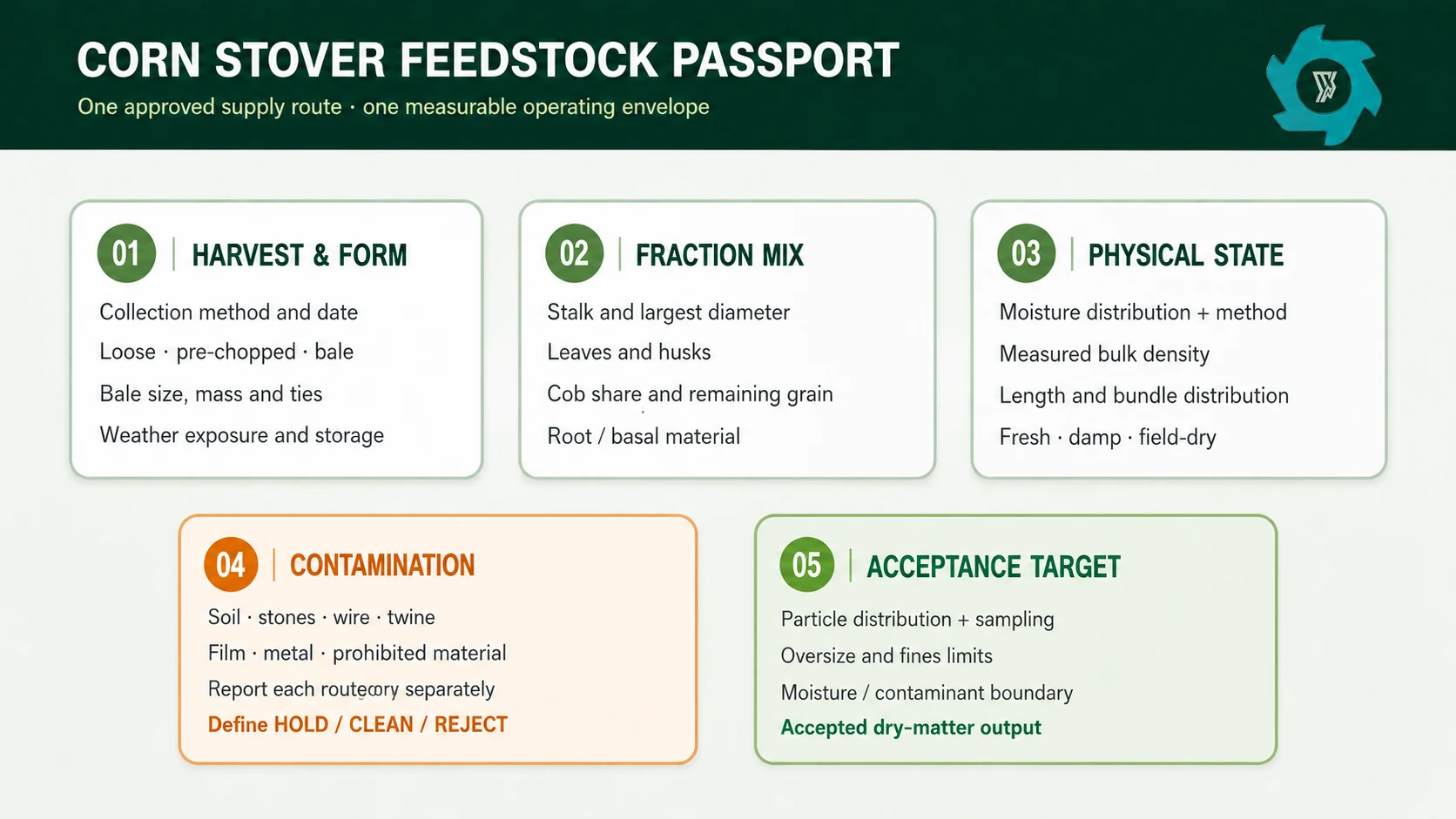
- Source and harvest: field region, harvest date, collection method, cutting or raking height, and weather exposure.
- Presentation: loose, pre-chopped, rectangular bale, round bale or compacted bundle; include dimensions, mass and tying material.
- Composition: visible shares of stalk, leaf, husk, cob, root material and grain.
- Physical condition: moisture results and method, bulk-density method, stalk dimensions and largest recurring bundles.
- Contamination: soil, stones, metal, wire, twine, film and prohibited material, each reported separately where practical.
- Acceptance target: required particle distribution, oversize ceiling, fines limit, moisture band and contaminant limits from the downstream user.
Sustainable collection depends on soil, slope, yield and management, and removing residue carries nutrients and carbon away from the field. The available plant feed should therefore be based on contracted, sustainably collectable and deliverable material—not the total residue estimated in a region.1
Convert field estimates into usable annual dry feed
A regional residue estimate is not a design throughput. Build a monthly supply ledger that removes agronomic retention, collection loss, storage loss and rejected deliveries before applying plant availability. Keep every percentage tied to a named evidence source; do not hide several uncertain deductions inside one “recovery factor.”
Usable annual dry feed = field residue × approved removal share × collection recovery × storage recovery × delivery acceptance × dry-matter fraction
| Ledger item | Evidence to retain | Why it matters to line sizing |
|---|---|---|
| Approved removal share | Farm- or field-specific conservation plan and harvest boundary | Separates total biological residue from material that may actually leave the field |
| Collection recovery | Weighed field trials by harvest method and weather condition | Raking, baling and loading do not recover every available dry ton |
| Storage recovery | Opening inventory, dispatched inventory, rejected/spoiled mass and moisture basis | Prevents disappeared or degraded material from being treated as plant supply |
| Delivery acceptance | Loads accepted, conditionally routed and rejected by cause | Dirty or wet contracts may deliver tonnage that the line cannot turn into qualified feedstock |
| Seasonal availability | Monthly delivery plan plus weather and transport constraints | Annual tonnage can still starve a plant during several months |
If the downstream plant needs a steady dry-matter rate, the buffer must cover the longest credible gap between accepted deliveries—not merely the average gap in a normal harvest month.
Route the material by condition, not just crop
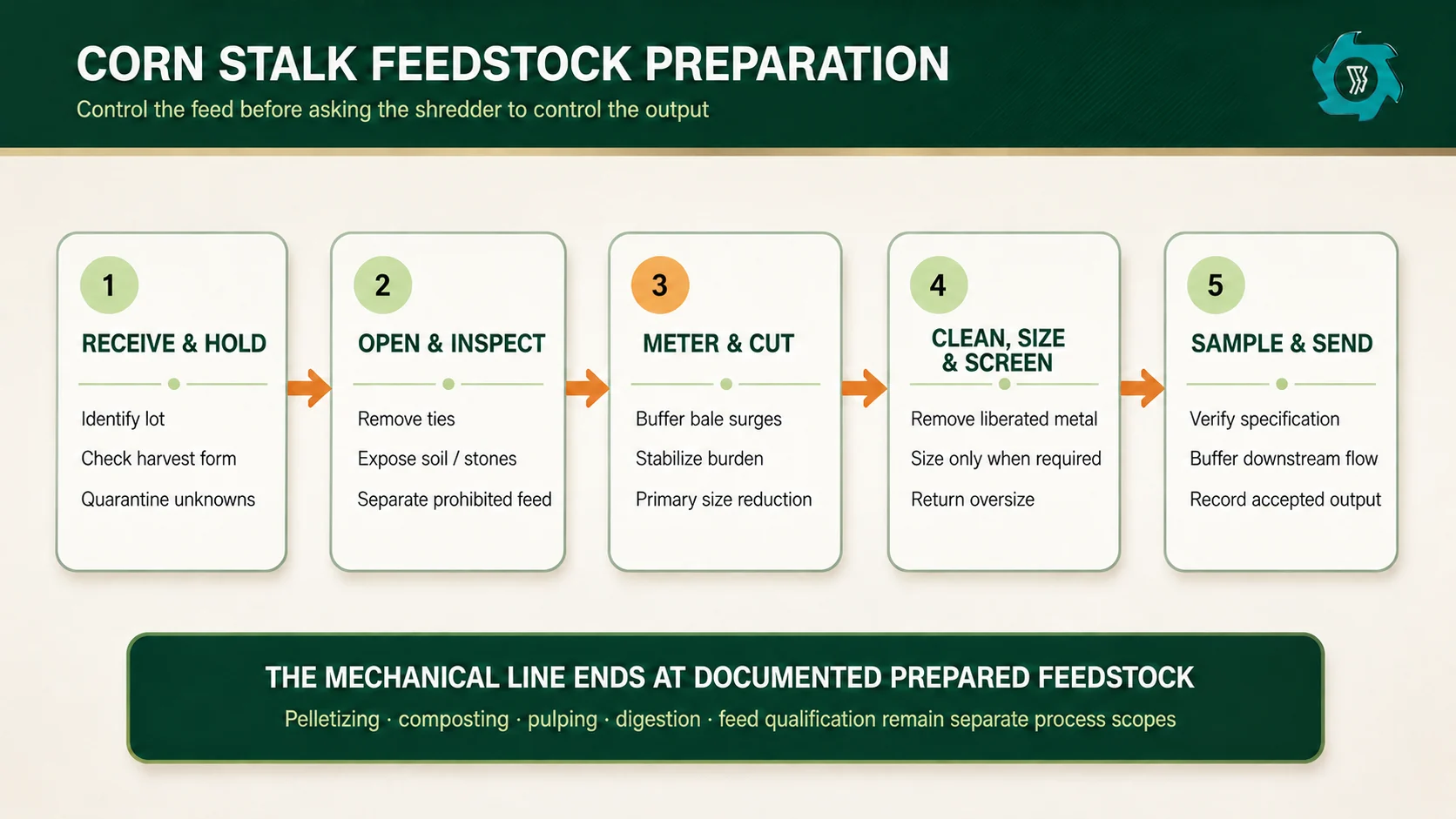
A practical line usually follows receive and hold → inspect and open → meter → primary size reduction → remove liberated contamination → optional sizing and screening → buffer, sample and transfer. The exact route changes with presentation and moisture. The YUXI biomass shredding and recycling line provides the configurable process framework; the project specification must decide which stages are justified.
| Incoming form | Front-end priority | Common mistake |
|---|---|---|
| Tied rectangular or round bales | Safe tie removal or controlled bale opening; buffer the released surge before cutting | Dropping a whole compact bale into a hopper that cannot meter the decompressed fiber |
| Loose long stalks | Wide receiving opening, live-bottom or positive feed, and protection against bridging | Sizing capacity from an empty-belt speed rather than sustained mass flow |
| Pre-chopped residue | Inspect for soil and metal, then meter consistently; verify whether primary cutting is still required | Adding another reduction stage without proving an output benefit |
| Wet or green stalks | Open discharge, torque margin and a bypass around moisture-sensitive fine screening | Guaranteeing dry-stalk capacity and screen performance on damp feed |
| Dry, dusty residue | Enclosed transfers, controlled drop heights, housekeeping and dust hazard assessment | Treating dust extraction as a cosmetic add-on after layout is fixed |
Decide whether anatomical fractionation creates value
Some projects benefit from separating a cob-rich or soil-rich fraction before uniform fine grinding; others only add transfers, loss and complexity. DOE research treats anatomical fractionation as a way to manage feedstock quality, and later work has investigated mechanical separation of corn-stover fractions in integrated preprocessing.2,3
Run a value test with three numbers for every proposed split: the mass yield of each fraction, its measured quality difference, and the destination value after extra handling and loss. Keep the fractions separate only when the downstream benefit exceeds the additional equipment, sampling, inventory and clean-out burden.
Incremental value of a split = value of separated qualified streams − value of unsplit stream − added processing and loss cost
Moisture changes cutting, conveying and storage behavior
There is no universal moisture number that divides all corn residue into “processable” and “unusable.” The line needs a validated window tied to the intended storage and downstream use. Damp fibers can fold, raise torque peaks, compact in hoppers and blind small screens. Very dry material flows differently and may increase fines and dust.
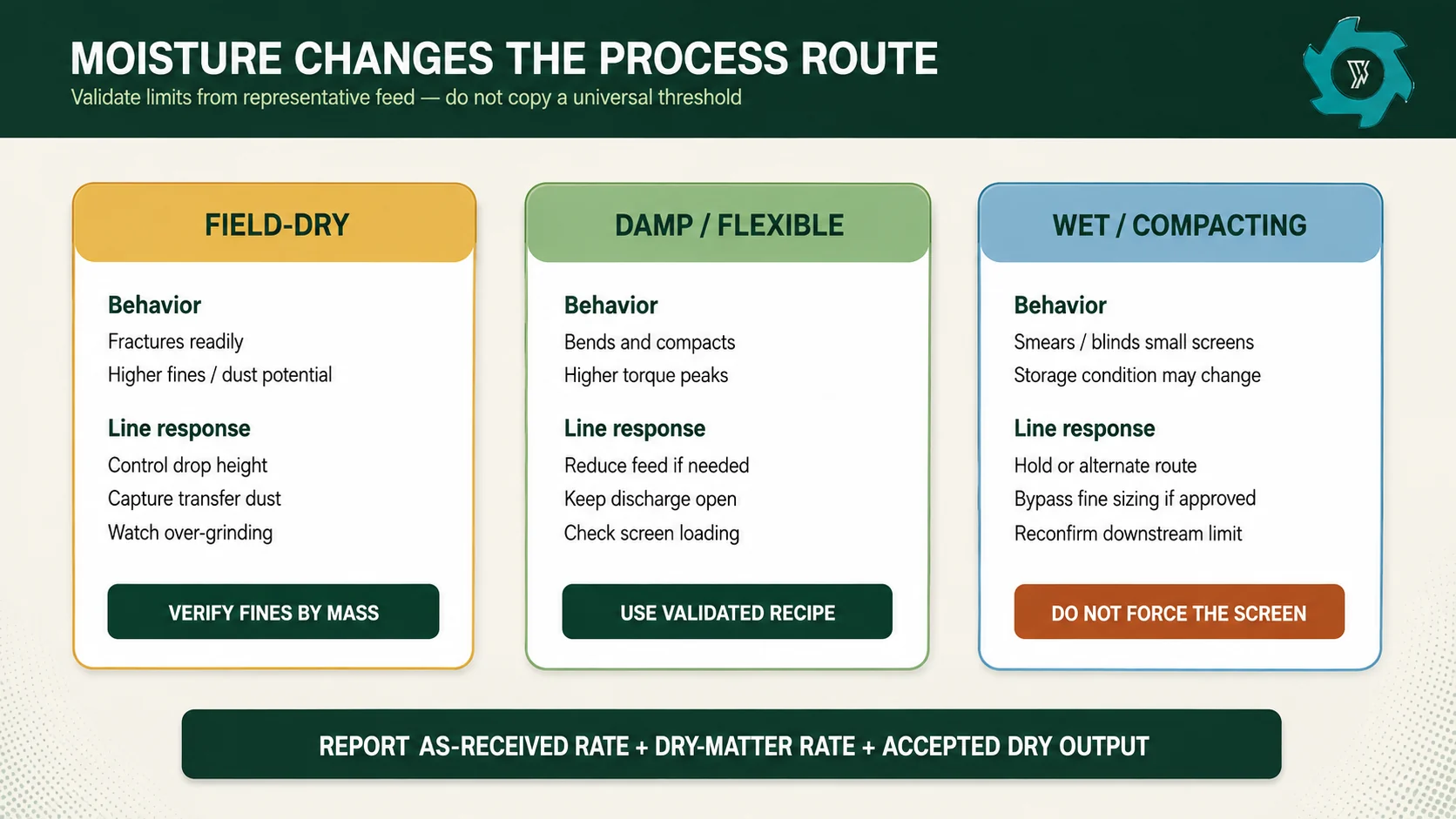
Dry-matter feed rate = as-received feed rate × (1 − moisture fraction on the agreed basis)
Storage is a separate engineering boundary. If material is accepted before it is stable for the chosen storage method, microbial activity, heating, spoilage or leachate can change both safety and downstream quality. Specify maximum residence time, stock rotation, temperature or condition checks, fire response and the route for suspect material.
Control soil before spending energy on finer grinding
Soil increases mineral matter in the product, accelerates abrasive wear and can reduce the useful yield of conversion processes. Research available through the U.S. Department of Energy’s OSTI repository reports that lowering ash in corn stover can improve conversion efficiency and reduce process cost.2
Prevention is usually better than trying to separate soil after it has been pulverized into the biomass. Work back through the supply chain: adjust collection practice where agronomically appropriate, avoid dragging windrows through wet soil, segregate visibly dirty bales, and provide a receiving hold point. Inside the line, opening and gentle pre-cleaning should occur before a fine grinder turns removable dirt into distributed fines.
Magnetic separation has a narrow job. It can remove liberated ferrous wire and metal. It cannot remove stones, most soil, plastic twine or metal still trapped inside an unopened bale. Assign a specific detection or removal route to each contaminant.
Choose size reduction from the next process backward
Corn stover fractions do not reduce uniformly: a screen change that shortens stalk pieces may have a smaller effect on flexible leaves, or it may increase fines without solving long-fiber carryover. DOE research has documented feedstock-specific particle-size responses to preprocessing, reinforcing the need for representative trials rather than borrowed settings.4
- Obtain the downstream user’s allowed size range, maximum oversize, fines limit, moisture band and sampling method.
- Test primary cutting first and retain the coarsest output that passes.
- Add a secondary mill only if the measured primary output fails a necessary requirement.
- Sample each relevant fraction by mass. Do not judge the result from a handful of visually attractive pieces.
- Return oversize to the correct stage without counting each recirculation pass as new production.
For a deeper treatment of baled receiving and dry-mass throughput, use the industrial straw recycling line guide. Rice-specific silica and downstream routing are covered separately in the rice straw recycling machine guide.
Design stable flow before increasing installed power
Low bulk density makes volume handling decisive. The primary machine cannot deliver a stable hourly rate if a bale opener sends alternating voids and dense plugs. Place a controllable buffer between opening and cutting, measure conveyor burden or mass flow where practical, and coordinate speeds so the shredder sees a repeatable bite.
Track bridging, wrapping, automatic reversals, high-load events and manual interventions by cause. A line that meets average output through frequent unsafe clearing or violent feed surges has not demonstrated stable production. Access doors, guards and clearing procedures must be designed around hazardous-energy control.
Measure feed stability instead of relying on average rate
Average tonnes per hour can hide alternating starvation and overload. During trials, export short-interval conveyor mass or motor-load data and report its variability over the stable window. A simple coefficient of variation makes two feed arrangements easier to compare when they deliver the same average mass.
Feed variability index = standard deviation of short-interval feed rate ÷ mean short-interval feed rate
Use the same interval and measurement point in every comparison. Pair it with high-load duration, reversals, bridges and accepted-output variation. If variability falls after adding a buffer or changing the bale-opening sequence, the improvement is visible before a larger drive is considered.
Dust and fire controls belong in the process scope
OSHA states that handling and size reduction of biomass feedstocks can generate combustible dust and that the risk depends on the material and operating conditions.5 A project-specific hazard assessment should cover cutters, screens, elevators or conveyors, transfer points, dust collectors and storage. It should also consider ignition sources, bonding and grounding where applicable, housekeeping, isolation, explosion protection, emergency response and safe maintenance.
Accept capacity on dry, on-spec output
A credible factory acceptance test uses representative material from the agreed feed envelope, including the recurring difficult condition. Run long enough to expose normal loading variation, then reconcile all outputs over the same clock window.
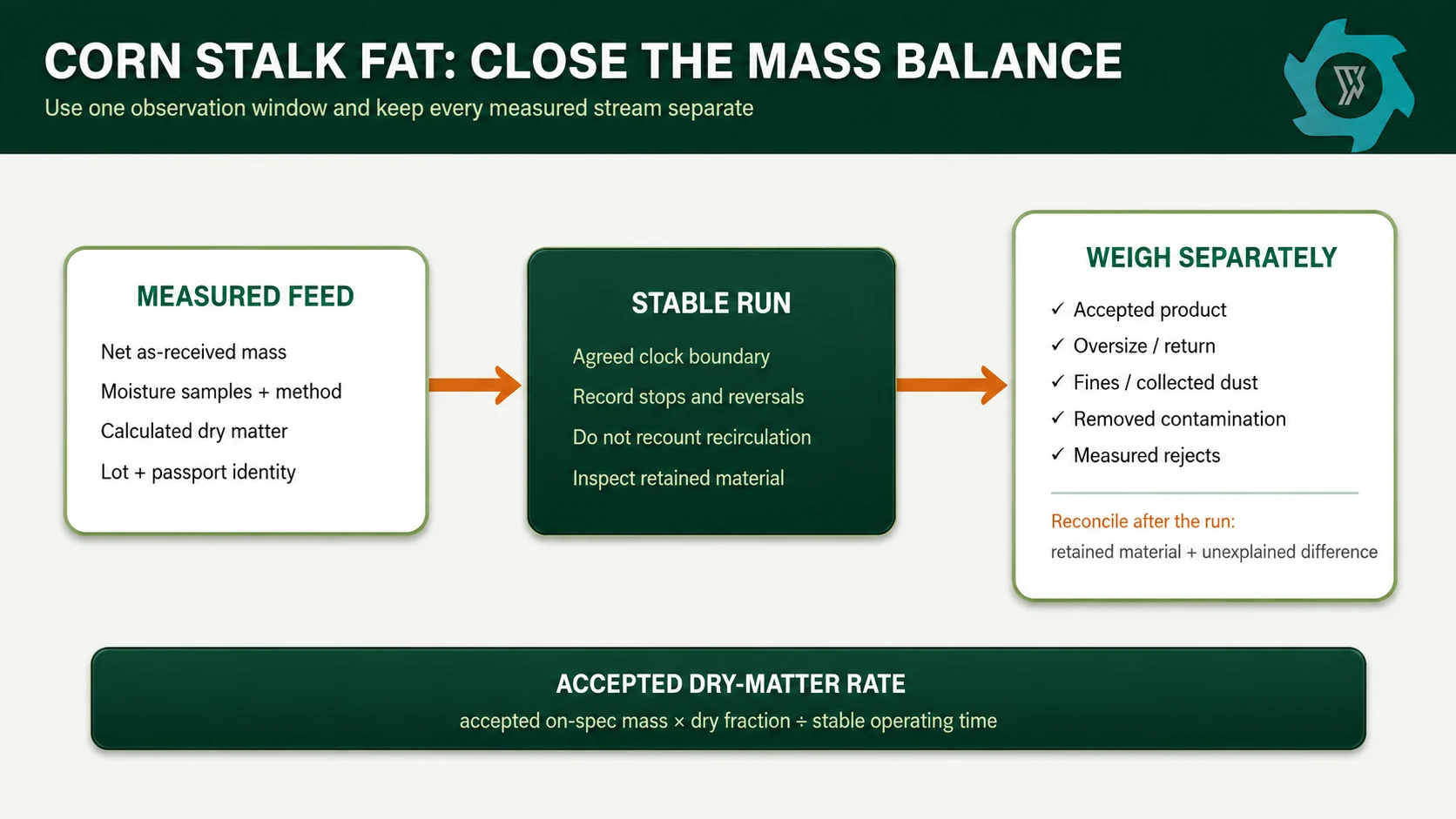
| FAT field | Required record |
|---|---|
| Feed identity | Passport, lot, presentation, fraction mix, moisture samples, bulk density, soil and foreign material |
| Test boundary | Start and stop rules, stable operating time, planned stops, downstream availability and internal recirculation |
| Input | Net as-received feed mass and calculated dry matter using the agreed moisture method |
| Outputs | Accepted product, oversize/return, fines, removed contamination and rejects, all kept separate |
| Quality | Particle-size distribution, moisture and any downstream-specific contaminant or ash test |
| Operation | Stops, reversals, bridges, wraps, manual actions, energy boundary, cutter condition and clean-out observations |
Material remaining in hoppers, conveyors, screens and collectors at the end of the test must be reconciled separately. Do not label the unexplained balance as a directly weighed “loss,” and do not combine it with measured rejects. Agree the permissible mass-balance tolerance and sampling method before the run.
Write the sampling plan before seeing the output
A single grab from the top of a pile can miss long pieces, dense cob fragments and fine soil. Define the lot, sample location, increment interval, increment mass, number of increments, compositing method, sample reduction, test method and retained-sample period before the FAT. Collect increments across the full stable run, including normal feed variation, and prevent operators from hand-selecting favorable material.
| Stream | Minimum purpose | Do not combine with |
|---|---|---|
| Incoming feed | Moisture, fraction mix and contamination on the agreed lot basis | Output samples collected after drying or contamination removal |
| Accepted product | Particle distribution, moisture and downstream quality checks | Oversize return or screen reject |
| Oversize / return | Quantify recirculation burden and diagnose cutter or screen mismatch | Final accepted output, even if it later passes after recutting |
| Fines / collected dust | Quantify yield loss and dust-generation consequence | Measured soil or other removed contamination |
| Rejects and contamination | Attribute supplier, collection or inspection failures by cause | Unexplained mass-balance difference |
Retain a sealed feed and accepted-product sample from each test lot with its moisture basis and chain of custody.
Plan commissioning as a controlled campaign
The DOE Feedstock-Conversion Interface Consortium focuses on quantifying and reducing the effect of feedstock variability on conversion performance, while Idaho National Laboratory’s Biomass Feedstock National User Facility uses modular, integrated preprocessing to de-risk scale-up.6,7
| Campaign | Purpose | Release condition |
|---|---|---|
| A — normal dry baled lot | Establish baseline opening, metering, cutting, dust and output data | Stable flow and qualified output across the agreed run |
| B — difficult dry lot | Test low density, long bundles and higher fines without changing the contract boundary | Safe clearing; limits and alternate recipe documented |
| C — approved damp lot | Validate torque, discharge and screen/bypass response | Conditional operating window and hold point documented |
| D — higher-soil but acceptable lot | Verify receiving control, cleaning route, wear observation and product-quality impact | Contamination accounting closes and output remains within specification |
| E — changeover / clean-out | Measure retained material, cross-lot carryover and clean-out time | Next lot can be traced without hidden mixing |
Keep a 90-day baseline that operators can actually maintain
During the first 90 operating days, preserve a small set of comparable shift records: accepted as-received and dry tonnes, scheduled and running hours, loader hours, energy boundary, reversals, bridges and wraps by cause, unplanned maintenance, cutter inspection or rotation, fines and oversize shares, hydraulic or bearing temperatures where applicable, and rejected feed by reason.
Normalize consumables and interruptions to accepted dry output, not only incoming wet tons. Review results by feedstock passport. Otherwise, a wet or dirty campaign can make unit energy, wear and labor appear better or worse for the wrong reason.
Qualified yield = accepted on-spec dry mass ÷ accepted incoming dry mass
Intervention rate = bridges + wraps + manual feed corrections ÷ accepted dry tonnes
Questions to include in the RFQ
- Does “corn stalk” include leaves, husks, cobs, root material or remaining grain?
- Which harvest forms, bale dimensions, ties and moisture bands are included in the proposal?
- What soil, stone, metal, film and twine limits define accepted feed?
- Which equipment opens bales, absorbs feed surges and meters the shredder?
- Which dry and wet feed conditions have been tested, and how did settings change?
- How are long fibers, fines and oversize sampled and reported by mass?
- Is capacity stated for wet input, dry-matter input, total discharge or accepted on-spec dry output?
- Where does each contaminant leave the line, and what remains the operator’s responsibility?
- Which dust and fire protection boundaries are included, and which require site engineering?
- What access, wear parts, inspection intervals and safe clearing provisions are supplied?
- Which downstream equipment—drying, pelletizing, composting, digestion or other conversion—is explicitly excluded?
Configure the line around your delivered corn residue
Send YUXI representative photos and video, harvest form, bale data, moisture range, contamination, required particle distribution and accepted dry-output target.
Frequently asked questions
Can fresh and field-dry corn stalks use the same shredder settings?
Not automatically. Fresh or damp stalks tend to bend and compress, while dry stalks fracture more readily and create more fines. Validate feed rate, cutter setting, screen route and discharge behavior for each approved condition.
How should corn stalk line capacity be measured?
State incoming as-received rate, dry-matter feed rate and accepted on-spec dry-matter output over an agreed stable operating period. This prevents moisture, recirculated oversize or rejected material from inflating the result.
Does every corn stalk line need fine grinding?
No. Add secondary grinding only when the receiving process requires a smaller, verified particle distribution. Unnecessary fine grinding increases energy use, wear, fines and dust-control duty.
What contaminants should be checked before shredding corn stalks?
Check for soil, stones, root balls, baling wire or twine, plastic film, metal and any chemically treated or otherwise prohibited material. Define a visible hold or reject route before the feed reaches the shredder.
Engineering references
- UMN residue: crop management.
- Ash reduction: corn stover.
- Corn stover fractions: separation.
- Moist biomass: preprocessing.
- OSHA dust: hazards.
- FCIC: variability.
- INL facility: preprocessing.