




 Request Quote



Refrigerator Plastic Recycling: ABS, HIPS, PP and Mixed-Plastic Challenges
Once a refrigerator is broken down, its plastic output is rarely one neat resin stream. After the steel, non-ferrous metals, and most of the PU foam are removed, the remaining fraction can still be quite mixed. ABS, HIPS/PS, and PP may be present together with labels, rubber pieces, dust, glass, and traces of metal. If a cleaner plastic grade is needed, this mixed fraction normally has to go through another sorting step before it is ready for sale or further processing. That difference matters because a plastic-rich fraction is not automatically a polymer-grade feedstock.
YUXI’s waste refrigerator recycling line is designed to liberate the cabinet and recover metals, foam and a recyclable plastic fraction. If the target is separated ABS, HIPS or PP flake, the project usually needs a dedicated downstream plastic-sorting scope rather than simply another pass through the metal-separation section.
Refrigerator plastics are a family of materials, not one “plastic”
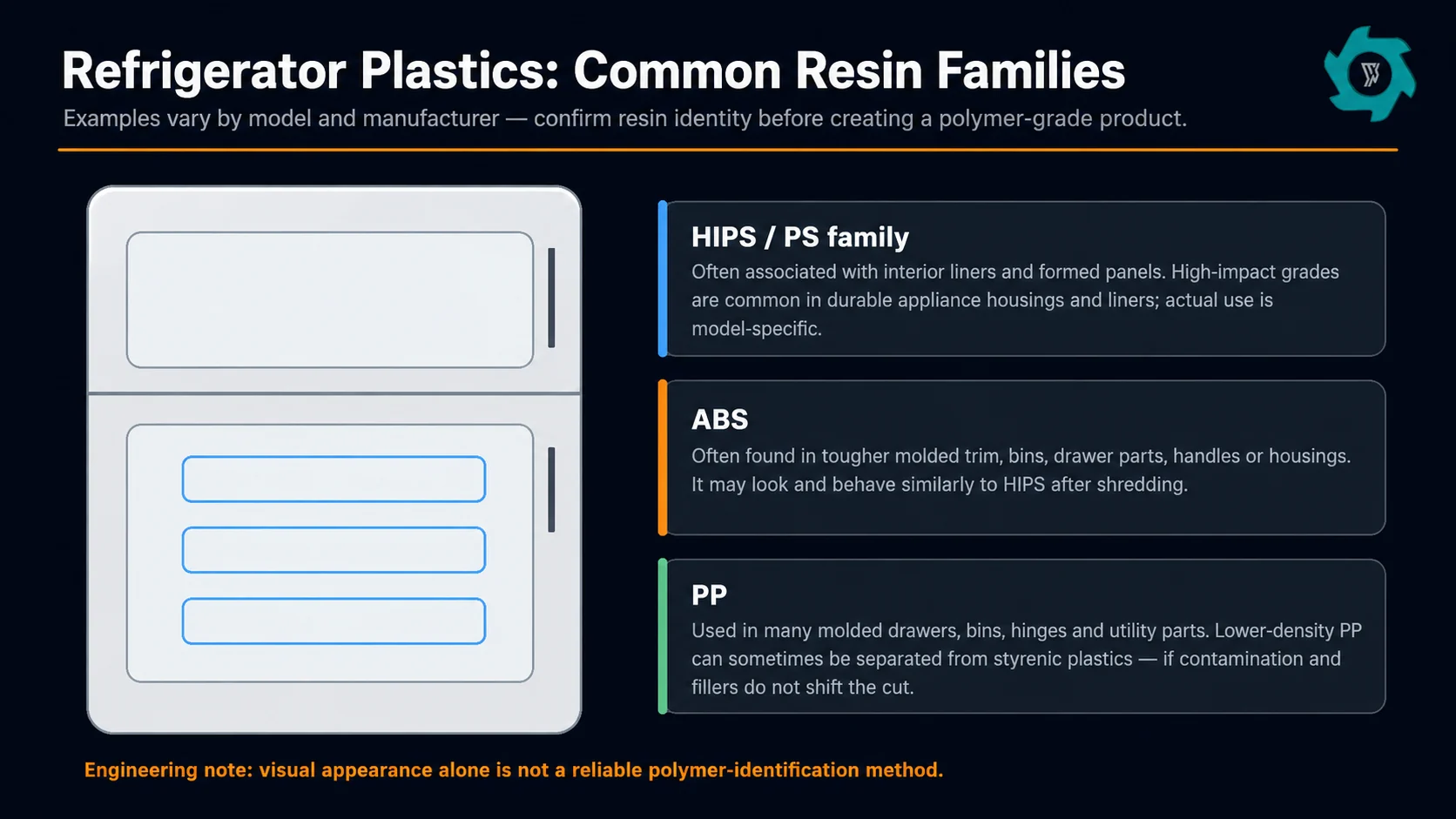
Modern refrigerators use multiple polymers because the parts do different jobs. A rigid inner liner, a tough drawer, a hinge, a decorative trim piece and a compressor-area cover do not need the same stiffness, impact resistance, surface finish or temperature behavior. Across appliance designs, HIPS/PS, ABS and PP are among the important recyclable thermoplastics associated with refrigerator and appliance plastics.12
| Polymer family | Where it may appear | What matters in recycling |
|---|---|---|
| HIPS / PS family | Interior liners, formed panels and other rigid parts in some designs | Can be difficult to separate cleanly from ABS because the two can overlap in density and visual appearance. |
| ABS | Durable molded trim, bins, drawers, handles or housings depending on the model | Higher-value recycling depends on removing non-plastic contamination and separating it from PS/HIPS and other engineering plastics. |
| PP | Drawers, bins, hinges and other molded utility parts in many appliance designs | Its lower density often creates a useful separation opportunity, but fillers, attached labels and mixed pieces can shift actual behavior. |
| Other plastics | Gaskets, films, cable insulation, small molded parts and legacy components | They can become cross-contamination if the output is sold as a narrow polymer grade. |
Do not specify the downstream system around a brochure statement such as “refrigerator plastic.” Specify the incoming appliance mix, the plastic-rich fraction you expect after appliance processing, and the product the recycler or compounder is willing to buy.
The first challenge is liberation, but the second is polymer identity
The appliance line must first free the plastic from steel sheet, insulation foam and attached metal. That is why primary shredding, secondary liberation, foam extraction and metal recovery still matter to plastic quality.3 The YUXI guide on improving refrigerator material separation covers that upstream problem in detail.
Once a plastic-rich fraction exists, the remaining job is no longer mainly “metal versus non-metal.” It becomes polymer versus polymer. Research on waste-refrigerator plastics has specifically identified ABS and HIPS as difficult to distinguish with simple physical separation because their properties are close; industrial studies therefore add more controlled fine-sorting steps after impurity removal and particle preparation.14
Why ABS and HIPS are the difficult pair
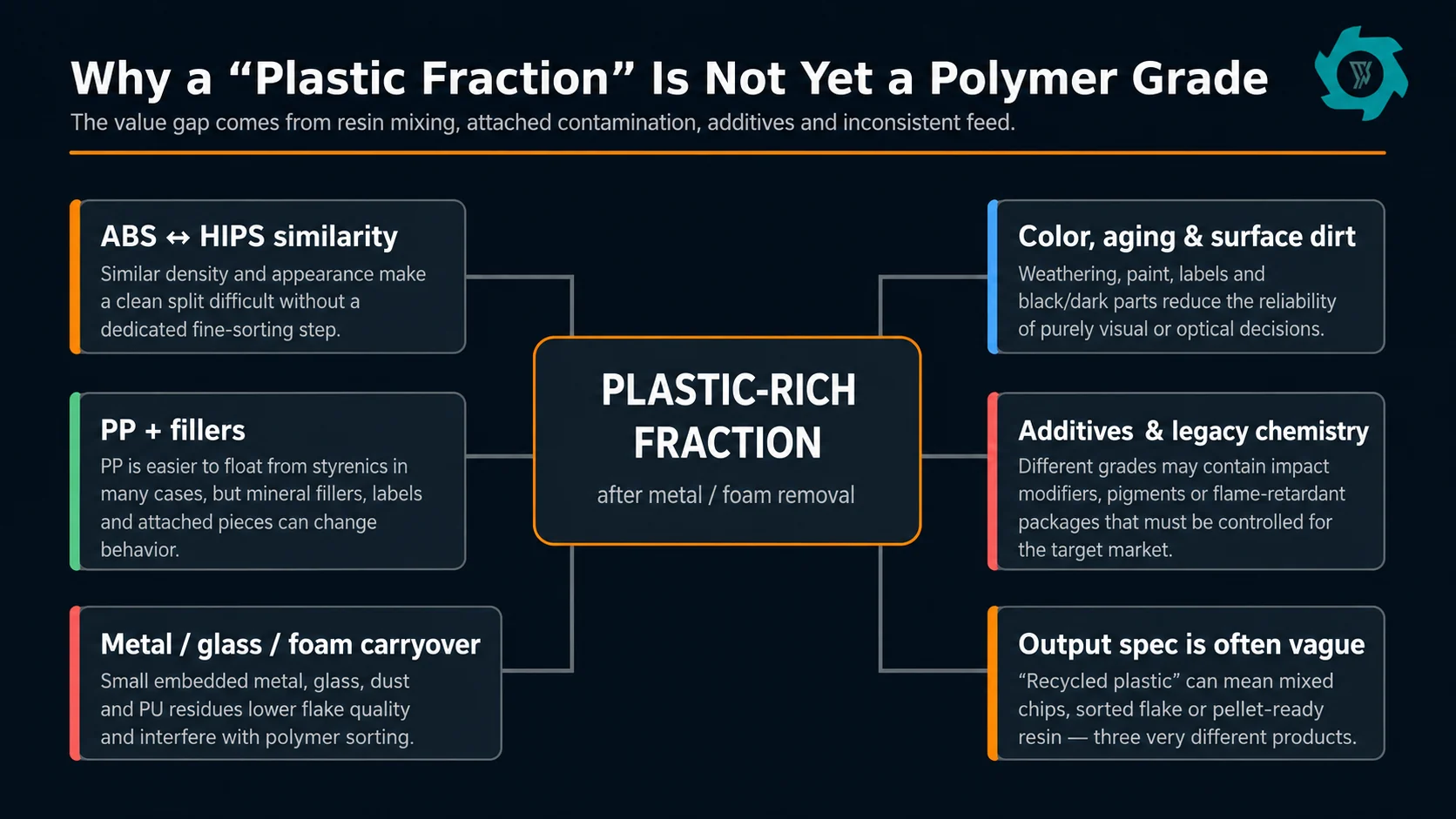
PP is not always easy, but ABS and HIPS create the more important fine-sorting problem. In a clean laboratory sample, polymer identity can be confirmed with spectroscopy or other analytical methods. In an industrial flake stream, however, the separator has to work continuously on pieces that vary in color, thickness, surface condition, size and history.
ABS and HIPS can occupy a similar density range. After shredding they can also look very similar, especially when parts are white, gray or dark. A simple sink-float stage that works well for a PP-rich light fraction may therefore leave ABS and HIPS together in the heavier stream. Published refrigerator-plastic work has addressed this with electrostatic separation in combination with impurity removal and staged physical sorting.1
That does not mean every plant needs the same electrostatic separator. It means the flowsheet should be selected around a representative sample. If the buyer accepts an ABS/HIPS mixed product, splitting the two may add cost without adding value. If the buyer requires individual resin grades, then the ABS/HIPS cut becomes a core design duty rather than an optional polishing step.
PP can be easier to split — until real feed changes the density cut
PP typically has a lower density than ABS and HIPS, so density-based separation can be used as one method for processing pretreated mixed plastics. However, fillers, residual metals, labels, rubber fragments, trapped air, and bonded composite materials can alter the effective density and behavior of individual particles, which may affect separation performance in sink-float tanks or other density separation equipment.
After years of service, plastics recovered from waste appliances can show both material degradation and considerable variation in composition. Research on mechanically recycled PP from waste appliances emphasizes degradation and heterogeneity as key variables when deciding whether recycled PP is suitable for a new application.2
For that reason, “PP floats” is a useful process starting point, not a product guarantee. The line still needs a controlled flake size, stable washing or dry-cleaning condition, and a sampling method that measures what reports to both sides of the cut.
Where the refrigerator recycling line should stop
There are two valid project boundaries, and confusing them creates bad quotations.
Boundary A — appliance recovery: the line liberates the refrigerator cabinet, removes foam, recovers ferrous and non-ferrous metals, and discharges a plastic-rich fraction. This is consistent with the YUXI pillar page, which describes plastics as a recovered fraction after size reduction and separation, not as guaranteed single-resin pellets.
Boundary B — polymer upgrading: the plastic-rich fraction is further screened, cleaned, dried and sorted into PP-rich, ABS-rich, HIPS-rich or other buyer-defined grades.This may require density, electrostatic or optical sorting, while XRF or other analytical screening may be added where elemental or additive controls are required.
EPA’s current appliance-disposal guidance also illustrates why this distinction matters commercially: metals are routinely recovered, while plastics and foam are not always recycled in real-world appliance handling even though they are technically recoverable.5 A project that wants higher plastic value therefore has to define the downstream market instead of assuming that “plastic recovery” and “polymer recycling” are the same scope.
A practical downstream sorting route
1. Stabilize the plastic-rich feed
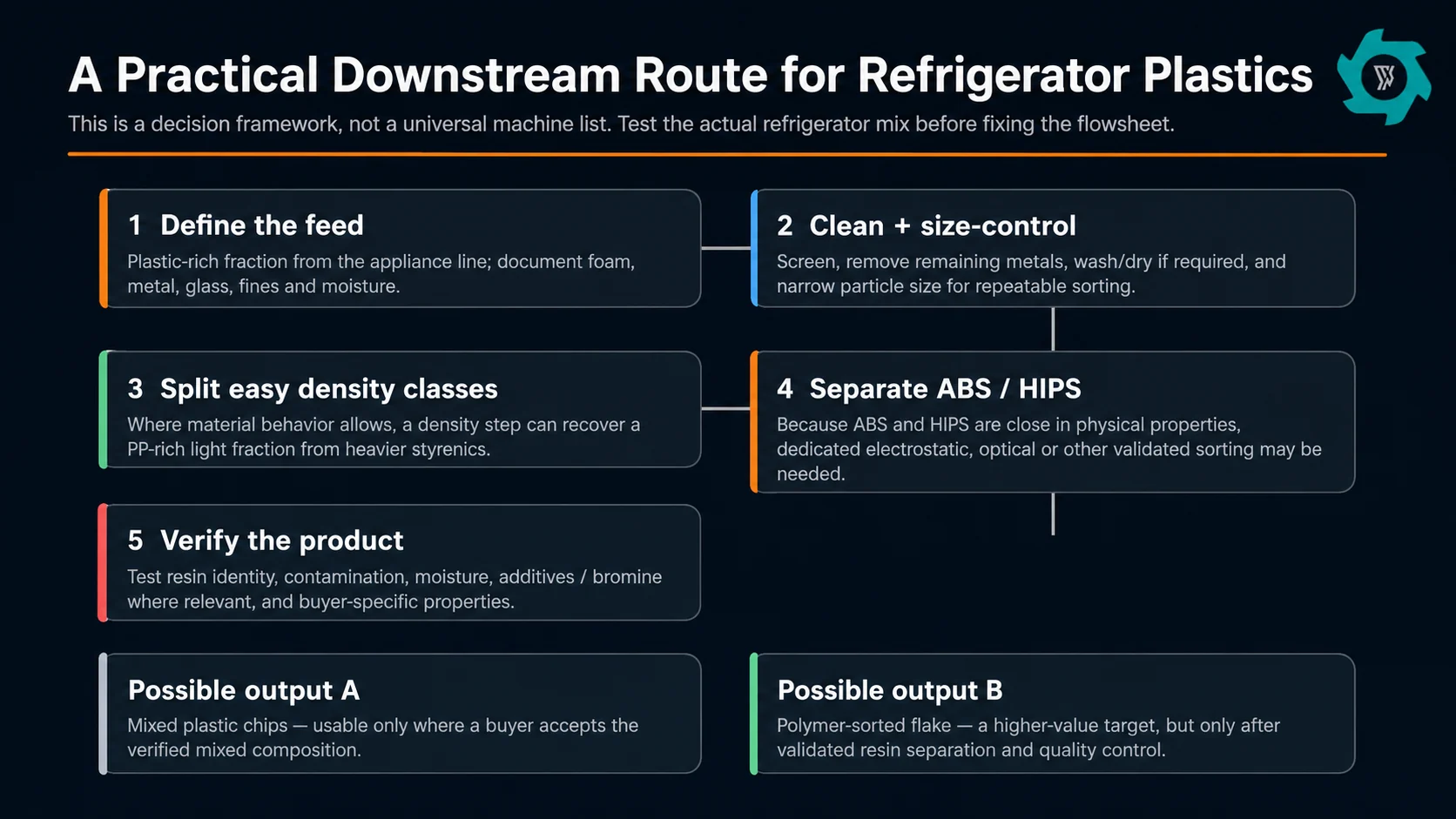
Start with the fraction after foam and metal separation. Record its particle-size distribution, moisture, metal carryover, foam carryover, glass, fines and the approximate share of large molded pieces versus thin liner flakes. Do this before choosing the fine separator. A separator selected on a hand-picked clean sample can look impressive in a test and fail on shift material.
2. Remove embedded impurities before fine polymer sorting
Small steel pieces can stay encapsulated inside plastic after shredding. Published refrigerator-plastic work has used staged magnetic separation to reduce this kind of impurity before polymer recovery.1 Glass and grit also matter because they raise ash, accelerate wear and reduce the value of a recycled flake.
Washing may be needed where food residue, labels, oil or dirt is significant. Dry routes can be appropriate for cleaner industrial streams, but electrostatic and optical separation generally benefit from controlled surface condition and particle size. The correct answer depends on the feed, not on a universal appliance-recycling recipe.
3. Use density to simplify the mix where it creates a real cut
If a representative sample shows a stable density gap, a density step can remove a PP-rich light fraction from heavier styrenic plastics. The aim is not to claim perfect polymer purity in one pass. It is to reduce the complexity of the stream so the next separator sees fewer competing materials.
Take samples from the light product, heavy product and middlings. If PP recovery improves but too much ABS/HIPS is misplaced, the cut may need a narrower particle-size range, a different medium density or recirculation of borderline material.
4. Treat ABS/HIPS separation as a dedicated fine-sorting duty
Research on refrigerator plastics has demonstrated combinations of electrostatic and other physical separation methods for ABS/HIPS purification.14 Optical systems can also contribute where surface color and spectral response are suitable, but dark plastics, contamination and labels can reduce reliability.
A good supplier should be willing to define the required feed condition for this stage: minimum and maximum flake size, moisture, metal contamination, dust level and expected polymer mix.
Important equipment distinction: polymer–polymer electrostatic sorting for an ABS/HIPS split is a different duty from a conductor/non-conductor electrostatic separator used to remove fine metal from plastic. Do not assume one machine specification covers both jobs.
Additives and bromine screening can change the acceptable market
Polymer identity is only one part of product quality. WEEE plastics can contain pigments, impact modifiers, mineral fillers and flame-retardant packages. Brominated flame retardants are a known issue in some WEEE plastic streams, and studies using handheld XRF have shown that bromine distribution can be highly uneven across devices and plastic components.6
This does not mean every refrigerator ABS or HIPS part should be treated as brominated. It means a recycler targeting a regulated or tightly specified end market should not infer additive compliance from resin identification alone. Depending on the destination and local rules, screening may need to include bromine or other restricted substances, followed by more specific laboratory analysis where required.
Do not confuse mixed chips, sorted flake and pellet-ready feed
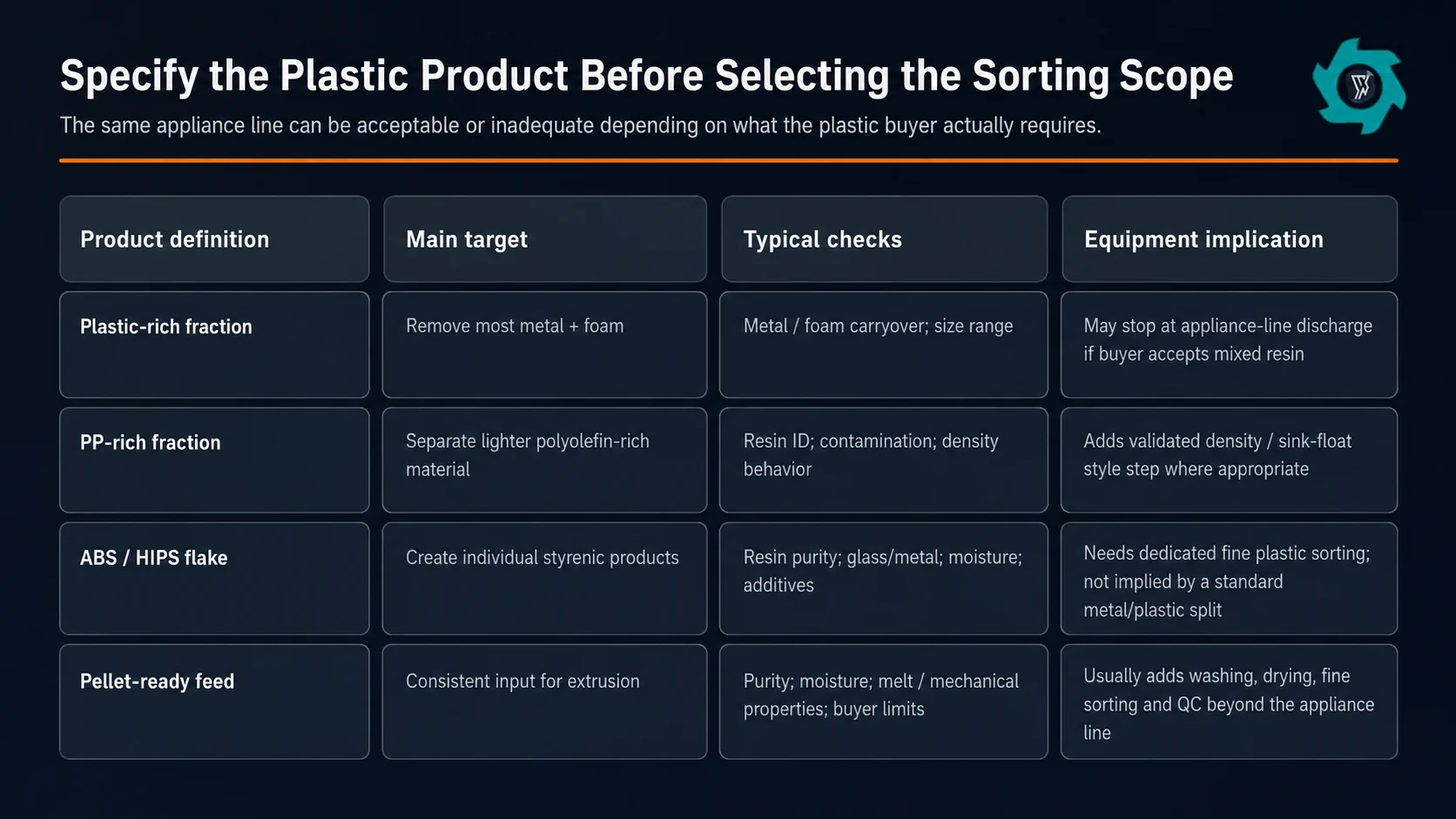
One of the easiest ways to avoid project disputes is to name the product precisely:
- Plastic-rich fraction: most metal and foam have been removed, but multiple polymers remain mixed.
- PP-rich fraction: a light polymer product dominated by PP, with a defined contamination limit.
- ABS-rich or HIPS-rich flake: a polymer-sorted product with a stated resin purity and limits for glass, metal, moisture and other plastics.
- Pellet-ready feed: a prepared flake with the moisture, purity and consistency required by the downstream extrusion or compounding process.
What should be measured during FAT?
A factory acceptance test for the plastic section should use the same logic as a metal-separation test: define both the product and the losses. A very clean ABS sample is not a good result if a large share of ABS was discarded with HIPS or residue.
| Item | What to define before the test | Why it matters |
|---|---|---|
| Feed lot | Appliance source, pre-treatment condition, mass, moisture and representative polymer mix | Prevents a hand-picked feed from representing the whole project. |
| Particle size | Target range and oversize/fines limits | Density, electrostatic and optical behavior all change with size. |
| Product definition | Mixed fraction, PP-rich, ABS-rich, HIPS-rich or pellet-ready feed | Determines which purity number is meaningful. |
| Resin purity | Sampling method and polymer-identification method | Visual sorting alone is not enough for a narrow resin specification. |
| Contamination | Metal, glass, foam, rubber, PVC/other polymers, moisture and fines as relevant | Small amounts can change buyer acceptance and extrusion behavior. |
| Recovery | Target polymer captured versus target polymer lost to other streams | Stops purity from being optimized by simply throwing good material away. |
| Additives | Bromine or restricted-substance screening where required by the end market | Resin identity does not prove additive compliance. |
Common mistakes in refrigerator plastic recycling projects
Assuming the appliance line automatically makes pure ABS, HIPS and PP
Metal-plastic separation and polymer-polymer separation are different duties. The first can create a cleaner plastic-rich stream. The second may require dedicated downstream technology.
Choosing the fine separator before testing the plastic stream
The best separator on the wrong feed condition is still the wrong system. Use representative material after the actual appliance line, not clean virgin resin samples.
Ignoring moisture, dust and particle-size distribution
Fine sorting is less forgiving than coarse metal recovery. Dryness, size range and surface contamination can determine whether an electrostatic or optical process is stable.
Writing “plastic purity ≥ X%” without defining the resin
A 98% plastic product could still be an unusable ABS/HIPS/PP blend for a buyer who needs one polymer. Specify resin purity and non-plastic contamination separately.
Testing only the saleable product
Always sample the reject and middlings as well. A cleaner product can hide a large recovery loss.
How YUXI should define the plastic scope in a refrigerator project
For a standard refrigerator recycling proposal, YUXI should first define the condition of the plastic-rich fraction leaving the appliance mechanical line: expected size range, remaining metal/foam contamination and the point where the customer’s downstream plastic process begins. If the project requires polymer-specific products, the RFQ should include representative plastic samples and the buyer’s target specification before a fine-sorting route is selected.
FAQ: Refrigerator Plastic Recycling
What plastics are commonly recovered from refrigerators?
ABS, HIPS/PS, and PP are common recyclable thermoplastics found in refrigerators and other white goods, but the specific materials used can vary depending on product design and manufacturer. Therefore, the actual polymer composition should be verified before the material is sold as a single-resin grade.
Can ABS and HIPS be separated by density alone?
Not reliably in many mixed refrigerator streams. ABS and HIPS can occupy similar density ranges, so a density step may simplify the feed but usually does not guarantee a clean ABS/HIPS split. Dedicated fine sorting may be required.
Is PP easier to separate from refrigerator plastics?
Often, because PP is generally lower density than ABS and HIPS. However, fillers, attached contamination, labels and composite pieces can change particle behavior, so the density cut should be validated with representative material.
Does a refrigerator recycling line produce pellet-ready plastic?
An appliance line can recover a plastic-rich fraction after metal and foam removal. Pellet-ready feed normally needs additional preparation such as cleaning, size control, polymer sorting, drying and quality verification.
Why are small metal and glass residues a problem?
They lower flake value, interfere with fine polymer sorting, increase wear and can create problems in downstream extrusion. Impurity removal should be measured before the polymer-sorting stage.
What should be included in a plastic-sorting FAT?
The feedstock batch, particle size, and moisture level should be clearly defined, along with the product name, polymer identification method, resin purity, non-plastic contamination, recovery rate, and material losses. If required by the end market, relevant additive or bromine screening results should also be provided.
Define the plastic product before adding more sorting equipment
Send YUXI representative refrigerator samples, the current pre-treatment condition, the plastic-rich fraction after your existing process, and the product specification required by your buyer. We can then separate the appliance-recovery duty from any additional polymer-sorting scope and build the process around the real feed.
References
- Qin et al. — ABS/HIPS recycling LCA.
- Ha and Kim — PP appliance recycling.
- Ruan and Xu — refrigerator cabinet recovery.
- Dong et al. — ABS/PS regeneration.
- U.S. EPA — appliance disposal.
- Jandric et al. — brominated plastics.