




 Request Quote



When a refrigerator recycling line produces dirty steel, a non-ferrous fraction full of plastic, or too much metal in the residue, the first reaction is often to blame the separator. In practice, the problem frequently starts one or two machines earlier. A magnetic separator cannot pull clean steel out of a plastic-steel composite that was never opened properly, and an eddy current separator cannot compensate for a deep, foam-rich burden that changes from minute to minute.
The useful way to improve material separation is to treat the whole mechanical section as one connected preparation-and-sorting system. The YUXI waste refrigerator recycling line follows that logic: pre-treatment is followed by shredding, secondary liberation, foam removal, ferrous recovery and non-ferrous separation. Each stage should leave the next one with a more controllable feed.
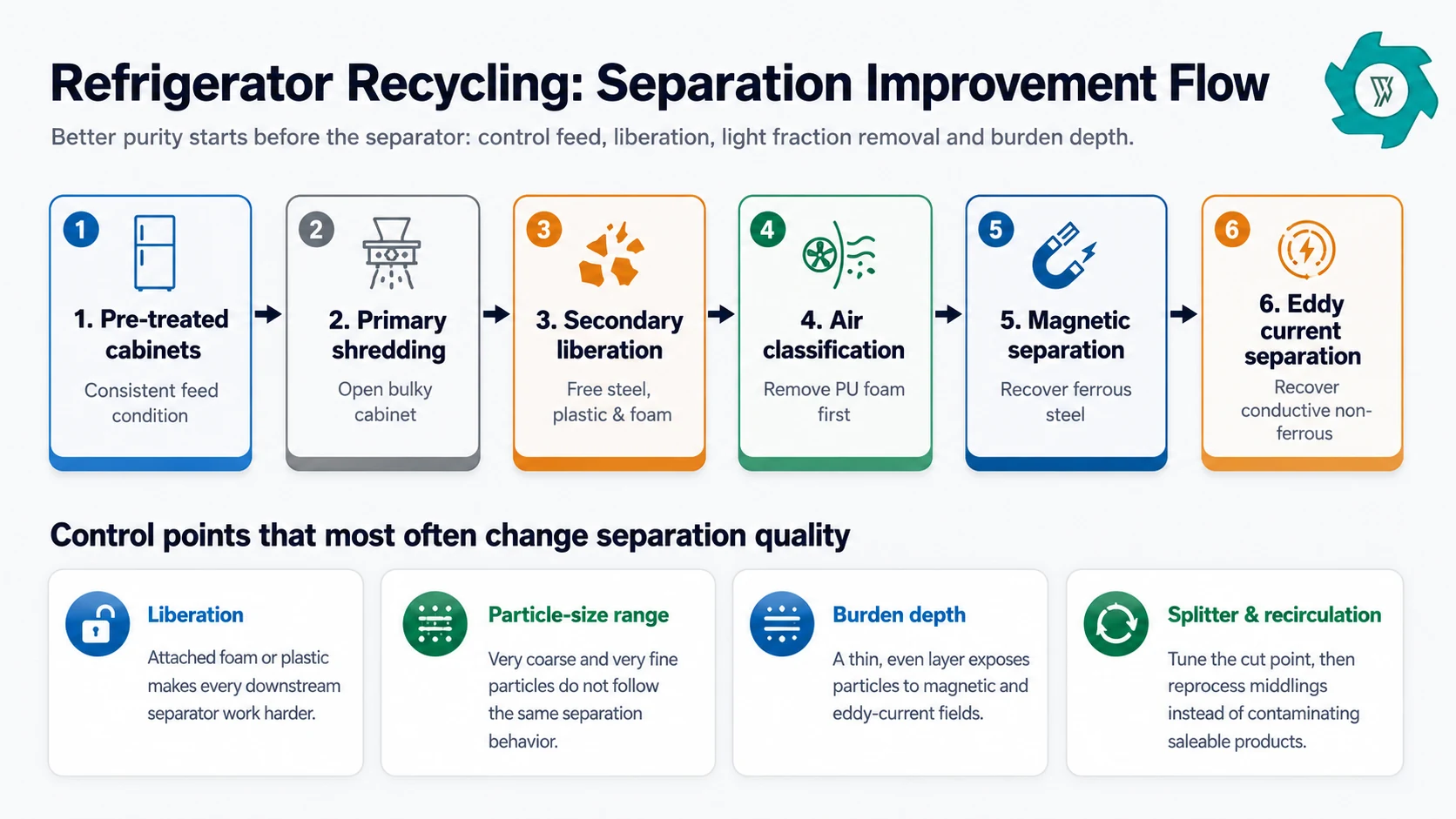
Start by Defining What “Better Separation” Means
“High purity” is too vague for troubleshooting. Before changing a machine setting, identify which product is failing and how. Is the ferrous fraction carrying plastic and foam? Is non-ferrous metal disappearing into the residue? Is the plastic stream contaminated by copper-bearing pieces? Or is the plant making acceptable samples for ten minutes but losing quality over a full shift?
1. Make the Pre-Treatment Feed More Consistent
Refrigerators that arrive with different loose parts, glass, compressors, wiring, food residue, or other foreign material create a changing burden downstream. The mechanical line then has to process not only different cabinet constructions but also avoidable contamination.
The plant should therefore define what a “ready for shredding” cabinet looks like. Refrigerant handling, compressor and oil removal, and the decision about glass or loose internal parts should be consistent from unit to unit. YUXI’s guide to refrigerator depollution before shredding is useful here because a clean process boundary reduces the number of surprises that later show up as separation problems.
2. Improve Liberation Before Adding Another Separator
Primary shredding mainly reduces the bulky cabinet into pieces that can be conveyed and processed. It does not guarantee that the steel skin, plastic liner, insulation foam and small non-ferrous parts have separated from one another. That is the job of the liberation stage.
When too many composite pieces remain, every downstream machine is forced to make an impossible choice. A steel sheet with plastic still attached may report to the magnetic product and carry plastic with it. A copper-bearing piece trapped in plastic may not follow the trajectory expected by the eddy current separator. Foam still bonded to cabinet fragments can also distort air classification.
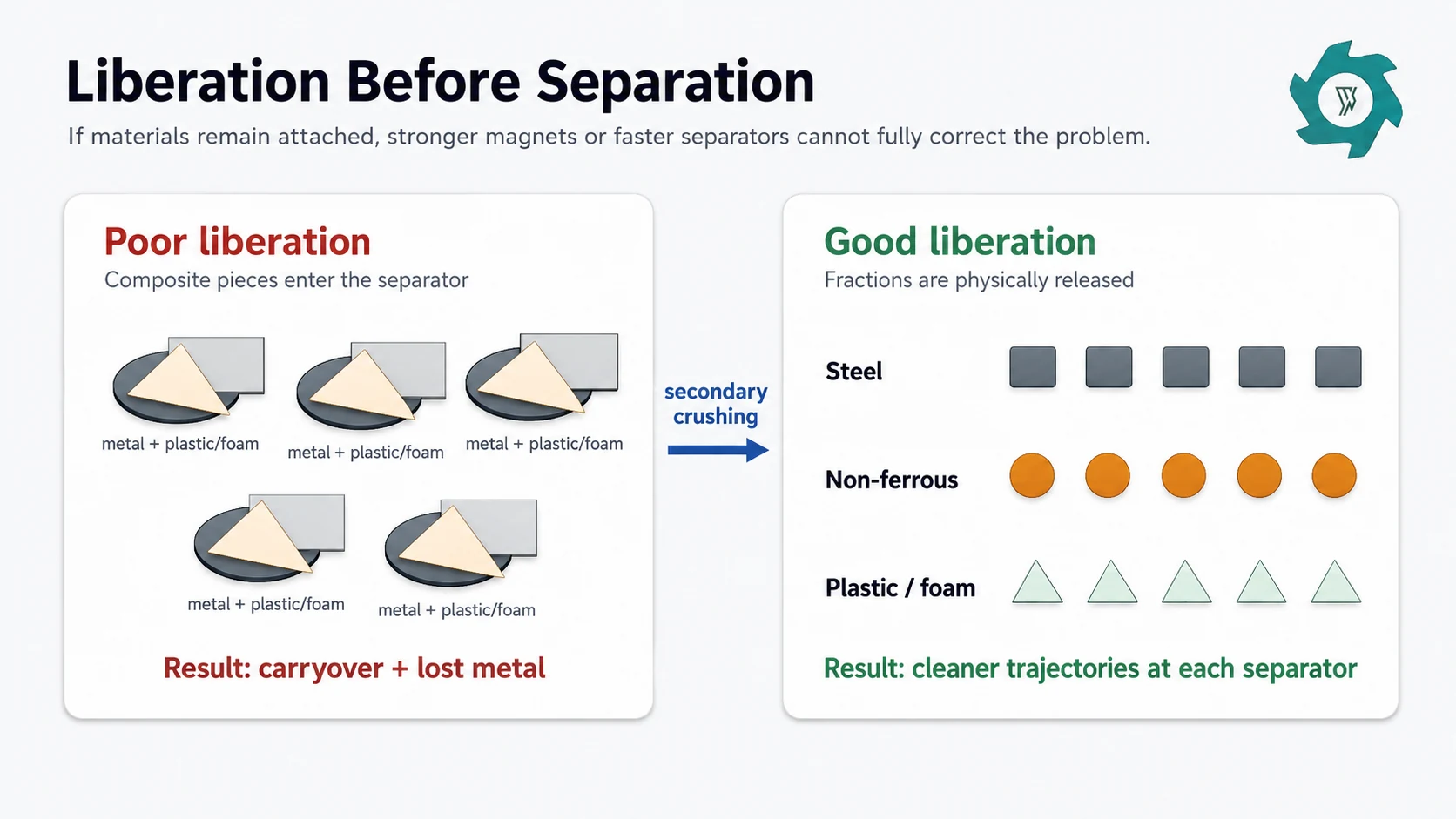
If the metal products are contaminated, inspect the material immediately after the secondary crusher. Look for attached foam, plastic-metal laminates, folded sheet around wires, and thick composite lumps. If those are common, changing a splitter plate several machines later may only hide the real cause.
3. Control Particle Size Instead of Sending Everything to One Setting
A very broad particle-size range makes separation harder. Large flat sheet pieces, small copper fragments, light foam particles and fines do not move through air, magnetic fields or the discharge trajectory in the same way. One separator setting is being asked to solve several different physical problems at once.
Where the process justifies it, screening or another size-control step can narrow the range before fine separation. The goal is not to create more machines for the sake of complexity. It is to stop coarse particles from dictating a setting that loses fines, or fines from forcing a cut point that contaminates the coarse product.
Different eddy current rotor designs are offered for coarse, fine and ultra-fine fractions, which is a useful reminder that particle size should be treated as a design input rather than an afterthought.
4. Remove PU Foam Before It Overloads the Metal Sorting Stages
Refrigerator insulation is light, bulky and easy to entrain. Once it is released from the cabinet, the foam can occupy a large share of the visible material volume even though it contributes much less mass than the steel. If that light fraction is allowed to ride through the entire metal separation train, it deepens the burden, hides small particles and increases the chance of carryover.
A stable air-classification system should therefore be treated as a process circuit, not just a fan. The classifier, ducts, cyclone, filter, rotary discharge and collection point all affect the pressure balance. Air leaks, filter loading or unstable feed can change the cut even when the fan speed has not changed.
Too much air can pull desirable light pieces into the foam stream; too little leaves foam in the heavy stream. Sample both outputs after the system stabilizes, then adjust around the actual particle-size range and the buyer’s product specification.
5. Keep the Burden Thin and Even Before the Magnet and ECS
Separator nameplates assume the material is presented to the machine in a usable way. A conveyor loaded in piles produces a different result from the same mass spread across the working width. Particles buried under other material may never see the effective magnetic field or may leave the belt with a trajectory dominated by the pieces around them.
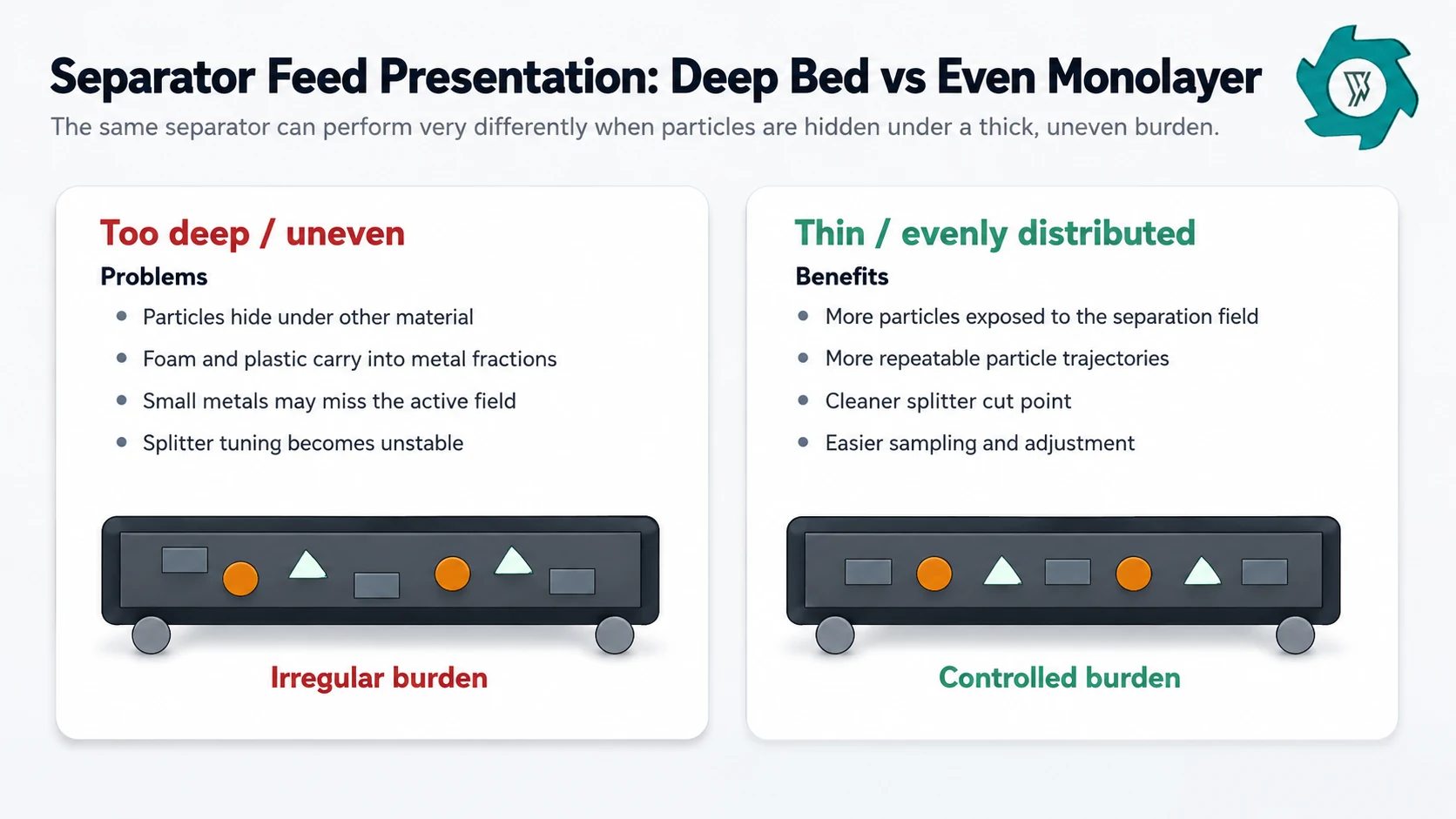
Check the transfer point before the separator. A small chute change, spreader, feeder adjustment or lower surge rate may improve product quality more than a larger separator. This is especially important when throughput is increased. The refrigerator recycling capacity guide explains why a line can keep moving material at a higher rate while separation quality falls because the burden becomes too deep.
6. Improve Ferrous Recovery Before Non-Ferrous Sorting
Ferrous steel is normally the largest recovered metal fraction from a refrigerator cabinet. Removing it well simplifies the rest of the process. If steel reaches the eddy current separator, it adds unnecessary burden and can destabilize the downstream split.
Magnetic performance depends on more than field strength. Liberation, particle size, belt speed, burden depth, magnet position and the way the product leaves the magnetic field all matter. A tangled mass of steel and plastic can pull non-magnetic material into the ferrous product. A deep layer can hide smaller ferrous pieces beneath non-magnetic material.
Before increasing magnetic intensity or changing hardware, inspect the feed bed and the discharge. Also check for re-mixing where the magnetic product drops into a bin. A clean separation can be lost in the last meter if two trajectories overlap or if a full bin forces operators to combine products temporarily.
7. Tune the Eddy Current Separator Around the Actual Size Fraction
An eddy current separator creates a rapidly changing magnetic field that induces currents in conductive non-ferrous particles. The resulting repulsive force changes their discharge trajectory relative to non-conductive material. In refrigerator recycling, this is useful for recovering aluminum and copper-bearing pieces after ferrous material has been removed.
Particle size, shape, conductivity, belt presentation, rotor configuration and splitter position all change the cut. Fine particles have shorter trajectories than larger pieces, while broad size variation makes one splitter position a compromise.
When non-ferrous metal remains in the residue, do not move the splitter immediately. First confirm that the feed is evenly distributed and largely free of steel. Then check whether the size range fits the rotor and whether the belt and rotor settings match the intended fraction. After that, adjust the splitter in small, measurable steps and resample both products.
8. Do Not Assume One Eddy Current Pass Creates Finished Copper and Aluminum Grades
An eddy current separator is excellent at separating conductive non-ferrous metals from a prepared non-metal stream. That does not mean it automatically produces individual copper and aluminum products.
This is why the output specification should be fixed before final equipment selection. The refrigerator recycling equipment guide separates the roles of the magnet, eddy current separator, air classifier and optional fine-sorting equipment rather than treating all of them as interchangeable “sorting machines.”
9. Use Recirculation for Middlings Instead of Contaminating a Product
Some material sits close to the cut point. Trying to force every borderline particle into either the product or residue can increase contamination. A better approach for difficult fractions is often to create a small middlings stream and run it again, provided the extra circulation does not overload the line.
Multi-stage rougher, cleaner and scavenger concepts are used in metal recycling for the same reason: one pass can be tuned for recovery, another for product cleaning, and misplaced material can be reprocessed. The exact configuration for refrigerator scrap must be tested with refrigerator material, but the process principle is useful—separate recovery and cleaning duties instead of demanding both extremes from one cut.
10. Stop Re-Contamination After the Separator
It is surprisingly easy to lose separation quality after the machine has already done its job. Common causes include overlapping discharge trajectories, wind at open drops, overfilled bins, material bouncing out of a chute, forklift operators exchanging containers too late, or a conveyor carrying residue beneath an open product stream.
Trace each product from the separator to the final storage point. Check whether it crosses another stream, whether the drop height causes bounce, whether a bin can be changed without stopping the line, and where operators take samples. Product handling should preserve the cut rather than undo it.
11. Troubleshoot From the Dirty Product Backward
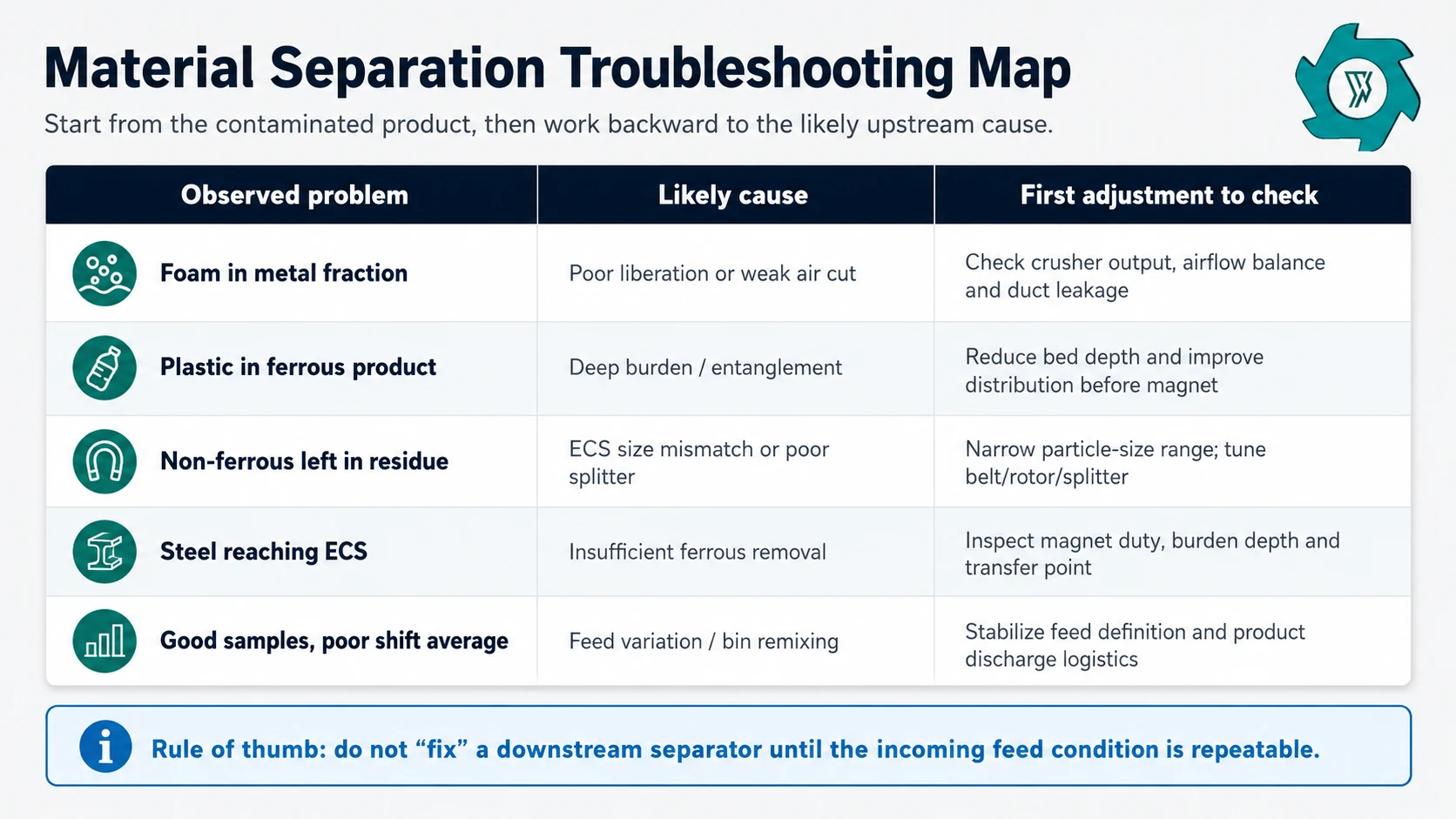
| Symptom | Likely first checks | What not to assume |
|---|---|---|
| Foam in metal product | Secondary liberation, airflow balance, duct leakage, filter loading | That a stronger magnet will solve it |
| Plastic in ferrous fraction | Composite pieces, tangled material, burden depth, discharge overlap | That magnet strength is the only variable |
| Non-ferrous metal in residue | Particle-size range, ECS feed distribution, residual steel, rotor/splitter setting | That moving the splitter alone is enough |
| Steel reaches ECS | Magnetic separation duty, burden depth, liberation and transfer point | That the ECS should be used as a ferrous cleaner |
| Good short test, poor shift average | Feed variation, surges, filter condition, bin changes and operator routine | That the peak test represents sustained quality |
12. Build a Simple Separation Control Loop
Once the line is mechanically stable, routine sampling keeps the settings from drifting. The plant does not need a laboratory at every conveyor. It does need consistent sample points, sample mass, timing and record keeping.
Sample the saleable product and residue, weigh or sort the unwanted fraction, record the current machine settings, change one variable, allow the line to stabilize, then sample again. Changing fan speed, belt speed and splitter position at the same time makes the result impossible to diagnose.
Variables worth recording during optimization
- Feed description and pre-treatment condition
- Throughput at the same process boundary
- Secondary crusher output condition and approximate size range
- Air classifier / fan setting and filter condition
- Separator belt loading and visible burden depth
- Magnet or ECS operating settings used for the test
- Splitter position
- Product sample weight, contamination and residue losses
FAQ: Improving Material Separation in Refrigerator Recycling
Why is refrigerator recycling separation sometimes poor even with good separators?
The separator may be receiving poorly liberated, foam-rich, uneven or overly broad particle-size material. Separation quality is a line problem, so feed preparation and presentation should be checked before changing the separator itself.
Should PU foam be removed before magnetic and eddy current separation?
In most refrigerator cabinet lines, removing the light PU foam after adequate liberation reduces downstream volume and carryover. The exact air-classification arrangement depends on particle size, airflow design and the required products.
How can magnetic separation of refrigerator steel be improved?
Start with adequate liberation and a controlled, reasonably thin burden. Check that material is distributed across the belt, that the magnet is positioned for the actual feed, and that discharge does not remix steel with non-magnetic material.
What affects eddy current separation in refrigerator recycling?
Particle size, conductivity, shape, belt presentation, rotor selection, splitter position and remaining ferrous contamination all affect the trajectory of non-ferrous pieces. A broad or unstable feed makes one fixed setting less effective.
Can an eddy current separator produce separate copper and aluminum products?
An eddy current separator is primarily used to separate conductive non-ferrous metals from non-metals. It may produce a mixed conductive fraction; separate copper and aluminum grades can require additional sorting depending on the feed and sales specification.
How should separation performance be checked during a factory acceptance test?
Use representative feed and define the process boundary, run duration, throughput basis, sampling method, product streams and contamination limits in advance. Measure both recovery and product quality rather than judging the line from appearance alone.
Improve Separation Around Your Real Refrigerator Feed
Send YUXI representative refrigerator or cabinet photos, the pre-treatment condition, required throughput, current product contamination and the fractions you need to sell. The separation route can then be checked from liberation and foam removal through magnetic and non-ferrous recovery.