




 Request Quote


Polyurethane insulation is easy to underestimate when a refrigerator recycling line is still on a flowsheet. It looks like a light by-product. Once the line is running, however, foam can become the material that decides whether the secondary crusher, air separator, cyclone, filter and discharge system behave as one stable process or as five separate machines fighting each other.
YUXI’s waste refrigerator recycling line places foam extraction after cabinet opening and secondary liberation, then combines it with dust collection and downstream metal separation.
In this guide
- Where foam separation fits
- Liberation before air separation
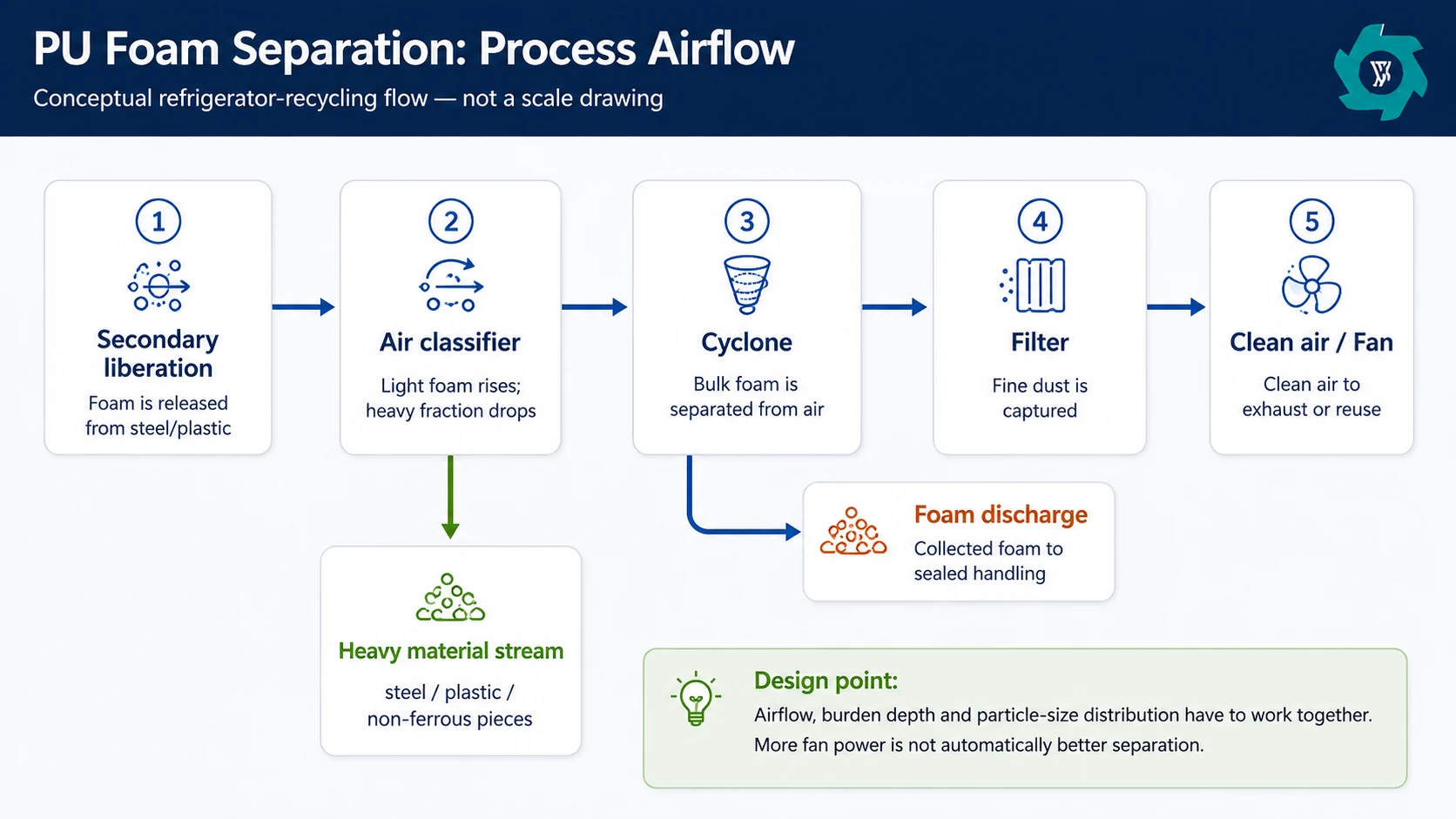
- How airflow separation actually works
- Equipment that forms the foam circuit
- Dust control is part of the separator
- Blowing-agent handling is a separate scope
- Designing for mixed refrigerator populations
- Monitoring, interlocks and shutdowns
- What happens to the recovered foam
- FAT and commissioning checks
- What to put in the RFQ
Where PU Foam Separation Fits in a Refrigerator Recycling Line
Foam separation does not begin when the fan starts. It begins upstream, with the condition of the refrigerator body entering the mechanical section. Refrigerant recovery, compressor removal, oil handling and removal of unsuitable loose parts should already be defined. EPA’s appliance-disposal guidance likewise describes refrigerant recovery and hazardous-component removal before evacuated appliances are shredded. [1]
The cooling circuit is handled during depollution. The foam stays inside the cabinet in many mechanical recycling routes and is released later when the steel skin, plastic liner and insulation are opened. Our separate guide to refrigerator depollution before shredding covers the upstream boundary in more detail.
Engineering shortcut that causes trouble: writing “foam separator + dust collector” as two line items without a process-air balance. In practice, the fan, ducts, classifier, cyclone, filter and rotary valves all influence the pressure and flow seen at the separation point.
Liberation Comes Before Air Separation
A refrigerator cabinet is a bonded sandwich. Thin steel, plastic liner and rigid PU insulation are not loose particles when the cabinet enters the shredder. Primary size reduction opens the box, but secondary crushing or impact is normally what exposes more foam surface and breaks the attachment between materials.
The air separator can only work on what has been liberated. If the crusher leaves large steel-and-foam sandwiches intact, increasing suction may move the whole composite piece rather than separate it. At the other extreme, over-crushing can create a larger fines load, which raises filter demand and may make the foam stream harder to handle. The target is not “the smallest possible particle.” It is a particle-size distribution that gives the downstream separators something they can actually sort.
This is why a refrigerator line equipment list should be read as a sequence of jobs rather than a catalog of machines. The refrigerator recycling equipment guide describes the same handoff: primary opening, secondary liberation, foam extraction, ferrous recovery and non-ferrous separation.
How Airflow Separation Actually Works
Liberated PU foam has a much lower bulk density and different aerodynamic behavior from steel and most plastic pieces. A controlled air stream can therefore lift or divert the foam while denser material continues along the heavy-product path. The difficulty is keeping that separation stable as the feed changes.
1. Pickup must be strong enough, but not indiscriminate
If the air velocity at the separation zone is too low, foam remains in the heavy fraction. That can contaminate steel, plastics or the feed to an eddy current separator. If the draw is too aggressive, thin plastic, wire pieces or small non-ferrous particles may enter the foam circuit. The correct setting is the one that creates a usable cut for the actual particle-size distribution, not the highest fan speed available.
2. Burden depth changes the cut
Air cannot classify material it cannot reach. A deep, uneven bed shields light particles and makes the separator respond differently across the belt or chute. Upstream metering, spreader design and stable crusher discharge often have as much influence on separation quality as the classifier itself.
3. The collector changes the separator
A clean filter and a loaded filter do not present the same resistance. Duct buildup, a partially blocked cyclone outlet or a poorly sealed rotary valve can also shift system pressure. That is why operators need more than a fan-frequency number.
The Foam Circuit Is More Than an Air Separator
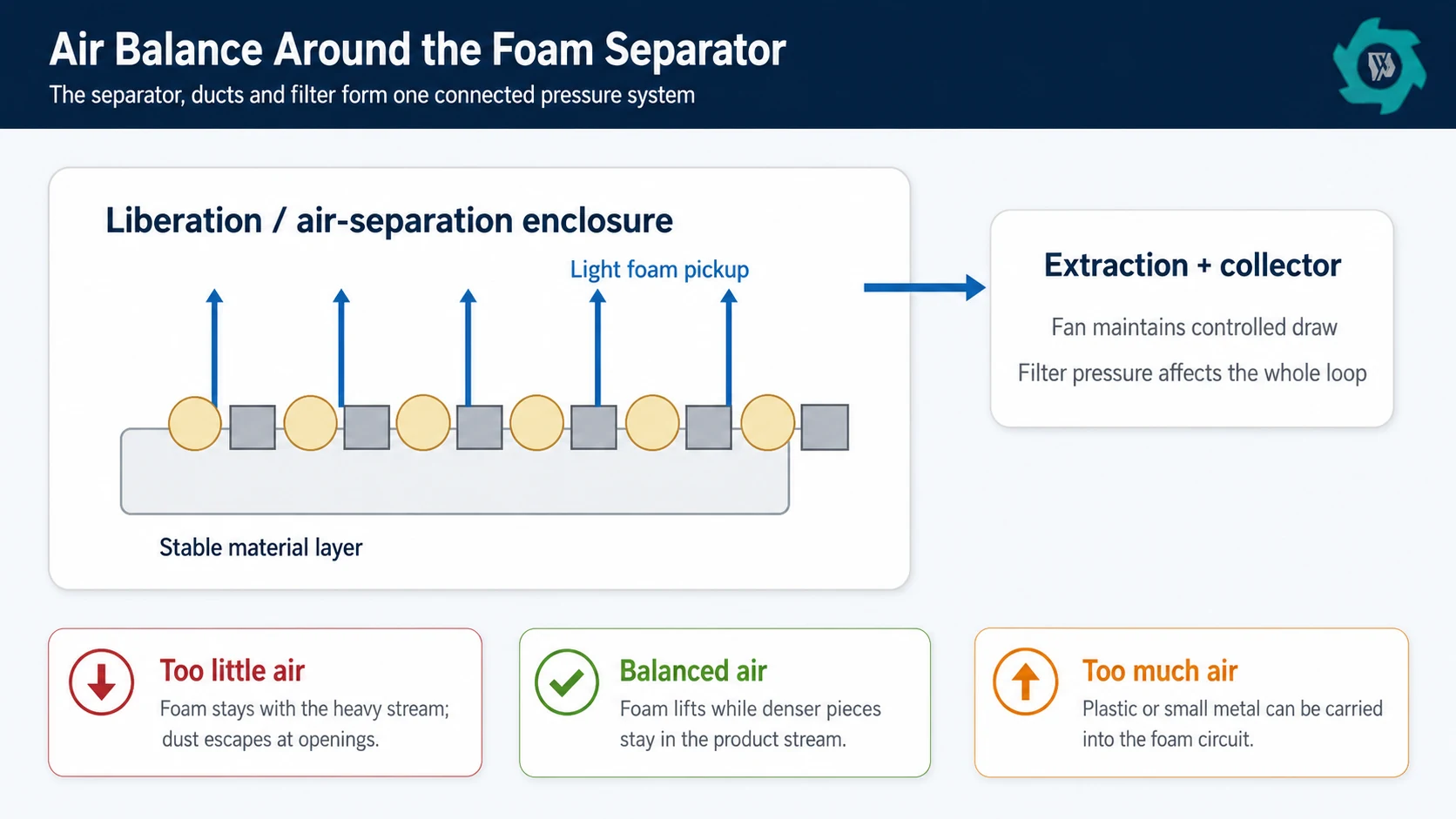
Different suppliers use different layouts, but the foam circuit usually combines several functions. The exact choice should be tied to throughput, particle size, building layout and whether the project includes blowing-agent recovery or only physical foam separation.
| Section | Main job | What should be checked |
|---|---|---|
| Enclosed liberation / transfer | Keep the newly released foam and fines inside a controlled process zone. | Openings, leakage paths, inspection doors, maintenance access and extraction points. |
| Air classifier / foam separator | Create the aerodynamic split between light foam and the heavier product stream. | Feed spread, adjustment range, carryover in both products and sensitivity to particle size. |
| Cyclone or primary separator | Remove bulk foam from the conveying air before fine filtration. | Inlet loading, discharge stability, air leakage at the outlet and foam bridging. |
| Filter / dust collector | Capture fine particulate that remains in the air stream. | Filter media, pressure drop, cleaning system, dust discharge and safe location/design for the actual dust hazard. |
| Fan and duct network | Provide the pressure and flow that connects the whole circuit. | Duct sizing, balance points, wear, access for cleaning and the effect of filter loading. |
| Foam discharge / compaction | Move collected foam without re-entraining it into the building. | Sealing, bridging, storage volume and whether compaction is downstream of a clean enough foam fraction. |
Dust Control Is Part of the Separator, Not Housekeeping
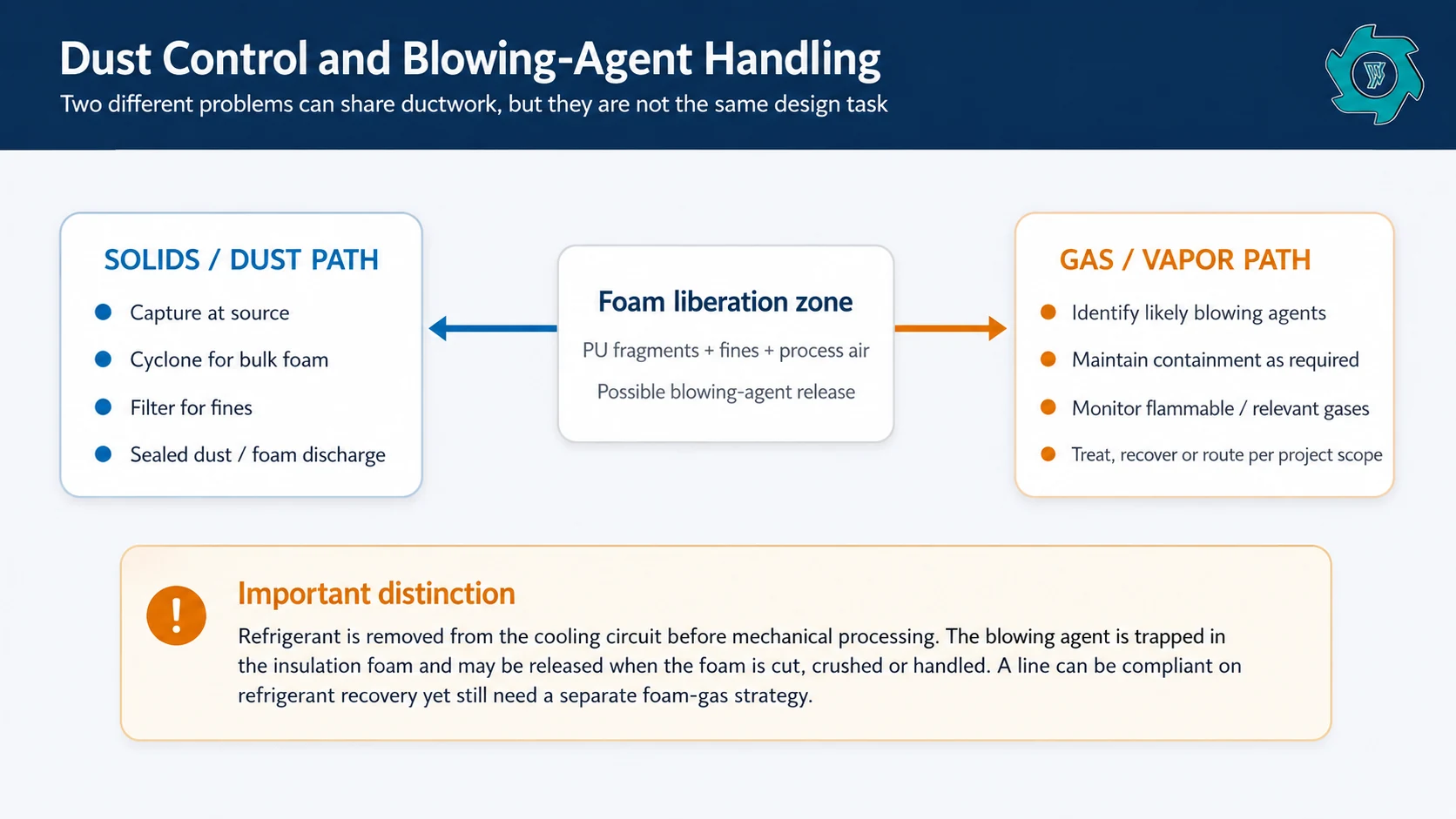
PU insulation is brittle after years in service, and secondary crushing also generates plastic fines, coating fragments and dirt. EPA’s 2024 foam-recovery guidance specifically calls for dust collection during manual foam removal to prevent small particles from entering the lungs. It also recommends keeping foam pieces as intact as possible where manual removal is used, because additional breakage can increase blowing-agent release. [2]
In an automated mechanical line, the principle carries over even though the equipment is different: capture the material where it is generated rather than allowing the building to become the collector. Enclose high-release points, keep transfer distances short, avoid uncontrolled gaps around ducts and discharge valves, and make the filter part of the line’s operating logic.
Combustible-dust note: do not assume that every refrigerator foam/dust mixture has the same fire or explosion behavior. OSHA’s combustible-dust guidance stresses that particle size, dispersion, concentration and the actual material all matter. If explosion protection, classified electrical equipment or venting depends on the dust properties, the project should use a hazard analysis and representative material data rather than a generic label. [3][4]
The mix can include PU fines, plastic dust, paint, food contamination and occasional metallic fines. The safest specification states what the supplier assumes, what the buyer must verify and which party is responsible for final site hazard classification.
Blowing-Agent Handling Is a Separate Environmental and Safety Scope
EPA notes that appliance foam has used different blowing agents over time. Older units may contain CFC or HCFC blowing agents; later appliances may contain HFCs; newer populations can also include climate-friendlier alternatives such as hydrocarbons or fluorinated olefins. [5] Some hydrocarbon blowing agents, including pentane variants, introduce a flammability consideration that is very different from the ozone-depletion issue associated with older foam chemistries. UNIDO’s guidance on alternative foam blowing agents likewise notes that pentane-based systems require significant safety changes because of flammability. [6]
Refrigerant recovery does not automatically solve the foam-gas question
The refrigerant circuit is evacuated upstream. The blowing agent remains distributed through the insulation foam. When that foam is cut or crushed, some of the blowing agent can be released. EPA’s current RAD guidance treats foam recovery as an additional best-practice step and describes manual, semi-automated and fully automated routes. Its fully automated example uses enclosed processing after refrigerant, oil, doors and shelving have been removed. [2]
There are at least three different scopes that can all be described casually as “foam handling”:
- Physical foam separation only: the line removes PU from metals and plastics, then collects the foam as a solid fraction.
- Contained foam processing: the separation and conveying system is enclosed or operated under controlled draw to reduce uncontrolled releases, but there may be no dedicated blowing-agent recovery step.
- Blowing-agent recovery/treatment: process gas is routed through additional technology selected for the identified agent and the required environmental outcome.
Those scopes have different equipment, monitoring and operating costs. They should never be compared as if they were the same line.
Design for the Refrigerator Population You Will Actually Receive
The age mix of incoming refrigerators can matter as much as the hourly tonnage. A municipal program may receive appliances spanning several decades. A manufacturer take-back program may have a narrower age range. A scrap yard may not know the foam chemistry at all.
When feed history is uncertain, we normally recommend writing that uncertainty into the design basis. Do not invent a single “typical gas.” Define how appliances will be inspected, what labels or records will be collected, whether unknown units are segregated, and what monitoring is needed before the mechanical line is authorized to run.
Mechanical variability also matters. Moist foam, very old friable foam, retained door sections, different liner plastics and incomplete removal of loose parts can all change the separator load. A good design therefore gives the operator a controlled adjustment range rather than one fixed setting. The broader line-selection logic is covered in how to choose a refrigerator recycling line.
Monitoring, Interlocks and Shutdown Logic
Air systems often fail gradually before they fail visibly. A filter loads, a rotary valve starts leaking air, a duct accumulates foam, or a discharge bin fills. The product quality usually moves first. By the time dust is escaping from a door seam, the process has already been drifting.
For that reason, the useful control points are the ones that tell the PLC and the operator whether the process-air circuit is still available. Typical project discussions include fan status, pressure or differential-pressure signals, filter cleaning alarms, blocked-discharge detection and permissives that stop upstream feeding when the collection system is not ready.
If the project includes flammable blowing-agent control, gas-monitoring points, alarm levels, ventilation response and equipment shutdown philosophy have to be engineered around the identified hazard and local requirements. The article should not substitute for the site’s fire, electrical or environmental design; the procurement specification should state who performs that work and who signs it off.
What Happens to the Recovered Foam?
Once foam is separated, volume becomes a practical issue. Loose PU occupies space quickly and can be awkward to convey or store. A compactor or densifier may therefore make sense after the foam stream is clean enough to justify it.
Compaction is not a separator. If large pieces of steel or plastic are still entering the foam line, a densifier simply hides the contamination and can make maintenance worse. Treat foam purity and foam densification as two separate acceptance points.
The final destination also depends on local facilities and the project’s environmental scope. EPA’s foam-recovery guidance discusses physical and chemical recycling as well as approved disposal/destruction routes; it does not present one universal destination for every region. [2] That is a useful way to specify a plant: define the on-site product condition, then confirm the permitted downstream outlet separately.
Use the FAT to Test the Whole Foam Circuit
A factory acceptance test should not be a short empty-machine run followed by a photo of clean foam. The test has to show whether the connected process remains stable under representative feed.
Before the FAT, agree the refrigerator condition, average cabinet weight, pre-treatment status, test batch or run duration and sampling method. Then inspect both sides of the separation. A foam stream can look clean while a large amount of foam is still being lost with the heavy fraction. The reverse can also happen: impressive foam recovery achieved by pulling too much plastic or non-ferrous material into the light stream.
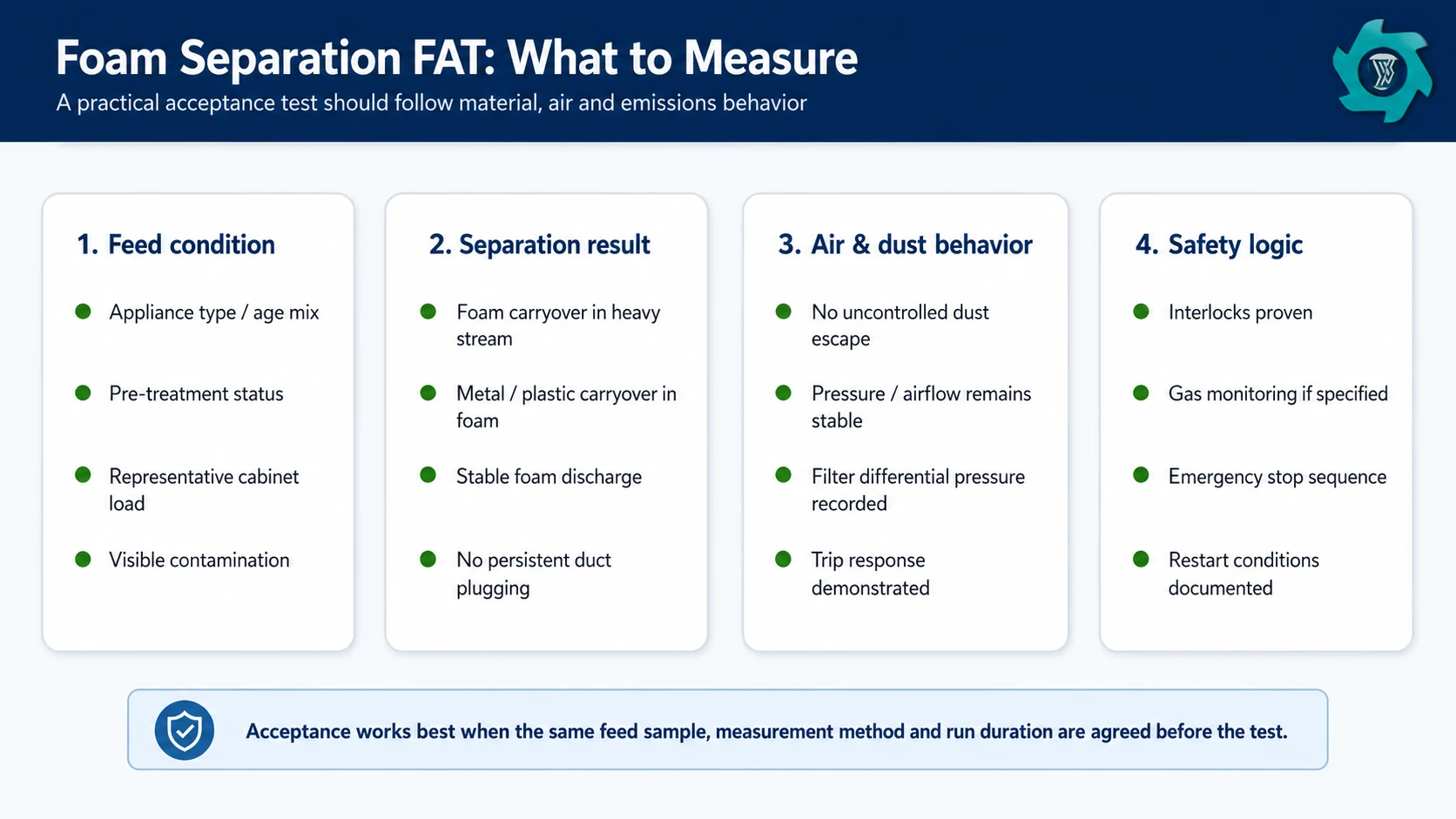
Useful acceptance observations
- Foam carryover remaining in the heavy product stream.
- Metal and plastic carryover entering the foam circuit.
- Stable cyclone and foam discharge without repeated plugging or bridging.
- No persistent visible dust escape at normal operating access points.
- Filter differential pressure remains within the agreed operating range during the test.
- Upstream feed stops or alarms correctly when the collection system is unavailable.
- Any specified gas-monitoring or ventilation interlocks are demonstrated with the agreed test method.
What to Put in the RFQ for PU Foam Separation
| RFQ item | Why it matters |
|---|---|
| Representative refrigerator photos, age information and labels where available | Shows cabinet construction and helps define uncertainty around refrigerants and foam blowing agents. |
| Pre-treatment condition | Confirms whether refrigerant, compressor, oil, shelves, drawers and other parts are already removed. |
| Units/hour and tonnes/hour | Separates appliance count from real material loading. |
| Primary and secondary discharge size targets | Provides the particle-size basis for air classification and dust generation. |
| Required foam and heavy-fraction cleanliness | Turns “good separation” into measurable product criteria. |
| Foam downstream route | Defines whether loose collection, compaction, recycling or controlled destruction is expected. |
| Blowing-agent scope | Clarifies whether the supplier provides only foam separation, containment, or dedicated gas recovery/treatment. |
| Local dust, emissions, fire and electrical requirements | Determines the site-specific safety and environmental design basis. |
| FAT feed sample and test method | Prevents a brochure recovery figure from replacing a measurable acceptance test. |
Configure the Foam Section Around Your Refrigerator Feed
Send YUXI representative refrigerator photos, pre-treatment condition, target throughput, expected appliance age mix, required output fractions and your dust/gas-control requirements. We can use that information to define the foam separation boundary before equipment is selected.
FAQ
How is PU foam separated from refrigerator scrap?
After secondary crushing liberates the insulation, controlled airflow lifts the low-density foam away from heavier metal and plastic.The extracted foam is carried to a cyclone, where the bulk foam is separated and discharged. The remaining process air then passes through a filter to capture finer particles. The exact equipment arrangement depends on particle size, throughput and the required cleanliness of both the foam and heavy fractions.
Is foam separation the same as blowing-agent recovery?
No. Foam separation is a physical sorting step. Blowing-agent recovery or treatment deals with gases or vapors released from the insulation foam. A plant can separate foam mechanically without recovering the blowing agent, so the environmental scope should be stated clearly in the project specification.
Why does a refrigerator recycling line need dust collection around the foam system?
Crushing PU insulation, plastics and surface contamination creates fines. Local extraction helps keep dust inside the process, and the collector also affects the air balance used for foam separation. For that reason, the dust system should be designed and commissioned with the separator rather than treated as a housekeeping add-on.
Can the same airflow setting work for every refrigerator feed?
Usually not. Refrigerator age, cabinet construction, moisture, retained plastic, foam fragmentation and particle-size distribution change the aerodynamic behavior of the material. Operators need a stable adjustment range, and the FAT should use a feed sample that represents normal production.
What should be checked during a foam-separation FAT?
Agree the feed condition first, then record foam carryover in the heavy stream, heavy-material carryover in the foam, discharge stability, visible dust leakage, collector pressure behavior and the response to specified interlocks or gas-monitoring alarms. The test method matters as much as the headline recovery claim.
References
- U.S. EPA — appliance disposal.
- U.S. EPA RAD — foam recovery guidance.
- OSHA — combustible dust guidance.
- OSHA — dust fire and explosion prevention.
- U.S. EPA RAD — appliance foam blowing-agent context.
- UNIDO — HCFC phase-out and foam alternatives.