




 Request Quote



Before shredding, check what can still be saved. Some pallets can go back into use, some are worth repairing, and others may still provide usable boards. The shredder is mainly for material that no longer has a practical reuse option. Once that boundary is clear, the mechanical job is straightforward to describe but easy to specify badly: meter irregular pallets, open their joints, liberate embedded nails, remove ferrous metal, and deliver a chip specification the next user will actually accept.
This passage concentrates on the pallet-specific engineering that a broader waste wood recycling process cannot cover in the same depth: reuse triage, nail liberation, magnet presentation, residual-ferrous verification, and a pallet-based factory acceptance test.
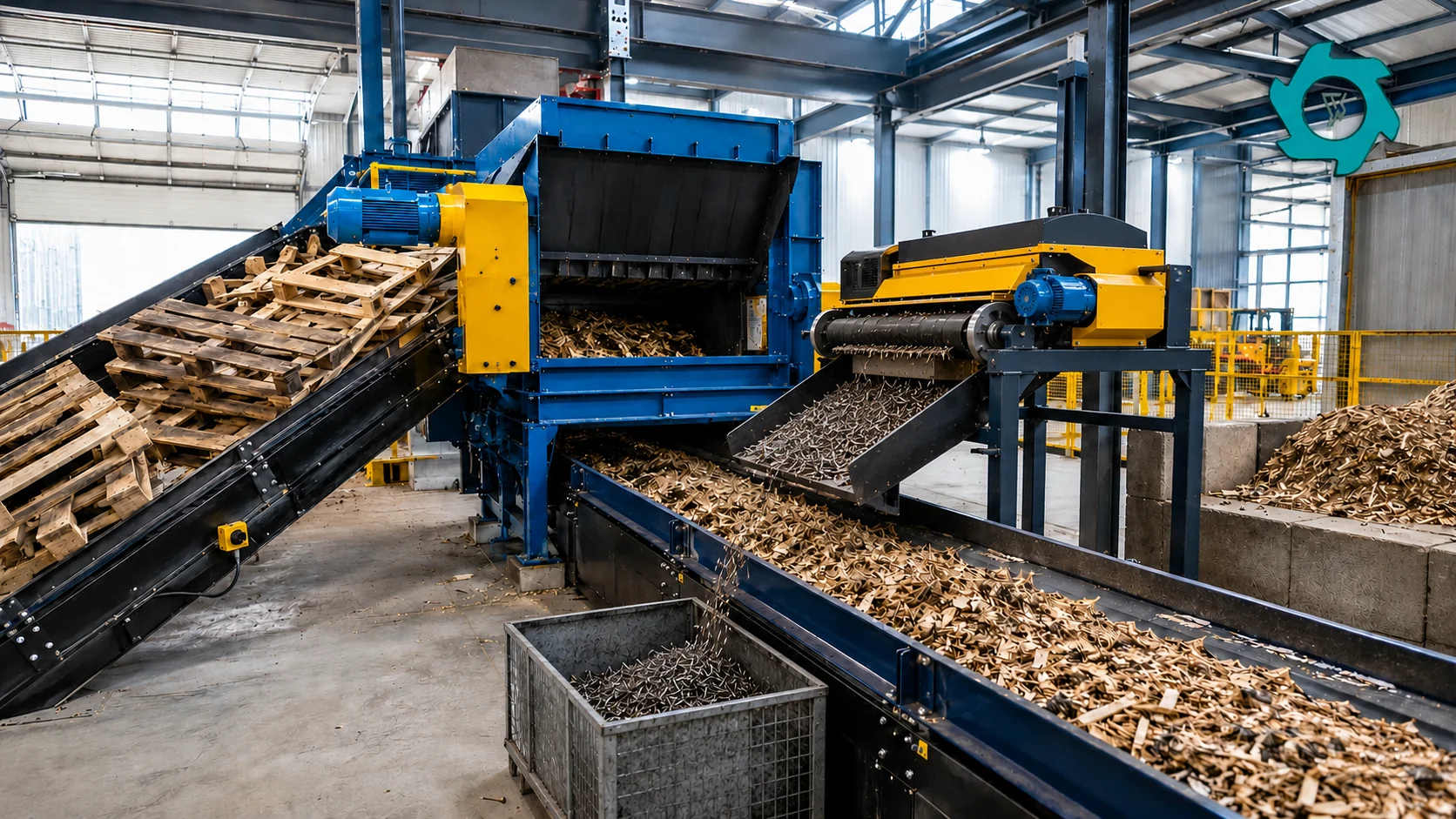
Quick answer: what equipment does a pallet recycling line need?
A practical line may include an inspection and sorting area, loader-fed hopper or chain conveyor, low-speed primary shredder, discharge conveyor, suspended magnet or magnetic drum, optional screen, oversize return, dust capture, and product storage. Secondary grinding belongs in the scope only when a documented outlet needs a finer distribution. The current YUXI biomass shredding and recycling line shows the broader process route, while the pallet project still needs feed, separation and sizing stages selected around its own material condition.
Project boundary: a pallet shredder liberates metal; it does not guarantee nail-free wood by itself. Product cleanliness belongs to the complete shredder–conveyor–magnet–sampling system.
Do not shred a pallet that still has higher reuse value
EPA’s wood-material accounting identifies pallets as the dominant form of wood packaging in its methodology.1 That scale makes the order of decisions commercially important. Sound pallets can return to a pool or customer. Repairable units may need only deck boards or stringer work. Damaged units can sometimes be dismantled for components. Shredding is the irreversible route for material that fails the approved reuse and repair criteria.
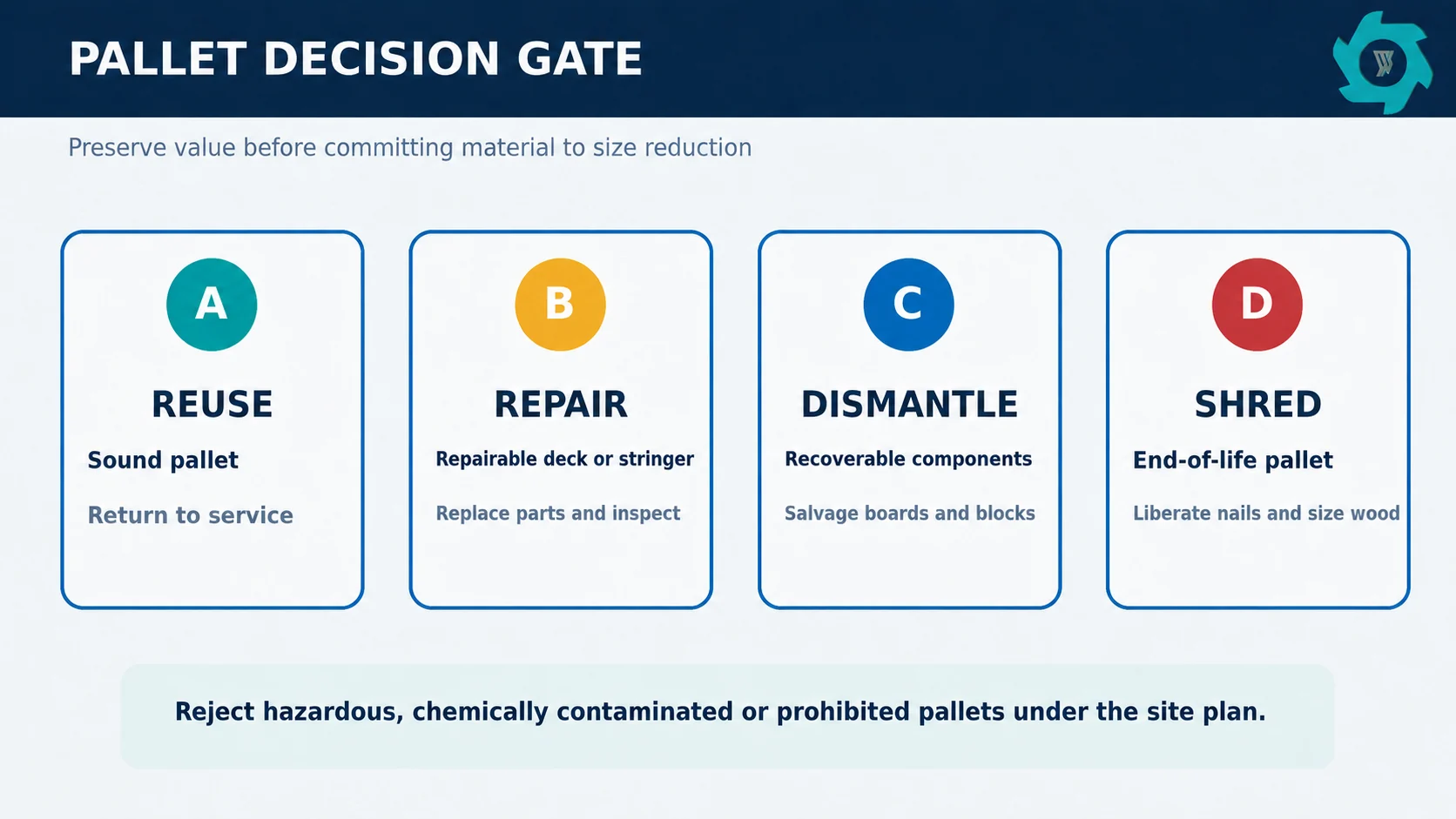
Build the receiving rule with operations, sales and EHS personnel. A visually broken pallet is not automatically acceptable feed. Chemical spills, unknown residues, pallets with treatment markings that the receiving facility does not accept, batteries, pressurized objects, large steel plates and stones need an explicit hold or reject route. Paint and composite blocks may also change what the downstream buyer will accept.
Define the feed envelope before choosing a shredder
| Feed variable | What to record | Why it changes the line |
|---|---|---|
| Pallet construction | Block/stringer design, hardwood/softwood, board thickness, double-face share | Controls bite, torque peaks and bulk presentation |
| Dimensions and mass | Normal and maximum size, measured weight range | Sets opening, conveyor, hopper and mass-capacity basis |
| Fasteners | Nails, staples, plates; typical and worst-case quantity | Controls cutter exposure, liberation duty and magnetic load |
| Condition | Dry, rain-wet, broken, nested, frozen or soil-contaminated | Affects grip, energy, screen behavior and product moisture |
| Prohibited material | Hazardous residue, large metal, stones, plastics or treated wood as applicable | Protects people, equipment and the outlet specification |
| Required product | Size classes, oversize limit, fines limit, residual ferrous criterion | Determines screen, recirculation, magnets and sampling |
“Two tonnes per hour” means little if one supplier tests uniform dry stringer pallets and the buyer feeds wet, nested block pallets. State sustained feed rate and sustained accepted output separately, then define whether stops, oversize return and magnet cleaning are inside the observation period.
How the pallet shredding and nail-removal process works
1. Inspect, classify and meter the pallets
Separate reuse, repair, shred and reject routes physically. A chain conveyor or heavy belt gives the operator a visible feed and limits batch dumping. Metering matters because stacked or nested pallets can create several seconds of starvation followed by a torque spike. Use conveyor feedback, level sensing and shredder-current logic to control the surge.
2. Use primary shredding to open joints
A low-speed, high-torque cutting action is commonly suited to bulky pallets because it can pull boards apart while reducing uncontrolled high-speed impact. The cutter stack, hooks, shaft speed, clearance and drive protection still need a trial. A generic industrial shredder supplier comparison is useful only after the pallet feed and output test have been defined.
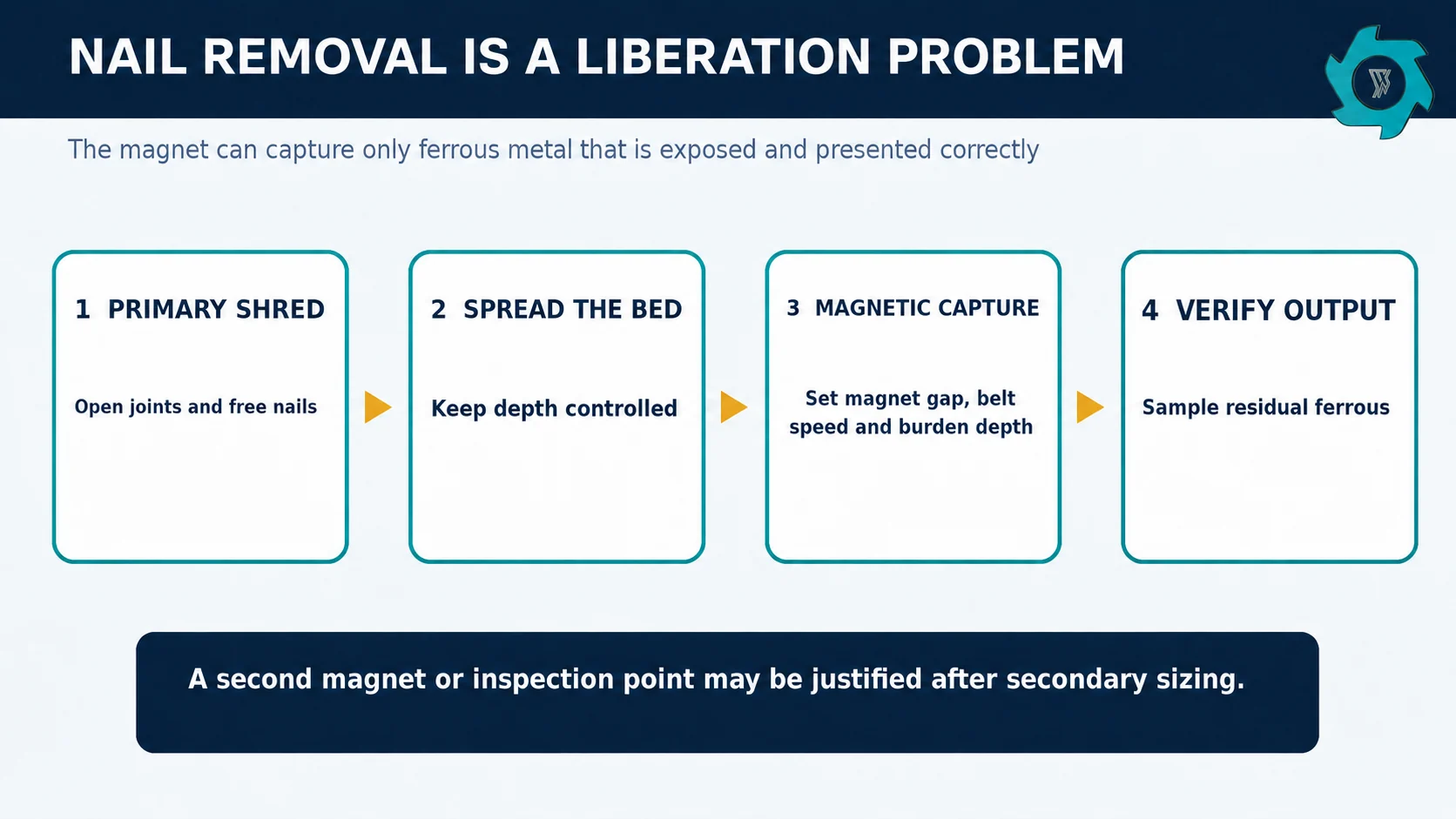
3. Present a shallow, stable burden to the magnet
Embedded nails cannot be captured until enough wood has fractured away from them. After liberation, the conveyor must spread the material rather than bury metal under a deep bed. Magnet type alone does not prove performance. Suspension gap, field strength at the burden, belt speed, burden depth, conveyor width and self-cleaning discharge all influence capture.
4. Screen only to a contracted product distribution
A screen classifies; it does not make every particle equal to its aperture. Report at least accepted product, oversize return and fines by mass. Return genuine oversize instead of repeatedly grinding the whole stream. If the first pass already meets the outlet’s distribution, secondary milling may add cost without saleable value.
5. Check whether a second metal-removal point adds value
Secondary cutting can expose fasteners that remained attached after the first pass. Where the residual-ferrous limit is tight or the downstream machine is sensitive, sample after each size-reduction stage and compare one- and two-magnet arrangements. The decision should come from captured-metal mass and residual-metal results.
Specify nail removal with measurable acceptance criteria
Agree on the sample location, sample mass, collection frequency, metal detection or hand-sorting method, reporting unit and disposition of borderline pieces. Suitable metrics may include recovered ferrous mass per tonne of feed, residual ferrous pieces per kilogram of accepted wood, residual ferrous mass fraction, or a downstream detector/reject rate. Choose the metric the outlet can audit.
Ferrous capture indicator = recovered ferrous mass ÷ net pallet feed mass
This ratio is a process indicator, not capture efficiency, because the true incoming metal mass is normally unknown. To claim efficiency, the test must establish the incoming ferrous inventory or use a controlled tracer method. Keep magnetic tramp metal separate from non-ferrous pieces, stones and other rejects.
Match chip size and cleanliness to the actual outlet
| Potential route | Mechanical line must establish | Not guaranteed by shredding |
|---|---|---|
| Industrial fuel preparation | Handling size, moisture sample, metal and mineral controls | Boiler compatibility, emissions, ash behavior or permit compliance |
| Pellet or briquette feed | Clean pre-sized wood and a stable feed to later preparation | Drying, fine milling, pellet durability or fuel certification |
| Panel or composite feed | Buyer-approved particle and contamination limits | Adhesive compatibility, pressing performance or finished-board quality |
| Mulch or landscaping outlet | Size and contaminant specification agreed with the buyer | Suitability of painted, treated or chemically contaminated wood |
The safest specification is outlet-first. Ask the buyer to define prohibited wood, size classes, fines, moisture and metal limits. Then design the line backward. Green waste requires a different specification approach because branches, leaves and soil create different feed and quality constraints from fastened dimensional lumber. For comparison, see the broader green waste recycling process.
Control dust, fire and mechanical hazards
OSHA identifies wood dust as a health concern and points employers to combustible-dust inspection guidance.2 OSHA also warns that many materials can be explosible when finely divided and dispersed.3 The site must assess the actual dust, ignition and explosion hazards for the material and operating conditions involved.4
- Capture dust at shredding, screening and transfer points based on the site assessment.
- Control ignition sources, hot work, bearing temperature, friction and electrical suitability.
- Provide guarded access, emergency stops and a documented lockout/tagout procedure.
- Prevent unsafe manual clearing of bridged pallets and wrapped material.
- Inspect cutters and conveyors for damaged metal that could become a projectile or ignition source.
- Use housekeeping methods that do not disperse accumulated dust into the air.
Noise, mobile equipment, falling stacks and sharp protruding nails also belong in the operating plan. A machine quotation should identify interface responsibilities: who supplies extraction, fire protection, guarding between machines, platforms, controls integration and commissioning validation.
Run a FAT that reconciles wood, metal and rejects
Use representative batches spanning the agreed construction, moisture and damage range. Reach steady operation, then observe long enough to include loading variation and normal magnet discharge. Weigh meaningful streams separately over the same time window.
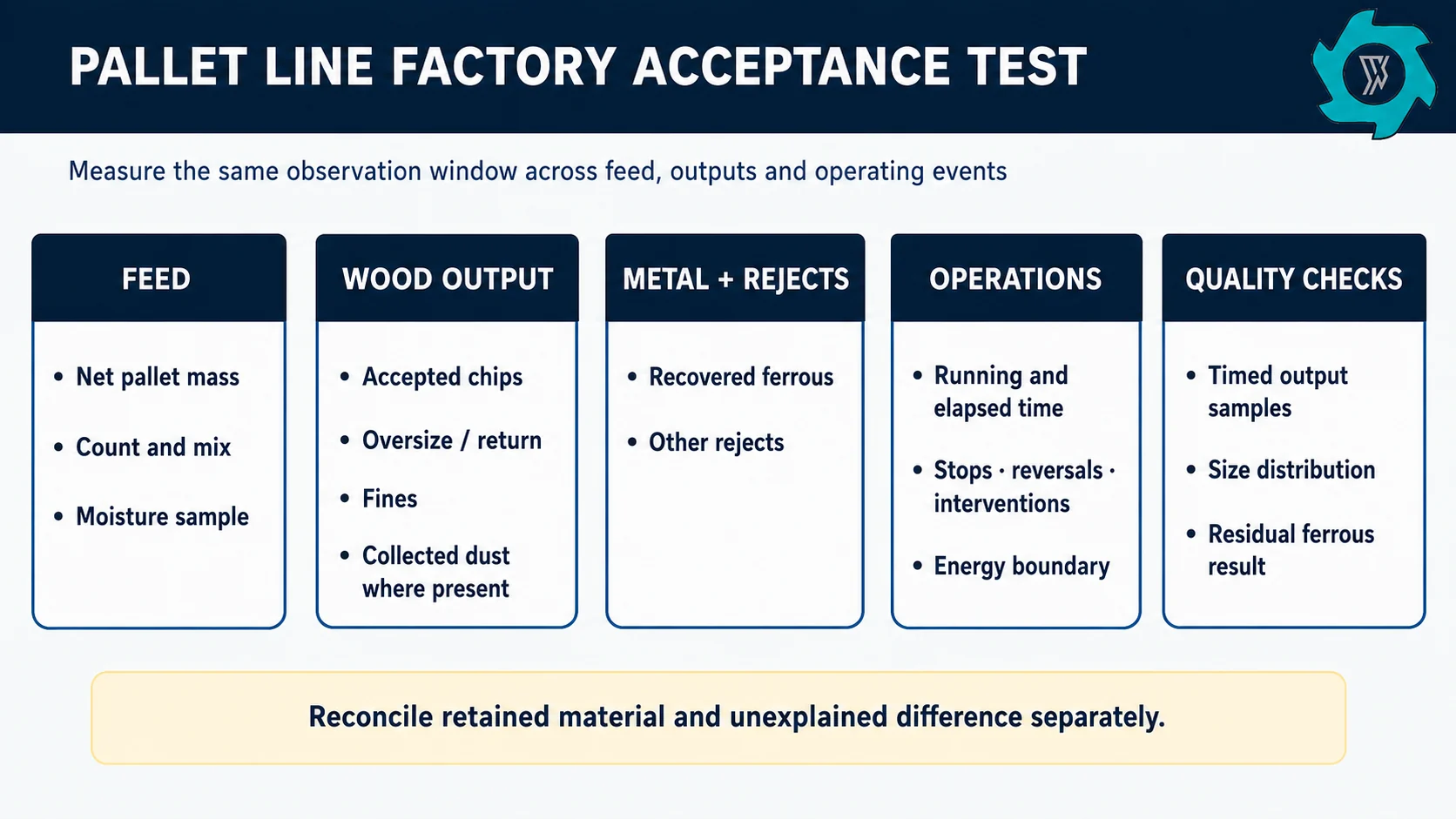
- Net pallet feed, pallet count and recorded feed mix;
- accepted wood product;
- oversize or return material;
- fines and collected dust where present;
- recovered ferrous metal;
- other rejects and retained material, each recorded separately;
- unexplained mass difference;
- running and elapsed time, stops, reversals and interventions;
- energy within an agreed machine or complete-line boundary;
- size distribution and residual-ferrous result from timed output increments.
Sustained accepted output = accepted wood mass ÷ elapsed observation time
Report both machine running time and elapsed test time. Otherwise, time spent clearing bridges, cleaning the magnet or handling oversize can vanish from the headline rate. Retain representative output samples and link every sample to the batch and time log.
RFQ checklist for a wood pallet recycling machine
- What pallet designs, dimensions, weight range and moisture range must be accepted?
- What share is reusable, repairable, shreddable and prohibited?
- Which fasteners are normal, and what heavy metal must be rejected?
- Is capacity stated as feed rate or accepted product rate, and over what time basis?
- What output size distribution and fines limit has the downstream user approved?
- Where is ferrous metal liberated, captured, discharged and sampled?
- What residual-ferrous metric and sample method will decide acceptance?
- Can secondary sizing be bypassed when coarse product already meets the specification?
- Which dust, fire, guarding and controls interfaces are included?
- What cutter wear assumptions, service access and critical spares are quoted?
FAQ
Can a wood pallet shredder process pallets with nails?
A suitably configured primary shredder can process an agreed quantity and type of embedded ferrous fasteners, but this must be confirmed by a representative trial. Shredding liberates the nails; a downstream magnet removes exposed ferrous metal. The feed specification must still exclude prohibited heavy metal and unsafe contaminants.
Should nails be removed before or after shredding?
Remove loose or hazardous metal before the shredder, but ordinary embedded nails are often captured after primary shredding because the wood must first release them. Magnet performance depends on liberation, burden depth, belt speed, suspension gap and the agreed residual-ferrous limit.
What type of magnet removes pallet nails?
A suspended overband magnet or magnetic drum is commonly used for ferrous fasteners. The correct choice depends on conveyor width, bed depth, speed, particle size, required cleaning method and the mass of metal expected. A trial should verify the complete arrangement rather than the magnet name alone.
How small should recycled pallet wood be?
There is no universal target. Specify a size distribution that the receiving boiler, board plant, pellet line or other outlet accepts. Use the coarsest product that meets that requirement because unnecessary secondary grinding raises energy, wear, fines and dust.
What should a pallet recycling machine FAT measure?
Use representative pallets and record net feed, observation time, accepted wood, oversize return, fines or dust, recovered ferrous, other rejects, retained material, residual ferrous in sampled wood, stops, reversals and energy within an agreed boundary.
Configure the line around your pallets and buyer specification
Send pallet photos, dimensions, measured batch weights, moisture range, fastener details, prohibited materials, target capacity and the downstream size and metal limits. YUXI can use those boundaries to propose a process and representative test plan.
References
- EPA wood data: waste.
- OSHA wood dust: hazards.
- Combustible dust: explosion.
- CCOHS dust: controls.