




 Request Quote



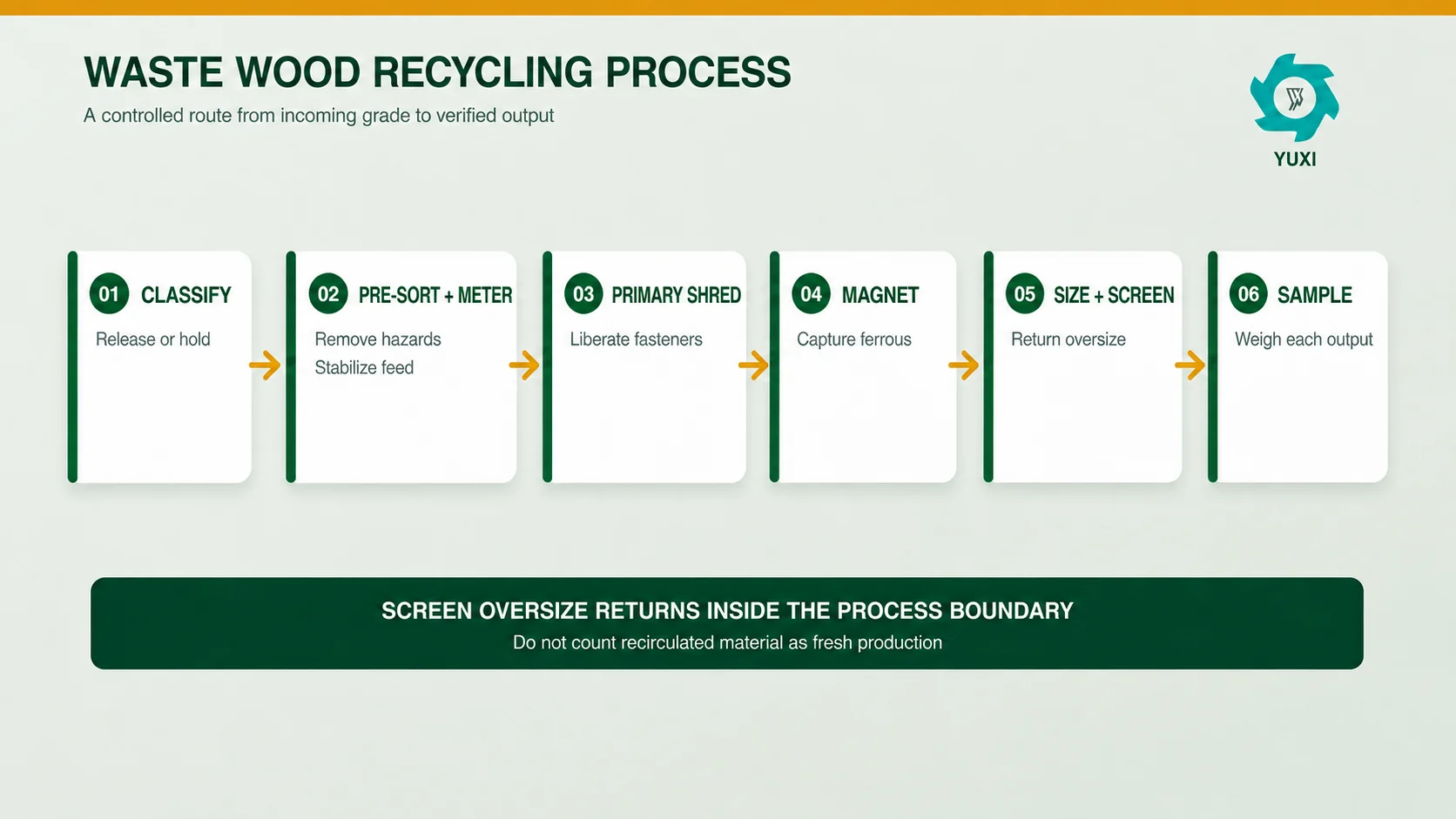
The waste wood recycling process is receive and classify → remove prohibited items → meter the feed → primary shred → capture liberated ferrous metal → size only as far as necessary → screen and return oversize → sample each output. The sequence is simple on paper. The difficult work is defining which wood may enter, exposing nails without making unnecessary fines, proving what the magnet missed, and holding a stable particle distribution when pallets, boards and demolition timber arrive together.
The broader YUXI biomass shredding and recycling line covers several plant-based feedstocks. This passage stays inside the waste-wood boundary: pallets, crates, clean production offcuts, untreated lumber and conditionally accepted construction or demolition wood.
Start with an acceptance map, not a shredder model
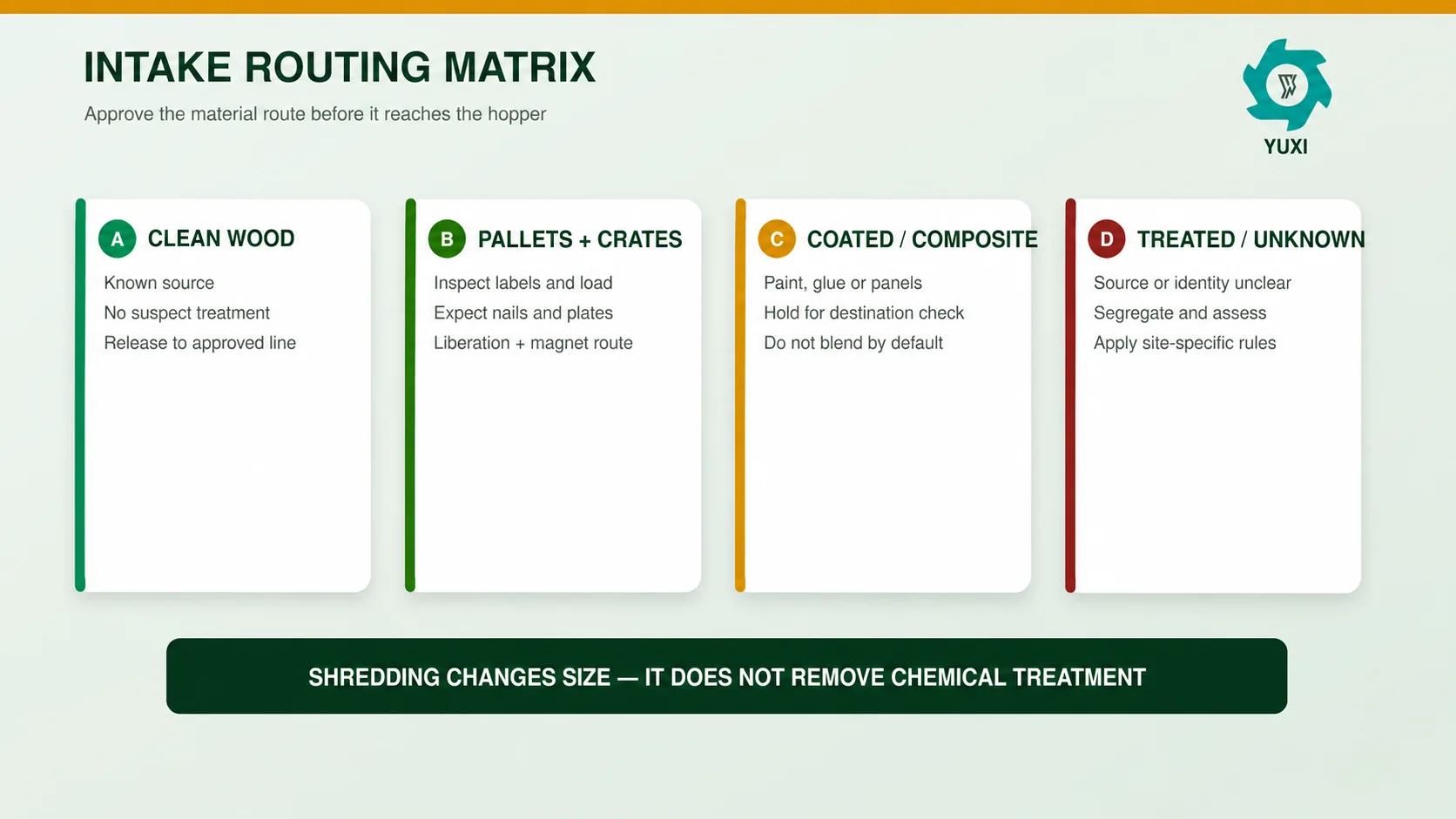
“Waste wood” can describe clean kiln-dried offcuts, broken pallets, painted panels, glued composites, preservative-treated outdoor timber or demolition material carrying plaster, insulation, cable and masonry. Those loads do not share one legal status, one wear profile or one safe downstream use. A machine may physically reduce all of them, but processability is not the same as acceptability.
A peer-reviewed review of cascading wood recycling found that composition and contaminant levels change with the origin of the waste. That variation is the reason an intake specification must name sources and conditions rather than use a single catch-all grade.1 State rules can also differ. Washington, for example, says treated wood usually qualifies as dangerous waste under the state’s designation process, although businesses may determine that a specific exclusion applies.2 California operates its own alternative management standards for treated wood waste.3
| Incoming class | What changes in the line | Release decision |
|---|---|---|
| Clean solid-wood offcuts | Usually consistent; low metal burden if source control is reliable | Route to the named wood-chip or fiber specification after sampling |
| Pallets and crates | Nails, staples, plates and occasional strapping require liberation and magnetic capture | Confirm residual metal against downstream tolerance |
| Mixed demolition wood | High variability; may include plaster, masonry, insulation, wire, coatings and treated pieces | Hold and sort by an approved site-specific acceptance plan |
| Painted, coated or glued wood | Coatings and binders remain after shredding; fines may concentrate surface contamination | Do not blend into clean wood without market and regulatory approval |
| Preservative-treated or suspect wood | Mechanical treatment does not neutralize preservatives | Segregate and follow applicable jurisdiction and receiving-facility rules |
Old material may have lost labels, weathered surfaces or been painted over. The National Pesticide Information Center notes that reused or recycled treated wood often lacks an end tag and can be difficult to identify by appearance.4 Build supplier declarations, source history, receiving inspection and a hold route into the commercial specification.
Work backward from the downstream specification
The useful output is not “small wood.” It is a documented fraction that a named receiver accepts. A board-panel route may care about wood species, coatings, mineral contamination, metal and controlled particle geometry. A thermal user may specify moisture, ash, chlorine, net calorific value, particle distribution and prohibited material. Mulch or animal-related uses can impose still different contamination restrictions.
Ask the receiver for the test method as well as the limit. “Under 50 mm” is incomplete unless everyone agrees whether that means a screen aperture, a maximum measured dimension, a percentile, or all pieces passing a particular sieve method. Long thin splinters can pass through an aperture in one orientation and bridge a downstream feeder in another.
Define the feed
Source, wood type, normal and worst piece dimensions, moisture range, bulk density, metal burden, mineral matter and prohibited items.
Define the product
Accepted size distribution, oversize ceiling, fines limit, moisture basis, residual metal limit, chemical restrictions and sampling method.
Define the test
Representative mixture, sustained run time, stoppage rules, weighed streams, recirculation accounting and laboratory chain of custody.
Metering protects the whole line from pallet-shaped load spikes
A loader can fill a hopper with a loose stack that looks light, then push in a compact bundle containing dense hardwood blocks and metal fixtures. The average tonnes per hour may appear reasonable while momentary torque, current and conveyor burden swing sharply. Those peaks trigger reversals, stall the discharge or bury the magnet under a deep material bed.
Use the receiving area to break the surge. A live-bottom hopper, walking floor or controlled conveyor should deliver a repeatable bed. Record mass flow where practical. If only volume is observed, changes in void space and wood density can make two equally full conveyors carry very different mass.
Before feeding, remove stones, large non-ferrous objects, gas cylinders, batteries, heavy structural steel and entangling wire by the approved route. A magnet downstream is not a license to send every metallic object through the cutters. For broader mixed-feed comparisons, the agricultural waste recycling line guide explains why bulk density and presentation can limit a plant before installed motor power does; waste wood adds impact loading and embedded fasteners to that same flow problem.
Primary shredding should liberate metal without destroying value
The first shredder has two jobs: reduce bulky wood into conveyable pieces and break enough wood around nails, staples and fittings for the magnetic stage to reach them. It does not need to make the final particle size when that would increase wear, power demand and fine dust before contaminants have been removed.
Low-speed, high-torque shearing is often suited to bulky pallets and boards because it can accept irregular pieces and control the bite. Cutter geometry, gap, shaft speed and hydraulic or electronic load control influence splinter length, throughput and reversal frequency. Hard knots and dense blocks raise local load. Thin panels may flex and bridge. Wet wood can compress; very dry brittle wood can fracture into more fines.
The relevant question is not whether a shredder can break one sample pallet. Ask whether the complete line can sustain the agreed feed blend while the discharge conveyor, magnet and screen remain inside their operating windows.
Metal removal begins with liberation, then depends on presentation
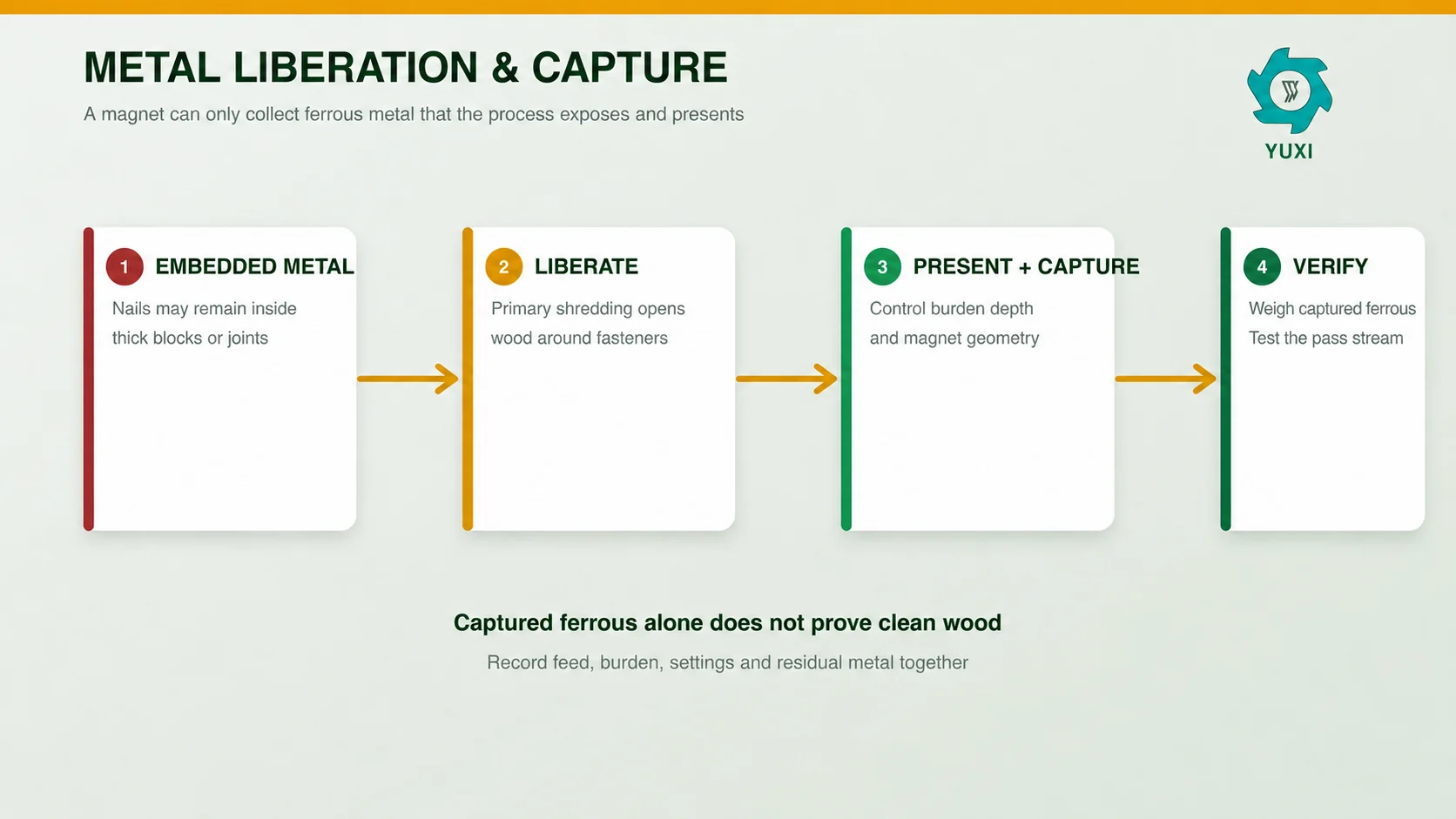
An overband magnet can only capture ferrous pieces that have been exposed and brought into its effective field. A nail still buried inside a thick wood block is not available to the separator. A nail hidden under a deep, uneven burden may also escape even after liberation.
Use a two-question metal test
- What did the magnet capture? Weigh ferrous output separately and inspect its wood carryover.
- What remained in the wood? Sample the post-magnet product, inspect it under an agreed method or run it through a controlled verification stage, and report residual metal.
Record conveyor speed, burden depth, magnet position, feed class, moisture and particle size with the result. If the captured-metal mass rises, that may mean better separation—or simply a dirtier load. Use residual metal in the passing stream to judge cleanliness.
A second magnet after secondary sizing can be worthwhile when more fasteners are exposed by the second reduction stage. Prove the incremental capture against added conveyor length, cleaning work, wood loss and capital cost.
Screening controls a distribution, not a single size
A screen splits material by its interaction with an opening. It does not guarantee identical chip geometry. Feed depth, vibration, moisture, aperture shape, wear and dwell time all influence the split. Long slivers may behave differently from blocky chips even when their mass is similar.
Test primary-shred output first. If it already meets the receiver’s limits, do not add secondary reduction merely to make the plant diagram look complete. When the primary product fails, identify which fraction fails and why:
- Return true oversize to the stage able to correct it.
- Do not count recirculated tonnes again as fresh output.
- Keep fines or dust-collector discharge separate where present.
- Check whether screen blinding, excessive bed depth or long splinters—not insufficient crusher power—is creating the oversize result.
The coarsest compliant setting usually preserves more usable mass and reduces unnecessary breakage. This is particularly important where mineral or coating contamination is concentrated on surfaces: repeated grinding can distribute that material through a larger product fraction.
Measure yield on a closed process boundary
Useful production reporting separates fresh input from internal circulation. A line can show a high conveyor tonnage when the same oversize travels through twice. Calculate saleable yield from accepted output divided by fresh accepted input on the same moisture basis. Report running time and scheduled observation time separately so blockages and interventions do not disappear from the capacity figure.
| Measure | Correct boundary | Misleading shortcut |
|---|---|---|
| Fresh throughput | Weighed accepted input ÷ running or scheduled time, both stated | Total conveyor movement including return |
| Saleable yield | Accepted wood output ÷ accepted input on an agreed moisture basis | Output volume divided by incoming truck volume |
| Metal separation | Captured ferrous mass and post-magnet residual-metal result, reported separately | Captured ferrous mass alone |
| Size compliance | Representative mass-based sample by the agreed method | A photograph of selected good chips |
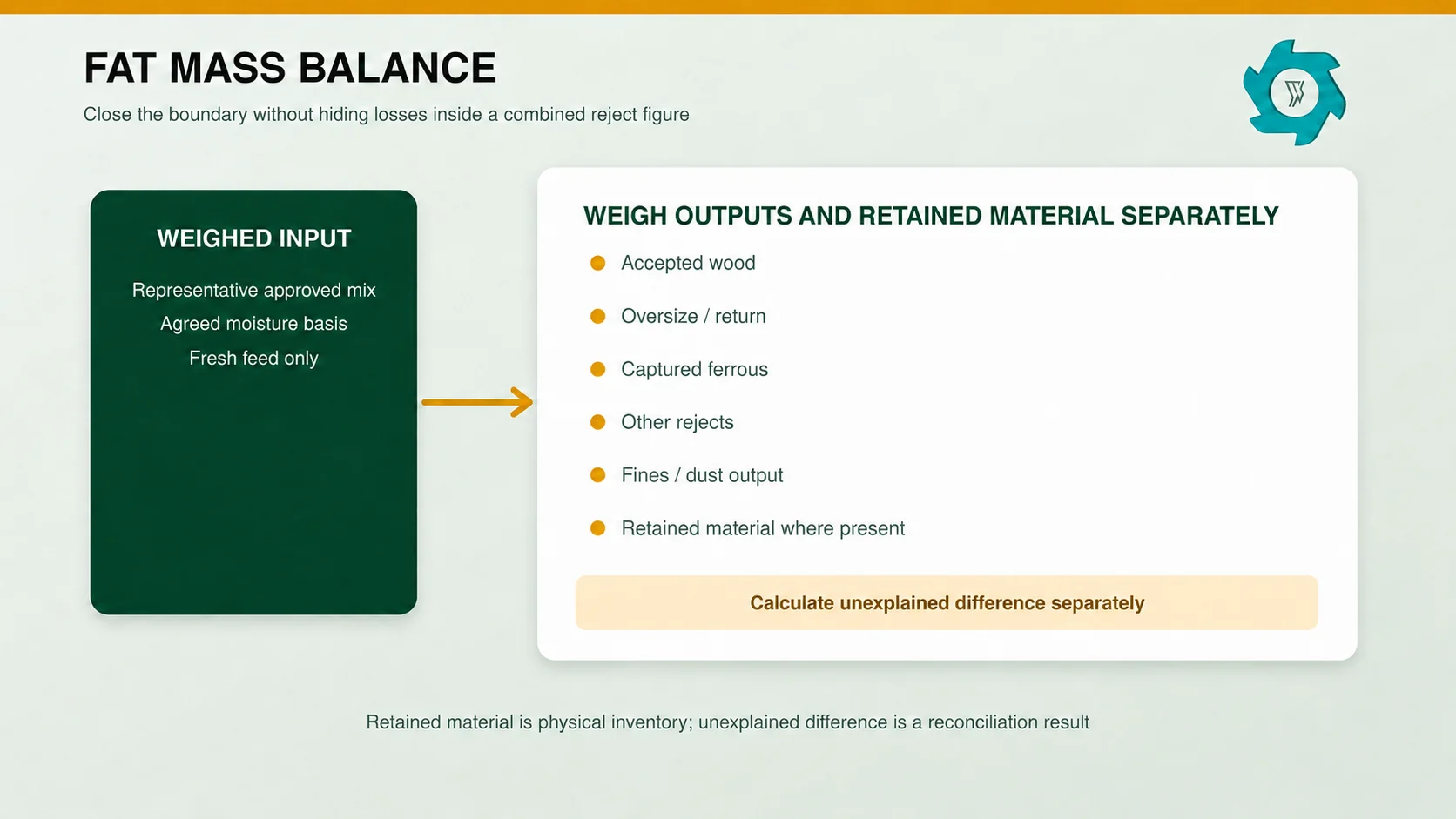
| Loss accounting | Retained material and unexplained difference reconciled separately | Combining both with rejects |
Dust and fire controls belong in process design
Dry wood size reduction, screening and transfer can create fine dust. OSHA identifies wood dust as a health concern and links the topic to its combustible-dust inspection program.5 OSHA’s control guidance favors engineering controls such as local exhaust ventilation and collection at dust-producing points.6
A site-specific hazard assessment should cover dust explosibility where relevant, ignition sources, bearings and overheated material, tramp-metal sparks, electrical classification, collection and isolation, housekeeping, fire detection and emergency response. Dust properties, duct transport, explosion or fire protection and discharge arrangements need competent design under the rules that apply to the site.
Machine guarding, lockout, access platforms and safe clearing procedures are equally part of the line boundary. Automatic reversal can clear some overloads; it does not make reaching into a hopper or screen safe.
Troubleshoot by following material, not by changing every setting
| Observed symptom | Check first | Adjustment to test | Evidence of improvement |
|---|---|---|---|
| Frequent shredder reversals | Feed bundles, dense blocks, foreign objects, cutter condition and metering surges | Stabilize feed; remove prohibited items; restore cutter gap or edge as specified | Reversals per accepted tonne fall without more oversize |
| Metal remains in product | Whether fasteners are liberated; burden depth and magnet setup | Improve first-stage liberation or presentation before increasing magnet strength | Residual metal in a controlled sample falls |
| Screen oversize rises | Aperture blinding, wet mats, feed depth, worn cutters and long splinters | Clean or open the screen; reduce burden; correct the particle geometry | Oversize mass fraction falls at stable fresh feed |
| Fines increase | Extra passes, brittle feed, high-speed impact, worn screen or excessive residence time | Use a coarser compliant setting and remove needless recirculation | Qualified yield rises while product remains in spec |
| Magnet captures too much wood | Cross-belt discharge, entanglement and deep mixed burden | Improve spread and separator cleaning; inspect captured stream | Wood carryover per unit of ferrous falls |
Run the FAT with the buyer’s real mixture
A factory acceptance test should use representative pallets, boards and other approved grades, including the normal fastener load and a documented share of difficult pieces.
- Define the test boundary, scheduled duration, warm-up, stop rules and permitted interventions.
- Weigh incoming material and sample moisture by the agreed method.
- Record running time, stops by cause, reversals, motor load trend and operator interventions.
- Separately weigh accepted wood, oversize or return, ferrous, other rejects, fines or dust discharge, and retained material where those streams exist.
- Sample particle distribution and residual metal from timed increments, not one convenient location at the end.
- Reconcile input and outputs. Report unexplained difference as its own calculation.
Keep an exception log. A jam caused by one prohibited steel part should not be erased, but it should not be interpreted the same way as repeated bridging on approved feed. The log lets buyer and supplier decide whether a result reflects machine design, feed nonconformance or test operation.
Send suppliers a feed-and-product dossier
A useful request for quotation includes load photographs and videos, source categories, piece dimensions, moisture range, bulk density method, metal and mineral contamination, prohibited items, required fresh-feed throughput, product distribution, oversize and fines limits, residual-metal criterion, operating hours, utilities and layout constraints. State the destination for each output.
For branches, leaves, root balls and compost preparation, use the separate green waste recycling process; those materials bring biological instability and soil issues that do not belong in a pallet-focused specification.
Waste wood recycling process FAQs
What is the correct order for shredding and metal removal in waste wood recycling?
Remove obvious hazardous or unsuitable items before shredding, then shred far enough to release nails and fittings before magnetic separation. A second magnet may be justified after further size reduction if testing shows that the first stage does not liberate all ferrous metal.
Can painted or treated wood enter the same recycling line as clean pallets?
Painted, preservative-treated, glued or contaminated wood needs a separate acceptance decision based on local rules and the receiving market. Mechanical processing changes size; it does not remove chemical treatment.
Why does a waste wood screen produce too much oversize?
First check whether the shredder is producing long splinters, the screen is overloaded, apertures are blinded, or wet material is forming mats. Measure the oversize fraction by mass before changing screen size or adding another crusher.
How should magnet performance be tested on shredded wood?
Weigh the captured ferrous stream and inspect or re-run a representative sample of the wood passing the magnet. Record feed type, belt burden, particle depth, magnet settings and residual metal so the result can be reproduced.
What should a waste wood recycling line FAT measure?
Use representative feed and record operating time, stoppages, input mass, accepted wood, oversize or return, captured ferrous metal, other rejects, fines or dust output, and retained material where present. Calculate the unexplained difference separately rather than hiding it in rejects.
Turn the process boundary into a line specification
Send feed photos, source classes, maximum dimensions, moisture range, metal burden, prohibited materials, required fresh-feed rate and the receiving market’s size and contamination limits. YUXI can use those details to define the feeding, liberation, magnetic separation, sizing and test boundary.
References
- Waste wood study: composition.
- Washington guidance: treated wood.
- California DTSC: treated wood.
- NPIC treated wood: identification.
- OSHA wood dust: hazards.
- Dust controls: ventilation.