




 Request Quote



A boiler does not buy “shredded biomass.” It needs fuel that can be received, conveyed and burned within a defined operating window. That makes fuel preparation a controlled interface between variable field residue and a combustion system—not simply a size-reduction job.
This guide focuses on crop residues headed for boilers, thermal-energy plants and industrial energy users. For the wider process configuration—from controlled feeding and primary shredding to separation, screening and transfer—see the biomass shredding and recycling line.
Start with a fuel specification, not a shredder model
“Crop residue” can mean brittle field-dry straw, damp corn stalks, leaf-rich material, cobs, loose chopped fiber or bales carrying soil and twine. Those loads do not have the same bulk density, flow behavior, ash contribution or cutting response. The useful question is not whether the machine can shred them once; it is whether the delivered material can repeatedly meet the boiler owner’s receiving and firing limits.
A written fuel specification should state the sampling basis, moisture basis, acceptable particle-size distribution, maximum oversize, fines handling rule, foreign-material limit and the definition of capacity. It should also name which quality limits belong to the fuel supplier and which are only verified after preparation.
| Specification field | Why a boiler operator cares | Preparation-line response |
|---|---|---|
| Moisture range and method | Changes usable energy per delivered tonne and affects storage, flow and combustion stability. | Route wet lots separately; publish both as-received and dry-matter rates. |
| Particle distribution | Oversize can bridge or hang up; excessive fines can raise dust-handling duty. | Use primary cutting first, then screen or secondary reduction only where required. |
| Soil, stones and metal | Soil increases ash; stones abrade equipment; metal threatens machinery. | Inspect, hold or reject before fine reduction; use magnets only for liberated ferrous items. |
| Delivery form | Bales and loose crop residues create radically different infeed surges. | Use bale opening, buffering and metering suited to the delivered form. |
Dry-matter feed rate = as-received feed rate × (1 − moisture fraction)
This simple conversion prevents a wet delivery from looking like a capacity increase. For dry, baled material, the relevant constraints are often volumetric feeding and bridging rather than motor nameplate power. See the industrial straw recycling line guide for the receiving side of baled straw.
Use a feedstock passport to protect the boiler
Every approved supply route should have a one-page passport. It turns “normal agricultural biomass” into data an operator can check at the scalehouse and in the receiving yard. Retain a representative photo set with each version of the passport; conditions change across harvests and storage seasons.
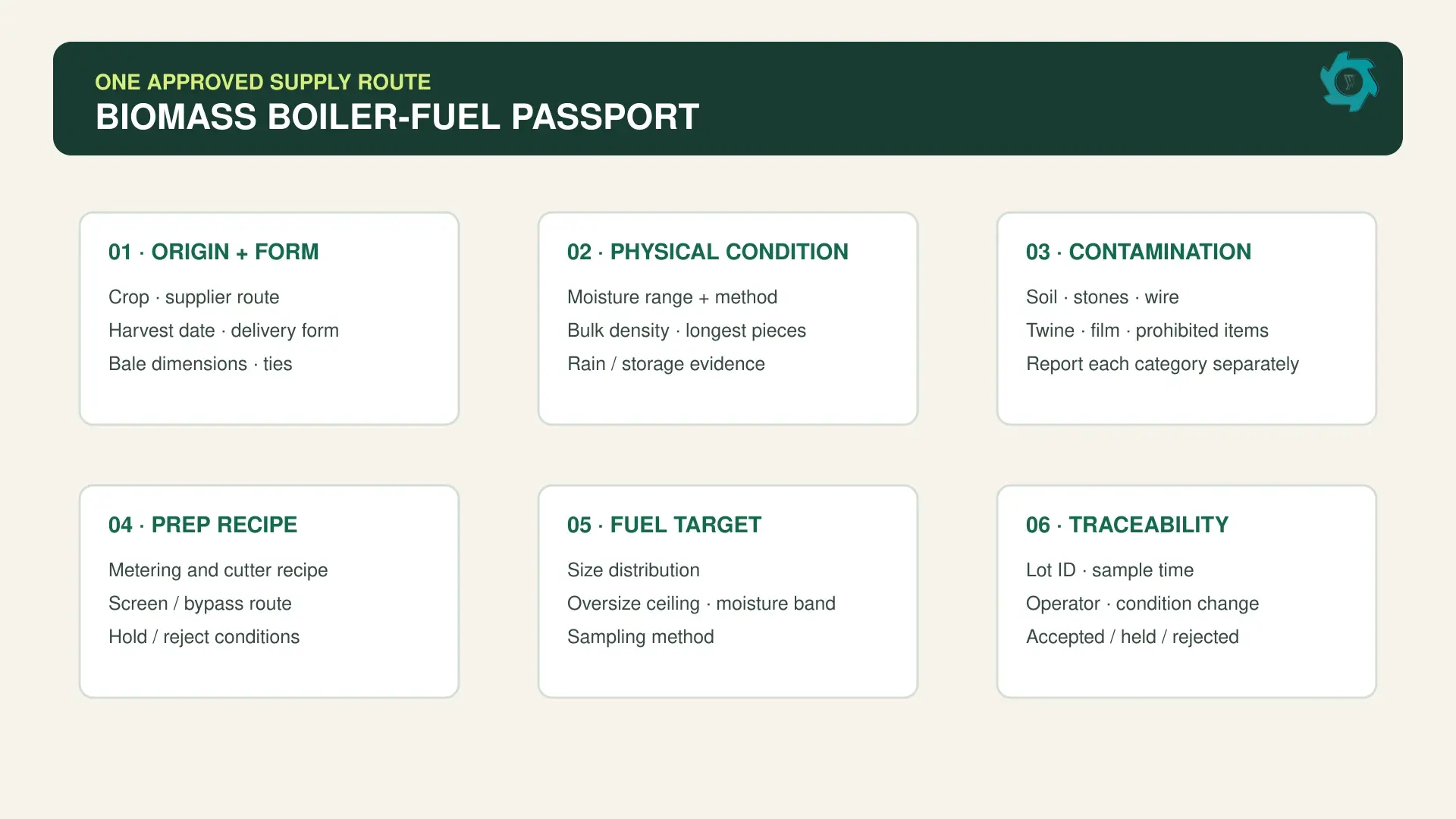
- Origin and form: crop type, field or supplier route, harvest date, loose or baled presentation, bale dimensions and tying material.
- Condition: normal, minimum and maximum moisture; bulk density method; longest recurring pieces; evidence of rain or deterioration.
- Contamination: soil, stone, wire, twine, film and prohibited materials reported separately where practical.
- Fuel target: output-size distribution, oversize ceiling, moisture band and sample method agreed with the boiler operator.
Corn residues often arrive with leaves, husks, stalk sections, cobs and near-ground material in the same load. Where those fractions matter, use the more detailed corn stalk feedstock-preparation guide.
Build the line around stable flow and selective sizing
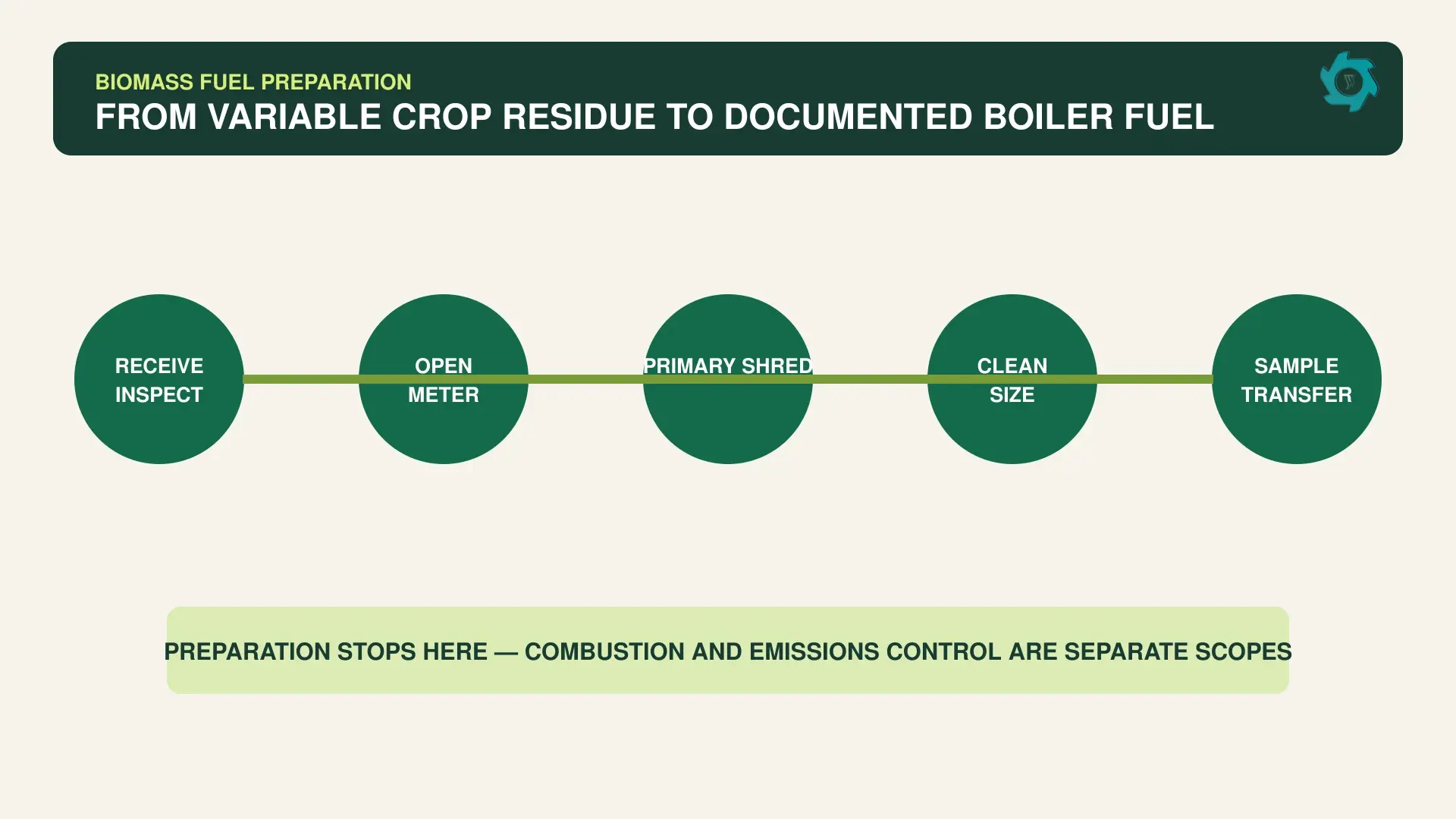
The route is receive and inspect → open or decompact → buffer and meter → primary shred → remove liberated ferrous contamination → screen or selectively re-size → sample and transfer. Fine grinding before inspection distributes removable soil and makes simple rejects harder to separate. A primary cut before the magnet helps release wire and small fittings, but it does not remove plastic, stones or metal hidden in an unopened bale.
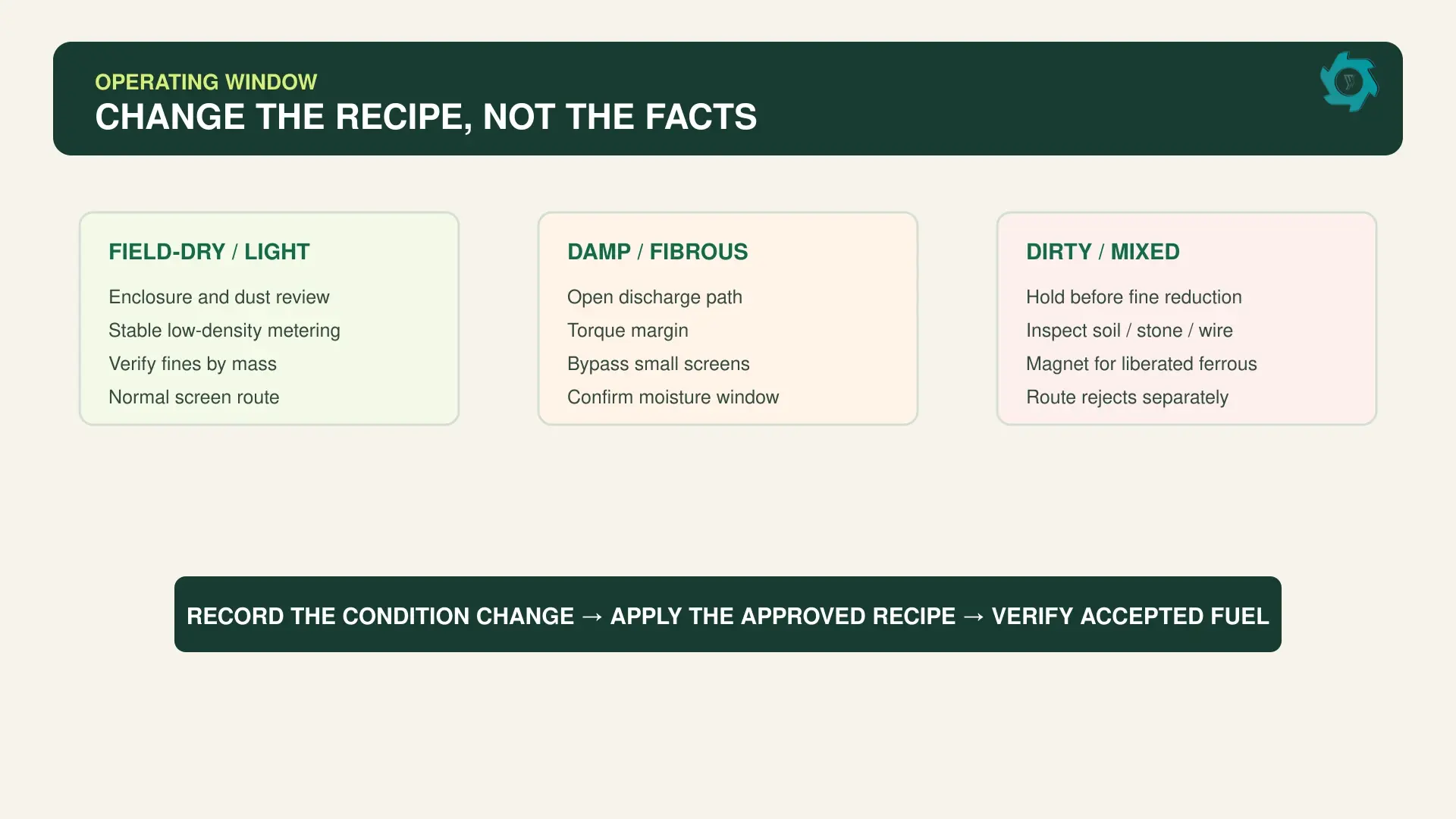
The coarsest output accepted by the fuel-handling and combustion system is normally the correct starting point. Every extra reduction stage needs a measured reason: an oversize limit, a conveyor or feeder constraint, a tested combustion requirement, or a known handling fault. Smaller material may solve one problem while adding power draw, wear, fines and dust-collection load.
Wet fibrous material deserves its own recipe. It can fold rather than fracture, compact at transfers and blind fine screens. In that condition, a more open discharge path and bypass around moisture-sensitive screening may be more useful than a finer screen. For a dedicated wet-fiber case, read the sugarcane bagasse processing guide.
Measure accepted fuel, not just tonnes entering the hopper
For boiler fuel, capacity should be reported over an agreed stable period with the same material lot and the same process boundary. A high input rate is not a useful result if a portion is oversize, recirculates, becomes dust, or waits in the equipment at the test stop.
Report three quantities together: incoming as-received tonnes per hour, incoming dry-matter tonnes per hour and accepted on-spec dry fuel tonnes per hour. The last figure is the one that links preparation output to usable fuel supply. Keep returns out of final output; counting a piece each time it passes the shredder inflates production.
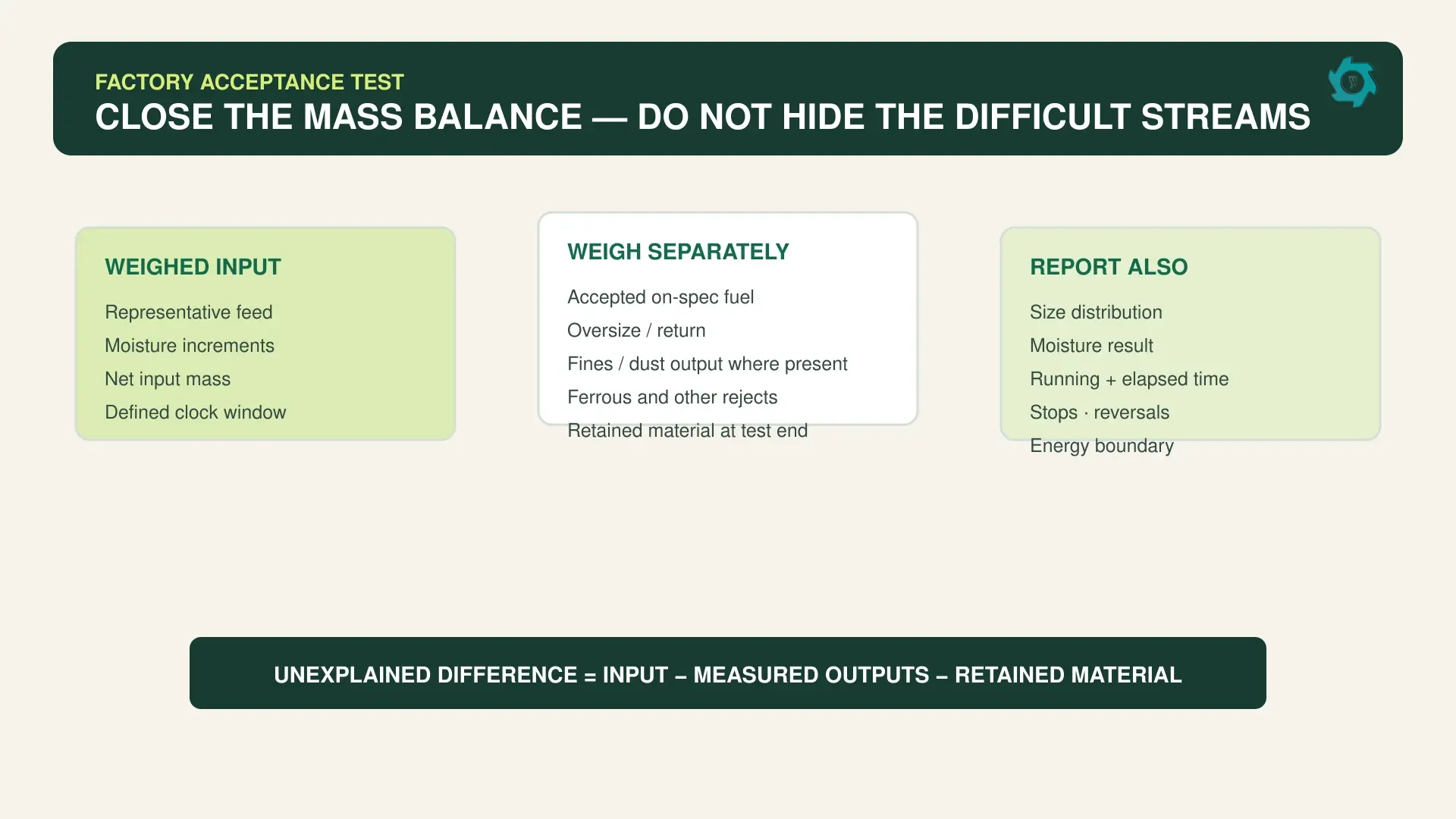
| FAT record | What to measure |
|---|---|
| Representative input | Net mass, feedstock passport, moisture increments and known contamination. |
| Separate output streams | Accepted fuel, oversize/return, collected fines or dust output, ferrous material and other rejects. |
| Material retained in line | Material remaining in hopper, conveyor, screen, separator and collector at the end of the run. |
| Quality confirmation | Timed particle-size samples, moisture on the agreed basis, plus any ash or contaminant test specified by the boiler operator. |
| Operating evidence | Running and elapsed time, stops, reversals, bridging, manual intervention, energy boundary and cutter condition. |
Calculate unexplained difference only after separately accounting for known streams and retained material. For rice-straw-specific considerations such as silica-rich ash and storage routing, use the rice straw recycling machine guide.
Dust, fire and maintenance are part of fuel preparation
Dry crop residues can generate combustible dust at cutting chambers, screens, transfer points and collectors. OSHA notes that combustible dust hazards can arise across many industries and must be evaluated for the actual material and operation.1 Treat enclosure, collection, housekeeping, ignition-source control, access for cleaning and safe isolation as engineering requirements, not optional upgrades after commissioning.
Operators should log bridges, wraps, high-load events and manual clearing by feedstock passport. This makes repeat faults visible: a change in supplier, bale density or moisture often explains a rising intervention rate better than a change in motor load alone.
Release fuel by risk class, not by one average result
A yearly average moisture or ash result is too blunt for day-to-day boiler protection. Add a three-way receiving decision to the passport: release when the lot is within the agreed operating envelope; conditional route when it needs a slower feed rate, a screen bypass, blending approval or a separate stockpile; and hold for review when visible contamination, abnormal storage condition or missing evidence makes the lot untraceable. This gives the receiving operator a practical response before a problem reaches the fuel house.
| Fuel signal | Why it is not just a laboratory number | Immediate control decision |
|---|---|---|
| Higher moisture than the normal recipe | Can lower delivered useful energy per tonne and change flow, screen and storage behavior. | Confirm the agreed moisture method; route to the damp-fuel recipe or hold if outside the approved band. |
| High mineral matter / visibly dirty material | Can increase ash handling and abrasive wear; one dirty delivery can distort a blended result. | Segregate, inspect the collection cause and decide whether a defined cleaning route is justified. |
| Unusual chlorine- or salt-bearing contamination risk | May affect the boiler owner’s corrosion, deposition and emissions-control review. | Retain a sample and obtain the boiler operator’s release decision. |
| Particle distribution shift | Can alter feeder behavior, dust loading and residence time in the combustion system. | Check timed size increments; correct the preparation recipe before changing boiler settings. |
The key is traceability: retain the sample ID, original lot ID, preparation recipe and final release decision together. ISO’s solid-biofuel standards provide recognized methods for sampling, moisture, ash, calorific value and particle-size work; using named methods avoids a supplier and a boiler laboratory comparing unlike results.2
Compare fuel on delivered energy and handling reliability
Two loads with the same wet mass can deliver very different usable fuel to the boiler. A better procurement dashboard keeps mass, condition and handling separate. Each shift should show: accepted as-received tonnes, accepted dry tonnes, measured calorific value on the stated basis, qualified yield, oversize share, fines or collected-dust share, and intervention rate. The last two indicators reveal whether a nominally on-spec fuel is still creating an operational burden.
Energy-delivery record = accepted fuel mass + stated moisture basis + stated calorific-value basis + documented sampling method
Do not calculate a financial saving from a heating value alone. The boiler owner must assess its own firing system, auxiliary fuel, ash removal, emissions requirements and permit conditions. The preparation line’s job is to deliver an accurately described, mechanically reliable fuel stream for that review.
Run a controlled trial-burn handoff
Before a new residue source becomes routine fuel, hand off a defined trial lot. The preparation team should deliver a retained feed sample, retained prepared-fuel sample, timed particle-size results, moisture result, contamination record and the exact recipe used. The boiler team should return a written disposition: released for normal use, released with a limit, or held pending investigation. This closes the gap between a successful shredder demonstration and actual thermal use.
| Trial stage | Preparation team evidence | Boiler-side decision |
|---|---|---|
| Pre-trial review | Passport, visual condition, known contaminants and proposed operating window. | Confirm fuel boundary, sampling method and stop / investigate triggers. |
| Timed preparation run | Mass balance, particle-size increments, moisture and events by time window. | Confirm that the delivered fuel is representative of the intended campaign. |
| Controlled fuel introduction | Lot identity and retained samples accompany the delivery. | Record feedability and any agreed boiler observations under site procedures. |
| Release review | Recipe, yield and exceptions are documented. | Approve, conditionally approve, or reject the source with a stated reason. |
Questions to put in the RFQ
- Which crop fractions, delivery forms and moisture bands are included in the capacity promise?
- Is capacity stated as wet feed, dry feed, total discharge or accepted on-spec dry fuel?
- Which contaminant routes are included, and which remain a site or supplier responsibility?
- What is the maximum permitted oversize and how will it be sampled?
- What happens to wet material that cannot pass the normal screen?
- Which dust-control boundary, safe-clearing provisions and hazardous-energy controls are included?
- Which output streams will be separately weighed during the factory acceptance test?
Configure biomass preparation around the actual boiler fuel window
Send representative feedstock photos, moisture range, contamination details, target fuel size and required accepted dry-output rate.
FAQ
Does a boiler always need finely ground biomass?
No. Start with the coarsest size the boiler’s receiving, conveying and combustion system accepts. Fine reduction should solve a verified requirement, not be assumed to improve every fuel.
Why report dry-basis capacity?
Moisture changes delivered mass without adding dry combustible material. A dry-basis result makes different moisture lots and equipment tests comparable.
Can a magnet remove all contamination from crop residues?
No. A magnet can remove liberated ferrous items. It will not remove soil, stones, plastic twine or metal still trapped in material that has not been opened.
What should be included in a boiler-fuel FAT?
Use representative feed; separately weigh accepted fuel, oversize or return, fines or dust output, ferrous material, other rejects and retained material; then document moisture, particle size, running and elapsed time, operating events and the agreed energy boundary.
References
- OSHA: dust hazards.
- ISO methods: sampling, moisture, ash, calorific value, particle size.