




 Request Quote


Refrigerator recycling rules do not give buyers a universal machine list. They set duties around refrigerant, hazardous components, treatment, records and recovery. The equipment specification must translate those duties into a clear plant boundary—then add the state, national, permit and site conditions that apply to the actual project.
The Main Difference: Federal Disposal Rules vs a WEEE Treatment System
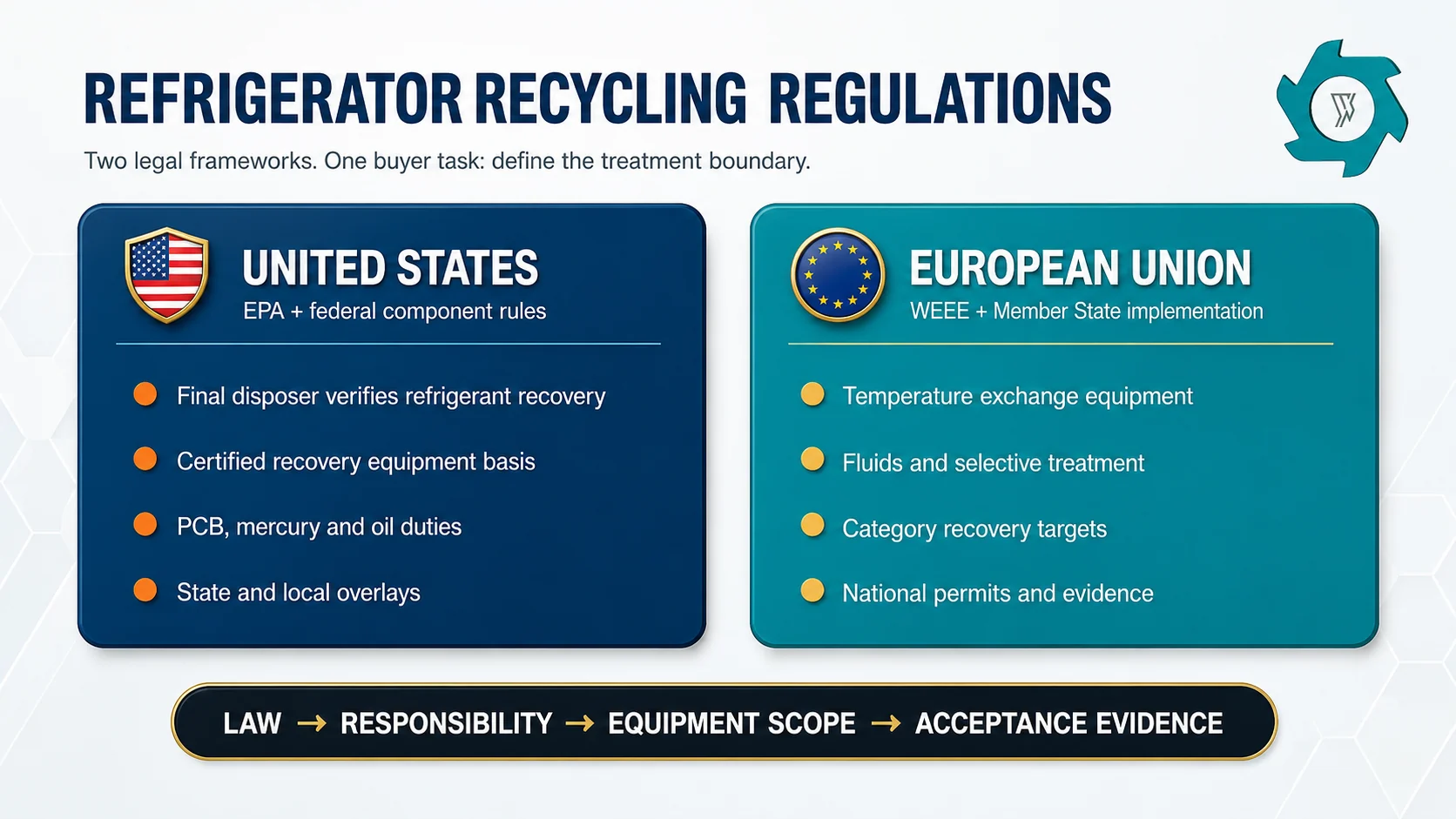
In the United States, the federal rules most directly relevant to a discarded household refrigerator sit across several environmental programs. Clean Air Act Section 608 governs refrigerant recovery and the final disposer’s verification duty. Separate federal rules apply to components such as used compressor oil, mercury-containing items and PCBs. States and local authorities may add collection, appliance-recycling, waste, air, fire or facility requirements.
The European Union takes a broader product-waste approach under the WEEE Directive. Refrigerators and freezers fall within “temperature exchange equipment.” The Directive addresses separate collection, proper treatment, selective removal, recovery targets and producer responsibility, while each Member State implements and enforces the system through national law. A buyer therefore cannot treat “EU compliant” as a complete specification without naming the destination country and operator obligations.1
| Question | United States | European Union |
|---|---|---|
| Core buyer reference | Clean Air Act Section 608 / 40 CFR Part 82, Subpart F, plus component-specific waste rules | Directive 2012/19/EU (WEEE), Member State transposition, permits and applicable treatment standards |
| Refrigerator category | Household refrigerators and freezers are small appliances when they meet the regulatory definition | Temperature exchange equipment |
| Key upstream control | Ensure refrigerant recovery before final disposal and keep the required verification where another party performed recovery | Proper treatment, including removal of all fluids and selective treatment of specified substances and components |
| Why location matters | State and local rules may be stricter or add facility duties | The Directive is implemented through national systems; operator approvals and evidence requirements vary |
What a U.S. Buyer Should Take From EPA Rules
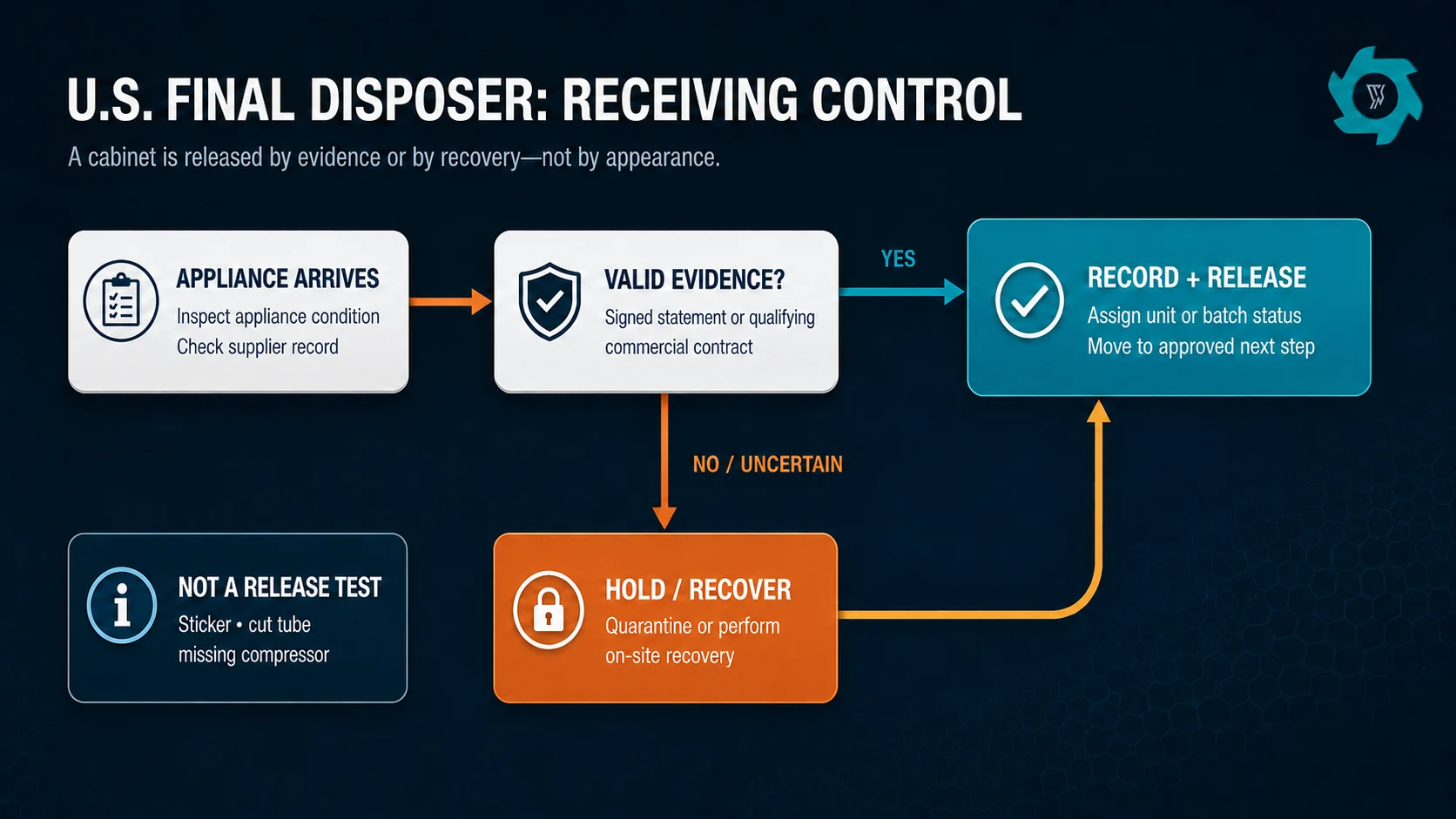
1. The final disposer owns the verification problem
EPA states that the final person in the disposal chain—such as a scrap recycler or landfill—is responsible for ensuring refrigerant is recovered before final disposal. If appliances arrive without a charge because someone upstream performed the recovery, the final disposer must obtain a signed statement containing the recovery provider’s name and address and the recovery date. For regular commercial suppliers, an appropriate contract can cover the verification arrangement. A sticker alone is not EPA’s required verification.2
A buyer needs a documentation route and an exception route, not merely a refrigerant station. Units with missing, incomplete or inconsistent evidence need a defined hold area and disposition procedure. The plant’s refrigerator depollution boundary should identify who inspects each unit, who releases it, and which record follows the batch.
2. Recovery equipment and technician rules are not the same question
EPA says people recovering refrigerant from small appliances in the waste stream for disposal are not required to hold Section 608 technician certification. However, the equipment used for recovery must meet the applicable performance standards. EPA’s current equipment guidance identifies certified recovery equipment and states that small-appliance equipment must recover 90% of the refrigerant when the compressor operates or 80% when it does not.3
A quotation should therefore identify the appliance class, refrigerants expected, recovery method, equipment certification basis and how recovery completion is checked.
3. Refrigerant is not the entire federal disposal boundary
EPA’s appliance-disposal guidance separately points to removal of regulated hazardous components, including PCBs, mercury and compressor oil, under 40 CFR Parts 761, 273 and 279. It also makes an important distinction: federal rules do not require appliance-foam recovery, although the former voluntary RAD program promoted recovery of foam blowing agents as a better environmental practice.4
That distinction prevents two common specification errors. First, a buyer should not describe optional foam-gas recovery as a universal federal requirement. Second, “not federally required” does not mean irrelevant: a customer contract, state rule, air permit, corporate standard or emissions goal may still make foam treatment part of the project.
What an EU Buyer Should Take From the WEEE Directive
1. Refrigerators are temperature exchange equipment
Annex III of the WEEE Directive places refrigerators, freezers and similar products in the temperature exchange equipment category. That classification matters because recovery performance is reported by category and the treatment route must be suitable for equipment containing refrigerants and insulation systems—not merely for generic white-goods scrap.1
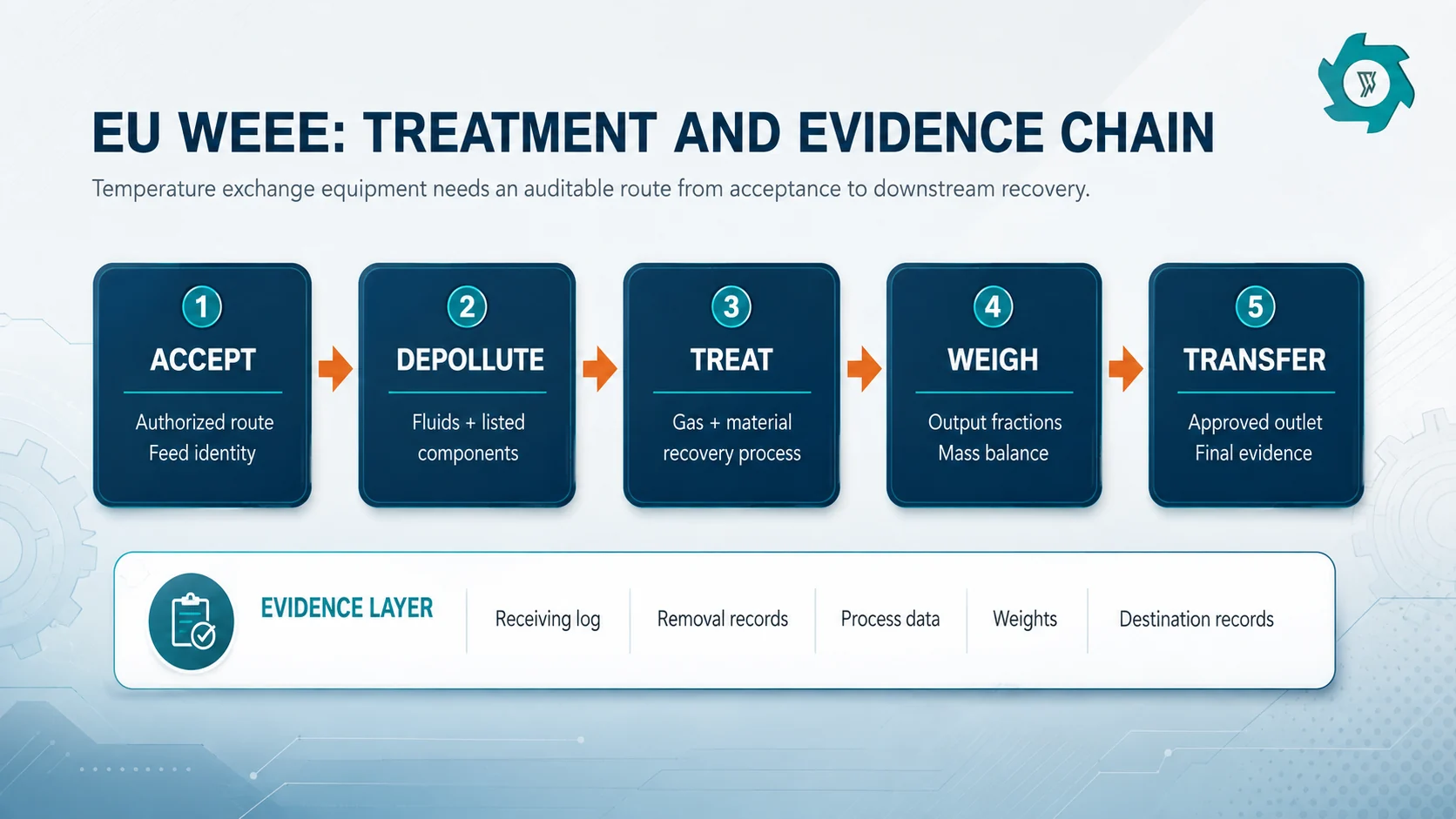
2. Proper treatment begins with depollution
Article 8 and Annex VII establish the treatment baseline. Proper treatment must, at minimum, include removal of all fluids and selective treatment of listed materials and components. For temperature exchange equipment, the gases that deplete the ozone layer or have a global-warming potential above 15 must be properly extracted and treated. The Annex also calls for removal of specified items such as PCB-containing capacitors, mercury-containing components and plastics containing brominated flame retardants where present.1
The buyer must define how the operator will recognize relevant appliance types, remove accessible controlled items, deal with damaged units, manage oil and fluids, and treat insulation-related gases under the project’s approved route.
3. Targets are facility outputs, not separator guarantees
For temperature exchange equipment, Annex V sets an 85% recovery target and an 80% preparation-for-reuse-and-recycling target by average weight per appliance. These are category-level treatment results calculated under the Directive’s rules; they should not be copied into a purchase contract as if one separator must achieve “80% purity” or “85% metal recovery.”1
The plant still needs a defensible mass balance. Weighing points, batch or campaign identification, output containers, residue codes and downstream destinations should allow the operator to support the reporting method required in the Member State.
4. “Built to a European standard” still needs a named standard and contract edition
The European Commission has asked CENELEC to develop standards for WEEE collection, transport and treatment, including preparation for reuse. These standards can help operators demonstrate good treatment practice, but a supplier should name the exact standard, part and edition in its offer instead of using “WEEE compliant” as a catch-all phrase.5
Turn Regulatory Duties Into a Purchasable Equipment Scope
Start by placing a boundary around the machinery. YUXI’s waste refrigerator recycling line can begin with prepared cabinets or include upstream refrigerant, compressor and oil handling, depending on the project. That choice must be explicit in the RFQ.
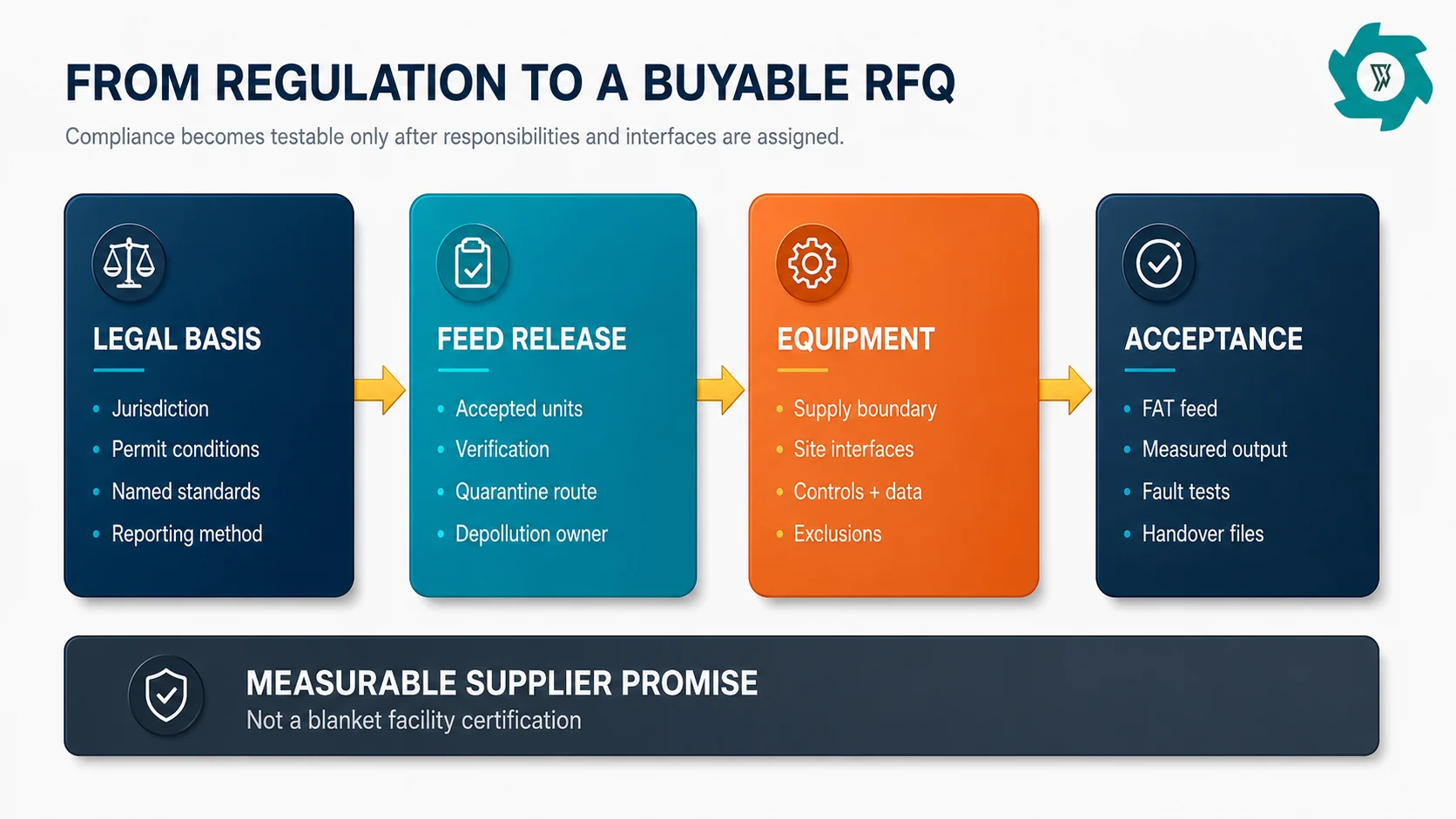
A useful specification separates four layers:
- Legal and permit basis. Destination jurisdiction, competent authority, operator permit, applicable waste codes, air/fire conditions and referenced standards.
- Feed release. Accepted appliance types, prior-recovery evidence, quarantine conditions, on-site depollution steps and authority to release a unit.
- Mechanical treatment. Cabinet condition at the shredder, throughput basis, liberation and sorting duties, dust/foam/gas interfaces and final fractions. Use the refrigerator recycling equipment guide to map each machine to its actual function.
- Evidence and acceptance. Weighing, logs, alarm history, material accounting, FAT/SAT tests, training, manuals and handover records.
Do not ask the machine supplier to certify the entire facility
A supplier can document its machinery, controls, declared scope and test results. It usually cannot guarantee the operator’s collection contracts, environmental permit, building ventilation, downstream waste outlets or day-to-day recordkeeping. Assign these interfaces in a responsibility matrix.
Keep regulatory targets separate from FAT metrics
Factory acceptance should use measurable equipment criteria: sustained throughput on agreed feed, availability during the test window, recovery or carryover for named material fractions, dust capture conditions, alarm and interlock response, and complete data logging. Legal recovery targets may depend on the full treatment chain and downstream accounting, so they belong in the project compliance plan rather than being reduced to one machine test.
Documents to Request Before Award
- A process description showing the exact incoming condition and the first point inside the supplier’s scope
- A responsibility matrix for receiving, refrigerant recovery, oil and component removal, foam/gas treatment, residues and downstream transfer
- The recovery-equipment certification basis and compatible refrigerant/appliance classes for a U.S. project
- The named WEEE/CENELEC standard parts and editions where they are contractually required for an EU project
- Mass-balance architecture: scales, batch IDs, output definitions, sampling points and data export
- A controls narrative and cause-and-effect matrix for gas, ventilation, dust and fire interfaces
- A list of exclusions: permits, civil works, building ventilation, fire system, utilities, waste containers, laboratory testing and third-party certification
- FAT and SAT protocols tied to the agreed feed, operating boundary and evidence package
The related refrigerator recycling plant safety guide goes deeper into gas monitoring, dust/fire controls, interlocks and jam-clearing provisions.
US vs EU Buyer Checklist
| RFQ item | U.S. emphasis | EU emphasis | Acceptance evidence |
|---|---|---|---|
| Incoming appliance release | Refrigerant recovered or verified under final-disposer rules | Accepted into an authorized proper-treatment route | Receiving record, exception log, release status |
| Depollution | Refrigerant plus component-specific federal/state duties | All fluids and Annex VII selective-treatment items | Work instruction, operator log, removed fractions |
| Recovery equipment | Applicable EPA performance/certification basis | Project and national treatment requirements | Certificates, equipment data, commissioning test |
| Foam treatment | Not a universal federal requirement; may be driven by other obligations or buyer policy | Gas extraction/treatment requirements for covered gases in temperature exchange equipment | Defined process, containment and downstream route |
| Performance accounting | Contract and facility metrics; no federal WEEE-style category target | Category recovery and preparation-for-reuse/recycling targets | Mass balance and approved reporting method |
| Local overlay | State/local waste, air, fire and licensing requirements | Member State law, permits, scheme/audit rules and standards | Compliance register and responsibility matrix |
Questions to Put in the Supplier Clarification Meeting
- Does your price assume complete refrigerators or verified, evacuated cabinets?
- Who supplies and validates refrigerant-recovery equipment?
- Which components and fluids are removed before shredding, and who records them?
- How are damaged or undocumented appliances quarantined?
- Does the quoted foam system separate solid foam only, or also capture and treat blowing agent?
- Which legal requirements, standards and editions does the design explicitly address?
- Which permits, third-party approvals and building systems are excluded?
- What measurements will support the operator’s mass balance?
- Which compliance-related alarms, trips and records will be demonstrated during FAT/SAT?
- What feed and output conditions are excluded from the performance guarantee?
Define the Compliance Boundary Before Comparing Lines
Send YUXI the destination country or state, incoming appliance condition, required depollution scope, throughput target and output plan. We can turn those inputs into a mechanical-line boundary and a technical clarification list for your project team.
Refrigerator Recycling Regulation FAQ
Does the U.S. EPA require refrigerant removal before a refrigerator is shredded?
The final disposer must ensure that refrigerant is recovered before final disposal. When recovery was performed upstream, EPA requires the appropriate signed verification or qualifying commercial-supplier contract.
Does a person recovering refrigerant from a discarded household refrigerator need Section 608 technician certification?
EPA states that a person recovering refrigerant from a small appliance in the waste stream for disposal does not need Section 608 technician certification. The recovery equipment must still meet the applicable performance standards. Different rules can apply to servicing work or equipment outside the small-appliance disposal context.
Does U.S. federal law require recovery of the blowing agent in refrigerator foam?
EPA’s appliance-disposal guidance says foam treatment is not federally required. A state rule, permit, customer contract or environmental program may still require or favor foam-gas recovery, so the project basis must be checked.
What does the EU WEEE Directive require before mechanical processing?
Proper treatment includes removal of all fluids and selective treatment of specified materials and components. For temperature exchange equipment, covered ozone-depleting or high-GWP gases must be properly extracted and treated.
Does “WEEE compliant” prove that a refrigerator recycling line meets every EU requirement?
No. The destination Member State’s law, operator permit, compliance scheme, applicable standard editions, site interfaces and operating records all matter. The supplier should state exactly which machinery and documents are included.
Should the EU 85% recovery target be used as a separator guarantee?
No. It is a category-level treatment target based on average appliance weight and the Directive’s calculation rules. Machine FAT criteria should instead define measurable feed, throughput, fraction recovery or carryover, and the test boundary.
Engineering References
- EUR-Lex WEEE — selective treatment rules.
- EPA Safe Disposal — refrigerant disposal.
- EPA Certification — recovery equipment.
- EPA Appliances — appliance disposal.
- European Commission — WEEE implementation.