




 Request Quote
Product Center
-
- Biomass Shredding and Recycling Line
- OCC Paper Dry Pulping & Cardboard Recycling Line
- Scrap Aluminum Recycling Line
- Waste Car Recycling Line
- Waste Refrigerator Recycling Line
- Copper Aluminum Radiator Recycling Line
- Motor Rotor Recycling Line
- Copper Wire Recycling Line
- Waste Ink Cartridge Recycling Line
- Aluminum UBC Scrap Recycling Line
Get a Quote
Contact Us


Pellet mills do not handle changing feed conditions particularly well. Moisture and particle size need to stay within a workable range. That makes pretreatment more than a simple size-reduction step. Seasonal biomass has to be prepared and fed consistently, otherwise plugging, temperature changes, and uneven pellet quality can quickly become operating problems.
For the upstream handling architecture—receiving, controlled feeding, primary shredding, separation and transfer—see the biomass shredding and recycling line.
Why pellet pretreatment fails at the interfaces
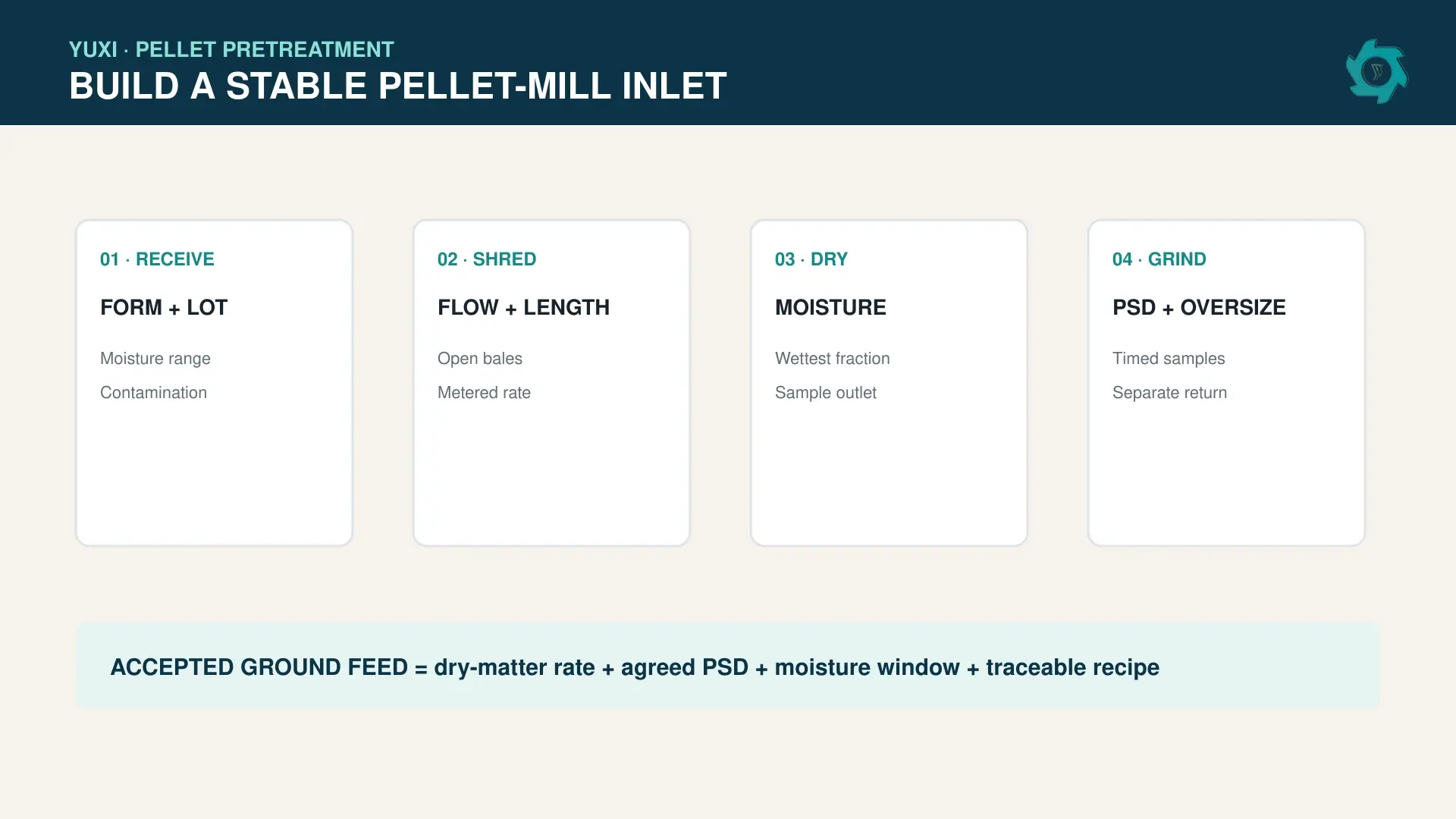
Most unstable pellet lines do not have a single “bad machine.” They have a mismatch at one of four interfaces: bulky material enters a small metering system; wet material reaches a mill designed for dry flow; oversized fibers bypass the grinder; or ground material leaves the grinder with a moisture distribution too wide for consistent conditioning.
| Interface | What must be controlled | What goes wrong when it is not |
|---|---|---|
| Receiving → primary size reduction | Form, longest pieces, contaminants, bulk density | Bridging, wrapping and unpredictable surge loads |
| Shredding → dryer | Thickness and size distribution, not one nominal length | Uneven residence time; wet cores leave the dryer |
| Dryer → fine grinder | Moisture band, temperature and foreign-material control | Screen blinding, poor throughput or excessive fines |
| Grinder → pellet mill | PSD, moisture uniformity and short-term buffer behavior | Variable die load, weak pellets and frequent adjustments |
Start with the pellet mill’s feed window
Ask the pellet-mill supplier for a written inlet specification before selecting reduction or drying equipment. It should identify the accepted moisture band, maximum particle size, particle-size distribution (PSD), permitted oversize, target bulk density if relevant, temperature limit and any restrictions on bark, soil, treated wood or agricultural contaminants.
Do not substitute one “average moisture” or “screen size” for this specification. A 4 mm grinder screen does not prove that all particles are below 4 mm, and a single grab moisture sample does not describe a wet pocket in a storage pile.
Set the reduction sequence by material behavior
Primary shredding opens bales, shortens long stalks and makes conveyor feeding predictable. It is not automatically a fine-grinding step. Fine grinding belongs after the material is dry enough and clean enough to pass the selected mill reliably.
| Material condition | Preferred first move | Pellet-preparation caution |
|---|---|---|
| Dry baled straw | Open, meter and cut long fibers before drying or grinding | Low bulk density can limit t/h even when motor load is low. See the baled straw processing guide. |
| Corn stalk mix | Separate abnormal soil or wire, then reduce bulky stalk sections | Cobs, leaves and stalks may dry and grind differently; keep the recipe linked to the incoming mix. Review corn stalk feedstock preparation. |
| Rice straw | Control dust and dry-matter flow before chasing a smaller cut | Mineral-rich field contamination affects ash and wear; do not hide it inside a single “biomass” result. |
| Wet bagasse or green fiber | Use open discharge and drying before fine screening | Wet fibers fold and smear rather than fracture; tight screens can become a bottleneck. See wet bagasse processing. |
Design drying around moisture distribution, not dryer nameplate
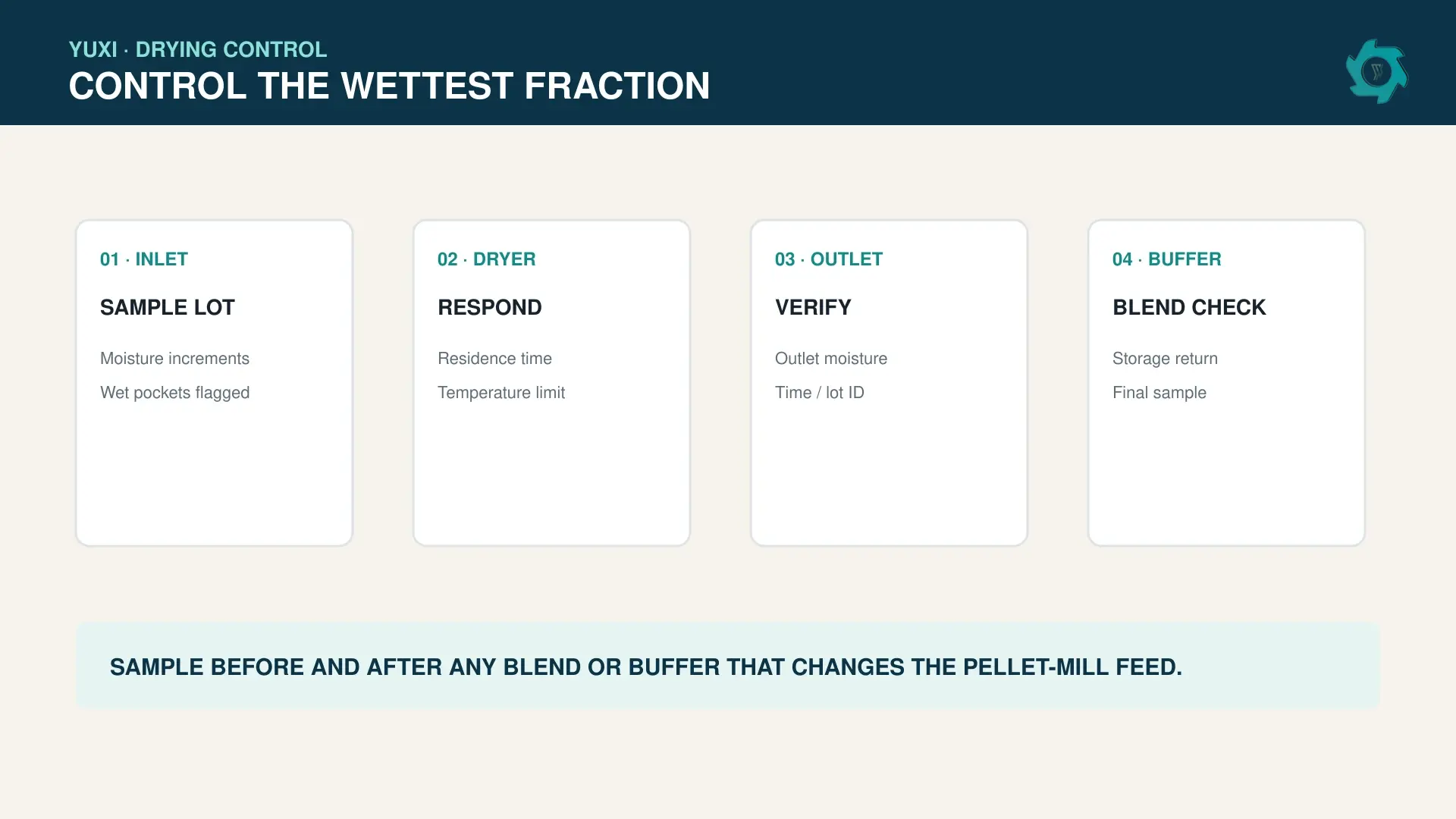
A dryer must deal with the wettest credible fraction. When thick fragments, wet clumps and thin dry fibers share the same residence time, the dryer outlet can look acceptable on average while still sending unstable pockets to the grinder.
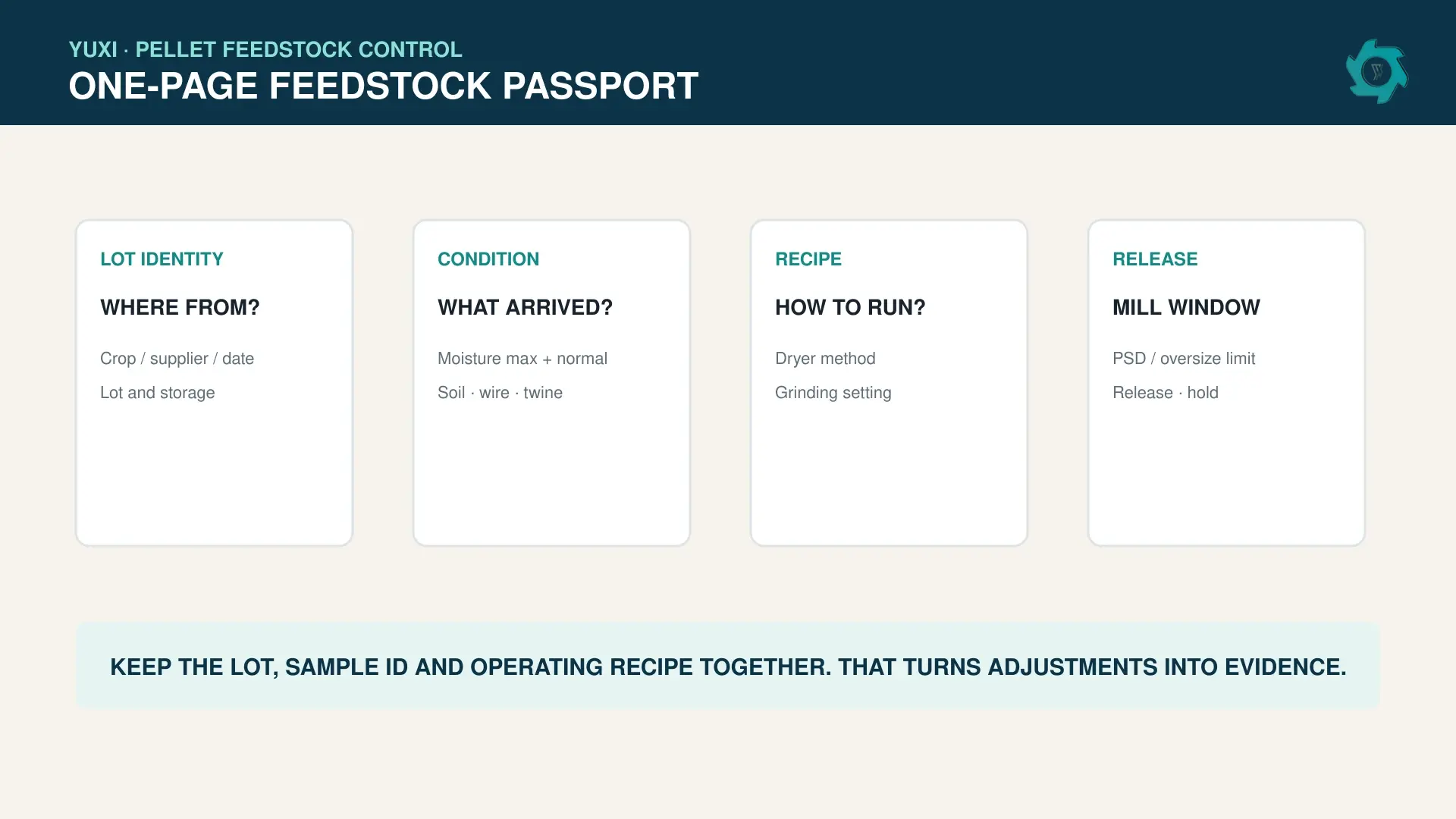
Map moisture at three points: representative incoming material, dryer discharge and the grinder feed buffer. Report the sampling time, lot and basis. If the dryer output is blended with a returned or stored stream, sample after that blend as well. That extra sample often explains a pellet-mill shift problem that cannot be seen at the dryer outlet. Use a documented total-moisture method and report the result on a wet basis.1
Engineering check: calculate both wet feed rate and
dry-matter rate. Dry-matter rate = as-received rate × (1 − moisture
fraction). Use this basis when comparing dryer duty, grinder capacity
and pellet output.
Fine grinding: specify the distribution that the die needs
Fine grinding is a controlled liberation and distribution step. The mill should be selected with the material’s dryness, fiber behavior, contamination risk and desired PSD in mind. Smaller openings can increase the share of fine particles and energy use, but they may not fix a long-fiber or moisture problem upstream.
During trials, retain timed samples before and after the grinder. Determine the particle-size distribution using an agreed method, such as an agreed method2 where its sieve range suits the material. Report the oversize fraction separately, and record screen condition, mill amperage, product temperature and running time. An average sample from a full shift can hide short periods of bad output that make the pellet press unstable.
Use a qualification run that closes the material balance
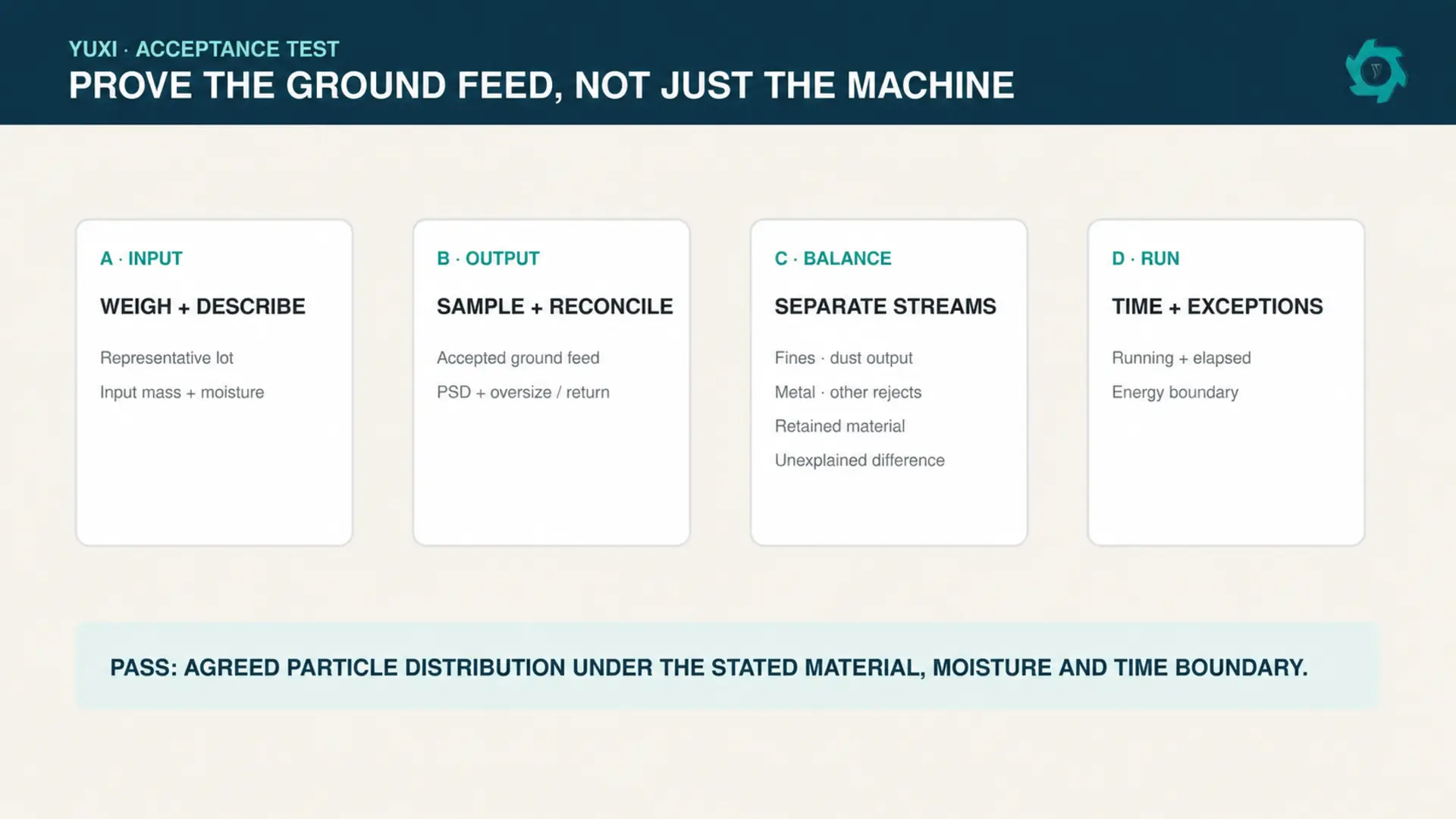
A credible factory or site acceptance test uses a representative lot and a fixed process boundary. The reported result should distinguish the material that the pellet mill can use from material that recirculates, becomes dust, remains in the equipment or is rejected.
| Record separately | Why it matters to pellet production |
|---|---|
| Weighed input with moisture samples | Establishes wet and dry-matter basis for every later rate |
| Accepted ground feed | Measures useful mill inlet, not simply material entering the shredder |
| Oversize / recirculation | Prevents reprocessed material from inflating output |
| Collected fines | Shows the fine fraction created or separated by the process and its effect on usable-feed yield |
| Dust-collection output | Separates captured airborne material from the product stream and makes dust-handling loss visible |
| Metal rejects | Confirms removal of ferrous or other metal that could damage downstream equipment |
| Other rejects | Shows non-metal contamination or prohibited material removed from the lot |
| Retained material | Identify where it remains in the process and how it will be recovered, cleaned out or dispositioned |
| Unexplained difference | Report it separately and investigate any result above the agreed mass-balance tolerance |
| Running and elapsed time | Separates machine production from clearing, adjustments and stoppages |
Four controls that add real information
- Recipe change log. Record moisture band, screen or die-related target, feeder setting, dryer setting and any bypass used for each lot.
- Wet-pocket rule. Define when a lot is slowed, re-dried, blended under approval or held.
- Short-interval quality samples. Pair each PSD and moisture sample with a time window and operating events.
- Dust and ignition review. Dry biomass can create combustible dust at grinders, screens and transfer points, so the actual dust hazard and operating controls should be assessed for the site.3
For residues with special storage and mineral considerations, the rice straw recycling guide is a useful material-specific reference.
Use a moisture-to-energy ledger before choosing dryer size
Dryer selection is often framed as a wet-tonnes-per-hour question. That can conceal the real load: kilograms of water removed per hour, plus the material’s sensible-heat requirement and losses in the air or gas system. Build a ledger for each credible feedstock condition rather than one annual-average case.
| Ledger item | Calculation / record | Why it changes the project decision |
|---|---|---|
| As-received throughput | Weighed incoming material per hour | Shows the physical receiving and conveyor duty |
| Incoming dry matter | Wet rate × (1 − inlet moisture fraction) | Lets unlike wet lots be compared fairly |
| Water evaporated | Input water − outlet water, where outlet water = dry-matter rate × target moisture fraction ÷ (1 − target moisture fraction) | Sets the first-order drying load; it is not pellet-ready t/h |
| Useful heat and losses | Metered thermal input, outlet temperature and operating state | Separates a normal wet-lot response from air leaks, insulation loss or poor mixing |
| Accepted mill feed | Dry-matter t/h after grinding, rejects and retained material | Prevents dryer nameplate from being mistaken for usable production |
Use three design cases: a normal lot, the wettest accepted lot, and a low-density fraction that may over-dry. A line that only performs on the annual average gives the operator no reliable response when weather changes.
Make blending a controlled compatibility decision
Blending can smooth moisture or bulk-density variation, but it can also create a mixture that is harder to grind, dry or run at the die.
| Before approving a blend | Record separately | Decision trigger |
|---|---|---|
| Moisture distribution | Each stream’s range and the blend sample after mixing | Hold if wet pockets remain after the planned blend time |
| Particle and fiber behavior | Long-fiber fraction, fines share and grinder response by component | Change the mix or recipe when wrapping, screen blinding or oversize rises |
| Ash / contamination risk | Soil, bark, field debris and prohibited material by component | Do not dilute a questionable load into an otherwise traceable lot |
| Pellet-mill response | Die load, product temperature, fines and pellet durability under the agreed site method | Approve only after a repeatable timed run |
Commission with a seven-day data sheet, not one demonstration shift
A short factory run can establish a mechanical baseline. It cannot prove how the process responds to normal feed variation. During the first production week, log each shift by feedstock passport and retain a small set of time-linked indicators.
| Daily indicator | What a drift may mean | First investigation point |
|---|---|---|
| kg water removed per dry tonne | Feed condition changed, or dryer heat is being lost | Incoming moisture increments and dryer air / gas path |
| Grinder kWh per accepted dry tonne | Material is wetter, tougher, dirtier or screen condition changed | Timed PSD, screen wear and reject stream |
| Oversize / return share | Grinding recipe is no longer holding the target distribution | Sample timing, screen condition and long-fiber share |
| Manual interventions per operating hour | Bridging, wrapping or transfer behavior is degrading before throughput collapses | Exact location, material lot and moisture band |
| Feed-buffer level variability | Upstream production is cycling despite a respectable average t/h | Metering, buffer discharge and dryer-to-grinder handoff |
This record creates a practical operating envelope. It helps a buyer distinguish a true equipment limitation from a supplier, storage or feedstock-change issue.
FAQ
Should biomass be dried before fine grinding?
Often yes when the material is wet, fibrous or likely to blind the grinder screen. The right sequence depends on feed behavior and the pellet mill’s inlet requirement; prove it with a representative trial rather than assuming a generic moisture value.
What particle size is best for biomass pellets?
There is no universal number. Use the pellet-mill supplier’s stated feed window, then verify the actual PSD with timed samples. Specify an oversize limit as well as a nominal screen opening.
How should capacity be quoted?
Quote as-received input, dry-matter input and accepted ground feed separately, with the moisture method, material description, operating time and process boundary stated in the report.
Get a Quote Now
Send feedstock photos, normal and maximum moisture, delivery form, target pellet size, required dry-matter rate and any existing mill specification. A practical proposal starts with the material window, not a generic machine model.
References
- ISO: moisture method.
- ISO: particle size.
- OSHA: combustible dust.
Online Message