


 Request Quote



Summary
A motor rotor recycling machine price is not one reliable number. A stand-alone crusher, a dismantling station, and a connected line that makes saleable metal fractions do different jobs. The right quote depends on the actual motor mix, the preparation work already done, the hourly mass that can pass through separation, the quality of the output, and which installation items are included. Before comparing offers, define the feed and the point at which the supplier’s responsibility ends.
If you already have dismantled motor rotors ready to process, start with the YUXI motor rotor recycling line to see its published process route. This guide looks at the buying decision behind that route: what changes the quotation, where costs appear after delivery, and how to calculate an honest cost per input ton.
First, identify what the seller is actually pricing
Search for “electric motor recycling machine” and you will find machines that look nothing alike. Some listings show a bench-sized cutter for removing windings. Others show a heavy crusher connected to magnets, conveyors, dust collection and a gravity table. The product names overlap, but the operating boundaries do not.
Three quotations that should never be compared as equals
| Quotation type | Work included | What the buyer still needs |
|---|---|---|
| Stator cutter or motor dismantler | Opens prepared motor housings and helps remove windings | Labor, handling of shells and rotors, and outlets for separated parts |
| Stand-alone rotor or metal crusher | Reduces size and helps release connected materials | Feeding, magnetic separation, finer classification, dust management and discharge |
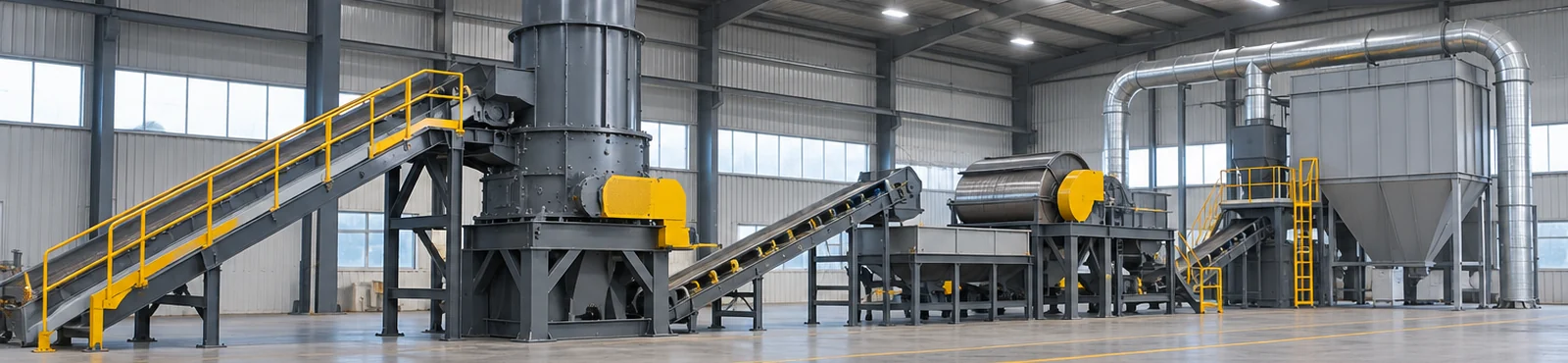
| Connected motor rotor recovery line | Links crushing with iron removal, additional separation and material handling | Site works, electrical supply, commissioning, and any specialist pre-dismantling |
Even a “complete line” may stop before you have a clean copper grade accepted by your local buyer. One seller might include the control panels but not cable installation. Another may include the dust collector but exclude ductwork. A price only becomes useful after these differences are put into the same equipment-and-services schedule.
Buyers sometimes treat a low advertised price as proof that a project will pay back faster. It can be the opposite. A machine that crushes material successfully yet leaves copper locked in steel sends value into the wrong output stream. You may save money on the initial invoice and lose more during every working shift.
The motor feed mix sets the price before machine power does
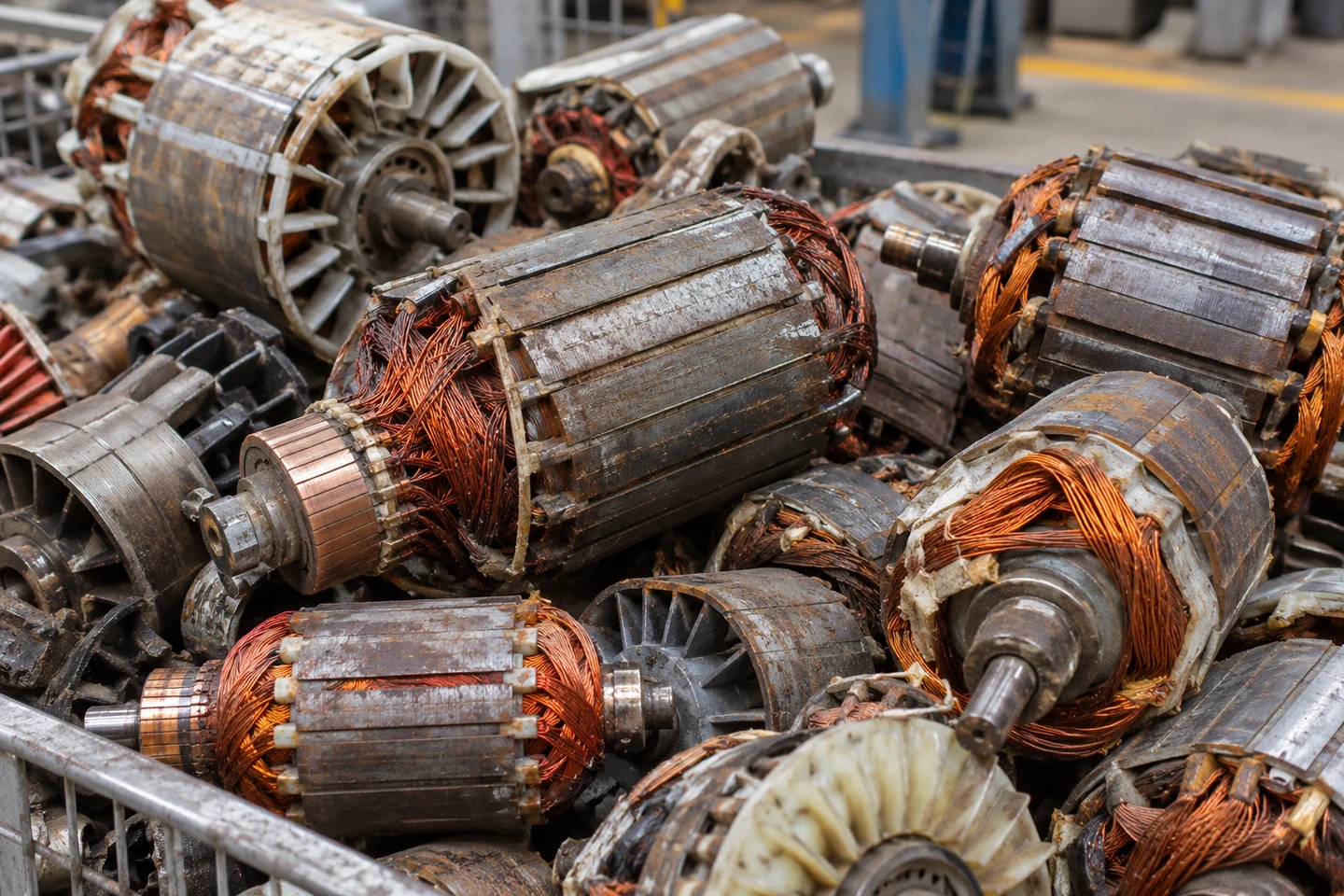
“Motor rotor scrap” sounds like a uniform feedstock. It is not. Motors vary in construction, size, coatings, winding materials, shaft mass, bearings and attachments. Research on low-voltage induction motors notes that ordinary squirrel-cage rotors commonly contain aluminum, while wound rotors and some specialized designs have copper conductors.[1] Research on copper flows in motor recycling also describes why the combination of tightly joined steel and copper makes separation difficult.[2]
Ask for photographs and weights, not just a scrap category
| Inbound material | Pricing implication | Practical concern |
|---|---|---|
| Loose, dismantled armatures with visible copper windings | Usually less housing-removal work; liberation and copper sorting remain important | Commutators, insulation and long steel shafts change breakage behavior |
| Aluminum squirrel-cage rotors from induction motors | Process must address aluminum and steel rather than assume copper income | Conductors are cast into the laminated core |
| Stators with windings still fitted | May justify a separate cutting/pulling route or a different liberation arrangement | Tightly held copper, varnish and laminated steel |
| Complete small motors | More pre-dismantling, feeding and residue handling | Housings, shafts, fans, bearings and mixed non-metals |
| Mixed high-torque, permanent-magnet or traction motors | Separate technical assessment rather than a standard rotor-line price | Strong magnets, special alloys, electronics and possible hazardous assemblies |
A useful starting sample should cover the normal daily mix, not the cleanest pallet in the yard. Record the weight of whole motors, dismantled rotors, stators, attached housings and obvious reject items separately. Even a rough five-bin record over a week is more helpful to equipment selection than a single photograph labeled “electric motors.”
Selection note: A motor-recycling line optimized around dismantled industrial induction-motor scrap should not automatically be offered for EV traction motors or magnet-rich assemblies. These materials may need different removal, identification and specialist recovery steps. A European electric-motor end-of-life report treats dismantling and material-specific routes as important choices, not interchangeable line add-ons.[3]
What equipment changes a motor rotor recycling line quotation?
1. Receiving, sorting and dismantling
The line may start with a hopper, or it may start with people who have to remove housings and oversized shafts. Those are different projects. If motors arrive intact, ask who removes end covers and what fraction of the stream must be manually inspected. Add the time, handling space, lifting equipment and rejected-material route to the comparison. Dismantling can preserve cleaner individual materials, but it also creates a labor requirement that should be measured.
2. Primary crushing and liberation
YUXI publishes a vertical crushing stage for its rotor line. Its vertical metal crusher product page identifies motor stators and rotors among relevant applications. That makes the crusher a logical part of the project discussion, but not proof that one machine model handles every motor type.
Cost depends on rotor diameter, maximum piece mass, abrasive steel content, shaft geometry, how easily the copper or aluminum releases, the wear-part design and any return of oversize material. Smaller discharge fragments are not automatically better. If they require excessive energy or create fine mixed particles that are difficult to sort, the project may spend more to earn less.
3. Ferrous removal
After liberation, magnetic equipment removes strongly ferrous material. The useful quote details include magnet type, working width, position, feed depth, cleaning method and how the ferrous discharge is handled. A large magnet does not solve metal that remains physically attached. If you see bright copper strands still trapped in the steel fraction, the issue may lie upstream in liberation rather than in magnet strength alone.
4. Gravity and air-based sorting
YUXI’s published route places specific-gravity separation after iron removal. This stage matters because the remaining material is not automatically a marketable copper product. Size distribution, feed uniformity, dust and the density difference between fractions all affect separation quality. The company’s air gravity separator page explains the general sorting principle; the correct machine configuration still needs to be matched to the tested rotor mix.
Ask for the quality of each output fraction, the share of copper reporting to ferrous scrap, the share of saleable metal reporting to residue and the mass of recirculated material. A single close-up photograph of clean copper proves little about recovery across a full shift.
5. Dust collection, conveying and controls
Dust collection may be described as an auxiliary item, but it changes the project budget. Hoods, ducts, filters, fans, access, fire risk assessment, electrical controls and disposal of fines all have to be defined. The actual dust hazards depend on the materials and particle sizes handled; OSHA identifies combustible metal dust as a potential industrial hazard.[4]
Conveyors, platforms, chutes, overload protection, emergency stops, interlocks and controls also belong in the price comparison. Without a defined scope, one supplier can appear far cheaper simply because these parts are missing from the offer.
Machine price, landed price and installed price are different budgets
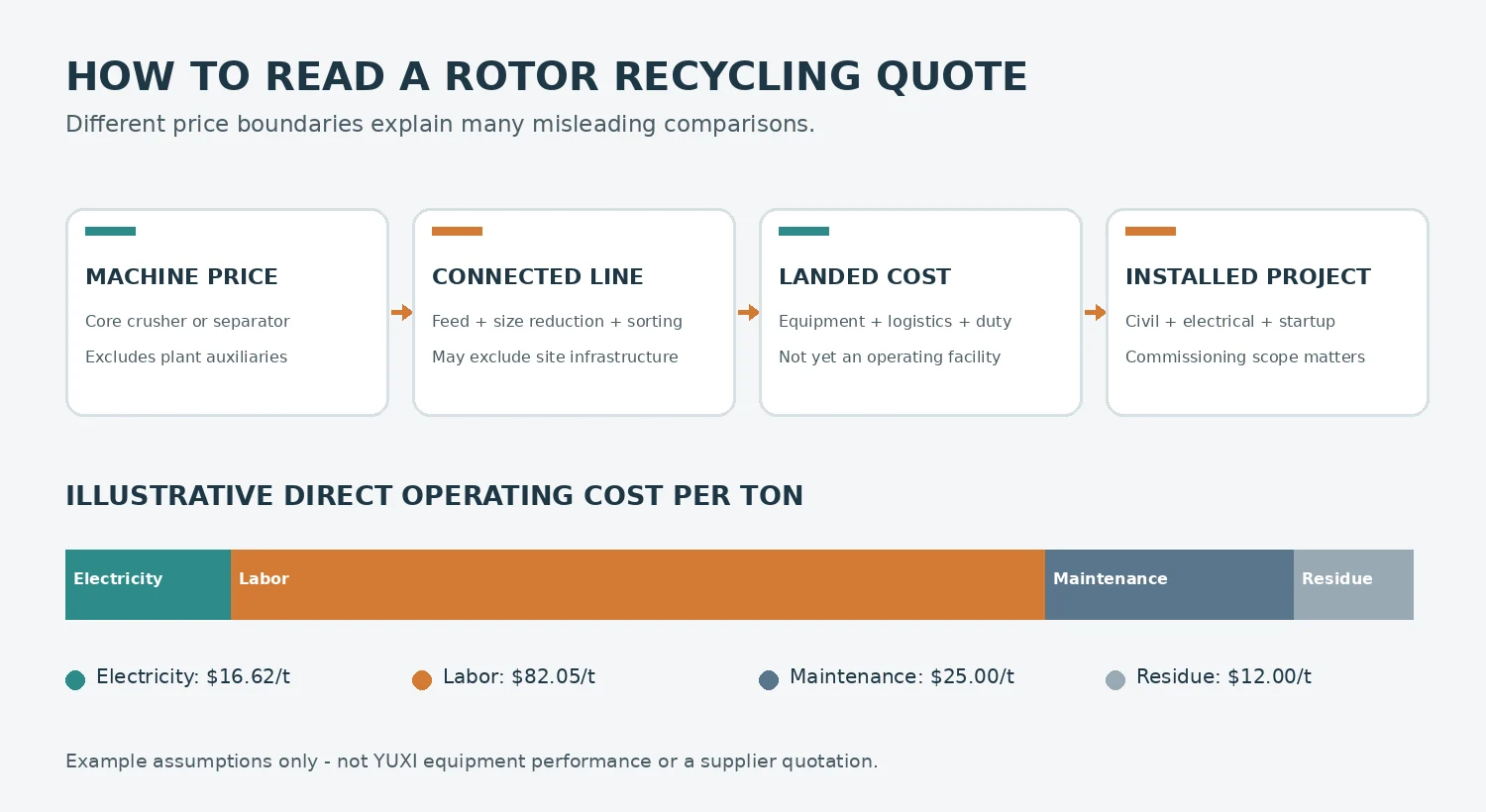
For purchasing, I would ask every supplier to return the same four figures. This helps prevent a low ex-works machine price from being mistaken for the money needed to put the line into service.
| Budget boundary | Include in the calculation | Question to ask |
|---|---|---|
| Core machine | Named crusher or separator, base drive and stated accessories | What equipment is excluded? |
| Connected equipment line | Feed system, conveyors, all separation stages, dust equipment, controls and startup spares | Is there a numbered equipment list and layout? |
| Landed equipment | Packaging, freight, insurance, unloading and applicable customs duties and taxes | Which Incoterm and destination apply? |
| Installed, commissioned project | Foundation, local assembly, wiring, utilities, safety provisions, operator training and trial work | Who is responsible for each site item? |
Do not add these rows together as if each were an independent charge. They are progressively wider cost boundaries. Many offers quote a narrower boundary than the headline suggests. A short responsibility matrix is often enough to reveal the difference.
For a factory with a pre-existing scrap yard, some site infrastructure may already be available. For a new building, the same equipment line may require new floor works, power distribution, ventilation and material-storage areas. That is why a published line price cannot stand in for a local project budget.
Example: calculate a realistic direct processing cost per ton
Here is a small numerical exercise, not a market price forecast. Assume a plant actually processes 0.65 metric ton per running hour for 6 productive hours during an 8-hour paid shift. The other two hours cover changeovers, checks, clearing and ordinary interruptions. That is 3.90 metric tons per shift, not the 5.20 tons you would get by multiplying rate by the entire shift.
Now assume the complete operating line averages 90 kW while running, electricity costs $0.12/kWh, two operators each cost the employer $20 per paid hour, routine consumables and maintenance are budgeted at $25 per input ton, and residue handling costs another $12 per input ton. These are selected example assumptions, not measured supplier values.
| Cost item | Method | Illustrative result |
|---|---|---|
| Electricity | 90 kW × 6 h × $0.12 ÷ 3.90 t | $16.62/t |
| Operators | 2 × 8 h × $20 ÷ 3.90 t | $82.05/t |
| Maintenance and consumables | Assumed allowance | $25.00/t |
| Residue handling | Assumed allowance | $12.00/t |
| Direct processing total | Sum of four rows | $135.67/t |
Notice what this figure leaves out: the purchase price of motor scrap, inbound transport, financing, rent, site taxes, insurance, depreciation, corporate overhead, sales discounts, and any additional quality-related sorting. It also omits standby energy and other site power that may run during downtime. So it is not a claim about gross margin or plant profitability.
If this schedule runs 250 shifts a year, the worked example handles 975 input tons annually. An illustrative $150,000 depreciable project cost allocated evenly over seven years would add about $21.98 per annual input ton at this utilization, before financing and other accounting adjustments. The same machinery handling only half as much feed would carry about twice the depreciation per ton. This is one reason sustained feed supply matters as much as a supplier’s brochure capacity.
Measure actual running time, not just nominal motor power
Rated drive kW is not the same as measured average electrical demand. A line also has conveyors, separators, fans, controls and possibly other equipment. Ask for a representative whole-line power measurement, the defined feed, the start/stop pattern and the mass that passed over the weighbridge during the same trial. If a vendor supplies only the main crusher drive rating, do not use it as the plant’s electricity estimate.
It is useful to calculate kWh per incoming ton and kWh per ton of each finished product. Those numbers answer different questions. The first shows what it costs to handle the scrap. The second shows how costs change with yield and product quality. Never quietly switch between the two denominators.
Recovery and saleable grade can matter more than a cheaper machine
Suppose two suppliers promise the same tons per hour. One produces cleaner metal and captures more of the recoverable copper. The other makes a slightly cheaper line but leaves metal in steel and residue. You cannot compare their payback from equipment price alone.
Start by making a mass balance for the same input batch:
- Weigh total feed that enters the trial.
- Weigh ferrous fraction, copper-bearing fraction, aluminum-bearing fraction, residue, dust and any collected oversize.
- Reconcile outputs with feed and explain moisture, dust, spillage or retained machine inventory.
- Sample each main fraction to determine metal content and contamination, using a suitable agreed sampling and assay method.
- Get actual buyer terms for each saleable grade, including deductions, freight and rejection rules.
Be careful with two numbers that sales brochures often confuse. Purity measures how much target metal exists in a particular product fraction. Recovery measures how much of the target metal in the feed reached that fraction. A very pure copper sample can come from a line that loses a large amount of copper elsewhere.
A compact yield sensitivity check
For each input ton, every additional 0.5 percentage point of metal captured in a payable product is five kilograms, provided that amount is actually present in the feed. If the incremental net payable value after treatment charges is assumed to be $6/kg, the additional gross value is $30 per feed ton. At 1.0 percentage point, it is $60 per feed ton. These are arithmetic examples only; they are not copper-market quotes or plausible gains for every motor batch.
This calculation helps evaluate an extra liberation or sorting module. A $30-per-ton change would mean $29,250 a year across the example’s 975 input tons before any extra power, maintenance, labor, financing or downtime. But do not add this revenue until an input/output trial shows that the extra metal really is recovered and paid for. More machinery is not always the right choice.
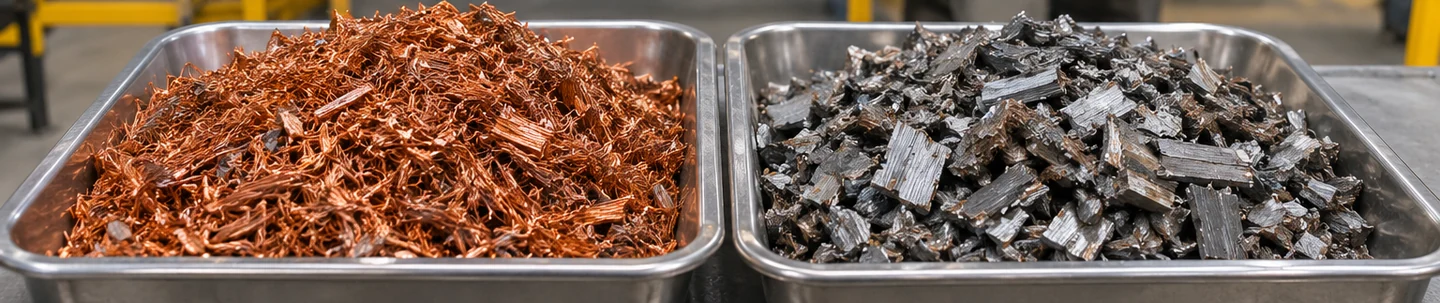
Some scrap merchants sell whole motors under contract grades rather than making a separate copper product. ReMA’s industry scrap specifications provide categories and trading language for motor scrap, but a supplier’s final acceptance conditions still control the transaction.[5] A recycler should compare the extra revenue from processing with the value of selling the incoming motors or dismantled parts directly.
Ask for the following information in every motor rotor machine quotation
You do not need to be an engineer to ask these questions. A clear procurement request makes it easier for the equipment manufacturer to propose something useful and easier for you to compare the replies.
Feed definition
- Photos of the usual motor and rotor types, plus at least one photograph of the least-clean batch.
- Maximum rotor diameter, length, piece mass and examples with shafts or bearings attached.
- Estimated shares of copper-wound rotors, aluminum-cage rotors, stators and intact housings.
- Weekly or monthly available tonnage, its variability and whether the material is already sorted.
- Known oils, coatings, attached electronics or other materials that may be excluded.
Product and duty
- Target throughput expressed as input tons per productive hour, with stated feed conditions.
- Desired finished fractions and written buyer acceptance criteria.
- Required separation target based on an agreed sampling method, not a universal recovery guarantee.
- Operating hours, available labor, voltage, frequency and site space.
- Required dust management, local permits and delivery destination.
Scope and commercial comparison
- A numbered machine schedule with motor kW, major quantities and a layout drawing.
- Which stages are included: pre-dismantling, crusher, magnetic separation, gravity sorting, conveyor, dust system and PLC.
- Spare parts, installation supervision, wiring, guarding and commissioning responsibilities.
- Performance-trial method, duration, sample composition, and how rejects or recirculation will be counted.
- Warranty boundaries, response support and how additional wear parts are priced.
A field note worth keeping: a vendor that asks for actual feed photos before quoting is usually helping to expose the important unknowns. A vendor who sends the same model for every rotor photograph may be pricing a product category rather than your project.
Site conditions and maintenance are not optional afterthoughts
Even when a supplier provides the main machines, the site owner needs a safe means of feeding, cleaning, inspection and maintenance. Put floor loading, anchor requirements where applicable, forklift and loader routes, clear access to wear parts, lifting points, emergency exits and safe access around conveyors on the layout before equipment arrives.
Any dust handling system should be assessed for the actual dust generated. A generic filter bag number does not answer all fire, explosion or exposure questions. Use local competent safety and environmental professionals to establish requirements. Workers should be protected from hazardous moving parts and from unexpected startup during servicing; OSHA’s recycling and lockout/tagout resources explain these general safeguards.[4]
Maintenance cost is more than the price of a liner or blade. The time needed to isolate the line, open guards, inspect wear, remove jammed material and return it to service all affects effective tons per shift. Ask the supplier to identify routine inspection points, expected consumable types and the tools needed to change them. Do not request a universal wear-life promise without stating the feed and operating conditions.
How to run a purchase trial without being misled by a clean sample
For a project involving mixed feed, a witnessed trial is more useful than a maximum-throughput video. Use enough material to show changing conditions. Record start and stop times and keep the normal mix representative of your actual procurement stream. A short trial with a neatly prepared copper armature batch tells you little about the next load of mixed industrial motors.
Before the test, agree on five items: incoming feed boundary, maximum acceptable attachments, input-weight measurement, sampling of finished fractions, and permitted return of oversize material. Then ask for a table with input tonnes, actual productive hours, each recovered fraction, grades, power used if measured and reasons for stops. An independent lab test can be justified when product purity drives a large financial decision.
Do not infer motor rotor line performance from a supplier’s test on radiators or aluminum cans. Those materials do not have the same steel laminations, copper windings or shaft geometry. Their separation targets are different too. The wider scrap metal crusher applications discussion is useful for general feed screening, but it cannot replace a motor-specific trial.
When a rotor recycling line may be the wrong investment
There are circumstances in which buying a whole line is not the best next move. If your supply is occasional, a local processing partner might have better utilization. If a dismantling team already recovers high-grade windings cleanly, more crushing may reduce their sale value. If the incoming material is mostly aluminum-cage rotors, a business case built on copper recovery will not hold. And if magnet-rich traction motors dominate the feed, a conventional mixed-rotor process may be a poor technical fit.
A second-hand machine may be sensible for a stable, familiar stream if the wear condition, maintenance access and available spares are verified. It is less attractive when the buyer cannot inspect the crushing chamber or see the machine process their own feed. The cheapest machine is not cheap when it requires expensive unplanned add-ons.
For broader supplier screening, the existing motor recycling manufacturers comparison explains the difference between dismantling machines and connected recovery systems. This article intentionally does not repeat that ranking: it focuses on defining the cost of a specific project.
A useful request for quotation
Tell the manufacturer what you have, what you want to sell and what has already been removed. For example: “We receive dismantled motor rotors and stators from industrial maintenance scrap. The approximate incoming volume is [x] tons/month. The attached photographs show the largest pieces and the usual mix. We want separate ferrous and copper-bearing fractions and need to know whether aluminum is worth a separate stream. Please propose the equipment boundaries, expected site needs, test conditions and itemized costs.”
This is much stronger than “Please send your lowest rotor recycling machine price.” A meaningful quotation should tell you whether the proposed line matches the material, what the operating assumptions are and what happens if the test does not match the promised duty.
Ready to discuss a project? Send YUXI your typical rotor photographs, maximum piece size, approximate monthly tonnage, location and target output grades. Ask for a scoped equipment list and a process recommendation based on that feed.
Frequently asked questions
How much does a motor rotor recycling machine cost?
There is no dependable single figure across the category. A dismantler, a stand-alone crusher and a fully connected crushing-and-separation line have different prices and responsibilities. Request an itemized quote that specifies the feed, material flow, electrical equipment, sorting steps and installation scope.
Can one machine process complete electric motors and loose rotors?
Not necessarily. Complete motors include housings, bearings, shafts and other attachments that may require separate preparation. Ask the manufacturer to confirm the allowable feed size, mass and materials for the actual equipment model before ordering.
Do all scrap motor rotors contain copper?
No. Many induction-motor squirrel-cage rotors use aluminum conductors. Other motors use copper windings or special designs. The feed must be identified before anyone uses copper recovery to support a payback estimate.[1]
What matters more: throughput or separation purity?
Both matter, but they answer different questions. Throughput determines how much feed is treated over time. Purity describes the quality of recovered fractions, and recovery shows how much target metal was captured. A useful economic model needs all three, plus the buyer’s actual payment terms.
Can I calculate ROI from the machine price alone?
No. A reliable project model needs landed and installed cost, actual operating hours, power and labor, consumables, purchase cost of feedstock, yield by material grade, sales deductions and a realistic volume forecast. Treat any simple payback claim without those inputs as a preliminary marketing statement.
References
- Recycling Potential of Low-Voltage Three-Phase Induction Motors, Motor materials study.
- Enabling Circular Copper Flows in Electric Motor Lifecycle, Copper-flow research.
- EU-MORE, Analysis of End-of-Life Practice for Electric Motors, EU-MORE report.
- Occupational Safety and Health Administration, Recycling: Waste Management and Recycling, OSHA recycling guidance.
- Recycled Materials Association, Scrap Specifications, ReMA specifications.